Question on Taphonomy of fuchsine magenta in a Baluch context

Collapse

Announcement

Collapse
No announcement yet.
X
  •  
  • Filter
  • Time
  • Show
Clear All
new posts

  • Question on Taphonomy of fuchsine magenta in a Baluch context

    Hi everybody,

    in the meantime I have been following the discussions on Baluch textiles more closely, and I have recently acquired two another study pieces: a small, finely knotted rug with a lattice field composed of octagonal compartments enclosing cross motifs (sometimes described as Aina-Gotschak?), as well as three animal figures in the main field, and a bag face with a quite cool kilim panel.
    My first question concerns the small arrow-shaped motifs distributed along the border. Is there an established or commonly accepted name for these arrow-like devices in the Baluch universe?

    Both pieces show an aniline pink–magenta dye — which I suspect is most probably fuchsine — used for certain motifs. In both cases the dye bleeds when it comes into contact with wet cotton. In the rug, there is quite heavy sun fading affecting the magenta areas. What puzzles me is the very high saturation of the magenta in the bag face, despite the strong erosion of the brown dyes and noticeable abrash in the reds. In addition, there are a few isolated knots in two “snowflake” motifs that appear to be made of what I suspect is yellow silk.
    So, my second question: do you think it is plausible that the bag face is a genuine late 19th–early 20th century piece that, for some reason, was not exposed to sunlight for a sufficiently long period of time? Or could it instead be some kind of later copy or imitation?

    I would be, again, very interested in your thoughts.

    Greetings,

    Marta

    Click image for larger version  Name:	20260122_095958.jpg Views:	1 Size:	298.2 KB ID:	4066 Click image for larger version  Name:	20260122_100221.jpg Views:	1 Size:	292.6 KB ID:	4067 Click image for larger version  Name:	20260122_100043.jpg Views:	1 Size:	339.3 KB ID:	4068 Click image for larger version  Name:	20260122_100048.jpg Views:	1 Size:	331.0 KB ID:	4069 Click image for larger version  Name:	20260121_121214.jpg Views:	1 Size:	294.0 KB ID:	4070
    Marta Korczynska
    Junior Member
    Last edited by Marta Korczynska; 01-23-2026, 02:37 PM.

  • #2
    Click image for larger version

Name:	20260122_100728.jpg
Views:	89
Size:	339.7 KB
ID:	4075 Click image for larger version

Name:	20260122_100448.jpg
Views:	88
Size:	311.0 KB
ID:	4074 Click image for larger version

Name:	20260122_100744.jpg
Views:	118
Size:	230.8 KB
ID:	4072 Click image for larger version

Name:	20260122_100418.jpg
Views:	116
Size:	283.4 KB
ID:	4073 Click image for larger version

Name:	20260122_100425.jpg
Views:	86
Size:	288.9 KB
ID:	4076
    Few photos of the bag face...

    Comment


    • #3
      Dear Marta,

      As a general rule magenta aniline dye on wool will fade when exposed to light but it will not bleed, presumably due to its high affinity for the wool. Conversely, the second generation synthetic azo dyes will run (particularly if applied as a direct dye without a metal salt mordant) but are relatively light-fast. Similar reddish-purple hues can also be achieved using carminic acid dye from cochineal insects, plus a mordant. In this case the resulting color is both light-fast and will not bleed.

      Regarding your bagface, I would be comfortable with a late 19th or early 20th century date.

      Joseph

      Comment


      • #4
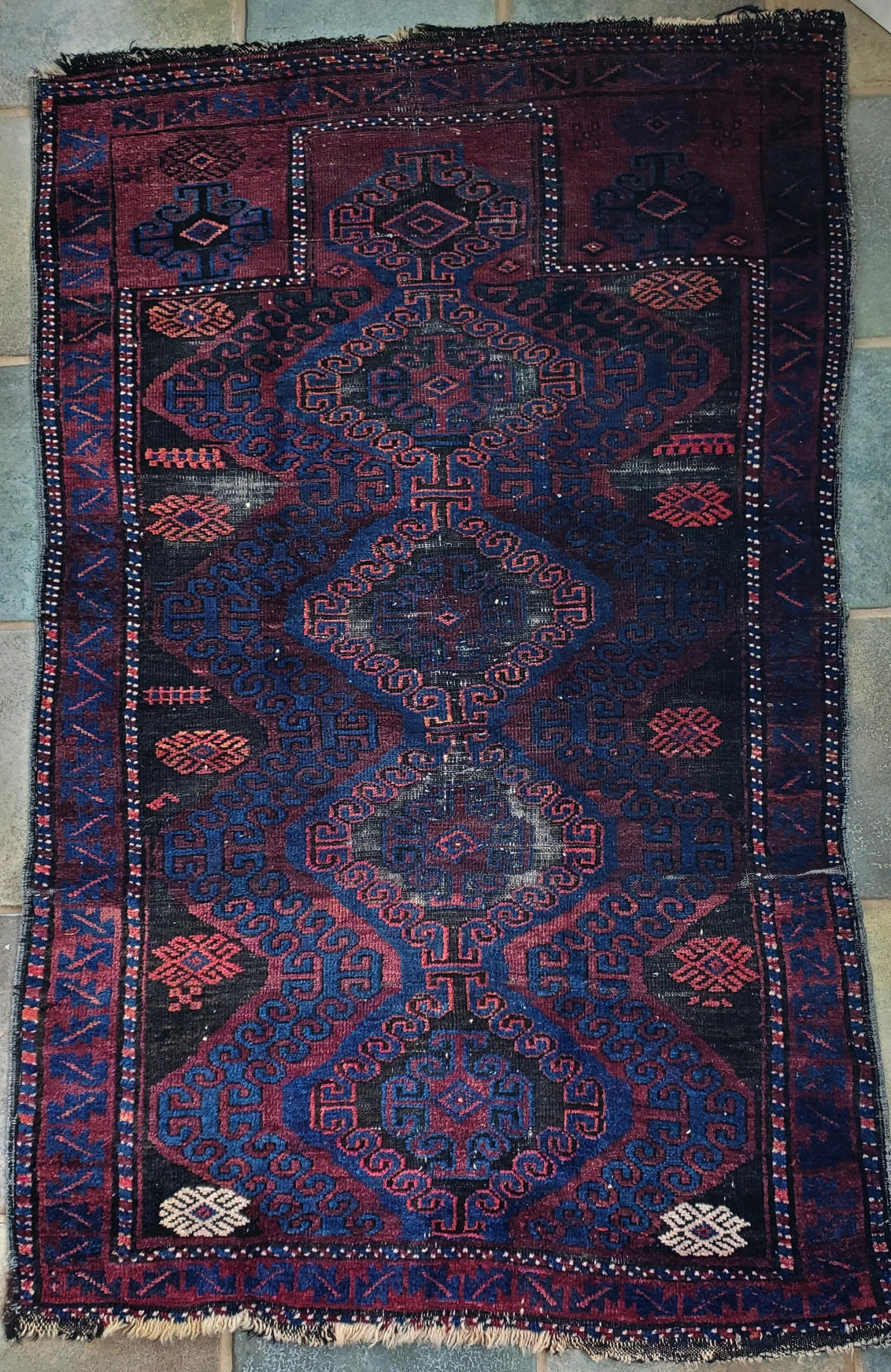
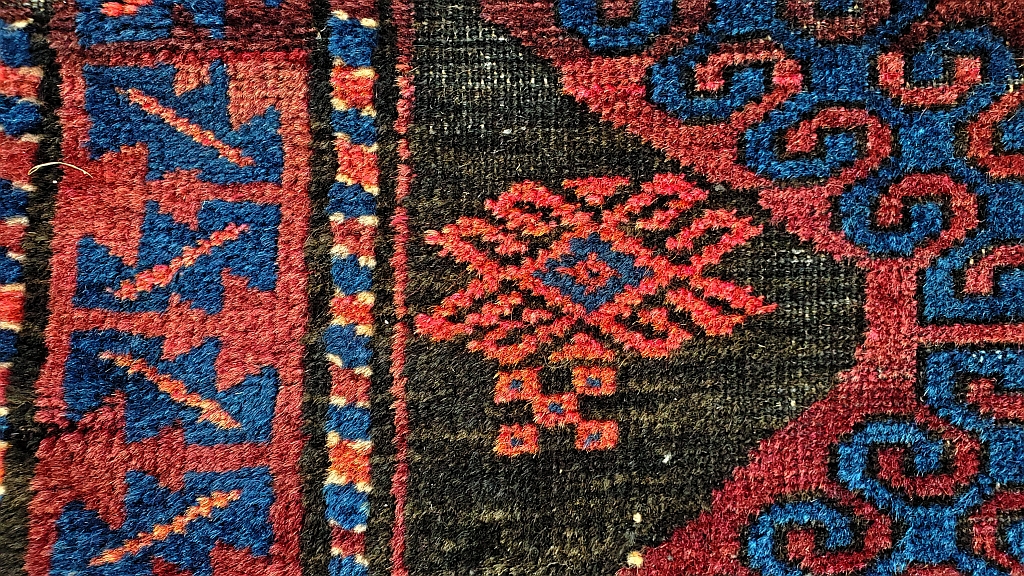
        It's very difficult to make reliable date attributions on Belouch group rugs. The problem is that they continued to use natural dyes until WW-II (roughly, 1940). The corroded blacks (browns?) on nearly anything except a Belouch piece would place it to no later than 1900.


        Steve Price

        Comment


        • #5
          Steve, can you post an example of a corroded black or brown?
          Joe Lawrence

          Comment


          • #6
            I may have found one of my own examples.

            Click image for larger version

Name:	IMG_2458.jpg
Views:	112
Size:	235.5 KB
ID:	4081
            Joe Lawrence

            Comment


            • #7
              Hi,

              Here's an example of corroded brown on a Baluch prayer rug that I think is late 19th-early 20th century.

              See closeup, second image:


              Regards
              Chuck

              Comment


              • #8
                Dear all,

                thank you very much for the very useful and thoughtful comments — they are extremely helpful.

                Following the second part of the discussion, I can also share another Baluch (or Timuri?) rug with corroded browns ;-)

                Regarding the question of magenta: thank you, Joseph, for clearing this up. I carried out a very limited spot test on the reverse only, using minimal moisture and a cotton swab (no rubbing), simply to check for colour transfer in different areas of the rug.

                The response of the magenta areas was uneven: some spots showed clear colour transfer, while others showed little or none. I also noted that neither the degree of fading nor the apparent colour intensity correlated positively with the amount of colour transfer. However, the most noticeable transfer has occurred in one very intensely coloured cross motif.

                I stopped testing at that point and do not draw any firm conclusions from this. However, I am wondering what it might indicate if a dye appears to show both behaviours. Could this point to a later dye applied over an earlier undyed foundation?

                I am fully aware of the limitations of such spot tests and mention these observations only for context and visual corroboration. The final photo shows the corresponding test carried out on the bagface.

                Many thanks again to all contributors for sharing their insights and photos.

                Best regards,

                Marta

                P.S.Even with no certain dating possibilities based on typology and taphonomy this Baluch rugs grop is really interessting!

                Comment


                • #9
                  Click image for larger version

Name:	20251231_142852(1).jpg
Views:	100
Size:	301.6 KB
ID:	4102 Click image for larger version

Name:	20251231_143316.jpg
Views:	96
Size:	250.3 KB
ID:	4103 Click image for larger version

Name:	20260124_220722.jpg
Views:	98
Size:	237.3 KB
ID:	4106 Click image for larger version

Name:	20260124_215651.jpg
Views:	94
Size:	51.2 KB
ID:	4105 Click image for larger version

Name:	20260124_215810.jpg
Views:	94
Size:	39.0 KB
ID:	4104
                  Photos part 1...

                  Comment


                  • #10
                    ..and part 2.. Click image for larger version

Name:	20260124_220220.jpg
Views:	71
Size:	57.3 KB
ID:	4108 Click image for larger version

Name:	20260124_220001.jpg
Views:	86
Size:	78.2 KB
ID:	4109
                    Click image for larger version

Name:	20260124_220539.jpg
Views:	88
Size:	83.6 KB
ID:	4111
                    Attached Files

                    Comment


                    • #11
                      Hi, Marta;

                      Assuming that your transfer test was performed with water alone or together with a mild detergent it clearly demonstrates use of a non-fast dye. The most likely candidate is one of the second generation synthetic azo dyes, in this case probably used as a directly without a mordant. With few exceptions (e.g., some tannin-rich natural dyes such as oak galls being one) most natural dyes require a mordant to bind to wool and once bound will not run or bleed. Therefore, running or bleeding indicates the presence of a synthetic or mixed dye with very high probability. Finally, I think it unlikely that those parts were later "painted" as was done with some Sarouk carpets.

                      Joseph

                      PS: As an interesting aside, indigo sulfonic acid, discovered in the mid-18th century, is considered by some to be the first synthetic, actually semi-synthetic, dye. It converted indigo from a cumbersome vat dye to a direct dye. Unfortunately, not being light-fast it tends to tip-fade.
                      Joseph R. Putnak
                      Member
                      Last edited by Joseph R. Putnak; 01-24-2026, 11:14 PM.

                      Comment


                      • #12
                        Hi Joseph, thanks a lot for the confirmation! Greetings, Marta

                        Comment


                        • #13
                          Marta,

                          A few years ago we had an extended discussion about dyes in Timuri and Baluch pieces; you might find it instructive. Pierre Galafassi contributed; he works in the dye industry.

                          http://www.turkotek.com/misc_00127/timuri.htm

                          Regards
                          Chuck

                          Comment


                          • #14
                            Chuck, thank you very much for the hint! Indeed, this discussion and two other archival threads prompted me to pay closer attention to the color palette of Baluch&Timuri rugs. I had hoped for cochineal dye in this one, which—as we can clearly all see by now—is not the case here. I will, however, reread the topic you linked more carefully, paying attention to Infos, that Pierre Galafassi shared. Greetings, Marta
                            Marta Korczynska
                            Junior Member
                            Last edited by Marta Korczynska; 01-25-2026, 08:16 AM.

                            Comment

                            Previously entered content was automatically saved. Restore or Discard.
                            Auto-Saved
                            x
                            Insert: Thumbnail Small Medium Large Fullsize Remove  
                            x
                            or Allowed Filetypes: jpg, jpeg, png, gif
                            x

                            Please enter the six letters or digits that appear in the image below.

                            Registration Image Refresh Image
                            Working...
                            X