
 Tweet
Tweet
Hi everybody,
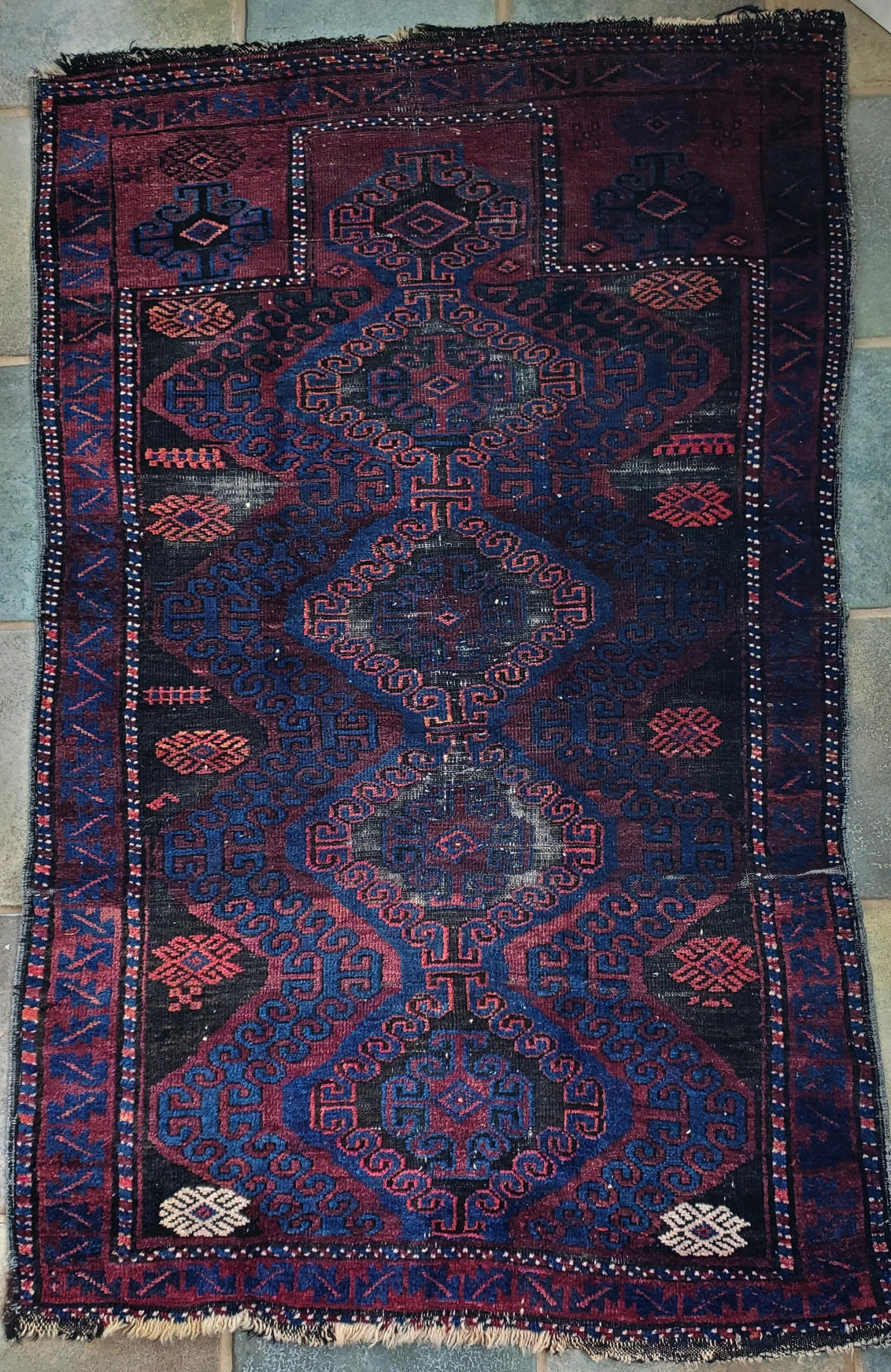
in the meantime I have been following the discussions on Baluch textiles more closely, and I have recently acquired two another study pieces: a small, finely knotted rug with a lattice field composed of octagonal compartments enclosing cross motifs (sometimes described as Aina-Gotschak?), as well as three animal figures in the main field, and a bag face with a quite cool kilim panel.
My first question concerns the small arrow-shaped motifs distributed along the border. Is there an established or commonly accepted name for these arrow-like devices in the Baluch universe?
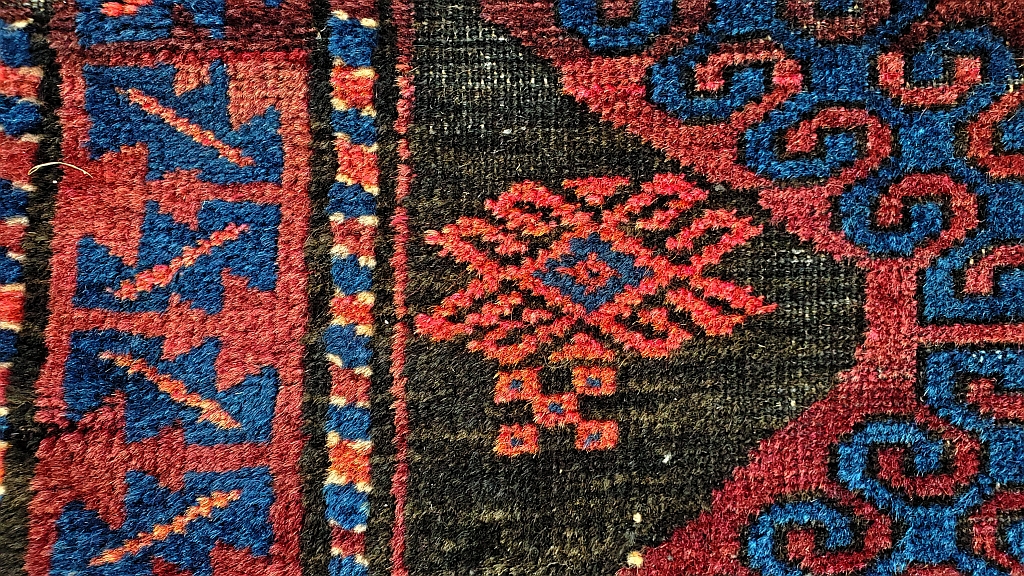
Both pieces show an aniline pink–magenta dye — which I suspect is most probably fuchsine — used for certain motifs. In both cases the dye bleeds when it comes into contact with wet cotton. In the rug, there is quite heavy sun fading affecting the magenta areas. What puzzles me is the very high saturation of the magenta in the bag face, despite the strong erosion of the brown dyes and noticeable abrash in the reds. In addition, there are a few isolated knots in two “snowflake” motifs that appear to be made of what I suspect is yellow silk.
So, my second question: do you think it is plausible that the bag face is a genuine late 19th–early 20th century piece that, for some reason, was not exposed to sunlight for a sufficiently long period of time? Or could it instead be some kind of later copy or imitation?
I would be, again, very interested in your thoughts.
Greetings,
Marta


in the meantime I have been following the discussions on Baluch textiles more closely, and I have recently acquired two another study pieces: a small, finely knotted rug with a lattice field composed of octagonal compartments enclosing cross motifs (sometimes described as Aina-Gotschak?), as well as three animal figures in the main field, and a bag face with a quite cool kilim panel.
My first question concerns the small arrow-shaped motifs distributed along the border. Is there an established or commonly accepted name for these arrow-like devices in the Baluch universe?
Both pieces show an aniline pink–magenta dye — which I suspect is most probably fuchsine — used for certain motifs. In both cases the dye bleeds when it comes into contact with wet cotton. In the rug, there is quite heavy sun fading affecting the magenta areas. What puzzles me is the very high saturation of the magenta in the bag face, despite the strong erosion of the brown dyes and noticeable abrash in the reds. In addition, there are a few isolated knots in two “snowflake” motifs that appear to be made of what I suspect is yellow silk.
So, my second question: do you think it is plausible that the bag face is a genuine late 19th–early 20th century piece that, for some reason, was not exposed to sunlight for a sufficiently long period of time? Or could it instead be some kind of later copy or imitation?
I would be, again, very interested in your thoughts.
Greetings,
Marta
Comment