Seeking Expert Feedback: A Technical Dossier on a Hybrid Baluchi-Yomut Rug

Collapse

Announcement

Collapse
No announcement yet.
X
  •  
  • Filter
  • Time
  • Show
Clear All
new posts

  • Seeking Expert Feedback: A Technical Dossier on a Hybrid Baluchi-Yomut Rug

    Hello everyone,

    I'm a longtime admirer of the deep knowledge shared on this forum and am hoping to draw upon your collective expertise. My background is in Human-Computer Interaction, but my passion is in tribal weavings.

    I recently acquired a piece that I find fascinating. To properly understand its origins and significance, I've spent considerable time compiling a detailed technical dossier. This research involved synthesizing information from a wide range of sources: foundational books on the subject (like MacDonald and Parsons), articles from HALI, analysis of comparable pieces in museum collections (such as The MET), and of course, the invaluable expert discussions found within the Turkotek archives.

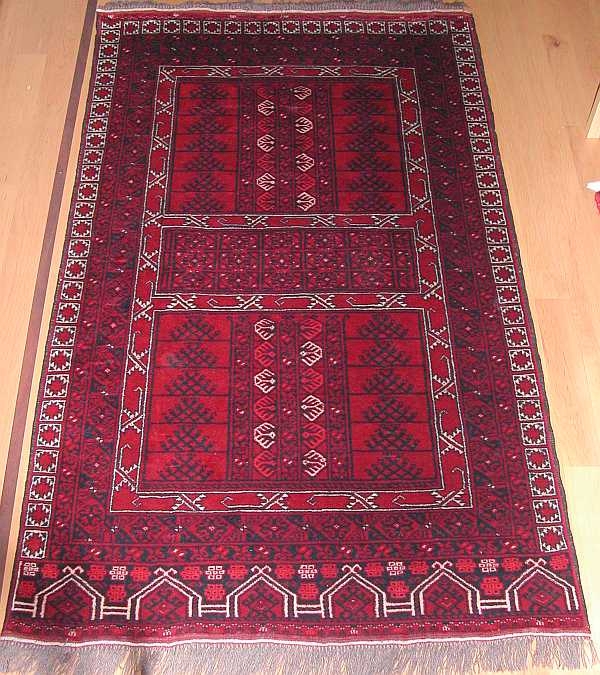
    From this synthesis, a central thesis has emerged: this rug appears to be a deliberate and sophisticated act of cultural appropriation—a Baluchi Mushwani weaver creating a piece using the prestigious Turkmen Yomut hatchli layout.

    I have summarized the main points of my dossier below and would be incredibly grateful for your expert opinions on whether my analysis holds water.

    Here are photos of the rug:


    Click image for larger version

Name:	yomut0.png
Views:	200
Size:	481.7 KB
ID:	3241


    Click image for larger version

Name:	yomut1.png
Views:	244
Size:	421.7 KB
ID:	3239


    Click image for larger version

Name:	yomut2.png
Views:	193
Size:	391.7 KB
ID:	3240


    Click image for larger version

Name:	yomut4.png
Views:	197
Size:	380.9 KB
ID:	3242


    Click image for larger version

Name:	yomut5.png
Views:	196
Size:	404.4 KB
ID:	3243


    Summary of the Dossier's Findings


    Here is a breakdown of the key points from the analysis.

    1. Technical Specifications
    • Attribution: Mushwani Baluchi subgroup, Herat region, Western Afghanistan, with strong Yomut Turkmen design influence.
    • Date: Late 19th to first quarter of the 20th century (c. 1880–1930). This aligns with forum discussions suggesting most dated Baluch rugs are from 1880 onwards.
    • Dimensions: Approx. 1.90 m x 1.23 m (

      6′3"×4′0").
    • Materials: Wool pile on a wool foundation (warp and weft).
    • Knot: Asymmetrical (Persian/Senneh) knot, which is a classic Baluch weaving technique.
    • Finishes: The rug features multi-cord selvedges and, most notably, wide, brocaded kilim skirts. These elaborate flatwoven ends are considered a hallmark of fine Baluch weaving and are structurally different from the simpler finishes on traditional Yomut pieces.

    2. The Central Thesis: A Baluch "Signature" with a Turkmen "Story"

    The core of the dossier’s argument is the cultural hybridism.
    • The Layout is Turkmen: The cruciform hatchli design, which divides the field into four quadrants, is an iconic feature of Turkmen ensi (yurt door hangings), particularly from the Yomut tribe. These pieces served as ceremonial "doors" to yurts.
    • The "Structural DNA" is Baluch: Despite the Turkmen layout, the rug's construction is unequivocally Baluch. The use of the asymmetrical knot, the all-wool foundation, and especially the elaborate kilim ends and selvedge structure are the weaver’s technical "signature".

    3. Iconography: A Dialogue of Motifs

    The dossier argues that the weaver filled the borrowed Turkmen "frame" with her own cultural "voice."
    • Instead of the geometric guls a Yomut weaver would place inside the hatchli panels, this rug features stylized arboreal figures. This is identified as a classic Baluch interpretation of the

      "Tree of Life" (Darakht-e Hayat) motif, commonly found in Baluch prayer rugs from the region. This suggests a conscious thematic replacement, not a simple copy.

    4. Condition and Probable Function
    • The rug is in excellent condition, with no significant wear and its original finishes intact. This strongly suggests it was not a utilitarian floor covering.
    • The hypothesis is that it was a

      dowry piece (jahaz) or a special ceremonial weaving, preserved and stored for decades rather than used.


    Selected Sources & References

    To provide context for the dossier's analysis, I've compiled the primary sources used in the research below.

    Books & Journals
    • MacDonald, Brian. Tribal Rugs - Treasures of the Black Tent (2017).
    • Parsons, R.D. The Carpets of Afghanistan (2016).
    • Cole, Tom. "From the Horses Mouth-Talking 'Baluch' with Jerry Anderson". HALI Magazine, Issue 78 (1994). Hosted at:
      http://www.tcoletribalrugs.com/article10JA.html

    Museum & Gallery Examples
    Online Discussions & Articles

    Conclusion

    At the end of this analysis, this rug reveals itself less as an object and more as a document of a fascinating tribal confluence. The thesis proposed here is that we are looking at a piece that speaks a Turkmen visual "language"—the prestigious hatchli layout of an ensi—but with an unmistakable Baluch structural "grammar," evidenced by its asymmetrical knots, robust selvedges, and rich, brocaded kilim skirts.

    Far from being a mere copy, the piece suggests a creative reinterpretation, raising questions about the weaver's intent. Was it a demonstration of virtuosity, an elite artisan absorbing an admired design? An homage to Yomut neighbors, perhaps woven into a dowry piece to seal an alliance? Or an act of personal innovation, filling a foreign frame with the symbology of her own heritage, such as the Tree of Life?

    Regardless of the motivation, the result is an artifact that interrogates our categorizations. It reminds us that the borders along the Silk Road were porous, and that tribal identity was a field of dialogue, not a fortress. Its excellent state of preservation, in itself, tells a story—that of a cherished piece, stored for over a century, valued perhaps more for what it represented than for what it was used for.

    Therefore, this dossier is presented not as a final verdict, but as a structured hypothesis, open to the scrutiny and wisdom of this community. I would be grateful to hear if this interpretation resonates with your own knowledge, or if you see a different story woven into these threads.


    My Questions for the Community:


    I would be very grateful for your thoughts on the following:
    1. Does the overall thesis of a Baluch weaver appropriating a Yomut design seem plausible to you based on the images?
    2. The dossier points to Mushwani or Taimuri origins for the Baluch elements. Based on the details, does this seem like a reasonable attribution, especially considering the known complexities of these terms?
    3. Do you agree with the dating of c. 1880-1930? Does anything in the colors or design suggest an earlier or later period?
    4. Are you aware of other documented examples of such a direct and complete hatchli layout being used in a rug with clear Baluch structural characteristics from this period?

    Thank you in advance for lending your eyes and your knowledge to this fascinating piece. I look forward to hearing your insights.

    Best regards,
    Eduardo Horvath


  • #2
    Hi Eduardo

    Thanks for your very professional post. It's a pleasure to read.

    Regarding your questions:
    1. Belouch weavings using Turkmen elements aren't unusual.
    2. I have nothing to contribute about this question.
    3. The dating seems plausible. I lean more towards 1930 than 1880, but that's nitpicking.
    4. I don't recall ever seeing a hatchli layout in anything except a Turkmen ensi.

    Steve

    Comment


    • #3
      I thoroughly enjoyed reading your very professional and well documented summary of your Ensi. You did an outstanding job with your research.

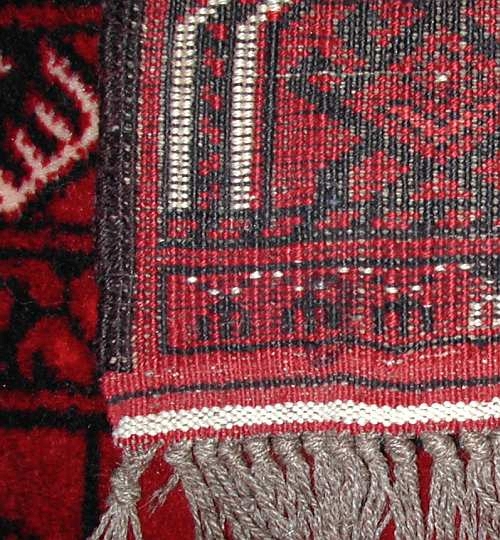
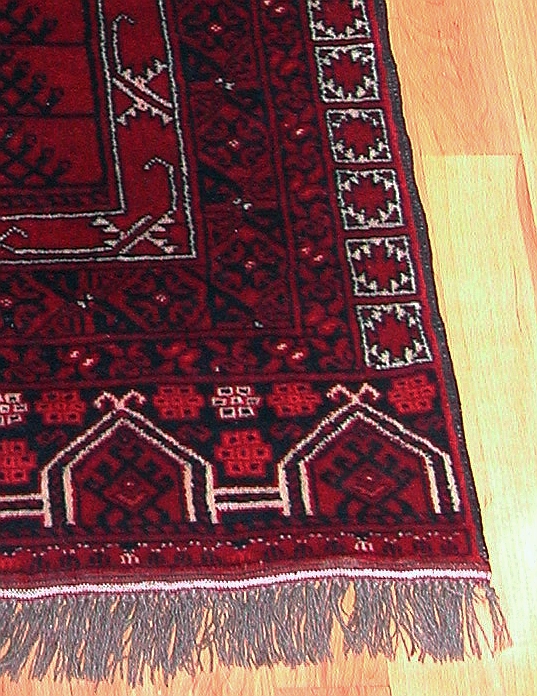
      I believe from what I can see in the pictures, the rug may have been made after 1930. The selvages and fringes look to have been redone. I respectfully believe the fringes have been added and are not original. I have included a few pictures that may suggest they were added later. As you can tell from one picture, you can see “warp” lines above the fringes. This is characteristic of a needle repair to include the second picture where it appears the pile is somewhat separated. This is the area of the rug a needle would start at for a fringe repair. This too is a sign of needle work. By no means if true does it take away from the beauty of the rug, but just may suggest it’s been repaired at some point during its life. The selvages look new to me and from looking just pictures, it looks to be acrylic yarn. A simple clipping with a match can answer that question.

      The Hatchli Ensi design has been copied in various forms throughout the years. I have seen examples although normally done in poor taste with no harmony or even care. Your example is not the case obviously. Nor do I believe it’s a copy.

      I do not see any Kilim weaving at the skirt, just pile.

      I had this link saved with some great information about Ensi’s in general. For some reason I cannot paste the link here but search this forum for “The Turkmen Engsi:
      Doorway to Paradise”
      Click image for larger version  Name:	IMG_1432.jpg Views:	0 Size:	105.9 KB ID:	3252
      Click image for larger version  Name:	IMG_1433.jpg Views:	0 Size:	83.4 KB ID:	3251
      Joe Lawrence
      Senior Member
      Last edited by Joe Lawrence; 07-24-2025, 05:28 PM.
      Joe Lawrence

      Comment


      • #4
        Hello Steve,

        Thank you very much for your valuable insights.
        It is a pleasure to discuss this piece in such a high-level forum. Your feedback, particularly your inclination towards a later dating and the confirmation of the layout's rarity, was the catalyst for more in-depth comparative research.

        With your comments in mind, I returned to my dossier and analyzed the piece's characteristics against documented Baluch examples from the late 19th and the first third of the 20th century. The result is a more robust argument that corroborates your intuition. I present here a summary of that analysis.

        Subject Piece: Hybrid Baluch–Yomut Carpet (c. 1920-30)

        I. Validation of the Dating (c. 1920-1930) through Stylistic and Technical Evolution

        Your suggestion of a dating closer to 1930 than to 1880 is strongly supported by the evidence when we analyze the evolution of Baluch weaving during this period. The comparison reveals a clear transition in three main areas:
        • Evolution of Design: From Tribal Spontaneity to Geometric Refinement Baluch examples from the late 19th century (c. 1875-1890) often exhibit an archaic power and a vigorous composition, but with a spontaneity reflected in subtle asymmetries and less formal rigidity. It is the mark of a "wilder," less standardized tribal art. In contrast, the piece under study demonstrates an exceptional level of planning and control. The rigorous axial symmetry imposed by the hatchli layout, and the meticulous precision of the secondary motifs and borders, are characteristic of a more mature and refined aesthetic, consistent with elite Baluch production from the first third of the 20th century, when the weaving tradition already benefited from a more sedentary context and greater interchange with urban patterns.
        • Evolution of the Palette: From Somber to Chromatic Zenith The 19th-century Baluch palette, though rich, is predominantly sober and earthy, dominated by deep reds and indigo blues. The period of c. 1900-1930 represents, for many specialists, the "zenith of natural dyes" for this group, where the mastery of the dyers allowed for a palette that maintained traditional depth but with greater saturation, clarity, and variety. The palette of this piece is a perfect exemplar of this phase: a ruby-red and indigo-blue ground serves as a base for vibrant saffron-yellow and bright ivory highlights, creating a sophisticated contrast. This chromatic richness, especially the prominence of yellow, is a signature of certain high-quality Mushwani weavings from precisely this artistic peak.
        • Evolution of Structure: From Rustic Spinning to High Density The physical structure of the rug is perhaps the clearest indicator of its era. Older 19th-century pieces can have a more rustic and irregular hand-spinning, resulting in lower knot densities. The subject piece, with its fine and consistent spinning, allowed the weaver to achieve a high knot density (~130 KPSI), which was essential for the crisp execution of such a complex design. This technical refinement is a direct product of the apex of the Baluch weaving tradition, consistent with the best productions from established tribal workshops in the Herat region around 1920-1930.
        Click image for larger version

Name:	knos.png
Views:	198
Size:	436.3 KB
ID:	3254


        II. Comparative Analysis and Singularity: The Exception to the Rule

        Your observation that you "don't recall ever seeing a hatchli layout in anything except a Turkmen ensi" prompted us to contextualize the piece's rarity, especially in comparison to other documented hybrids, such as the "Afghan Ensi from Chakesh" (c. 1920).

        Click image for larger version

Name:	other.png
Views:	169
Size:	441.0 KB
ID:	3255


        While the Chakesh example serves as an important reference, documenting the phenomenon of the hatchli layout's appropriation by non-Turkmen weavers in early 20th-century Afghanistan, the comparison primarily accentuates the singularity of the piece under study. The Chakesh rug is an ensi (door hanging), remaining faithful to the original function and format of the design.

        In contrast, the piece in question represents a far more ambitious typological transposition: the conversion of an ensi design to the format of a large-format main carpet (khali). The weaver did not limit herself to imitation; she performed a complex artistic synthesis. She retained the visual syntax of the Turkmen hatchli layout but replaced its iconographic semantics, infusing the cruciform structure with the endemic Baluch idiom of the "Tree of Life." This act was underscored by the application of her native chromatic palette, made notable by the bold use of saffron-yellow.

        The sophistication of the piece is finally sealed by the treatment of the borders. The use of a double frame, which includes the classic and transcultural meander ("Greek key") motif, functions as a prestigious framing device. This classicist frame further elevates the status of the central field and reinforces the piece's origin in a cosmopolitan environment where a vast visual repertoire was available to an elite artisan. The result transcends mere copying, constituting a deliberate artistic reinterpretation of high complexity.

        In summary, while other documented examples demonstrate influence, this piece demonstrates an artistic synthesis of a far superior caliber. As far as current research indicates, this makes it a unique example in its specific combination of format, design, and color.

        I thank you again for the exchange of information and for the insights that were fundamental to deepening the analysis.

        As I am ultimately an enthusiast who is striving to understand more about this complex world, I would be very grateful to hear your and other members' opinions on this analysis.

        Thanks once more,

        Comment


        • #5
          Dear Joe,

          Thank you so much for taking the time to share your expertise. Your observations are extremely valuable, and I sincerely appreciate your detailed analysis. The opinion of an experienced member is precisely what I was hoping for.

          Based on your comments, I realized that the photos I initially posted may not have had the necessary resolution to show the finer details. So, I have taken new macro photographs in better light to help clarify some of the crucial points you raised.

          1. Regarding the Kilim Ends:

          You mentioned a fundamental point about the ends, stating that you didn't see any kilim weaving, only pile. I have always perceived these areas as being wide, brocaded kilim "skirts". Could you please take a look at this more detailed photo? Am I misinterpreting this flatweave texture?


          Click image for larger version

Name:	kilim01.png
Views:	200
Size:	783.3 KB
ID:	3257

          Click image for larger version

Name:	kilim02.png
Views:	166
Size:	535.6 KB
ID:	3258

          2. Regarding the Fringes and Material:

          Your observation about the fringes and selvedges being redone, possibly with acrylic yarn, is also fundamental, as the dating depends heavily on it. I wonder if the rug's exceptional state of preservation and the intrinsic quality of the wool might not be a bit deceptive at first glance, perhaps making the materials appear more recent than they are. This is precisely why I took some macro photos in sunlight, so we can better judge the material.

          To my amateur eye, the fiber appears matte and has the micro-irregularities of wool, but your expert opinion on these closer images would be immensely helpful.


          Click image for larger version

Name:	yarn.jpg
Views:	166
Size:	86.6 KB
ID:	3260

          I have also included a photo that shows the transition from the kilim weave to the fringe, which appears to me to be an integral continuation of the warp threads.

          Click image for larger version

Name:	warp threads.png
Views:	173
Size:	602.5 KB
ID:	3261

          I want to particularly thank you for your comments regarding the overall quality of the piece and your assessment that it is not a copy. Coming from a senior member with your experience, that confirmation is especially reassuring.

          I've presented this new visual evidence in the hope that it might clarify the structural questions. I would be grateful for any further thoughts you or other members might have, as I believe a discussion around complex pieces like this enriches us all.

          Thank you once again for your time and for fostering such a high-level discussion.

          By the way, I did search the forum for "The Turkmen Ensi: Doorway to Paradise" as you suggested, but I couldn't seem to find the thread.

          Best regards,

          Eduardo


          Attached Files

          Comment


          • #6
            Eduardo,

            Thank you for the kind comments. I am not an expert and always a students. I just got lucky with your post as I have a little knowledge on it.

            Upon further examination of your new pictures, I can say that the fringes do not look false from my perspective. I can clearly see now that the fringe area was professionally fixed with what is called a “buttonhole stitch”. This occurs when a repair is needed to secure the top and or bottom of a rug to prevent the rug from coming apart. My previous comment suggested this was a part of a false fringe. It is not.

            I still cannot see any kilim or flatweave although it’s still difficult to see just from a pic. It’s extremely possible the kilim was removed hench the buttonhole stitch and the fringes were tied off with what appears from the pics as an “Antwerp stitch” Normally when this happens, you can clearly see the ends of the fringe closest to the rug with a tight curl about them. This can also be removed with steam so it’s hard to say. I do not believe the fringe is acrylic. It should be cotton or wool and appears to be cotton. If you cut a small piece off and burn it, cotton will smell like burnt paper while wool will smell like burnt hair. The red edge or selvage looks acrylic to me. A simple burn test will tell you for sure. Burnt acrylic will have neither a paper nor hair smell and the burnt end will form a hard ball at the end.

            We do have some highly knowledgeable members on this forum. Hopefully they will contribute to this post.

            Here is the buttonhole stitch.

            Click image for larger version

Name:	IMG_1438.jpg
Views:	204
Size:	111.5 KB
ID:	3263

            http://www.turkotek.com/ensi/engsi.html
            Joe Lawrence

            Comment


            • #7
              I am certainly no expert but the fibres in this (now cropped) photo of yours looks to me to be much too fine to be wool. I wonder what others think?

              At bottom is a comparison pic of cotton and wool that I pulled from a website.

              BTW, you say rug has asymmetric knots, if I am ask, which way, left or right?

              Click image for larger version  Name:	image_1352-croped.jpg Views:	0 Size:	62.9 KB ID:	3288


              Click image for larger version  Name:	Wool-left,-Cotton-right.jpg Views:	0 Size:	133.2 KB ID:	3286


              Phil Smythe
              Member
              Last edited by Phil Smythe; 07-26-2025, 10:02 AM.

              Comment


              • #8
                I sincerely thank everyone for the previous insights — especially Joe Lawrence for the sharp observation regarding the selvedge structure and materials. After personally performing the burn test, here is what I observed:

                The rug is wool on wool. I burned fibers from both the fringe and the pile — all exhibited the typical smell of burnt hair, with a slow-burning flame and friable ash.

                Click image for larger version

Name:	4.png
Views:	165
Size:	523.2 KB
ID:	3295

                However, the selvedges behaved differently: while the flame self-extinguished, the fiber contracted into small beads that crumbled upon touch. About half an hour later, I experienced mild throat constriction — some kind of reaction, though I’m not entirely sure what I inhaled. I didn’t initially notice a chemical smell, so I sniffed again (not a good idea), but it wasn’t the same burnt hair scent as in the wool fibers.

                Click image for larger version

Name:	5.png
Views:	145
Size:	701.3 KB
ID:	3296

                [Warning to others reading this — please don’t inhale deeply during a burn test like I did. I had to gargle with warm salt water, and only the next day did my throat improve.]

                This led me to conclude — and I await your confirmation — that the selvedges were likely repaired with a modern yarn, likely synthetic — perhaps acrylic, though I’d value your opinion on that.

                So, it appears we have an originally wool-on-wool rug with later restorations to the fringe and selvedges. The fringe, although consistent in appearance, seems to have received a modern reinforcement, possibly laid over the original base.

                The kilim ends remain somewhat ambiguous to me — I’ve attached detailed photos and would appreciate any insights into their structure or origin

                Click image for larger version

Name:	1.png
Views:	147
Size:	731.3 KB
ID:	3297

                Upon closer inspection, the knot appears to be asymmetrical and open to the left — a characteristic often associated with Baluchi or Yomut weaving traditions, particularly from the late 19th to early 20th century. I welcome corrections if I’m misinterpreting the structure.

                Based on the technical and iconographic elements, I’d like to share further details for your judgment and analysis:

                Technical structure:
                • The rug is wool on wool, with an estimated KPSI of around 130 — somewhat high for typical tribal weaving, though not unprecedented in finer domestic or transitional workshop pieces.
                • The wool shows high lanolin content and a noticeable sheen — which led me to speculate whether it could be Karakul, though I cannot confirm this without further analysis. The texture and luster are somewhat reminiscent of examples I’ve seen in older Baluch pieces.
                • Knot: asymmetrical, open to the left.

                Composite iconography:

                The rug combines meander (Greek key) borders — commonly associated with urban pieces or Turkmen influence — with a tribal field structure featuring simplified guls and motifs that resemble the Yomut-Chaudor repertoire.

                The elem displays angular motifs that visually evoke portal-like or ceremonial panels, as seen in certain Turkmen or Baluch ceremonial pieces. I’m curious whether others recognize this configuration.

                The combination of motifs and structural elements may point toward a hybrid composition — possibly reflecting Baluchi weaving practices influenced by Yomut design vocabulary. This kind of overlap has been documented in transitional or borderland weaving contexts.

                Comparison with similar pieces:

                The use of yellow (possibly saffron or another vegetal dye) is rare and striking. I’ve observed that this kind of yellow tends to vanish from pieces post-1930 — though this is based on my own research, and I welcome corrections.

                Absence of post-1930 features:

                – There is no cotton foundation, and no widespread use of synthetic dyes (except perhaps in the selvedge repair).
                – The structure and guls diverge from the simplified patterns found in commercial rugs of the 20th century. The composition feels more refined and deliberate, suggesting nomadic or domestic workshop origins.


                I also came across another example that is strikingly similar to mine, but lacking many of the details present in my piece, such as the saffron tone, the specific gul style, and the Greek key borders. Still, the structural resemblance is significant. It also appears to have a lower KPSI.


                Click image for larger version

Name:	6.png
Views:	146
Size:	507.5 KB
ID:	3298


                Look at the differences

                Click image for larger version

Name:	7.png
Views:	147
Size:	439.8 KB
ID:	3299


                I deeply appreciate your guidance. This rug is the first in my collection, and I’m eager to develop both critical observation and historical understanding through it. I often reflect on the possible life of the piece:

                Was it a marriage dowry between a Baluch and a Yomut family?
                Was it used as financial resource during wartime, passed from hand to hand, and eventually restored?

                These are the kinds of questions I enjoy pondering as the evidence slowly emerges.


                Thank you in advance to anyone who might share their knowledge, thoughts, or corrections. I truly value the opportunity to learn from this group and deepen my understanding through your insights.

                Comment


                • #9
                  Joe,

                  Thank you again for sharing the link. The material on engsis is truly remarkable.

                  After analyzing my piece in light of that catalog, it’s clear that this is not a classical engsi. It lacks the formal divisions and direct symbolic structure of a traditional “door rug.” However, there’s a strong dialogue with the symbolic architecture of engsis — especially those from the Yomut and Chaudor traditions — both in structural layout and graphic vocabulary.

                  The features that stand out and led me to this observation are:
                  • The tripartite axial structure that organizes the entire field;
                  • The use of meander-pattern borders, with an almost architectural character;
                  • A visually dominant elem bearing what appears to be ritualistic graphic intent;
                  • A central field arranged in a modular and vertical configuration;
                  • And, above all, the technical care: approximately 130 KPSI in wool on wool — an investment that points to a special function well beyond commercial use.

                  Given that the rug was most likely woven in the Herat region by a Baluchi weaver, but clearly carries this visual “grammar” inherited from the Yomut-Chaudor tradition, the most coherent hypothesis seems to be that it was intended as a ceremonial piece.

                  Possibly it was made as a marriage dowry (jahaz) or as a prestige gift, perhaps to mark an alliance between families, or simply as a demonstration of status. The fusion of traditions suggests that the rug carried a representational or transitional function, even outside the classical engsi format — a kind of symbolic echo, a tribute to a revered structure adapted to a different cultural context.

                  I’m truly grateful for the opportunity to connect these dots and to continue learning from everyone here.


                  Comment


                  • #10
                    In the post above where you do the burn test you say "The kilim ends remain somewhat ambiguous to me", but there are no kilim ends on your rug, the two photos you show with the words "front" and "back" in the photos show just low / worn pile.

                    Comment


                    • #11
                      I appreciate the comment. After studying the concept of kilim more thoroughly, I came to understand that it refers to those flat-woven ends without pile — something my rug clearly does not have. This absence alone rules out a pre-1900 date, which is consistent with other visual and technical evidence.

                      The piece shows a high degree of artistic refinement, with well-defined guls, precise symmetry, and strong graphic cohesion. In addition, it has 130 KPSI, is wool on wool, features noble colors (deep burgundy, saffron yellow, dark blue), and a tripartite axial structure — all elements suggesting a symbolic function, possibly intended for wall display rather than everyday or commercial use.

                      I compared it with a clearly more recent piece (the Another Rug image, likely from the 1960s/70s) with similar composition, and the difference is striking: my rug shows greater technical control, more expressive contrast, and a graphic complexity that is rare in postwar pieces — a period during which tribal weaving began to lose its artisanal refinement (please correct me if I'm wrong).

                      Given this, the evidence points to a dating between 1920 and 1935, possibly during the transitional phase between nomadic tradition and a more refined atelier aesthetic. The absence of kilim, far from being a limitation, actually supports this timeline.

                      I’ve been studying with dedication, though I’m still a beginner on the subject. Any critique, correction, or suggestion from more experienced members is truly welcome — and I sincerely thank everyone who has contributed so far.

                      Comment


                      • #12
                        Don’t rule out missing kilim top and bottom sections as being newer. Sometimes the ends are so frayed and/or destroyed, they are removed for appearance reasons. Although I don’t believe this is the case with yours, you will see many for sale without the kilim ends. Those that still have them are a bonus. When a reduction is done….the entire Kilim or part of it, the restorer will tie off the remaining warps to make fringes. Normally, this is easy to tell not only due to the shortened or missing Kilim ends, but also the fringe closest to the rug is normally a different color and is curly from it being woven at one time.

                        I appreciate your dedication not only to your piece but also being a student of this fascinating subject. Keep up the good work.
                        Joe Lawrence

                        Comment


                        • #13
                          Hi Eduardo,

                          I agree with your fundamental assessment: This is an attempt at implementation of a classic Turkmen ensi layout, but not done with classic Turkmen structure, motifs, or palette.

                          And it may well be a Baluch product, although attribution to the Mushwani weaving group is tenuous in my opinion; the structure is unlike any Mushwani piece I've seen or handled. I would not rule out modern Ersari work from north Afghanistan.

                          I agree with Joe on a couple topics (see illustrative images below) : I don't see any kilim at the ends of your piece, and the selvage is what would be termed single cord. The images below are from a modern Afghan Chakesh ensi, and show the short kilim ends and multicord selvage typical of Chakesh work. Note that the warps are dark handspun Karakul wool. From what I can see, the warp on yours seems to be spun on nice ivory machine-spun wool. A quite sharp closeup image of the end of your rug would be helpful.:


                          Note the dark multicord selvage at the side of the rug. Also note that the short kilim end begins just below the end of the multicord selvege. Everything to the right of the selvage is knotted pile.:


                          You can see the kilim end here:


                          The palette and structure on yours seem to me to point to Afghanistan, or Pakistan, and a more modern time period, perhaps mid 20th century. There are many examples of rugs woven by Turkmen who are settled in northern Afghanistan that meaningfully depart from tradition, some of which could be interpreted as Baluch work - in particular, modern Kizil Ayak products. The alternating red and orange in the wide vine and leaf border in the center bar of the rug is as nontraditional as it gets.

                          Additionally, there are two motifs on your piece that are not rendered correctly, at least, from a traditional Turkmen perspective. The elements of the outer white and black paired sainak gul minor border are rotated 90 degrees from their proper position, and point away from each other rather than toward each other . And, the vine in the wider meandering vine and leaf border curves gracefully on one side and has a sharp angle bend on the other. These are indicators of non-Turkman weavers.

                          There are several archived discussions on ensis that you might enjoy.

                          Regards
                          Chuck Wagner

                          Comment


                          • #14
                            Hello everyone, my apologies for the delay.

                            Joe Lawrence, your analysis of the possible removal of the kilim ends is excellent and truly a piece of forensic investigation. The hypothesis that the original ends degraded to the point of being intentionally removed during a restoration makes perfect sense.

                            This would explain the piece's current condition: the weft structure was stabilized, and the warp threads were then tied off to form the current fringes. This intervention would be consistent with the other repairs we've noted, such as the "buttonhole stitch" you previously identified to secure the end of the pile. The absence of the kilim, therefore, would not be an original feature but rather a result of the piece's history of use and conservation. I am immensely grateful for you sharing this perspective.

                            Chuck Wagner, thank you so much for your detailed analysis; it is extremely helpful. As requested, I will provide the close-up photos of the warp and selvedge structure so we can better examine these points.

                            I appreciate the suggestion regarding a possible Ersari origin; it's a line of research I will certainly explore. My initial inclination towards a 1920-1930 date is based on features like the high knot density (approx. 130 KPSI) and the vibrancy of the dyes, which seem to me consistent with the peak of tribal weaving from that era, before the more massive influence of the market. What is your opinion on this?

                            What I found most fascinating in your comment was the precise observation about the motifs not being "rendered correctly" from a traditional Turkmen perspective. It has given me much to think about. Details like the rotation of the elements in the

                            sainak gul border and the asymmetry in the vine are exactly what makes me question if the weaver's goal was a faithful copy.

                            Instead of interpreting them as errors, could we not be looking at a deliberate reinterpretation? Your observation seems to support my reading that the piece follows a Turkmen visual "language" (the hatchli layout), but is executed with a Baluchi stylistic "grammar."

                            This fusion, this artistic synthesis, is what intrigues me and led me to speculate about the piece's function as a ceremonial or prestige item, where the intention was not to copy, but to create a dialogue with another culture.

                            In my simple logic, and I am very open to reflecting on this, there was great care taken with this piece, in its elements, its density, and its colors, which makes me wonder if the inversion of the patterns was a mistake or intentional. Aren't such errors more common in simpler, commercial pieces?

                            Thank you once again for prompting me to delve deeper into these questions.

                            Comment


                            • #15
                              I am not a native Persian speaker but during the years I spent in Afghanstan, I never hear anyone use "hayat" for life. Omr/umr or zendigi was what I used. And I NEVER heard anyone call any design "darakht i zendigi!

                              Comment

                              Previously entered content was automatically saved. Restore or Discard.
                              Auto-Saved
                              x
                              Insert: Thumbnail Small Medium Large Fullsize Remove  
                              x
                              or Allowed Filetypes: jpg, jpeg, png, gif
                              x

                              Please enter the six letters or digits that appear in the image below.

                              Registration Image Refresh Image
                              Working...
                              X