 Tweet
Tweet
 Seeking Expert Feedback: A Technical Dossier on a Hybrid Baluchi-Yomut Rug
Hello everyone,
I'm a longtime admirer of the deep knowledge shared on this forum and am hoping to draw upon your collective expertise. My background is in Human-Computer Interaction, but my passion is in tribal weavings.
I recently acquired a piece that I find fascinating. To properly understand its origins and significance, I've spent considerable time compiling a detailed technical dossier. This research involved synthesizing information from a wide range of sources: foundational books on the subject (like MacDonald and Parsons), articles from HALI, analysis of comparable pieces in museum collections (such as The MET), and of course, the invaluable expert discussions found within the Turkotek archives.
From this synthesis, a central thesis has emerged: this rug appears to be a deliberate and sophisticated act of cultural appropriation—a Baluchi Mushwani weaver creating a piece using the prestigious Turkmen Yomut hatchli layout.
I have summarized the main points of my dossier below and would be incredibly grateful for your expert opinions on whether my analysis holds water.
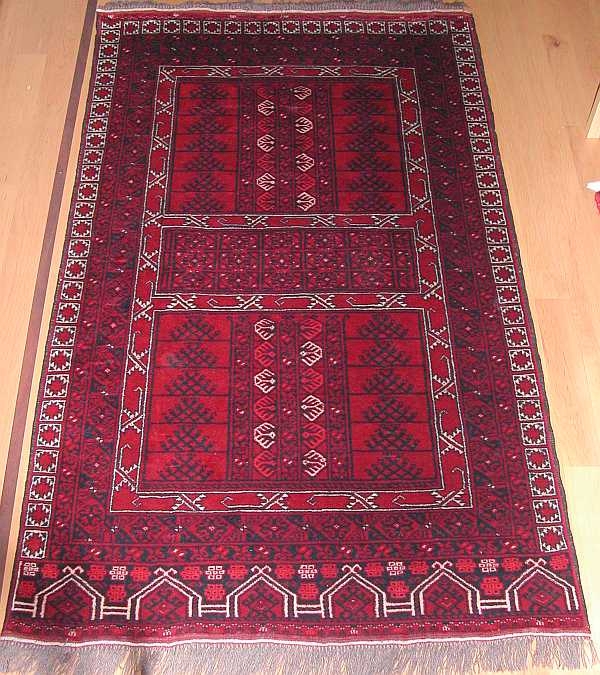
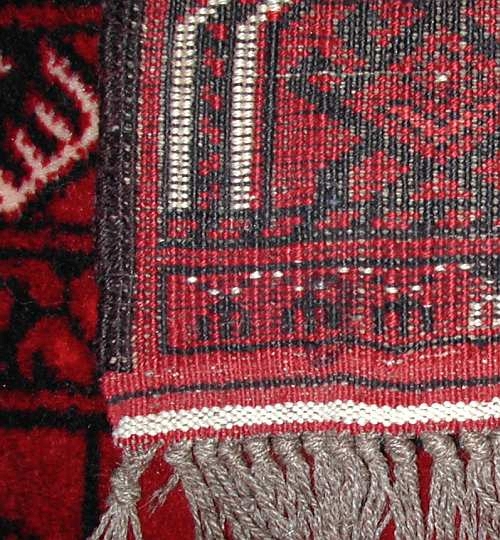
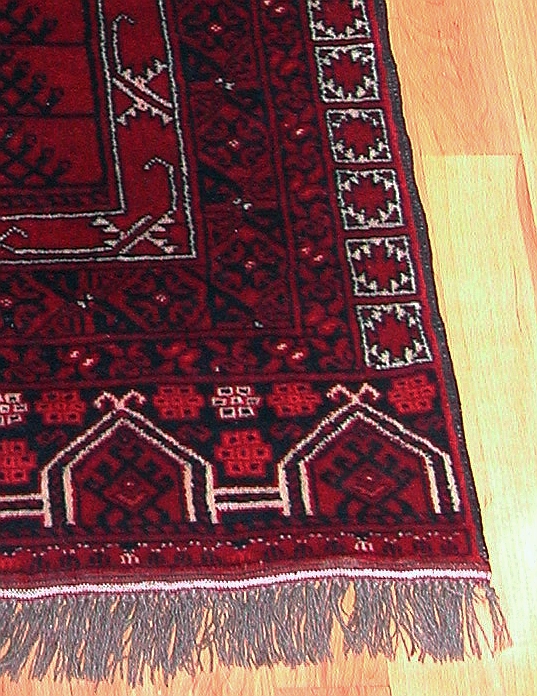
Here are photos of the rug:


Summary of the Dossier's Findings
Here is a breakdown of the key points from the analysis.
1. Technical Specifications
2. The Central Thesis: A Baluch "Signature" with a Turkmen "Story"
The core of the dossier’s argument is the cultural hybridism.
3. Iconography: A Dialogue of Motifs
The dossier argues that the weaver filled the borrowed Turkmen "frame" with her own cultural "voice."
4. Condition and Probable Function
Selected Sources & References
To provide context for the dossier's analysis, I've compiled the primary sources used in the research below.
Books & Journals
Museum & Gallery Examples
Online Discussions & Articles
Conclusion
At the end of this analysis, this rug reveals itself less as an object and more as a document of a fascinating tribal confluence. The thesis proposed here is that we are looking at a piece that speaks a Turkmen visual "language"—the prestigious hatchli layout of an ensi—but with an unmistakable Baluch structural "grammar," evidenced by its asymmetrical knots, robust selvedges, and rich, brocaded kilim skirts.
Far from being a mere copy, the piece suggests a creative reinterpretation, raising questions about the weaver's intent. Was it a demonstration of virtuosity, an elite artisan absorbing an admired design? An homage to Yomut neighbors, perhaps woven into a dowry piece to seal an alliance? Or an act of personal innovation, filling a foreign frame with the symbology of her own heritage, such as the Tree of Life?
Regardless of the motivation, the result is an artifact that interrogates our categorizations. It reminds us that the borders along the Silk Road were porous, and that tribal identity was a field of dialogue, not a fortress. Its excellent state of preservation, in itself, tells a story—that of a cherished piece, stored for over a century, valued perhaps more for what it represented than for what it was used for.
Therefore, this dossier is presented not as a final verdict, but as a structured hypothesis, open to the scrutiny and wisdom of this community. I would be grateful to hear if this interpretation resonates with your own knowledge, or if you see a different story woven into these threads.
My Questions for the Community:
I would be very grateful for your thoughts on the following:
Thank you in advance for lending your eyes and your knowledge to this fascinating piece. I look forward to hearing your insights.
Best regards,
Eduardo Horvath
I'm a longtime admirer of the deep knowledge shared on this forum and am hoping to draw upon your collective expertise. My background is in Human-Computer Interaction, but my passion is in tribal weavings.
I recently acquired a piece that I find fascinating. To properly understand its origins and significance, I've spent considerable time compiling a detailed technical dossier. This research involved synthesizing information from a wide range of sources: foundational books on the subject (like MacDonald and Parsons), articles from HALI, analysis of comparable pieces in museum collections (such as The MET), and of course, the invaluable expert discussions found within the Turkotek archives.
From this synthesis, a central thesis has emerged: this rug appears to be a deliberate and sophisticated act of cultural appropriation—a Baluchi Mushwani weaver creating a piece using the prestigious Turkmen Yomut hatchli layout.
I have summarized the main points of my dossier below and would be incredibly grateful for your expert opinions on whether my analysis holds water.
Here are photos of the rug:
Summary of the Dossier's Findings
Here is a breakdown of the key points from the analysis.
1. Technical Specifications
- Attribution: Mushwani Baluchi subgroup, Herat region, Western Afghanistan, with strong Yomut Turkmen design influence.
- Date: Late 19th to first quarter of the 20th century (c. 1880–1930). This aligns with forum discussions suggesting most dated Baluch rugs are from 1880 onwards.
- Dimensions: Approx. 1.90 m x 1.23 m (
6′3"×4′0"). - Materials: Wool pile on a wool foundation (warp and weft).
- Knot: Asymmetrical (Persian/Senneh) knot, which is a classic Baluch weaving technique.
- Finishes: The rug features multi-cord selvedges and, most notably, wide, brocaded kilim skirts. These elaborate flatwoven ends are considered a hallmark of fine Baluch weaving and are structurally different from the simpler finishes on traditional Yomut pieces.
2. The Central Thesis: A Baluch "Signature" with a Turkmen "Story"
The core of the dossier’s argument is the cultural hybridism.
- The Layout is Turkmen: The cruciform hatchli design, which divides the field into four quadrants, is an iconic feature of Turkmen ensi (yurt door hangings), particularly from the Yomut tribe. These pieces served as ceremonial "doors" to yurts.
- The "Structural DNA" is Baluch: Despite the Turkmen layout, the rug's construction is unequivocally Baluch. The use of the asymmetrical knot, the all-wool foundation, and especially the elaborate kilim ends and selvedge structure are the weaver’s technical "signature".
3. Iconography: A Dialogue of Motifs
The dossier argues that the weaver filled the borrowed Turkmen "frame" with her own cultural "voice."
- Instead of the geometric guls a Yomut weaver would place inside the hatchli panels, this rug features stylized arboreal figures. This is identified as a classic Baluch interpretation of the
"Tree of Life" (Darakht-e Hayat) motif, commonly found in Baluch prayer rugs from the region. This suggests a conscious thematic replacement, not a simple copy.
4. Condition and Probable Function
- The rug is in excellent condition, with no significant wear and its original finishes intact. This strongly suggests it was not a utilitarian floor covering.
- The hypothesis is that it was a
dowry piece (jahaz) or a special ceremonial weaving, preserved and stored for decades rather than used.
Selected Sources & References
To provide context for the dossier's analysis, I've compiled the primary sources used in the research below.
Books & Journals
- MacDonald, Brian. Tribal Rugs - Treasures of the Black Tent (2017).
- Parsons, R.D. The Carpets of Afghanistan (2016).
- Cole, Tom. "From the Horses Mouth-Talking 'Baluch' with Jerry Anderson". HALI Magazine, Issue 78 (1994). Hosted at:
http://www.tcoletribalrugs.com/article10JA.html
Museum & Gallery Examples
- Carpet, 19th Century (Baluchistan). The Metropolitan Museum of Art, Accession No. 22.100.12. Available at:
https://www.metmuseum.org/art/collection/search/447478 - Yomud Ensi Rug, c. 1900-1925. HEIRLOOM Gallery, Brooklyn. Available at:
https://www.heirloombk.com/products/...nsi-rug-42-x-5 - Baluch Prayer Rug, c. 1925-1950. HEIRLOOM Gallery, Brooklyn. Available at:
https://www.heirloombk.com/products/...er-rug-3-x-410 - Old Afghan Purdah Ensi Hatchli Rug, c. 1920. 1stDibs / Cotswold Antiques. Available at:
https://www.1stdibs.com/furniture/ru...id-f_40536762/
Online Discussions & Articles
- Turkotek Discussion Forums. "The Dating Game, featuring 'Baluch' rugs" (Nov 2006). Available at:
http://www.turkotek.com/misc_00061/dating.htm - Turkotek Discussion Forums. "Tree of Life Baluch Prayer Rugs" (Aug 2006). Available at:
http://www.turkotek.com/misc_00054/tree_of_life.htm
Conclusion
At the end of this analysis, this rug reveals itself less as an object and more as a document of a fascinating tribal confluence. The thesis proposed here is that we are looking at a piece that speaks a Turkmen visual "language"—the prestigious hatchli layout of an ensi—but with an unmistakable Baluch structural "grammar," evidenced by its asymmetrical knots, robust selvedges, and rich, brocaded kilim skirts.
Far from being a mere copy, the piece suggests a creative reinterpretation, raising questions about the weaver's intent. Was it a demonstration of virtuosity, an elite artisan absorbing an admired design? An homage to Yomut neighbors, perhaps woven into a dowry piece to seal an alliance? Or an act of personal innovation, filling a foreign frame with the symbology of her own heritage, such as the Tree of Life?
Regardless of the motivation, the result is an artifact that interrogates our categorizations. It reminds us that the borders along the Silk Road were porous, and that tribal identity was a field of dialogue, not a fortress. Its excellent state of preservation, in itself, tells a story—that of a cherished piece, stored for over a century, valued perhaps more for what it represented than for what it was used for.
Therefore, this dossier is presented not as a final verdict, but as a structured hypothesis, open to the scrutiny and wisdom of this community. I would be grateful to hear if this interpretation resonates with your own knowledge, or if you see a different story woven into these threads.
My Questions for the Community:
I would be very grateful for your thoughts on the following:
- Does the overall thesis of a Baluch weaver appropriating a Yomut design seem plausible to you based on the images?
- The dossier points to Mushwani or Taimuri origins for the Baluch elements. Based on the details, does this seem like a reasonable attribution, especially considering the known complexities of these terms?
- Do you agree with the dating of c. 1880-1930? Does anything in the colors or design suggest an earlier or later period?
- Are you aware of other documented examples of such a direct and complete hatchli layout being used in a rug with clear Baluch structural characteristics from this period?
Thank you in advance for lending your eyes and your knowledge to this fascinating piece. I look forward to hearing your insights.
Best regards,
Eduardo Horvath


Comment