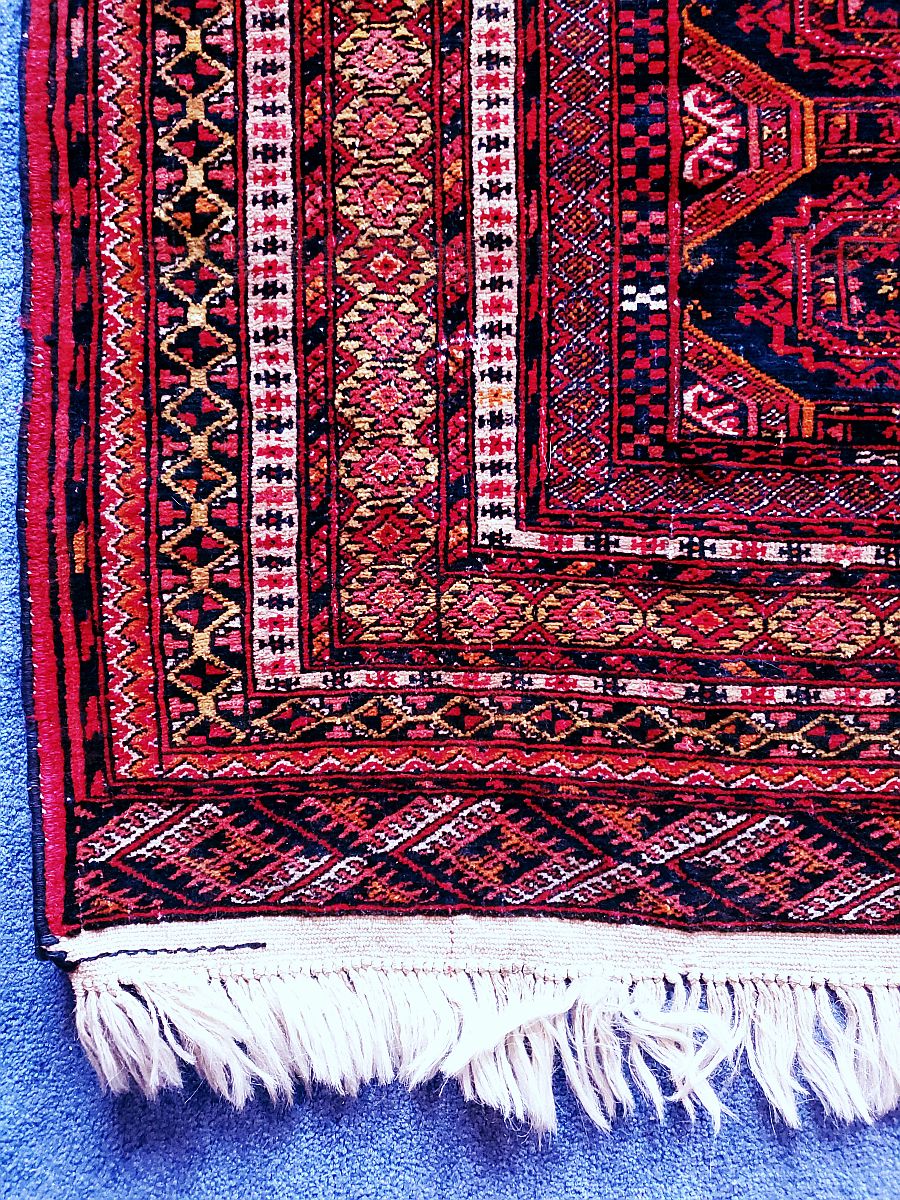
Very small highly knotted rug

Collapse

Announcement

Collapse
No announcement yet.
X
  •  
  • Filter
  • Time
  • Show
Clear All
new posts

  • Very small highly knotted rug

    Here is an unusual piece I’ve had for some time. I never really took a hard look at it since I considered it as a tourist piece. After looking at it today, I may have changed my opinion. The knot count is very high which confuses me. I’m not sure where this was made but I can probably be safe guessing Afghanistan or Pakistan.

    Here are the details;

    Wool on Cotton
    26 x 18.75 inches
    66 x 48 cm
    KSPI 220
    KSPD 3410
    Colors: Red, light red, blue, white. No sign of fading.
    Age: 1970’s to 1980’s?

    It’s so finely woven I had a hard time counting the knots. Why would a weaver work so hard on a small piece if intended for tourist?

    There is some old moth damage as can be seen in the picture.

    Does anyone have any idea about this size and type of rug?

    Click image for larger version

Name:	IMG_2576.jpg
Views:	146
Size:	325.6 KB
ID:	4209
    Joe Lawrence

  • #2
    Hi Joe,

    The style of kilim end and the small multi-triangle motif along each end strongly suggest Turkmenistan, maybe Ashkhabad or Merv, or, alternatively, far northwest Afghanistan maybe near Herat or Bala Murghab/Marucharq. All the motifs are traditional Turkmen with the exception of the diamond minor border which is often seen on Afghan work. I haven't personally seen in on late Turkmen work but it's possible. The white cotton warps fit with those locales as well. Mats like these are often made by the wives of men making the pilgrimage to Mecca, where they are sold for some extra cash. Also, they are sold into the tourist trade in the local rug markets. I think 1960s-1980s is as good as guess as any. A fine weave suggests early rather than late in that window, but that's just my opinion. I've seen very fine work (Khoja Roshnai rugs) coming out of Afghanistan up into the 1980's. A photo of the back with a ruler or scale would be nice to see.

    Regards
    Chuck

    Comment


    • #3
      Thank you for that information Chuck. Here is a pic although it’s a lower count than I counted yesterday. I did have difficulty counting as the 8 or so counts I did were all different. I took the highest number although it’s not consistent.

      The count in the picture is 18x11 which equals a KPSI of 198 or a KPSD of 3069.

      Click image for larger version

Name:	IMG_2582.jpg
Views:	127
Size:	191.5 KB
ID:	4212
      Joe Lawrence

      Comment


      • #4
        This item reminds me a little of the Afghani "telephone rugs" sold in the 90s. As they were well suited as gifts, I used to buy them in a rug shop in Stockholm not far from the main railway station, when I was there on business and had some time to kill before the journey home. Here is an example (approx. 40 x 25 cm):

        Click image for larger version  Name:	IMG_20260220_113531729.jpg Views:	0 Size:	153.1 KB ID:	4214

        These were cheap, small and of low quality, but still quite attractive, I think. Here is a close-up of the reverse of the above rug.

        Click image for larger version  Name:	IMG_20260220_113540628.jpg Views:	0 Size:	224.1 KB ID:	4216
        Erik Persson
        Senior Member
        Last edited by Erik Persson; 02-20-2026, 10:58 AM.

        Comment


        • #5
          Eric, that is an interesting small textile that appears to have a high knot count for such a small piece.

          I did find a picture of a similar example of the piece I posted located in James Opie’s Tribal Rug book (fig. 17.4) The picture was from 1973 of “newer” pieces hanging outside of a rug store. This helps confirm a suspicion of the era these were produced.
          Joe Lawrence

          Comment


          • #6
            Joe,

            Here's an example from Afghanistan, the area around Marucharq, that is described in George O'Bannon's book on Turkoman rugs. He was seeing them on the markets in the 1970's and considered the overall design to be a modern creation. Observe the diamond and multi-triangle border motifs I mentioned above. These are not common traditional Turkmen ornaments. But in new, post WW II work, all bets are off with respect to tradition. This one is on a wool foundation and has fully depressed warps.

            Regards
            Chuck

            Comment


            • #7
              Thanks for the info Chuck.
              Joe Lawrence

              Comment


              • #8
                Mr Lawrence, where exactly did you buy the 1" sqr magnifier you show above when measuring the knots? I have found many online with linear graduations but none with both imperial and metric numerals. Thanks.

                Comment


                • #9
                  Greetings, mystery Guest

                  As noted above:

                  "Please use your full name. We do not permit posting anonymously..."

                  Please use your name, whether a registered user or not, or you will be blocked.

                  You can add it to your existing post, using the Edit tool at the bottom right of your post frame.

                  Regards
                  Chuck Wagner

                  Comment

                  Previously entered content was automatically saved. Restore or Discard.
                  Auto-Saved
                  x
                  Insert: Thumbnail Small Medium Large Fullsize Remove  
                  x
                  or Allowed Filetypes: jpg, jpeg, png, gif
                  x

                  Please enter the six letters or digits that appear in the image below.

                  Registration Image Refresh Image
                  Working...
                  X