If this is your first visit, be sure to
check out the FAQ by clicking the
link above. You may have to register
before you can post: click the register link above to proceed. To start viewing messages,
select the forum that you want to visit from the selection below.
The TurKoTek Home Page can be accessed by clicking the link, or on the image on the top of the page on the left side. From there (or from the link here), you can access our Archived Salons and Selected Discussions. Our forums are easy to use, and you are welcome to read and post messages without registering. However, registration will enable a number of features that make the software more flexible and convenient for you, and you need not provide any information except your name (which is required even if you post without being registered) and a working email address. Please use your full name. We do not permit posting anonymously or under a pseudonym, ad hominem remarks, commercial promotion, comments bearing on the value of any item or on the reputation of any seller.
Thanks! This last weekend, I just got that Chub Bash up on a wall where it's fairly unobscured. I think I have the right ID, but I sure have no idea about the age of it. "Old enough," as Rich Larkin used to say.
The sides were re-selvaged at some point, and the ends are missing whatever kilim was once there, but I'll start with some shots of the back. The weave doesn't look Chodor to me (but I could be educated...) , and I have seen old main carpets from the Middle Amu Darya region with skinny borders like this, though I have yet to see an analogue to this carpet.
So, a bit of a mystery! Thanks for checking it out... I am always on the lookout for something similar...
First, please include your full name when you post. Second, it would be much more useful to readers if you pointed out the characteristics that allow you to identify the piece as having been made in or sold through Peshawar.
I have found a few grossly similar pieces in my books; I'll post a few images sometime this week. I don't buy the suggestion that this piece is a Pakistani knock-off, at all. This looks like typical work from northern Afghanistan.
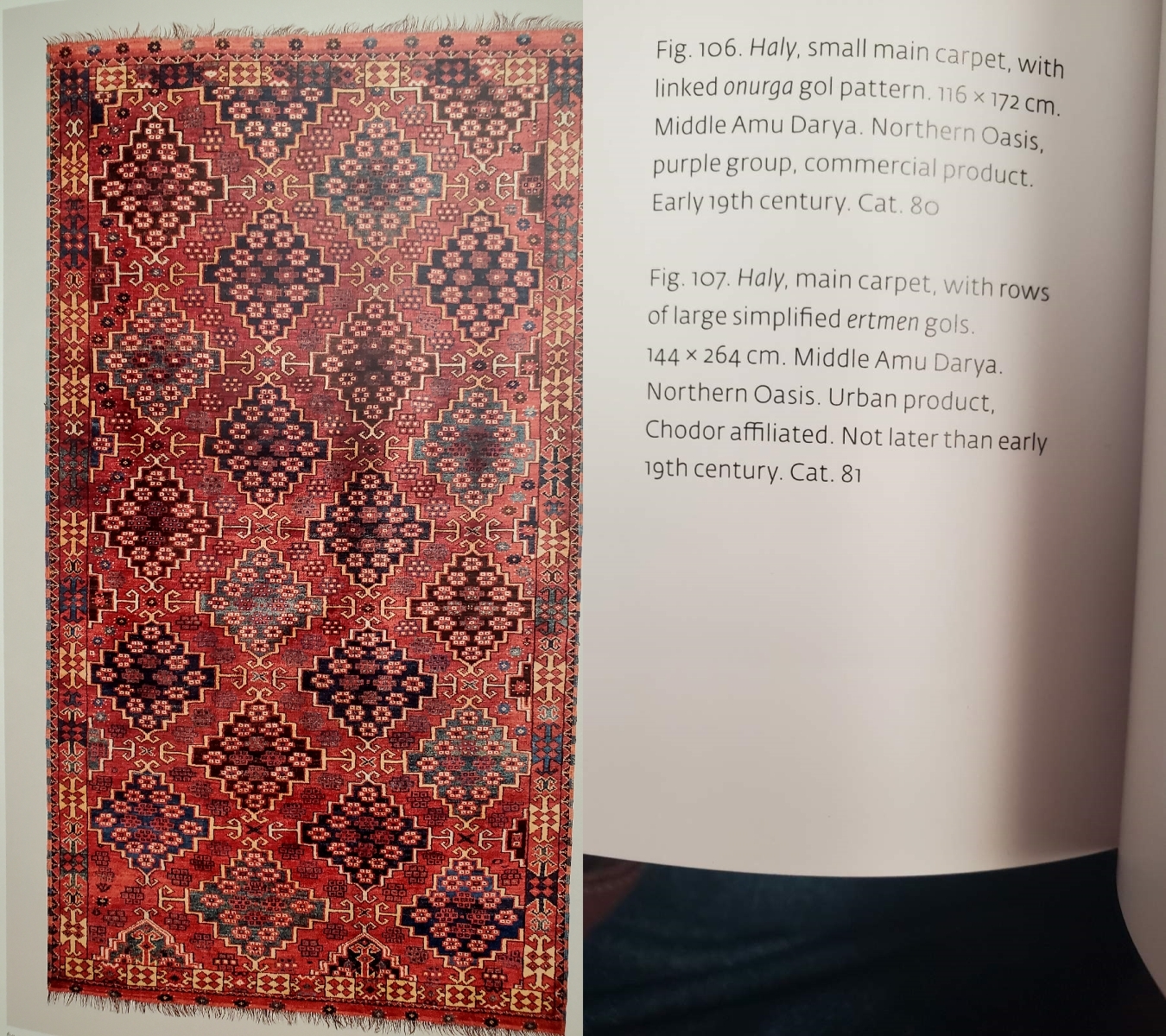
This is the closest to yours that I've found; clearly different in important ways but related w/respect to genre.
The use of handspun Karakul wool on yours excludes the possibility that this is a Peshawer knockoff, in my opinion. I do think it is an Ersari piece, and I suppose could be Chob Bash but the minor motifs in the quartered guls on yours are a little different from most Chob Bash examples, with the "animal head" more common to Ersari and Tekke work. I have found -zero- examples of Chodor work with quartered guls, and the weave looks like typical Ersari work.
The example below is from Tsareva's book on the Neville Kingston collection.
Although I am primarily interested in Near Eastern rugs and flatweaves, a Panamanian mola panel certainly ranks right up there for me (see image link, below).
Molas were originally made to adorn a type of blouse traditionally worn by the Guna (Kuna) women of Panama. They are constructed of multiple layers of different colored fabric (typically machine woven cotton cloth) decorated primarily using a technique known as reverse applique to form a positive-negative image. It is thought that the making and wearing of molas by the Guna peoples started around the end of the 19th century. Antecedents are unclear but body painting is one possibility frequently mentioned. Starting around 1940 the addition of decorative stitchery elements became more common. Other clues to age are size (older molas tend to be larger), hand vs. machine stitching, and the type of fabrics used.
One nice thing about molas is that they represent an art form that is still readily accessible. They are also easy to display, which is a plus. Most dedicated collectors look for earlier examples, say pre-1975, which presumably stand a greater chance of having been made for personal use rather than for the tourist trade. Nevertheless, inspired pieces are undoubtedly still being produced today. While rarity/uniqueness tend to command a premium for many textile arts (e.g., rugs), this is not necessarily so with molas. Here, the design repertoire is so diverse and the medium so unrestrictive that seemingly unique molas representing one woman’s imagination are not uncommon.
I’m not a mola collector per se but stumbled upon this one by chance almost 30 years ago and couldn’t resist it. The design can be imagined as a ‘nia’ (translation devil) or feline figure surrounded by what appears to be an energy field. Recently, I’ve had the mola archivally mounted, framed and hung on the wall where it literally vibrates. This mola appears to belong to a small group; I have been able to find at least four others with similar imagery including one on Rugrabbit.com used to advertise mola collector Tom Hannaher’s 2022 webinar: “Painting with Scissors: Mola Art of the Kuna (Guna) Indians.”

 Tweet
Tweet

Comment