Yomud with green dyes

Collapse

Announcement

Collapse
No announcement yet.
X
  •  
  • Filter
  • Time
  • Show
Clear All
new posts

  • Yomud with green dyes

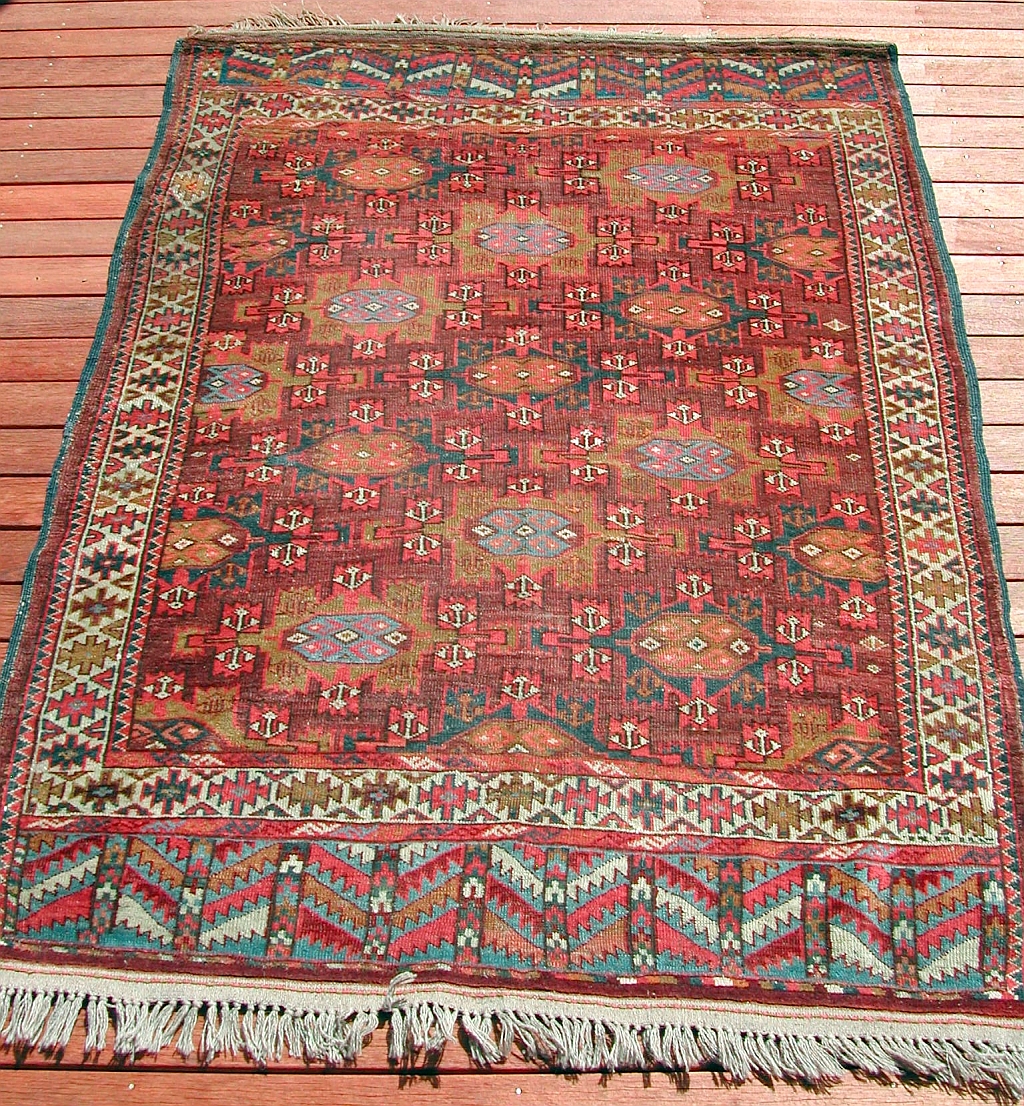
    Not mine - but i think worth observation. Typical yomud said to be 1900. And from my viewpint aubergine base color supports this age. But there are a few things i find strange.
    1. Green colors insted of typical blue. This bottle green could be seen in 195o pieces.
    2. Proportions. Earely pieces are 1 to 2 almos in every case. This one is more practical 3 to 2. ( 330cm to 210cm)
    So what do you guys think? First quarter 20c commercial production or...? Click image for larger version

Name:	yomud_1.jpg
Views:	127
Size:	245.1 KB
ID:	3369 Click image for larger version

Name:	yomud_6.jpg
Views:	124
Size:	209.9 KB
ID:	3370 Click image for larger version

Name:	yomud_2.jpg
Views:	126
Size:	238.8 KB
ID:	3371 Click image for larger version

Name:	yomud_3.jpg
Views:	123
Size:	230.2 KB
ID:	3372 Click image for larger version

Name:	yomud_5.jpg
Views:	125
Size:	231.2 KB
ID:	3373

  • #2
    I am not an expert in yomud Kepse gül rugs but a few things that may suggest a later piece to me are;

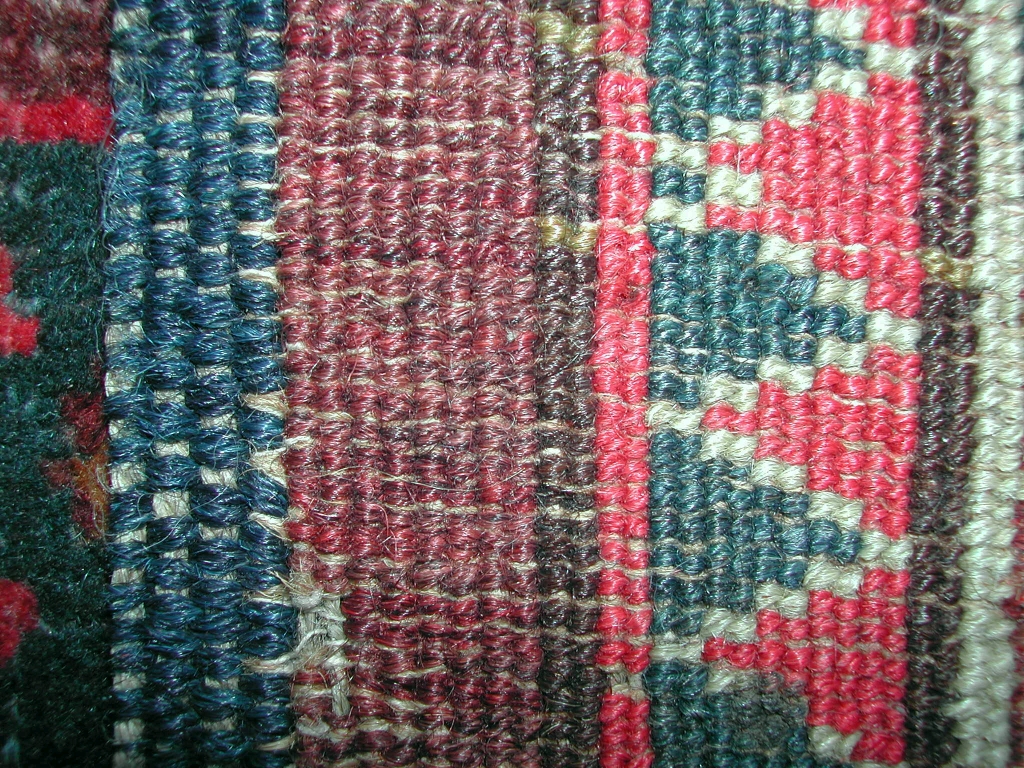
    The overall color appears to be faded suggesting synthetic dye. I also see what may be slight bleeding. The overall paleness could be from some type of chemical wash at some point in its life.

    The triple cord selvage is a suspect of being a later date.
    Joe Lawrence

    Comment


    • #3
      Originally posted by Joe Lawrence View Post
      I am not an expert in yomud Kepse gül rugs but a few things that may suggest a later piece to me are;

      The overall color appears to be faded suggesting synthetic dye. I also see what may be slight bleeding. The overall paleness could be from some type of chemical wash at some point in its life.

      The triple cord selvage is a suspect of being a later date.
      Thnk you Joe. Make perfect sence.

      Comment


      • #4
        Originally posted by Joe Lawrence View Post
        I am not an expert in yomud Kepse gül rugs but a few things that may suggest a later piece to me are;

        The overall color appears to be faded suggesting synthetic dye. I also see what may be slight bleeding. The overall paleness could be from some type of chemical wash at some point in its life.

        The triple cord selvage is a suspect of being a later date.
        Joe - a later date as you say . This i a little tricky for me to understand with period turkmen rugs. Say this rug is 1900. Up to 1920 it would be almost unchanged. Starting from 1930' - purely "soviet type production". Totally different story.

        Comment


        • #5
          Those are just my observations so let’s wait and see what the pros say. I did read that these types of rugs generally have two main field colors pending where in the region they are made. One is the “purple-brown” color shown from your example and the other is a “brilliant brick red” field. (Turkoman Tribal Rugs, Werner Loges page 65).

          A few other identifiers according to Loges;

          KPSD is 1800-2800 (KPSI 116-180)
          Symmetric or Asymmetrical knots
          Older pieces are normally lighter in color


          Joe Lawrence
          Senior Member
          Last edited by Joe Lawrence; 08-18-2025, 04:54 PM.
          Joe Lawrence

          Comment


          • #6
            Hi,

            Here's a Yomud rug from our collection that I suspect is from the early 1900's.

            I'd guess 1900-1930, and from a weaving group further north and west than the Yomud populations in southwest Turmenistan and Iran.

            The aubergine ground color seems prevalent in both late Chodor and late Yomud pieces away from the more central Turkmen weaving areas.

            Of course, this is my own speculation.

            Another characteristic of these later rugs is the particularly unattractive choice of a dull natural brown as a motif fill color.

            Note that this rug has a four-cord selvage. I don't think that's a dating characteristic, as much as is is something that points to a particular weaving population.


            Regards
            Chuck

            Comment


            • #7
              Originally posted by Chuck Wagner View Post
              Hi,

              Here's a Yomud rug from our collection that I suspect is from the early 1900's.

              I'd guess 1900-1930, and from a weaving group further north and west than the Yomud populations in southwest Turmenistan and Iran.

              The aubergine ground color seems prevalent in both late Chodor and late Yomud pieces away from the more central Turkmen weaving areas.

              Of course, this is my own speculation.

              Another characteristic of these later rugs is the particularly unattractive choice of a dull natural brown as a motif fill color.

              Note that this rug has a four-cord selvage. I don't think that's a dating characteristic, as much as is is something that points to a particular weaving population.


              Regards
              Chuck
              Chuk for my eyes the piece you have posted is much later. mid 1930 id the earlies. And could be up to 1950. Mable up to early 1960/

              Comment


              • #8
                Konstantin,

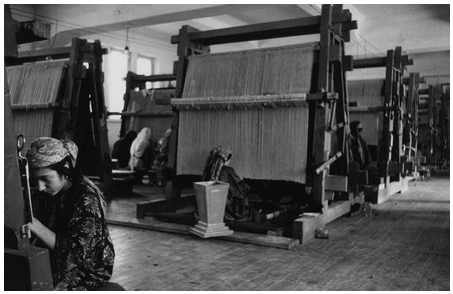
                Well, you would be incorrect with that assessment, because now you are talking about the Soviet era when Turkmen weaving was forcibly collectivized and moved into workshops with steel beam or timber frame looms and machine spun yarns to enforce uniformity. This piece is all hand spun wool. And the larger kepse guls and more crowded space is consistent with several other pieces in various books all dated to the end of the 19th century or early 20th century. I'm sure that there were still nomadic weavers that were able to evade the collectivization but not many.

                Regards
                Chuck

                A workshop in Ashkabad:

                Courtesy Alamy Images

                Comment


                • #9
                  Originally posted by Chuck Wagner View Post
                  Konstantin,

                  Well, you would be incorrect with that assessment, because now you are talking about the Soviet era when Turkmen weaving was forcibly collectivized and moved into workshops with steel beam or timber frame looms and machine spun yarns to enforce uniformity. This piece is all hand spun wool. And the larger kepse guls and more crowded space is consistent with several other pieces in various books all dated to the end of the 19th century or early 20th century. I'm sure that there were still nomadic weavers that were able to evade the collectivization but not many.

                  Regards
                  Chuck

                  A workshop in Ashkabad:

                  Courtesy Alamy Images
                  Chuck you are right but my assessment was based on a different ground. I have a theory that certain colors was typical for a certain age everywhere. In rugs, dress, decorative arts… everywhere. As a native soviet citizen I could tell you from my experience that I saw this color scheme in 1950-1960 examples
                  But my assessment was based on a different ground. I have a theory that certain colors was typical for a certain age everywhere. In rugs, dress, decorative arts… everywhere. As a native soviet citizen I could tell you from my experience that I saw this color scheme in 1950-1960 examples

                  Comment


                  • #10
                    Hi Konstantin

                    What's the evidence for your theory that certain colors were typical for certain ages everywhere? I'm more than a little skeptical that it was even true throughout the USSR in the 1950's.

                    Best

                    Steve Price

                    Comment


                    • #11
                      Not to hijack this topic but Chuck, what a stunning and unique piece you have there!

                      Concerning the 3-4 warp selvage, although my research is limited, I found a lot of Yomud examples with this type of weaving more common in later pieces…meaning very late 19c - first qtr+ 20th century. BUT…I could be way off on that too. The piece could have been re-selvaged years ago unbeknownst to us. Without a hands on examination, it’s difficult to say for sure. One thing is for sure, any example posted on this forum garners options and at times, historical documented facts….at least to the best of their knowledge at the time.

                      Back to your rug. It’s a wonderful piece.
                      Joe Lawrence

                      Comment

                      Previously entered content was automatically saved. Restore or Discard.
                      Auto-Saved
                      x
                      Insert: Thumbnail Small Medium Large Fullsize Remove  
                      x
                      or Allowed Filetypes: jpg, jpeg, png, gif
                      x

                      Please enter the six letters or digits that appear in the image below.

                      Registration Image Refresh Image
                      Working...
                      X