Karakalpak?

Collapse

Announcement

Collapse
No announcement yet.
X
  •  
  • Filter
  • Time
  • Show
Clear All
new posts

  • Karakalpak?

    The floors and walls in our home already being much too crowded, I recently made the decision not to buy any more rugs. Then, however, the item below showed up on a web auction in Germany and it turned out that I was the only bidder, so now I and my wife are scratching our heads over where to put it in our house. Here is the short description of it by the selling auction house:

    "Karakalpak , Uzbekistan, mid 20th century, wool on wool, approx. 202 x 142 cm, (several lanes)"

    An interesting feature of the rug is that the depth of the pile has been varied, so as to make the eagles, the garlands and the mid portion stand out from the dark "background".

    Knowing nothing about Karakalpak rugs, I found this useful resource on the web:

    http://www.karakalpak.com/index.html

    The couple behind the site, David and Sue Richardson, has also written a very impressive, learned and sumptuously illustrated book on the Karakalpaks that includes a lot of interesting stuff on their yurts and textiles:

    http://www.karakalpak.com/book.html

    None of the rugs in the pictures in this work, on their site or found by googling around seems the least similar to my one. The mid 20th century dating also appears strange due to the most un-Soviet symbols on the rug. So is this really a Karakalpak and what is its age? Any ideas?


    Erik Persson
    Senior Member
    Last edited by Erik Persson; 06-22-2025, 02:33 PM.

  • #2
    Erik,

    I would have guessed somewhere in the Balkans. The Karakalpakstan emblem has a single-headed eagle.

    Regards
    Chuck

    Comment


    • #3
      I have zero knowledge of this piece. Why does it look like pieces were sewn together?
      Joe Lawrence

      Comment


      • #4
        Thank you, Chuck and Joe, for the input! The Balkans seems like a most reasonable guess! Yes, the rug consists of three lanes sewn together.

        There are some discolorations in the photos which, however, appear to be some kind of photographic artefact, as they are absent in the real rug.

        Comment


        • #5
          Originally posted by Joe Lawrence View Post
          I have zero knowledge of this piece. Why does it look like pieces were sewn together?
          Because they are.


          Looking at this piece, although the photo of backside is not quite close / sharp enough to say for sure, to me the weaving has more in common with Scandinavian ryijy's than a middle eastern carpet. I am not saying it is by any means, just what the weaving style appears to 'look like'. Be very surprised if it turns out to actually be Karakalpak though.
          Phil Smythe
          Member
          Last edited by Phil Smythe; 06-23-2025, 08:47 AM.

          Comment


          • #6
            Thank you, Phil, very interesting suggestion! As a matter of fact, I now recognize that the weaving style is somewhat similar to that in a rug my father's grandmother has woven (I live in Sweden).

            Comment


            • #7
              Originally posted by Erik Persson View Post
              Thank you, Phil, very interesting suggestion! As a matter of fact, I now recognize that the weaving style is somewhat similar to that in a rug my father's grandmother has woven (I live in Sweden).
              Well then Eric you probably know more about rya's* than I do. I have seen a few two panel ones, but cant recall seeing a three panel like yours. Nice!

              *For other's info, rya is the Swedish spelling - as opposed to Finnish 'ryijy' - for same textile type.

              Comment


              • #8
                Well, the piece woven by my father's grandmother is not what I would call a "ryamatta", but just a "matta". Here is a picture of it:
                Click image for larger version  Name:	IMG_20250623_163204763.jpg Views:	0 Size:	128.2 KB ID:	3110
                It is very long, somewhat worn and a bit dull in appearance, so we have folded it double and tucked it away in a not very prominent place, in one of the many book aisles in our home. However, the weaving style and the smooth structure of the rug strike me as somewhat similar to the ones in the would-be Karakalpak. The double eagles motif of the latter I don't think is common in Sweden, though. It looks quite Russian to me - this is certainly a far shot, but could perhaps the origin be Finland during the times it belonged to Russia? And what about the multi-coloured tassels? Are they in use outside Turkmen and various other Oriental tribal rugs?

                My parents had a modern, very shaggy "ryamatta" bought new in the 60s I think, but I was not particularly fond of it. The antique ones, however, can be quite nice.
                Erik Persson
                Senior Member
                Last edited by Erik Persson; 06-23-2025, 05:39 PM.

                Comment


                • #9
                  Originally posted by Erik Persson View Post
                  My parents had a modern, very shaggy "ryamatta" bought new in the 60s I think, but I was not particularly fond of it. The antique ones, however, can be quite nice.
                  Eric, if you look at some of the close ups of the backs of the ryijy's on this web page you will see what I mean about backside of yours looking 'similar' to them (or so I think from what I can make out of yours). But again, I don't have enough knowledge to say yours is one by any means.
                  https://warpandweft.club/scandinavia/

                  As for the double headed 'bird', could be Russian, or even German maybe?


                  Comment


                  • #10
                    Coda: The would-be eagle Karakalpak, being quite smooth and supple in structure, ended up as a bedspread in our guest room. It fits perfectly and looks quite formidable on the bed!

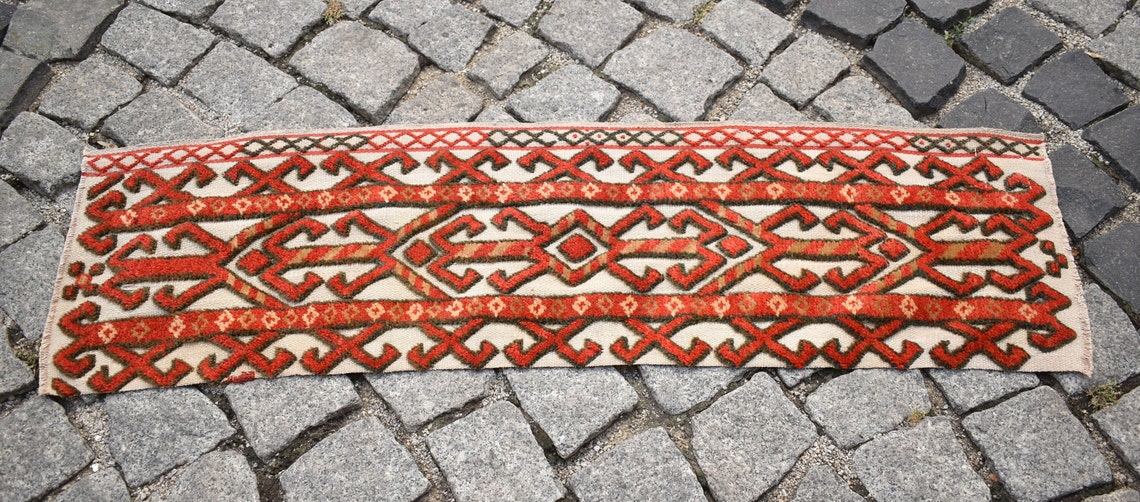
                    Additionally, I found a small Karakalpak (?) tent band fragment for sale in Ankara, which I promptly ordered:

                    There is a plethora of images of more or less similar tent bands in the Richardsons' book, so it seems reasonable to believe, I think, that this is indeed a Karakalpak, although the seller's description is a bit confusing as he seems to believe Karakalpakstan is in the Caucasus. Here are some parts of his description of the rug:
                    • vintage from the 1930s
                    • Materials: Cotton, wool
                    • Width: 12 inches
                      Length: 40 inches
                    • 90_100 YEARS OLD NATURAL WOOL AND VEGETABLE DYE
                    If anyone begs to differ as to the origin, dating etc, please let me know

                    Comment


                    • #11
                      I can say I recognize the stones in the pic and visited the sellers store in Ankara 2 years ago. He is extremely humble, honest and very knowledgeable and I have yet to see him wrong on an attribution and date time frame with a piece. His store is not fancy, no signs, and just a few pieces hanging outside. If you were looking for a rug store, you may walk right past it. Nothing flashy or fancy but he has an amazing variety with wall to wall, floor to ceiling examples. I have ordered from him in the past and his shipping from Ankara to the West Coast of the USA is 3-4 days. Incredible.

                      I like your piece btw!

                      Here is a picture I took at his store. I bought a few pieces.

                      Click image for larger version  Name:	IMG_1496.jpg Views:	0 Size:	240.4 KB ID:	3322
                      Joe Lawrence
                      Senior Member
                      Last edited by Joe Lawrence; 08-04-2025, 06:15 AM.
                      Joe Lawrence

                      Comment


                      • #12
                        Hi Erik,

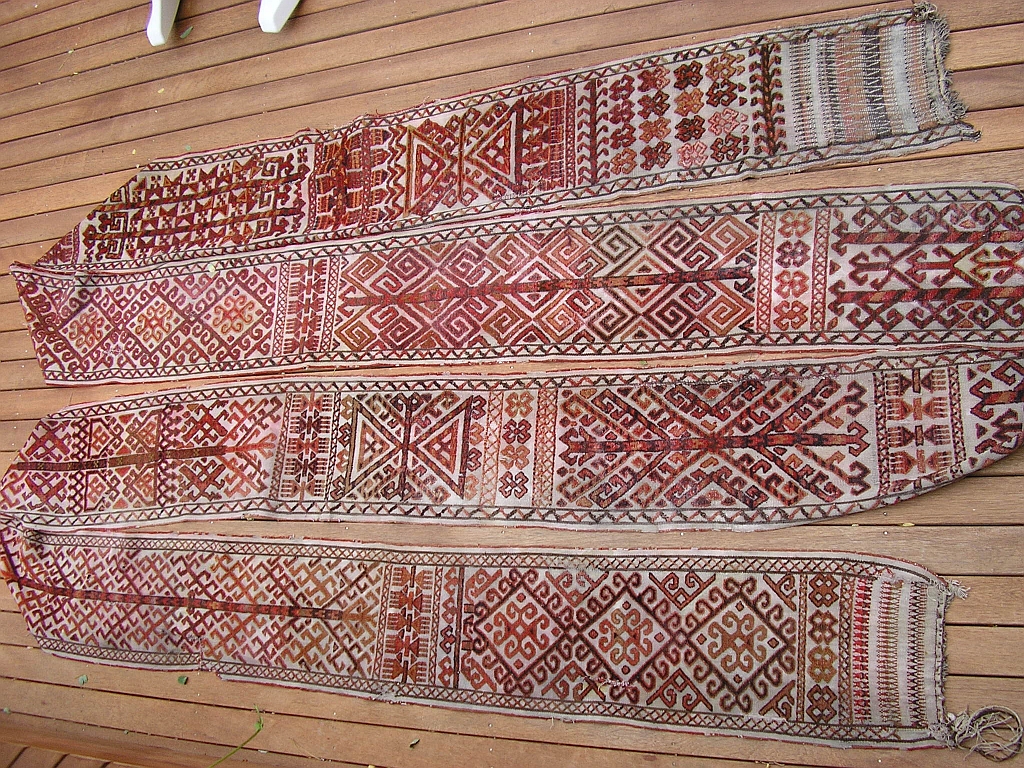
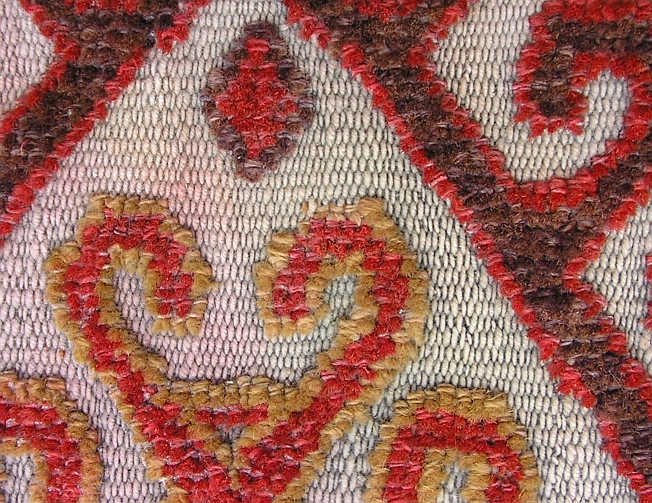
                        Here are a couple images of a Karakalpak yurt band in our collection for comparison. Ours is piled with symmetrical knots. The color palette of yours says Turkmen to me, as do the minor ornamentations (diamonds, hashes). There's lots of examples on the web for further research.

                        Regards
                        Chuck


                        Comment


                        • #13
                          Joe and Chuck, thank you for the interesting comments and pictures!

                          Comment


                          • #14
                            On another occasion, I also bought these two fragments of a tent band from another Turkish seller:
                            Click image for larger version  Name:	icm_fullxfull.751932615_mj5l6u3f2k0osgscw4c0.jpg Views:	0 Size:	291.1 KB ID:	3345
                            These were advertised as "antique Turkoman" and dated as vintage from the 1930s. If this seller is right, it clearly confirms Chuck's verdict as to the Turkmen ornamentation and colours of the would-be Karakalpak fragment.
                            Attached Files
                            Erik Persson
                            Senior Member
                            Last edited by Erik Persson; 08-08-2025, 08:06 AM.

                            Comment


                            • #15
                              This may be helpful.

                              http://www.karakalpak.com/tentbands.html
                              Joe Lawrence

                              Comment

                              Previously entered content was automatically saved. Restore or Discard.
                              Auto-Saved
                              x
                              Insert: Thumbnail Small Medium Large Fullsize Remove  
                              x
                              or Allowed Filetypes: jpg, jpeg, png, gif
                              x

                              Please enter the six letters or digits that appear in the image below.

                              Registration Image Refresh Image
                              Working...
                              X