If this is your first visit, be sure to
check out the FAQ by clicking the
link above. You may have to register
before you can post: click the register link above to proceed. To start viewing messages,
select the forum that you want to visit from the selection below.
The TurKoTek Home Page can be accessed by clicking the link, or on the image on the top of the page on the left side. From there (or from the link here), you can access our Archived Salons and Selected Discussions. Our forums are easy to use, and you are welcome to read and post messages without registering. However, registration will enable a number of features that make the software more flexible and convenient for you, and you need not provide any information except your name (which is required even if you post without being registered) and a working email address. Please use your full name. We do not permit posting anonymously or under a pseudonym, ad hominem remarks, commercial promotion, comments bearing on the value of any item or on the reputation of any seller.
I just completed reading the article you wrote in Hali issue 69 June/July 1993. It was very well written and you really established a concrete analogy….we don’t know much about them and there is still much to learn. You referenced two sources for either having a picture of one in use or they said they had a picture in their possession. I would really like to see these examples.
My layman’s approach to this subject is that these bags were made for a purpose and more than likely had multiple uses. It’s time like these that we wish there would have been a written history on the tribes.
Again, thanks for the tip on the article and it was a pleasure to read.
Thanks, Joe. I'm sure these were utilitarian, and were probably referred to as spoon bags, spindle bags, etc. depending on what was in them most of the time. It's like my socks drawer, underwear drawer, etc. - it's just a way for me to identify them and they could change names tomorrow if I decided to change what I put in them.
Steve recommended Peter Andrews as a good source in this thread earlier, and I have now ordered some of his book that I did not have before. His quite interesting homepage is here:
Hi Erik - Peter Andrews is an excellent source of information on Turkmen. That was his specialty as an academic anthropologist, and his wife is a Yomud woman. He doesn't present romantic myths.
Not surprisingly, bags with this particular geometry - and rumored use - are not restricted to Turkman weavings, and are found in work from other nomadic groups. Here are a Luri and a Bakhtiari bag with similar characteristics:
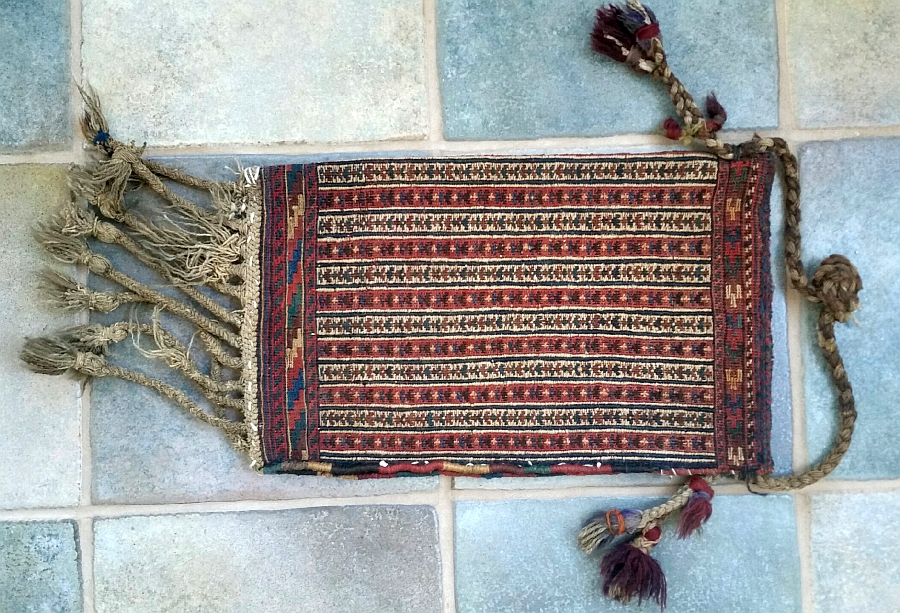
I’d like to follow up on this older post. I have done a lot of research on the Ok Bash as of late. I no longer feel these could have been used to feed animals although I don’t rule out it could have been used as a container to haul animal feed if one was inclined to do so. Speculation of course. I have concluded that the yurt strut pole cover is likely the intended use and then utilized in the yurt after migration as a storage container. I have read all the older posts from the early 2000’s here on this site and there has been much discussion on the subject. My questions and confusion for this being used as a strut cover was the size of the opening on the Ok Bash. It seemed a little small to hold half of the 50-70 poles needed to construct a yurt. Apparently, the poles were divided equally on either side of the camel. Further research revealed that the top ends of the struts were tapered to around 1 inch. It still seems like a tight fit unless the strut poles were tapered to a point, or like an arrow (Ok, UUk, Uk).
My bag has a knot count of KPSD of 2790, has 8 colors which all appear to be natural dye on wool and the size and knot count is consistent with other published pieces. The odd thing about my bag are the tassel locations on the side instead of the bottom and the bottom section was not secured to a tapered finished piece. Why? It’s possible it was a weavers choice? This will always remain a question that may be never answered.
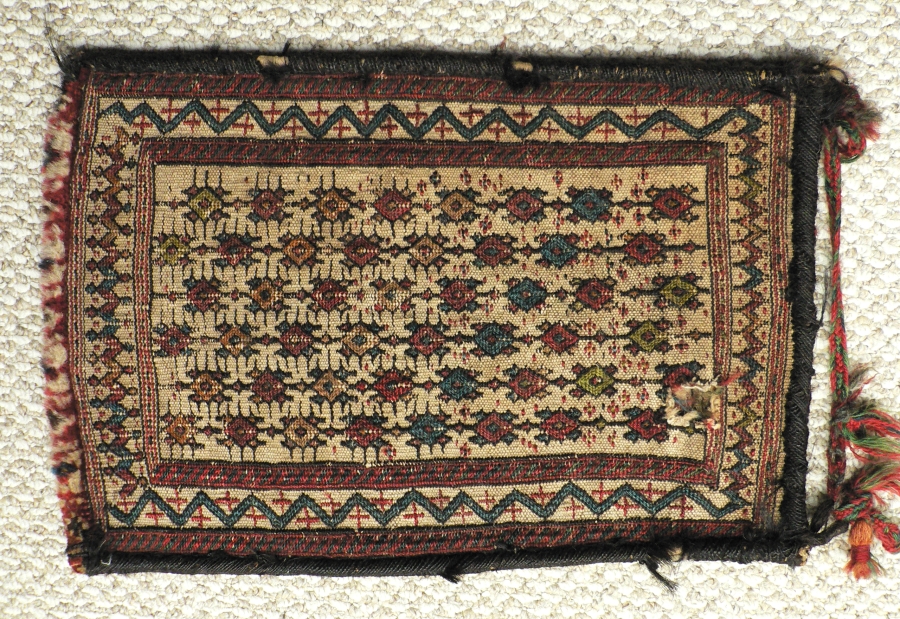
I have included a picture from a previous post by Eric showing a very similar piece, an Igsalik utilized as a spoon holder. I have included a picture of my Ok Bash with a similar hand carved spoon I purchased in Ankara Turkey in 1984 for reference.
What appears to be black in the picture is actually a brilliant indigo blue.

 Tweet
Tweet




Comment