
 Tweet
Tweet
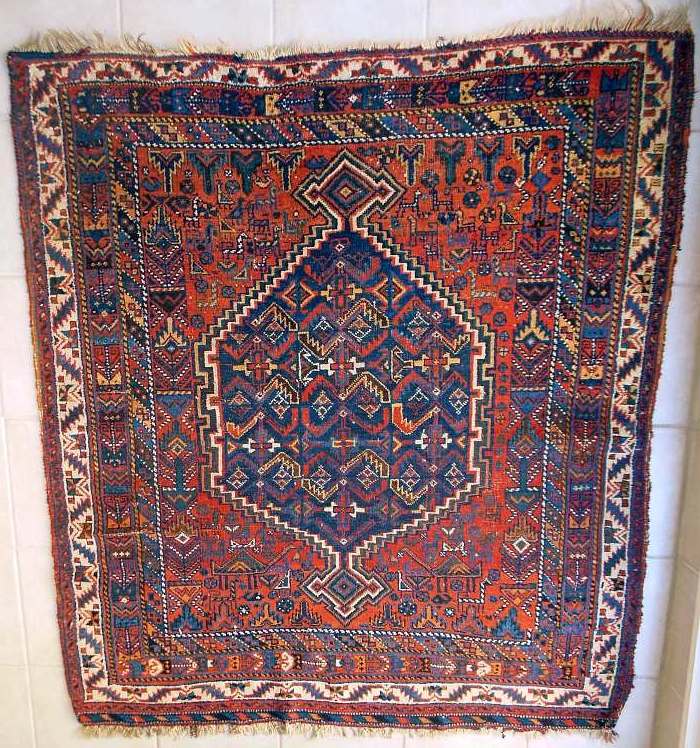
I purchased this Afshar rug a couple of years ago, and recently decided to get some more rugs up on the walls--ten-foot ceilings seem to ask for some stuff hanging all the way up to the ceiling. Anyway, this Afshar is pretty thin, but because of the red wefts, the wear is mostly obscured in the borders and the outside of the field, and you really only see it as a kind of abrash in the deep indigo central field/medallion. I think this piece is from deep in the 19th century, with the lovely embroidered kilim ends, the fine knotting (though very soft and floppy), detailed drawing, and spectacular colors. There's a super-pale blue in the details that is very intriguing.

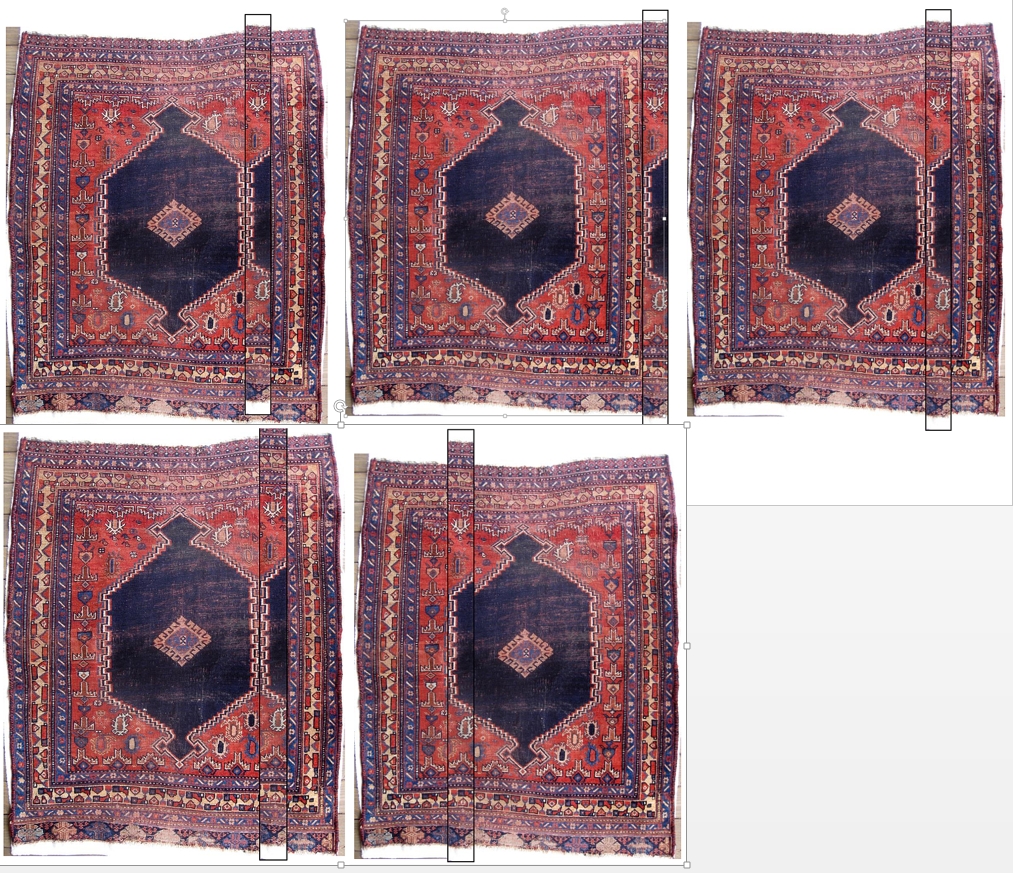
So once I had it up there and started looking at it, the profound wonkiness of the blue medallion/field impressed me more powerfully than it had previously. The medallion's right side starts and ends significantly higher than the left side. There are little "teeth" on the edge of it, and she clearly started the right side one tooth late and finished the same way. The "teeth" do actually sort-of line up, with one extra tooth on the lower side on the left, and a higher tooth on the right.

I am forever enchanted by what seems to me to be a deliberate distortion of the design in this way. I think that many old tribal pieces achieve a sense of movement and three-dimensional depth with this sort of distorted design. Baluchis and Turkmen do this sort of thing all the time. Sometimes it seems to be the work of a novice but often it seems like this--a skilled weaver making a special piece, and she did this deliberately. The mystery of course is what the intention was. All we have is speculation, but of course, that's the fun of it.
BTW, while I'm here, I thought I'd show the super-pale bluish color from the back. From the front, at this point, it looks like more ivory... but it clearly is not...

So once I had it up there and started looking at it, the profound wonkiness of the blue medallion/field impressed me more powerfully than it had previously. The medallion's right side starts and ends significantly higher than the left side. There are little "teeth" on the edge of it, and she clearly started the right side one tooth late and finished the same way. The "teeth" do actually sort-of line up, with one extra tooth on the lower side on the left, and a higher tooth on the right.
I am forever enchanted by what seems to me to be a deliberate distortion of the design in this way. I think that many old tribal pieces achieve a sense of movement and three-dimensional depth with this sort of distorted design. Baluchis and Turkmen do this sort of thing all the time. Sometimes it seems to be the work of a novice but often it seems like this--a skilled weaver making a special piece, and she did this deliberately. The mystery of course is what the intention was. All we have is speculation, but of course, that's the fun of it.
BTW, while I'm here, I thought I'd show the super-pale bluish color from the back. From the front, at this point, it looks like more ivory... but it clearly is not...
Attached Files
 . For your rug I think a good case can be made that the irregularity was caused by the less than perfect cooperation of two weavers. Looking at the rug as a whole, it looks like the right side has in almost every part different, mostly better, drawing than the left. The blue ground floral meander border from top and bottom is continued as is on the right side, left it stops meandering and has all diagonal lines going the same way. The white ground Khamseh border is not particularly well drawn anywhere, but on the right side the elements at least stay together, while on the left the bar and the opposing two 'tents' shift away from each other as we move up. There the border also seems to wobble and become wider towards the top. In the red field on both sides of the blue centre there are the Afshar combinations of a toothed 'skyline' with a shield shape above it. On the right, they are all well drawn and regular. On the left the teeth of the three at the very bottom are a mess, then the first single one above that has no teeth, just two triangles, while the tops of all the central tall teeth are like a roof instead of indented. The shields are also clumsily drawn on the left. I think it more likely that the irregular drawing of the blue medallion was caused by the obvious lack of coordination of two ladies, than by any intent to create movement in the rug. I do not deny that the effect is there, and I actually like it very much, but I cannot imagine a weaver intentionally and consistently drawing well on the one side of her rug, and drawing clumsily on the other. I am sure weavers have fun with the treatment of certain designs, but I don't think that is the case here.



Comment