If this is your first visit, be sure to
check out the FAQ by clicking the
link above. You may have to register
before you can post: click the register link above to proceed. To start viewing messages,
select the forum that you want to visit from the selection below.
The TurKoTek Home Page can be accessed by clicking the link, or on the image on the top of the page on the left side. From there (or from the link here), you can access our Archived Salons and Selected Discussions. Our forums are easy to use, and you are welcome to read and post messages without registering. However, registration will enable a number of features that make the software more flexible and convenient for you, and you need not provide any information except your name (which is required even if you post without being registered) and a working email address. Please use your full name. We do not permit posting anonymously or under a pseudonym, ad hominem remarks, commercial promotion, comments bearing on the value of any item or on the reputation of any seller.
Mr Wagner unsure what the spoiler alert actually relates to however if it is your rug looking from the back like it is open right asymmetric although actually being symmetrically knotted, as explained on the page Phil linked, symmetrical knotted carpets cannot be positively identified from the back (because of any left or right bias the weaver may have had when pulling down on the knot). It is only asymmetrical knots that can be differentiated left or right from the back so one has to know if the rug is or should be knotted asymmetrical to start with. As that page explained the knot shape on back is not a one shoe fits all rugs id method b3cause it cannot be used for symmetrical knots [although many symmetrical knots are plainly obvious from back at times anyway].
Please use your full name when posting, and by all means feel free to become a member (also requires first and last name for username).
My point is three-fold, I guess
a) Symmetrical knots often have a direction and an image of only the back cannot distinguish between symmetric and asymmetric
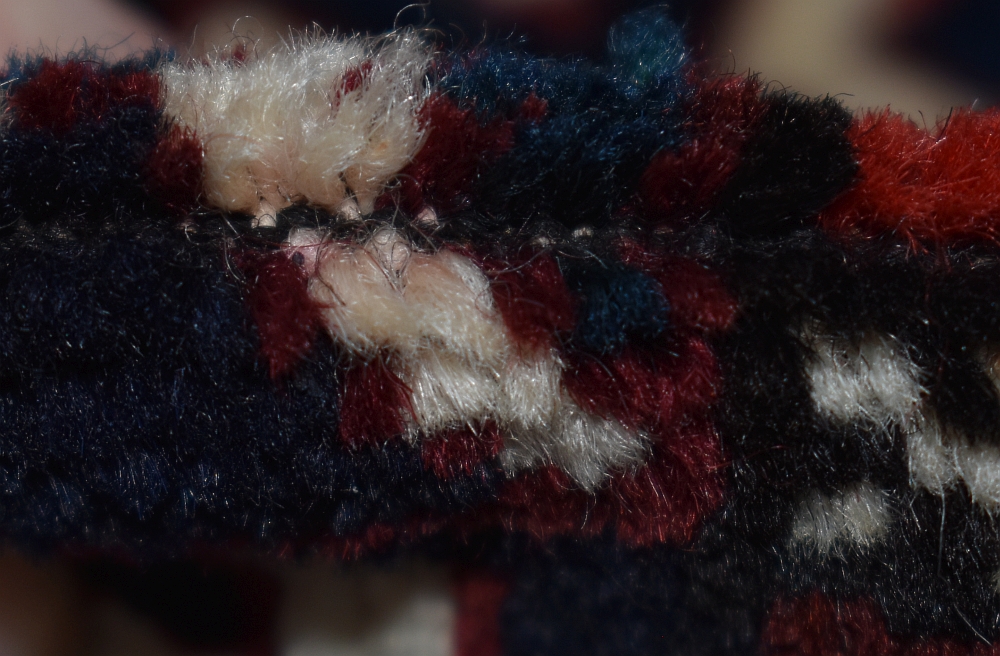
b) If the knots are pounded down hard enough there is no vertical displacement visible on the back with either knot style. I have an example.
c ) Either you have the carpet or you don't.
If you don't, yes, you can make reasonable guesses from images, but they must be oriented correctly and ancillary information must help place the rug and likely knotting method.
If you have it, then just open the pile from the front, and look.
Chuck, while I respect your knowledge immensely and hope one day to know half as much as you do about rugs, you are wrong in ‘this’ particular instance re the back of a rug having to be orientated the same way up as the weaver wove it to tell what kind of asymmetric knot it is (OL or OR). From the front you certainly do, but not the back, as will be born out below. (Your previous post's statements below in black)
a) Symmetrical knots often have a direction and an image of only the back cannot distinguish between symmetric and asymmetric
Seems you may not have read/looked very closely at the web page I linked as it is stated on that page exactly what you say above (about the bias as ‘guest’ also stated). For instance the example you posted is a symmetric knot but ‘looks’ asymmetric from the back because of the weavers knot ‘pull down’ technique/bias. And as the page also states, what is described/shown there does not work for symmetric knots.
b) If the knots are pounded down hard enough there is no vertical displacement visible on the back with either knot style. I have an example.
Why do you need ‘vertical displacement’ though for the back? Serious question, as I truly don't understand and am always looking to learn.
c) Either you have the carpet or you don't.
Well pretty obvious if you have it, but if all you have is a close up photo of the back in a book, etc then………………...
If you don't, yes, you can make reasonable guesses from images,
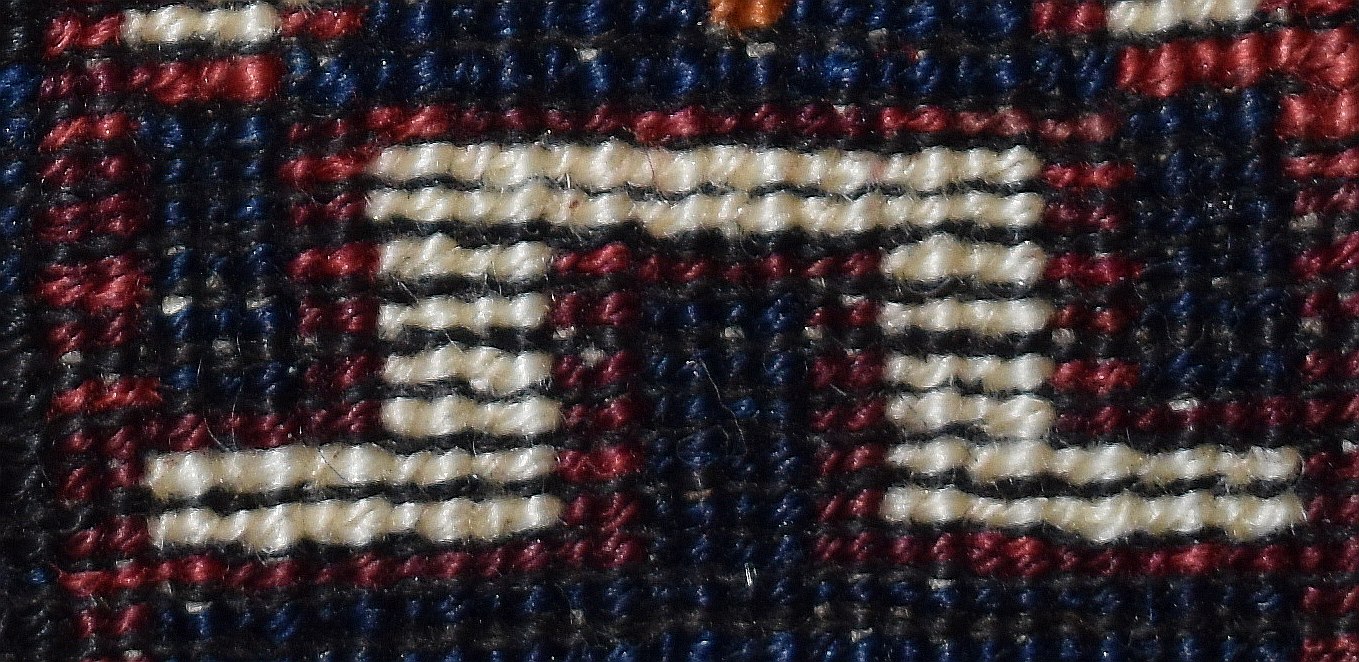
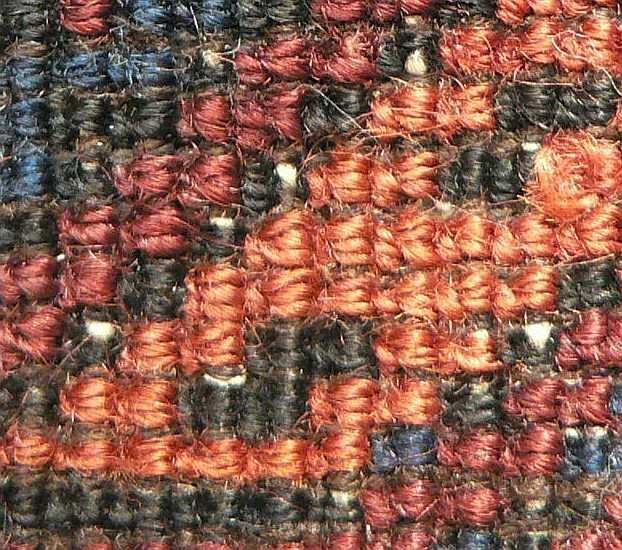
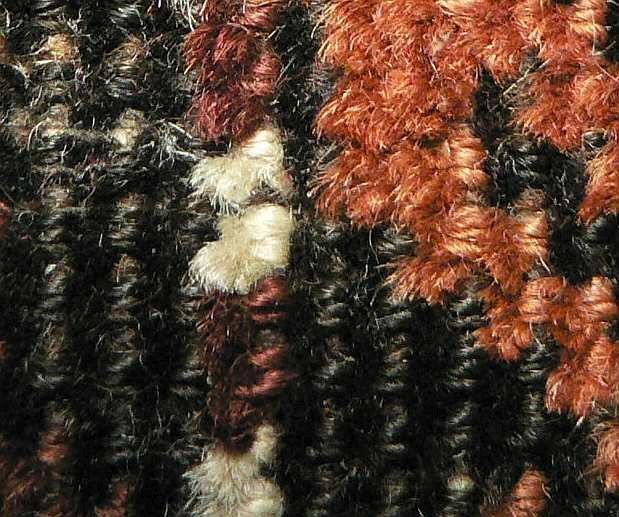
There is no guess work involved whatsoever (see image below: top image is just the bottom one placed "upside down"). If you know the carpet/knot is/should be asymmetrical then you don't have to guess to know what shape the knot is from a close-up photo of the back. It jumps right out at ya!
but they must be oriented correctly and ancillary information must help place the rug and likely knotting method.
Simply not true for ‘from the back’ photos. So you did not read / look through the linked article after all then? Take a look below and you will see that from the back it does not matter which way an asymmetrical knotted rug is orientated to tell if it is OL or ORfrom the back. It’s only from the front that you must have the rug the ‘right way up’ to tell the knotting direction. (The knot direction for both the carpets that the below photos come from was also confirmed from the front, so you can be sure that what you see below is actually an OL and an OR knot.)
If you have it, then just open the pile from the front, and look.
Yes, but, I repeat, if all you have is a pic of the back (in a book, etc), then………………….as long as it is an asymmetric knot it will tell you what you want to know as to whether it is OL or OR.
I agree that a look from the back can often point at asymmetry direction; I've made such observations several times. But the circumstances where you can have confidence, have their limits. In the end there's only one characteristic that points at asymmetry direction, and that is which node is higher than the other, because of the way asymmetrical knots are tied in the Caucasus, Middle East and Central Asia. The sloped look of the nodes is primarily dependent on whether the yarn is "S" piled or "Z" plied. In the case where there is significant warp depression, you can't tell one way or the other, and if the knots are pounded down hard enough it's very difficult to discern direction. Executive summary: It can work sometimes, and sometimes is better that never.
In your examples of AS-R and AS-L knotted rugs, what is the approximate degree of warp depression in each? You also mentioned how the shape of the nodes may depend on whether the yarn was S-plied (left/counterclockwise twist) or Z-plied (right/clockwise twist). I was under the impression that with few exceptions (e.g., Egypt) wool yarns were almost always Z-spun and S-plied in the Near East and elsewhere. In Egypt the difference is said to have resulted from a tradition of spinning linen fibers, which have a natural twist.
For the first example, Asym R, there is no meaningful warp depression, so 0-5 degrees. For the second, Asym L, I would judge the depression to be 45-55 degrees or more; as you can see, in some places the depressed node looks extruded.
Thanks. I agree that although the method works in some cases, the orientation of the knot nodes as seen from the back is far from foolproof in determining the type of asymmetrical knot used.
 Tweet
Tweet

Comment