Asymmetrical knot direction

Collapse

Announcement

Collapse
No announcement yet.
X
  •  
  • Filter
  • Time
  • Show
Clear All
new posts

  • Asymmetrical knot direction

    The direction of the asymmetrical knot can be confusing. Here is what I know.

    First, look at the knots to see if they are symmetrical or asymmetrical. You can also look to see where the leg of the knot is and the knot itself on individual knots. It’s easier to do this with two adjoining colors with one being a lighter color like beige or white.

    Find the weave direction first by moving you hand up and down. The smooth side will be directed towards the bottom or where the weaver started the piece.
    Then going right to left, run your hand across the pile. The smooth side will be the direction of the weave. The knot will have one leg and one knot node. The node portion is considered the open direction. The leg of the node will be smooth if it’s open right. The leg would be left of the knot node.

    Every book I’ve read describes it like I mentioned above.

    The confusing part; I have seen it written online, even in this forum that when moving right to left with your hand, the direction of the weave is where you feel the most resistance of the knot leg (not being smooth). So if the resistance is to the left of the piece, it’s considered open to the left.

    The reason for this post is because I am second guessing myself. I have two old Tekke pieces that are open to the right…to the smooth side. By all accounts, older Tekke pieces are nearly exclusively open left.
    Joe Lawrence
    Senior Member
    Last edited by Joe Lawrence; 05-25-2026, 12:20 AM.
    Joe Lawrence

  • #2
    Originally posted by Joe Lawrence View Post
    The direction of the asymmetrical knot can be confusing. Here is what I know.

    First, look at the knots to see if they are symmetrical or asymmetrical. You can also look to see where the leg of the knot is and the knot itself on individual knots. It’s easier to do this with two adjoining colors with one being a lighter color like beige or white.

    Find the weave direction first by moving you hand up and down. The smooth side will be directed towards the bottom or where the weaver started the piece.
    Then going right to left, run your hand across the pile. The smooth side will be the direction of the weave. The knot will have one leg and one knot node. The node portion is considered the open direction. The leg of the node will be smooth if it’s open right. The leg would be left of the knot node.

    Every book I’ve read describes it like I mentioned above.

    The confusing part; I have seen it written online, even in this forum that when moving right to left with your hand, the direction of the weave is where you feel the most resistance of the knot leg (not being smooth). So if the resistance is to the left of the piece, it’s considered open to the left.

    The reason for this post is because I am second guessing myself. I have two old Tekke pieces that are open to the right…to the smooth side. By all accounts, older Tekke pieces are nearly exclusively open left.
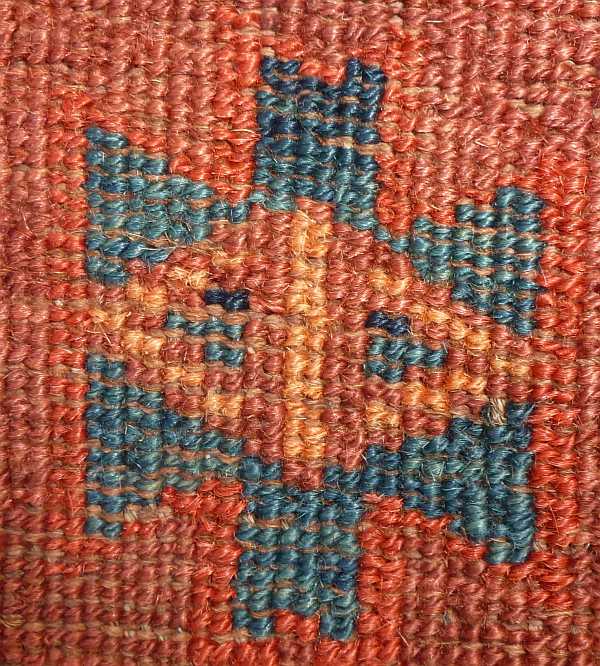
    Joe, and chance of a clear close up photo of a small area of the back of each please?

    Cheers, phil

    Comment


    • #3
      Thanks Phil. The first pic is from a published Tekke rug dated to the 3rd qtr of the 19c.


      Click image for larger version  Name:	IMG_3223.jpg Views:	5 Size:	192.5 KB ID:	4455
      Joe Lawrence
      Senior Member
      Last edited by Joe Lawrence; 05-26-2026, 05:24 PM.
      Joe Lawrence

      Comment


      • #4
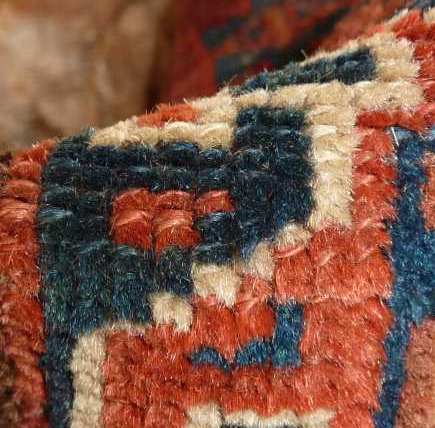
        Here is a better one from a very early Chuval.

        Click image for larger version

Name:	IMG_3233.jpg
Views:	70
Size:	160.7 KB
ID:	4467
        Joe Lawrence
        Senior Member
        Last edited by Joe Lawrence; 05-26-2026, 05:23 PM.
        Joe Lawrence

        Comment


        • #5
          Hi Joe,

          So the three epics of of three different rugs, right?

          If so, from my limited study of comparing knot shapes front and back of (same) rug/s, I would say the first photo you posted is open right (OR), the second seemingly OR but pic a little blurry when enlarged to be 100% sure, and 3rd too blurry (when enlarged) for me to tell, but ‘looks’ maybe open left(?).

          How did I do?

          Comment


          • #6
            Hi,

            You have to know which side of the image is at the top in order to judge the direction of the knot asymmetry. Also, the last image needs a 90 degree rotattion in the appropriate direction. It seems to have the least asymmetry and may be a symmetrical knot, but even symmetrical knots often have some "direction" due to tensioning while weaving.

            Regards
            Chuck

            Comment


            • #7
              Thanks for the input. Both pics have been edited and show the proper layout from the front of the rug as in the direction of the weave.
              Joe Lawrence
              Senior Member
              Last edited by Joe Lawrence; 05-26-2026, 06:36 PM.
              Joe Lawrence

              Comment


              • #8
                If the two above photos are from carpets with asymetrical knots then in my experience they are open right knots.

                Comment


                • #9
                  Originally posted by Phil Smythe View Post
                  If so, from my limited study of comparing knot shapes front and back of (same) rug/s, I would say the first photo you posted is open right (OR), the second seemingly OR but pic a little blurry when enlarged to be 100% sure, and 3rd too blurry (when enlarged) for me to tell, but ‘looks’ maybe open left(?)
                  Joe, could you confirm or otherwise my questions from my previous post please (although from your last post it seems there were only the back of two rugs shown, not three, as I had previously assumed). If so, then my italicized above here would by my conclusions if only two rugs.

                  That is, to me the last two pics you posted show the backs of rugs with open right knots.

                  So, am I right or wrong?

                  Thanks,
                  Phil

                  Comment


                  • #10
                    There were 3 examples and I removed one as it was made within the last 80-100 years. The two examples shown are the backs of (1st pic) a publish Tekke main rug 3rd qtr 19c, and the other is from a Tekke Chuval that contains silk which I believe is late 18c to early 19c. If a high majority of Tekke weavings are open to the left, I am confused to as why these two examples are open to the right.
                    Joe Lawrence

                    Comment


                    • #11
                      Originally posted by Joe Lawrence View Post
                      . If a high majority of Tekke weavings are open to the left, I am confused to as why these two examples are open to the right.
                      So reading between the lines Joe, my assessment from looking at the back of the two carpets was that both were open right, RIGHT (i.e. correct)?

                      If so, just more data / confirmation that it is possible to tell asymmnetric knot direction from the back of a carpet (but not possible always to tell symmetric knots unfortunately).

                      So, anyone else care to post backs of ASYMMETRIC rugs and see if the procedure I am using works / has a high success rate probability (as it seems too).?

                      THANKS,
                      Phil

                      Comment


                      • #12
                        Thanks Phil. With my hand and loupe, both are open to the right. am also question if my hand and eye assessments are correct. Sometimes just when you think you have a strong understanding of something, you learn you really don’t. I guess that is what I enjoy with Turkoman rugs. There is always a mystery.
                        Joe Lawrence

                        Comment


                        • #13
                          update: After pulling my hair out and over thinking this to no end, I stand corrected. I went back to my notes on about 80 different pieces and realized somewhere along the way, I started to change the direction of the weave from the most resistive to the smooth side with the hand. I guess I also switch the node and leg side of the knot in my mind. So, to sum it up, when using your hand to feel for knot direction, the side with the most resistance is the direction of the weave. The leg of the knot will be on the left and the node will be in the right for an asymmetrical knot open to the left.

                          Time to go back to the symmetrical knot rugs for awhile.

                          Click image for larger version

Name:	IMG_3294.jpg
Views:	56
Size:	143.9 KB
ID:	4477

                          Here is a comment from Steve buried within the forum. He was correct.

                          Click image for larger version

Name:	IMG_1480.jpg
Views:	54
Size:	89.4 KB
ID:	4478
                          Joe Lawrence

                          Comment


                          • #14
                            Joe, may I suggest this very informative web page - with both text and visual examples -re knots. Mostly to do with Tibetan and Chinese carpets and knots, but also a section or more on open left and open right knots, as Chinese carpets are made with an open left asymmetric knot.
                            https://warpandweft.club/knotting-comparisons/
                            Hope it helps (as it certainly has me!).

                            Comment


                            • #15
                              Hi,

                              Spoiler alert...

                              Back:


                              Front:


                              Cheers,
                              Chuck

                              Comment

                              Previously entered content was automatically saved. Restore or Discard.
                              Auto-Saved
                              x
                              Insert: Thumbnail Small Medium Large Fullsize Remove  
                              x
                              or Allowed Filetypes: jpg, jpeg, png, gif
                              x

                              Please enter the six letters or digits that appear in the image below.

                              Registration Image Refresh Image
                              Working...
                              X