Hi Horst,
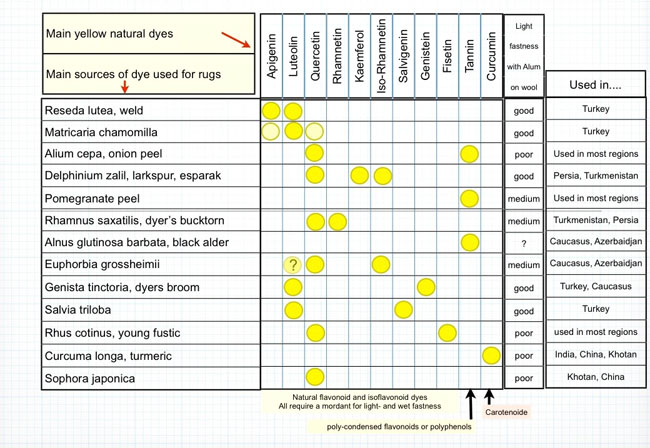
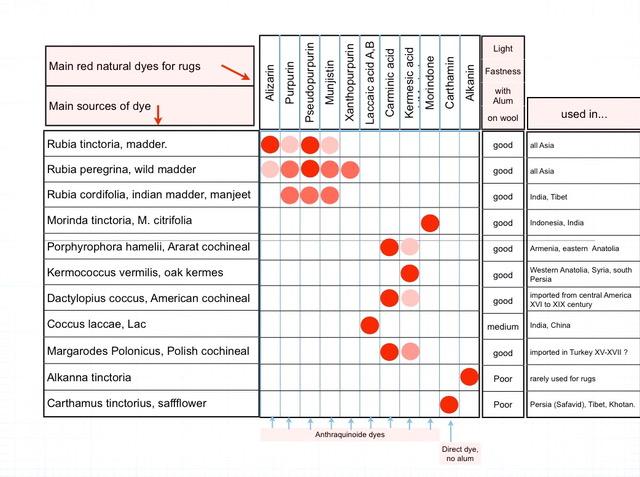
The tables below show the main tinctorial plants and insects used for
dyeing yellow and red shades on rug wool and the main dyes in each
plant.
The list may seem very long, but fortunately some dyes are likely to be
found much more frequently and in higher concentration than others on
rugs. I believe also that some Eastern Asian plants had only a local
importance and never went West in any significant way.
Thus, I would guess that one can do a pretty good TLC job with:
For yellows: powder samples of the first five plants listed (Reseda
Lutea, Matricaria chamomilla, Alium cepa, Delphinium zalil and
pomegranate). They will allow to identify the important dyes Luteolin,
Apigenin, Quercetin and Rhamnetin and two types of yellow tannins.
For reds: powder samples of Rubia tinctoria , indian madder and
american cochineal . Enough to identify on TLC plates all the main red
chromophores (Alizarin, pseudo purpurine, purpurine, munjistin and
carminic acid)
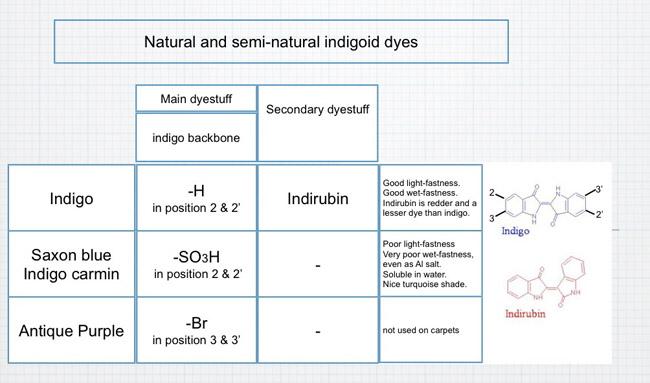
Blues are a piece of cake.
You may want to addd a sample of Juglans regia, which main dye juglone
was an excellent brown (direct) dye and probably reasonably frequent,
but perhaps less used than brown wool shaded with the mentioned reds
and indigo.
The Museum of Applied Arts, Budapest, has identified the natural dyes
present on a large number of its (turkish) rugs, the results were
published in F. Batari’s «Ottoman turkish Carpets». It gives a pretty
good idea of which dyes were important in this region of Rugdom,
between XVI and mid XIX centuries.
Have fun!
Regards
Pierre