Posted by James Blanchard on 02-03-2008 05:30 PM:
Collecting Baluch - Evolution?
Hi all,
Recently in another thread Chuck Wagner alluded to the
evolution of his taste in collecting Baluch pieces over time. From time to time
we have new collectors joining Turkotek showing their early purchases and asking
for opinions from more experienced collectors. Not infrequently, there are
subtle suggestions that these new pieces would not be of much interest to
"serious collectors". Personally, even though I am still very new at this hobby,
I know that my taste in rugs has evolved over the past several years. So, for
what it's worth, I'll try to illustrate a bit of my "collecting trajectory",
which I think shows how spending some time reading, looking and more
importantly, handling lots of rugs changes one's perspective about what is a
"good rug". I'll leave it to others to judge whether "progress" is evident, but
I can tell you that many of my family, friends and acquaintances don't seem to
think I am moving in the right direction. In particular, they are curious about
a penchant to get older and more worn out rugs, and to hang them on
walls.
Okay, so here are 3 Baluch rugs from my collection, representing
my favourites from my "early" (i.e. >10 years ago), "middle" (5-10 years) and
"late" (<5 years) collecting periods. One aspect of my collecting approach
that has remained somewhat constant is a penchant for pieces in good condition.
I think I would only purchase a piece in distressed condition if it were really
special and/or rare. Otherwise, I tend to find bad condition to detract too much
from the overall aesthetic, which kind of defeats the purpose for me.
I'd
be interested in seeing how others' tastes have changed over time, either within
the Baluch or any other genre.
James.
Early ("Yakub Khani" prayer
rug, purchased in 1986... my first rug)

Middle ("Yakub
Khani" rug, purchased in 2002)
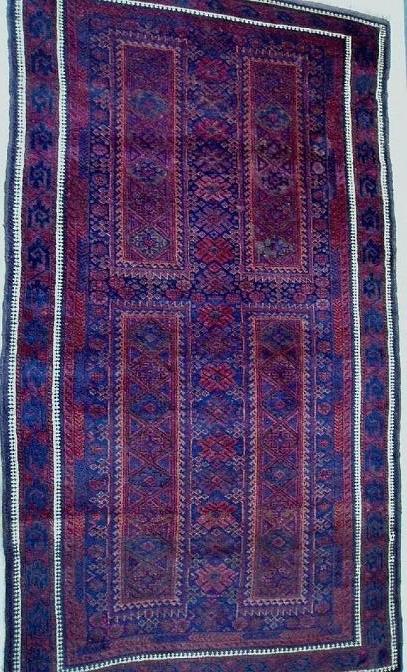
Late ("Jehan
Begi"? rug, purchased in 2006)

Posted by Patrick Weiler on 02-04-2008 11:00 PM:
Better Late than Never!
James,
Your collecting evolution has eclipsed mine by far. It only
took 22 years for me to progress from a modern Afghan mat to a questionable
Salar Khani bag face.
I anticipate that soon you will be publishing a popular
Baluch Antique Rug book.
The "engsi-like" design of your first rug is
interesting. The middle rug is certainly "respectable".
The "Late" rug seems
"early" and would easily compete for the place currently taken by my Pak
Bokara.

Patrick
Weiler
Posted by James Blanchard on 02-05-2008 07:38 AM:
Hi Patrick,
What I noticed was how quickly and substantially my
"taste" in rugs changed. I think this is partly based on gaining more knowledge,
but it probably also relates to a socialization process (i.e. communicating with
a bunch of people who like dusty old rugs).
I think that luck and
opportunity has a lot to do with "evolution". Although I would like to continue
to find rugs like the last (Jehan Begi) rug in my price range, I realize that
could be difficult. So I would be content to pick up an occasional rug that
might be considered a "regression" in my trajectory. But I am definitely much
more selective now than I was 5 years ago.
If I were ever presumptuous
enough to try to publish my rugs in a book, it would be very short... Maybe a
leaflet would be more appropriate.
James.
P.S. I would show you a picture of my Pak
Bokhara that was purchased a bit after my first Baluch rug (same trip), but I
haven't had the courage to take a picture of it yet...
Posted by Unregistered on 02-05-2008 06:20 PM:
bravo
Hi James, based on the example you've provided of your latest stage of
collecting, the direction things have taken is enviable. The formal balance --
the overall distribution of color, light and dark, shape and line, the visual
weight of the borders in relation to the field -- in your 'Jehan Begi' is really
fine. The rigor of the lattice in the field and the angular tracery in the main
border plays beautifully off the lively distribution of small motifs throughout.
I would love to spend an hour just looking at the different kinds of passages
articulated by the white knots.
Posted by Steve Price on 02-05-2008 06:36 PM:
Hi
Please send me your name by e-mail, and I'll add it to your post.
And, when you post, please overwrite the word "unregistered" in the user name
field with your name. If you are registered and logged in, that will happen
automatically.
thanks
Steve Price
Posted by Richard Larkin on 02-05-2008 08:56 PM:
Hi James,
I wish I had something profound to say or slick to show in
order to generate some momentum in this thread. I'm interested in hearing what
people have to say along the lines of the evolution of their collecting
instincts and proclivities.
When I was actively looking for rugs, I
thought there were three important considerations: color, color, and color.
Well, not quite that extreme, but for the most part, I considered the design a
relatively neutral vehicle for the color. To take Caucasian rugs as an example,
say an Eastern Caucasian white field prayer rug, it didn't matter that much what
the particular design components were from among the usual selection. It was the
color that had to be right. No excellence of design could make up for bad
color. I have become much more attuned to small differences in design elements
since tuning into TurkoTek.
Looking at your three examples, one might use
color as the differentiating factor in your evolving discrimination. The third
one, which we've seen before (and are more than happy to see again) has
wonderful color, in the Baluch manner. It's low key but glowingly elegant, and
distinguished by that special cochineal, or whatever it is. The second doesn't
look bad, but is not in the league of the third. I can't say for sure on #1, but
it may be a late synthetic, no?
Beyond the color question, there is also
a progression in the three pieces as regards the secondary elements of texture
and finish (ends and selvages) which characterize the pieces as traditional
Baluch. In a general way, I correlate these considerations with age. The third
one is what a Baluch is suppposed to be. The other two show the decline of the
type into homogeneity, the first moreso.
Do you still have #s one and
two? What do you think of them now?
__________________
Rich
Larkin
Posted by Fred Carver on 02-05-2008 10:10 PM:
Hi James,
I am very uninformed of nice rugs vs. crap since I am new to
rug collecting. The first rug I purchased was from a shop in Turkey while I was
there for a couple of days in 2005 on a military assignment. I was told it was a
Persian village rug from Khorasan by Barry O'Connell.
I have a total of
eight rugs and have only purchased three of them in person, the rest were
purchased off of ebay or (dealer's name, deleted). I am happy with all of
them except one (my latest purchase from ebay). I thought I was buying a runner
from Iran but the packaging was from a place in Pakistan.
Where was my
point going in this post? Oh yeah... My reasoning for the purchases I make now
is totally looks and cost. My most expensive rug is $350, the Khorasan I
mentioned above. One of my favorites is a Baluch prayer I picked up in Kuwait
for $70 so for me it is not how much a rug cost, but how I view it. I would say
most collectors would think my rugs are junk but what matters is what pleases
you. So if you like your rugs be happy with that.
I will take any advice
someone of more knowledge of rugs on what to look for in a good rug. I don't
think I will ever look for older rugs though. Thanks a lot.
Fred
Posted by Richard Larkin on 02-05-2008 10:15 PM:
Hi Fred,
Don't give up on old rugs. You may have a change of mind.
Happy collecting.
__________________
Rich
Larkin
Posted by James Blanchard on 02-05-2008 11:57 PM:
Hi Rich,
Like you, a very important consideration for me has been
colour, especially in the past few years. The decision to acquire the "Jehan
Begi" (#3 above) was almost instantaneous and based largely on the first display
of the rug, which impressed me with the wonderfully lustrous multi-toned blue
field that seemed to be a window inside the strong but spacious borders. Over
time I have come to appreciate some of the finer points of the rug. I've come to
think that it has a fairly sophisticated composition, using traditional design
elements and motifs artistically.
Yes, I still have both of the other
rugs. I am persuaded that the prayer rug has a synthetic red, but I admit that I
still like it enough, partly due to sentimentality. The wool is very good and
the blues are impressive. Still, it is more of utilitarian mat than anything
else now. I still have considerable affection for #2 (the Yakub Khan). The wool
and colours are very good, and there is considerable corrosion of brown wool
resulting in a nice 3-D effect.
Fred, I have bought the large majority of
my rugs "in person", though I have had some satisfying purchases on line as
well. One reason for this ratio is that I have had the opportunity to visit a
variety of dealers here and there with good rugs. Another reason is that I am
much more impulsive when I am handling rugs in person than I am "on line".
Personally, I doubt that I will look much at new rugs in the future. I
think that there are enough inexpensive "oldish" rugs with good colours,
acceptable designs and in good condition to meet my decorative requirements. I
recently purchased a mint condition room sized "Afghan" carpet (maybe 50-70
years old) with rich colours for a little more than $1000. I just can't see how
a new machine made or factory woven carpet could offer comparable value, but I
know that in the general population I am likely in the minority on this. The one
complication is that we sometimes need to change the colour of our walls or
decor to go with the rugs.
Finally, I am persuaded that one can still find some excellent and relatively
old pieces at relatively low prices, especially if you are content with small
pieces. I have a few small old Baluch pieces in the $100-350 range that I really
like, though their "collectibility" is debatable.
James.
Posted by Richard Larkin on 02-06-2008 10:24 AM:
Hi James,
Is the second image (Yakub Khani) a typical older style wool
foundation piece? I may be underestimating it. I didn't see it as having the
sculpted pile effect one likes to find in a Baluch. There is a modern quality of
Baluch that has different materials for warp and weft than they formerly used,
along with the diminution or omission of certain secondary features (e. g.,
flatwoven ends), resulting in an essentially different fabric. Your first image
may be one of them. Intending no disrespect, I have no desire for
them.
Is there any chance of a close-up or two of the Yakub Khani? I've
posted an image you may have seen before of a Baluch with considerable erosion,
giving the sculpted effect. I hate to be repetitive, but I haven't been
acquiring lately. However, this piece is a good example of the results of my
former strategy, which was to try to find "sleepers" in the marketplace (thus,
remotely germaine to the theme of the salon).

The rug posted was sold
at a high visibility auction for next to nothing. It was so soiled, the pattern
was hard to make out, and the fabric was very stiff. The professional (and
amateur) bidders ignored it, but it turned out to be extremely supple, and well
woven with excellent wool and very saturated and good color. Moreover, the
secondary characteristics, including the flatwoven ends and typical Baluch
selvages, were very well done. The wear patterns resulting from the erosion
aren't as obtrusive in real life as they are in the photo.
I bought this
about 25 years ago, but I thought it might yet be useful to show recent
enthusiasts that it is possible to find worthy items with patience and
attention.
__________________
Rich
Larkin
Posted by James Blanchard on 02-06-2008 10:40 AM:
Hi Rich,
I agree that you made a really nice selection with that
Baluch. I especially like the border and the effective use of Baluchi "white
punctuation".
Here are a few close-up pictures of my "Yakub Khani". You
can see that it has a rather "rosy" palette compared to some Baluch... perhaps
not as traditional.
I think it might have had some traditional kilim
weaving at the ends, but it is worn to very close to the pile edge. It looks to
have wool on wool construction. The corrosion of dark brown is at a relatively
early stage, so this rug should age well!
James


Posted by Richard Larkin on 02-06-2008 11:10 AM:
Thanks, James. Some age, but not real old. I like it, though, better than I
thought on the full shot.
__________________
Rich
Larkin
Posted by Scott Young on 02-07-2008 06:54 PM:
Great Rugs!
James, that third rug is especially nice. I love the
composition!
Richard, your Baluch is also very nice and I am surprised no
one else wanted it. It seems that dirty rugs are a treasure hunter's best
friend.
My own evolution has been slow and more due to necessity for
good, attractive floor coverings than as collectibles, though my tastes are
greatly improving thanks to this site. Now I have a good Baluch on my
acquisition list!
Posted by Richard Larkin on 02-07-2008 09:42 PM:
Hey Scott,
If my take on the market is any good, it is possible to
acquire Baluch reasonably these days. Hold out for a good one, as there are
half-baked examples everywhere.
Go to the TurkoTek links at NERS. Click
on their "gallery" link, then on the Mark Hopkins Baluch exhibition. Look at
Nos. 29 & 30. You will see a flock of birds looking for your flock. The fact
that any number of Turkotekkers refrained from pointing out the similarity in
your birds to the classic Baluch bird is an astonishing demonstration of mass
restraint.
__________________
Rich
Larkin
Posted by Chuck Wagner on 02-08-2008 07:35 PM:
Hi James, et al,
Sorry for the long delay between posts - it looks
like Fridays & weekends are all I'll have for a little while. I particularly
like your third rug - which fits with my current state of evolution, BTW - the
multicolor main border is nicely done, IMHO.
And, the second is quite
nice as well. I like that border motif, as you'll see in a moment.
Rich -
is yours really as dark as it looks in the image, or is that a function of
lighting ?
I should note that I'd like to be describing my current state
as "fully Timuriated". But the nice old Timuri pieces are few & far between
- in short, I don't own one yet.
So, on to Baluch evolution. The first
few (like, about 3) Baluch pieces we bought were purchased for decorative floor
cover. We had been cruising rug shops for a couple years, but without money and
without a well developed sense of tribal weaving. One thing the cruise time
provided was ample opportunity to judge what is mundane and common, and what is
a little unusual. So, even though these first few purchases get little more than
turned up noses from the average Turkotekker, they are still unusual within
their own genre (20th century commercial Baluch production).
So, you hard
core Baluchophiles hold your noses and scroll down a little. The rest of you can
see what the earliest days were like. Here's our first Baluch (probably 1985)- a
prayer rug with a stripped down tree-of-life motif, most unusual borders, and a
non-traditional but moderately interesting color pallette (no garish Afghan
orange - that's natural brown wool in the tree with dark orange
outline):

The
next one has a design that was apparently popular in the 1970's - weird by any
measure but interesting nevertheless, with the bat-winged figures in the
medallions. Zillions of totemics scattered around randomly in the field; not
that common in commercial pieces. This one doesn't have any nasty orange either,
but it does have a very queasy pistachio green in a minor border that is a
little creepy. Four cord selvage and embroidered kilim ends are a nice touch
from the older style of construction:

A little further along, we
were looking for things more like this one, a classic Kawdani prayer rug with
about 220 knots per square inch, a very nice dark madder red, and that border
motif I mentioned above. By this time we were also buying Baluch khorjins, and
had begun focusing on the old pieces (we can do bags in another thread). New or
old, Baluch or otherwise, we were aways looking for finer than average
workmanship:


More recently - the last 10 years or so - a combination of
availability, experience, and increasing available cash has allowed us to
acquire some "better" Baluchi (and Baluch-like) pieces. I've shown these in Show
and Tell sessions before, but here's a couple from the last 3 years. Ths first
is a Persian Ferdowsi figural rug showing a scene from the tale of Khosrow and
Shiriin:

I don't know what to call this next one, obviously Baluch, not
particularly common, and attractive:


So, there's another
progression, not unlike James' in some regards, over the course of about 25
years now.
Regards,
Chuck Wagner
__________________
Chuck
Wagner
Posted by James Blanchard on 02-09-2008 11:43 AM:
Hi Chuck,
I like your progression, with the last two rugs being the
"keepers" in my opinion.
One thing I have noticed in some of your
previous posts is an interest in the quality of construction, especially for
utilitarian pieces. I must confess that has not been any part of my
considerations. I tend to go for the aesthetic appeal and/or "tribal interest"
angle, perhaps because I am generally ignorant of the details of weaving
techniques.
James.
Posted by Richard Larkin on 02-10-2008 09:09 PM:
Hi Chuck,
My modified Mina Khani is dark, but not muddy. When I'm
looking at it, the thought is, "Mahogany." Here's a detail shot. The color is
pretty accurate on my monitor.

I have a Baluch very
much like the last image you put up. I tried to photograph it today, but the
camera balked. Battery issue. I'll try to persevere. Regarding the third image
you posted (?Kawdani? prayer rug), I see a big difference in the red color
between the full shot and the detail. The detail looks much the better. With
that fineness of knotting, I see why yoou are taken with the piece.
I
would have a lot of trouble looking at the green in your first image for very
long. What do you think of it?
P. S. The pictorial rug. Wild. It looks
like some Caucasians of the same ilk. Did they copy those people from a deck of
playing cards?
__________________
Rich
Larkin
Posted by Scott Young on 02-11-2008 06:41 PM:
Rich and All,
Thank you for the great link, it looks like I need to
browse through all the Turkotek links. I hadn't expected sites with so many cool
rugs!
It's too late, I already acquired a slightly more than half-baked
example on ebay, and forgot that I had a Baluch en-route! Still, it looks nice
on the floor and gives me some different colors to look at.
This rug is a
little more crooked than I would like. It has caused some bunching and extra
wear in those areas. It was quite dirty when I received it and looked much
better after a good wash!

Look,
critters!

The weaver made a mistake in the width of the field and had to
correct after the first line of guls.

Looks like I
still have some evolving to do...
Scott
Posted by Richard Larkin on 02-11-2008 09:35 PM:
Well, Scott, that's my kind of Baluch. First and foremost, the colors look
good. The banana shape is not an issue. Repeat: not an issue.
__________________
Rich
Larkin
Posted by Paul Smith on 02-11-2008 10:28 PM:
Scott--
I'm with Rich; the only evolving you might need to do is
recognize that as a classic 1st-quarter 20th c. Baluchi carpet. I like the blue
accents in the border, myself.
Paul
Posted by Chuck Wagner on 02-11-2008 10:29 PM:
Hi James,
That last rug is not easy to photograph. It typically comes
out looking orange, when in fact it's a pale tannish-red. It takes a disciplined
eye to pick that shade out of the images. I think I have another image with
better color; I'll post it shortly.
Rich,
Dark is right, and some
wool corrosion loss as well, huh ? Still, in the right light, with those white
highlights, it must be quite striking. It's another one of a cast of thousands
that demonstrate that getting rug photos right is a real pain in the
neck.
You're right about the Kawdani - the red in the closeups is dark
and rich. The first photo is one of my many contributions to the Not-That-Good
Rug Color Representation Society.
The green in the first rug comes
across as more neon that it actually is for the same reason. If I darken the
image to get it right, everything else starts to look unrealistically dull. Oh
well. Regardless, that's now a utility floor rug that will live a life of
celibacy - I won't be buying anything like that again. That's
evolution...
Regarding the figural rug, Parviz Tanavoli published a book
called "Kings, Heroes and Lovers: Pictorial Rugs from the Tribes and Villages of
Iran" that has lots of interesting photos and two or three examples of Ferdowsi
rugs. The style is highly variable in detail, but in the end the failure to
achieve good perspective does gives most of them a King Of Hearts
look.
Scott,
You could do worse. That's not a bad rug. I like the
odd critter tossed into the mix.
Regards,
Chuck Wagner
__________________
Chuck
Wagner
Posted by Scott Young on 02-12-2008 01:39 AM:
Thanks guys! I know the bent shape is somewhat common and from what I hear a
mark of tribal authenticity, but this one seems a little too much; it is a
little disconcerting at times. But I like the rug so I am sure I'll get used to
it. The best thing about it is I'm starting to get an affinity for the Beluch
aesthetic. I like how during the day it lightens up and at night under the
incandescent lights it becomes dark, somber, and somehow warm. It provides a
great contrast to most of my other rugs.
I can see that the new plan is
to revolve rugs... 
Scott
Posted by Chuck Wagner on 02-14-2008 12:40 AM:
Hi James,
Here's that other image of the Baluch rug - less orange than
the big image implies:

Regards,
Chuck Wagner
__________________
Chuck
Wagner
Posted by Dinie Gootjes on 02-14-2008 09:42 AM:
More poker faces...
Chuck,

Here is a collage of Firdows rugs to keep yours company. As you
see, yours is in there too, plus if I remember rightly, another one from a
Turkotek member. Ours is the larger one in the middle . The Sotheby's description of the
older rug on the bottom left said: "The origin of rugs of this group is a matter
of some contention. Julian Homer and more recently Dennis Woodman have pointed
to a Beluch attribution (see Hali, issue 120, p. 13), but Tom Cole (Hali, issue
117, pp. 82-86, fig. 7) has suggested an Afshar origin." We do have the rug, but
not the Halis  The picture on
the late 19th c. rug at the far right is practically identical to ours, but less
playing card-like. The faces show more individuality, and the border has escaped
the later squarification.
The picture on
the late 19th c. rug at the far right is practically identical to ours, but less
playing card-like. The faces show more individuality, and the border has escaped
the later squarification.

The other picture shows a rug that was presented as a mid 20th
century afshar.
Rich, we call that a masculine jaw, with excuses to the
ladies there in of course.
Dinie
Posted by Walter_Davison on 02-15-2008 05:31 AM:
Hi Rich,
A bit off the evolution topic but relevant to your very nice
“modified” Mina Khani rug: I take it that the modified part refers to the
border. I have been looking for years on end, without success, for that
particular border design as it closely matches the border of a rug I picked up
in Kabul about forty years ago. Here is a picture of one corner.
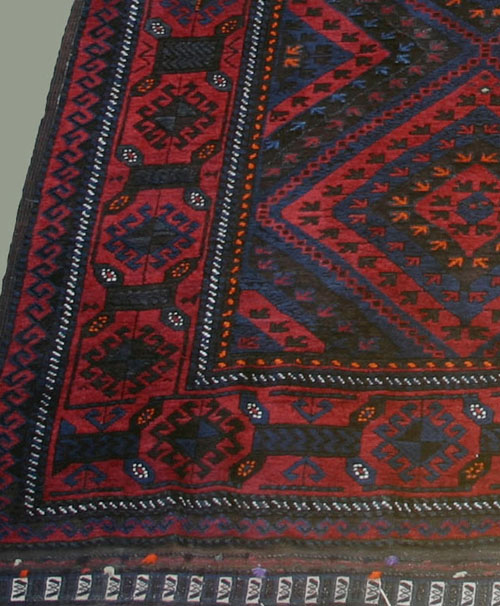
Do you happen to
have any information about this design aside that it is found on an occasional
Baluch rug?
Thanks.
Walt Davison
Posted by Richard Larkin on 02-15-2008 05:29 PM:
Hi Walt,
When I said "modified Mina Khani," I was really referring to
the field design. The "true" design as I understand it is a particular layout of
palmettes or medallion pieces with an additional or subsidiary component
consisting of vines with (usually) five-petaled flowers. The latter are usually
white, though not always (see the Bijar image I posted in Joel's Caucasian
thread). The literature often characterizes variant designs as being Mina Khani
related or inspired. My dark Baluch would be an example, with the four-petaled
white flowers and the much more regular designs alongside them. By the way, one
also hears or reads that the "variant" versions are derivative, and presumably
later (at least as a general proposition) for that reason. I have my doubts
there, however, as some of the "variant" versions seem ancient, and some of the
standard ones, particularly Baluch renditions, seem more recent. For example,
there is a plate in Black & Loveless (Wandering Baluchi) that they seem to
consider the oldest piece in the exhibition (sorry, don't have the book handy
for the plate number), and it looks like a Mina Khani variant design, including
(if memory serves me) six-petaled white flowers.
Anyway, I have also
always liked the border system on your and my pieces. It is a Baluch usage, I
think. I can't think offhand of having seen it in other weavings. I like the
generally strong and clear drawing in your rug. That outer, double hook border,
for example.
Posted by Richard Larkin on 02-15-2008 11:40 PM:
Hi Walt,
I've had a look at the Black & Loveless plate, it's #39.
The white petaled flower in that rug is eight petals. Sorry I don't have a
scanner to put it up here. I never saw that rug in the wool, but the authors
were quite taken with it.
__________________
Rich
Larkin
Posted by Patrick Weiler on 02-18-2008 12:59 AM:
Baluch Collection
Here is an extremely abbreviated selection of Baluch pieces I have collected
over the years. This is one of my early pieces, although the first was the main
carpet that I still have not found a photo of, and the second was a small Afghan
piece long ago traded away. This is a small mat, with synthetic colors and a
unique ? field design. It is interesting and different. It has an eerie
similarity to Ferdows pieces, and the winged rider has what appears to be
headphones from a music player. I was not aware that they had i-pods that long
ago.

A few years
later I found this piece, resting under some baseball trinkets in an antiques
store. It was my first balisht and I did not know what it was. The closure loops
seen near the top were a first clue. It was unusual to me and seemed rather old.

After a few more
years, this little thing presented itself on the bottom shelf of an antiques
store, underneath some trinkets and gew-gaws. It is a significantly better
balisht, much older than the first and related in design. By this time, I knew
that it was a balisht and that it was a very nice one.
Both of the antiques
stores have long since closed.

This was an early e-bay piece. It is a bit odd as these things go,
but big and colorful, with some light blue that has a yellow component which has
faded on the front and shows as light green from the back. Having read a bit
about Baluch rugs, and buying a subscription to Hali, I had seen a few Baluch
pieces with this design. It is a design that is always interesting.

And my most recent
Baluch.

This
progression of collecting Baluch weavings has been long and satisfying -
although due to being ostracized by "real" rug collectors I have had to pursue
this activity privately. As I learned more, the pieces I acquired were a little
bit better, and now I restrain myself from buying something just because it is a
bargain. And, of course one reason is that I just do not have enough shelf space
in the inert-gas, climate-controlled vault - to keep them from contaminating the
rest of the collection.
Patrick Weiler
Posted by Steve Price on 02-18-2008 06:55 AM:
Hi Pat
The figure in the first one in your last post is not only
listening to her iPod, she's obviously caught up in the music and
dancing.
So, you're now a public Baluchomaniac. We have a "don't
ask" policy, so we would never have raised the issue with you. But I'm sure
you'll find that finally coming out of that closet will take the heavy weight
you've been carrying around off your shoulders.
Regards
Steve
Price
Posted by Richard Larkin on 02-18-2008 11:44 AM:
Hi Patrick,
I'm glad you explained that opening one. At first look, I
took it to be one of the famous "Baluch portrait rugs." You know, the kind where
the weaver is set up right there in the suq, and you actually sit for her while
she weaves the rug. (For the incredulous, may I refer you to the equally famous
TurkoTek portrait gallery, more specifically, the entry for brother
Weiler.)

But
seriously, as they say... Patrick, You seem to be saying the second of your two
ToL balishts is significantly older and better than the first. I would say both
are corkers, but what is it about the distinctions between them that leads you
to that conclusion? BTW, I hope Steve is right about your closet Baluchotic
affliction. Anyone who doesn't have it and who is finding this stuff under
baseball card collections, or whatever, at the local antique shoppe, needs a
good flogging.
__________________
Rich
Larkin
Posted by Richard Larkin on 02-18-2008 01:37 PM:
Hi Patrick,
BTW, as I'm sure you're aware, the second last image in
your latest post, the bagface with the strong sky blue, has a design in the vein
of the famous prayer rug in the collection of the V & A. I'm too inept to
place the link here, but it can be seen at the "Thomas Cole" site that is part
of the TurkoTek links. Go to articles on Baluch rugs and keep going, etc.
__________________
Rich
Larkin
Posted by James Blanchard on 02-18-2008 01:56 PM:
Hi Patrick,
Ummm, not much to say about item #1, though I agree that
it is "interesting" and "different", in so many ways.
I like the rest of
the group, and especially the bag-face with the octagonal "S guls". I also like
both balishts. I am still trying to figure out your most recent acquisition. I
have an inkling that it indicates that you are instinctively trying to break
away from the Baluchophilia and migrate back to S. Persia, starting with a nod
to the Veramin aesthetic.
James.
Posted by Patrick Weiler on 02-18-2008 01:57 PM:
Too Good
Richard,
Here is a link to the Tom Cole web site page with the prayer
rug:
http://www.tcoletribalrugs.com/article27VABaluch.html#anchor
The
V&A wanted mine, but it was too expensive and old for them.
James,
You are seeing the tail
end of a long, disgusting, odiferous trail of buying and discarding Baluch
weavings. The dirty underbelly of a distasteful pursuit. Baluch collecting is
abhorrent to the mainstream. How abhorrent is it? They don't even have a 12 step
program yet.

Patrick
Weiler
Posted by James Blanchard on 02-18-2008 01:59 PM:
Hi Patrick,
Yes, I have been having the same trouble with some of my
pieces. Those museums just refuse to pay for quality and age these days....
James.
Posted by Patrick Weiler on 02-18-2008 03:03 PM:
Good, Bad, Ugly
Rich,
Since the intent of this thread is to explore our Baluch
collecting evolution, I thought I would share an earlier piece along with some
later acquisitions.
I would most likely not purchase that first piece today,
although it only cost the equivalent of a good meal when I bought it. Of course
when I bought it a good meal consisted of a six pack and a pizza.

The balisht trajectory started
innocently enough with that first piece. It has a rather heavy handle, not
floppy like the second, earlier piece. The design is considerably "degenerated"
or modified from the original version seen on the earlier piece. My (uneducated
guess) age estimate for the first piece is 1900 +/- and the second piece could
be 3rd quarter 19th century. The colors are better and the wool is finer in the
early piece. I also have a third balisht which is late 19th century with a
questionable pink and with offset knotting. A photo of it can be seen on Marla
Mallett's web site page on offset knotting:
http://www.marlamallett.com/offset-f.htm
I would have shown
a couple of my less distinguished (euphemism for hideous) early-acquisition
Baluch pieces but this is a Family web site.
Patrick Weiler
Posted by Richard Larkin on 02-18-2008 05:55 PM:
Hi Patrick,
I know just what you mean about the heavy handle vs. the
lighter texture of the older piece. All things being equal, it is a good rule of
thumb item on the age question. Still, I wouldn't necessarily look at the later
balisht as representing degeneration in the design. I like that
treatment.
Great link to the Marla Mallett thing on offset knotting. If
that entry of yours is "Baluch," it is near the periphery of the umbrella in my
view. A neat, funky piece, for sure, with offset knotting to boot. If you don't
mind, can you say with reference to the image on Marla's site where in the piece
you find the questionable pink?
BTW, thanks also for the link to the Tom
Cole site where the V & A Baluches can be seen. I was able to find it
myself, but a few of the whippersnappers following this thread absolutely need
to look at those rugs. Required reading. On a rather tangential note, I happened
to be looking through an old exhibition catalog from 1983 published by the
London dealer, Raymond Benardout, in conjunction with the International rug
symposium that took place there that year (the Jon Thompson "Carpet Magic)
conference. He (Benardout) was stating in the preface that he considered it
ridiculous that some were heard to be dating Baluch rugs to the middle or early
19th century. He stated there that the earliest V & A Baluches bore
acquisition dates in the 1920's. Of course, it isn't true, as the Tom Cole link
readily shows.
Posted by Scott Young on 02-21-2008 04:47 PM:
Whippersnapper
Pat,
As one of the whippersnappers, thanks for that link! It is good
to see some old Baluch pieces with real dates assigned. And your Baluch pieces
look great, though the Pegasus-lady is a bit odd...
Scott
Posted by Joel Greifinger on 03-08-2008 05:45 PM:
My first rug
Hi all,
This was the first rug I ever bought. I got it at a fund
raising event supporting Cultural Survival's work with Afghan refugees in
Pakistan about ten years ago. I've always figured that it was late 20th century
Afghan refugee production and that "Baluch" was all the description
necessary.


However, now that I've caught the rug bug and spend much time
checking the Turkotek discussions, I have the need to try to find out more about
it. I've looked through all the books on Baluch weaving that I can get my hands
on, but haven't found the answers I seek (like, "it doesn't look like a triple
mihrab. Are those combs up there?) I know there are some hard-core folks who
savor discussing all things Baluch (or related) who will see this, so I hope to
draw out some more specific info. I've included a picture of the back and a
clumsy attempt at a close-up of the end finish and weft-wrapping on the kilim.
Any thoughts as to origin (or anything else) will be
appreciated.
Thanks,
Joel
Posted by Paul Smith on 03-08-2008 09:33 PM:
Hi Joel--
I think this is precisely "late 20th century Afghan refugee
production," as you describe it, a version of the venerable Baluchi "mosque"
prayer rug design. If you have a copy of Craycraft's Belouch Prayer Rugs
handy, you can look at plates 5 and 12 for old versions, and then go ahead to
plate 19 for the intermediate example between these and your example. In this
Taimani example you can see your pointed arch, and the three-and-two-half (?)
little mosque roofs at the top that are about to become the four-and-a-half in
your example. If I had a scanner I would provide these images, but alas, I am
barely able to operate my wife's digital camera (this is by way of explaining
the low quality of the images I often post here...sigh...). The colors in your
piece are nice modern versions of an older tonality, and I like the embroidered
ends, which reproduce a minor border design that turns up on a lot of old
Baluchis, like the stars-and-bars border that your weaver used on the sides of
the field. I don't know if you're following Jim Allen's discussion of an
Anatolian border design currently in another forum, but a version of that
appears to surface here in your main border. You sure did better in your first
purchase than I did in my first Baluch, to which I refer in the thread I started
elsewhere in this forum.
Paul