South Persian Bag with Jaff Design
Hi People
First, I want to thank Chuck for generating this
Salon.
Not too long ago we had a thread that opened with a recent
acquisition that I liked very much, a Turkmen mina khani juval. It's archived here,
so there's not much point in presenting that one again.
Another fairly
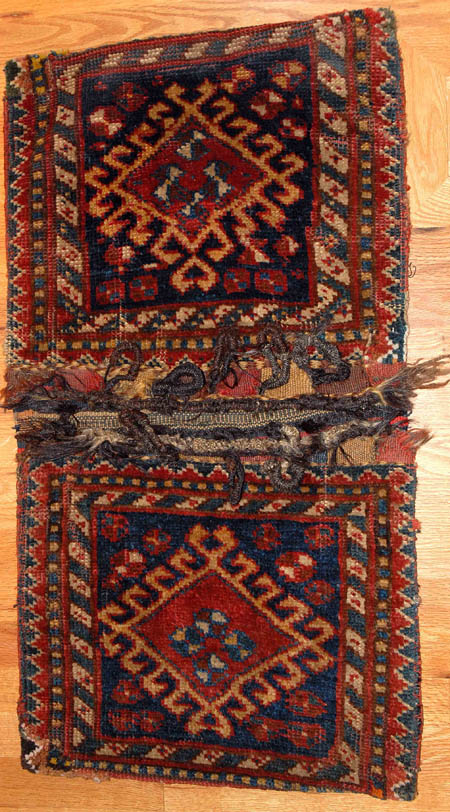
recent acquisition that I like a lot is this south Persian bagface.

It appeals to me
aesthetically, and I find the Jaff Kurd-like field interesting in these Jaff
Kurd-unlike colors and the soumak technique (if that's actually soumak, strictly
speaking).
Regards
Steve Price
Posted by Sophia Gates on 01-17-2008 11:06 AM:
This is wonderful and I love Chuck's pieces too, especially the
flatweaves.
As I study more I'm increasingly attracted to flatweaves. Of
course the dragons are wonderful
As to the growing respect I have for flatweaves: the sensuous
quality of pile is undeniable and it will always appeal to me. But the crisp
designs that emerge from various flatwoven techniques are truly
impressive.
Also I get the sense that technically they require a lot of
various skills, although not being a weaver I can't speak to this
directly.
I'll see if I can photograph my two recent acquisitions and
post them, I'm kind of swamped for the next couple of days but will describe
them. One is a Luri (I think) chanteh (I think - a small bag in any case), which
is primarily in flatwoven techniques except for a small piled area on the
bottom. I have read these protect animals from chafing? In any case it adds a
very rich touch to the bag.
The other piece is a small Turkoman bagface,
which is Tekke but has some cool design elements more commonly seen, in my
experience, on Yomud pieces, i.e. a variation of the "bird on a pole" design. It
seemed sort of unusual plus I could afford it
Meanwhile thanks to all for
hosting this beautiful Salon!
Posted by Marty Grove on 01-18-2008 08:21 AM:
Nice!
G'day all,
Steve, your flatwoven bags colour and design is one we are
pretty familiar with, and its good to be able to see a picture which confirms
how well this pattern and those colours come together.
These gullish
elements of the field always seem so archaic to me - I can see this bag thrown
over the withers of a mongol warriors pony as he comes trotting into
camp.
There is a similar bag in the entry to a bedroom at home, in pile
and is a medium aged Baluch type, but is essentially the same field and
colours.
Yours being flatwoven contributes greatly to its picture
presenting so clearly compared to a coarser piled bag.
Definitely nice!
Thanks,
Marty.
Posted by Patrick Weiler on 01-19-2008 05:22 PM:
Flat is the new Pile
Chuck,
I have a few pieces acquired in '07, which sort of indicate the
direction of my collecting in the recent past. I think the majority of my
purchases in the last year or so have been flatweaves.
Steve showed his
diamond-lozenge bag above, so here is one of mine.
It is a Baluch bag I
bought in '07 and posted earlier:

OK, OK! It is Afshar......
Well, actually Bakhtiari. With
the cotton white bird-head border edging the field and the Jaf-like animal-head
lozenges. As speculated by Marla Mallett and others, this design probably
originated in flat weaves and when "translated" into pile, the Kurds used offset
knotting to retain the angles of the diamonds. But was it the Lurs or the Kurds
who started using it first?
It is loosely related to the third piece you
showed in your introductory remarks.

It has the pile woven strip along
the bottoms and was extensively patched with leather pieces on the back.
And here is a chanteh of unusual design. It shows, and part of the
writing says, "Shah Abbas", with some of the other writing roughly translated "I
will cut off the head of my enemy with my sword from India" . Some of the
writing is not legible.

It could be Khamseh from the early 20th century - the pink may
be synthetic. On the right side of the middle panel is an amphora with a similar
design of the sitting Shah with his sword.
It is 10" x 10", rather small. If
it was a small khorjin, if you have the other face send in a
photo!
Sophia, you wrote about the pile strips at the bottom of some bags
"I have read these protect animals from chafing? " Generally it is assumed that
the pile strips add a bit of sturdiness to the areas most susceptible to wear. I
have some bags where the corners have been worn, torn or repaired so the wear
and tear does occur in this area.
A recent article in Hali says that pile
bags may not have been woven for actual use, but more for commercial sale or
keepsakes because there are no photos of pile bags in use on animals. However,
the movie Grass shows a Bakhtiari migration and some still photos from that film
show their large saddle bags upside-down on the animals. I might speculate that
we do not see many photos of pile bags on pack animals simply because the pile
side is against the animal - precisely to protect them from chafing.
Of
course not everyone will agree with me.....


Patrick Weiler
Posted by Sophia Gates on 01-20-2008 12:58 PM:
Wow what a bag.
I think, Patrick, your point about protecting the bag
from wear makes sense, but I also think you may be on to something in your
reference to the movie "Grass" and the upside-down bags, the pile side being
down against the animal.
There's another case in which "pile" is
sometimes inside-out - as you know this is seen in Moroccan women's shawls and
also sometimes rugs made with pile techniques but which are variously used pile
side up or down, depending.
On some of the shawls, the "floating wefts"
are left really long so they form a "fur", the outside being tightly woven and
flat, and the "fur" creates a warm insulation for the wearer in wet weather or
also for the bed. On the other hand in dry weather or maybe for ceremonies (?)
the "fur" is worn outside, as evidenced by the presence of sequins which are
attached in many instances.
I have one like this, I think it's Zaer
people, the flatwoven side is natural beige with bands of designs, primarily
diamond variations, in reds and greens, and the "fur" side is spectacular,
covered with silver mozunas. It's really a magical object, functional yet
something way more than that. And in fact to animist people the designs really
are alive, they aren't just decorative but in fact have real power, protective
power - and the mozunas, like mirrors and sequins in other cultures, are not
merely decorative but also protect against the "evil eye."
I guess also
this bears on the question of what do we collect? I do tend to gravitate toward
these functional items that demonstrate such incredible artistry as well. The
closure systems and tassels alone, on bags and trappings, are often just amazing
and every bit as beautiful as the bagfaces themselves. Of course you guys have
seen pix of my favorite piece, the ak chuval, which is *just* a storage
sack...
I shudder to think of the bags which have been cut apart and the
"worthless" flatwoven parts thrown away! But also one must reflect on our own
throwaway culture and the judgements we make of other people...
Posted by Patrick Weiler on 01-20-2008 05:43 PM:
Paper or Plastic?
Sophia,
They did not have the same choice we do, of Paper or Plastic,
at the grocery store way back when. In the US late in the 19th century, women
made bead purses, men had leather saddle bags, steamer trunks (they tend to fall
off camels, which is probably why the nomads did not use them much) canvas bags,
the NW coast native Americans made corn husk bags, etc. And, of course, there
were the infamous carpetbaggers of post-Civil War times who actually did have
cut-up old hand-made carpets made into luggage carriers.
We may end up sooner
than later in the same circumstances. Some cities, counties, states and
countries are considering a ban on plastic bags. They are a scourge in China and
I read that they are quite popular in Cuba.
As for wear and tear on the
corners of bags, here is a photo of the back of the bag I posted above, with the
leather patches on the back of the bag - at the bottom corners where the wear is
most severe. Some Bakhtiari bags have "saddle-shaped" pile strips which cover
the areas of this bag that have been repaired with the leather patches. I have
folded both faces over towards the bridge of the bag. The pile strips are at the
middle of the picture and the closure tabs from one face are below the pile
strips:

This
next photo is of the lower part of the photo above. You can see that the pile is
especially worn at the corners, and has been sewn up and covered with
leather:

This is
a full-pile Luri khorjin. It has wear in the bridge area and all four corners
have either been re-woven or patched:
This photo shows one corner that
has had a patch job. The dyes in the patch are not natural, but the original
dyes are:

This
picture may be difficult to make out the details.
I turned the bag 180
degrees and folded it almost all the way in half so the bottom, right corner is
now the top left corner. You can tell because the synthetic orange minor-border
dash is now at the top left. And the brighter, synthetic flatweave of the patch
is visible to the right.

I doubt that these repairs were made so these pieces could be
sold to collectors. They were probably made many years after the bags were made,
and would have extended the life of the bags for many more years.
Patrick Weiler
Posted by Sophia Gates on 01-20-2008 06:04 PM:
Gorgeous stuff!!!
It's a pleasure to see it, thank you.
On
throw-aways: this of course reflects attitudes as well as bags. Art in our
culture often reflects mass marketing economics rather than the simple desire to
create something wonderful, and which will last - both esthetically and
physically.
Also there is the process, the actual making of the thing,
and its connections to ideas, culture and even spiritual concepts.
The
choice therefore isn't merely one of paper or plastic but of a way of life, of
values -
Or maybe I am reaching too far here - not that this would be
unusual.
In a sense
though this is a perfect example of Mies' statement, "form follows function."
Both the woven bag and the plastic bag are functional to carry things but the
one also functions as art, and embodies human skill and creativity and even
spiritual meaning - have we decided to lose those things in the name of mass
production, convenience and the petrochemical industry?
Posted by Steve Price on 01-20-2008 06:15 PM:
Hi Sophia
Your criticism of art in our culture ... often reflects
mass marketing economics rather than the simple desire to create something
wonderful, and which will last - both esthetically and physically is
precisely the criticism often leveled at the woven arts of western and central
Asian cultures after the middle of the 19th century.
Some things never
change.
Regards
Steve Price
Posted by Chuck Wagner on 01-21-2008 12:19 AM:
Hi all,
Mass marketing economics and art are not mutually exclusive.
It gets down to whether "art" requires original expressive content, entirely
free from any external non-naturally occuring influences.
If that is what
art is, then there is almost no "art". But if art can be the process of
expressing ones own impressions of a concept that does not necessarily originate
within the artist, then there is hope for those who feel they have identified an
element if individualist expression in a weaving, commercial or
otherwise.
This is the process that good illustrators follow, which is
why the fantastic (related to fantasy, not "great") illustrations of N.C. Wyeth
and Alfons Mucha continue to be held in such high regard.
What we should
aspire to avoid, if we're looking for art, is the "trite" - that which slightly
alters some previously existing concept in an effort to mimic (rather than
express) that conceptual communication.
Steve,
..an interesting bag,
but I have to admit that the red puts me off rather a lot. Maybe it's just the
photo, but it seems a rather dull and opaque red to me. The borders reveal that
the design was a product of evolution - I like that in a piece - it doesn't
bother me a whit that there may have been a design whoopsie. There seems to be a
repeating boundary that runs through the middle of the motifs - is it just me or
is that real and structural.
Pat,
I like the sponteneity of the
inner critterhead border outline along the sides. Looks like we hadn't really
thought through exactly how to handle that one, prior to embarking on the
weaving process. And I love the little chanteh.
I have one or two bags
with similar "new material" fixes to "old material" base work. Not leather,
though. Some sly Uzbeki ran out and shot a Nauga, and used the hide for repairs.
I just don't know where those pieces are right now... but I'll post some images
when I find them.
I'm guessing there is no such thing as too many Luri
bags in Casa Weiler. If it ever gets to that point, you can toss them in my
trash can...
Regards,
Chuck
__________________
Chuck
Wagner
Posted by Steve Price on 01-21-2008 05:49 AM:
Hi Chuck
The piece is in a trunk right now, and I can't conveniently
get to it for the next few days. So, what I say here is from memory; mine isn't
always a reliable source.
The red on my monitor looks the way I remember
it looking. I think there's too much of it and not enough contrast in intensity
in the other colors nor a very wide range of colors. Maybe this contributes to
your impression.
The vertical lines that run through the apices of the
diamond shaped compartments are real (not a photographic artifact), although I'd
have to take the piece out and look to see their structural basis.
Regards
Steve Price
Posted by Dinie Gootjes on 01-21-2008 10:00 AM:
Hi Everyone,
On the subject of carpetbaggers and plastic bags: at a
garage sale of somebody who had lived in Turkey for some time, we found two
flatwoven double bags they had bought there. One seems to be an example of
recycling pieces of weaving, maybe even larger bags. It consists of a back with
two pieces sewn onto it to form the pockets. All edges are cut, including all
sides. It is sewn together with synthetic yarn and has a few tassels of that
same yarn. There is clear evidence of colour run in the wool used for the fronts
of the pockets. I don't think any priceless tribal treasure was cut
up.
The other one consists of one piece of warp faced band, with the two
short sides folded inward to form the bags. The material is partially a very
rough (goat?) hair, partially a mixture of hair and wool, as far as I can see,
with longitudinal stripes of a glossy synthetic looking yarn. The opening of
both sides is protected by strips of see-through plastic, sewn on with hair
yarn. Sometimes the twain shall meet, I guess.
One of our sons took the
camera with him on a trip. If anyone wants to see them, let me know, I can post
a picture at the end of the month. Otherwise I will leave them in their
obscurity.
Dinie
Posted by James Blanchard on 01-21-2008 10:01 AM:
Hi Steve and all,
First, I think that Steve's bag has a really
effective design, aesthetically. For such a small piece, the interplay between
the border and the field is quite lively, dare I say dramatic. I agree the red
could have a bit more "pop", but there is a fine line there.
The issue of
defining "tribal art" is even trickier than defining "art", but I agree with
Chuck that commercialism is not necessarily a disqualifier. As I mentioned in
another thread, in some ways some tribal weavers were able to become more
"artistic" when they began weaving for a wider audience, since they were able to
express themselves through a wider range of designs. Conversely, this made their
"art" less tribal, since it lost meaning and specific appeal within their
ethno-cultural group.
Could we conceive of the notion that Andy Warhol's
art shared some of the characteristics of "tribal art"? Maybe not....
James.
Posted by Steve Price on 01-21-2008 10:22 AM:
Hi All
I dug the bagface out and made a couple of direct scans, which
usually show colors better than photos do, and include one of the back that
shows the structural basis of the thin vertical lines through the diamond
apices.
First, just for convenience, the photo:
Next, a direct scan of
one corner, for color accuracy:

Notice the yellows
peeking through the green areas, typical of natural greens made by dying with a
yellow plus indigo, which abrades off in places.
Finally, a direct scan
of the back:

Regards
Steve Price
Posted by Steve Price on 01-21-2008 02:39 PM:
Hi People
Wendel Swan sent me an e-mail a little while ago telling me
that the bag is Kordi, made by Kurds in NE Iran (Khorassan), and that the
technique is known as reverse offset soumak. Wendel is usually right on the
money about such things, and I'm confident that he's got it right.
Thank
you, Wendel.
Steve Price
Posted by Sophia Gates on 01-21-2008 03:24 PM:
Hello all,
Thank you for the thoughtful responses.
Re art: it
isn't the work itself I'm questioning, because I think art is often in the eye
of the beholder/creator, and certainly isn't limited to pre 20th work or tribal
work or whatever - I love modern art for example - but rather the nature of a
society that has somehow ceased to value people's work, their expression, the
act of creativity itself. This is reflected in the sheer amount of time taken to
create a wonderful bag like these illustrated - that reflects a value
system.
Does this make sense? I know I'm not expressing myself very well.
But contrast this with the value systems of our culture, in which everything has
to be done fast and artists and craftsmen literally starve, unless they hit a
mass-market nerve or are otherwise politically connected - also, we look
backwards and marvel at the Gothic cathedrals. These for one example were built
by people who knew they'd never see them. They were expression of faith, faith
in the future and in the hands of man as well as the love of God. Maybe we see
some of this in the Space Shuttle, in our attempts to fly beyond our planet
-
And, it interests me that we often refer to societies as "primitive,"
which regardless of other cultural mores and customs do seem to value such work
and individual or group creativity, and are willing to invest a lot of time and
economic wealth in making even utilitarian objects sing.
I'm worried that
a society which doesn't value (these processes) is becoming passive and
uncreative not to mention buried in plastic.
Posted by Chuck Wagner on 01-23-2008 09:12 PM:
Hi Steve,
Thanks for the scans; that presence of that bag in your
collection now makes a lot more sense. And I can now see that the lineations are
from the reversal of the soumak direction.
Sophia,
In not too many
years, people will begin to appreciate non-electronic art. Everything that is in
electronic representation is transient. Real, tangible, works of art are not. As
CDs, DVDs, tapes, and disks begin to degrade and fail, a lot of folks (I include
myself) will start wishing they had made silver paper prints of their more
precious digital imagery.
This fascination with electronics explains much
of the transition in attitude toward art that you detect. But, take heart, the
animators are now realizing that the cost of matching the best of hand drawn
animation exceeds the value. People are starting to produce cartoons by hand
again.
One also has to take into account that a lot of the "new money"
does not patronize the arts to the same degree as the "old money" used to. The
"old money" is in the grave and in many cases, their snotty descendents are
squandering the cash on badly run hedge funds and Hummers. The remaining few
still subsidize art.
But art lives, away from the mainstream electronic
media - take a trip to Cape Cod and cruise the little galleries that are
sprinkled liberally between
the real estate agencies. Or Santa Fe, Sedona, or the Montrose section of
Houston (go figure), for that matter. All is not lost. But art hasn't changed a
bit in one regard - the term "starving artist" has been around for centuries,
and continues to describe those who foolishly believe that there are enough
monied and tasteless art buyers out there to obviate the need for a normal job.
Still, I suspect the bags are not considered art by their weavers, so
much as utilitarian items to which they can apply their artistic inclinations.
Like the chores of farm and ranch wives of rural America in the not-so-distant
past, weaving is what these folks do much of the day. Stitch-N-Bitch sessions,
nomad style.
Regards,
Chuck Wagner
__________________
Chuck
Wagner
Posted by Sue Zimmeran on 01-24-2008 11:37 AM:
Chuck,
Young ''new money'', thanks to the newly ''hip'' knitting
craze has discovered that rather than being tedious and boring, knitting can be
calming and Zen like. Meditation with a bonus, a product. An objective record of
what has been accomplished is a good and rare thing these days, and people like
it.
Knitting doesn't seem to be just another flash in the pan fad. The trend
is cascading into peripheral areas like spinning and weaving. Progress is being
made in these areas and is being fostered by really good teachers and an
unusually intelligent niche of craft supply manufactures who have not dropped
the ball by focussing mainly on beginners, as has been the case throughout most
of that industry.
I predict these ''new money'' knitters will be the people
who will form the next generation of textile collectors and that they will be
very, very good at it. Sue
Posted by Sophia Gates on 01-25-2008 01:01 AM:
Chuck - with respect, how do you know the weavers and embroiderers didn't -
or don't - think of their work as art?
Nobody asked them, did they?
I'll tell you what though: Dineh weavers most certainly think of their
blankets as art and so do Pueblo potters.
Posted by Sue Zimmerman on 01-25-2008 09:15 AM:
By the way, some of these really good knitting instructors are historians and
scholars. Their work is relevant to rug studies. For one thing nalbinding,
knitting's predecessor, in my opinion, would make an ideal medium for sample
making. Not only could nalbinding samples be directly translated to rug
production they require no loom time.
Here is a photo of a nalbinding
fragment I find highly relevant to rug studies. It is from Egypt and dated by
someone as 969-. I notice it has gif in this link so someone computer literate
might have to do something to make it appear. It's amazing. Sue
Click
here: http://monsite.wanadoo.fr/tricot-fluor/images/1-picture3.gif?0.5558077273518636
Posted by Richard Larkin on 01-25-2008 09:42 AM:
Hi Sue,
That fragment is amazing. Can you say more about it, where it
was found, etc. Also, as to the dating, did you intend to write 969 BCE?
Posted by Sue Zimmerman on 01-25-2008 10:44 AM:
Hi Rich,
I lifted the picture several years ago from a site which is
no longer there, unless the writing left there, which is in French, redirects. I
don't know French so I don't know.
The oldest known nalbinding fragment I
know of was found in Syria. As I recall it was dated to the 3rd c. AD. All of
the one's found in Egypt, that I know of, are cotton. If I were computer
literate I'd certainly blow this gif up to a size where the yarn spin can be
seen.
Unfortunately I don't even know where this amazing fragment now is. I
posting it hoping someone will pick up the trail. I don't have time for that.
Sue
Posted by Filiberto Boncompagni on 01-26-2008 09:09 AM:
Here’s the full web-page page where the image is:
http://monsite.wanadoo.fr/tricot-fluor/page1.html
No
redirections to bigger size photos.

The caption says: Pièce
en tricot , soie, Egypte, époque Fatimide, 969-1171, coll privée
i.e.
Knitted fabric, silk, Egypt, Fatimid era, 969-1171, private colletion.
To
have the page roughly translated, you can copy & paste the link in the
“Translate a web page” window in Google Language Tools
http://www.google.com/language_tools?hl=en
Regards,
Filiberto
Posted by Filiberto Boncompagni on 01-26-2008 09:30 AM:
Notice the similarity of the Fatimid border with the ones shown in this old
thread, the "Precolombian puzzle" (the first is the Precolombian Inca
one):
http://www.turkotek.com/misc_00070/precolombian.htm


P.S. -
Sorry for the divagation
Posted by Filiberto Boncompagni on 01-26-2008 02:20 PM:
I apologize again for the digression, but I have an oldish (or newish - it’s
a matter of opinion, like that glass of water half full or half empty) Baluch
Balisht with almost the same border

It's the irrefutable
demonstration that this design was disseminated, since ancient times, by Baluch
nomads on their way to Peru. 
(Just an attempt to keep our Balunatics happy,
OK?)
Filiberto
Posted by Richard Larkin on 01-26-2008 04:44 PM:
Hi Filiberto,
Of course, it's a pictorial rug. Those curly blue things
are the antennae on the helmets of the space aliens who carried the Baluch
nomads to the Andes, looms, goats and all. They're trying to duck behind that
barber pole stripe, but it was too thin to completely cover them. Amazing rug, a
document of history.
Posted by Marty Grove on 01-28-2008 08:44 AM:
Divergence
G'day Steve, Filiberto and all,
From the Jaff flatweave of Steve's to
Filibertos beaut balisht, there seems to be a similarity in the colours, at
least the orange/rust which has that nicely subdued tone, and the descending to
pale blue in Filiberto's offering last seen. The differences in how the light
strikes the two pieces is what I think may be from one being flatwoven and the
other in pile.
With the last photo, of the balisht from Filiberto, the
'alien' shape suggested, to me comes across more as an interpretation of the
triangular head of the 'comb' shape that has been said to be, literally, an
amulet when it is woven into a rug. Joined as they are in the border may be a
multiplicity of amuletic forms, in an interpreted form.
These last
hundred years is but a shiver and a shake compared to the time rugs have
probably been woven. Im wearing a cylinder seal from Ur round my neck and Im
sure that rugs have been woven at least as long since the seal was made. During
these likely thousands of years, designs, shapes, forms and intention of
iconographic description has been going thru changes we cant even
contemplate.
Each and every rug we look at has something we can interpret
and discuss and attempt to quantify - aint it grand!
Regards,
Marty.
Posted by Chuck Wagner on 02-03-2008 12:00 PM:
Hi all,
Welcome to those seeking rehab from Baluchomania, and those
sucked in by the Persian tag. Our initial Persian acquisitions were more in line
with my wifes preference for city rugs. More recently, I've been allowed to put
increased emphasis on tribal pieces (as long as they don't displace the city
rugs on the wall...)
Here's a new acquisition that I'm quite happy with;
I don't recall seeing many pile pieces with this particular motif (the name of
which, if any, is unknown to me) It was described as a Qashqai piece by the
seller; I have no reason to dispute that - but then, ignorance is
bliss:

Note the change from red, to light brown, to dark brown, weft
from bottom to top:

The colors are delightful up close; the first image makes it
look a little darker than it really is :

An interesting feature is the
occasional appearance of symmetrical knots, randomly, throughout the
field:

The
majority of the piece is asymmetrical, as would be expected:

Regards,
Chuck Wagner
__________________
Chuck
Wagner
Posted by Filiberto Boncompagni on 02-03-2008 12:27 PM:
Qashqai or not, that's a very nice one, congratulations!
The motif is called
birds-on-a-pole, I think...
Good colors!
Posted by Richard Larkin on 02-03-2008 02:24 PM:
Hi Chuck,
Nice piece. I don't recall seeing the mixed knotting in
South Persian tribal weavings. Interesting.
Others seem to be able to
say "Qashqai" or "Khamseh" on these things with much confidence, but it often
eludes me. John Collins had a hanging of small pieces in his gallery near Boston
not too long ago, and both groups were well represented. I tried to brush up on
my rules of thumb, but with mixed success. As to your item, the presence of
symmetrical knots would push me away from the "Khamseh" label. Not sure whether
that is sound thinking or not. They're very general groupings anyway.
Posted by James Blanchard on 02-03-2008 05:02 PM:
Hi Chuck,
That is a really nice bag. The palette suggests "Khamseh" to
me. Richard, I would have thought that the admixture of symmetric knotting might
nudge the attribution towards Khamseh, not away. There are some Khamseh groups
that use the symmetric knot, but as far as my knowledge goes Qashqa'i weavings
are more consistently asymmetrically knotted (excepting the Shekarlu
group).
James.
Posted by Alex Wolfson on 02-06-2008 11:28 PM:
Coming back to the fatimid fragment, the border is found not only on Belouch
pieces but also on S.Persian weaving. Could we perhaps attribute the
dissemination of this motif to the arab tribes who moved to this area? Notice
also the arabic calligraphy has alredy been abstracted into a purely decorative
form.
Posted by Richard Larkin on 02-07-2008 09:44 AM:
Hi Alex,
Interesting observation. I wonder how frequently it is linked
to Arab sources.
__________________
Rich
Larkin
Posted by Fred_Mushkat on 02-18-2008 09:49 PM:
Hi Steve,
I have a chanteh that has characteristic Qashqa'i
coloration, top and bottom iconography, and a well known Qashqa'i back, with
classic a classic Jaff Kurd field design. The bag measures 18.5w x 16h cm
(11-1/4" x 10-1/4"). It has about ten warps and ten wefts per cm, and has white
cotton thread, with the remainder in wool. There is a purple which has faded to
gray, suggesting this bag does not have great age, but is unusually finely woven
for a soumak bag. I believe the finishes at the top of the bag suggest that it
is not a cut khorjin, but was woven as a single chanteh. There are slits at the
top, and two remaining loops for closure.


Many Jaff Kurd pile bags,
even some of the best, have a characteristic deterioration of the main icon on
the edges of the field. The Qashqa'i example reproduces these partial icons with
great clarity, I have seen one other Kurdish khorjin with this iconography also
made in soumak, and the icons did not deteriorate on the edges of the field in
that example. It has always puzzled me that talented Kurdish weavers made the
designs seem to fall apart on the edge of the field. I suspect there is some
tradition to this, which Westerners have failed to understand.
Regards,
Fred Mushkat
Posted by Chuck Wagner on 02-18-2008 10:00 PM:
Hi Fred,
I like your chanteh. If you haven't done so already, take a
look at the opening essay for the salon, for an interesting
coincidence.
Also, if you don't mind, would you comment on whether you
think the orange in the Bakhtiari-Lor khorjin might be vegetal
?
Regards,
Chuck Wagner
__________________
Chuck
Wagner
Posted by Fred Mushkat on 02-18-2008 10:14 PM:
Hi Chuck,
As we have discussed in different forums, even experts are
sometimes wrong when they guess about vegetal vs artificial dyes. Given that
caveat, I believe the orange to be vegetal, on the basis of the intensity of the
color being on a par with other colors used in the bag. All too often textiles
with an analine orange have muted colors, with the exception of the bright
orange, which takes on a garish appearance, given the relative appearance of the
neighboring vegetal colors. Although the closeup photos seem to make the oranges
stand out, they do not do so when the bag is viewed in person.
I do,
however, believe the bag was made in the post-vegetal era, since there is a
'weak' purple which has faded in a way that is characteristic for analine purple
dyes. There do not seem to be any other suspect dyes in the
bag.
Regards,
Fred
Posted by Fred Mushkat on 02-18-2008 10:20 PM:
Hi Chuck,
My reply may have skirted your question, but I am reluctant
to judge analine vs vegetal on a computer image. As the detail photos of my
Qashqa'i bag suggest, if I am right that the oranges are vegetal, then the
digitization of the image and display on a computer screen can mislead one into
believing the oranges are suspect. Oh well, there is always the prospect of
chemical analysis...
Regards,
Fred
Posted by Fred Mushkat on 02-18-2008 10:45 PM:
Hi Chuck,
Your finely woven bag in your Salon with the similar back
must be more than a coincidence...in two finely woven bags with nearly identical
backs, there must be a connection between the weavers.
Your bag has 20
warps/inch, mine is at 10/cm, which is about 25 warps per inch. The finest woven
textile I have encountered from a nomadic pastoralist group is a Qashqa'i band
with 16 warps per cm, which comes to 40 warps/inch. I point this out, not to
state who has a finer woven bag, but to comment on the extraordinary skill the
best Qashqa'i weavers had, with tour de force structures that rivaled the best
court textiles. I strongly suspect that such finely woven pieces were consigned
by wealthier members of the Qashqa'i, and were not common usage items. It is
doubtful that such finely woven bags would have been created for sale to Western
markets.
Regards,
Fred
Posted by Fred Mushkat on 02-18-2008 11:48 PM:
My apologies, I mis-spelled aniline. I have noticed that the alternative
spelling, analine, is being used from time to time.
Fred
Posted by Filiberto Boncompagni on 02-19-2008 08:01 AM:
Wasn’t Freud that coined
the expression “anal-ine retention”?
Posted by Chuck Wagner on 02-19-2008 11:47 PM:
Hi Fred,
Hi Fred,
Hi Fred,
and
Hi Fred,
Not to worry
about the spelling. And, for what it's worth, I think your comment regarding the
failure of this orange to frighten, is sensible. As you note, most synthetic
orange - in the hands of tribal weavers - leaves no doubt regarding its origins.
And this orange is darker in tone than most sythetics, another point in its
favor.
The inscribed age on the back supports the notion that this is a
post-synthetic era piece. I'm less certain that the purple has faded - I'll take
another look (and maybe a couple more images) in daylight tomorrow. Which image
causes you to see weak purple ?
As for the Qashqai - yes, those backs are
remarkably similar to be pure coincidence. And, notice the manner in which the
selvage cords are pulled around to the front of the bag, another odd feature to
have in common. They make an interesting pair to
consider.
Regards,
Chuck Wagner
__________________
Chuck
Wagner
Posted by Fred Mushkat on 02-20-2008 06:32 AM:
Hi Chuck,
The purple I mentioned was in my bag. If you find a similar
fading of the purple in your bag, it would suggest that our two bags are of
similar age.
Regards,
Fred
Posted by Filiberto Boncompagni on 02-20-2008 08:52 AM:
Fred, Chuck,
The colors of the backs of your bags look quite
different, but it could be the usual problem of calibration of the photo,
aggravated by the different behavior of our computer screens.
The best
solution would be taking more pictures together with “Color Input Targets”, like
the ones visible in this page:
http://www.aim-dtp.net/aim/calibration/kodak_q60/index.htm
A
more economical and much lesser perfect method … why you guys don’t just use
something else more easily available… Like, taking pictures of your bags with
the upper half of last “Time magazine” cover, for example. Comparing the photos
between them and also with the cover visible on Time’s website could give an
idea of the difference of calibration.
Regards,
Filiberto
Posted by Fred Mushkat on 02-20-2008 09:58 AM:
Hi Flilberto,
I have a Spyder program for calibrating color on my
computer, along with programs within Photoshop CS2 for calibrating colors to
specific printers, for purposes of publishing. Even with all this technology,
unless we all use similar programs and screens, it will be difficult to make the
colors come across the same way on all user's computers.
Besides, part
of the fun of sites like Turkotek is that a user can take a few acceptable
photos and post them a few minutes later and create a thread. When I have
carefully calibrated my photos for printing or publication, it is not uncommon
to spend an hour a photo getting everything right.
The best way to
compare colors of two bags would be to put them side by side, and view them in
person. The second best method would be to place them side by side, photograph
both at once, and post it on the web. At least that way, all viewers would have
the opportunity to view the relative color scale of the two bag faces.
I
will await the arrival of Chuck's bag for my evaluation, and continued
caretaking.
Regards,
Fred
Posted by Filiberto Boncompagni on 02-20-2008 10:14 AM:
Fred,
Of course.
I volunteer to view them in person, photograph
both at once and post the photo on Turkotek, if you and Chuck kindly send your
bags to me.
I will send them back in the next few years. 
Regards,
Filiberto
Posted by Dinie Gootjes on 02-22-2008 12:21 PM:
Hi Fred, Chuck, Filiberto,
This may be a far fetched idea, but are
there no standardized colour charts, for example for the fabric/garment
industry, which could be used to describe/compare colours? The Royal
Horticultural Society has one to describe flower colour. It uses fans of related
hues and tints, contains more than 900 samples, but is not exactly a bargain at
170 British Pounds. That is more than the price of a good dinner for most of us
 . But maybe there are
cheaper alternatives? Just a thought.
. But maybe there are
cheaper alternatives? Just a thought.
By the way, I could buy one, and
you people all send your rugs to me for exact colour identification. I the rugs,
you the reports. Fair deal, not?
Dinie
Posted by Chuck Wagner on 02-24-2008 08:53 PM:
Hi Dinie,
Perhaps we should look at the Kodak Q-14 color control
chart; it's far less expensive. I suggested this once before; the response was a
little like listening to crickets on a still summer night. It was a little like
trying to get some of the original Turkotekkers to crawl out of their lairs and
show us some of their early attempts at collecting rugs.
Fred, Filiberto,
Funny, I
was making space for your pieces, when they arrive for
analysis...
Regards,
Chuck Wagner
__________________
Chuck
Wagner
Posted by Dinie Gootjes on 02-25-2008 12:21 PM:
Hi Chuck,
I just talked to my daughter, who studied Fashion Design.
They had to buy an (expensive) large size version of a set of colour cards
called Color-aid,which in its full version has over 300 colours. A 2" by 3"
version is priced at a far more modest $32 on their website. She will bring hers
over one of these days, and I will see if it is useful to describe the colours
of our rugs. I googled the Kodak Q-14 system. I could not find how many colours
it has. It sounds terrific to use for the grey areas, though .
Dinie
Posted by Dinie Gootjes on 03-04-2008 08:44 AM:
Hi Chuck and all,
OK, one nice (?) idea down the drain. Last Saturday
I took 4 rugs that are at this moment in our living room: one old Arab Baluch
with the nice brick red, two older Shiraz with brick/ coppery tones and a new
refugee production Ersari with a similar mild red. I was immediately struck with
the difference between the lively micro abrash in the rugs and the absolutely
flat, harsh colours on the test strips. Long live rug colours! Another
difficulty is the direction of the pole, which can give a major change in the
intensity of the colours. I chose to look into the pile, slightly from a
distance to cancel out the irregularities in the dye jobs. It was now possible
to find a good match for the Arab red and one of the Shiraz. For the other 2 you
would have to use descriptions like : mostly X, but more brownish/ orangey/ or a
few tints darker/ lighter than X. Of three main blues, I could find only one
match: a dark slatey colour. A purer dark and middle blue had no equivalent. The
middle brown in the Arab was not to be found either. At this point I gave up. I
must say that in practice the abrash and the pile direction were not really a
problem. My husband and I both agreed that the matches we found would give
another person in possession of the same samples a good indication of the
colours of these rugs.
In conclusion: theoretically it should be possible
to describe the colours in rugs with the aid of a standardized set of colour
samples, but Color-aid with 318 samples is woefully inadequate. Maybe the set
from the Royal Horticultural Society would work, as it consists of more than 900
colours, and they would not have all those grey tones (not many grey flowers).
But 170 British Pounds... No go for me I am afraid. Sigh.
Dinie
Posted by Richard Larkin on 03-09-2008 10:11 PM:
Hi Dinie,
One problem about trying to match rug colors to a
standardized chart is that in many antique rugs, there is too much variation in
the shading within the color. I'm not only referring to abrash, although that is
a factor as well. But in a finer sense, there is variation within the pile
yarns. Micro-abrash, as you aptly called it. Years ago, when I did a little
repiling work on rugs, I used to purchase yarns from the Chatalbash Rug Company
in New York City. They would supply you with a little fur ball of a few hundred
strands tied together. Each one was a different sample color. The idea was to
match one strand to the color you wanted and send it back to them. They would
send along a few skeins of the chosen color. I found that it was not so easy to
pick out one suitable color. Occasionally, I would re-ply strands of two close
but different colors to get it right. On the other hand, as you also said, those
sample strips are flat.
__________________
Rich
Larkin
Posted by Filiberto Boncompagni on 03-10-2008 04:08 AM:
The idea is not of trying to match rug colors to a standardized chart.
The idea is to take a photo which includes the standardized chart and
calibrate the result (print or web-photo) to match the standardized chart
visible inside the photo against the real one.
Regards,
Filiberto
Posted by Richard Larkin on 03-10-2008 07:43 AM:
Hi Filiberto,
Of course! I lost track of the discussion.
__________________
Rich
Larkin
Posted by Dinie Gootjes on 03-13-2008 10:42 AM:
Hi Richard, Filiberto,
I think I was off track all the time and took
you with me, Rich. I was visualizing a situation in which members would show
pictures of rugs with a comment like : "the red is like Or 17". Whoever had the
same chart could then correct the colour on the monitor 'in his head'. With what
you are proposing I would have to go into calibrating the monitor myself instead
of leaving that to computer savvy sons  . If necessary I 'll live and even learn I guess.
Dinie
Posted by Steve Price on 03-13-2008 10:59 AM:
Hi Dinie
If someone included a standard color chart with each image,
any reader who had a copy of that chart could interpret the colors in the image
whether the monitor was calibrated or not.
Obviously, it would take less
mental gymnastics if the monitor was calibrated. But it isn't really
necessary.
Regards
Steve Price
Posted by Dinie Gootjes on 03-14-2008 04:22 PM:
Hi Steve,
Thanks for the explanation. Now for the
chart...
Dinie