| Subject | : | The Border |
| Author | : | Bob Emry |
| Date | : | 08-29-2000 on 12:15 a.m. |
| Hello all: I'm intrigued by the border of Daniel's Memling gul rug,
which is seen again in the Kazak rug at the beginning of part 2 of the
salon, and again at the end of part 2 in the Housego mafrash panel (I
assume this is pile rather than soumak). In his discussion at the
beginning of another thread, Michael Wendorf mentions two other rugs with
this border: one advertised by Peter Pap (HALI, No. 86, page 55), and a
fragment previously in the Rudnick collection (I believe this might be the
same one shown in Skinner Auction catalog, April 23, 1994, lot 171). I can
cite pictures of two other examples: One is another long rug, very similar
to the Pap rug, illustrated in Jon Thompson's "Oriental Carpets from the
Tents, Cottages and Workshops of Asia" on page 79. The other is a
"Shahsavan Soumak Cargo Bag Side Panel" (Skinner auction catalog, April
20, 1995, lot 89). This soumak panel is remarkably similar in both border
and field designs to the Housego panel that Daniel illustrates (each has 3
large memling guls, unusual in each having only two hooks on each
quadrant, and the field ground filled with "Z" devices). I can offer
another example that clearly belongs to the same group (design group at
least, if not ethnic) as the Pap and Thompson rugs and the Skinner
(?Rudnick) fragment: The picture here shows only one end but imagine it
with 10 medallions: |
| Subject | : | RE:The Border |
| Author | : | Daniel Deschuyteneer |
| Date | : | 08-30-2000 on 11:04 a.m. |
daniel.d@infonie.be
GROUP 3 – the rosette border group - Dear Bob and you all, Thanks for your
interesting thoughts and references. I think that these two constructed
pictures containing your references will help into the discussion. 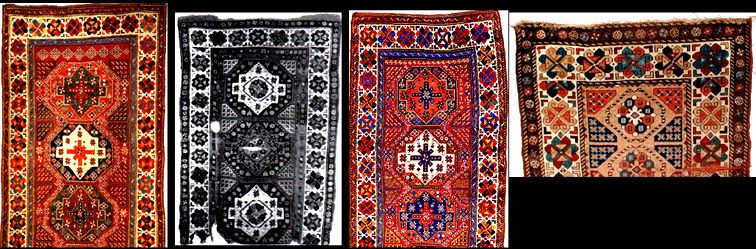 Picture constructed
with close-up of, from left to right: 1/ Peter Pap (HALI, No. 86, page 55)
– Shahsavan - 2/ Skinner Auction catalog, April 23, 1994, lot 171,
fragment previously in the Rudnick collection – labeled Shasavan 3/ Jon
Thompson's "Oriental Carpets from the Tents, Cottages and Workshops of
Asia" on page 79 – probably Shahsavan - 4/Bob’s "interlaced rosette
border" – Shahsavan? - Picture constructed
with close-up of, from left to right: 1/ Peter Pap (HALI, No. 86, page 55)
– Shahsavan - 2/ Skinner Auction catalog, April 23, 1994, lot 171,
fragment previously in the Rudnick collection – labeled Shasavan 3/ Jon
Thompson's "Oriental Carpets from the Tents, Cottages and Workshops of
Asia" on page 79 – probably Shahsavan - 4/Bob’s "interlaced rosette
border" – Shahsavan? - 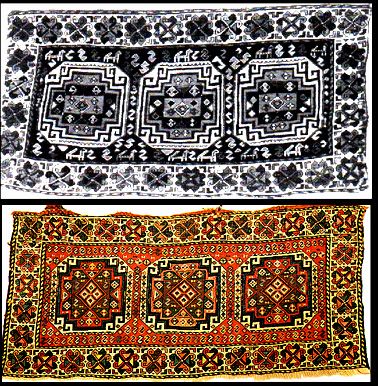 Related soumak mafrash panel labeled Shahsavan Top: Skinner
auction catalog, April 20, 1995, lot 89 – Bob’s comments: Each has 3 large
memling guls, unusual in each having only two hooks on each quadrant, and
the field ground filled with "Z" devices Bottom: Housego’s Shahsavan
mafrash panel (Tribal Rugs plate 8) – size 46cm x 97cm - 1’6" x 3’ As you
noticed all these pieces are labeled Shahsavan. As this board is visited
by Shahsavan experts I am curious to see what think about. Do we have for
once a group of pile rugs that would be really woven by Shahsavan tribes?
Let us pay attention do the structure of the rug Bob offers here: Bob’s
"interlaced rosette border" structure analysis: Yarn: spin Z Size: 44" x
124"(112cm x 315cm) (has been reduced by about 3.5") Size ratio 1/3 Knot:
symmetrical, H7pi V 7pi 49psi; H29/dm V29/dm 841/sdm Warps: 3 ply wool
mixed white, tan, brown. Often two white and one tan or brown. No warp
depression. Wefts: dark red wool, usually 4 picks - occasionally extra
interlacing along the edges. Selvage: 2 units (4,4) reinforced in two
groups with extra selvage red wool yarns. Sometimes the reinforcing yarns
also interlace the first ground warp. It is worth noticing that the
structure of Bob’s rug is EXACTLY the same one as the structure of the
first Azerbaidjiani group we have isolated in another thread. The only
differences appearing only in the color scheme used. As a rfeminder, the
characteristics of the "Group 1-Azerbaidjiani" rugs are: Runner format –
mean ratio 1/3 Pile: long and silky symmetrical knots - 56psi to 79psi -
Warps: 2 or 3 ply white or mixed wool – no depression. Wefts: dark red or
brown wool – 2 to 6 picks – no information about eventual weft crossing
Reinforced selvage (selvage warps interlaced by the ground wefts and
reinforced with interlacing additional yarns) Ends: no information Design:
gul forms and other old Turkish devices Color: characteristic apricot and
light yellowish green as well as light blue. Frequent use of extremely
corrosive dark brown color. Would this be the usual structure of Shahsavan
pile rugs? We don’t notice here the "wavy warps" once pinpointed by
Wendell in a long rug having a somewhat Kurdish look and a lack of weft
ease. Were these wavy warps just weaving errors? Did such characteristic
"interlaced rosettes and corner brackets" borders migrate from the
Caucasus to Azerbaidjian or vice-versa ? I haven’t the answer. Thanks,
Daniel Related soumak mafrash panel labeled Shahsavan Top: Skinner
auction catalog, April 20, 1995, lot 89 – Bob’s comments: Each has 3 large
memling guls, unusual in each having only two hooks on each quadrant, and
the field ground filled with "Z" devices Bottom: Housego’s Shahsavan
mafrash panel (Tribal Rugs plate 8) – size 46cm x 97cm - 1’6" x 3’ As you
noticed all these pieces are labeled Shahsavan. As this board is visited
by Shahsavan experts I am curious to see what think about. Do we have for
once a group of pile rugs that would be really woven by Shahsavan tribes?
Let us pay attention do the structure of the rug Bob offers here: Bob’s
"interlaced rosette border" structure analysis: Yarn: spin Z Size: 44" x
124"(112cm x 315cm) (has been reduced by about 3.5") Size ratio 1/3 Knot:
symmetrical, H7pi V 7pi 49psi; H29/dm V29/dm 841/sdm Warps: 3 ply wool
mixed white, tan, brown. Often two white and one tan or brown. No warp
depression. Wefts: dark red wool, usually 4 picks - occasionally extra
interlacing along the edges. Selvage: 2 units (4,4) reinforced in two
groups with extra selvage red wool yarns. Sometimes the reinforcing yarns
also interlace the first ground warp. It is worth noticing that the
structure of Bob’s rug is EXACTLY the same one as the structure of the
first Azerbaidjiani group we have isolated in another thread. The only
differences appearing only in the color scheme used. As a rfeminder, the
characteristics of the "Group 1-Azerbaidjiani" rugs are: Runner format –
mean ratio 1/3 Pile: long and silky symmetrical knots - 56psi to 79psi -
Warps: 2 or 3 ply white or mixed wool – no depression. Wefts: dark red or
brown wool – 2 to 6 picks – no information about eventual weft crossing
Reinforced selvage (selvage warps interlaced by the ground wefts and
reinforced with interlacing additional yarns) Ends: no information Design:
gul forms and other old Turkish devices Color: characteristic apricot and
light yellowish green as well as light blue. Frequent use of extremely
corrosive dark brown color. Would this be the usual structure of Shahsavan
pile rugs? We don’t notice here the "wavy warps" once pinpointed by
Wendell in a long rug having a somewhat Kurdish look and a lack of weft
ease. Were these wavy warps just weaving errors? Did such characteristic
"interlaced rosettes and corner brackets" borders migrate from the
Caucasus to Azerbaidjian or vice-versa ? I haven’t the answer. Thanks,
Daniel |
| Subject | : | RE:The Border |
| Author | : | Patrick Weiler |
| Date | : | 08-30-2000 on 01:14 p.m. |
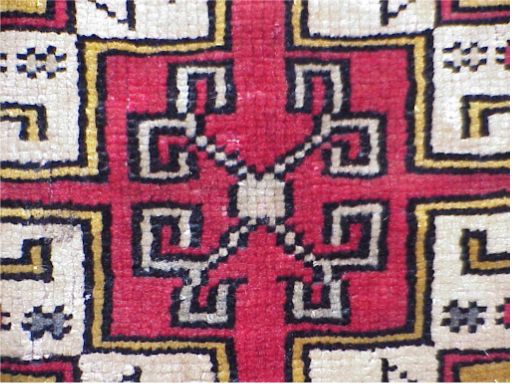
Daniel, Bob and all, The "pointing arrows"/"rosette" border in the
memling rug is familiar in another way, too. The photo below shows the
center of the medallion from an Anatolian bag of the synthetic dye era.
It, too, shows the "pointing arrows" and swastika-like "arms".
|
| Subject | : | RE:The Border |
| Author | : | Patrick+Weiler |
| Date | : | 08-30-2000 on 01:25 p.m. |
jpweil00@gte.net
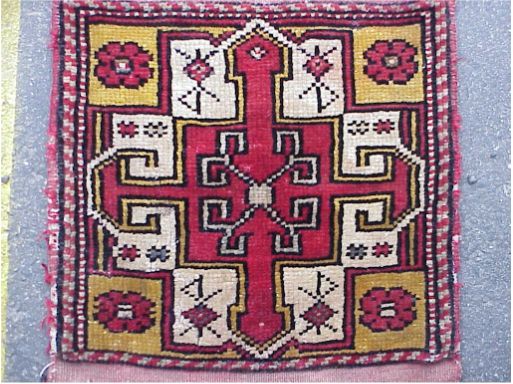
The Border, Part Two: Sorry, I hit the "reply" button instead of the
"preview" button! Her is the rest of the thread: The photo below shows the
whole bagface from the detail in the above posting. You will note that the
design has been expanded to include outward-pointing arrows at the extreme
ends of the inward-pointing arrows. Was the smaller rosette form expanded
here? Was the device in this bag shrunk down for use as a border motif?
You may note the resemblance between this bag and Wendels beautiful
Shahsavan flatwoven bagface, along with many similar Shahsavan bagfaces.
This one, however, is pile woven with symmetric knots, 2 or 3 weft picks,
undyed or red, and two ply undyed wool warps:
|
| Subject | : | RE:The Border |
| Author | : | Daniel Deschuyteneer |
| Date | : | 08-30-2000 on 01:35 p.m. |
daniel.d@infonie.be
Dear all, In the second part of my Salon I wrote that I didn’t know if the
"interlaced rosette" motif seen in the borders of my Kazak rug 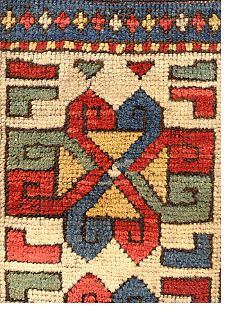 and the other
Northwest Persian rugs actually illustrated in previous postings, also
appeared in Anatolian rugs. Here are two photos showing this motif in the
center of the field of two Anatolian yastiks illustrated in Brian
Morehouse’s book, YASTIKS. and the other
Northwest Persian rugs actually illustrated in previous postings, also
appeared in Anatolian rugs. Here are two photos showing this motif in the
center of the field of two Anatolian yastiks illustrated in Brian
Morehouse’s book, YASTIKS. 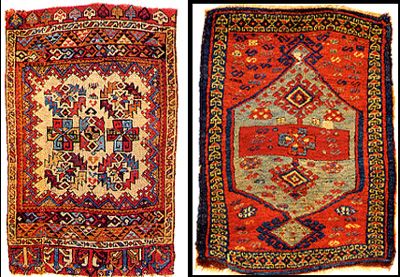 From left to
right plate 77 – Central Anatolian yastiks probably Kurdish plate112 –
Eastern Anatolia - Sivas Now, as expected, we have illustrations of the
same design appearing in the three areas. Does it have any ethnic
significance? Considering what Michael said in previous posting, probably
not. All these illustrations still don’t tell us where this design is
coming from: the warp substitution weave or an old heritage from the
Coptic tradition?. If some reader has an opinion about this it would be
best to open a new thread on this topic. Thanks,
Daniel From left to
right plate 77 – Central Anatolian yastiks probably Kurdish plate112 –
Eastern Anatolia - Sivas Now, as expected, we have illustrations of the
same design appearing in the three areas. Does it have any ethnic
significance? Considering what Michael said in previous posting, probably
not. All these illustrations still don’t tell us where this design is
coming from: the warp substitution weave or an old heritage from the
Coptic tradition?. If some reader has an opinion about this it would be
best to open a new thread on this topic. Thanks,
Daniel |
| Subject | : | RE:The Border |
| Author | : | Christoph+Huber |
| Date | : | 09-03-2000 on 09:06 a.m. |
| huber-ch@pilatusnet.ch
Dear Daniel Here is an other one with the same border:
|
| Subject | : | RE:The Border |
| Author | : | Filiberto |
| Date | : | 09-04-2000 on 03:44 a.m. |
| filibert@go.com.jo
Dear Daniel, Found another one with your border: Shahsavan runner, NWP,
XIX century, cm 322x107, lot 159, Christie’s London, Spring (April?) 2000.
I’ll try to post directly my bad scanning without bothering Steve (I do
not have a website, but may be I found another way around) |
| Subject | : | RE:The Border |
| Author | : | Filiberto |
| Date | : | 09-04-2000 on 03:46 a.m. |
| No way, it seems I have to bother Steve! Filiberto |
| Subject | : | Filiberto Boncompagni's Image |
| Author | : | Steve Price |
| Date | : | 09-04-2000 on 07:56 a.m. |
sprice@hsc.vcu.edu
Dear Filiberto, 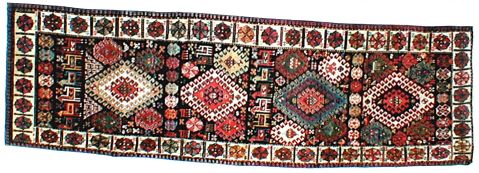 Here's the
image. It's no bother at all. Steve Price Here's the
image. It's no bother at all. Steve Price |
| Subject | : | RE:The Border |
| Author | : | Mike Tschebull |
| Date | : | 09-04-2000 on 09:37 p.m. |
| Responding to Bob and Daniel's posts - Take a look, if you haven't already, at plate 25 and related text in "Rugs of the Peasants and Nomads of Anatolia", Brueggemann and Boehmer, 1983, surely one of the half dozen rug books - if that were the limit - any informed ruggie would want to have with him were he marooned on a desert island. That group of rugs you both cite certainly has pile-woven designs that appear exactly in apparent Azarbayjani nomad carrying bags. You have to ask yourself why nomads would weave monster rugs like the Pap piece, or very long ones like the Thompson kennereh. Maybe, if you looked into relevant anthropological issues, you'd conclude those rugs were woven by settled peoples, possibly under nomad control. But why aren't there more such instances of complex design transfer? Ya gotta wonder...and not have fixed ideas in this area. My |