marlam@mindspring.com Daniel's mention of a possible "Coptic
connection" for the border rosettes on his rugs prompted me to prepare
some notes and photos. Although these overlap with the material posted by
Wendel above, my conclusions differ. Why on earth do we need a 1400- to
1500-year-old Coptic/Byzantine predecessor for these particular motifs
when there are sources directly at hand in the ancient warp-substitution
jajim traditions of Kurdish, Turkic and other western and central Asian
weavers themselves--including the prolific Shahsevan jajim weavers? I
won't bore you here with the rationale for the warp-substitution pattern
development, as I've written about that elsewhere, but instead will just
include one of several variations on the common warp-substitution arrow
motif--in this case a rather elaborate detail from a striped Kurdish
jajim. 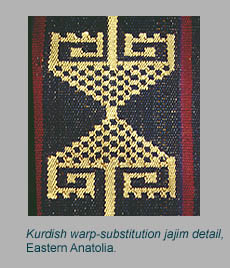 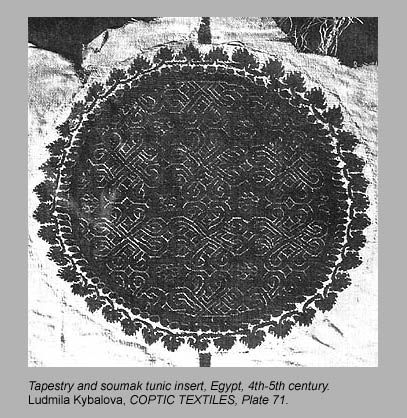 Here's the only thing I
could find in Coptic work with even a vague resemblance to Caucasian
rosettes--an Egyptian tapestry tunic insert in the standard Greco-Roman
4th-5th century interlace style. Its motif is similar to Wendel's example.
But resemblances between these and the pile rug and soumak border rosettes
are superficial. Subdivided and ornamented circles are so basic to human
expression, that comparisons make little sense unless we consider the
subtleties. The Devil's in the Details--the building blocks. The
three-dimensional continuously interlacing scrollwork seen throughout
Byzantine, Coptic and early Islamic art has little in common with
four-part multi-colored rosettes made with triangles and angular hooked
attachments--including those with eventually rounded corners. The concepts
and basic design elements are very different. Surely no logic suggests
that one idea developed out of the other. Elaborate interlaces are pen and
paper (or brush and papyrus) concepts, while the knotted pile motifs in
the arrow borders represent a straightforward on-the-loom design
development. It makes no sense to pluck fully developed examples from the
END of an evolving Caucasian/Persian/Anatolian pile-rug border
developmental sequence and suggest a dependency upon forms from a far
distant, earlier culture. When we compare the full range of evolving Asian
warp-substitution, soumak, and knotted-pile arrow borders with a range of
complex Egyptian interlace designs, passing similarities seem to
evaporate. To know the difference between the END and the BEGINNING of any
evolutionary sequence, we have to study intermediate examples--whether
it's in nature or in human design. Unless we find the missing links, there
is no way to identify derivative forms. With textiles, it is certainly
foolish to ignore the natural accommodations made by weavers to technical
and structural factors. It's still more foolish to ignore the information
provided by extant developmental series of works. Examples can always be
found to bolster pet theories, but lining up lots of fully developed
motifs tells us nothing about their evolution. The four-part "rosettes" in
both of Daniel's rugs display clear tell-tale signs of derivation from
TWO-PART motifs. The horizontal and vertical parts are
differentiated--that is, they are shaped in different ways. This
characteristic is common when composite motifs are constructed from
simpler one-directional forms--in this case a simple vertical border
figure. The first of the examples below shows a detail from a Caucasian
soumak "bug bag." The small arrow motifs in this border are identical to
those in the simplest of common warp-substitution borders. The important
thing to notice is that the two side elements in these figures are simply
triangular space fillers, with no stems or hooks. In later examples,
weavers gradually added stems, then hooks, to these side parts, forming
"rosettes." Here's the only thing I
could find in Coptic work with even a vague resemblance to Caucasian
rosettes--an Egyptian tapestry tunic insert in the standard Greco-Roman
4th-5th century interlace style. Its motif is similar to Wendel's example.
But resemblances between these and the pile rug and soumak border rosettes
are superficial. Subdivided and ornamented circles are so basic to human
expression, that comparisons make little sense unless we consider the
subtleties. The Devil's in the Details--the building blocks. The
three-dimensional continuously interlacing scrollwork seen throughout
Byzantine, Coptic and early Islamic art has little in common with
four-part multi-colored rosettes made with triangles and angular hooked
attachments--including those with eventually rounded corners. The concepts
and basic design elements are very different. Surely no logic suggests
that one idea developed out of the other. Elaborate interlaces are pen and
paper (or brush and papyrus) concepts, while the knotted pile motifs in
the arrow borders represent a straightforward on-the-loom design
development. It makes no sense to pluck fully developed examples from the
END of an evolving Caucasian/Persian/Anatolian pile-rug border
developmental sequence and suggest a dependency upon forms from a far
distant, earlier culture. When we compare the full range of evolving Asian
warp-substitution, soumak, and knotted-pile arrow borders with a range of
complex Egyptian interlace designs, passing similarities seem to
evaporate. To know the difference between the END and the BEGINNING of any
evolutionary sequence, we have to study intermediate examples--whether
it's in nature or in human design. Unless we find the missing links, there
is no way to identify derivative forms. With textiles, it is certainly
foolish to ignore the natural accommodations made by weavers to technical
and structural factors. It's still more foolish to ignore the information
provided by extant developmental series of works. Examples can always be
found to bolster pet theories, but lining up lots of fully developed
motifs tells us nothing about their evolution. The four-part "rosettes" in
both of Daniel's rugs display clear tell-tale signs of derivation from
TWO-PART motifs. The horizontal and vertical parts are
differentiated--that is, they are shaped in different ways. This
characteristic is common when composite motifs are constructed from
simpler one-directional forms--in this case a simple vertical border
figure. The first of the examples below shows a detail from a Caucasian
soumak "bug bag." The small arrow motifs in this border are identical to
those in the simplest of common warp-substitution borders. The important
thing to notice is that the two side elements in these figures are simply
triangular space fillers, with no stems or hooks. In later examples,
weavers gradually added stems, then hooks, to these side parts, forming
"rosettes." 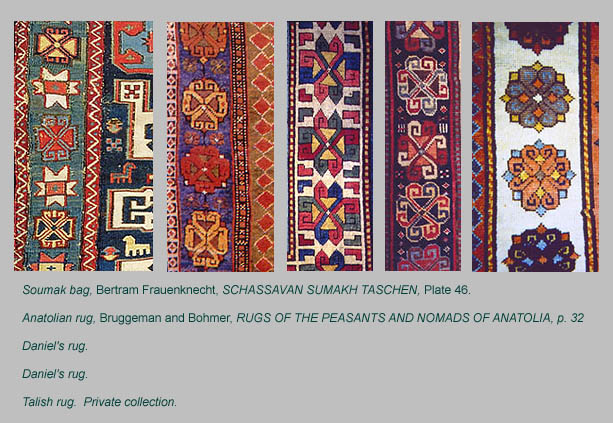 In the
second photo, an Anatolian rug border, the horizontal parts also still
appear in abbreviated form--with no stems, and with simpler hooks. Again,
it's the subtle but tell-tale horizontal/vertical differentiation
characteristic of transitional motifs. The mental processes for a weaver
working without a cartoon are distinctly different when articulating
design parts right side up versus turned sideways. It's not so easy to
immediately make them identical. To cover the problem, the artisan often
opts to emphasize differences between them. The details on Daniel's two
rugs show this exaggerated horizontal/vertical differentiation. In the
first, the hooks are pointed on the top and bottom, rectangular on the
sides. In the second, they are rounded on top and bottom, flat on the
sides. The same differentiation appears when these forms are isolated and
used as field motifs. On an earlier thread, Daniel showed a couple of such
examples on Anatolian yastiks--one with a plain, simple outside arrow
border as well!!! Even when the motif was developed further by Talish
weavers, a few of the earliest plump, refined rosettes display tell-tale
signs of their origins--hroizontal/vertical differentiation. Sorry that I
can't put my hands on one of those at the moment, but they DO exist. If
you scroll to the right, you will see one of the earliest Talish versions
that is quadrilaterally symmetrical. The scan below, from a Sahhsevan
soumak bag shows an example that expands on Patrick's astute point on an
earlier thread: The composite arrow motif here has four vertical arrows
still arranged in a border configuration. Or, one might say it has arrows
added on the top and bottom. Again, in this example, horizontal and
vertical parts are treated differently. It is no stretch to say that one
logical next step would be the addition of extra hooked arrows on the
sides, and then manipulation or reversal of the outmmost parts. In the
second photo, an Anatolian rug border, the horizontal parts also still
appear in abbreviated form--with no stems, and with simpler hooks. Again,
it's the subtle but tell-tale horizontal/vertical differentiation
characteristic of transitional motifs. The mental processes for a weaver
working without a cartoon are distinctly different when articulating
design parts right side up versus turned sideways. It's not so easy to
immediately make them identical. To cover the problem, the artisan often
opts to emphasize differences between them. The details on Daniel's two
rugs show this exaggerated horizontal/vertical differentiation. In the
first, the hooks are pointed on the top and bottom, rectangular on the
sides. In the second, they are rounded on top and bottom, flat on the
sides. The same differentiation appears when these forms are isolated and
used as field motifs. On an earlier thread, Daniel showed a couple of such
examples on Anatolian yastiks--one with a plain, simple outside arrow
border as well!!! Even when the motif was developed further by Talish
weavers, a few of the earliest plump, refined rosettes display tell-tale
signs of their origins--hroizontal/vertical differentiation. Sorry that I
can't put my hands on one of those at the moment, but they DO exist. If
you scroll to the right, you will see one of the earliest Talish versions
that is quadrilaterally symmetrical. The scan below, from a Sahhsevan
soumak bag shows an example that expands on Patrick's astute point on an
earlier thread: The composite arrow motif here has four vertical arrows
still arranged in a border configuration. Or, one might say it has arrows
added on the top and bottom. Again, in this example, horizontal and
vertical parts are treated differently. It is no stretch to say that one
logical next step would be the addition of extra hooked arrows on the
sides, and then manipulation or reversal of the outmmost parts. 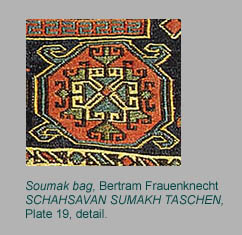 To note vaguely similar
decorative motifs from cultures separated widely by time and space proves
exactly what? That human experience and artistic inclinations display
similar tendencies just about everywhere? Why do we have such an intense
desire to prove this again and again? To play the game, though, we need to
at least avoid superficialities and refrain from using the available
evidence selectively. Marla To note vaguely similar
decorative motifs from cultures separated widely by time and space proves
exactly what? That human experience and artistic inclinations display
similar tendencies just about everywhere? Why do we have such an intense
desire to prove this again and again? To play the game, though, we need to
at least avoid superficialities and refrain from using the available
evidence selectively. Marla |
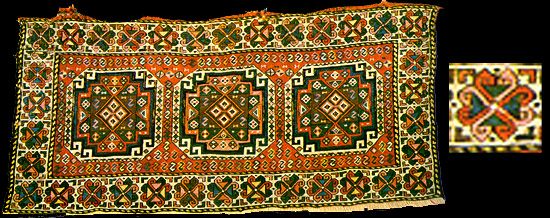 There is an undeniably similar
spirit in the long rugs, the mafrash panels and Daniel's rugs, probably
due to the color palette and distinctive juxtaposition of color. The
colors may lead us to group them all, perhaps correctly, but the designs
themselves yield no answer to their "ethnic" origin. The rug community
often speaks of certain designs as if they belong only to a certain time
period, geography or people, when in fact many are both timeless and
ubiquitous. In part two of the Salon, Daniel inquires if some of these
designs are derived from the Coptic tradition. Whether they originated in
the Coptic era or not, some of these designs can clearly be traced back at
least that far. Both the field and the border of the Pap, Rudnick,
Thompson and Emry rugs have ancestors in Coptic textiles. Here is a Coptic
tunic decoration from the 2nd or 3rd Century A. D. with an interlace
design that is little changed from those in Daniel's borders. (For
convenience, it might be called a rosette, but since it seems not to have
been a floral motif almost 2,000 years ago, I think we have little reason
to believe that more recent versions specifically represent flowers.)
Note: I have shown an inverted image on the right for the purpose of more
easily reading the design.
There is an undeniably similar
spirit in the long rugs, the mafrash panels and Daniel's rugs, probably
due to the color palette and distinctive juxtaposition of color. The
colors may lead us to group them all, perhaps correctly, but the designs
themselves yield no answer to their "ethnic" origin. The rug community
often speaks of certain designs as if they belong only to a certain time
period, geography or people, when in fact many are both timeless and
ubiquitous. In part two of the Salon, Daniel inquires if some of these
designs are derived from the Coptic tradition. Whether they originated in
the Coptic era or not, some of these designs can clearly be traced back at
least that far. Both the field and the border of the Pap, Rudnick,
Thompson and Emry rugs have ancestors in Coptic textiles. Here is a Coptic
tunic decoration from the 2nd or 3rd Century A. D. with an interlace
design that is little changed from those in Daniel's borders. (For
convenience, it might be called a rosette, but since it seems not to have
been a floral motif almost 2,000 years ago, I think we have little reason
to believe that more recent versions specifically represent flowers.)
Note: I have shown an inverted image on the right for the purpose of more
easily reading the design. 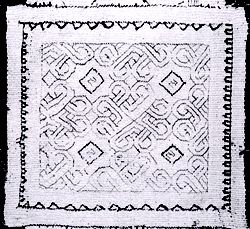 Here is a detail of the interlace at the center in its original
white pattern on black ground format.
Here is a detail of the interlace at the center in its original
white pattern on black ground format. 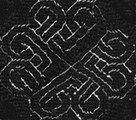 I chose this embroidered piece
from among several examples because it was easiest to scan. While the
medallions adjoin, they do not interlace with one another. However, they
do create very interesting patterns with positive and negative space;
notice that the inter-medallion space comprises an eight-pointed star with
a diamond at the center. While "Coptic" textiles cover a broad range of
styles (from the pictorial to the geometric), I suspect that almost any
variation of familiar eight-pointed stars or eight-lobed medallions could
be found among them. Next, the Coptic interlace is followed by several
interlaces in this tradition. I have aligned them in the order in which
one might say that the pattern most resembles that of the Coptic
interlace. However, I'm not certain that doing so serves any real purpose.
But the similarity to the Luri and Belouch examples is most striking. And
the Talish interlace that follows is also nearly identical in drawing.
I chose this embroidered piece
from among several examples because it was easiest to scan. While the
medallions adjoin, they do not interlace with one another. However, they
do create very interesting patterns with positive and negative space;
notice that the inter-medallion space comprises an eight-pointed star with
a diamond at the center. While "Coptic" textiles cover a broad range of
styles (from the pictorial to the geometric), I suspect that almost any
variation of familiar eight-pointed stars or eight-lobed medallions could
be found among them. Next, the Coptic interlace is followed by several
interlaces in this tradition. I have aligned them in the order in which
one might say that the pattern most resembles that of the Coptic
interlace. However, I'm not certain that doing so serves any real purpose.
But the similarity to the Luri and Belouch examples is most striking. And
the Talish interlace that follows is also nearly identical in drawing.

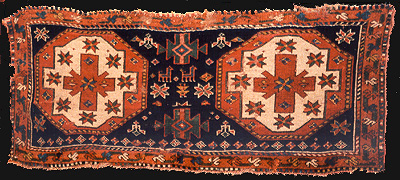
 Now I'd like to turn to the
fields of pile rugs that seem to most commonly have this interlace border.
Following are details of the Pap and Rudnick rugs (with better resolution
and color than they appear elsewhere in the salon) and well as a pile
mafrash side panel which has structural qualities very similar to those of
the Rudnick rug.
Now I'd like to turn to the
fields of pile rugs that seem to most commonly have this interlace border.
Following are details of the Pap and Rudnick rugs (with better resolution
and color than they appear elsewhere in the salon) and well as a pile
mafrash side panel which has structural qualities very similar to those of
the Rudnick rug. 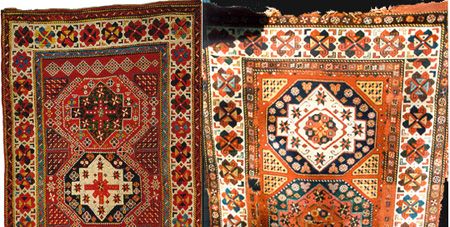
 Next we can compare these
medallions with a medallion design found on a linen and wool Coptic
textile on the far right believed to come from the 7th or 8th Century A.
D. While the color palettes are entirely different, there can be little
doubt that the designs of the NWP/Caucasian rugs are descended from the
earlier Coptic textile tradition (unless one chooses the spontaneous
recreation theory).
Next we can compare these
medallions with a medallion design found on a linen and wool Coptic
textile on the far right believed to come from the 7th or 8th Century A.
D. While the color palettes are entirely different, there can be little
doubt that the designs of the NWP/Caucasian rugs are descended from the
earlier Coptic textile tradition (unless one chooses the spontaneous
recreation theory). 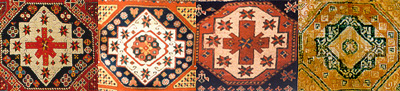 This
is an overall view of the Coptic textile seen in detail above.
This
is an overall view of the Coptic textile seen in detail above. 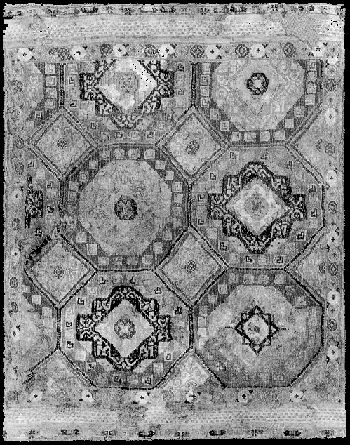 I'm unable to do more than
observe the similarity between these Coptic designs and many that we see
today. I certainly can't account for the path of descent of these designs
over the 1,200 to 1,800 years or how the Coptic styles themselves may have
evolved. I don't know where else in the world these interlaces and eight
sided devices may have existed during the first millennium. I do know that
we frequently see and discuss many other geometric patterns with ancestors
among Coptic textiles. For example, one can easily find Coptic medallions
that strongly resemble Turkmen guls. The Coptic connection raises
important issues. Knowing that the rugs that most collectors cherish have
an ancient history is both comforting and troubling. It may, for example,
substantiate the beliefs of some who are trying to establish great age for
Turkmen rugs by C-14 dating, since the designs seem to have been around
almost unchanged for a long, long time. But this knowledge does little for
those who are trying to establish narrow time slots for the rugs that most
collectors buy and own. We have great difficulties trying to specifically
date Caucasian rugs in the period before the commercial boom of the last
part of the 19th Century, simply because we collectively really don't know
much about what rugs were made in the Caucasus before about 1850. We
further don't really know much about Persian rugs between about 1700 and
1850. We can see how the dynamics of trade and commerce altered the look
of rugs in the boom period, but if certain designs can remain virtually
unchanged for more than a millennium, how can we decide, based upon
design, that any given rug was woven during a specific decade prior to
about 1850? The issues become even more problematic when we try to decide
which ethnic group produced them. Wendel
I'm unable to do more than
observe the similarity between these Coptic designs and many that we see
today. I certainly can't account for the path of descent of these designs
over the 1,200 to 1,800 years or how the Coptic styles themselves may have
evolved. I don't know where else in the world these interlaces and eight
sided devices may have existed during the first millennium. I do know that
we frequently see and discuss many other geometric patterns with ancestors
among Coptic textiles. For example, one can easily find Coptic medallions
that strongly resemble Turkmen guls. The Coptic connection raises
important issues. Knowing that the rugs that most collectors cherish have
an ancient history is both comforting and troubling. It may, for example,
substantiate the beliefs of some who are trying to establish great age for
Turkmen rugs by C-14 dating, since the designs seem to have been around
almost unchanged for a long, long time. But this knowledge does little for
those who are trying to establish narrow time slots for the rugs that most
collectors buy and own. We have great difficulties trying to specifically
date Caucasian rugs in the period before the commercial boom of the last
part of the 19th Century, simply because we collectively really don't know
much about what rugs were made in the Caucasus before about 1850. We
further don't really know much about Persian rugs between about 1700 and
1850. We can see how the dynamics of trade and commerce altered the look
of rugs in the boom period, but if certain designs can remain virtually
unchanged for more than a millennium, how can we decide, based upon
design, that any given rug was woven during a specific decade prior to
about 1850? The issues become even more problematic when we try to decide
which ethnic group produced them. Wendel