daniel.d@infonie.be
Dear all, In his Salon introduction, citing Zimmerman, R. John asked why
the flowers are so prevalent in these designs Nevber Gürsu (pages 60-61)
says that the naturalistic flower motifs which were employed in various
pattern in Turkish decorative art from the middle of the 16th century
onwards arose from the Turkish love of flowers. The Ottoman palace formed
a complex in which gardens and architecture were intimately involved. The
colorful display of flowers in the palace gardens must have formed a
source of inspiration for the court artists. Flowers in the naturalistic
style are generally represented in the colour, configuration and in the
form which they are to be found in nature. Here are pictures showing
naturalistic flower composition in wall tiles from the Topkapi Saray
Museum. 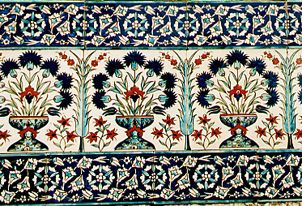 And here is a
closeup And here is a
closeup 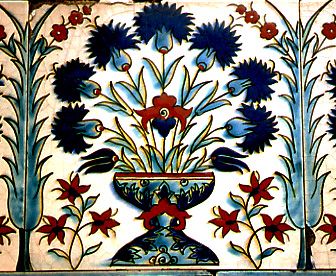 A naturalistic
flower composition employed especially in ogival medallions and ogival
systems constitutes one of the forms most frequently encountered in
fabrics. This style was applied to a wide variety of Ottoman products such
as fabrics, ceramics, tiles. Some fabrics with ogival patterns and
naturalistic flowers are already illustrated in this Salon. These were
arranged on a ground in staggered rows in accordance with the principle of
infinity. According to N. Gürsu, the ogival medallion pattern made its
first appearance in the wall-tile designs in the Rustem Pasha Mosque,
which was completed in 1560 and is not to be found in Ottoman fabrics
before the second quarter of the 16th century. This ogival pattern may
have been imported from the arts of the Mamelukes in Egypt. It influenced
first of all the designs employed in Italian silk fabrics, and
subsequently, those employed in Ottoman. The ogival medallion pattern is
essentially a rather monotonous design but combined with the inner
naturalistic patterns it is fascinating. Here are closeups from ogival
medallion in in wall tiles from the Topkapi Saray Museum A naturalistic
flower composition employed especially in ogival medallions and ogival
systems constitutes one of the forms most frequently encountered in
fabrics. This style was applied to a wide variety of Ottoman products such
as fabrics, ceramics, tiles. Some fabrics with ogival patterns and
naturalistic flowers are already illustrated in this Salon. These were
arranged on a ground in staggered rows in accordance with the principle of
infinity. According to N. Gürsu, the ogival medallion pattern made its
first appearance in the wall-tile designs in the Rustem Pasha Mosque,
which was completed in 1560 and is not to be found in Ottoman fabrics
before the second quarter of the 16th century. This ogival pattern may
have been imported from the arts of the Mamelukes in Egypt. It influenced
first of all the designs employed in Italian silk fabrics, and
subsequently, those employed in Ottoman. The ogival medallion pattern is
essentially a rather monotonous design but combined with the inner
naturalistic patterns it is fascinating. Here are closeups from ogival
medallion in in wall tiles from the Topkapi Saray Museum 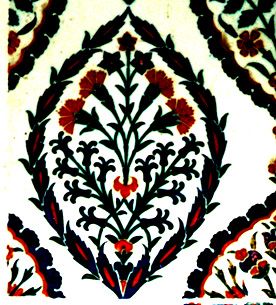 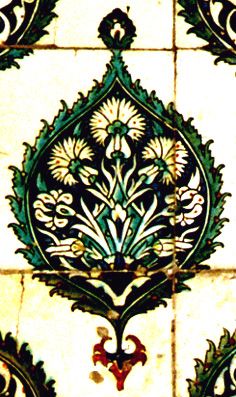 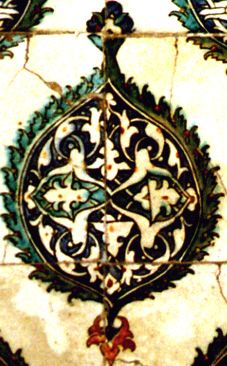 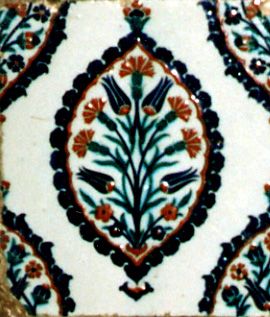 Thanks,
Daniel Thanks,
Daniel |