| h.koll@gmx.de
Dear Daniel, Thank you for your compliments, I am really a little bit
embarrassed. I am happy to say, that we were busy and can offer now a
supplement in English language to our book "Kultkelim: ausgewählte
anatolishe Flachgewebe." The supplement contains the complete text in
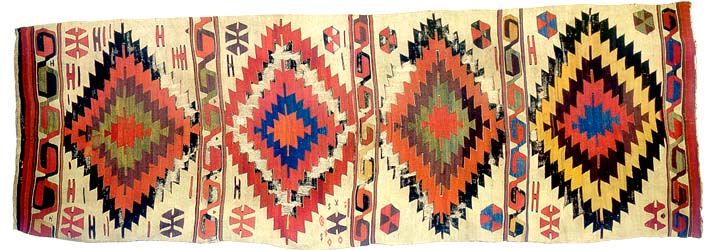
English. The kilim you are talking about belongs to a friend, and I really
like it. Udo Hirsch placed this example in a yerli-village in the south of
Karapinar, he dated this kilim in the middle of the 19th century. For
centuries Karapinar woman have been weaving kilims with this pattern: the
giant rhombi assembled from parallelograms seem to be soaring above the
white background. Tribal variations are recognizable by the color
arrangement and the separating patterned bands. The kilims shown in this
discussion are really good and I congratulate Robert Torchia. The piece Nr
14 from "Kultkelim" is particularly striking for its vast fields with
relatively few supplemental details. Emphasis was placed on the separating
bands figured in "S" shapes. Best regards, Harry Koll |
 I had
some e-mail exchanges with Harry Koll one or two months ago. He’s a very
good guy, and I will alert him about this discussion. Even if he has, like
me, some difficulties to express himself in English he will surely add
some interesting thoughts. Best regards Daniel
I had
some e-mail exchanges with Harry Koll one or two months ago. He’s a very
good guy, and I will alert him about this discussion. Even if he has, like
me, some difficulties to express himself in English he will surely add
some interesting thoughts. Best regards Daniel