Posted by Windsor Chorlton on 06-13-2007 01:05 PM:
A Modest Bag, But Where From?
Hi, all
Not wanting to be too parasitic on Turkotek's experts, I tried
hard to make my own identification of this bag's area of origin. With no
success. None of the hundreds of pieces I've viewed show this spare type of
design.
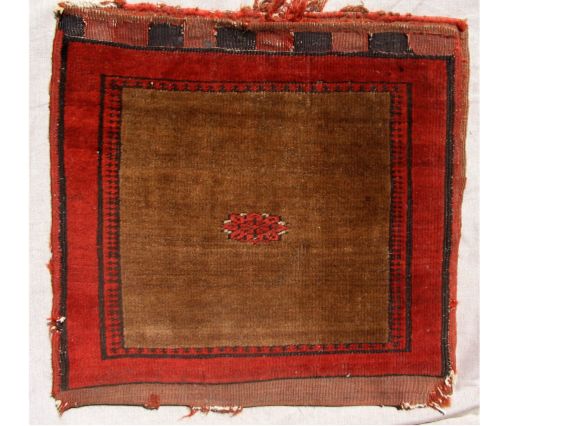
I thought that the internal 'spearhead' borders resembled those
on a couple of Baluch bags that featured in Turkotek Discussion Number 6, but
Steve Price tells me that this 'mechadyl' design is very widespread in western
and central Asia.
The central gul(?) may provide clues.
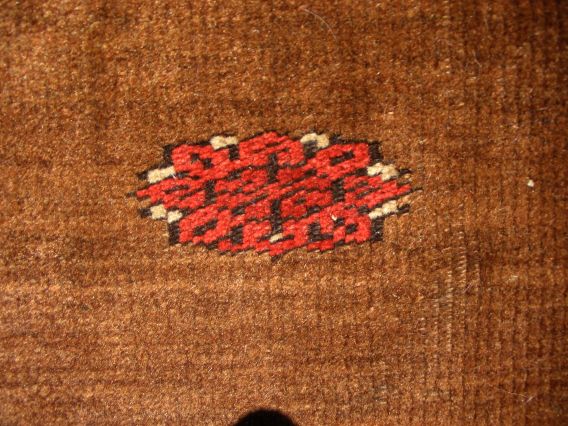
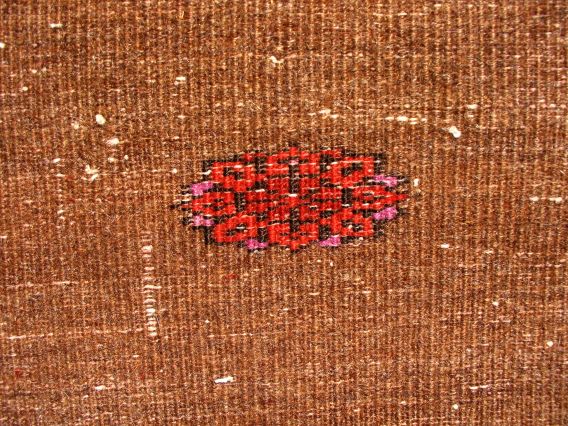
As you can
see from the back, the 'white' was presumably a synthetic fugitive
violet.
The bag is about two feet square. Colours are rich, abrashed
red, and warm oatmeal brown, all the black borders being in flatweave, which
accentuates the thick, lustrous knotted areas.
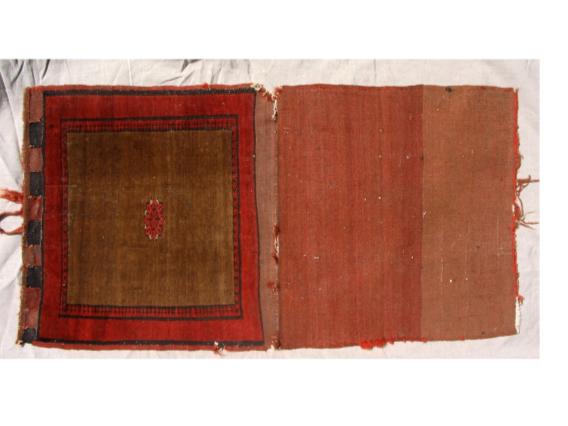
Knot structure is AsL and
count per inch is approx 6 wide and about 12 high (the wefts are too tightly
packed for my untrained eye to make an accurate reckoning).
Any info much
appreciated
Regards
Windsor Chorlton
Posted by Louis Dubreuil on 06-13-2007 02:08 PM:
Empty space
Bonjour Windsor
Your bag makes me to think to the designs we can
encounter in flat weaves of the Kurds of azerbaijan, in the Seneh and Bidjar
area (see Tanavoli, Persian Flat weaves). In those flat weaves we can find the
same use of the empty space magnifyed by the frame (a kind of window opened on
the empty universe of the sky or of the desert) and by the use of a single
object floating in the empty space. I think this design can have a mystic
signification linked with the infinity of the desert and of the sky. We find it
also in Caucasian design like Talish (the blue field can be also undertstood as
water pond in a "paradise" garden).
There are also good Seneh rugs with wide
field and sophisticated floating medalions (often the color of the field is a
sand beige made with special undyed wool). I don't know if the ASL knot can be
consistent with this attribution.
Amicales salutations à tous
Posted by Gene Williams on 06-13-2007 02:23 PM:
back and Kelim
Windsor,
Can't tell from the pictures...the flatweave back doesn't
look as if it belongs with the front. Is that orangish-brownish and oatmeal back
sewn to the flatweave remains of the front portion? or is the back actually an
integral part of the warps of the whole bag?
Gene
Posted by Windsor Chorlton on 06-13-2007 03:33 PM:
Bonjour Louis. Hi Gene
Louis' fascinating response transported me into
a dreamlike state -- 'window opened on the empty universe', 'a single object
floating in the empty space'. I'll follow up the references, but in the
meantime, Louis, Je vous remercie beaucoup pour renseignements tres
interessant.
Gene, glad to exchange words again. I take your point about
the apparent mismatch between front and back, but having looked closer at the
piece, I can say that the two halves are integral, sharing the same warps. A
useful lesson in looking, and thanks for it.
Regards
Windsor
Posted by Gene Williams on 06-13-2007 06:14 PM:
Another question
Windsor,
I'd love to see a close up of the back...the area where the
holes are..the separation zone between oatmeal and orange-brown with a picture
of the joining warps.
Also, you said the black borders are flatweave.
Both of them on the face? Does this include the "crenilated battlement" black
inside borders? Are they flat weave too? Is there corrosion in the black
dye?
Why do you say the violet is synthetic? Somehow I got it into my
head synthetic violet had to be much more stable than natural purple.
Gene
Posted by Steve Price on 06-13-2007 09:00 PM:
Hi Gene
Fuchsine is an early synthetic violet that is extremely light
sensitive; was in use in parts of western Asia from about 1875 to about 1925.
Other early synthetic violets were similarly unstable. Later dyes - say, from
1950 on - are much more resistant to fading from
light.
Regards
Steve Price
Posted by Windsor Chorlton on 06-14-2007 04:18 PM:
Hi Gene
Steve has already answered your query about light-sensitive
violets (aniline dyes used from the last half of the 19th century).
You
couldn't produce this delicate hue using natural, tried and tested, and
reasonably permanent dyes.
You asked about the black borders and
outlining, mentioning corrosion, a phenomenon I've read about, but not actually
seen -- until now. I should have looked harder before leaping. On the right side
of the face, all the blacks do appear do be done in flatweave, the outer border
looking like an extension of the selvedge.
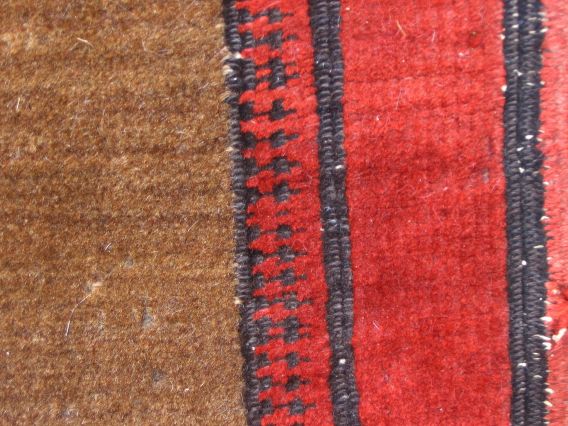
But go to upper left and,
oh dear, the border outside the crenellated design still retains some pile. And
a few other parts show evidence of knotting. Which means that all the blacks
must originally have been knotted, and what we are seeing is a textbook
illustration of corrosion, where ferrous compounds havey eaten away the pile.
(But why haven't they damaged the underlying structure ????)
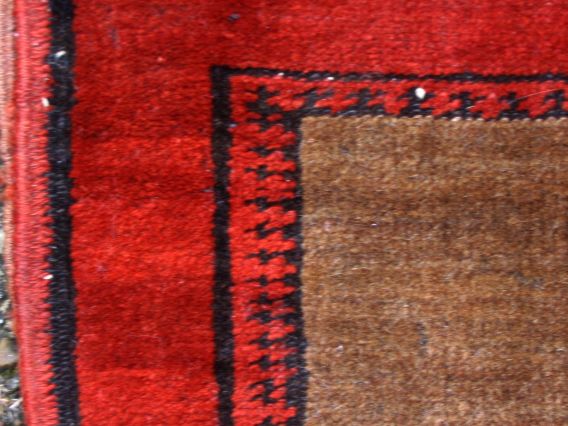
I feel I'm on firmer
ground when I say that the bag is all of a piece, the warps common to piled and
flatweave halves.
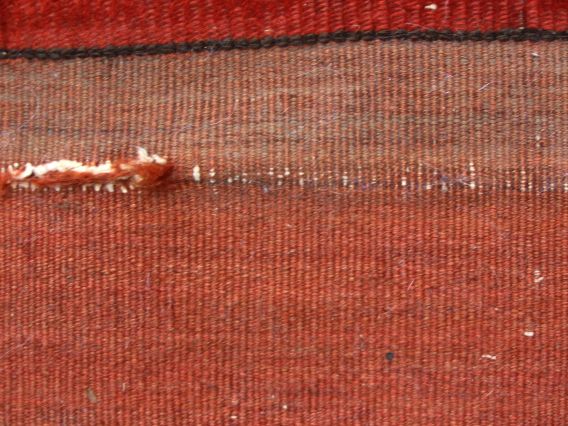
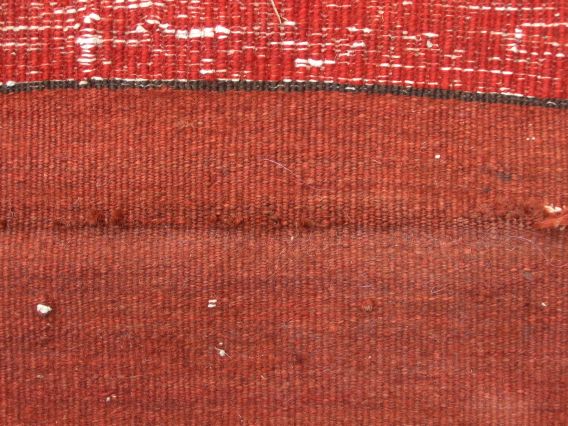
The image of the bag's
interior shows a more harmonious transition than is seen on the faded
face/back.
All this is detail. We still haven't established where the bag
came from or the weaving tradition it represents. Surely, someone must have come
across a piece that's broadly similar.
regards
indsor
Posted by Gene Williams on 06-14-2007 05:01 PM:
I donno
Thanks Windsor,
And I must say that is one very beautiful and
interesting and unique bag. The rust colored red is magnificent and recalls the
color in the best Jan Beg borders with to me a faint turkman cast. My
overwhelming irrational feeling for some reason is that it's connected to my
beloved Baluch, possibly from Khurrasan...Jan Beg.for no particular reason other
than color. David Black has a very large textile picture in his "Rugs of the
Wandering Baluch" used for dining apparently, which has pile on the
border..flatweave in the center, and which has a similar minimalist design if I
recall but with a "mina khani" or "Jan Beg" type border (I don't have my books
with me). And the Baluch did use a corrosive black called "mak" made with iron
fillings..JA even said they'd use it deliberately to create a 3D effect in 25
years (and I can affirm that it takes only 25 years for the iron to eat away the
pile).
But on the other hand, on the bag there are no Baluch designs in
the flatweave where you'd expect them..etc.
There are several Baluch
commentators on the site whom I trust...James and Richard Larkin and Michael and
Horst and Chuck and Jack (from time to time) and..and come to think of it a
number of others (I think turkotek is approaching critical mass...Baluchotek is
definitely the wave of the future). Maybe they could quantify my gut
feelings.
Gene
PS. Dyes are not my specality. but purple of any
shade in Baluch, from my experience, synthetic or natural, is very
furtive....just about any Taimani will be an illustration. I'm not splitting
hairs or anything. Its just that I'm not sure purple or violet is stable under
just about any conditions...natural of fuscine. And when you get to purple
silk...well, another question entirely. You certainly know dyes so I'll let the
experts elucidate.. "I am never chastised, only educated"
PPS. Why call
the "spearpoint" Baluch border a "Crenilated Battlement"? Well a few years ago
Jack sent me a picture of several Mogul era forts in the Punjab which used that
kind of cross design as the design for their battlements. so I assumed they were
used by Timurid Turks across the region from Delhi to
Samarkand...voila..ecco..there you go...a more logical explanation for a
border..walls or whatever rather than "spearpoints." Maybe he can find the
photo.
ppps: 17 years ago I bought my wife a ruby in New Delhi...It was
big..beautiful...but tended more towards the purplish cocchinal..still red but
vaguely sapphire like. Actually, I was looking for that exact red-orangish color
and couldn't find it except in a stone too small for my (her) taste ...oh...to
find a stone with that color...with carats behind it!!!
Posted by Steve Price on 06-14-2007 10:00 PM:
Hi Gene
If you've seen purples in Belouch rugs that are severely faded
in areas that were exposed to light, you can be virtually positive that they
weren't natural nor were they post-World War II synthetics. It's common to refer
to them as fuchsine, but there are other fugitive violets dating to roughly the
same time.
Regards
Steve Price
Posted by Jack Williams on 06-14-2007 11:33 PM:
Purple vs violet
Gentlemen, Gentlemen...please! Purple and violet are two different things
entirely!
Windsor, this is a fine and beautiful bag-khodjoin. Don't worry
about the corrosion...it adds to the beauty over time. I'll add a picture of one
of my best (my opinion) Baluch rugs with a lot of corrosion. You'll see it the
effect isn't of consequence, indeed it adds a 3D effect which is striking in the
wool.
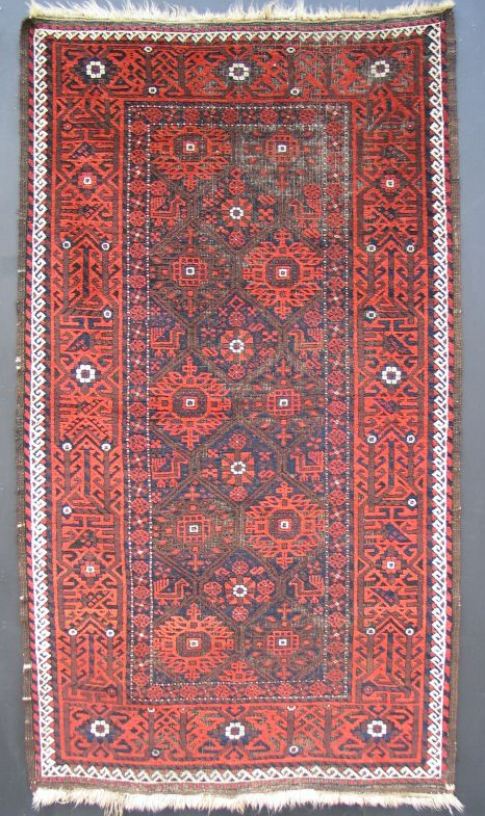
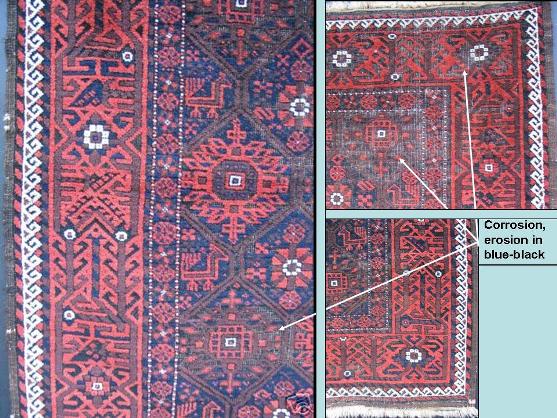
The warp and weft of your rug did not corrode probably because
they were not dyed with Mak. One reason I think the pile corrodes is that the
dye embrittles the wool. This makes it unable to withstand stress in the
engineering sense...such as produced by walking on it.
Black is not the
only color...some "blues"...usually with some black in them... and a lot of
browns will also corrode. I've heard that certain mordants will accelerate the
process, but do not know that for a fact.
I look for corrosion, but
don't sweat it too much. Gene will tell you that the wool will just corrode by
itself and point to some of his carpets that have been in a trunk for 30 years.
I still think you have to have the Mak and some physical stress before the wool
dies from dyes (heh heh).
I am fairly certain the purple faded to light
cream is indeed probably fuchine. However, this dates your bag probably to
around the turn of the 19th-20th C. (if Baluch). Also...at that time fuchsine
was pretty expensive and usually used sparingly for accent, often with silk.
Silk is a different thing entirely when it comes to dye fastness. I recommend
taking a look at the pile that is fuchsine on the back and see if it is silk. If
so, WOW!!! [Add: the entire little flower may be silk... with two reds and the
violet-fuchine]
Now...Gentlemen...a gentle remonstration. There is a
difference between “violet” and “purple.” Violet is a color in its own right
with a place at the wheel. But purple is a shade of red with some blue. You may
think this is splitting wool yarn, but it isn’t. Purple will usually be a
somewhat naturally fugitive to light because of the red component. But…violet is
another story…and believe me, a very long and complicated one. I suggest a quick
visit to wikipodia and a check on the differences between the two.
Remaining question…what is this bag? I would lean toward something
Caucasian-eastern Turkish but the type knot would be a problem. Perhaps knot
though...
Regards, Jack Williams
ps: Notice how the structure goes
from fairly depressed warps in the pile section instantly to flat structure in
the flat weave. you would think this to change the dimensions of the rug...but
it doesn't. I have a rug where this happens within the pile...depressed warps,
then a 5 inch section of undepressed warps...returning to depressed warps.
Posted by James Blanchard on 06-15-2007 01:57 AM:
Hi all,
The women of my family would call the colour on the back of
Windsor's bag "fuschia". Females tend to have a wider range of vocabulary for
colours.
I have a couple of Baluch pieces with that colour on the back,
that have fortunately faded to cream on the front.
I would be surprised
if either of them are as early as early 19th century, but maybe
pre-WWII.
By the way, I agree that the bag looks "Baluch", but it is an
unusual one if that.
James.
Posted by Camille Khairallah on 06-15-2007 05:31 AM:
Hi everyone,
I would like to have two information about this
bag:
The nature of the warp (I have a feeling it's cotton), that of the weft
if possible and the nature of the red that seems too saturated and could be
synthetic but this could also just be a screen brightness effect.
While
most of you are thinking East, I'd rather go West and suggest a possible
Feraghan (/Malayer) attribution mainly for three reasons:
1- Knot
structure.
2- Use of early synthetic dyes.
3- The use of empty
botders which was a rather common feature in the guards in that region
especially that these were either red or camel color.
Windsor, did you
test the red colour if it runs or you are sure it is
natural?
Regards
Camille
Posted by Steve Price on 06-15-2007 05:53 AM:
Hi Jack
You're right, purple and violet are different things. But you
can't distinguish those colors by eye. I haven't chased down the absorption
spectra of fuchsine or its relatives, but I'm pretty sure they produce
violets.
The fugitive dye on Windsor's piece, like many rugs in which
similar dyes were used, has faded essentially to white. If it was purple (dyed
consecutively with a fugitive red and with indigo), it would be blue on the
front, purple on the back. So, it is almost certainly a fugitive
violet.
I inserted the image into your last
post.
Regards
Steve Price
Posted by Windsor Chorlton on 06-15-2007 10:46 AM:
Burning Cotton and Fuchsine Fog
Hi all, and thanks for your kind responses
I'll start with Camille's
questions, since my answers might have some bearing on attribution. Camille, in
rug matters I'm an unreliable witness, but in this case I'm sure that both warp
and weft are cotton (the singed threads smelled of burning paper).
I
can't be so certain about the saturated red, which appears brighter on the
screen than it does in real life (Gene's description 'rust-red' is close, but
the colour varies greatly according to the angle of the light). I'd say that the
abrash points to a natural dye, as does the fact that when I washed the piece a
couple of years ago, not a hint of redness transferred to that bleached white
foundation.
I hope that might prove useful.
James, I assume you
meant early 20th century. You said that the women in your family would call the
violet colour 'fuschia' -- not 'fuchsia'. A lot of people do that, including me
when I'm talking about fuschia -- I mean fuchsia -- flowers. Maybe the correct
pronunciation sounds like an obscenity. '
Here's a fuchsine fact.
Victorian London's notorious fogs were sometimes coloured. Fuchsine smog was
sometimes produced by chemical reactions in the coal-tar emissions from millions
of domestic fires. Claude Monet was a great admirer of London's colourful fogs
-- really; he much preferred London winters to London summers. So when he
painted a magenta sky, he wasn't being impressionistic; he was painting direct
from nature, only other painters didn't know that and thought 'wow, a violet
sky; I' must try that myself.' And that's how Impressionism was born.
Remember, you read it here first. (Smilie here)
On a more serious
note, I was surprised to read in Max Doerner's 'The Materials of the Artist'
that neither pale madder, nor cochineal, nor indigo were considered to be
permanent colours. Certainly, they weren't included in the palette of most Old
Masters -- but then paint and dye aren't the same thing.
Gene, you've
been so positive in your estimation of the bag that I'd be sorry if the cotton
foundation ruled it out as one of your beloved Baluchs. Swap it for your wife's
ruby? What's a Jan Beg border? Jack, your stamina is amazing; after your Afshar
odyssey I thought you'd be lying down in a darkened room.
You both talk
about the black and corrosion. Gene, I'm not sure I buy that story about weavers
deliberately using iron compounds to create a 3D effect 30 years down the line
-- just doesn't seem to fit the mindset of practical tribal people. Jack, I
think you're right about the black dye embrittling the wool, rather than eating
it away. I checked the violet areas for silk, but it's wool, so no added Wow!
factor there.
I'm still following up some of the other comments, so I'll
call a halt for now.
Regards
Windsor
Posted by Gene Williams on 06-15-2007 01:03 PM:
Jan Beg
Windsor,
For me the Jan Beg border is the Baluch version of mina
Khani...take a look at Jack's rug above which is one version of it..the border
has inevitably 3 flowers in it.
As for cotton, if warp and weft are
cotton..It would be hard to imagine its Baluch...maybe a Pak copy but not from
what we think of as Baluch. Afshar??
I was thinking if I had any fuschine
violet in any Baluch I own. The only one I could think of is this Farah province
Taimani (I think thats what we all finally agreed it was last summer in a long
line) which does have some vaguely fading violet (fuschine?) in the small
"endless knot" medallions in the field.

Gene
Posted by Camille Khairallah on 06-15-2007 03:15 PM:
Hi Gene,
Have you ever seen fuchsine color in an old (semi-antique)
Afshar weaving?
I never did.
Regards
Camille
Posted by Windsor Chorlton on 06-15-2007 04:01 PM:
Gene
Thanks for showing me that handsome bag. ( I forgot to thank
Jack, too, for posting the image of one of his favourite rugs, showing
corrosion. To be honest, I'm such a beginner that I find it hard to process the
input that I myself have asked for. Forgive me if I don't always acknowledge
your responses as fully as they deserve).
The medallion does appear to
include pale violet. Is it fuchsine, though ? Only if the piece is first
quarterish 20th century or earlier and has been stored in a dark environment.
Fuchsine is very, very fugitive and, as Steve says, was abandoned early in the
20th century. For evidence of its tendency to fade, you need only go as far as
the National Museum of American History (www.150.si.edu/150trav/remember/r224a.htm), where they have
the gown worn by the wife of President James Garfield on the occasion of the
1881 inaugural ball. Originally fuchsine -- 'fuschine' in the website caption --
the gown is now 'oyster white'.
As Camille suggested, I headed west and
checked out the possible Fereghan/ Malayer attribution. Let's be clear. My rug
library consists of three volumes, one of which is due back at the local
library. That one lumps the aforementioned districts into the Hamadan area, and
says that 'almost all examples from the last century [20th] have cotton
[foundations]'. It also says that many early examples have 'a camel-coloured
field.' Great! Except that the same brief description describes Hamadan area
village rugs as symmetrically knotted, whereas Camille based his tentative
attribution partly on the AsL knot structure.
??
Regards
Windsor
Posted by Camille Khairallah on 06-15-2007 04:25 PM:
Hi Windsor,
You are right for the Hamadan region, as for Feraghan both
knots are used.
Anyway, if the red is natural -and I guess it is as it
did not bleed- you've got a really nice piece in spite of what was first violet
and that was probably imtemded to ward off the evil eye or
so.
Personally, I have seldom seen bags with such a silent
design.
 Bravo!
Regards
Camille
Posted by Gene Williams on 06-15-2007 05:18 PM:
Farah Province prayer carpet
Windsor,
That prayer carpet provoked a 100 comments last summer. Some
like it..most thought it strange or garish or odd or crude or one fellew even
said it was "common" (I guess he'd seen dozens or something). Its very loosely
knotted...maybe 25-30 KPSI.
Jerry Anderson wanted it for his never
published book. Lad Duane suggested Farah province Taimanis...there are a few
Taimanis there, Some around Shewan village in Bala Balok district..big opium
growing place now..no carpets being made there at all..its not economic. I've
posted several observations about the Taimani and the Chahar Aimaq and we had a
thread started by Danny Mira on Taimani..maybe someone has saved
it.
Jerry attributed the prayer rug..I threw all of them away, fool that
I am. I showed photos of the rug to the eldest rug dealer left in Herat in
February this year. He said...Farah province...80-90 years old. Who am I to
quibble.
There is violet in the rug...and you can still see traces of the
violet in the kind of curly-que designs. it hasn't gone all white...and actually
I think the front and back colors remain pretty consistent (I'm overseaqs and
don't have access to the rug). It was bought in 1976 in Karachi. Its been stored
in a trunk or hung on the wall of a usually darkened room since. Actually the
violet may not be fuschine...I'm not a dye guy...and I'm not at all sure the
Taimani would have bought dyes anyway. My feeling is that the Taimani, while
extremely intelligent (everywhere conceded in Afghanistan), were so poor they
couldn't afford diddly when it came to buying anything to make a rugs. Up until
very recently, if they could get $25 for a carpet..they'd doubled their family
income for the year. So, I don't know if its fuschine....the carpet remains
something of an enigma.
And...that aside..That bag of yours is quite
interesting and striking as Camille pointed out. Mais, je vais penser un peu...
Je quois que peut-etre nous pouvions trouver l'origin...nous
verrons.
Gene
PS. by the way, I visited some country houses around
7 Oaks south of London 20 years ago. one huge mansion rambling structure of a
palace had a "silk room" with trappings and bed made for a visit of some British
king...(one of them..one of the Stuarts maybe..I've forgotten). Its kept totally
dark..you can look at it for 30 seconds.for a pound...they're so afraid of the
colors fading.. Same with some of the Frescos in Rome in Santa Maria sopra
Minerva by Fra Angelico or Fra Lippo Lippi (I think). I guess light and color
don't mix.. If they do..its synthetic.
And Camille, in my imperfect
understanding of dyes, if red runs...doesn't necessarily mean its systhetic
Posted by Steve Price on 06-15-2007 05:42 PM:
Hi Gene
I guess light and color don't mix.. If they do..its
synthetic
Every dye is photolabile to some extent. The thing that
makes them dyes is that they absorb light at some wavelengths in the visible
range. Light has a surprising amount of energy, and absorbed light = absorbed
energy. Energy absorbed by a molecule makes things happen. Small amounts of
energy (infra-red is the low energy end of the spectrum) just makes atoms jiggle
around. Shorter wavelengths (from red to ultraviolet on the spectrum) cause more
interesting things to happen, and absorbing high energy light, especially if the
source is intense, can cause chemical reactions in the absorbing molecule. When
a dye molecule undergoes a reaction, the odds are good that the product will no
longer have color. That's why dyes are photolabile.
The natural dyes used
in antique rugs are relatively stable to light. They fade slowly. They were
probably selected, in part, for that property. Early synthetics are very
photolabile, an aggressive orange being a well known exception. In a palette of
faded colors, it looks garish.
By World War II, most synthetic dyes were
quite resistant to light-induced fading, and that is still true of most
contemporary synthetic dyes.
Regards
Steve Price
Posted by Gene Williams on 06-15-2007 06:06 PM:
Professor
Steve,
That is a elegant and very precise explanation. Thanks. Comng
from a family of engineers and professors (one sister is the black-sheep..wound
up teaching law - come to think of it, Law kind of deals with different shades
of grey right?)...where can I sign up for your chemistry class?..are you doing
anything on-line?
Gene
Posted by Steve Price on 06-15-2007 06:54 PM:
Hi Gene
I took a fling at teaching on line. Found it unsatisfying, so
I stopped doing it. Turkotek is on line, of course, but I see my role in it more
as an aggressive student and sometimes referee than as an
instructor.
But, thanks for your very flattering
remarks.
Regards
Steve Price
PS - I had a strong interest
in photobiology (vision, photosynthesis, and bioluminescence) once upon a time,
which required learning a bit of photochemistry, and included it in a cell
physiology course that I taught for years. I even have one or two outrageous
photochemistry jokes. I'll spare you that.
Posted by Windsor Chorlton on 06-16-2007 04:21 AM:
Hi Gene
The house you visited near Sevenoaks must have been Knole,
originally the home of the Sackville family, known among other things for its
connections with Vita Sackville-West and her lover, Virginia Woolf. The 17th
century tapestries are still there, still viewable by the public, but only in
strictly controlled conditions.
Some museums go even further in protecting
precious works from light and contaminents. At London's V&A, I remember
leaning to take a closer look at a 16th century miniature portrait -- only for
the glass to cloud over and black out -- making me wonder if I'd brushed my
teeth that morning.
Regards
Windsor
Posted by Camille Khairallah on 06-16-2007 05:29 AM:
Hi Steve,
Thanks for your valuable explanation on dyes and as this
thraed was unplied, I would like to ask a side question.
I know that
natural dyes never run -with water- but sometimes they fade away and so we talk
about light absorbing colors, like for instance for certain yellows.
During
ICOC XI I met professor Bohmer and as we exchanged a few ideas, some of which
were of course dyes, I told him about the good results I obtained by dying with
red onion skin as it yielded a very nice orange color. He quickly commented:"It
will not resist to light!". I said:" But I used tin mordant". He said:" It
encloses ..... (I don't remember the technical term) and you have to put the
yarn under the sun and test it."
Don't you think the mordant affects the
fastnes of a color?
Regards
Camille
Posted by Rob van Wieringen on 06-16-2007 12:37 PM:
Hi Windsor,
It looks like the empty space is full of natural camel
hair.
Do you notice any difference, by eye and by feel, in material used
for the field with the material used for the colored parts?
Rob.
Posted by Jack Williams on 06-16-2007 12:48 PM:
the evergreen (or red, or blue..) topic of dyes
Good afternoon all.
I am quite curious about this khorjin. The cotton
is a clue but the As3 knot is part of the mystery. If we…
1. Assume As3
knot places item into area where such knot is traditional.
2. Assume cotton
weft-warp is a traditional use in such an item.
3. Assume the fact that it is
a khorjin tends to indicate it is an item woven for use… more likely to be
“tribal-nomadic.”
If all the above are correct, we might focus on
Persian “nomadics” including Lurs-Bachtiari, Kamseh, Afshar, Shahsevan
(maybe…knot could be a problem) ... or the Central Asian eastern
groups….. Uzbek, Kirghiz, Karakalpak, Turkman.
Camille, dye fastness
to water generally has less to do with the use of natural or artificial dyes
then you may think. VERY early in the artificial dye era, some dyes did run when
wetted. But this was often because of incorrect dying technique. But the
same fault absolutely holds true for “natural” dyes, with cochineal especially
having a reputation for being capable to “bleed like a slaughtered hog"
(Edwards).
Improper dye amounts, failure to use proper amount and type
of mordent, wool preparation, post-dye washing, etc., is usually blamed. The
most common artificial dye encountered is red. But in the “chemical dye era,”
after the production of some initial poor dyes, by the early 1890s or so the
reds used were virtually chemically identical to one of the components of
madder, alizarin.
http://aic.stanford.edu/jaic/articles/jaic25-01-004.html
Above
is an excellent article about the effect of various energy types on wool and how
they affect dyes..this is article is “color-change 101.”
http://www.handprint.com/HP/WCL/pigmt1c.html
I don’t
want to divert yet another line onto dyes and colors. But above is a really deep
site dedicated to art…specifically painting. Painting of course requires
“paints” which of course are derived from “pigments” of different “colors”
What is especially interesting is how colors and products are judged to
be stable. A painting’s colors are judged to be stable on a different time scale
than rug colors. I think color in a utilitarian item such as rugs is “good” if
it last the life of the rug…usually pretty short. The assumed life of paint
colors is on a longer scale. Actually, for paint purposes most of the natural
dye materials used in rugs, including madder and cochineal, are judged
unacceptably fugitive for paints.
http://www.handprint.com/HP/WCL/pigmt6.html#lightfast
Of
interest is how colors and paints-pigments are scientifically measured using a
set of wool pieces dyed with indigo and exposed to light (see "Blue wool test"
in section bookmarked immediately above). The pigment-paint fastness is
expressed on a scale by comparing the fading of the paint to the rate of fading
of the indigo-dyed wool. In our world, indigo is assumed to be "fast." So much
for conventional wisdom...again.
Regards, Jack
Posted by richard tomlinson on 06-16-2007 01:14 PM:
hi windsor
the more i look at this piece the more i like it. i
have no idea where it's from - i will leave that to the experts, but i love
these minimalist design pieces.
i would guess that rob v.w is correct in
assuming the field is camel hair. as for colours, i would assume too that they
are natural and not synthetic (except for the faded purple) . i would also guess
it's early 20c ....doesn't have that 'old' feel to it.
it kind of
reminds me of a piece wendel swan posted a while back. it was a prayer rug with
a 'ghost' mihrab. that piece also had a camel field and was minimalist in
design. i can't recall the attribution but possibly NW persian???
given
that this piece works only with 4 colours, it's a wonderful change from the
busy, multi-bordered, filler motif pieces we sometimes see.
cheers
richard tomlinson
Posted by Jack Williams on 06-16-2007 01:36 PM:
the nose of the camel
Warning.
Windsor may have relatively recently found this board and may
not have read some of the topics that have come before. Therefore, I'll
respectfully amend other's above comments so that the wrong impression is not
given.
This does not affect the interest in Windsor's
khordjin...but...
It is impossible to tell true "camel wool" from sheep's
wool without a microscope. Even with the piece in hand, unless the examiner is
extremely experienced in camel wool he cannot tell, and this includes almost all
dealers even those with a life time of experience.
Furthermore, Edwards,
Eiland et. al. have noted the rareness of use of true camel wool in the pile of
carpet items Eiland goes so far as to note that every time he has examined a
carpet supposedly using camel wool, it has proved to be regular sheep. Camel
wool apparently does not lend itself to either weaving pile type items or to
longevity.
As we have discussed several times before, I personally am
very skeptical about the the use of camel wool in a carpetry item. If it has
occurred, it is rare.
Jack
Posted by Gene Williams on 06-16-2007 01:55 PM:
Camel wool on a carpet
Windsor,
Hand on wallet when camel wool is mentioned, espcially on a
working bag with holes in it. The central field wool looks somewhat different
from the border..true. But, my understanding of camel wool is...it comes from
the 2 humped camel..not the one humped dromedary.
There are 2 humpers in
the Turkoman areas of central asia...as far West as Khiva..as far east as
Samarkand, Bokhara, Tashkent, Fergana as far south as maybe the Amu Darya basin
area of Afghanistan (I haven't been there) (edit..ok ok I've been relatively
recently to Tashkent..I almost made a comment relating to the thread and
mini-skirts..Its not appropriate)....And, Fraser in 1821 noted that "fabric of
camel wool" was being made by Turkoman tribes in that area. He did not say it
was being used in carpets. He implied it was an expensive fabric (I assume used
for garments).
In Herat, Afghanistan for 8 months in Fall, Winter, Spring
2006-07 I increasingly confronted a couple carpet dealers selling to Americans
who advertised their wares as "camel wool." I asked them to show me the camels,
the sheering implements, the carders, the spinning wheels, etc. There is actally
a whole street in Herat where all the dyers are at work. These two guys finally
took me aside and said it wasn't "camel wool," but rather fine sheep's wool.
They asked me not to say anything to the others. The dyers on the street in
Herat rolled their eyes when asked about "camel wool."
Anyway, Camel wool
on a presentation or wedding piece I could theoretically believe in (but would
have to look for proof) and would have it tested. On a working bag...one with
holes in it...It'd hold the mustard please. (And I, unlike brother Jack, have
occasionally been wrong, something I freely admit, as most humans (non-aliens)
would).
Windsor, on your fascinating bag, are you absolutely sure the
warp and weft of your Kordjin is cotton? Not a white wool?
Gene
PS.
another thought...might it be Fergana..Uzbekistan..Babur's birthplace....East
Turkistan?
Posted by Windsor Chorlton on 06-16-2007 05:44 PM:
Hi, all
I went off to mow the paddock and came back to find lots of
interesting comments, suggestions and queries. I can't address any of them with
confidence, but here goes.
Rob raises the possibility that the field is
camel hair. Eye and hand tell me that the material in the field and border are
the same. I think it's sheep wool. Remember that Camille talked about 'camel
colour', not camel wool. So did the book I consulted when following up the
Feraghan attribution -- a primer for beginners like myself, by Murray Eiland
III. I think Jack and Gene are correct when they say that the use of camel hair
in weaving is very rare -- and I would guess that this bag is not one of those
rare exceptions.
Jack also talked about something that I touched on in
passing -- the fact that some colours that are considered 'fast' in weavings --
madder, cochineal -- are classed as impermanent when used as painting
materials.
Gene asks if I'm absolutely sure the warps and wefts are
cotton. Gene, when I took a close look in response to Camille's query, even my
uneducated eye said 'cotton', but to make sure, I applied a blowtorch to some
frayed warps and got the telltale smell of burning paper. However, I'm beginning
to learn that accuracy is really essential when discussing rugs -- especially in
cyberspace --so I humbly admit that I didn't apply the burn test to the wefts.
Look at the images, though, and you should be able to see white wefts that are
of the same material as the frayed warps. With a magnifying glass, I also
compared the foundation with white cotton highlighting on a Tekke (?) flatweave
chuval -- same matt surface and soft and slightly fuzzy texture. The knotted
areas are definitely not cotton.
Richard posits an early-ish 20th century
date, and I wouldn't disagree. I'm so glad that the spare design and ecomomic
use of colour have given pleasure to Richard and other
correspondents.
Jack, Gene and Richard point to many possible places of
origin. Gentlemen, I'd need an hour with an atlas just to establish where all of
them are, only to find that we'd narrowed the search area to a chunk of the
landmass between the Pamirs and the Bosphorus.
My feeling is that
Camille's Feraghan attribution -- not stated as fact, but suggested on the basis
of the bag's structureand field colour -- is the soundest put forward so far.
That's where my research is concentrated -- unless or until someone comes up
with a more compelling alternative.
Regard
Windsor
Posted by Gene Williams on 06-17-2007 05:27 PM:
E. Turkistan?
Windsor,
I been thinking about your bag a bit more…I know it has that
Crenilated border and that closure mechanism with the flatweave which looks
Baluch or one of the tribes leading from Azerbaijan down to the Seistan basin.
But I keep thinking about the cotton structure and the minimalist design with
central medallion with its slightly odd design and the asymmetric open left
construction.
Take a look further at the Uzbeks in Ferghana valley or
over the mountains into Sinjiang Province…the E. Turkistan group Yarkhand,
Khotan and Kashgar. They have cotton warps and wefts and can have a minimalist
tradition. There is the problem of the “battlement border” but the rest seems to
fit with E. Turkistan...and they did weave traditional Turkish emblems as well
as others.
Here is a Bag from ORR to illustrate the point:
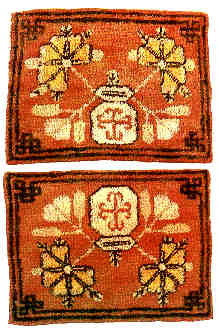
Donkey Bag_The two
panels are from a double donkey bag. The pattern seems to be a pictorial of a
vase with two flowers and leaves.
Size: 1'8"x3'2"_
Beg. End: 2" kilim with
3/4" slits
Fin. End: Same
Colors: ORANGE, ivory, yellow, brown, pink
(faded), green (faded)
Knot: Persian, left; 7 h. x 7 v. = 49 p.s.i.
Warp:
Z3, S, cotton, white
Weft: Z4,S, cotton, white, three shoots
Edge: Woven
strips, sewn on
Here is the article from ORR:
http://www.rugreview.com/116eturk.htm
at least the
structure seems close...
Gene
Posted by Louis Dubreuil on 06-18-2007 07:19 AM:
afshar
Hello everybody
I have find pictures of an Afshar sofreh with empty
field and same serrated bordure enclosing it.
I'll send the picture when
I come back home.
Amicalement
Louis
Posted by Windsor Chorlton on 06-18-2007 10:11 AM:
Hi Gene and Louis
Louis, that's great! I very much look forward to
seeing the piece.
Gene, thanks for taking time to continue your
researches. I would never have guessed that they would lead so far east. I read
the article that you kindly put up. Some of the technicalities were beyond me,
but I got the gist -- namely:
that several areas of East Turkestan used
an all-cotton foundation (more so from the late 19th century)
that they
used AsL knotting
that they were early converts to synthetic dyes
(including 'lavender ') -- so much so that by 1906 the use of vegetal dyes had
been all but abandoned
and that they borrowed designs from both east and
west.
One bit caught my attention -- where an early 20th century writer
talked of the 'strikingly warm, deep glowing red' produced by a natural madder
and indigo dye used by the Khotan. I've been a little worried that I'd jigged
the images too much, but yesterday, sitting in a dimly lit room with dusk
falling, I looked across at the bag hanging over a chair and, damn me, the red
was glowing like that ruby you were searching for all those years ago.
I
have to say, though, that -- apart from colour, possibly -- I couldn't make any
connections with the pieces illustrated in the article -- including the donkey
bag. The design says 'Chinese' to me. So, while your suggestion has quite a bit
going for it, we need to find at least one specimen that matches my bag in
design terms.
I've been dabbling in the field of cotton, trying to find
out how many other areas used all-cotton foundations. More than I'd imagined, it
seems. In fact I've found three hand-knotted examples at home. Two of them are
old Caucasians (I think); the third is a Tibetan rug made in 1981. One of the
things that sets the bag apart from these pieces is its stiffness. Whereas you
can fold the other pieces flat across the warps without flinching, you get the
feeling that if you pressed too hard on the bag, you'd break something.
So...Feraghan, East Turkestan, Afshar? Isn't Jack an Afshar
enthusiast?
Regards
Windsor
Posted by Gene Williams on 06-18-2007 03:23 PM:
Handle
Windsor,
When it comes to feeling a carpet, I trust Richard (Larkin)'s
opinion on handle. (nobody will admit to being an expert here...Richard seems to
have felt more carpets with a sensitive hand than the rest of us and can explain
it better). From the books, the leathery hard handle would indicate indeed
Feraghan. but darned if I can reconcile that tribal look to Feraghan unless some
Afshar groups were living in the area.
I'd still like to think that that
red border color is not happenstance..once you see a real blood-red ruby (not
the saphirre-like cocchinal purplish red stones whch in modern day are now
permitted to be called rubies), you'd understand why real blood-red rubies are
still the most expensive gems in the world...and imho from the screen...I think
that border mirrors the small stones I saw in New Delhi. Where can you find
those stones? India...which had long-standing trading routes running up into the
Sinjiang Basin. And those Central Asian Oaises are Turk - think Mogul-Timur
connections... really...which would explain the crenilated border. and indeed I
was thinking Khotan..though there is precious little information on what
differentiates a carpet amongst the city designs along the N. edge of the
Tibetan Plateau....then again, this isn't a city design. (train of thought of
course).
Anyway, whatever, its a unique bag and quite an intellectual
challenge. Already in my imagination I'm traveling the silk route..a romance
which is pretty much to me what the hobby is all about. I want to see Louis'
Afshar...and if I was home, I'd post that David Black Baluch Baluch dining
fabric as well for good measure.
Gene
PS. I sure you're right
about the country house near Sevenoaks (I understand there's only one left
right?..oak not house)..."Sackville" sticks in the mind after all these
years..for a strange and very unsophisticated reason. Because some hairy foot
created from an Englishman's imagination seemed to have had a cousin related to
him who tried to take over his Bag-Ends hole when he retired...reread
"Fellowship of the Ring" and "Return of the King" re the Sackville-Baggins'.
There are Canneletto's on the wall near the billard room right?
PPS. Upon
second though, I wonder how many of us actually have an E. Turkistan carpet from
the turn of the century. They weren't imported into America much (per
someone..Edwards or somebody)..they weren't much to american tastes. But they
were to India..and in 1988 in New Delhi i bought one..oh it dates to about
1900..it's pretty much gone in the pile with some reweave. It has lots of purple
and classic Chinese like E-turkistan borders with a cotton warp and weft and a
very stiff handle..Jack has seen it. It has no glowing red like Windsor's
bag..and it definitely has a much more purplish synthetic dye, city-like
patina...but the feel is what hit me..it feels like it will crack if you bend
it.
PPS. I keep thinking of something else to say...Your glowing red in
the English light at 9:00 PM. That is a purplishish feeling hour which is oddly
elvinishly addictive..I'm thinking of walking across Regent's Park at
twilight...maybe the lions roared..I don't remember... it felt strangely like
Kenya. But I do remember its a light like nowhere else..oh maybe Belgium but
without the drearyness. (you guys who don't know N. Europe and especially
Britain laugh...bring your stuff you bought in the Med or C.Asia..paintings or
carpets..and lets see how the look in British light. Light mattrers.)!
(
By the way, if you get a chance take a look at the Marian North House in Quai -
Key .. (jehosephat .. how in the world to you spell "Key Gardens" ..in
British)...
Posted by Steve Price on 06-18-2007 09:43 PM:
Hi Gene
Joy Richards sent me an email saying that you're probably
referring to Marianne North Gallery, in Kew Gardens.
Regards, and thanks,
Joy.
Steve Price
Posted by Rob van Wieringen on 06-19-2007 08:11 AM:
Camel wool
Warning:
Looking at these pictures is fully at your own risk!
It
could be hazardous for those with rigid views.
Views formed by following to
many others important noses, about the impossibility of detecting camel wool in
rugs, instead of following their own.

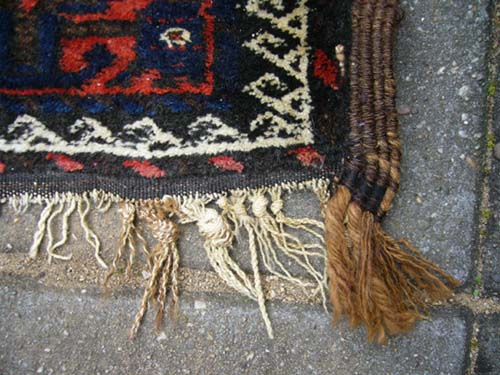
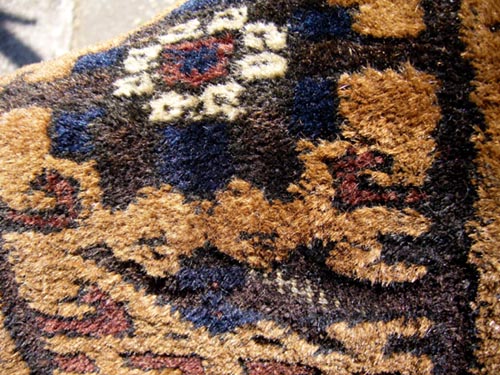
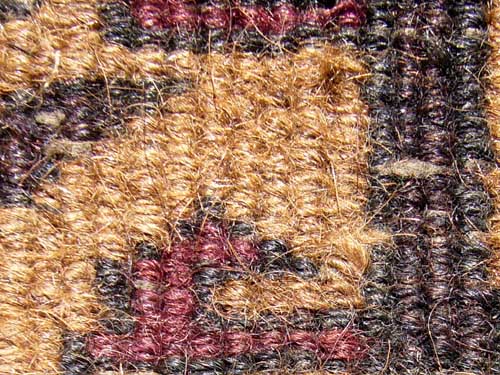
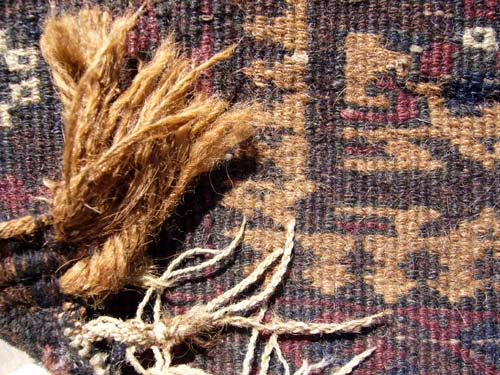
Best regards,
Rob
Posted by Windsor Chorlton on 06-19-2007 09:18 AM:
Hi all
Rob, I assume that you're saying your images do indeed show
genuine camel hair. It certainly looks like what I'd expect camel hair to look
like. Tell us more about the piece. How does the look/texture/feel compare with
sheep's wool?
Gene, thanks for doing your bit for English tourism (though
comparisons with Belgium won't bring the visitors flocking). Can't remember a
Canaletto at Knole House, but since the place has as many rooms as there are
days in the year, it's easy to miss the odd masterpiece or three. At 2 pm on
this English midsummer day, the sky's turned black and thunder has begun to
roll. I'd better post post now before the power grid
fails.
Regards
Windsor
Posted by Jack Williams on 06-19-2007 10:41 AM:
I'd walk a mile...for real camel wool.
Good morning all:
Windsor, this line has lurched into a familiar
abyss...and I’ve made the points below before. Perhaps it is useful to review
them again.

Rob, that is one beautiful Baluch. I for one would love to see a full
shot of the whole rug. It looks to be Jahan Begi. If so the camel ground field
would be especially cool, if it is old or antique which I guess it could be (the
fuzzy back might be of some minor concern). The selvedge warps and to a lesser
extent the camel-colored ground have some characteristics usually popularly
attribued to camel wool, but so does burlap. Unfortunately, I've been rudely
disabused of my illusions.
I for one would love to see a full
shot of the whole rug. It looks to be Jahan Begi. If so the camel ground field
would be especially cool, if it is old or antique which I guess it could be (the
fuzzy back might be of some minor concern). The selvedge warps and to a lesser
extent the camel-colored ground have some characteristics usually popularly
attribued to camel wool, but so does burlap. Unfortunately, I've been rudely
disabused of my illusions.
[add: Odd how the selvedge warps are so
completely different from the rug warps, so odd it doesn't look natural. Were
these selvedges added later?]
About a year-+ ago, I contacted the
Cashmere and Camel Hair Manufactures Institute, (see website, http://www.cashmere.org/cm/index.php) and posed the question
of identification of camel wool in rugs. I received a reply from Mr. Karl
Spilhaus, President, CCMI (text of his reply is included below). The
key point he makes he sums up by quoting Emily Dickinson verse, with minor
phrasing liberties...
“Faith is a fine invention when gentlemen can
see,
but microscopes are prudent in an emergency”.
His points
are:
 (a) The
fragility of camel hair makes it a questionable material for use in a rug unless
the wool uses the guard hairs of the camel;
(a) The
fragility of camel hair makes it a questionable material for use in a rug unless
the wool uses the guard hairs of the camel;
(b) Only microscopic or DNA
testing can confirm camel wool...the identification of camel from purely sensory
evidence is either impossible or that ability is confined to experts who have
extensive experience with camel wool.
Cecil Edwards, in The Persian
Carpet, p.25 writes, "There are only three of importance: [materials
used in weaver's craft] silk, wool and cotton...Some commentators appear to
have taken it for granted that the characteristic brown Hamadan rugs were woven
with camel-hair yarn. Actually, it was very rarely used in the past; and it is
never used today..." Characteristically polite, he later expresses
skepticism regarding a tale about camel wool in Baluch rugs. Dr. Murray Eiland’s
microscopic evaluation findings decades later [never once confirmed camel wool]
seem to back up Mr. Edwards’.
Some time ago I hesitantly concluded the
following:
(1)
True camel wool is a rare item in rugs;
(2) Absent microscopic or DNA
testing, a claim of camel wool should be suspect;
(3) For both geographic
(possibly) and economic reasons, the use of camel in rugs made by Turkish,
Kurdish, various Caucasian, or other western groups is probably rare, and if
used at all would possibly be in limited amounts because of the cost. Baluch use
of camel may also be suspect because of their predominent use of the dromedary
camel.
(4) Dr.
Eiland’s note that he has never confirmed a claim of camel wool after
microscopic analysis could be applicable across the board.
(5) Absent specialized
expertise in camel wool, even dealers with extensive rug experience probably
cannot identify camel wool using sensory perceptions.
And my deductions
from conclusions: *Camel wool in rugs is possibly mostly mythical.
*The claim of camel wool has possibly always been a marketing tactic
because of the high regard held for camel wool as a fabric. *This myth
has been perpetuated for so long it has come to be accepted fact by many in the
industry-hobby without scientific proof. (note: if camel wool were actually
used, I would think it might be in small personal bags not subject to foot
traffic, but that is speculation.)
I have seen some rugs items I thought
were "camel,” especially one particular Caucasian carpet from an exhibit (I’ll
look for the picture). But Sue noted once that sheep's wool has 36 (or some
such) different qualities and characteristics, depending on shear, animal, time
of shear, part of animal, etc., not counting combinations, goat hair, etc. so
whatever characteristics camel wool has, it probably has a sheep's wool twin.
I suspect that knowledgeable dealers, especially at the high-end auction
houses, know the difficulty with camel wool, hence the spread of the use of the
term “camel ground” which can simply be a reference to color, not wool
composition.
I'm open to rebuttals
Regards, Jack
Williams

Text of email from Mr. Karl Spilhaus, President, CCMI, to
Jack Williams:
Dear Mr. Williams:
Our organizations
involvement with camel hair extends only to apparel uses. The camel hair which
is used for apparel is from the Bactrian camel of central Asia, Mongolia and
China. It is a soft fibre distinguishable from sheep’s wool by the normal
microscopic methods as well as DNA extraction.
I do not know the
carpet trade but, like you, have always been lead to believe that camel hair was
often used. I also do not know the physical characteristics of the hair of the
Dromedary or typical Arabian camel. My thought is that to be used in a carpet
you would want a higher micron than that which is typically used for the fine
garments from the hair of the Bactrian camel. It is possible, however, that they
use the guard hair from either type of camel and that would be significantly
higher micron, unsuitable for garments but suited for other textile uses
including carpets.
While I do not have first hand knowledge of
the Dromedary I am reasonably certain that that hair could be distinguished from
sheep’s wool by any qualified microscopist or by the extraction of DNA. You
might want to contact one of the laboratories listed on our
website.
I would agree that sensory clues such as touch, smell and
appearance would not be a reliable indicator of the fiber except unless you were
dealing with a real expert in the field. It brings to mind a quote from Emily
Dickerson, which I am not sure I have precisely verbatim:
'Faith
is a fine invention when gentlemen can see,
but microscopes are prudent in
an emergency."
Sincerely,
Karl
Spilhaus
President, CCMI
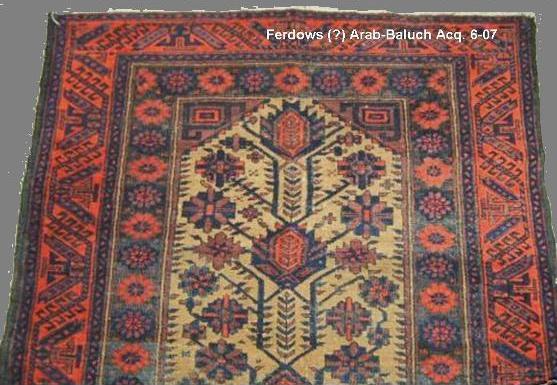
Add ed: Hopes for camel wool springs
eternal for people such as moi, ie: rigid person that I am who just follows
passively what others tell me. Here is a picture of an "Arab-Baluch" I recently
purchased. Here's hoping it proves a nice value (if not, hit the road). It was
adertised to have "camel wool field." It hasn't arrived yet, but I doubt the
"camel wool" to the point that I won't bother to get it checked at a lab. They
want too much material anyway. What we need is a post showing what to look for
under a microscope, complete with a lot of examples.
 ,
,
Posted by Marty Grove on 06-19-2007 10:44 AM:
One hump or two?
G'day Windsor and Rob,
Hey Rob, if 'tis, does it have a dryly
cottonish softness? Thats how I always remember what it feels like, and it
really appears its as rare as platypus in carpets...
Regards,
Marty.
Posted by Camille Khairallah on 06-19-2007 11:13 AM:
Camel hair
Hi all,
As already mentioned in this thread, camel hair is not widely
used in pile weavings but also not as scarce as was stated.
Relying on my
own experience (and please don’t quote me for I’m not a fiber specialist), the
touch of camel hair is soft and particularly dense –regardless of the texture-
hence hardwearing, and usually stays higher than wool with age. It is also more
vulnerable to moth attack than dyed wool.
Still, male and female camel hair
should have a different as is true for sheep wool. Color range is also quite
important going from ivory (close to wool) to dark brown.
Rugs where
camel hair occur and can be compared to wool are antique Chondzoresk: Most of
the time you will find that the camel-colored cloud-bands in the medallions have
a different touch than the rest of the wool.
Nevertheless, I guess it is
difficult to recognize and/or to remember from just one
touch.
Regards
Camille
Ps: I had just finished to write my
note when Jack sent his afar more valuable post. One can consider mine for as
much as it is worth.
Posted by Marty Grove on 06-19-2007 11:19 AM:
Camel Wool
Sorry all, I should have stated in my post above the only experience of the
wool on/from camels comes from feeling the 'wild' wool on one humpers belong to
friends which browsed around my camp, and the wonderful feel of a camel wool
coat which was bought in the Middle East in 1955.
There are speculative
areas on several of my own carpets that I wonder at, but I am as sceptical as
most here.
Regards,
Marty.
__________________
Martin R.
Grove
Posted by Windsor Chorlton on 06-19-2007 12:56 PM:
The Finer Points of Wool
Hi again
A bit of Googling yielded the following info.
Fine
woollen garments use wool thinner than 25 microns. Merinos are one of the sheep
breeds that produces wool of this fineness.
Wool thicker than about 35
microns is used for outer garments and rugs. Most crossbreeds, including the
majority of Asian pastoralists' flocks, yield wool with this degree of
coarseness.
According to the Australian Rural Industries Research and
Development Corporation, the winter coat of the Bactrian camel is from 18 to 26
microns-- that is, it produces very fine wool suitable for fine garments but not
for your common or garden rug. Presumably, if it was used in a rug, it would be
fairly easy to identify by feel alone.
This is more or less the same as
what Karl Spilhouse told Jack. He mentioned the possible use of coarser guard
hairs, but I don't know how easy or worthwhile it would be to harvest them.
That said, I'd be surprised if camel- herding pastoralists didn't use
every last bit of their woolly resources (although in a report on the decline of
camels (dromedary) in Rajastan, I couldn't find any mention of wool as an
economic by-product).
Regards
Windsor
Posted by Marty Grove on 06-19-2007 01:32 PM:
Rajasthan
G'day Windsor,
Speaking of Rajasthan, and your finding in a Report no
mention of utilisation of camel wool as a percentage of economic consideration,
surprises me a little.
I have a couple of coarse heavy kilim type
Rajasthan pieces in which a jute type fibre has been used as the weft element on
what very much appears to be camel warps.
Saying that seems a bit
hypocritical, considering my stated scepticism about much camelid fibre
constituted in weavings in general. But I join you in believing that people
living with camels in a rural environment would not waste an available
resource.
Regards,
__________________
Martin R.
Grove
Posted by richard tomlinson on 06-20-2007 12:17 AM:
hi
according to the experts who try to define what is and is not a
shahsavan piled rug, these experts often cite the use of camel wool in the pile
as a particular defining characteristic of shahsavan piled pieces.
i
guess they must all have microscopes, or are they pulling the wool over our
eyes???
cheers
richard tomlinson
Posted by Rob van Wieringen on 06-20-2007 05:37 AM:
Hi All,
About feel and texture of the camel wool in the Baluch, it is
exactly as Marty has put it : "dryly cottonish softness" and I can add to it
that, compared to the sheep wool, it holds the plying not as good, it lacks the
shiny lustre, it is more messy at the back of the rug and seems to be better
resistant to surface wear as any of the colored sheep wool surounding
it.
Jack, thanks for liking the rug ( ..it could have been yours, it was
on ebay for a week, without one bid..! ) and the selvedges are original.
I'm
not very impressed however by your arguments. I do not realy want to go in
extensive debates about the issue; I prefer the pictures to speak for
themselves. But nevertheless here are some comments.
Of course the
tendency in the trade is to proclaim every brown color instantly as: Holy Camel
Wool...but it doesn't exclude the tale to be actually true now and then.
First: Was camel wool actually used in rugs?
Edwards opinion, which I
do not consider very decisive ( his main interest was the modern ( 1950's )
carpet weaving industry ), is : "rarely used in the past", so the answer should
be : Yes. ( whatever "rarely" and "the past" is ment by him ).
Mr.Spilhaus
doesn't exclude the possible use in rugs either.
Second: Is camel wool
detectable in rugs without the use of a microscope?
You concluded, on several
occasions, that : " unless the examiner is extremely experienced in camel wool"
, it wouldn't be possible.
This isn't what Mr. Spilhaus wrote. The exact
quote is : "unless you were dealing with a real expert in the field".
So the
answer to the posed question should be Yes again.
( whatever "expert" and
"field" is ment by him ).
And last there is Murray Eiland, of whom you
stated that : "he never confirmed a claim of camel wool after microscopic
analysis".
This seems to be a strong argument.
Could you give some more
info about this statement? Where is this to find? Was he actually looking for
camel wool? What kind of rugs were his object of examination and what time frame
did he choose?
Best regards,
Rob
Posted by Louis Dubreuil on 06-20-2007 07:11 AM:
afshar hypothesis
Bonjour à tous
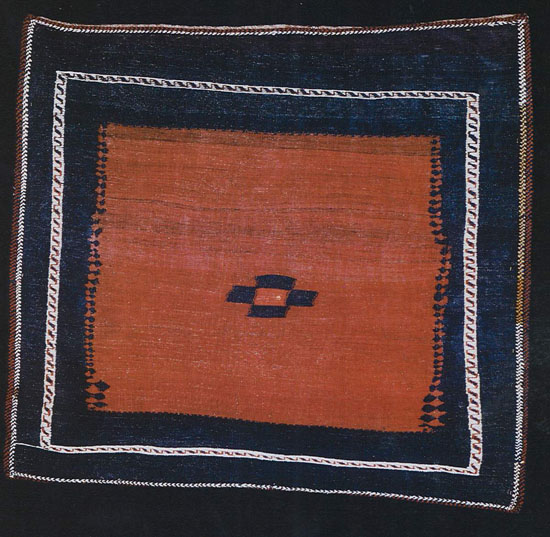
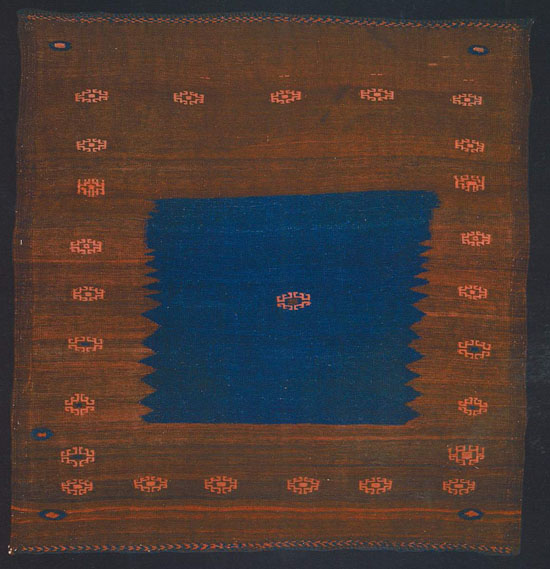
I have found in a little exhibition catalog about
Sofreh, two ex of afshar sofrehs that feature design quite near of the bag face.
The first have a field border of the same type (but coarsly executed in
a kilim technic) with a monochromatic empty field with a cen tral simple device.
The second has also a central medalion device floating on an
empty deep blue sky field.
The two ex are said to be
afshar.
This is especially the design style and the general idea we can
compare with the bag, the technic being very
different.
Amicalement
Louis
Posted by Windsor Chorlton on 06-20-2007 09:42 AM:
Simple Sofrehs
Bonjour Louis
Many thanks for posting those images. Sofrehs are new to
me -- I understand that they're dining cloths, so presumably don't take the form
of a bag -- but I have no difficulty recognizing the stylistic similarities
between these two pieces and my bag. Substitute the two central motifs, and item
one could easily be regarded as a naive version of the pile bag.
Having
been introduced to sofrehs, I did some searching and found enough examples to
show that this spare treatment is common. I also learned that knotted pieces
aren't that rare. Louis, you're probably aware that while we've been waiting for
your posting, we've been sidetracked by the topic of camel hair. Bringing the
two together, here's something I read on a commercial site, Caroun.com, which is
something of a sofreh specialist.
Speaking of Baluch sofrehs, the author
says: 'Some parts, like margins and some of middle motives, are pile woven and
the latter group is much more interesting. Ground of Baluch sofreh is
soil-coloured, woven of camel wool with fine and ornamental margins.'
Hmm.
Thanks again
Regards
Windsor
Posted by Jack Williams on 06-20-2007 12:37 PM:
healthy questioning
Good Morning all:
Rob and Richard, thanks for the camel wool replies.
It is always an interesting subject. I don’t want to hijack Windsor’s line just
as progress is being made.
Windsor, that second sofra especially seems
to have the elements of your bag. Louis you have added a lot to this with that
post. Though I am a Baluch and Afshar admirer, I might caution to perhaps search
a bit longer.
The structure, cotton-cotton-As3 knot concerns me a bit
with an Afshar attribution...especially as I think Windsor's bag might be older
than WWII (no particular reason, just aethetic hope). Unlike rugs, I don’t have
a sense for the frequency of cotton structure used in Afshar personal items such
as bags, nor do I have a feel for structural changes in time in those items.
The drawing and weaving on Windsor's bag is very precise. The central
flower and borders are meticulously done, which is often not the case on
minimalist designs. I have a memory of a item posted on this board some time
ago. Perhaps it is the same item that Richard Tomlinson is refering to. However,
Louis’ Afshar sofras are a good directional analog and could be arrow pointing
to the attribution.
Windsor, I will caution that in my opinion,
regardless of the source most declarations about camel wool are heresay, unless
proof is offered. This is true even within a respected published
reference.
Regards, Jack
Posted by Jack Williams on 06-20-2007 01:08 PM:
Murrey Eiland carries a microscope in his pocket
Good Morning again: Re: camel wool in rugs, or... Murrey Eiland carries a
microscope
Rob, here are two Jehan Begi carpets perhaps
similar in design to yours. These were subjects of discussion by Jerry Anderson
in that great interview with Hali-Tom Cole (see: http://www.tcoletribalrugs.com/article10JA.html)
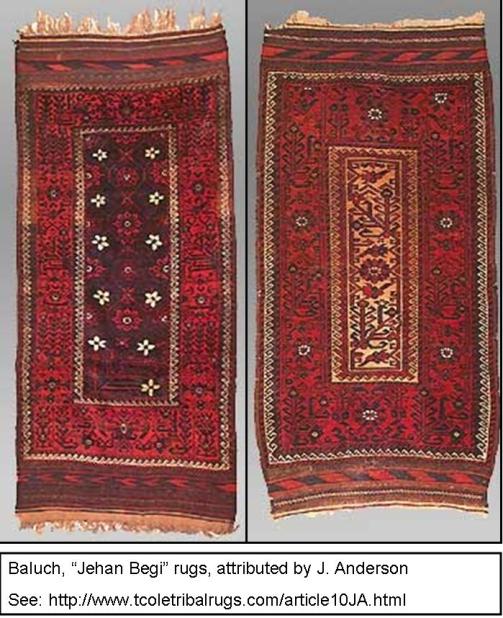
I don’t know if
your rug reaches these rarified heights. Treading carefully around Turkotek
rules, how/why I overlooked it, if I did, is a mystery, unless I thought I
already owned an equivalent example.
Camel wool is one of our
reoccurring themes, but ever without a definitive answer. Here is some more hard
data:
From Oriental Rugs, Murrey Eiland, Little, Brown and
Company, Boston, 1981, p. 48, “Camel wool is made up of extremely fine
fibers, and it is distinguished from sheep’s wool mainly by a characteristic
scale pattern and by the distribution of pigment granules. Many of the cloaks
worn by the mullahs in Iran are of camel hair, and these fabrics are extremely
soft....”
“...Nevertheless, when I have examined microscopically
the camel-colored areas of certain nineteenth-century Hamadan and Kurdish rugs,
which are often described in the rug trade as camel hair, they have always
proved to be the same sheep’s wool as that in the rest of the carpet.”
[Ibid, p. 87], “…One is assured by dealers that these rugs…are of
camel hair, but I have never been able to verify this. Camel hair provides a
soft, luxuriant cloth, both in the natural color and dyed black….Its suitability
as a carpet material is less clear. Microscopic examination of many ‘camel hair’
Hamadans reveals that sheep’s wool was used throughout…”
As
previously mentioned, Edwards was notably skeptical. However, he left the door
slightly ajar about Baluch...here is a quote from his book.
"Camel
hair is seldom used. I was informed, however, that the centres of prayer rugs,
or rugs made for priests or Sayyids are sometimes woven with it; the reason
being that the camel is regarded as a sacred animal because the Prophet rode on
one. The story is picuresque, however doubtful. Camel hair is also [my
comment: here I think he intended to insert the word “claimed” given his other
comments] used in the finest quality Balists.... Camel hair is also sometimes
used in the jahizi or Dowry rug which the bride-to-be weaves as part of her
dowry. These pieces are regarded as the best among the Baluchi rugs and are not
easy to acquire."
Decades ago, Jerry Anderson...in a statement given
in person to my brother Gene, though he did not rule out the possibility of
Baluch use of camel wool, expressed the opinion that most Baluch items
labeled camel wool were actually dyed sheep’s wool.
I don’t disagree
with much of what Rob has posted and that rug might indeed contain camel
wool, or at least some camel hair in the structure. But we had a hash of this
subject 1.5 years ago started by pictorial rugs with camel ground fields. If I
correctly recall, that line fortunately included posts by several technical
weaving people including Marla Mallet and Sue Zimmerman.
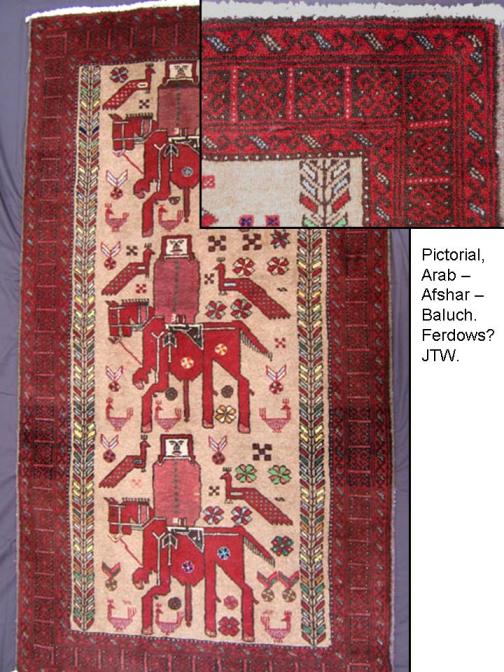
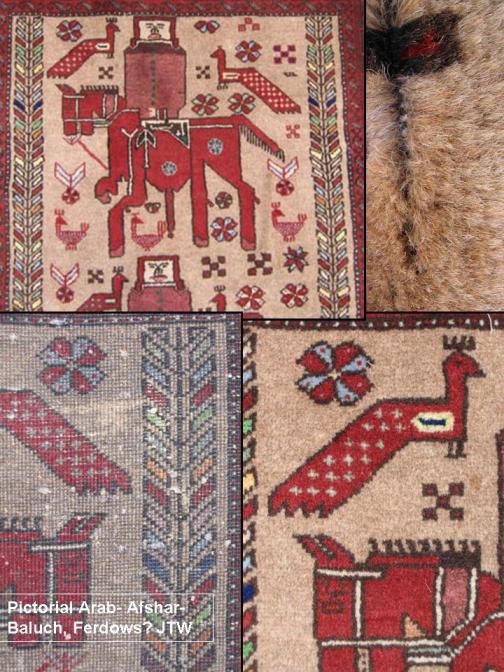
We have since
revisited the subject several times. Our previous lines have included pictures
of many items believed to be camel wool.
Our discussions have often been
fairly scientific, with a bit of heat. As I said, the "proofs" of camel wool
were close-up photos and the discussions have featured a LOT of knowledgeable
people absolutely convinced they have a camel wool rug. Yet when asked about
proof, these same experienced, cynical, and jaded collectors acted like
wide-eyed children, universally defaulting to one or all of the
following:
(1) “well the dealer, who I trust told me...,”
i.e.: default to "Appeal To Authority" (or "Anonymous
Authority" or "False Authority") argument.
(2)
“I’ve heard that camel wool looks like...” i.e.: default to folk lore and
myth about what camel hair looks like and feels like...and the possible myth
that camel hair has a consistent and unique look and feel,
(3)
“I know my rug has...” i.e.: default to strong fact-less personal
beliefs, and
(4) “This wool is different from the rest of the
rug, therefore...” i.e.: "Non Sequitur Argument," default to
unrelated facts presented as proof ignoring alternative explanation...(for
instance the possibility of jufti knots, effect of dyes on wool “feel,” etc).
In all these discussion, not a single rug could be proven to be
actual camel wooll...and without a data base of proven analogs,
identification of camel using sensory data is logically unreliable. And
this is irrespective of the natural inherent difficulties in sensory
identification mentioned by every expert in the camel wool field (consider:
there IS a reason Eiland carries a microscope with him).
When first confronted by this reality, I was amazed at the lack of facts
about the use of camel wool. Subsequently, I collected a healthy data base and
communicated with a lot of people outside of rugdom. I was further disheartened
to realize that even if an "expert" were to show examples of how to id camel vs
sheep, without proof that his "camel" examples were indeed "camel," and or proof
of his credentials, it would be just more heresay and circular reasoning (i.e.:
"I think that is camel wool because it looks like what I think camel wool
looks like'). This is where my conclusions about camel on rugs were formed.
This does NOT mean the camel wool has never been used. But...for
me, absent proof (and fabric industry experts invariably say that the average
collector must have microscopic evidence...this is the reason for the
existence of the CCMI...to test for counterfeit camel and cashmere) I
will assume a claim of camel wool to be purely a marketing
tactic...why?...because the weight of evidence has shown that to be true in most
if not all cases.
I hope to one day be able to develop a data base and
publish examples of microscopic data, thus enabling the average Joe to examine
his own rug with confidence. This is on my list of things to do...right
after....[fill in the blank].
Regards, Jack
add ed: I do recall
one post that stated a dealer in Istanbul (I think) had the ability to judge
using a jeweler's loup or glass, and had declared several items to contain camel
wool. I don't think it was followed up because I was very interested to know
what spedifically he looked for.
Posted by Windsor Chorlton on 06-20-2007 02:21 PM:
Bactrians
Hi all
Jack, no need to worry about diverting attention from Louis'
sofrehs. They're there for all to see, and I'm sure that if anyone has anything
to say, they'll say it.
When Louis' eagerly awaited message came through,
I was doing a bit more digging into the camel hair question. No earth-shattering
revelations, but for the sake of completeness, here are some more jottings.
(Skip them if you're here for rug aesthetics).
They come from
'Harvesting of Textile Animal Fibres', a bulletin published by the United
Nations Food and Agriculture Organization.
It confirms that camel hair is
largely obtained from the Bactrian, with China the largest producer (1800 tonnes
in 1987, of which more than 50% came from Inner Mongolia). The camel moults over
a six-week period, the neck hair falling off first, then the mane, and finally
the body hair. Harvesting is by combing, by shearing, and by collecting the
clumps of shed hair.
The publication states that, like cashmere, ONLY the
soft, fine underwool is used for the production of yarn. The long outer hair,
which has a diameter of 20 to 120 microns, is used to make felt for the
Mongolian yurts, for the herdsmen's winter coats, and for carpet
backing.
The dromedary is barely mentioned in the bulletin (a very
comprehensive publication that even covers the weasel). It sems that the
one-humped species doesn't qualify as an important economic resource. But...I
would have thought that, at the local level, in a subsistence economy, its wool
would be utilised down to the last hair. We have two sheep (used as lawnmowers)
that need to be sheared each year. The wool, though reasonably fine, has no
monetary value; you can't give it away. Each year it goes onto the compost heap,
but if there was a weaver in the family, you can bet that I'd have a new pair of
woolly gloves each winter.
Now I'm going back to
sofrehs
Regards
Windsor
Posted by Rob van Wieringen on 06-21-2007 05:38 AM:
To conclude
Hi Jack,
So what looked to be a strong argument from Murrey Eiland,
based on examination a broad range of different rugs, appears to be one based on
examination only Hamadans and Kurdish rugs, of which the trade claimed they
contained camel wool.
Rather thin ground for a conclusion like : "he never
confirmed a claim of camel wool". This could be true as such of course, but it
suggested much more then there is.
To stay with semantics....one other
good reason for the tales around camel wool in rugs is the simple explanation
that the word "camel" has double meaning: the animal and the color.
As I
already thought and as shows in many posts here: the direction to point a
microscope at ( if you insist ..) should be the
Baluchi's.
Regards,
Rob
Posted by Gene Williams on 06-21-2007 07:49 AM:
Baluch and camel wool
Rob,
The point about Baluch carpets and camel wool...having been up
into Baluchistan and along the Afghan border from Seistan to Khorrasan...is
there aren't any two humped Bactrian camels there to my knowledge. That was my
problem with the Herat rug dealers this last winter.
Now, Boucher donated
his rug collection to the Indianopolis museum. I met Boucher and McCoy-Jones as
I've recounted in 1978-79. Boucher claimed camel woool in several of the Baluch
carpets in his collection..see his book "Baluch Woven Treasures." I doubted it
in 1979 (but didn't have the guts to speak up..he was a former colonel with a
dominating manner..we talked mostly of Jerry Anderson)....and I still doubt
it...so much so that I'll send an e-mail to the museum and ask if they've ever
had the wool in the carpets he claimed was camel analysed.
And Jerry did
mention Camel Wool in a Baluch carpet in his interview with Tom Cole (see "from
the horse's mouth")...even saying that camel wool was dyed in Seistan...not what
he told me directly in my three years of contact with him...but I could be wrong
... or he mispoke with Tom.
Still, the idea of getting a good picture to
post on Turkotek of Camel Wool under the microscope compared to sheep's wool..is
very appealing.
Gene
PS. Windsor, in that JA interview, he
mentions Ferdows "Baluch" rugs being woven on a carpet foundation. That starts
me wondering again about your bag...Ferdows Baluch would fit from what I know of
them.
Posted by Camille Khairallah on 06-21-2007 08:38 AM:
Hello all.
Marty, Rob and I have the same approach to recognizing
camel-hair... Would that be a pure coincidence?
Not wanting to talk for
others but I guess we all believe in scientific facts, BUT!…If we agree on a
pile fiber bearing a definite description that is different from dyed wool in a
same given rug and that is neither wool nor camel hair, I wonder then what this
strange camel-color fiber could well be…
As for the sofreh that are
similar to the bag, one could count half a dozen sofreh provenances that are
equally similar. But would the pile weavings of those be technically similar to
the bag? Would the colors fit as well (including the fuchsine that we nearly
forgot about)?
Regards
Camille
Posted by Steve Price on 06-21-2007 08:50 AM:
Hi Camille
Marty, Rob and I have the same approach to recognizing
camel-hair... Would that be a pure coincidence?
Unlikely to be a
coincidence, but the fact that you all learned the same thing only means that
what you learned can probably be traced to a common source. Certainly, either
all three of you are right or all three of you are mistaken.
If we
agree on a pile fiber bearing a definite description that is different from dyed
wool in a same given rug and that is neither wool nor camel hair, I wonder then
what this strange camel-color fiber could well be…
Not all sheep wool is
identical, even from the same sheep. Spring and fall shearings, effects of
dying, for example. You don't really KNOW that the camel colored stuff isn't
wool, only that it seems different from most of the wool in the same
rug.
I don't know how to recognize camel wool or how common or rare it is
in textiles made at different times and places. But in the absence of definitive
evidence (testimony of someone who has handled lots of sheep wool and wool that
is unquestionably camel wool would do), I'm skeptical about whether anyone here
has yet presented trustworthy criteria for identifying
it.
Regards
Steve Price
Posted by Rob van Wieringen on 06-21-2007 10:48 AM:
Hi Steve,
Quote :
" ..'Marty, Rob and I have the same approach to
recognizing camel-hair... Would that be a pure coincidence?'
Unlikely to be a
coincidence, but the fact that you all learned the same thing only means that
what you learned can probably be traced to a common source. Certainly, either
all three of you are right or all three of you are mistaken."
Marty's
source for his information was: Handling a camel in the flesh. ( sounds a bit
odd...).
Ergo: what he learned was correct--> ergo: all three of us are
correct, following from your statement.
Well, that was an easy one,
Steve.
Regards,
Rob.
Posted by Steve Price on 06-21-2007 11:07 AM:
Hi Rob
I must have missed Marty's having handled camel hair while it
was still attached to a camel. That's plenty good enough to convince me that it
was camel hair, and to persuade me that all three of you have it
right.
Thanks
Steve Price
Posted by Windsor Chorlton on 06-21-2007 01:02 PM:
Hi all
I pat my dog, stroke my cat, and from time to time have run my
fingers through a woman's hair. But I don't think I'd know which hair was which
if they were woven into textiles.
Regards
Windsor
PS Don't
tell my wife I said that.
Posted by Gene Williams on 06-21-2007 01:36 PM:
Dromadary
Rob,
Unless I'm mistaken, Marty "handled" a one humper. One hump
dromadaries do live in the Baluch speaking areas and all the way over to Iraq.
..heck..all the way over to Morrocco. So, I've concluded that if there is camel
wool in those carpets then someone is using wool from dromadaries.
That
might be both a problem and a solution since we've focused on high end, small
micron camel hair as used in sports coats which comes from Bactrian camels-two
humps. Still, before I'll reach a conclusion that wool from dramdaries are used
in Baluch carpets...I need some scientific proof.
Its not that I
distrust Marty and his sense of feel...or for that matter you...its just at this
point I have conflicting information. On one side is you, Boucher and a large
number of other "oh it must be camel hair" Baluch owners; in the other corner is
Eiland and Edwards and the camel hair institute.
If anyone can show that
dromadary wool is being used..then we are closer to convincing me to believing
in camel wool in carpets. And I asked this question in Herat...noone could tell
me where the supposed "camel wool" they were advertising in their carpets...some
was "dyed"... was collected, carded or spun..it just sort of "appeared."
I'm still going to contact the Indianopolis museum and see what they say
about Boucher's collection. Perhaps someone with connections could talk to the
Textile Museum in Washington DC about the subject as well (I'd do it but am
overseas; John Howe though goes there from time to time)...maybe we can get some
tests run for free?
In the meantime, Rob you believe that that Khorrasan
Jan Beg you exhibited above has camel hair in the selvedges. There should be
enough wool strands there to test without destroying pile...why not do
it?
Gene
Posted by Marty_Grove on 06-21-2007 02:01 PM:
G'day all,
While its true that I have handled (tremulously) camels and
their coat a bit, they are of the one humped variety which is pretty
conclusively stated in many writings NOT to be of the type which is useful/used
in the making of carpets.
On the dromedarys belonging to my friend Gordon
there are several distinct types of hair/wool, and this is also dependent on
whether its winter or summer. Also the colours vary considerably.
I would
LIKE to believe that I have weavings which contain camel wool, if only for the
'romantic' sensation this gives me, however as said before, I am as sceptical as
the next person if only because having read so much in the negative about useage
of camelid wool in carpets.
The only POSITIVE woven camel hair/wool use I
have experienced in my hands is a now old 1955 camel hair coat of remarkable
softness which is as I described as 'dryly cottonish soft' - and which also
applies to certain areas of wool on the dromedary camels I have
touched.
Its the range of colours carried by the camels AND woven stuff I
think MAY be camel which leaves me wondering - none of mine have that classic
'camel' colour shown in the old Baluch rugs.
Its as bewildering to me now
after years of contemplation as it was originally, this conumdrum about camel in
carpets, but just as entertaining
Regards,
Marty.
Posted by Gene Williams on 06-21-2007 02:01 PM:
Arab Baluch
Thanks Marty...I think we narrowed down the problem and maybe even can find a
solution to the camel wool question.
In the meantime, coming back to
Jerry Anderson's notation that "Arab-Baluch" around Ferdows make "cotton based"
carpets...if this is true...Then I can readily believe that Windsor's bag is
Arab-Baluch. It looks like a baluch, has the colors of a Baluch...Its just that
darned cotton base. And heck, if its Ferdows...there are plenty of Afshar
connections there as well,. I'll post here what Jerry had to say about
it.
Here is Tom Cole's interview:
http://www.tcoletribalrugs.com/article10JA.html
And
here is what he had to say.
.... "HALI: And no.2 in the HALI Baluch poll
article?
.... "JA: Arab, just like he says, but from Firdows (26). I’m sure
it is woven on a cotton foundation. It’s more Baluch than most rugs from
Firdows. As I said before, they are usually a Persian type of rug."
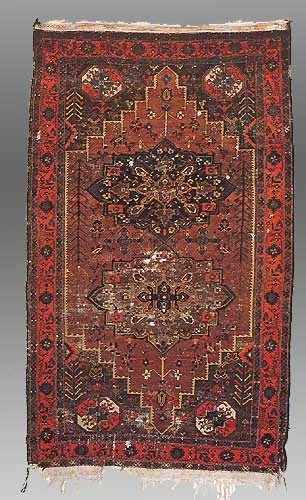
Here is the
description:
26. Arab Baluch carpet, Firdows area, Khorasan, 19th
century. 1.42 x 2.54m (4'8" x 8'4"). Warp: Z3S, white cotton, on one level;
weft: mostly white cotton, some grey, 2 shoots, loosely packed; knot: 2-3Z,
wool, AS open right, 9H x 10V = 90/in2 (1,395/dm2); sides: 1 cord of 2 3-4Z(Z3S)
cotton warps overwrapped and secured to sides with wefts around the outer cord
in figure-8, covered with simple overcast of goat hair; ends: top – balanced
cotton plainweave with 2 shoots of indigo wool flanking remants of weft
substitution zig-zag meander. ‘Baluch Perspectives’, HALI 59, p.114, attributed
to “Qain or Torbat-e-Heydariyeh, late 18th century”, subsequently reattributed
as “Arab or possibly Afshar, Birjand district, late 19th century”. Anne Halley
Collection, courtesy Adraskand Inc., San Anselmo, California.
The
important point for me relating to Windsor's bag is not the design of the above
carpet...which does look Afshar doesn't it?... but rather the cotton structure.
Can anyone confirm that cotton based pile rugs and bags are made around
Ferdows?
Gene
PS. Check out the crenilated battlement inner border
and the ground color on the outer border.
Posted by Louis Dubreuil on 06-21-2007 02:58 PM:
camel hair
Here is a picture of camel hair
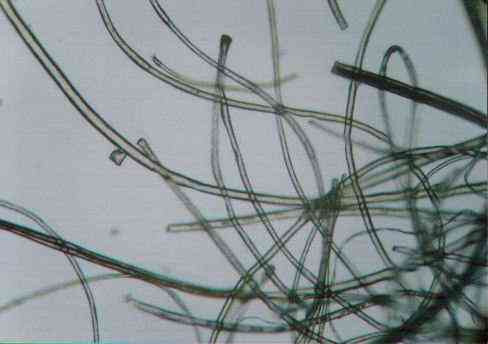
Louis
Posted by Jack Williams on 06-21-2007 03:43 PM:
I respectfully recall the great Red Baron, always a dogfight with a
Sopworth Camel
Gentlemen...Louis, as usual you have offered up some facts not
opinions...thanks.
I respect the knowledge and experience of those who
regularly participate here, and those in the business. And I always enjoy these
type of exchanges, because often I am driven to learn something new. I even think that somewhere, sometime, someone used some camel
wool in something other than a some garmet, perhaps even in some type of
rug.
However...
- The head of the CCMI says you
need microscopy to identify camel wool...and says sensory perception will not
suffice...
- The CCMI relies on lab tests to confirm or deny camel wool,
not someone's sensory opinion...
- Murrey Eiland carries a microscope and
checks behind dealers...invariably finding sheeps wool, not camel... and does
not claim to be able to tell camel by sensory perception, hence his use of a
microscope...
- Cecil Edwards says "camel wool was rarely used in the
past and never in the present [about 1950],"
- It is shown that classic
camel wool comes from the Bactrian, and that the Dromadary is the camel
primarily used by the Baluch, for transport, meat and milk, and it produces less
than one-fifth of the shed of a Bactrian...and none of the fine hair...
-
It is testified that true Bactrian inner coat "camel wool" in a fabric sense is
expensive, thin, fragile, soft, difficult to dye, and slippery and is thought to
be unsuitable for use where walked upon...[throw a camel wool coat on the floor
and see how long it lasts].
- References in the literature to use of the
guard hairs of the Bactrian camel separately from the inner fleese are generally
lacking...as is evidence of how it is woven into rugs, etc.
- For over a
year, the subject of camel wool has filled gigabits of band width on this
board with hundreds of posts from numerous experience hobbiests and
dealers, most of whom declare that "their particular rug is camel wool,
regardless of facts." Yet no one has shown a single example of a
proven camel wool rug to illustate to others what the material allegedly
looks like, or even if it has a distinguishable "look"...
Despite
the above, yet again people I respect for their insights and knowledge about
rugdom swear that they are different from the rest of the world...they
know what camel wool in a rug looks like and can tell it on sight, unlike the
CCMI, Murrey Eiland, Cecil Edwards, et. al. And yet again not one example
of proven, real camel wool is presented, nor a resume of experience with
camel wool.
[My mate Marty at least said he owns an old camel
wool jacket and has actually seen and touched a Dromadary camel...which is so
impeccably honest and guilless that I am truly impressed] [add ed: that was
written before Louis' post, which just goes to show even moi can be
hasty]...
I sincerely hope someone, someday, will share a data base of
proven examples of camel wool used in rugs. So far, no such luck...just more of
what everyone has one of...an opinion. And sometimes I think that if the
information exists, why should someone share it? All that will happen is that
people will swear that the published characteristics are incomplete because they
exclude their personal rug, which they KNOW has camel wool...
So, I'll
simply re-post something I previously wrote and return to searching for the holy
grail of Windsor's khordjin...
...Yet when
asked about proof, these same experienced, cynical, and jaded collectors acted
like wide-eyed children, universally defaulting to one or all of the
following:
(1) “well the
dealer, who I trust told me...,” i.e.: default to "Appeal To Authority" (or
"Anonymous Authority" or "False Authority") argument.
(2) “I’ve heard that camel wool looks like...”
i.e.: default to folk lore and myth about what camel hair looks like and feels
like, without even knowing if camel hair has a consistent and unique look and
feel,
(3) “I
know my rug has camel wool...” i.e.: default to strong factless
faith-based personal beliefs, and
(4) “This wool is different from the rest of the rug,
therefore...” i.e.: A "Non Sequitur Argument," default to unrelated facts
presented as proof ignoring alternative explanation...(for instance the
possibility of jufti knots, effect of dyes on wool “feel,” different
combinations of carded wool, etc).
Regards,
Jack Williams
New Orleans,
"proud to crawl home"
Posted by Gene Williams on 06-21-2007 04:44 PM:
$ late & L= short (no symbol for pound)
Jack,
We-Nous (Louis et moi) already solved it. Windor's bag is an
Afshar-Arab-Baluch from the Ferdows area. Should be close enough.
Gene
(There you were getting side-tracked as usual on peripheral issues..and
forgetting the first point in Clauswitz's principles from "On War"...i.e.
Objective.)
Posted by Gene Williams on 06-21-2007 06:39 PM:
Crenilated battlement vs. spear point
Hi all,
I've referred to the Baluch "spear point" border as a
crenilated battlement..I mean "spear point" seems vaguely stone age. Here are
two images illustrating my point..the first from the mosque in Lahore and the
second from the famous Mogul fort at Attock (the battlement there is not what I
was looking for - there are other forts which have that cross design on the
battlements..I've been in several..I just don't have access to my library)
...both from the Mogul period ...imported from Central Asia by Babur (the
Timurid turk/mongol) and/or from Iran via his son Humayun (who took refuge there
with his Kizilbash cousins..though Shi'i). (you'll recall Babur's last attempt
on Samarkand failed about 1520 because he was using in large part a Persian
Kizilbash turkman-presumably including Afshar - JA says it should be spelled
Afsar who are related to the Ersari - Shi'i army which outraged the locals.)
What do you think? Logical?
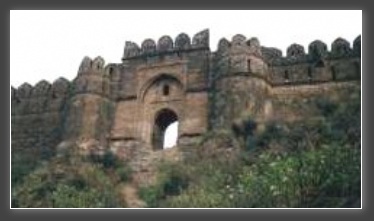
Besides..."battlement
border" has a certain ring.
Gene
Posted by Rob van Wieringen on 06-21-2007 07:23 PM:
Hi Gene,
"In the meantime, Rob you believe that that Khorrasan Jan Beg
you exhibited above has camel hair in the selvedges. There should be enough wool
strands there to test without destroying pile...why not do it?"
Yes, why
not. Good idea.
Enough selvedges there to settle this down once and for
all.
Any volunteers ( with knowledge and a microscope ) to send a sample
to?
Regards,
Rob.
Posted by Patrick Weiler on 06-21-2007 08:33 PM:
I Want MORE
Louis,
Do you have a photo of sheep wool with which to compare the
camel hair?
I have a small 60-100x hand-held microscope with an integral
light, about $10 at Radio Shack, that shows the wool in my "camel hair" gabbeh
that looks like the photo you showed. The areas of camel hair show finer,
thinner strands than the adjacent wool areas, too.
But the minute differences
are not easy to discern without a picture of sheep wool for
comarison.
Thanks for the picture!
Patrick Weiler
Posted by Richard Larkin on 06-21-2007 09:53 PM:
Hey gang,
I'm jumping into this thread very late, and in truth have
only skimmed all the entries. Please forgive superfluous or redundant
comments.
I thought we had killed this camel wool in rugs issue, but it
comes back. I was voting for "yes," based chiefly on having seen a "different"
type of fiber for the camel color in many Baluch rugs, a la Rob's example. I'll
hold out for that proposition in the face of all the microscopes in Afghanistan
(or San Francisco). However, assuming the truth of my assertion, it doesn't
necessarily prove camel hair. It could just as easily reflect a variant grade of
sheep's wool, turning up in that particular color for some plausible
reason.
About Windsor's bag. It doesn't seem Baluch to me, especially if
the red is the shade my monitor is providing. The incidental decoration and
finish doesn't suggest Baluch either. Neither do I see Feraghan or the greater
Sultanabad area, except that it is Persian knotted. It could really be from
anywhere and anybody. It's different.
[Aside to Gene: I really
appreciate you putting me up there in lights, but if I have pretended to some
special talent or expertise in the "handle" of rugs, I hereby confess it was
fraudulent. I have no doubt that at least half plus one of all the TurkoTekkers
out there could at a minimum handle rugs with me, grab for grab. My chief point
about handling rugs is, in the cases of some of these ambiguous "mystery" rugs
that seem to be pretending to be several different types (ubiquitous on
TurkoTek), one would like the chance to handle them to narrow the
possibilities.]
__________________
Rich
Larkin
Posted by richard tomlinson on 06-22-2007 03:53 AM:
hi
i think we SHOULD pursue this by microscopic verification of as
MANY samples as possible (from as wide a variety of weaving groups as possible)
i therefore urge anyone who thinks they have camel wool in a piece they
own to forward a sample to whoever is to undertake the testing.
let's see
for once and for all...
regards
richard tomlinson
Posted by Windsor Chorlton on 06-22-2007 05:51 AM:
Hi all
It's not difficult to find microscope images of sheep's wool on
the internet, but for a meaningful comparison with camel hair, you'd have to
subject selected samples to the same analytic techniques (Apologies for stating
the obvious). My impression is that 'ordinary' sheep's wool (not superfine
merino or similar), is pretty distinctive, being much scalier and more crimped
than the camel fibres image posted by Louis.
Gene, thanks for showing us
the inspiration for those 'battlement' borders. The problem, as Steve told me
even before the thread opened, is that the border pattern is used in many
different weaving areas.
Can it really be that the bag is unique? Unique
not good. Unique bad.
More later.
Regards
Windsor
Posted by Richard Larkin on 06-22-2007 06:14 AM:
Windsor,
Unique good. Trite bad.
__________________
Rich
Larkin
Posted by Steve Price on 06-22-2007 06:50 AM:
quote:
Originally posted by Windsor Chorlton
Can it really be that the
bag is unique? Unique not good. Unique bad.
Hi Windsor
No question about it, the bag is unusual.
In my experience, all you have to do is say "one of a kind" ("unique") out loud,
and a dozen more just like it appear out of nowhere. So, I'm reluctant to say
"unique" about any rug.
Is unique bad? Unique is frustrating because
collectors like to pin labels on their stuff, and that's generally easiest with
the commonplace, most difficult with the rare. Other than that, I think most
collectors enjoy the unusual and are attracted to pieces that are out of the
ordinary.
Regards
Steve Price
Posted by Camille Khairallah on 06-22-2007 10:03 AM:
Hi Richard,
If someone had seen a similar signed bag or one that had
comparable features + a trait that would point to a specific attribution, I
guess the thread would have stopped long ago.
Hence, while we are trying
to narrow the target, I believe, without being 100% sure, that the closest
attribution is the Feraghan area. And until someone comes up with a new
"convincing" provenance, I retain Feraghan.
You said:
quote:
[Neither do I see Feraghan or the greater Sultanabad area, except that it is
Persian knotted]
Can you please explain why (all of us believing that it has
an unusual design)?
Regards
Camille
Posted by Marty Grove on 06-22-2007 10:09 AM:
Testing Testing
G'day all,
With regards to Wiltons bag; it certainly has something
which interests and even piques a few of us for the difference it exhibits. The
cotton foundation has been considered fairly unusual in this type of weaving
although we dont really know its origin.
The red border dye has attracted
the ultimate description, akin to ruby (best mogok red Gene?) and it has what
could be called elegant simplicity with a very minimalist field design of only
one small medallion.
I like the 'crenellated' border which may literally
be a rememberance of castles from ages past.
Steve has put it nicely in
reply to what could be called a certain uniqueness in saying that most of us
like the unusual and out of ordinary pieces we may encounter.
This can
also be applied to Robs rug with the possible use of camel selvege cords and
field wool. Perhaps we would really like to confirm if camel wool is in our rugs
because we know it is unusual to find it, and the camel still conjours a
romantic past.
As for the testing of camel wool, Im up for it from a
couple of my rugs - I would dearly love to know for certain because I honestly
do believe that frugal people utilise everything which they can, and if they
live with camels then the wool from them would be used,
somehow.
Hopefully someone with enough interest and resources in 'is it
or aint it camel' will put their hand up to organise a testing of a bunch of
hairs from a not too large number of Turkotekkers
In
anticipation,
Marty.
Posted by Steve Price on 06-22-2007 10:23 AM:
Hi Marty
Microscopic inspection of fibers isn't very labor intensive.
Pat Weiler has a microscope at his disposal; I do too, and I volunteer my
services along with Pat's. The most time consuming element will probably be the
record keeping - matching the samples to particular rugs. If this isn't done,
it's a waste of time.
Another aspect, though, is that whoever does the
examination has to be pretty sure he knows the differences between camel wool
and sheep wool, in all their variations. Neither the sheep nor the camels in
western and central Asia are clones - there are bound to be lots of variations
in each. Consider the variability in hair type among humans (even in my own
family - my wife's hair is fine, mine is coarse, my son's is kinky - he's
African American).
Sheep wool samples from rugs of different times and
places are readily available (it only takes a few fibers to do a microscopic
examination), so that isn't a problem. Pat and I (and anyone else doing it) can
probably train ourselves to recognize the variations in sheep wool pretty
easily. Maybe there are good published microscopic photos of various kinds of
camel wool - that would help a lot.
Regards
Steve Price
Posted by Marty Grove on 06-22-2007 10:26 AM:
Guileless
Thanks Jack, I dont know about being guileless but I have been called
'gormless' which is English for 'not having much of a clue' which term more than adequately
describes my certain knowledge about the things which we (or more properly
'moi') discuss on these pages.
'En chuckle',
Marty.
Posted by Marty Grove on 06-22-2007 10:34 AM:
About how
G'day Steve,
Thanks, I agree entirely, and as a furtherment to doing
the testings, what about we photograph the rug we are testing the wool from with
also a closeup of/from the area where the wool was taken, attach the wool
somehow without contaminating it with glue or such and whistle it off to
whosoever of you has email the address or post box to which we might send
it.
Crikey, technology strikes me again - dont remind me, having to get
one of those newfangled digi cameras ugh! Im still using my Minolta
XE...(and only recently having given away my Box
Brownie)
Regards,
Marty.
Posted by Windsor Chorlton on 06-22-2007 11:55 AM:
A Word from Wilton
Hi all
I was being tongue-in-cheek about the bag being unique. I doubt
very, very much that it is. I think it was Gene who used the term; others have
described the bag as 'unusual', 'out of the ordinary', 'a puzzle', etc, all of
which are indisputable on the basis of the evidence so far.
'Is unique
bad?' Steve asks. In the marketplace, the answer is 'Yes, possibly.' if by
'unique' we mean a piece that doesn't fit the known pattern. Most collectors are
conservative. They chase those scarce items that are clearly classified,
categorized and catalogued. They want to be able to display a piece that's
undisputably Feraghan, or Baluch or Kazak or whatever, not one that could have
come from any of these areas or none. As for the truly unique object, it
presents a peculiar problem because it is so rare that, unless it has rock-solid
provenance as well as aesthetic appeal, there is no established market for it
and therefore no way of estimating market value (As soon as it's sold, the price
paid is the value).
I lean towards a city connection with this bag --
woven in a village for sale in an urban centre. I have an image of the bag
slapping up and down on the flanks of a prosperous merchant's mule. See what
flights of fancy this rug business bring on.
I chuckled at being called
Wilton. Marty, not everything in this world is
rug-connected.
Regards
Windsor (somewhere near Axminster)
Posted by Marty Grove on 06-22-2007 12:24 PM:
Its true
G'day Windsor, humble apols,
Talk about freudean When I was writing of being called
gormless, an english word probably unknown to the Americans, my own englishness
was prominent and with rugs also, it was a slip twixt the cup etc etc - thats my
story and sticking to it...
Curiously,
Marty.
Posted by Jack Williams on 06-22-2007 12:35 PM:
"MOM, do I have to do everything?"
RE: Camel wool testing. See:
http://www.cashmere.org/cm/testinglabs.php
("Mom...why
do I have to do everything?...")
RE: Testing methods. I wonder
if the CCMI would be interested in a project. If so, it would be nice to
experiment with some high-end items that are thought by a concensus to
have camel wool. If the CCMI were interested at all, and Steve did not want to
do the dirty work, I wonder if someone like Dr. Eiland (or Tom Cole, or Richard
Wright) would be interested in lending their expertise, expert emeritus or
some such... especially if the results proved to be publishable.
RE: "Unique-1." I opine that Windsor's (a.k.a. "Winston,"
'Wilton," "William," "Wilheim," et. al.) bag is unique as the term is
popularly used...in that I havn't seen anything quite like it, especially the
careful weaving of a minimalist design. It is generally assumed a "Khorjin" is
used on an animal. But actually, many seem to be just carried over the human
shoulder as a shopping or tote bag...hence the narrow connection between be bag
(I have pictures showing this...I'll add them later).
RE:
"Unique-2" Windsor, regarding collector's attitudes, I'll be happy to
evaluate your khorjin for you. Please forward it to me with a stamped return
box. Add extra postage because I may need to keep it on my wall for a while to
get the feel of it and postage rates will probably rise considerably during that
time.
RE: "Unique-3" Rob's rug also has a very unique feature. I
have never seen such selvedges on a rug. If original, weaving would have
required some careful pre-planning for using the radically different size and
material yarn when threading the warps.
The odd warp knotting at the
ends of his rug may just be a recent attempt to minimize further end damage, or
just less than stellar original work. But the radically different selvedge warps
look so different that it may affect the way the rug is regarded pictorially. I
would love to hear some weaving expertise opine about this... Hey Sue!
(ground control to major Sue...) how about returning to Earth and giving us the
benefit of your expertise?
Regards. Jack
Posted by Marty Grove on 06-22-2007 01:33 PM:
Iconic expertise
Thanks Jack,
Your terrific suggestion has just dropped me out of
it I dont HAVE any high
end stuff (never paid more than a grand Au for any) so will only be able to read
of it, not participate - what a bummer...
I really love how you pull
everything together - makes for an easy read. And I generally agree - must be
something Baluchiphile which created your gung ho acquisitive and successful
inquisitive self, or maybe just being second string timewise to bro
Gene.
Chortlin' Marty.
Posted by Gene Williams on 06-22-2007 03:36 PM:
must agree
that..and possibly being an alien...and me being the handsome one.
I
mean, who would choose to live below sea level...(humm..all you dutch guys...no
offense, you don't have hurricanes...except in 1953...I'm talking about the
latest lake in N. America)
Posted by Richard Larkin on 06-22-2007 09:35 PM:
Hi Camille,
About why I'm not persuaded towards the Feraghan area. As
I see that group of rugs: there are the classic old Feraghans, characterized by
Persianate designs rendered in asymmetrical knots on cotton foundations (warp
and weft), slightly to moderately depressed warps, wefts quite visible at the
back of the rug (this is important), a generally precise and regular weave,
a lighter color tonality [featuring a particular soft green and (on some) a soft
yellow], and a somewhat light (in weight) weave; there are Mahals, which are
similar to the Feraghans as noted above, but coarser, more brightly colored and
often not so regular in the weave; there are the old Sarouk types, showing fully
depressed warps in a Persian fancy workshop style of weave; and the "American
Sarouk" types, a studied kind of commercial production also exhibiting fully
depressed warps, with a rather rigidly consistent pallette and design.
As
I look at Windsor's bag, the only aspect of it that suggests the Feraghan area
is the Persian knotting with cotton foundations and slightly depressed warps.
However, I don't see this combination of features to be so distinctive as to beg
the Feraghan attribution. On the other hand, it lacks the distinctive Feraghan
"look" in the weave, which is characterized mostly by the look of the wefts. If
you have the Neff and Maggs book, which talked about "weave patterns," there is
a good example in it. The coloring of Windsor's is decidedly un-Feraghan-like,
as well as the pattern. Finally, I'm not aware of any quasi tribal or rustic
production from that area that would make me say "Feraghan."
__________________
Rich
Larkin
Posted by Camille Khairallah on 06-23-2007 06:11 AM:
Hello Richard,
You are talking about a precise weaving style of the
Feraghan that occurred in the second half of the 19th c. of which the Maggs/Neff
example is a typical one.
I would like to emphasize on two
points:
1 – Feraghan is a region and not a city and there are many
villages involved in knotted rug manufacture and I guess their number progressed
between let’s say 1870 and 1920 (being the approximate date of manufacture of
the bag). And while a typical 19th c. Feraghan was well described by you and so
can we describe a typical 19th c. Saruq or a 19th c. Malayer (or Mishin-) or a
Mir rug of the same period. But while we advance in time towards the 1920s a lot
of combinations appear like Feraghan-Malayer or Saruq-Malayer etc… and this is
due in my opinion to the progressive number of villages in the region that
started knotting rugs and combined features of different villages.
2 – We
should also bear in mind that technique of weaving and especially material
specificities change with time: An 1880 Mohtashem has nearly nothing to do with
a 1930 Kashan knowing that both cane from the same city… I am not only referring
to the wool quality or to the design or palette but for instance to the way the
threads (warp, weft or pile) were spun: thinner/ thicker, even/coarse,
hand/machine.
You also mentioned the colors of a typical 19th c. Feraghan
but you missed to mention the camel color that is often used in empty
border-guards, a feature that is typical of the Malayer/Feraghan region and that
is seldom seen in pile weavings of other rural areas. This is a hint that can
also be retained for that possible attribution.
Furthermore, a saddle-bag
that could have well been woven for personal use does not have to follow very
accurate aesthetic characteristics that are typical for a given production and
that the market is used to.
Besides, to be fair, "quasi tribal" or "rustic"
are not adjectives I would attribute to a rather fine piece with a well-centered
"medallion" and a relatively fine workmanship.
We all agree on the unusual
design of the piece and if you have another -or a more accurate- attribution, I
guess all would be pleased to discuss it.
Regards
Camille
Posted by Sue Zimmerman on 06-23-2007 09:41 AM:
What's this?
... Hey Sue! (ground control to major Sue...) how about
returning to Earth and giving us the benefit of your expertise? ...
Jack,
If little slave kids could do it so can you. Enter the REAL learning curve. You
don't have to be a chicken. Go for it. Sue
Posted by Richard Larkin on 06-23-2007 10:39 AM:
Hi Camille,
I agree with everything you say. I focused on the
"classic" 19th century Feraghan and Mahal types because they had some features
in common with Windsor's bag as to weaving: cotton foundations, asymmetric knots
and slightly depressed warps. I felt those resemblances were superficial,
however, and that Windsor's fabric did not seem (from look on my screen) to
belong with them for the reasons I mentioned. Your reference to subtle
differences among weavings as to matters such as weight of materials, their
processing, etc., is well taken, as it is these circumstances that lend to
various weavings their special character. I would be surprised if the subject
bag matched up with old Feraghans when compared at this level.
As to the
broader range of products from the region (which are not, in my opinion, very
much elucidated by combination labels like "Malayer-Sarouk", "Feraghan-Sarouk,"
etc.), there is little to suggest kinship with this piece in my opinion, any
more than other weaving regions over there. One can just as plausibly place the
piece farther to the Northwest, or the Southeast, and say that the anomaly is
the asymmetric knotting. I am at a loss to place the piece myself. I just don't
see any special likelihood in the Feraghan area. As you noted, if the origins
were obvious, the thread would have stopped already.
Your point about the
camel color used in some Malayer work is a good one, but I disagree that it is
seldom used as a plain field color elsewhere. Kurdish rugs, Serabs, Baluch, old
Hamadans, etc., are all known for this use of camel dyed wool. By the way, I
don't consider the terms "quasi tribal" and "rustic" to be denigrations of
Windsor's bag. Some of my favorite rugs are quasi tribal and rustic looking. I
think this piece is of the character we are referring to as we commonly apply
those terms.
One last point, a question for Windsor. Forgive me if it's
already been mentioned in this thread. The little dots of strong pink in the
central device that faded to white on the surface look like they could be an
alternate material to wool, such as cotton or silk. Is this possible? I also
harbored the thought that, from the look of the image on the screen, the
knotting might be symmetric. But I guess not.
Best regards!
__________________
Rich
Larkin
Posted by Richard Larkin on 06-23-2007 11:26 AM:
Hey folks,
Oops! I see that Windsor has already addressed the question
of the material of the pink knots.
What really bums me out is arguments
over points that don't mean a g. d. ("gol darned") thing. So let's get into one.
I'm referring, of course, to "violet" vs. "purple." My sweetie, Martha, the last
word in all matters of color, says that "violet" is the technical name for the
color on the wheel. "Purple" is a lay person's casual term for the same color
and nearby shades of the color. Y'all got it? (Martha's from Mississippi.)
__________________
Rich
Larkin
Posted by Windsor Chorlton on 06-23-2007 11:29 AM:
Silk and Knotting
Hi Richard, Hi Camille
I followed your exchanges with interest, but
I've got a long way to go before I understand the nuances.
Under a
magnifying glass, I couldn't find any trace of silk in the medallion -- the
material is the same throughout -- a shiny, stiffish but not coarse
wool.
I got a nasty sinking sensation when you asked me to confirm my
asymmetric knot aim. I know what As knots are, but have never examined them at
the macro level. My claim was based on general appearance and 'feel' -- the fact
that the pile 'leans' towards the left and that there is much more resistance
when rubbing the pile from left to right. Also, I compared the feel with a
couple of Kazak Caucasians, which I understand always use the symmetric knot. I
sure hope I haven't been misleading you guys all
along.
Regards
Windsor
Posted by Richard Larkin on 06-23-2007 11:55 AM:
Windsor,
My comment about the knot description was based on the
thought that, sometimes, the pile will lay to one side and mislead one into
thinking "Persian" (i. e., asymmetrical) when the reality is "Turkish." This is
especially apt to happen when the warps are slightly depressed, as in yours,
causing the pile to lean.
The fail-safe examination is to look at the
base of the knot where the yarn wraps around the vertical element of itself. In
asymmetrical knots, one end of the pile is wrapped by the collar, and the other
protrudes from between the collars. In the symmetrical version, both ends of the
pile yarn are wrapped by the collar, and there is no pile end protruding between
the collars. In many pieces with the Asymmetrical knot, you can fold the rug
along vertical lines to expose the pile, and the line of pile strands between
the collars will stand out prominently.
Kabish? (My best guess, looking
at the images, is you were right the first time.)
__________________
Rich
Larkin
Posted by Camille Khairallah on 06-23-2007 12:49 PM:
Hi Richard,
Thank you for the comment but as Frenchmen say with an
"if" Paris would fit in a bottle.
As for the camel color, I'm afraid you missunderstood what I
meant.
I was refering to the empty border and not to an open field (or empty
camel-color field), and that this feature (empty border) is essentially found in
old (rather antique) Malayer border guards and that it is usually of camel
color.
Anyway, when I first mentioned Feraghan at page 1, I added
Malayer- between brackets.
I also noted that the use of an early sythetic dye
also points -beside the other features- to that region.
Regards and nice
week-end to all.
Camille
Posted by Richard Larkin on 06-23-2007 01:04 PM:
Camille:
I take your point about the open border area, but surely,
that usage is not limited to old Malayer work, right? By the way, my slight
disapproval of the terminology ("Malayer-Sarouk," etc.) was not aimed at your
using the terms, but rather, the rug study fraternity/sorority. We have to use
the terms given to us. Anyway, my concern isn't that great.
__________________
Rich
Larkin
Posted by Gene Williams on 06-23-2007 05:29 PM:
Sue's expertise
Sue,
I think Jack meant the following. Of all the people on Turkotek,
you're the only one that I know of who actually cards, spins and dyes in a
traditional manner. (I still intend to get you your spindles, etc. out in W.
Afghanistan...I'm just not there right now). That's more important now than
design interpretation.
So the question is...have you ever carded, spun
and dyed camel wool? If so, where do you get it? How does it feel? Does camel
wool stick together like sheeps wool...i.e. is it "scaley," or is it more
"slippery"..non stickable?..how does take dyes?
Gene
ps. If I once
again (in a long line stretching back 60+ years) have misunderstood Jack...I
humbly apologize.
Posted by Richard Larkin on 06-23-2007 06:09 PM:
Hey Gene,
I think Jack was also inviting Sue to return to earth, as
in, from outer space.  Steve would be able to explain it. The idea is, it is sometimes hard to get what
Sue is trying to tell us. Too much stream of consciousness, unsignalled turns
and missing links in the chain.
Steve would be able to explain it. The idea is, it is sometimes hard to get what
Sue is trying to tell us. Too much stream of consciousness, unsignalled turns
and missing links in the chain.  It tends to get under Steve's
skin. For my part, I often think there's something really there if I were clever
enough to follow the rationale. But we love Sue, and I'm with you, Gene, as to
she could tell us a lot on this one.
It tends to get under Steve's
skin. For my part, I often think there's something really there if I were clever
enough to follow the rationale. But we love Sue, and I'm with you, Gene, as to
she could tell us a lot on this one.
__________________
Rich
Larkin
Posted by Jack Williams on 06-23-2007 07:01 PM:
Because you're dyeing to know...
Hello all.
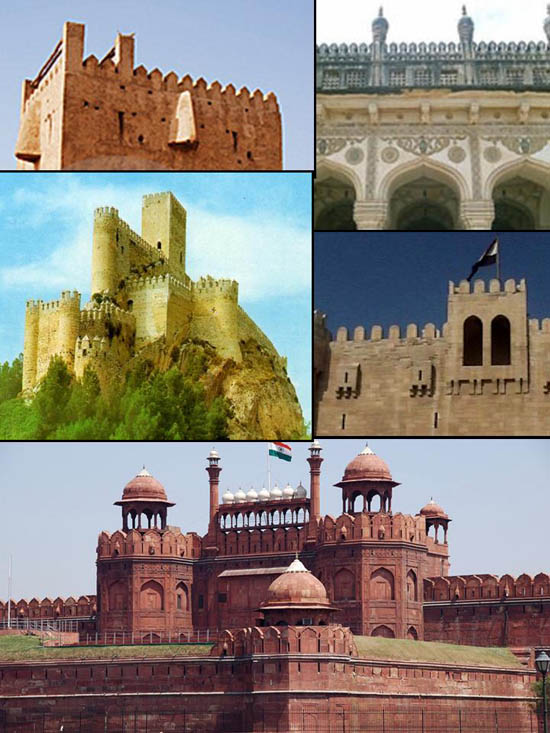
Above is a collage of Islamic-Indian battlements. I like Gene’s
coin of the phrase “battlement border” though strictly speaking it should be
“crenellated battlement.” A battlement is just a protective wall while a
crenellated battlement has gaps to shoot through.
But the source for
these borders could also be funerary monuments (but I guess they could be copies
of fortrifications). Below are a couple of tombs in Khotan and Yarkand. Also
below is proof that wool camel (as opposed to camel wool) do
appear in rugs.
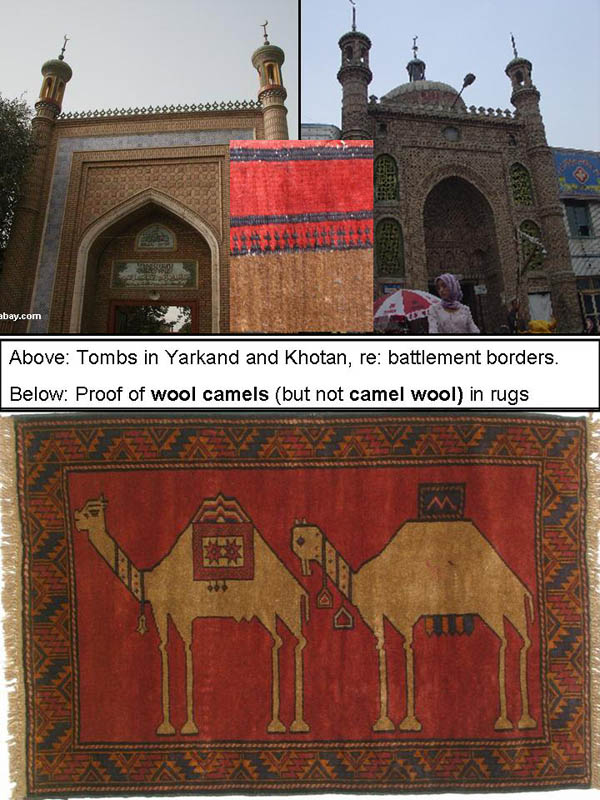
I went through six or seven hundred pictures of bags,
mafrashes, khorjins, chuvals, torbas, hajavs, jimkz, buggmqts, krtsxziays,
whtchamkllzats, and jiginsitazhitianains, etc. I also went through about 1-200
Khotan, Kashgar, Yarkand rugs. No Windsor-bag analog soup. I doubt E. Turkistan
as a source because I can’t find any bags.
Rich, I know you were just
kidding about violet and purple. You are so funny…I cannot resist giving you yet
more information that I know you are dyeing (sic) to know.

The colors produced at near
infra-red and near ultra-violet ranges, opposite ends of the visual spectrum,
may appear to be very close (violet and purple), but they reflect wave lengths
that are completely different, therefore absorb wavelenghts that are completely
different. The question was what causes changes in certain colors of “purple.”
The size, type bonds, overall charge, and complexity of the dye/pigment molecule
is important, but also the energy of the photon wave length impacting the
molecule has a lot to do with color change.
I just knew you were
hungry for the information, and were kidding about the other stuff.
I also knew you were an exceptional Bostonian. You have the incredible
good sense to locate a Mississippi honey. Next to Alabama and Baluchistan,
Mississippi is the homeland of the most beautiful, complex, home-rural products,
with lustrous sheen, perfect dyes that appear totally natural, symmetrical but
with quirkiness that adds life to the composition..., and the people are
terrific too. Did you show her my little 'southern cartoon, previously posted ?
Regards, Jack
Posted by Richard Larkin on 06-23-2007 08:13 PM:
Jack,
Yes I did show her that cartoon. Not only did she get it, she
was in it!!! 

__________________
Rich
Larkin
Posted by Windsor Chorlton on 06-24-2007 08:07 AM:
Monet's Fuchsine Fo
Hi all
Jack, I appreciate your picture research efforts. Thanks to
everyone for trying to pin down this bag. It's given us a good run. hasn't
it?
Jack's return to the violet dye topic gives me a chance to show a
painting of a 'fuchsine fog' in London. Early on I mentioned the phenomenon of
coloured fogs created by the coal-tar emissions from millions of domestic fires.
I came across the subject in 'The Chromatic Effects of Late Nineteenth-Century
London Fog' --
http://www.literarylondon.org/london-journal/september2006/novakov.html
Claude
Monet drew inspiration from these atmospheric effects, describing 'one
[coloured] marvel after another, each lasting less than five minutes'. In 1903
Monet painted this view of Charing Cross Bridge, with the Houses of Parliament
at right.
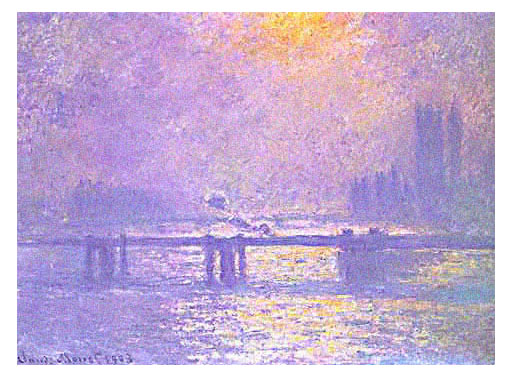
Still on the topic of fuchsine, I came across an article by
our own Steve Price on fuchsine and other dyes as aids to dating Caucasian
weavings ('Dyes and Dating Caucasian Weavings', Oriental Rug Review, Vol
15/4
www.rugreview.com/pricedy.htm
Steve says that fuchsine
became commercially available to Caucasian weavers around 1875-1880, but its use
was discontinued by 1900. The inference I draw from this is that it took about a
generation for weavers to recognise the instability of the
dye.
Regards
Windsor
Posted by Steve Price on 06-24-2007 11:00 AM:
Hi Windsor
I'd make one small correction to my earlier statements
about fuchsine - it's use probably wasn't discontinued in rugs until around
1925.
Regards
Steve Price
Posted by Richard Larkin on 06-24-2007 11:19 AM:
Hey folks,
Just so we understand one another, there's not a drop of
science in my views on dyes in general, or "fuchsine" in particular. But I have
a purple or violet color in my head that I think of as one of the earliest, if
not the earliest, synthetic colors. I think I've seen it in rugs that I consider
old (third quarter 19th, more or less), and it's the only synthetic color. It is
fully faded on the surface. For what it's worth, it isn't the color on the back
of Windsor's bag, as I view it on my screen, where his color is much more a
variation of pink. The color I'm thinking of is much closer to the Monet fog
picture he just posted, but even that's too pink.
Without a shred of
evidence (see comment above), I'd call his synthetic color a later one. While
we're on the subject, I echo Camille's earlier note that the red might trouble
me, too.
In case there's somebody who hasn't had enough speculation
about Windsor's bag's birthplace, I note that the look of the back from his
image reminds me of certain early mid 20th century Chinese workshop rugs, where
Persian knots are heavily hammered into cotton wefts. The result is the dense
look on the back, with cotton bits showing themselves randomly in a crushed
context. I don't think the piece is Chinese or Eastern Turkestan, and I think
the resemblance I see on the screen would disappear in person due to the
proportions. My real point here is that I think the high imbalance of wefts to
warps per inch is important. However, I don't know where that points. If I had
to choose a place from among unlikely candidates, it would be some sort of
Turkoman related provenance. But I don't find that convincing,
either.
BTW, didn't we have a knowledgeable commentator recently on
TurkoTek who observed that the customary use of the term "fuchsine" for various
reddish or purplish synthetic dyes was altogether too broad?
__________________
Rich
Larkin
Posted by Steve Price on 06-24-2007 12:08 PM:
Hi Rich
The first synthetic dye was fuchsine (synthesized in 1858, and
in pretty wide use within 10 or 15 years). As the 19th century progressed, other
fugitive violets were synthesized as well. It became customary to refer to
fugitive violets as though they were all fuchsine. In fact, some are, some
aren't.
Regards
Steve Price
Posted by James Blanchard on 06-24-2007 02:23 PM:
What the Fuchsine?
Hi all,
Paul Mushak, in an article in the Oriental Rug Review (15/5),
which can be found here, http://www.rugreview.com/5dyes.htm mentions that there are at
least six chemically different dyes that are called "fuchsin". One variety,
which is referred to as "New Fuchsine" was apparently invented around 1890 and
used well into the first half of the 20th century. Mushak notes that chemical
analysis is required to distinguish the "New Fuchsin" from
others.
James.
Posted by Steve Price on 06-24-2007 02:31 PM:
Hi Folks
Prompted by a message from our ever vigilant (and always
wrong) fan, JACK cASSin, I rechecked the history of synthetic
dyes. I was mistaken - fuchsine isn't the first synthetic dye, it's the second.
The first was mauve (or mauveine), synthesized in 1856 and never used much.
Fuchsine was synthesized in 1858 and was widely adopted soon
thereafter.
And JACK cASSin, for your information (not for
your education, since you are ineducable), indigo-sulphonic is not considered to
be a synthetic dye, it's the sulfonate of our old friend indigo, made by
dissolving indigo in sulfuric acid.
Steve Price
Posted by Gene Williams on 06-24-2007 03:40 PM:
groan
Hi all,
I suppose there must be someting complimentary about this
guy's obsession with Turkotek. I for one certainly don't need him and don't want
his opinion about anything. But apparently he needs Turkotek and insists on
imposing himself on simple hobbiests who enjoy this site..
Well..I don't
want to hear about him..see his face, I don't even want to know he's around
(still) ...I guess by nature I have a hard time putting up with someone who
harrasses me or my family...its almost as if we're dealing with a voyeur..a
peeping tom of some sort..it makes me want to take a shower. Pls..Ignore the
troll...Imho he's a sad sad loser.
Gene
ps. Maybe he'll take a
hint and get off his fat cASSin and come out to Afghanistan to do something for
his country rather than sniping at everybody and anything.
Posted by Gene Williams on 06-24-2007 03:57 PM:
Fuschine
Windsor,
About 1986 I bought a 1880's painting in Belgium done by a
minor Belgian painter...don't have the name with me..oh sort of the usual
landscape stuff...canal, ducks, forest, small cottage on the left bank with
chickens..slanting afternoon light from the left..shadows across the canal..done
in a quasi-impressionist manner. Really all in all very pleasant. Its still on
the living room wall now.
The key question-color in the painting,
however, was the use of violet to illuminate the deepest shades of the
background forest. I remember the charming lady in Petit Sablon who sold it to
us commented that use of that color was regarded as "very daring" in that time.
Well, actually, checking out her assertion, as I remember in the woods in
Belgium (thinking of the Forest which runs into the middle of Brussels..Foret de
Soignes?) there is a very distinct violet hue at mid-day. I've never seen it
anywhere else.
So the question I'm asking, was Monet painting a literal
color, influenced by fuscine which colored the fogs of London...or a figurative
color? edit: Whistler painted the same fogs..no violet. (I can accept all sorts
of stuff in fogs...in Brussels you tend to measure a winter by the number of
pneumonia attacks you have...and legend has it that it's because all the beer
breweries are open to the atmospher and the fogs are full of beer yeast. Don't
know if that..or the fuscine fogs..actuallly have a basis in
fact.)
Gene
Posted by Richard Larkin on 06-24-2007 03:58 PM:
Hey Gene:
Is the ineffable Jack an Afghani? That's a surprise.
__________________
Rich
Larkin
Posted by Richard Larkin on 06-24-2007 04:01 PM:
Hi Steve:
Do you have a confident sense of the particular hue imparted
by the first widely popular fuchsine dye?
__________________
Rich
Larkin
Posted by Gene Williams on 06-24-2007 04:02 PM:
Ferdows
Richard,
What do you think about the Ferdows area being the source of
Windor's bag? It seems to have everything. Cotton base; baluch borders; Afshar
influences; Arabs; Reds and undyed fields; Persian city influences; How about we
just declare that we won the war?
Gene
Posted by Steve Price on 06-24-2007 04:15 PM:
Hi Gene
We do generally ignore JACK cASSin, who submits
an average of one or two posts most days. They usually have no content beyond
expressions of disrespect for just about everyone here, and I doubt that anyone
(here or elsewhere) much cares what he thinks of them. Today there have been
four messages so far. Since the fourth one included some misinformation that may
be transmitted to others through various routes, I took a moment to correct it.
And, while I was at it, took a shot at JACK cASSin, too, for his
ridiculous habit of making statements with an air of total certainty about
things of which he is ignorant (which is most things).
Steve Price
Posted by Richard Larkin on 06-24-2007 05:18 PM:
Hi Gene,
I'm hardly the oracle on "anything and everything Baluch,"
let's be clear about that. But I just don't see Windsor's bag falling within the
Baluch range.
As we keep learning, there's a large variety of groups
that produced and are producing the "Baluch" fabric, and there are many weaving
types in that range that vary quite a bit among themselves, keeping nevertheless
the Baluch feel. My idea of the Ferdows type of rug is one on the coarser,
looser side than most Baluch; also with slightly longer, slightly shaggier pile.
No doubt there are other types from that region. For example, I don't think of
the Ferdows area producing cottton foundation rugs in the older pieces. So maybe
I'm not well enough informed on Ferdows. In any case, the characteristics I've
mentioned don't seem to echo Windsor's piece.
In an earlier post in this
thread, someone (I think it was you) commented on the outsstanding Jan Beg red
in Windsor's rug. I thought at the time I knew the red, but Windsor's rug didn't
seem to me to have it; and it occurred to me that what was going on there was
variation in color appearance from one monitor to another.
Windsor's
piece is really baffling and intriguing. There are several rug types that
suggest themselves, but some feature of the piece tends to knock that diagnosis
out. I have come up with no convincing one. Baluch of any kind doesn't do it for
me. Sorry I can't be more cooperative.
__________________
Rich
Larkin
Posted by Gene Williams on 06-24-2007 05:31 PM:
baluch vs Ferdows
Richard,
I agree with you totally. But my question is are the carpets
woven around Ferdows actually "Baluch" or even "Arab-Baluch"? Jerry Anderson
said they weren't. The carpets from that region quite often seemed to draw from
Afshar and Baluch designs. But they also used Persian city designs and often a
cotton base. JA said "real" "Arab-Baluch" actually came from another
place...(see T.Cole's interview). He said Ferdows were city carpets in
effet.
I guess what I'm asking is...if its cotton based..and has some
Baluch and Afshari elements..color or composition or something...and yet it
seems vaguely "city" in struture and dyes...but lacks some things (the designs
in the flat weave, etc.)...where else to put it?
Gene
Posted by Windsor Chorlton on 06-24-2007 05:49 PM:
Impressions of Violet
Hi Gene
Picked you out as a familiar face in this late flurry of
posts. I believe that violet was a new and fashionable colour in the late 19th
century. As I understand it, Monet was indeed representing -- in a heightened
way -- what he actually saw when he painted turn-of the-century London. Hence my
earlier joke about Impressionism being anything but. Must be the way I tell it.
In my experience, violets -- even modern permanent violets -- are not strong
colours. They may have prismic brightness, but they're overwhelmed by just about
any other colour on the palette.
I've tracked down another Monet
'fuchsine' London painting -- of the Houses of Parliament -- but most of his
foggy atmospheres are yellowish or blueish. Although that link I posted about
the chromatic effects of London fog has no obvious connection with rugs, it's
worth looking at -- Dickens, Oscar Wilde, Jack the Ripper, as well as synthetic
dyes.
Richard, everything's relative, especially when viewed in a
compressed computer image. To me, the highlights on the back of the bag are
violet -- not pink, not purple, but violet. I was impressed by your speculations
about the back of the bag face. I, too, have had uneasy thoughts about the
structure, which doesn't match that of any other tribal or village piece I can
compare it with. Yet the rustic flatweave section resembles those of Turkmen
pieces I'd place in the same age bracket -- 1900-1930. Having raised the
question, you then back off; I wonder if it's worth following up a little
further.
Regards
Windsor
Posted by Richard Larkin on 06-24-2007 06:13 PM:
Hi Gene:
I see your points, but in answer to your question, "...where
else to put it," I'd say, "Someplace else." As far as what's Ferdows, what's
Arab, and on and on, it's way beyond me. I'll tell you this, though, I envy the
hell out of you for your having had the experience of hobnobing all that time
with Jerry Anderson. Someday, you, I, and your brother, Jack, will sit down
(with the necessary refreshments at hand, but not too much for me) and sort all
this out.
Hi Windsor:
1. Did you ever go back and give the hard
eye to the rows of pile to confirm that the piece is, after all, asymmetrically
knotted?
2. I would love to get the chance to hold that piece, as a grab
is worth a thousand words in this field. Subject to the right to take everything
back if I ever get that chance, my working proposition is that the piece is some
kind of Turkoman spinoff, perhaps from Afghanistan; but hardly typical, and I
don't proffer that though with much confidence. The features I consider most
important for diagnostic purposes are the asymmetric knots tightly compressed
vertically along the warps, the particular red color, and the choice of the
device in the center field. I just can't juggle them into a convincing label. I
don't make too much of what particular shade those little violetish parts are.
The bag is almost certainly earlier in the 20th century, and that color is that
color. Note that there is precious little of it in the piece. I read with
interest your comment that those strands seem to be of the same ilk as the rest.
It wouldn't have been a surprise to have heard that those knots were something
different.
As you say, it's been a fun run.
__________________
Rich
Larkin
Posted by Richard Larkin on 06-24-2007 10:50 PM:
Hey folks,
I swear I didn't set this up. Martha's son left the dog for
an overnight so he could attend a party. This gave rise to the need for
something soft and faintly gamey with which to line the dog crate. A quick trip
to the attic, and what fell to hand but this Anatolian prayer rug. I thought
fate had sent it my way, between the plain ground border surrounding the field
(cf. Windsor's bag) and the topicality of ICOC IX. Granted, there is a sawtooth
border around the very outside, but what is that among friends.
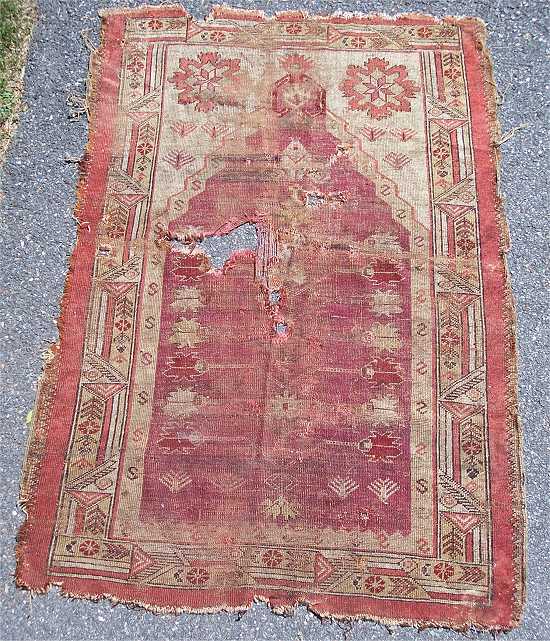
I emphasize the
following:
1. I had no intention of soliciting an offer on the piece from
John, well knowing the rule against commercialism.
2. I steadfastly
refrain from drawing any parallel to the Baluch tree-of-life prayer rug motif in
the field.
3. I similarly refrain from any discussion of "running reds"
by reason of the red soaked foundations in the center. In fact, I believe that
to be the vestige of an attempt at the "magic marker" method of restoration.
Judging from the color and the degree of fading, I would say it was done in the
seventh quarter of the 19th century.
__________________
Rich
Larkin
Posted by James Blanchard on 06-24-2007 11:37 PM:
Roses are red, violets are new...
Hi all,
There has been some discussion about "fading violets" and the
age of a weaving. Some have suggested that fading violets were fuchsine, which
probably dated these pieces to the early 20th century.
I have a couple of
small Baluch pieces that have a "violet" or "fuchsine" colour which has
completely faded on the front (thank goodness). My inclination would be to date
both of these pieces are rather recent, perhaps not more than 50 years
old.
Here is one of those "mats". It has some nice blues, including a
good blue-green, and was very inexpensive. The orange is a bit off-putting,
though not excessively. It has a lot of "wheat" coloured wool that was
originally dyed with a violet. Had the violet not faded, this would have been a
very different piece today.
Cheers,
James.
P.S. Rich, it is
nice to hear that you are hosting an overnight party for dogs. I never know what
to serve at these dog parties...
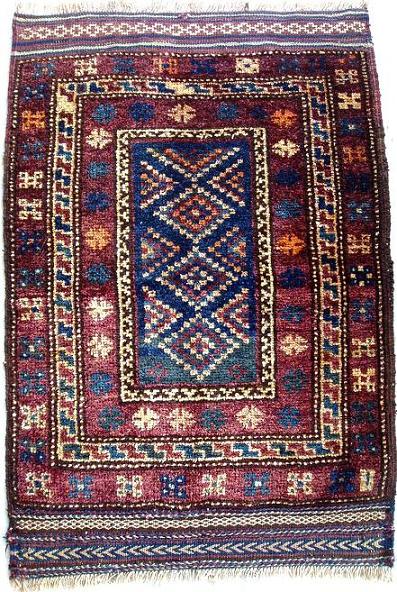
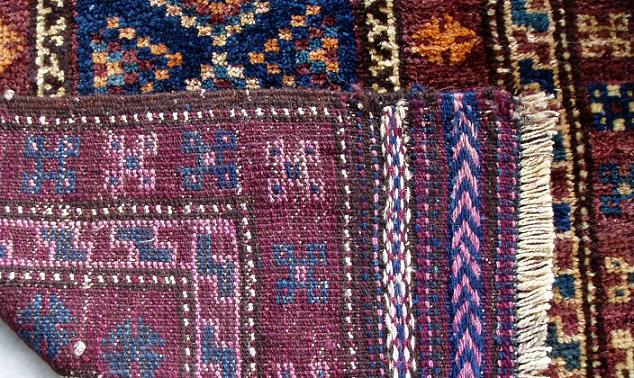
Posted by Jack Williams on 06-24-2007 11:38 PM:
weighing in...
Good evening all, I'm weighing in...again...
It is interesting how
this is all unfolding. We all went charging out to find an analogy in whatever
geographic direction seemed to fit the sum of the attributes of Windsor's
carpet, only to admit, we haven't yet suceeded. Now we applying general
principles.
First, I'm with Rich in that I too think this has a Turkmen
source, but what Turkmen? Afterall, Seljuks to Qajars to Salors to Uzbeks are
Turkmen. It might be that this is MAD-Ersari?
But...I do not think it is
(a) urban, (b) commercial, (c) recent. here is why... You rarely find truly
innovative and unique commercial weavings because the weaver could not know if
it would sell or not. Also, this is not just different, it is a
different...bag...not rug...again questionable for commercial purpose.
I
doubt this has an urban source, again because it is a bag, not rug. Most bags
are utiltarian when made and even if they are used in an urban setting they are
more likely to be used by rube-come-to-town. I'll post a couple of pictures of
how these are used in Afganistan later.
I don't think this is recent
(post WWII) because in addition to being intended to be used, and with a unique
design, it was probably woven by a very experienced and accomplished
weaver...probably an older woman with confidence enough to do something
different, and do it with skill.
As luck would have it, a new rug came
into my house this weekend. It is an "Arab-baluch" that I took a chance on. It
is far and away many grades better than what I thought it would be. The
3D effect of the corrosion is so compeling that you would almost be forced to
conclude that corrosion was anticipated and intentional. The red of the border
is of a unique tone, orange-ish seen down-pile, more glowing red into the pile.
AND....in the first border are flowers that seem to recall the blossum in
Windor's field. Below is a temporary bad picture, previously posted.
My
camera needs a battery so it will be tomorrow before I can take some good
closeups that show the color and detail of the blossoms. And I need time to
check out the structure...though I'm pretty sure the warps are cotton, wefts
possbly grey wool. The weave is unexpectedly fine...by first guess possibly at
least 80-90 kpi. Though the look is what we think of as Arab-Baluch, I think it
has a Turkmen root. More later. Oh...if I believed in camel wool, the field of
this rug has such a deep rich camel color and such a different look and feel
and...that... I need a microscope and a lesson.
Jack
Posted by Filiberto Boncompagni on 06-25-2007 01:20 AM:
The picture of Richard’s prayer rug has been inserted in his
post.
Regards,
Filiberto
Posted by Windsor Chorlton on 06-25-2007 07:32 AM:
Tied in Knots
Hi Richard
I've put up some new images. Obviously, they don't show
knot type, but they might just give you more of a handle on handle. The colours
are as they came off the camera -- no jiggery-pokery or gamma interference. The
pics were taken indoors in natural light, with rain sluicing down outside. Well,
it is the first day of Wimbledon.
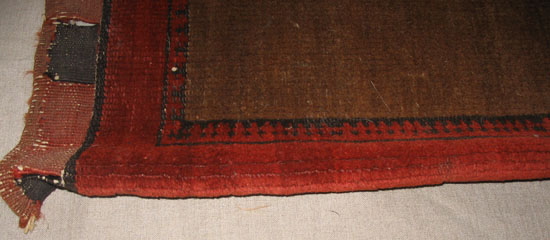
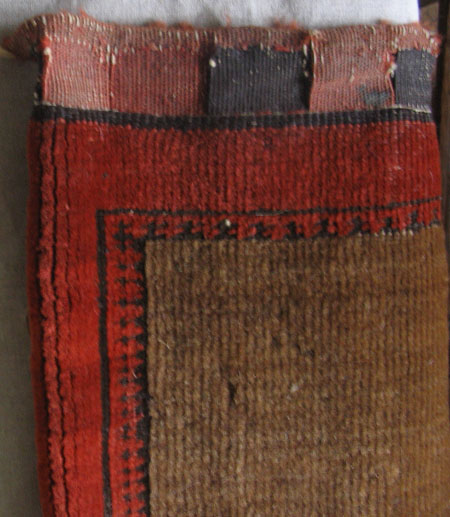
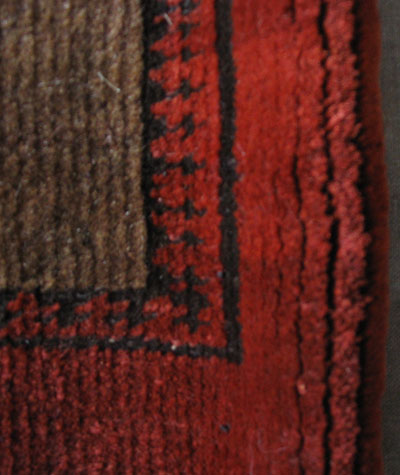
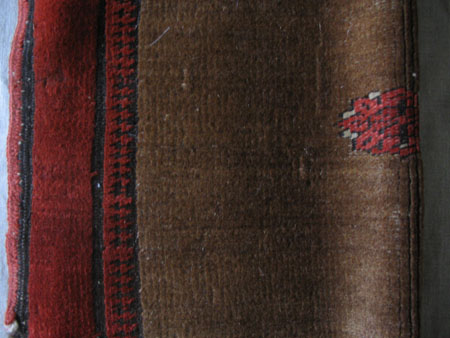
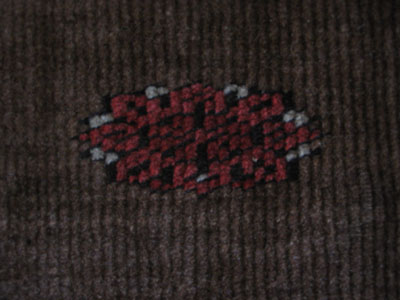
I tried your test for
knotting structure, failed, and hoped you wouldn't mention it again. But you
have, so I made another effort. I wouldn't go to the stake in defence of my
'findings' but...the base of the pile on the right side of the warps shows loops
at close and regular intervals. These loops are not apparent on the left side of
the warps. This less-than-elegant descriptions seems to me to be consistent with
an asymmetric knot structure, but I'm ready to accept
humiliation.
Regards
Windsor
PS In our household, that
prayer rug would still be in use as a floor covering. Over here, auction houses
describe well-worn pieces as 'in country house condition'. What's the euphemism
for 'wrecked' on your side of the pond?
Posted by Jack Williams on 06-25-2007 09:00 AM:
Euphemism or Euthanasia
W.
One euphemism that is seen regularly is, "Jack Williams, please
take notice" or "here doggy doggy, nice doggy!"
In truth
though, what I see a lot of is "New England shabby
chic."
Incidentally, I had a recently-acquired khorjin in my car and
tossed it onto an outdoor seat at a coffee shop Sunday morning to use as a
cushin. The slobbering Labrador retriever tied up next to me got an obligatory
pet..then he first sniffed, then licked, then joyfully grabbed the bag in his
teeth and shook it, precipitating a general scene.
One should get
mule/camel-smelling items washed, no matter how faint the odor, before being
used.
Regards, Jack
Posted by Camille Khairallah on 06-25-2007 09:02 AM:
Hello Richard,
I am a beginner at Turkotek and I wonder whether you
often face such “adventurous” cases… But I personally find it quite exciting and
enriching.
The prayer rug you posted has a design called “Medjidi”
referring to the latest Ottoman sultan Abd el Majid. Rugs with this style mostly
come from Central Anatolia but also Western Towns such as Ghiordes were also
involved in this style featuring large outer or inner (niche contour) empty
borders. Also sometimes a colorful bouquet in the gol Farang style is
represented in the center. The knot should be symmetric of course and the cotton
for the foundation is not rare but I do not recall having seen a Medjidi-style
rug with either camel color field or border. Besides, the medakheel (teeth in
the bag style) border seldom occur in Turkish rugs, however I guess saddle-bags
could have been made in the Medjidi style.
You were mentioning on our
latest discussion that this style of open border occurs in Hamadans and Serabs
but then it is not inscribed between two lines or two other borders while in the
Malayer it is and that’s one of the reasons why I retained this
possibility.
Regards,
Camille
Posted by Richard Larkin on 06-25-2007 10:19 AM:
Hi Chorlton,
Your red looks much better to me in these images. The
images in which the pile stands out discretely look a lot like symmetrical
knotting to me. If so, there's nothing to be humiliated about. Every person
posting to this site went through the learning curve, excepting possibly the odd
Saryk who came over to study at UCLA. Anyway, we're glad to have you and your
rugs.
Hi Camille,
The warp and weft in my prayer rug are wool. The
color on the monitor is less intense than the real rug. What appears "camel" (e.
g., the "s" border surrounding the prayer field) is a somewhat faded and dingy
yellow, altogether very Anatolian looking in the color. I know what you mean
about the cotton warped Medjidi style rugs, often exhibiting the "gul Farang"
motif. I have one of those, in roughly the same condition, but no holes (one
advantage to a stout cotton base) in the storeroom. Plenty of turquoise blue
(sulphonic?) and cochineal.
On those Malayers, aren't they apt to be
single wefted and symmetrically knotted?
__________________
Rich
Larkin
Posted by Richard Larkin on 06-25-2007 10:25 AM:
Hi James:
That Baluch of yours looks very nice on my screen. It
wouldn't had the purple held firm. Funny, isn't it? Of course, we are applying
our own aesthetic to all this. Take another look at the fashion statements being
made by the ladies fetching water in John's thread. Their great great
grandmothers wove those fantastic Anatolian carpets. I wonder what their real
preferences are in colors.
Hi Jack:
I'm not so detailed in my
analysis of who did what and why, but I agree with your take on the functional
place of Chorlton's bag. Allowing for the Murray Eiland axiom that all rugs are
commercial to some extent, it doesn't strike me as a commercial piece.
__________________
Rich
Larkin
Posted by Gene Williams on 06-25-2007 01:09 PM:
Oh, I wish
Windsor,
Symmetric/Turkish knot? Really? Richard is not usually wrong
but before diving in again...I'll wait until it can be confirmed...whatever I
like the most recent set of pictures even better. Even if it were new, I'd have
purchased it.
****(For those French and Italian linguists...notice the
English language subjunctive in that sentence...if I WERE you...Oh I wish I WERE
in the Land of Cotton. Did I suffer dealing with the French and Italian
versions...revenge is sweet!!!)****
And James, somehow that prayer carpet
looks more purple than violet. In fact the purple looks very "Taimani," the type
that fades to brown...David Black has one in his book..don't have it here..we
had a Taimani line which had several bags though with the purple and the fading.
Is this possible? Yours didn't look Taimani initially..but then again has that
kind of four cornered endless knot which is also in my Farah Province Taimani
prayer rug posted previously....and the strong simple geometric designs in the
field. What's the knot count?
Gene
Posted by James Blanchard on 06-25-2007 01:17 PM:
Hi Gene,
I think mine could be Taimani, but I don't think it is a
prayer rug. It is more like a balisht in size. It is very coursely woven, which
I suppose would fit with a Taimani attribution.
I'm not sure whether to
call the colour purple, violet, pink or "fuchsine". Whatever it is, the weaver
liked it a lot and it is fortunate that it faded so
completely.
James.
Posted by Windsor Chorlton on 06-25-2007 01:24 PM:
Purple Haze
Hi all
James showed us a faded violet rug. Here's another -- an
unidentified threadbare piece that's currently half covered by two filing
cabinets. The violet is most conspicuous in the bottom corners of the field, but
you'd hardly know it until you turned the rug over.
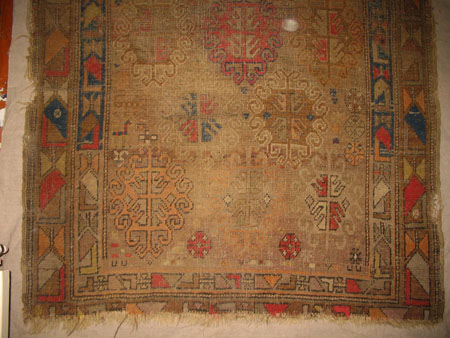
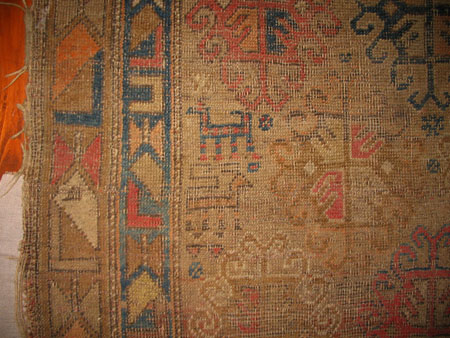
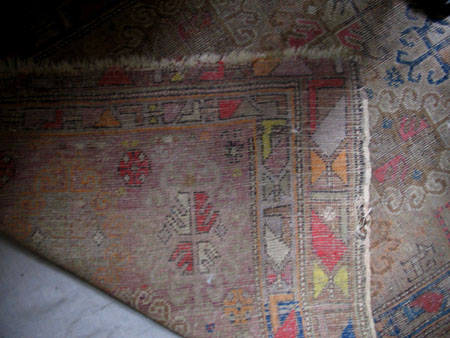
The first two
pics were taken with flash, which flatters the piece, the third by natural
light. In a few places some violet -- faded to a greyish hue -- remains visible
on the surface. Where it has been shielded from light, the colour looks similar
to the 'fuchsine' on the bag (the warps and wefts seem to be of pale brown wool,
which must make some difference to tone).
I included the detail of the
animals because I like them. I like the borders,
too.
Regards
Windsor
Posted by Jack Williams on 06-25-2007 01:40 PM:
"Bag'um Dano!" (uhhh..Hawai 5-Oh?)
Attached are two pictures of khorjins being used in the Turkmen populated
portion of Afghanistan, circa about 1975. The site is interesting with a
plethora of pictures.
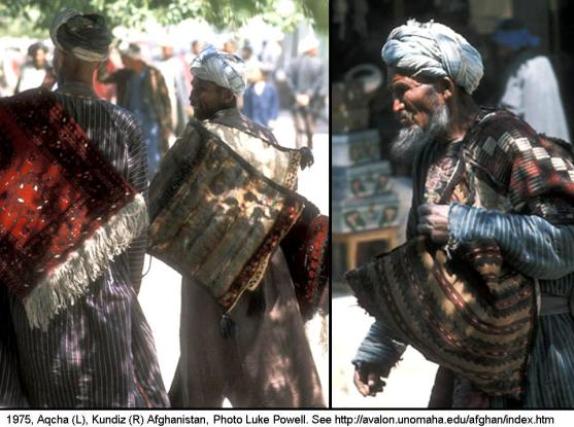
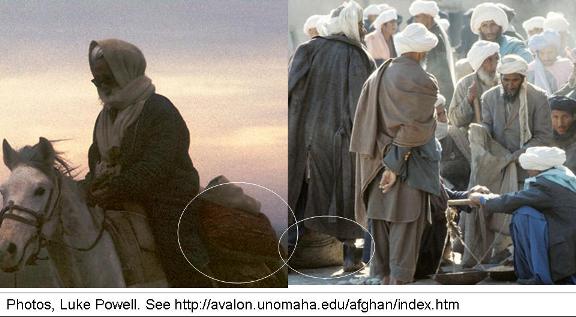
I’ve tried to make Windsor's Khorjin NW Persian or Azerbaijani.
But, am leaning Turkmen...and I think Gene’s proposal of “Arab-Baluch,”
which has more recently been interpreted as "Kizil-bash Turkmen” Baluch
[I cannot bring myself to say "Afshar"] from Ferdous, may have merit.
Regards, Jack
Posted by Gene Williams on 06-25-2007 01:45 PM:
motorcycles
Next time in Herat I'll take modern day versions of the above....Khurdjin's
now are mostly used in the city on motorcycles and bicycles.
The problem
of cotton warps and wefts though remains...how can you all postulate a Turkoman
origin with all the cotton in the weave...unless you get into E.Turkistan..which
is Turkoman too?? Now there is a Turkoman tribe around Ferdows...mainly called
"Afshar." I'll leave it at that.
Gene
Windsor...that rug which is
almost gone fascinates me..could you start a separate thread? otherwise we'll be
here till the cows come home.
Posted by Windsor Chorlton on 06-25-2007 01:57 PM:
Muddying the Waters
Hi Gene
You're right. Steve tells me that a thread isn't cut until
nobody's tried to unravel it for ten days -- which means we could be here until
next Christmas.
I'll get my coat.
Regards
Windsor
Posted by Gene Williams on 06-25-2007 04:07 PM:
Dragons and Dogs
Nah..we're not through with the bag yet.. But I'd like to get some idea of
where that fantastic...almost finished off..coat-of-arms-like
dragons-and-dogs-rug came from. Why not just start a new thread with it?
We'll find the solution to the blood-red-ruby-bordered-bag in a few more
posts..I'm sure.. Especially since Richard's objection to Afshar-Ferdows seemed
to have had to do with cotton warps and wefts in Ferdows weavings...that we can
handle.
Gene
ps. Windsor, your mention of "Purple Haze" just hit
me. I (and Jack) actually were at the Atlanta Pop on 04 July 1970 and saw Jimmie
Hendricks play "Star Spangled Banner" at midnight...that kind of explains some
of these carpets and the interpretations thereof.
pps. That's an enigma
as much as your bag...my kids think it was super "cool" that I was there 37
years after the fact ...well..I saw Louis Armstrong in concert in 1958..37 after
his hey-day..can't say that I thought my Dad was "super cool" because he had
grown up with Dixieland and big-band sounds. Is rock and roll - even the
psychodelic versions of it - the Turkoman carpeteria of music?
Posted by Jack Williams on 06-25-2007 09:53 PM:
A khorjin (not cajun) gumbo...
Good Evening all, and a propitious one it may be….
Perhaps we will be
able to somehow link Windsor's bag, the Baluch, and the Afshars all in one big
New Orleans khorjin gumbo. (You suspected this was coming didn't
you....?)
Below are 5 pictures of a certain “Arab-Baluch-Afshar”
whatever, possibly from Ferdous, that arrived this weekend. In it you may see a
resemblance of a border blossom perhaps analogous to the one on Windsor’s bag.
While at it, notice some pictures showing the 3-D effect of corrosive dyes on
black outlining…and how it would be reasonable to suppose it was either
anticipated, or done on purpose.
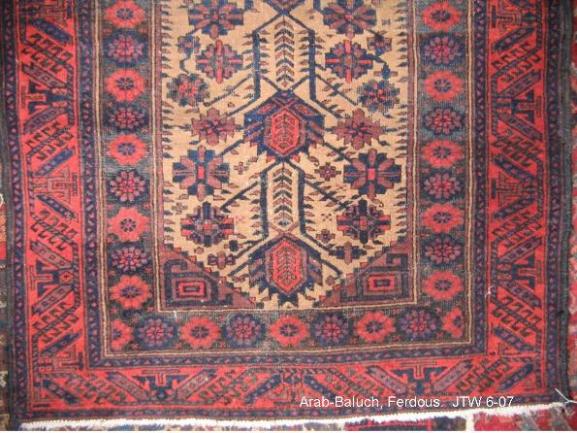
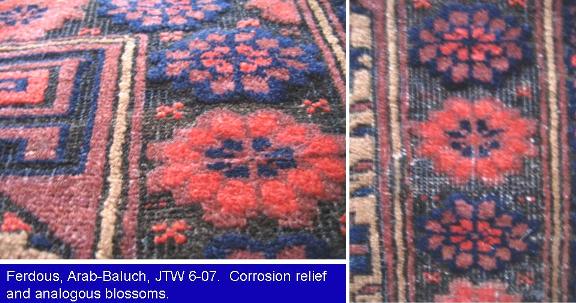
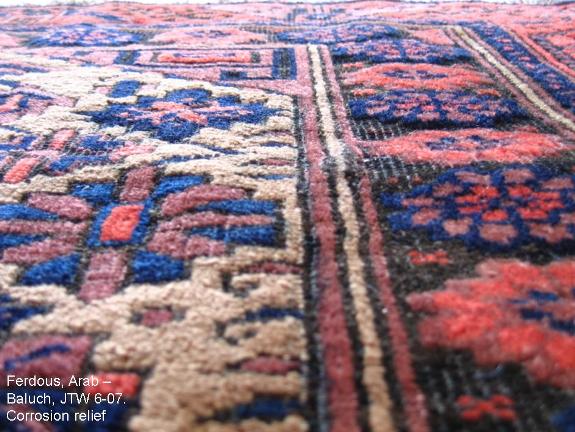
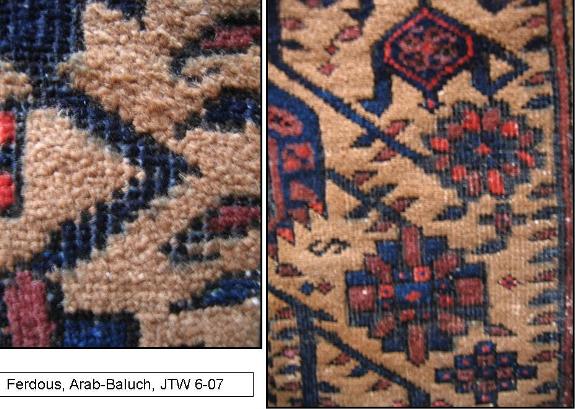
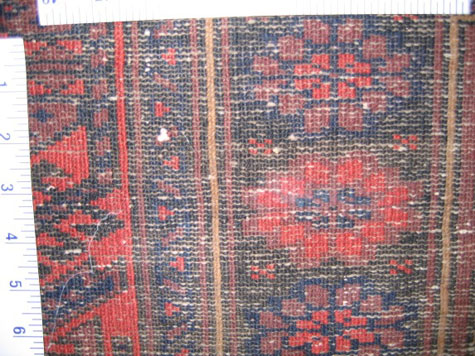
The picture of
the back has the best approximation of the red...which in the wool is more red
than orange, especially against the grain. There is not a lot of red in this
rug, and the red flowers are backgrounded against camel and corroded black,
whidh cause them to seem to "glow." Color of back and front are approximate,
front perhaps a little lighter color, not much.
I am no closer to
solving Windsor’s bag (is anyone?). But I do enjoy the incredible colors, with
that red butting up against the black outlining giving way to camel. Also the
precision of the weave and the wool, etc. is even more pronounced in the newest
pictures.
It is a high quality item…and so much more…er… intellectual
than some of the textile odds and ends that seem to wash ashore on this site
(Baluchotek) from strange places visited by members in abstentia, kind of like
flotsam from the Mississippi River thrown onto the New Orleans batture (Just
kidding John, I really like some of the...er...things. Sometimes it is good to
see what an incredible amount of...stuff...is available just in case I develop
dementia.)
I just wish you could find some happiness and finally settle
down, curl up with a nice Baluch rug or two, and give up that gadding about in
the textile wilds.
Regards, Jack
Add PS: ...ahhhh, at last!... I
just got word that two fine lynchpin Timuri Baluchi rugs will reside with me for
a while...what a night, wait to you see these rugs...
Posted by Marty Grove on 06-26-2007 08:41 AM:
WOW!
G'day Jack and all,
The effect of the corroded blacks on your most
recent, Jack, is really quite astonishing...
We have all read of how the
iron rich blacks of the past did corrode, however, personally I havent seen
anything quite like the effect you show.
My modern Melas runner has
clipped blacks which somewhat approximates the effect of yours in a minor way,
but poorly done. And yours hasnt been 'done', its a natural phenomenen. Another
I have, a not very old Ersari has a red ground which is disappearing beneath the
surrounding colours, but far too slowly for me now, if the ultimate appearance
is anything close to yours.
The reduced wool surrounding the ornaments really looks
beautiful, and can only say what a pity that the light cords of the foundation
show thru - maybe you can color them in!?
Sorry, had to say that, but
anyway, it really is quite spectacular. Thanks for the
look.
Regards,
Marty.
Posted by richard tomlinson on 06-26-2007 08:55 AM:
hi all
jack - i really cannot believe that weavers anticipated
corrosive dyes, or deliberately set out to create a 3-D effect.
you say
it is 'reasonable to suppose'? could you possibly
elaborate?
regards
richard tomlinson
Posted by Steve Price on 06-26-2007 09:03 AM:
Hi People
Like most, I think the embossed effect that corroded blacks
give a rug is aesthetically pleasing. This is probably a common preference among
ruggies and non-ruggies alike, since many commercially contracted rugs are
clipped to give the same effect.
The notion that corrosive blacks were
used intentionally because the weavers knew that the rug would become more
attractive later comes up from time to time, and although it's interesting, I
don't think there's much truth to it. They certainly knew that the corrosion
would occur, but probably accepted it as an unavoidable problem of using black.
It was abandoned soon after non-corrosive synthetic blacks hit the
scene.
For one thing, it takes awhile for the wool to corrode, so it
wouldn't make the rug more attractive when new, only after perhaps, 10 years (or
more). Besides that, it created areas that would wear much faster than the rest.
This must have been as undesirable to them as it is to us, and is probably the
reason that it was seldom used in large blocks.
Regards
Steve
Price
Posted by Gene Williams on 06-26-2007 11:07 AM:
corrosion
Hi All,
Jack probably mentioned Baluch deliberately using corrosion as
an art effect because I mentioned it to him. Jerry Anderson actually was the
source...he said it to me back in karachi in the mid-1970's. I don't know
whether he was serious...he said a lot of things...some questionable. I was
pretty wide-eyed and innocent in those days. Still, I wouldn't underestimate art
and artists...no matter how primitive.
Gene
Ill be starting a line
pretty soon on Bahlul Baluch...with a carpet with corroded black the age of
which i can document.
Posted by Jack Williams on 06-26-2007 11:29 AM:
corrosion
Good Morning Richard.
Early (page 1) the subject of corroded black
pile surfaced regarding the black outlining in Windsor's bag. As per Gene
Williams, Jerry Anderson [and others] speculated that the Baluch group weavers
purposefully used corrosion in designs, and that subject has surfaced
occasionally on this board, always getting a rise out of Steve.
I posted
this rug to propose a Windsor's-khorjin attribution for consideration. But as it
is a particularly good example, I wanted to illustrate the spectacular effects
corrosion can have. Given the intricate use of black outlining and the overall
corrosion effect in this rug, it is easy to believe that the corrosive effect
was anticipated when the rug was woven.
I doubt they deliberately put
corrosive dyes into the rugs (but no one knows). Like Steve, I too would guess
they knew the wool would corrode, and sometimes took that into account in the
design. There is a philosophical difference between accommodating
corrosion, and purposefully causing that corrosion.
But...more than the black dye, "Mak," corrodes. Brown wool will often
corrode rapidly in Baluch rugs as will occasionally some blues. Marty mentioned
red in one of his rugs.
On this board we have seen some old rugs that have
several different levels of pile depending on color. Obviously there is a little
more going on affecting corrosion, and the rate of corrosion, than simply acidic
dye from oak trees or iron filings.
To date there doesn’t seem to be
much scientific information about the corrosion cause (chemical) and how it
proceeds. Most rug literature sources pretty much repeat the same mantra about
Mak and its acidic nature. In the case of some rugs, there seems to be a true
acidic corrosion with loss occurring with the rug unused in a trunk. Other cases
seem to be related to an im-brittlement of the wool, needing the addition of
stress to cause pile loss.
Jack Williams
Posted by Camille Khairallah on 06-26-2007 12:30 PM:
Hi all,
Although, as Monsieur tout le monde, I like the effect
engendered by the corrosive black, I join you in saying that in was not intended
otherwise it would have occurred much more frequently in workshop production…
which is not the case (at least during the 19th c.). Hence the outline of motifs
in these rugs is often done with indigo color instead which is, on the contrary,
the most durable among all.
But again a question could be asked: Why
these same workshops produced the so-called embossed rugs (pile/flat-weave)
especially famous in Kashan, and the so-called “warjesteh” (high and low clipped
pile) in Iran that one can encounter in some Tabriz, Saruq or Malayer rugs? Was
that a question of fashion? Did it happen when the people started to appreciate
corrosion effect. When did the tradition start in China? Etc… many questions
that would probably deserve to be better
studied.
Regards
Camille
Posted by James Blanchard on 06-26-2007 12:39 PM:
Hi all,
I would say that I am a bit undecided about corrosion and
intended effect on rugs. On the one hand, I agree with Steve that weaving a rug
in such a way as to achieve an aesthetic result in a few or several decades
seems a bit farfetched. On the other hand, it seems very unlikely that weavers
were unaware of corrosive dyes and their effect on a rug's aesthetics and
durability. Most weavers must have seen enough old examples and were probably
aware of which dyes caused this effect. Regardless, I agree that if the
corrosion is not excessive, it can add much to the aesthetic quality of a
rug.
I have a "Yaqub Khan" rug, which I think dates to the first half of
the 20th century and not earlier, which has some nice effects due to corrosion.
Interestingly, the first 1/4 of the rug had a non-corrosive brown, which tended
to muddy the appearance of the adjacent colours, whereas the later 3/4 of the
rug had a corrosive brown that not only created some relief, it also allowed the
other colours to stand out more. Here are a couple of close-ups of the area with
corroded brown.
By the way, I think this rug has some nice purple and
perhaps even a violet? colour.
Cheers,
James.
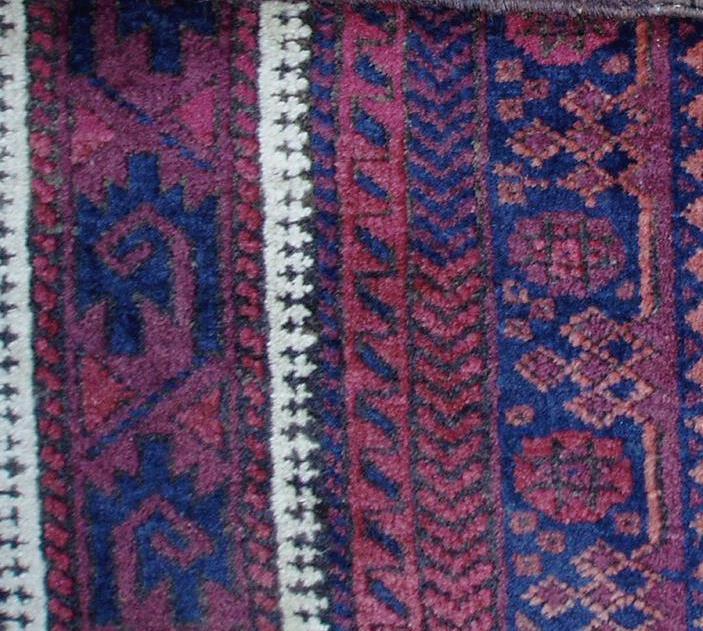
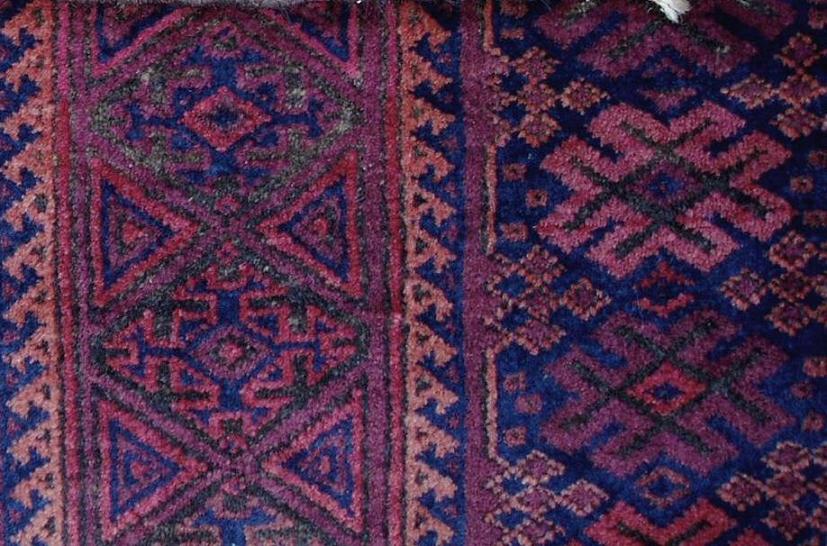
Posted by Steve Price on 06-26-2007 12:55 PM:
Hi James
It's hard to imagine that the weavers wouldn't have been
aware of the corrosive effects of their black (and a few other) dyes. I'm sure
that this is the reason that they used it mostly in outlines and in narrow
strips - you won't find a large field of corroded black in many rugs. I saw one
Caucasian prayer rug in a Skinner's auction many years ago that had a corroded
black field that had virtually disappeared. That's the only example that I can
ever recall seeing or hearing about.
Regards
Steve Price
Posted by Camille Khairallah on 06-26-2007 01:08 PM:
just for info
Hi Steve,
There was a rug production between Syria and Lebanon that
featured only two colors: black and red or black and cochineal-crimson, and
often, especially for the spandrels, the background was corrosive
black.
Regards
Camille
Posted by James Blanchard on 06-26-2007 01:08 PM:
Hi Steve,
I think I tend to agree with you, that weavers were aware of
the corrosive effects of dyes, and tended to minimize its use as a result. The
result has therefore been mostly positive. Whether they deliberately tried to
create this effect seems a less obvious conclusion, because the effect would
take such a long time to occur. I would also think that if they were going for
the corrosive effect, they would probably have favoured dark warps and wefts,
which would not show through the corroded areas. A good red or brown weft has
preserved the overall look of many old and worn rugs, with no marker pens
required. I wonder if that was intentional. Otherwise, why use more expensive
dyed wool for the base of a rug?
Jack, nice Ferdows rug. I like this
type, and the corrosion on yours gives it additional appeal as you have noted. I
also tend to like the ones of the this type that have a rich pink in some of the
floral elements. I think it looks great with a mid-blue and camel palette.
James.
Posted by Camille Khairallah on 06-26-2007 01:29 PM:
Hi James,
I appreciated your thought of the colored wefts, I would
like to know whether you read that somewhere or it is your own?
Following the
same idea, I have a small old black-wefted sort-of-yastik where undyed (white)
wefts only pass under the white end-borders!
I too liked Jack’s piece but
all of you who are talking about the corrosion effects, did you notice the
(up-side down in the pic.) tea-pot figure?..
Regards
Camille
Posted by Gene Williams on 06-26-2007 01:34 PM:
Taimani?
James,
Nice purplish Baluch rug and I've seen that type of outline.
...and again that rug or bag and the purple in it looks very Taimani. The
designs, the color... Is the knot count around 50-60?
Gene
ps.
Camille, I didn't notice the "tea pot" but do now. Looks like a Caucasian
dragon....Jerry after several Red Lables (we drank cheap in those days) might
have said it was a Viking (Swedish Viking..i.e. Vanagrian...Kiev) dragon ship.
(Lets not go there...been there once on Turkotek..remember the Kazak tribe which
had converted to Judaism, was defeated by the Vanagrians about the 10th century
and fled East....).
pps. and as for corrosion, in Karachi I got hold of a
couple of Mushwani cradles and a camel ground prayer rug. They had corrosion
which strikingly outlined the internal designs. I gave two to a "repairer" who
promptly replaced the corroded areas...the result was HORRIBLE. I really think
those weavers knew what they were doing...they'd only used those dyes for
hundreds of years.
Posted by James Blanchard on 06-26-2007 02:01 PM:
Camille, I haven't read anything about the use of coloured wefts to preserve
the appearance of worn rugs. It is just an observation I have made; worn rugs
look better with wefts that match the field in some way.
Jack, it is more
finely knotted than I would expect from a Taimani, about 90 kpsi. It has a
typical Yaqub Khan design.
James.
Posted by Gene Williams on 06-26-2007 02:13 PM:
Thanks
James,
That knot count puts it out of Taimani range and back into
Yakub Khani...which as I understand things is Timuri..right? Anyway, any chance
of seeing the whole rug?
And James, what's your latest take on Windsor's
khurdjin? Any new thoughts? (I guess we're all waiting for Windsor to confirm
its AsL or as Richard has postulated...turkish knotted (somehow this evening I
can't spell symmettricalll).
Gene
Posted by James Blanchard on 06-26-2007 03:57 PM:
Hi Jack,
I've shown it before, so I apologize for re-posting
it.
I think you can see how the lower 1/4 or so looks a bit less
colourful than the upper 3/4. That is because the brown wool has not corroded in
the lower segment.
I have included a picture of the back to show the
structure, and the purple.
James.
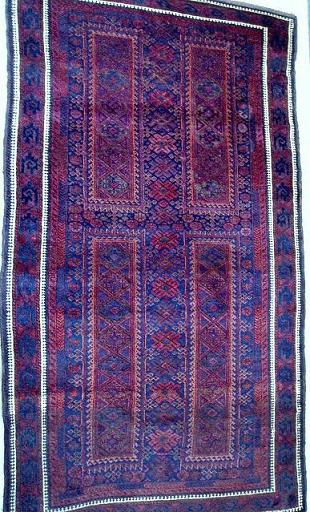
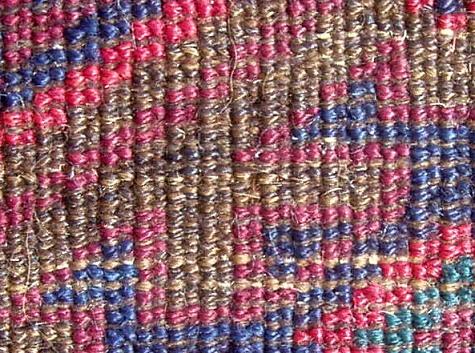
Posted by Richard Larkin on 06-26-2007 09:59 PM:
Hey folks,
Yes, that embossed effect resulting from corrosion of the
black is one of the many charms of the Baluch rug. It happened elsewhere, too,
but one thinks first of the Baluch in that regard.
As to whether the
weavers intended it, I am emboldened to offer an opinion because, frankly, I
have no doubt that my rank speculations are ever so much more acute than
any of yours. 
I agree with those
who opine that the weavers must have been well aware of the effect, by and
large. Since there are born artists and creative souls everywhere, I am sure
there were weavers who took the factor into account in the weaving of their
rugs. At the same time, I doubt there was any institutionalized use of the
phenomenon as a weaving practice or tool. I agree with Steve that knowledge of
the phenomenon probably had a moderating effect on the amount of open black
(brown) space most of the weavers would incorporate in their work.
I do
have an old Kurd rug with great big boteh (I'm always looking for the dovetail
topic) on a black corroded field. If I can get it photographed, I may post it,
as the corrosion played a funny role in the acquisition. It is in almost as good
condition as the Anatolian prayer rug I posted on the other thread,
demonstrating once again that John isn't the only TurkoTekker who approaches the
subject with a good dose of leniency.
Jack, I like your Ferdous rug, but
I don't see it as even a third cousin to Windsor's bag, whatever the knots turn
out to be. Nice rug, though.
__________________
Rich
Larkin
Posted by Richard Larkin on 06-26-2007 10:03 PM:
P. S.: Although I love a good "embossed effect" Baluch, or what have you, and
I can also appreciate a nice Persian city rug, those slick embossed jobs Camille
referred to, Kashan and Tabriz, etc., leave me quite cold. I think the fault is
mine, somehow.
__________________
Rich
Larkin
Posted by Jack Williams on 06-26-2007 10:49 PM:
lasting corrosion
Rich,
I agree on some points. But...certainly if a rug had been made
with large amounts of black corrosive dye, the rug was probably kaput quickly.
I.E.: rugs with lots of black might have been made, they are just not around
anymore. Opinion Alert...I think most weavers were aware of the
corrosion...some took it into account, usually the artistic ones, a lot couldn't
visualize it or just didn't...because rugs really don't last that long. But,
wouldn't you agree that my rug below (sorry, repeat post) seems to have a goodly
percentage of corrosive dye...though the weaver may not have known
it.
I would dearly like to make Windsor's bag into something
Azerbaijan...I don't know why. But, consider... the cotton-cotton, use of the
camel ground field, the crenelated border, sparing use of just a few knots of
fuchine dyed wool for accent (and it looks like the weaver ran out of yarn), the
disciplined weave and design, and even the appearence of the what remains of the
center connection between the bags (is this correct?).... When the totality of
what we know is piled up, don't you think it might just as well be Central
Asia-East Persian/Turkmen?
I don't know where else to
go.
Jack
PS I have a two room-size floor coverings, a commercial
Heriz, probably about 70 years old, and an older worn Mahal with a pretty cool
border. I have no problem with commercial Persian rugs. I don't care for
chinese, modern art deco, incised-embrodered, Elvis painted on silk or velvet,
shag, checkerboard, or custom made rugs.
Posted by Chuck Wagner on 06-26-2007 11:16 PM:
Hi Jack,
Regarding your Afghan bags a few posts ago, take
that:
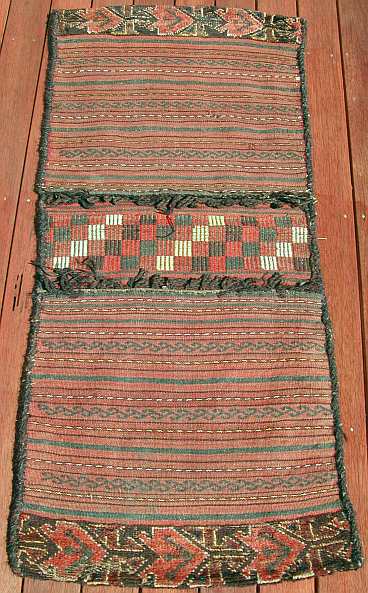
...and THAT (by the way, this type is generally
attributed to the Hazara, not the Turkoman):
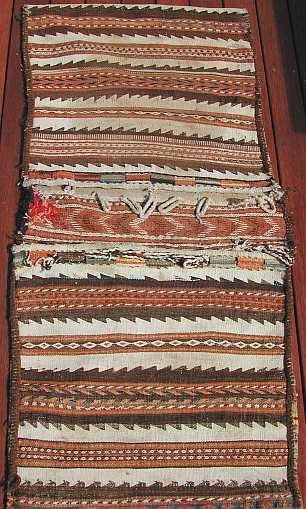
Regards,
Chuck
Wagner
__________________
Chuck
Wagner
Posted by Jack Williams on 06-27-2007 12:43 AM:
Awesome Chuck, you de man. And you covered both bases pretty darn well.
Finding that mixed technique, camel ground Ersari was an especially good piece
of work. Yours? Nice, both of them.
Actually the photographer spent
unusual amount of ink discussing those bags, including comments on age, etc. I
suspect he may be afflicted with the illiness. Oh...by any chance is that you in
the 1975 picture with the hazara bag, perhaps cleverly disquised, on some
collecting mission?
Regards, Jack
Posted by Richard Larkin on 06-27-2007 07:50 AM:
Hi Chuck,
Is that pile along the bottom edges of the first image? Nice
bags.
__________________
Rich
Larkin
Posted by Richard Larkin on 06-27-2007 07:59 AM:
Hi Jack,
I'm inclined to agree with your geographical assignment. If
the knots turn out to be symmetrical, there are other possibilities. When in
doubt, the Kurds, as they say. Crennelated borders are ubiquitous, aren't
they?
About your Ferdous Baluch. If you're suggesting that maybe the
weaver wouldn't have spread out the black that much, had she envisioned the
corrosion to come, perhaps so. I have a "Mina Khani" variant model with similar
nice effects, but with one or two spots just a little too "sculpted." Marty
suggested coloring those places in. We can't do that, of course.
James's
thought about weavers choosing foundation colors that would provide a margin of
forgiveness of wear is interesting. I'd never looked at it that way.
__________________
Rich
Larkin
Posted by Gene Williams on 06-27-2007 11:35 AM:
Kurds
Rich,
I like the attempt to blame the bag on the Kurds..There's a
bunch of them in khurrasan too...right near Afshars, Baluch and Turkomen tribes.
I think they used cotton in warps and wefts too. If its Turkish knotted..do we
declare victory?
Gene
Posted by Richard Larkin on 06-27-2007 12:45 PM:
Gene:
Sounds pretty good to me. As Pogo said, "We have met the enemy,
and he is us!"
__________________
Rich
Larkin
Posted by Camille Khairallah on 06-27-2007 03:54 PM:
Don't rush
Hi all,
If the piece is symmetrically knotted, there are many
possibilities and the most expected should be Hamadan and especially Serab but
some of you are already racing before the rules are
out…
Windsor,
I guess you must be kind of tired of our
debate.
One final inquiry: Is it possible for you to take a close-up (macro)
picture of the bottom of the pile after completely folding the front
horizontally between 2 rows of knots, or vertically between 2
knots?
Regards to all
Camille
Posted by Chuck Wagner on 06-27-2007 09:06 PM:
Hi Jack,
Yes, these are mine. I have quite a bit of Afghan and Uzbek
stuff, most of which was acquired while living (for a long time) in Saudi. The
both bags have some nice color, in detail. And you're right - in twenty years I
probably saw 3 or 4 mixed technique khorjins from Afghanistan, and I own two of
them.
Rich, yes it is pile. Closeups available if anyone is actually that
interested. Here is another one, made by a member of the Really Rough Looking
Khorjin Weavers Guild of Northeastern Afghanistan (whose skills exceed my own by
a long, long way...):
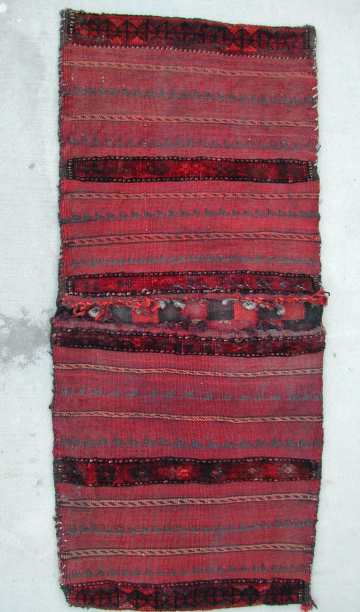
Also, Windsor, a clear
very close closeup image of the back of the piled area on your bag would be
really helpful.
Regards,
Chuck Wagner
__________________
Chuck
Wagner
Posted by Richard Larkin on 06-27-2007 09:54 PM:
Hey Chuck,
When and where did you live in Saudi Arabia? I lived in
Riyadh in 66-68, when I contracted rug fever. It's parasitic, as you know, and
although it can subside for years, it is apt to erupt when least expected.
__________________
Rich
Larkin
Posted by Jack Williams on 06-27-2007 10:05 PM:
Chuck,
Fantastic. Good or bad weave those are some unusual bags. I
had noticed the mixed technique bag in the picture...as had the photographer. He
commented on it in his writeup, which was unusual. It didn't occur to me that
someone on the board would have an analagous example.
That last khorjin
you posted shows one of the reasons I think maybe Windsor's bag is from eastern
Persia, Afganistan, and could be Turkmen origin, or perhaps Ferdous, or Chahar
Amiq. In your piece, I notice the connecting weave between the top of the two
bags is quite narrow, and characteristically squared. I suspect this khorjin was
designed to be carried by man, not animal, because of that narrow connection
piece.
Windsor's bag has a similar narrow squared addition at the top.
Though the second bag of his khorjin is missing, for some reason I have had the
impression that it too was connected directly to that narrow squared piece,
making it similar in construction to yours.
Regards, Jack
Posted by Chuck Wagner on 06-27-2007 10:55 PM:
Jack, et all,
Yes, his bag is clearly enigmatic, at least amongst the
Turkotekateers. I've stayed on the side because I don't know what to think, or
say.
I can't put my finger on it, but it has a "northwestern
Afghanistan" character to me, but not Turkoman. I want to see a better closeup
of the back. The existing one implies that there is quite a bit of warp
depression, which is rather unusual for Baluchi pieces. It's a little coarse as
well, although well within Baluchi range.
The selvage-like black areas
look like Afghan work, but the pile (to me) looks thick and dense, more like
refugee work than nomadic goods. But the kilim back looks like typical
back-country weaving.
Anyway, I'm strongly indecisive on this one.
Regarding the
over-the-shoulder khorjins, don't forget that donkeys are pretty common in
Afghanistan and Uzbekistan, and they have skinny, bony, narrow backs that would
easliy accomodate a bag with a relatively narrow median strip.
FYI, mine
has been stitched together and may have been broader in better days. I'll send
an image tomorrow.
Rich - Dhahran.
Regards,
Chuck
__________________
Chuck
Wagner
Posted by Patrick Weiler on 06-27-2007 10:56 PM:
Ch Ch Ch Changes
James,
There are examples of old Anatolian rugs with the weft color
changing from one area to another so they would match the pile color. The red
field of a Mudjur prayer rug, for example, would have red wefts and the rest
would be white.
And, for what it is worth, my take on the original bag in
this thread was that it looks Khamseh to
me......
Kontrarily,
Patrick Weiler
Posted by Jack Williams on 06-27-2007 11:53 PM:
Connect the squares (?) not dots...
Good evening Chuck, Patrick, et. al. Chuck, while this discussion meanders, I
would love to see some details of your Khorjin, especially the mixed weaves.
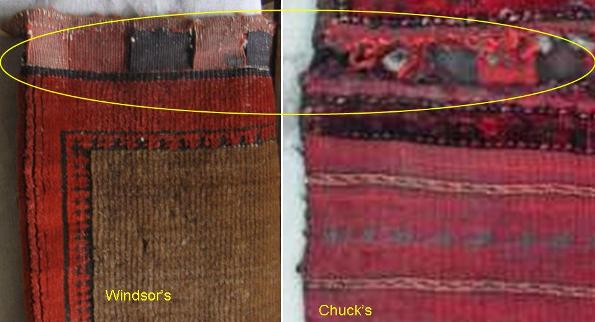
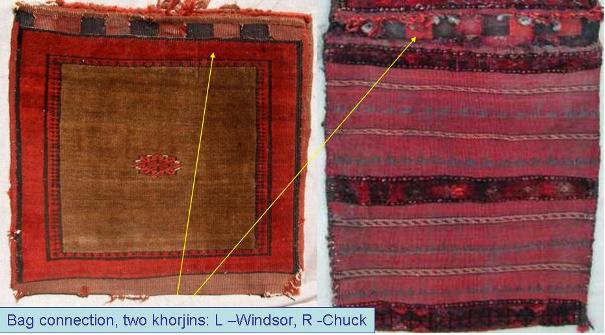
Here are two pictures
comparing the bags "connection" in the khorjins of Chuck and Windsor. I had
noticed this earlier in a Baluch khorjin of mine, but wasn't sure if this was
common in just this region. I'll chance looking foolish (again) and note the
resemblance. (add note later: The above is probably not germane being common
in lots of rugdom places. I now see how it is all conneted, a "squared piece"
sewn to each bag, then connected to a center piece, see Shahsevan bag,
http://www.tcoletribalrugs.com/resources/rugshtml/1006sk.html
)
Also, the fine, "reciprocating, crenelated border" of Windsor's bag
might not be totally ubiquitous, though the kurds seem to use the motif. It
does occur regularly in Baluch, Charar Aimq, Arab-Baluch, sometimes
Turkmen. In those rugs, that border frequently seems like Windsor's, the narrow,
"spear-point with hole" form seen on top of the two tombs in Khotan and Yarkand
I posted earlier. The border even occurs in some internal devices of the Timuri
(?) et. al. see below.
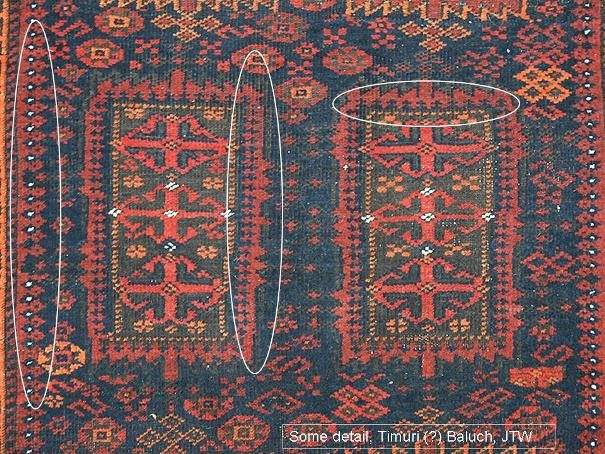
Patrick, Khamseh weaving (I assume you refer to the S.Persian
khamseh confederation, not Khamseh village) might fit structurally, but I have
some doubts about design and color. I've not seen this very simple type designs,
even from the Turkmen portions of that "tribe," except maybe in sofrasor
sleeping rugs. I don't recall many camel grounds on rugs from Fars Province,
except maybe Luri. (That statement will guarrentee a flood of such examples, I'm
sure).
I recall one of Tom Cole's sayings about Baluch, "palette is
provenance." Of course there isn't a lot of "palette" in Windsor's khorjin,
but what there is has a look more of Khurrisan to upper Amu Darya than South
Persia, at least to me. In the rug weaving world, camel ground bags seem to be
most prolific in that area. Heck, you can't move without tripping over a camel
ground balisht or something.
Chuck, I could be wrong, but I don't see
Windsor's khorjin as post WWII, or refugee camp work. It seems too
"un-commercial" in its simplicity...yet very well woven. It is in
remarkably good condition however, except for the black corrosion which has
almost run it's course.
Regards, Jack
Posted by Windsor Chorlton on 06-28-2007 05:11 AM:
Back again
Hi all
Camille and Chuck, I'll try to post the images you asked for,
but my camera doesn't take good close-ups.
Patrick, were you being
serious with the Khamseh attribution? I have a Khamseh bird rug, and that piece
has a completely different 'handle' -- characteristically floppy, whereas the
bag's structure is stiff and tight. Doesn't one of your bags -- shown on this
forum in a discussion with Tom Cole some years ago -- have a similar crenellated
border and closing loops?
Regards
Windsor
Posted by Windsor Chorlton on 06-28-2007 10:45 AM:
Bag by Popular Demand
Gentlemen
I take my hat off to you for sheer determination and
bloodymindedness.
Chuck asked for some closeups of the piled back. These
are as close as I can get.
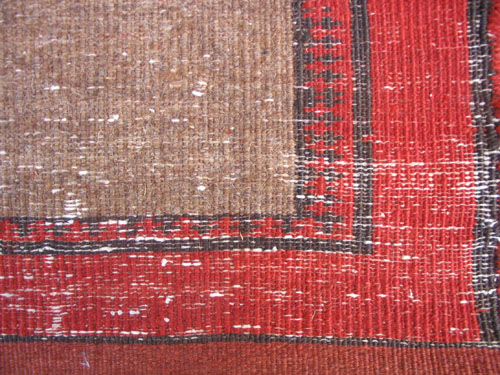
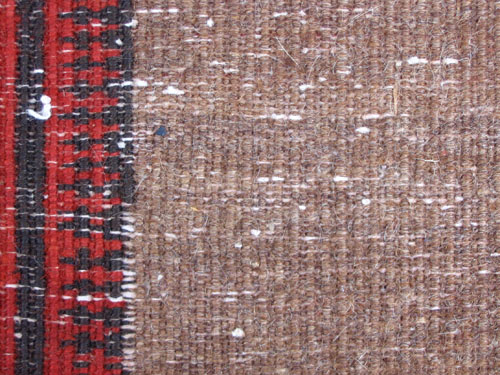
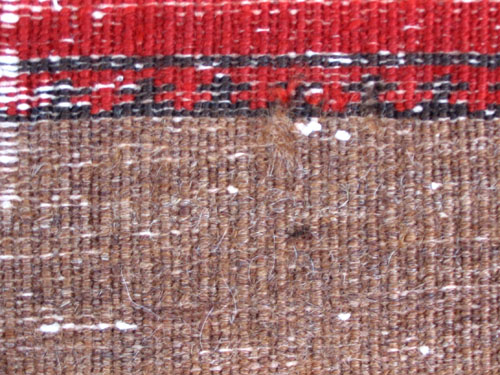
While looking at the
back, I noticed something I'm nervous about mentioning. Ages ago I was asked if
the camel-coloured yarn was different from the red. I looked only at the front
and said 'no'. There is a slight difference in texture, but nothing that
couldn't be accounted for by the use of different dyes. On the back, though, the
brown field shows lots of fine, loose hairs which you might be able to make out
for yourselves. I squinted along the length of the bag, and these hairs don't
appear in the red areas. Remember how someone -- sorry, my memory doesn't
stretch to a name -- said that the back of his camel-hair bag had fine loose
ends...?
No, let's not go there again.
Camille, again, this is
the best I can do with images of the piled area.
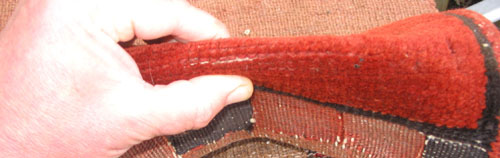
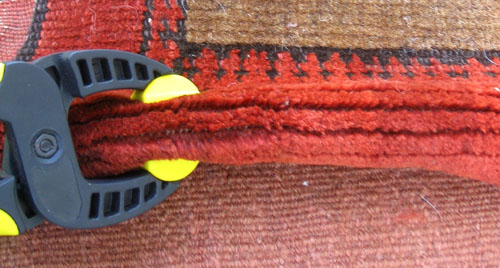
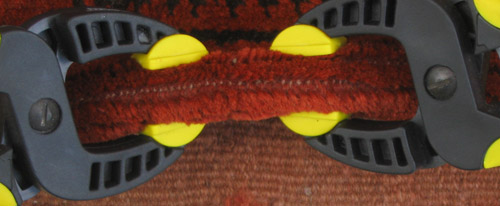
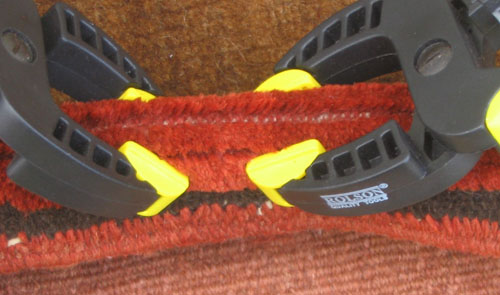
If they don't
show the knot type, I'll just have to take the bag to a dealer for an opinion.
(Now why didn't I think of that before?)
Regards
Windsor
Posted by Steve Price on 06-28-2007 11:05 AM:
Hi Windsor
I probably reduced the size of your photos too much to show
all the detail they had when you sent them to me. The file sizes were enormous
and they had to be reduced to some degree. I think I overdid it, and I apologize
for that.
The first one with the pile bent back to show the knot heads is
clear enough to identify the knots as symmetric, though.
It's hard to
conclude anything about the difference between the red and the camel color as
seen on the back, except that there's a difference. The camel color might be
undyed wool from sheep of that color, or there might be something else that
makes the fibers different - wool sources, dying process,
etc.
Regards
Steve Price
Posted by Windsor Chorlton on 06-28-2007 11:29 AM:
Doh!
Hi Steve
Thanks for settling that. And sorry to everyone for
misleading you from the start (actually, several of you were rightly dubious
about my asymmetric claim).
I suppose that could see the quarry bolting
in a different direction.
Regards
Windsor
Posted by Richard Larkin on 06-28-2007 11:32 AM:
Hey Folks,
Good gawd!!! The monitor at my office shows these images
very dark, so I could be wrong, and I hope I am. But it looks to me as though
the first image is symmetrically knotted, yet the others look asymmetrical. If
so, it must be a conspiracy to make us crazy, and j'accuse Windsor of
being a conscious agent of this conspiracy. Either that, or the bag was started
by a small group of Kizil Ajaks who were overrun by Azerbaijani Afshars, who
(among other things) took over the weaving.
The second and following
images are the darkest. What say you all?
__________________
Rich
Larkin
Posted by Steve Price on 06-28-2007 11:41 AM:
Hi Rich
I think the first image of the series with the piece folded is
folded along the warps. The other three appear to be folded along the wefts, so
only half of each knot head is visible.
And, yeah, the third and fourth
are darker than the first two. Unlike the loss of detail, that's not my doing.
Steve Price
Posted by Windsor Chorlton on 06-28-2007 11:57 AM:
Ambiguities
Hi Steve and Richard
The first image you're referring to shows the bag
folded from side to side -- across the warps. The three that follow show the bag
folded from top to bottom -- along the warps.
Regards
Windsor
Posted by Steve Price on 06-28-2007 12:03 PM:
Hi Windsor
Yup - my choice of words was bad. I was trying to say that
warps were folded in the first one, the wefts were folded in the other three.
Thanks for clarifying.
Steve Price
Posted by Richard Larkin on 06-28-2007 12:35 PM:
Hi guys,
Yup, that's it. I should have got the point on the folding
axis, as the first image of that orientation shows the flatwoven closure tabs to
the left. So I withdraw the accusation against Windsor relative to the
conspiracy.
Now that we're clear on the knots, I hereby withdraw from the
allocation task force, as I still don't know who wove it. It just isn't a big
bafflement now. All I can say is, anybody who wants to get my vote has to
adequately account for the squashed wefts.
About the camel colored wool.
The piece is a pretty good example of the sort of thing that leads one to think
that wool is different from the other colors, what with the fuzz and the
mottling of the color at close view. However, I'm also impressed by the
testimonials from those who say camel wool is of a different quality from what
we seem to be seeing here. Steve's idea that it could be some other wool, such
as undyed sheep's wool, sounds like a good line of inquiry to me.
__________________
Rich
Larkin
Posted by Camille Khairallah on 06-28-2007 01:00 PM:
Welldone!
Thanks Windsor for your fruitful efforts.
The first picture shows well
a symmetric knot and for me the piece could be Malayer but I am more tempted to
say Serab because of the slight depression showing at
back.
Regards
Camille
Posted by Richard Larkin on 06-28-2007 01:39 PM:
Hi Camille:
Is there a tradition of weaving this kind of utilitarian
item among weavers from the Malayer area? Although I take your point about the
occurrence of plain edges among old pieces from that area, I think of the design
repertoire there as being much more Persianate. What do you say about that?
Also, I think of Malayer as a single weft town. I get the impression this piece
is double wefted. Maybe I'm wrong about that.
In addition, I think of
both Serab and Malayer fabrics to be relatively much more "flexible" than what
Windsor describes this one to be. I attribute the stiff handle to the fact that
the knots were hammered into the warps very hard, resulting in the fact that the
wefts are mostly hidden. The Serabs of my experience tend to show much more weft
at the back, and to be pliable. I do agree that you find this sort of partial
depression of warps in Serab pieces.
Regards.
__________________
Rich
Larkin
Posted by Sue Zimmerman on 06-28-2007 02:02 PM:
Hi Rich,
THAT wool yarn looks just like undyed first clip Karakul, of the
color the Russians call "Rue". Sue
Posted by Jack Williams on 06-28-2007 04:00 PM:
"The Carpet of Belshazzar"
Good evening all.
I have loved every moment of this exploration, and I
am truly taken with Windsor’s khorjin. It would please me greatly if the field
were actually found to be camel wool.
For evening enjoyment, here is
something for everyone, ”The Carpet of Belshazzar” by Robert Chambers. A
quote from it recalls one aside within this discussion, “...the violet tinted April dusk...”
“Ten thousand
thousand stars shine down on Babylon
the desert well reflects but
one...”
http://www.horrormasters.com/Text/a0291.pdf
Regards,
Jack
Williams
Posted by Jack Williams on 06-28-2007 05:16 PM:
"The Carpet of Belshabijar?"
Another short story featuring Windsor's bag. "The Carpet of
Belsha-Bijar."
Near Bijar are groups of Kurdish and supposedly
ex-Kizilbash Turkmen (Afshari if you will). Use of camel ground in rugs is known
in the Bijar area and also production of bags and utility items. And, Bijar area
rugs are known to have some cotton foundations, and for packed down wefts, and
the Kurds use that border. Could it be Kurdish-Bijar? Or do we just concede the
field to a mystical origin?
Jack
Posted by Steve Price on 06-28-2007 05:35 PM:
Hi Jack
If you hold your ear against that camel color field, you'll
hear the sound of a sandstorm if it's really camel wool.
Or, so I've been led to
believe.
Steve Price
Posted by Camille Khairallah on 06-28-2007 05:49 PM:
Hi Richard,
I too believe the bag is double-wefted and I don't think
any depression can occur if it was single knowing that in this case the tension
of the weft should always be the same at each shoot and then
sinusoidal.
As for the attribution, Malayer for the border style much
more than for the technique although I don’t know how rigid and acurate this
attribution should be especially when combined to another name to point towards
a village in the area, and I don’t think until today someone undertook
researches and published a serious reference on that district.
One should
take into consideration that the piece is a bag and for the pile to remain in
this condition I doubt it was used on a floor, because walking on it would have
somewhat affected the height of the pile as well as the firmness of the
texture..
Another point related to that is the question of humidity that the
piece could have absorbed 30 years ago and hardened the texture for
ever.
Town or village saddle-bags were never produced in same numbers as
in tribes (that often produced them for the trade) of course but they existed
and many have been published: Philip Bamborough, Homer’s “Truly tribal”,
Reinich’s “Bags”, Benardout’s “small pieces” are a few examples and I am often
surprised to discover in Iran village saddle-bags I had never seen
before.
Regards
Camille
Posted by Jack Williams on 06-28-2007 06:11 PM:
How to be POSITIVE it is camel wool
Steve,
The best way to be sure that something is camel wool is simply to purchase it. Pre-purchase it was
sheep, post purchase, definitely camel.
Jack
Posted by Gene Williams on 06-28-2007 06:19 PM:
Opinion coming:
Hi all,
Sue's comment on the clip resonates...and for me It still
sings Khurresan...
Gene
PS. by the way for Chuck and Jack: I have
a mixed technique flatweave/pile Baluch bag at home..it'll have to wait a couple
of months.
PPS. by the way, Chuck and Jack, I looked at a lot of working
donkeys in Afghanistan Khorrasan..and those small saddle bags aren't used on
them as far as I can tell...horses, bycycles, motorcycles, mules... yes
...donkeys no. Working donkey bags look remarkably like Juwals..in size and
design. I've seem them being used to carry soil from digs, concrete block, seed,
whatever...but they are very large, made like saddlebags in pairs and are the
length of the side of a donkey. I know Juwals are called sometimes "camel
bags"..from what I've seen..I'd say they were used on donkeys, not
camels.
PPS. 0200 here and I keep forgetting what I wanted to say...I
bought some of John's Islay. Here's a couple of more observations for better or
worse: The corrosion in the bag means to me that the black has to be at least
40-50 years old. I base this on a carpet bought new in 1975..with similar black
crenelated battlements borders which has similar corrosion but with a much
shorter clipped pile. That's assuming the bag wasn't packed away...my
carpet..which I'll post at some point..was used regularly on the floor for 20
years..was packed away for 12..So it was walked on if that makes a difference as
Jack maintains (although I always assumed the iron just sort of ate its way into
the carpet like rust on my 1986 CJ-7 Jeep fenders). The pile of the bag looks in
good shape...thicker than Baluch..again bringing to mind Kurd...(Rich, is the
knotting too fine for Kurd?). The bag had to be used though...holes in the
back...separated from its pair...unless that were done deliberately...
Posted by Richard Larkin on 06-28-2007 06:27 PM:
Hi Camille,
Of course, you're right about the need for at least one
extra weft to get the warp depression. Not to harp on one issue, but I find it
hard to attribute the thing to Malayer on the strength of a plain border and
perhaps camel colored wool when little else suggests that provenance. Both of
those characteristics are not very rare elsewhere. I do agree with you that
there is probably a much greater variety of bag formats out there from small
village settings than is commonly suspected.
__________________
Rich
Larkin
Posted by Camille Khairallah on 06-28-2007 06:46 PM:
Hi Richard,
...and what about Serab, the first generation:
-
Cotton foundation.
- Double-wefted.
- Camel color.
- Knot nature and
depression.
- Fuchsine.
- Teeth (medakheel) border.
- Open large
border.
All are features that can be observed in an early 20th century
piece.
Posted by Richard Larkin on 06-28-2007 07:23 PM:
Camille:
Serab is more plausible. My sense of the weight and feel of
Windsor's bag, and the (narrow) range of colors puts me off Serab, but it is as
good a proposal as any. I agree that the bag is probably earlier in the 20th
century, not older.
__________________
Rich
Larkin
Posted by Patrick Weiler on 06-28-2007 08:59 PM:
Just the Design
The only reason I mentioned Khamseh is because the endless knot-type design
feature in the centor of Windsor's bag is common on Khamseh bags. Here are a
few:
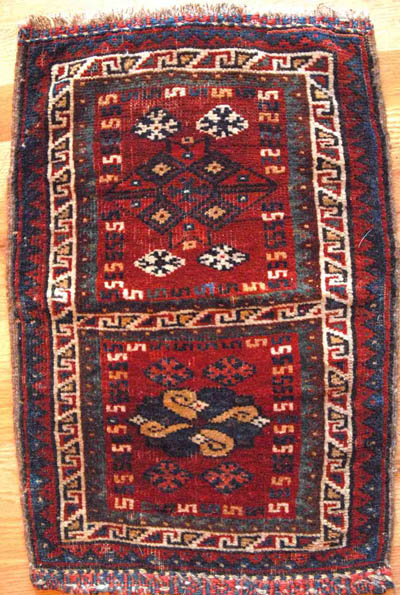
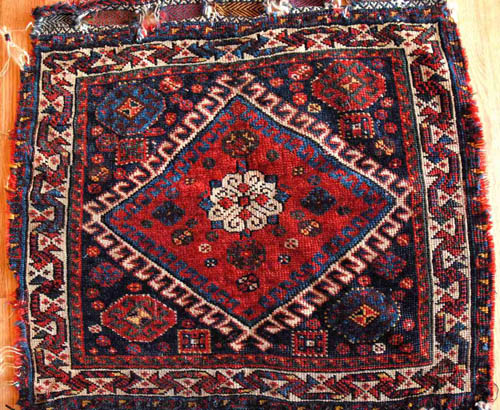
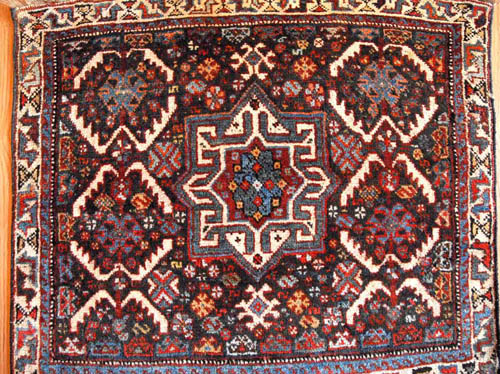
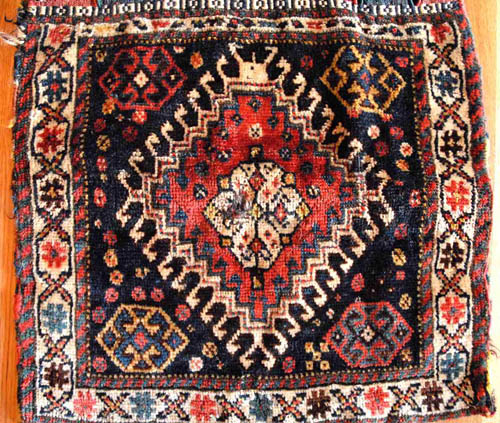
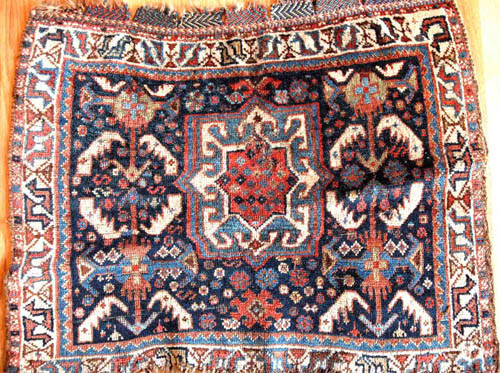
On this last piece, the knot
arms are entirely gone and only the interstitial diamonds
remain.
There was a sixth photo of a Khamseh rug with this
endless knot in the middle, but it did not appear when the link was inserted, so
I suppose it is lost in cyberspace somewhere.
The construction of village
pieces in the first third of the 20th century was perhaps evolved from the style
of the nomadic predecessors, so cotton foundations may have replaced wool, and a
more simple design could have been used rather than the quite busy type favored
by the nomads.
Serab is a reasonable suggestion, but I am not familiar with a
Serab tribal bagface tradition. Kurdish rural, perhaps.
Patrick
Weiler
Posted by Camille Khairallah on 06-29-2007 05:49 AM:
Hello Patrick,
I liked your bags especially the first that seems to be
a small chanteh: Well framed with nice design proportions.
The central
position of the motif in Windsor's bag and its resemblance to the infinite knot
let one think of it but finally it is the same.
I guess never cotton
occurred in Khamseh pile weavings not even in the 2nd third of the 20th c.
quote:
I am not familiar with a Serab tribal bagface tradition.
Neither am I Patrick, even with non-tribal-, but a saddle-bag
or any bag doesn't necessarily have to be tribal. We are often inclined to give
a tribal attribution to bags with wool foundation while these could well be the
work of sedentary villagers who have no link to any tribal constitution
(numerous examples from Turkey and the Caucasus).
The village saddle-bags
that I still remember having seen are for instance from Feraghan, Malayer,
Bakhtiar (pile on cotton), Mazlaghan, Meshkin, Alamdar (Hamadan district),
Karadja and many others, but I still say these are not easy to find as they were
all produced in small numbers and for personal use like is mostly the case of
Windsor's.
Regards,
Camille
Posted by Richard Larkin on 06-29-2007 07:34 AM:
Hi Camille,
Now I'm getting in step with you. There are lots of
possibilities as to where Windsor's bag could have been produced that aren't
particularly well known for this type of weaving. It is probably one of them.
When I find these odd bags, I usually call them "Kurdish." I'm probably wrong
much of the time.
Gene, I just picked up your question whether I think
the knotting was too fine for Kurds. I don't, but then, I am no expert on Kurds.
I use most of these terms bluntly, derivatively, and from a great distance. They
sound impressive when I say them, though. 
Patrick, I love your
Khamseh bags. I don't see them anywhere near Windsor's item, though.
__________________
Rich
Larkin
Posted by Camille Khairallah on 06-29-2007 08:14 AM:
Hi Richard,
I still retain my suggestion about Serab (or
Malayer/Feraghan).
The names I stated are the rural areas from where I
already observed saddle-bags and I am sure there are others I don't recall, just
to confirm that they existed in Iran.
Regards,
Camlle
Posted by Marty Grove on 06-29-2007 09:50 AM:
Comment?
G'day Windsor and all,
It has been quoted here recently that 'colour
is provenance'. Perhaps that is far too broad a statement, however we have
reached almost an impasse by dissection so to speak, not having been able to
reach a conclusion even after combining/analysing all the specifics known to
hand about this piece.
Maybe all we are left with is being able to come
up with the people, district or dyer who knows, has seen, or has an example of
the specific red which glows from the border of it. Gene likened it to a very
real gemstone best ruby colour which I thought could be named 'mogok' for the
famed best pidgeons blood rubies from Burmah. Surely this colour red is so
different that it could be remarkable, meaning someone in the greater weaving
world has seen/and or remarked on this colour red and just possibly might, might
know where it originates. Calling all colourists, calling all colourists
...
The field colour resembles the wool in the minor borders of a hamadan
type (suggestive of Kolyai) which belongs to me, that I have always wanted to be
camel - regardless, undyed handspun karakul sheeps wool (with minor kemp) named
'rue' (thanks for that appellation) is a more likely explanation for it. Mine also has a very different
appearance and with lots of fine fibre scraggles all over it, nothing like the
wool beside it, looking at it on the back. The two types of wool, in Windsor's
bag and my hammy kolyai in my estimation come from the same animal - just what,
I shrug my shoulders
My offering,
Marty.
Posted by Marty Grove on 06-29-2007 09:53 AM:
Book
PS. Jack, thanks for the story 'The Carpet ..etc) which will give me a lot of
pleasure during the next hour or so.
With anticipation,
Marty.
Posted by Martin Grove on 06-29-2007 10:32 AM:
G'day Patrick and all,
Referring to the uppermost of your last set of
bags, the one which has a different central component for each of the two bags.
Perhaps it really has nothing to do with the bag we are determining but there is
something about it that struck me, which is - the field centre has a design very
reminiscent of the field element in an old Turkman Zahir Shahi prayer rug I have
shown here on Turkotek.
Is this an indication of the age of the bag you
show Patrick, or is it a fairly common 'turkman' element which has been usurped
and utilised by many of the weaving groups over the last hundred years or
so?
Sorry if this is at cross purposes to Windsor's thread, but the
similarity struck me so forcefully that I had to ask before I
forgot.
Regards,
Marty.
Posted by Richard Larkin on 06-29-2007 10:39 AM:
Hi Marty,
You've seen it too, I mean that different kind of
camel-brown wool. But the institute of textile something or other won't let us
have our camel wool. It must come off some kind of beastie. I know that
I've eyeballed several (one-humped) camels that looked like just the sort that
would shed that kind of wool. No doubt, things change when you get into the lab.
Anyway, enjoy your piece, whatever critter it was that sacrificed to make it
possible.
Regards.
__________________
Rich
Larkin
Posted by Marty Grove on 06-29-2007 10:56 AM:
Thanks Richard - While its true that I often sniff my rugs, it cant be said
to date that I LISTEN to them also, regardless of Steves indicator toward
positivety re camel wool
although I do admit when in the deepest bush I may sit around the campfire,
smoke in one hand and large Barrier Reef shell to ear in the other, just
refreshing and reminding myself that there is a different, oceanic environment
from the hot and dry distant place currently (then) being
experienced...
And also, yes I agree with you that amoungst the one
humpers, the variety of hues la camel - from browns to lightest beige is very
evident. Determining whether the wool which we so desperately might wish to be,
really is the fascinating and romantic wool from Allah's chosen animal, the
camel, is a difficult quest
Regards,
Marty.
Posted by Jack Williams on 06-29-2007 11:11 AM:
bizarre bazaar bijars...handle firmly
Hello all.
Marty, your note about that color is a good one. Camille
and all, thanks for sharing your obviously deep knowledge about Persian carpets
in the Azerbaijan region. I am not confident of my familiarity with the
intricacies of weaving in that area.
However, I'm not sure the
Hamadan-Sarouk-Serab-Fereghan argument takes into account the handle of this
piece. Windsor has said that it is so weft packed it is difficult to
bend..and vice grips were apparently employed to open the warp and weft.
Also, the pile seems unusually long for the above areas.
To me that could
indicate Bijar area. A quick look at Bijars indicates they commonly have
a lot of the characteristics of this bag...village origin (rather than workshop)
and with both Kurd and Turkmen weaving roots. That border might indicate one or
the other.
Here is what one source said about "Bijar" weaves, see:
http://www.oldcarpet.com/bijar.htm
"...Texture:
A very dense hard pile, cut medium to high, though old and antique finely
woven pieces tend to be clipped lower....
"Foundation: Warp is
of cotton or, less frequently, goat's wool. Weft is cotton and both
warp and weft yarn is tightly spun. In old and antique pieces, warp and weft are
of wool...
"Knots: The majority of BIJAR rugs have Turkish
knots. However, Persian knotted pieces are also found...
"Although
the small Kurdish town of BIJAR in the province of Kermanshah has hardly ten
thousand inhabitants....a clear distinction...[is]... made between the products
of the BIJAR town workshops and the Tekab-BIJAR, which are woven by an
Afshari tribe that settled in the area...
"BIJAR rugs have a very
unique weave that uses the symmetrical Turkish knot and double weft compacted
very tightly, thus making them heavy and durable rugs....
"...Most
BIJAR rugs are woven by Kurd and Afshar weavers of the Gerus region
around the town of BIJAR in western IRAN. Bijar carpets are divided into the
following formats:
• Traditional Bijars (Bijars with rose motifs)
•
Halvai and Tahjavi-Bijars
• Afshar Bijars..."
The use of symmetrical
knot opened up a lot of other possibilities including up into the Cacausus Mts.
Despite all the above, I havn't quite abandoned the Kurrisan region. Marty's
note about the unique, fiery red is a good one. In my opinion, the best reds are
from much further east than Bijar, and as I said before, that area seems to be
the "home" of camel ground bags.
Regards, Jack
Posted by Marty Grove on 06-29-2007 01:06 PM:
G'day Jack,
Thanks, your Bihar entrant is a winner if looked at from
the description just shown and if Windsor's bag carries all those
characteristics...Those plastic pliers were a bit dramatic an illustration of
just how hard some Bihar's are, what they call 'iron rugs', so I have
read.
But I didnt think my ruby comment warranted so expressive a 'bold'
font when after all,
really it was your brother Gene's.
Smiled,
Marty.
Posted by Steve Price on 06-29-2007 01:17 PM:
Hi Marty
I don't know whether it's true, but I learned that Bijar rugs
were called "iron rugs" because of their durability - they reputedly "wore like
iron".
Only ten more posts until this thread reaches the coveted 200
post landmark.
Steve Price
Posted by Marty Grove on 06-29-2007 01:28 PM:
G'day Steve and all,
Would that I had an iron hard Bihar then for my
porch. The dogs camp rug in the entry is too soft for a wipe rug, when
durability is necessary.
Besides, Ive always have been afraid that surely
someone would swipe any oriental rug which we had thoughtfully left outside the
house...
As for
2000 Steve, no trouble with there; miles of interest in the thread because it
holds so many things which endlessly fascinates carpet lovers.
The things
make us smile!
Regards,
Marty.
Posted by Richard Larkin on 06-29-2007 01:57 PM:
Folks,
Somewhere in here, I said it could have come from anywhere, so
I can't very well say it can't be Bijar. And Jack's references suggest there are
different kinds of Bijars. But most Bijars, to me, include a heavy weft thread,
contributing to that stiff iron handle. This one seems a little
different.
BTW, I used to think of the Afshar as a shy little obscure
tribe that learned a lot from the neighboring Khamseh and wove a few rugs. Turns
out they're weaving everything in sight. Afshar Bijars! Really!?
__________________
Rich
Larkin
Posted by Marty Grove on 06-29-2007 02:07 PM:
Clues
G'day all,
What I think that Jack's latest corrosponding discovery has
given us, is the idea that tribal weavers were employing their craft from
isolated pockets throughout the breadth of their borders, the people cast
asunder from a myriad of horrific circumstances in their ancient
world.
Some of the remnants of the large tribal groups such as Afshars
might band together as the Muslim people today do, sharing customs etc, wherever
they came to succour, and readily take on the useful characteristics of the
people they were living amoungst, and keeping certain other identifiable
elements which we discover today.
Why not a characteristic Bihar type,
modified by the Afshar, such people being a blend of resettled Afshar from
whatever era, encompassing the Bihar mold?
Regards,
Marty.
Posted by Gene Williams on 06-29-2007 04:52 PM:
Polyglot cross polination
Hi all,
First...Marty on your comment on Jack's "discovery" of
pigeon-blood red.... Well...all you guys are out buying carpets, obsessing about
them...I'd dare say there are not too many of us who actually bought their
spouse/gf a ruby... Hey...From experience, buying a pigeon-blood ruby works
better than a carpet!!
Second, Afghanstan is an absoultely wonderful test
laboratory for the fracturing of tribal identity while retaining same.. You can
have Taimanis living in the same village with Sarbani pashtoons and Tadjiks, and
Timuris and Charhar Aimaqs (If you don't accept the Taimanis being part of the
latter). The Caucausus is absolutely the same. So why not Iran. We've already
seen an example of this in N. Khurrasan..N. of Mashhad..where the Turkoman
(sunni) slaving raids for 400 years forced full scale reorgnization of the
structure of the country..with strong Shah's moving:
-- Turkoman tribes, both
"Kizilbash" and Suni
-- Kurds moved in to protect to border (1580..some say
earlier)
-- Baktiari moved in likewise (1740)
-- Baluch moved in likewise
(1740)
-- "Els" (black tent users) of all types, Turkoman slavers,
whatever.
-- Timuri moving all over the place
-- Baluch raiding
I'd
expect the rest of Persia to be pretty much the same for 400 years in the
outback..so to speak...especially around Kerman...except in certain particular
areas..overwhelmingly of one tribe and relatively remote. I mean, the shahsevan
is a totally fabricated new "Turkoman" tribe by Shah Abbas along the order of
"Come to Daddy..I'll pay you and then you don't have to deal with tha cASSin who
is chief of your tribe"!!
Take a look at Jerry's interview...something he
always tried to say to us (and we made fun of him over it at the time)..when
confronted by a design he wasn't comfortable with he'd say something
like.."Yakub Khani girl married off to an Arab Baluch..." or some
such....laugh..we certainly did..but in hindsight at least he tried to explain
the interrelationships of the tribes in some rational manner...
For me
opinion on Windsor's bag now seems to be whittled down to these major groups
(post sk -symmetric knot - revelation thanks to Richard for the most
part):
-- Camille: Serab? (or Malayer/Feraghan)?..in the end Turkish
(turkoman) from Azaibaijan area?
-- Jack1: Bijar...maybe by an Afshar tribe
living in the Bijar area...maybe a Bijar girl married to an Afshar or vice
versa?. Possibly Martian...Men-in-Black known to operate in the area.
--
Richard: Have to deal with the hammered wefts before convincing him..but until
he can feel the fabric...default to "blame it on the Kurds."
-- Patrick:
Khamseh?..I mean Kamseh is Turkoman Shi'i..Kizilbash..tribal...related to
qashkai and afshar right?
-- Chuck: Punt...post WWII?
-- Gene: Khurrasan.
an amaglamation of Turkoman, Kurd, baluch...since its got Turkish knots..Kurd is
as good as any...(ok ok..I love the ruby color..postulated E Turkistan in its
assymetric mode...I like sword and sorcery fantasy and Great Game lit too.)
-- Marty: Khurrasan-Central Asia...but possibly other Turkoman tribals..from
someone who has seen a really good ruby and likes one hump dromadaries.
--
James: Dunno..looks vaguely Baluch but is not Baluch.
-- Jack2: Mystical
related to the 1994 video game "Prince of Persia."
-- Steve: I'm above it
all..but
..............Bijar is hard,
..............violet is fugitive,
..............I am a bard
..............but the bag is
undoubtative
................xxx (tba)
Apologies to you all if I've
trivialized the postulations. '' ' ' '
' ' ' '' ''
My point: Khurrasan has it
all...contact with India, Kurds, Baluch, cross fertilization with turkoman,
trade routes to Russia, a tradition of tribal bags stretching for 100's of miles
up/down the Afghan border and over to the Caspian and across the Salt desear to
Kerman... Cotton warps and wefts...whatever in the hammered area. it even has
the possibility of Two humper camel wool...It is documented that camel wool was
being woven in fabric in and around Samarkhand by Turkoman tribes in 1823..the
yarn had to come from somewhere...probably E.Turkistan..but then getting up into
the Tashkent area..you're getting into the world of the two-humpers too.
Gene
ps. humm, re "two humpers too," it reminds me of that famous
English language conundrum designed to confuse French and Italian speakers.
i.e.:
"Maria and Francine went to the station at 1358 hrs to buy a ticket
and left at 1402 hrs.
...-- Maria was at the station from two to two to two
two.
...-- Francine was at the station from two to two to two two too. ''
one thing. Hey you
all..I was trying to be witty which came out, upon my rereading this, fairly
obsidianly sarcastic...by no means did I intend it to be that way or to impune
your expertise..I've a great respect for the hobbiests on ths board...If I've
offended..how about a beer down in old-town Alexandria?
Posted by Don Ruyle on 06-29-2007 06:46 PM:
Hello All:
When I first saw this thread, I wanted to reply but didn't
have time. The discussion quickly became bogged down in a discussion of camel,
which to me, is a non-starter. I commited the time to read the intire discussion
to make sure my thoughts had not been covered.
The most recent pics
provided by Windsor seem to confirm my original suspicions that it was
originally a much different rug from what you see here. I see traces of red in
the "camel" field, leading me to believe that it was originally a "red" rug
probably dyed with one (or more) of the very early dyes that were so light
sensitive (mauvine or fuchine or whatever). With this in mind, I can also
picture the field being almost blue-purple, giving credance to a Bijar
attribution. My first thought when I saw it was how much it calls to mind Seneh
rugs.
I have a rug that is now several shades of brown with accents of
dark brown and white. Most of the white is tinted with red and was probably
originally dyed red as was most of the area that is now brown. I can see some
evidance of red in the brown, much like what I see from the back of Windsor's
bag and the red wefts fade to ivory where they have been broken and frayed.The
differing shades of brown tells me that by carefully sorting the brown wool by
color before dying the wool, the maker was able to get at least three shades of
red from the same dye batch. Add to that the ivory wool and one comes up with
The color scheme of turkman rugs.
Although it doesn't exactly match what
most think of as Turkman, it has much in comon with Turkman rugs and I think it
to be so. It a pretty shabby, but will submit pics if desired.
Regards,
Don
__________________
Don
Ruyle
Posted by Chuck Wagner on 06-29-2007 07:11 PM:
Hi all,
Gene : Punt ? Not really - west Afghanistan ? Still OK by me.
That said, once I saw the cotton (I must have missed Windsor's alluding to
cotton earlier) I am now happy with moving over the border to NW Iran. A lot of
post-WWII Persian Baluchi work is done on cotton warps. I don't buy the Bijar
attribution at all - wrong everything, including, if you can bend it open
without breaking it, it ain't a Bijar. To me, the very long pile yarn is a
message as well, and actually, could make me move it to Pakistan.
Jack:
Here's the khorjin closeups - first the rough one. By the way, I was wrong, it
hasn't been cut & sewn back together. I finally looked closely and noticed
the stitching seen from the back is for closure loops that replace the
originals.
The center panel, from the back:
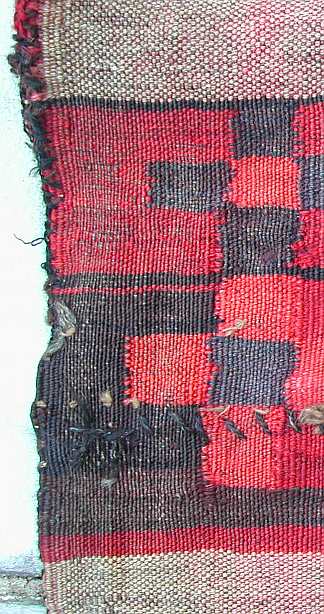
Closeup of same - no
cut:
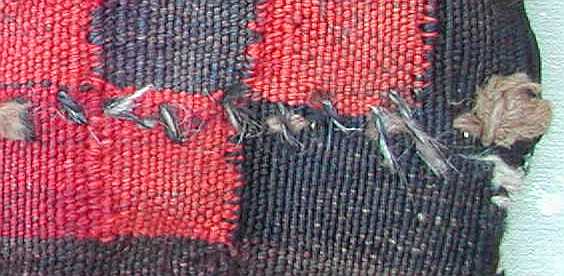
Closeup of pile from back:
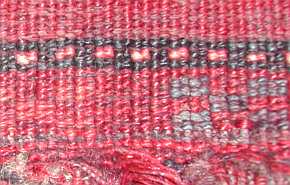
Edge treatment, such as
it is, and the pile:
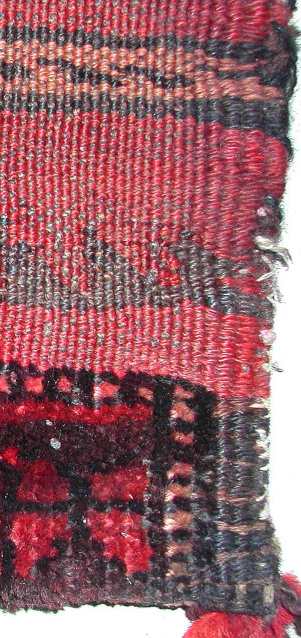
Now, the nicely done one. From a distance, it almost
looks like zilli technique on the center panel:
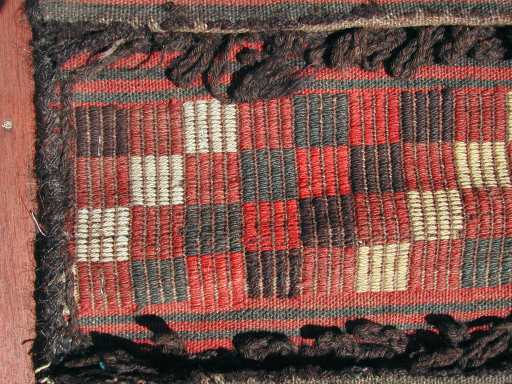
The pile at the
bottom:
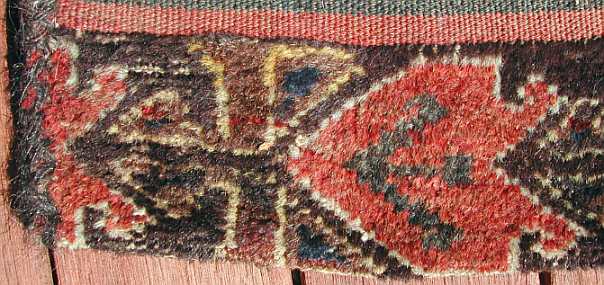
Nice pale yellow in this one:
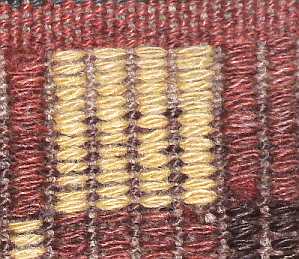
Last, one shot of the
Hazara bag; note color changes in the "teeth":
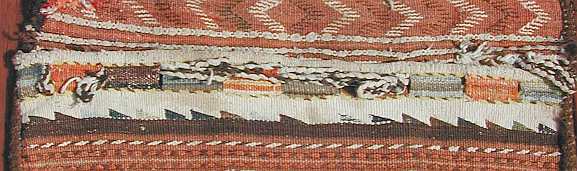
Regards,
Chuck Wagner
__________________
Chuck
Wagner
Posted by Jack Williams on 06-30-2007 03:25 AM:
Khorjin, Kurrison, Kamel, and Koachinal
Hello All:
Chuck, that "Ersari" mixed technique is an
outstanding find. Congratulations...and you are right, the center connection is
a very neat piece of work. But so is the pile on the bottom.
I also like
the other bag and the Hazara. Amazing how they surfaced in this discussion.
Amazing how you managed to replicate both of the khorjins in those offhand
pictures. I begin to suspect you have a lot of ammo stored away.
Question...when you said "happy with moving over the border to NW Iran,"
did you mean "NE Persia?" i.e.: into Khurrison from Herat? We could be
slowly developing some consensus because though I proposed Bijar, my heart still
thinks Khurrison.
Don, I’ve blown up the pictures of Windsor’s
khorjin to the max, and I just cannot see what I would interpret as red remnants
within the camel ground field. I suspect the central blossom medallion had two
different reds, but not the camel ground. I think if a slight pinkish tinge is
detectable, it may be some computer color aberrant derived from the tan wool.
The same tinge can possibly be seen in this carpet, yet it has no red, just
camel colored wool...even the warps are grey, not red.
Given the residual
“purple” on the back of the “fuschine” dyed parts of the blossom, if the camel
ground was originally dyed, wouldn’t it be pretty obvious from the
back?
Regards,
Jack Williams
Posted by Jack Williams on 06-30-2007 03:38 AM:
The Carpet of Bel-Ferdous
Good morning all:
My thoughts have further evolved (some would say,
“twisted”) over the past few days, and unless someone drives nails into a case,
I’ll probably hold to this opinion.
Though I proposed the idea mostly to
account for structure, I question whether Windsor’s khorjin “feels” of Bijar. I
think I will withdraw that nomination. Just for information though, we know
Bijar rugs are from a Kurdish region, and are defined pretty much only by their
distinctive structure…the classic “iron rugs.” But, west of Bijar village
proper, the Kurds weave a looser fabric, and they have been known to use a camel
ground field. Kurdish is my second choice for origin of Windsor's
bag.
The Afshari elements in Tekab, 50 KM from Bijar, also weave a looser
fabric, though they weave some of the finest rugs. (I was aware of the presence
of Afshar near Bijar, and another group next to Lake Urmina when we were into
our Afshar discussion. Actually, knowledge of their presence helped spawn that
discussion). Here is what is supposedly a “Bijar Afshar” khorjin, at least that
was how it was advertised. It does have a fairly significant pile length,
and uses symmetric knots, but…who knows...
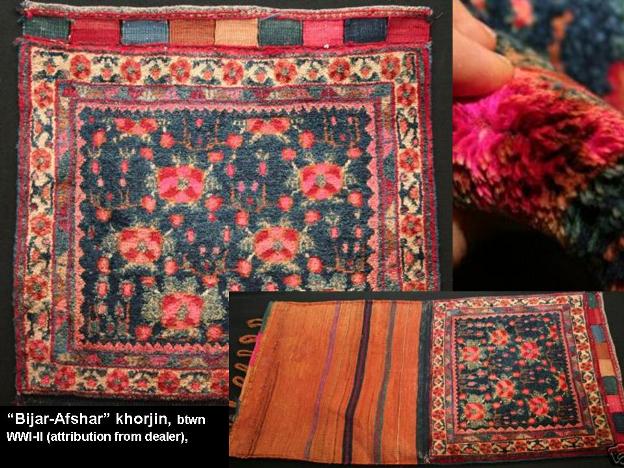
Also, here is an
ethnographic map of the NW Iran region. It is based on a CIA map, modified by
moi.
.jpg)
If not Bijar, what is my vote? I propose Bahluli weave, from Khorrison. This could bring the
ubiquitous camel ground bags, the symmetric knot, the remarkable
red color, the “battlement” border, and the overall feeling of
Baluchness together. Basically, back to a modified “Ferdous” theory,
simply moving east from Ferdous to the Gurrian valley Afgan-Iran border area
(see ethnographic map).
To add ethnographic geography, here is an
ethnographic map of the Khorrison region, and a double ended prayer rug of mine
that I think is Bahluli because of the symmetric knots. Also included is a bunch
of Ferdous rugs which though AS4, may be woven by kizil bash related to the
Bahluli.
Ethnograpic map of Khorrison area, modified from CIA
map.
.jpg)
Possible Bahluli double ended prayer rug, symmetric
knots.
.jpg)
Collage of Ferdous rugs.
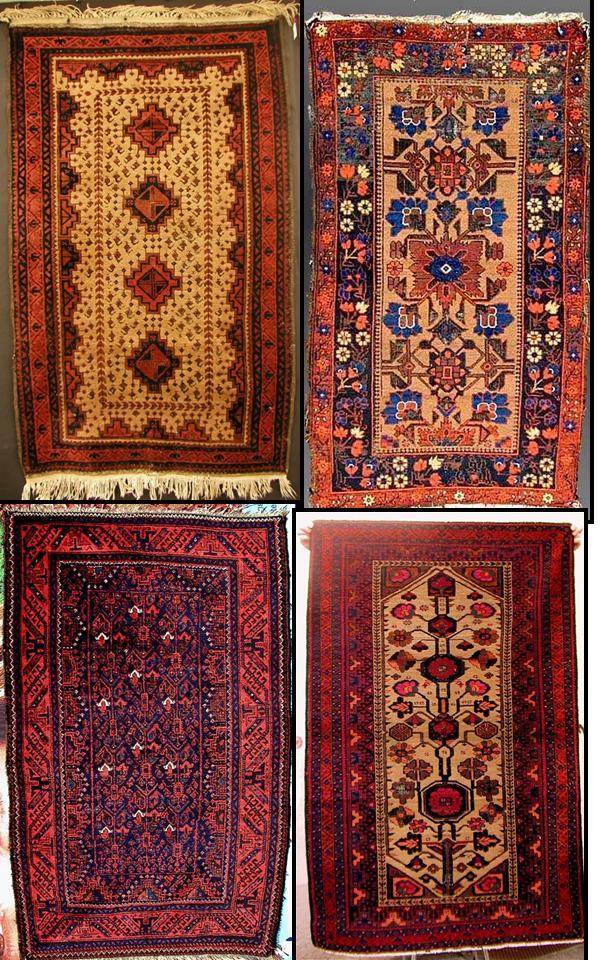
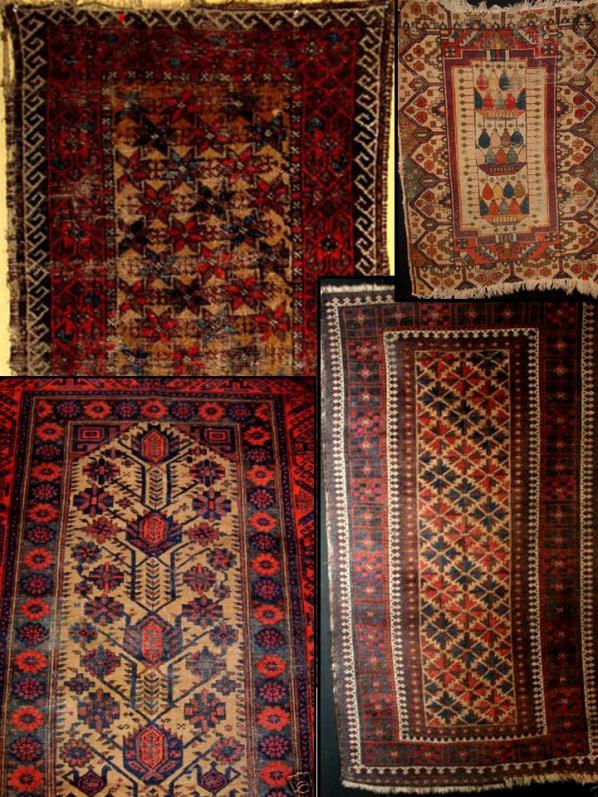
The only other region that
we have considered, (if we nix E. Turkistan-Khotan) is South Persia. To make a
set, here is an ethnographic map of that region…but I just don’t think that is
the answer, Afshar or no Afshar.
Ethnograpic map of South Persia,
modified from CIA map.
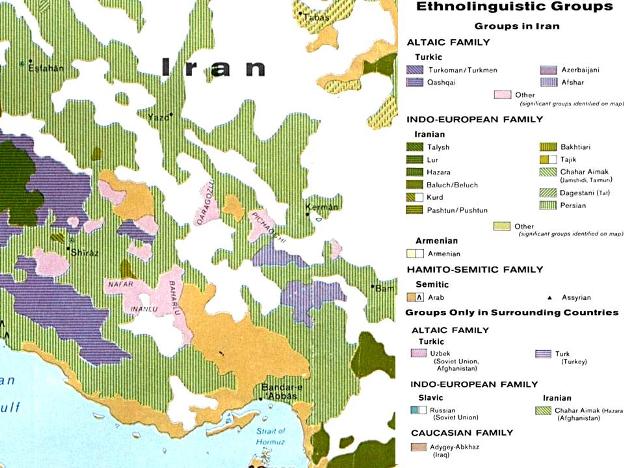
.
Anyway, I hope the maps and thoughts will at least provide a
geographic basis for the discussion.
Regards,
Jack
Williams
New Orleans, ”the Louisiana
Lake”
*************************************************
PS: Did
anyone read the 14 page short story, "the Carpet of Balshazzar"? It is
echoing like a song in my mind, a beautiful example of turn of 19th C.
fiction.
http://www.horrormasters.com/Text/a0291.pdf
”…We
were in the gallery as usual, Geraldine and I – the gallery where the carpets of
the East were hung along the shadowy walls. For lately it was my pleasure to
acquire rare rugs, and it was my profession to furnish expert opinion upon the
age and origin of Oriental carpets, and to read and interpret the histories of
forgotten emperors and the mysteries of long-forgotten gods from the colors and
intricate flowery labyrinths tied in silk or wool to the warps of some dead
sultan’s lustrous
tapestry…”
*************************************************
PPS:
Camille noticed the coffee pot in the "Ferdous" I used as an example previously.
I thought I would close that loop by showing that part of the carpet, featuring
one of man-kind's most important and greatest inventions.

Posted by Steve Price on 06-30-2007 08:57 AM:
Hi Jack
If you sent those image files to me, they never got here.
Filiberto is away until July 16, so if you sent them to him, they'll probably
not get seen until then, and it would be best to send them to
me.
Thanks
Steve Price
Posted by Chuck Wagner on 06-30-2007 09:40 AM:
Dyslexic Ditigs
Jack,
Yes, NE Persia.
Chuck
__________________
Chuck
Wagner
Posted by Richard Larkin on 06-30-2007 12:47 PM:
Hi Don:
Are you suggesting the piece was originally dyed fugitive red
over that brown wool, which faded out to leave what we see? Wow!! I don't think
so. I have doubts about the principal red (or reds?), and I'd have to have the
piece to settle my own opinion, but I see no possibility of the field having
been red. Unless somebody plucked every knot and reinserted new wool.
__________________
Rich
Larkin
Posted by Windsor Chorlton on 06-30-2007 01:56 PM:
Completely Irrelevant
Hi Jack
I'm a base type of fellow, and that beautiful line ' Ten
thousand stars shine down on Babylon...' made me remember -- for some
disconnected and wholly shameful reason -- the following floor-covering-related
doggerel, which now I can't get out of my head:
Would you like to
sin
With Elinor Glyn
On a tiger skin?
Or would you prefer
To err
with her
On some other fur?
Elinor Glyn (1864-1945) was an English
writer of racy novels who coined the use of 'it' -- as in 'it girls' -- for sex
appeal.
Sorry about that. Look forward to seeing the images that haven't
yet appeared in your last post.
Regards
Windsor
Posted by Steve Price on 06-30-2007 02:25 PM:
Hi Windsor
We did a doggerel Salon for an April Fool thing a few years
back It's in our archive, a Google search of Turkotek for doggerel will find it.
Wish you had been with us then. I'd say we'll do it again, but it nearly
triggered a revolt last time.
Steve Price
Posted by Windsor Chorlton on 06-30-2007 04:15 PM:
Tenuous connection
Hi Steve
I'm not sure if that was gentle rebuke or gentle
encouragement. In fact, there is a very dim and distant connection between Ms
Glyn and regions that have become more and more interesting to rug enthusiasts.
Gene Williams clearly knows the history of these regions, and perhaps he's the
one who made my neurones misfire by referring to the 'Great Game' -- the
19th-century jockeying for power in Central Asia between Britain and Russia.
Elinor Glyn was the mistress of Lord Curzon, the Indian Viceroy who gave the
go-ahead to the Younghusband Expedition into Tibet in 1903 -- the last play in
that imperial adventure.
A lot of pieces, including, I suspect, that
Kizil Ayak chuval of fond memory, are part of the legacy of that era.
Back on earth, I'm trying to sift through the conflicting claims about
the origins of that bag, as helpfully summarised by Gene
Regards
Windsor
Posted by Steve Price on 06-30-2007 05:12 PM:
Hi Windsor
That wasn't a rebuke. If you read the salon, you'll
discover that it was my doing. Limericks and doggerel are among my favorite
things.
Regards
Steve Price
Posted by Gene Williams on 06-30-2007 06:08 PM:
Pak?
Hi Chuck.
I reviewed the posts and realised you never punted.. even
though it was "4th and 10.". (we need a dictionary - "punt," "gormless,"
"Wilton"-never explained) So you are in the Khurrisan camp for the moment for
W.Afghanistan or more likely NE persia? At least there's a focus..
As
for the polls per the latest "Rug Times," for Khurrasan there's now me, you,
Jack (very mecurial-I did not use the term wishy-washy), Marty (lots of huge
big-jawed dogs in the area too), James (really middle of the road
non-commental..but good enough for government work), Possibly Rich (though he
won't commit until he can feel something)... gradually the force of numbers will
tell...the "big battalions" of Napoleon.
I noticed your uplifted eyebrow
on a possible Pakistan provinance. You'll note that I mentioned Paks early
on..but the symmetric weave, the corrosion..at least 40-50 years??...would
eliminate that option I'd think...
Gene
There was a Baluch from
Ferdows
with a bag all would suppose
with red in the border
and camel
field ordered
but whose order, sortof, confosed
(W.E. Lear I'm
not)
Posted by James Blanchard on 07-02-2007 01:54 PM:
Hi Jack,
You're right, I don't feel qualified to offer more than a
general opinion about the attribution of this rug. I now have a hard time making
it Baluch, unless perhaps Ferdows, because of the symmetric knotting and cotton
base materials. If it is a somewhat more recent weaving, then my tendency is to
say "all bets are off".
My reticence in offering a firm opinion is due
more to being conscious of my lack of knowledge than to my general demeanor.
Cheers,
James.
Posted by Gene Williams on 07-02-2007 04:08 PM:
Thanks
James,
I very much value your reticence and your opinion. In fact I
don't know anything either in depth..but neither do the Herat carpet merchants
or the traders in Karachi, and I doubt the High-end
sellers-advertisers-auctioneers-con men in London. The best we can do is say
that, at the limit of our knowledge this is where "x" would seem plausible.
In the end I really trust your observations...Rich's too...maybe Rich
more than most because he's looked at carpets in a way I haven't..and Chuck
because of his travels..and all of you guys on Turkotek, precisely because of
the humbleness (ok ego-accentuated..but I-still-have-an-opinion type of
.know-your-limits restraint. None of us is a JACK cASSin.. and all of us know
our strengths. None shirk an arguement..that would be too much fun to avoid. But
somehow working on such an enigma as Windsor's Kurdjin we become greater than
the sum of our parts... or at least.. it becomes more enjoyable...as if I were
going back to my youth..and we were drinking a good scotch together (which by
the way I have been) and looking at rugs at midnight in Karachi in Jerry
Anderson's house, with a circle of friends..with the shadows, and camel tassels
and falcons on their perches..as I did so many times.
Gene
PS.
that's pretty saccarin isn't it..come to think of it I think I made a similar
speech in Afghanistan to...
pps. Windsor, Lord Curzon? Didn't Sergeant
paint a portrait of him?..Lantern jawed..tiger skin inthe background>
Posted by Don Ruyle on 07-03-2007 01:29 AM:
faded reds
Hello Richard:
Yes. And I have and have had a few old dogs (I call
them "learner rugs".) that give testimony to the notion. All came from estates
and at least a few had some degree of provenance. They are all very much faded
and none now show the original intention of the weaver. I imagine most
contributors to this forum have or have had similars and are not too much
interested in discussing rugs with fugative dyes, but I tend to think that the
discussion, if it hasn't been done, might help pin down the dates that such dyes
were used in specific areas.
Regards,
Don
__________________
Don
Ruyle
Posted by Camille Khairallah on 07-03-2007 12:14 PM:
Is it convincing?
Hi everyone,
Here are some pictures for those who are not much
satisfied with words although these might not be convincing enough.
This
is a South-Caucasian khorjin that I dug out of my picture stock. I guess one
doesn’t have to comment much for comparing its “wide lines” to Windsor’s bag. It
could have been a source of inspiration to a Serab weaver same as many Caucasian
designs are for other N-W Persian villages.
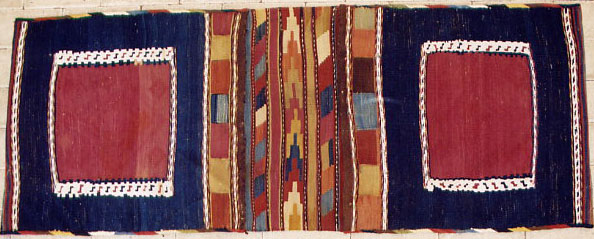
And here are two
pictures showing details of Serab rugs taken from the homonym article by Raoul
Tschebull in Hali #79.
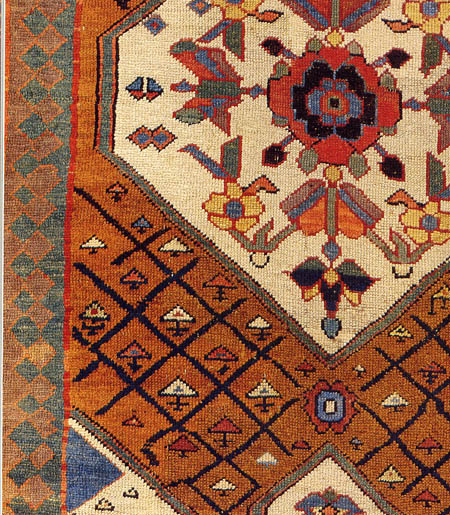 "
"
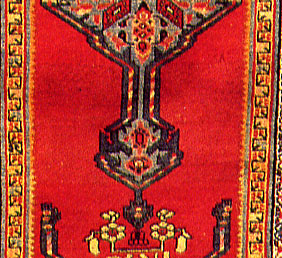
The above pictures
are to compare color hues if the original ones (especially the red) are
faithfull enough.
Regarding the texture:
The latest pictures posted by
Windsor show that it was easier to foldthe warps than the wefts which means
that:
1- It is not as heavilly packed as one can think.
2- As it was
harder to fold the wefts AND that -part of- these did not undergo a full tension
means that the bag most probably suffered humidity problems that engendered its
hard texture. The wefts were more affected as they seem to be thinner and are
more exposed than the warps.
I wonder whether it's too
For those who are thinking
cotton foundation Arab-Afshar-Balouch, these rugs have a totally different apeal
at back and have a dry wool of inferior quality to the usual Baluch. ; While
Windsor's bag appears to have -and he confirms it- a rather shining good quality
wool.
Regards
Camille
Posted by Windsor Chorlton on 07-03-2007 02:14 PM:
Texture and Colour
Hi Camille
Those images you posted are very interesting. That's the
first pile bag -- as opposed to soffreh -- I've seen that even begins to
approximate the spare design of the piece under discussion. And a very
attractive bag it is, too.
The reds on the Serab rugs do appear to be in
the same sort of colour range as the red on the bag, but it's very difficult to
be sure. Depending on the light, the red on the bag can appear to vary from warm
brick-red to the ruby that Gene so much admires. Although I do think the colour
is unusual, I suspect that the dye used is natural. Why? Well, a synthetic red
this good would be pretty expensive -- not the sort of dye to be squandered on a
utilitarian weaving. Note how the identifiable synthetic -- the fuchsine, fairly
costly in its day -- was used only for highlights. To me, the apparent presence
of fuchsine suggests an early 20th-century origin -- pre-dating the general
availability of reliable chrome dyes. Also, this bag was acquired before 1970 by
someone who had no time for 'new'; unless a piece had the appearance of
reasonable age, it would never have been allowed into the house. If the dye is
natural, the most likely source is madder, which contains up to 19 different
dyestuffs and which, depending on mordant, pH, temperature and other variables,
can produce colours ranging from pink to brown-purple.
Camille, although
the pics may suggest otherwise, I'm not sure if the warps are easier to fold
than the wefts. When I first tried, it seemed to me that that the opposite was
true -- folding the bag from side to side made me worried about breaking the
wefts. Repeating the exercise now, I find that folding in either direction
produces similar resistance. It's been raining here for a week, and since I live
in an old farmhouse, internal humidity is high, possibly affecting the 'give' of
the piece. Just to complicate matters, the red areas are noticeably stiffer than
the camel-coloured field.
Gene, just to tie up some loose
ends.
'Wilton' in Wiltsire was one of the main English
carpet-manufacturing towns in the 19th century.
'Gormless', probably
north-country dialect, means foolish or simple-minded.
If (John Singer)
Sargent didn't paint Lord Curzon, I'd be surprised. This American society
portraitist painted anyone who was anyone.
Regards
Windsor
Posted by Camille Khairallah on 07-03-2007 04:16 PM:
Hello Windsor,
The bag I posted is woven in weft-faced, but I relied
on the model, not on the technique knowing that bread sofrehs do not seem to be
known in that part of the Orient (N-W Iran/Caucasus)0.
But pre 1900 Serab are
wellknown for their large outer open border (usually of camel colour). So if it
happens to be Serab, it should belong to the end of the 19th c. (circa
1890-1900).
Concerning the colours and the hues:
The appeal of a
colour is directly affected by the wool quality.
The same dye would have a
different appeal if applied on merino than on a dead dry wool.
Furthermore,
the colour hue depends on the light and of course on the direction of the wool
vis-a-vis the viewer: Under the sun and from the upper side of the weave you'll
see the brighter and lighter hue, while at home under a white light and from the
lower side you'll probably discover Gene's ruby hue.
The dye quality is
doubtless a good one (whether madder or maybe an "over-dye" added), but the
support is not to be neglected.
I guess air humidity cannot affect a
texture that quickly (in one week), but if the piece was never -or rarely-
exposed -at back- to the sun once or twice a year, the texture would get
harder.
Regards
Camille
Posted by Jack Williams on 07-04-2007 10:22 AM:
Madman loose, or "running Aimaq"
Good Morning all.
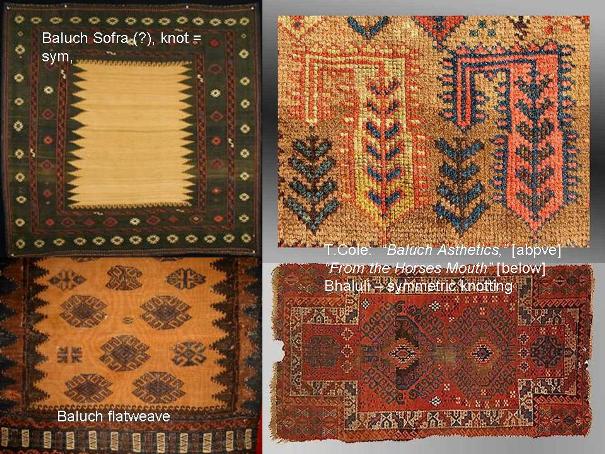
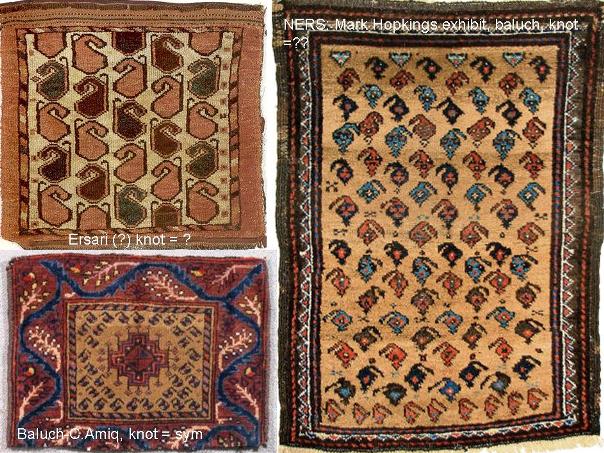
Above are some selected Baluch-group, Aimaq-Bahluli weavings.
Note the Afshari-ephedra border of the J. Blackmon owned item at lower
left
Camille, I understand your thoughts attributing the origin of
Windsor’s bag to Azerbaijan village weavers. However, I feel a certain
confidence about the Khurrisan attribution, even though the cotton structure
still must be rationalized to some extent. The source of that surety is the
symmetric knots.
Because of those knots, I not sure now that Windsor's
bag is a true “Arab-Baluch” from the Ferdous region. The term “Arab-Baluch” may
be a little outdated anyway. Considerable mention has been given to a Kizil
Bash–Afshar connection for many of those “Arab-Baluch” rugs (see Afshar series).
One argument for that Afshar attribution of the Arab-Baluch is their use of
As2-4 (asymmetric open right) knotting. Other arguments lie in the
A-B designs.
So, it may be that the use of symmetric knotting in
Windsor’s khorjin reduces the likelihood of a direct Ferdous connection. But
it may lend considerable weight to just moving the source east about 50-100
Km while maintaining the ethonological connection.
In Khurrisan
symmetric knots generally mean either Kurd from the Quchon area, or
Aimaq/Bahluli/Taimuri-Baluch group. In my mind, a Kurdish origin (east or
west) for Windsor’s bag is the most likely alternative to the
Aimaq/Bahluli/Baluch group because the Kurds are the people who seem to use that
“battlement border,” and camel ground wool most often, next to the Baluch. But
really, has anyone seen a Kurd weaving that is as simple as Windsor’s? Or that
has a similar colorization or aura?
Many writers from Edwards to Wegner,
to Jerry Anderson, to Eiland, have credited the Bahluli from the Gurion -
Astrakand valley area along the Afghan-Iranian border with weaving the Baluch
rugs with a symmetric knot. Here are a couple of examples, and I've collected
some rugs and lots of pictures ... many with camel ground fields and a the look
of a "Ferdous."
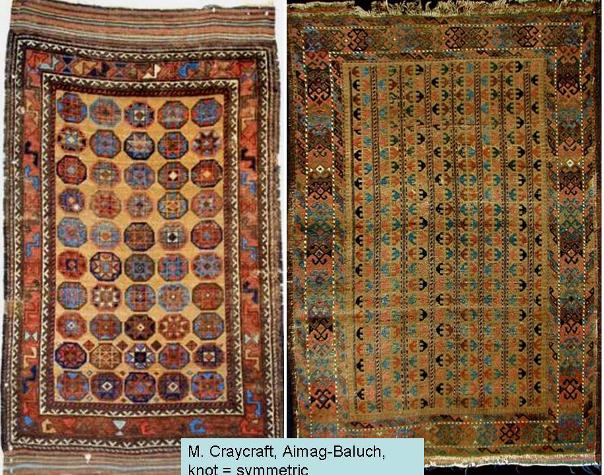
However, I've noticed that lately other subgroups of the Aimaq
peoples are also being credited with use of symmetric knotting. For one thing of
note, from a quick look into the literature, the Chahar Aimaq are
academically frequently identified as a sub set of the Aimaq, which has some
20 tribes in Khurrisan, many quite obscure and of widely varying
numbers.
I speculate the Aimaq-Bhaluli-Baluch group uses that
[i]”battlement border” in …oh… maybe 25 percent of their rugs. Also, I would
bet that up to 40 percent of all the Aimaq/Bhaluli/ Baluch-group bags,
balischts, khorjin’s, pushtis, etc., from NW Afganistan-Khurrison use camel
ground fields. It wouldn't surprise me if up to 75 percent of all of the
camel ground weavings in the entire world originate in
Khurrisan.
Eiland and others estimated that use of symmetric knot
occurs in about 5 percent of Baluch group rugs, But, in camel ground
weavings, I’ve notice that apparently the percentage of symmetric
knotting goes up quite a bit.
I recommend looking at Mark
Hopkins’ collection on the NERS site. His collection is beautiful and
especially interesting in its apparent main focus…an unusually large percent of
his collection is dedicated to items with camel ground fields…about 20 out of 30
pieces. Of those, seven, or almost 25 percent of the collection uses
symmetric knots. See his collection at: http://www.ne-rugsociety.org/gallery.htm
Here are
several of his pieces that are symmetrically knotted. See if the connection to
Windsor’s bag doesn’t begin to make sense.
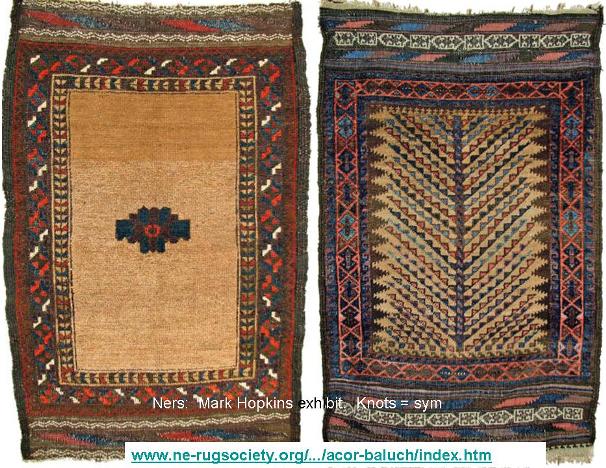
NOTE above: the
balischt on the left purports to have 'camel hair' in the upper one-third of the
field, and sheep's wool in the rest. (if anyone knows Mark personnally,
perhaps they could ask him how the different wools were identified. Hopefully a
microscope was used...if so this may be a bag face with camel wool right next to
sheep or goat wool.)
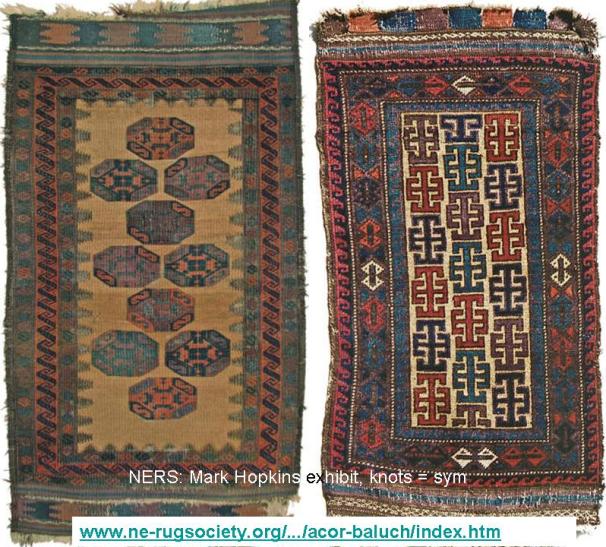
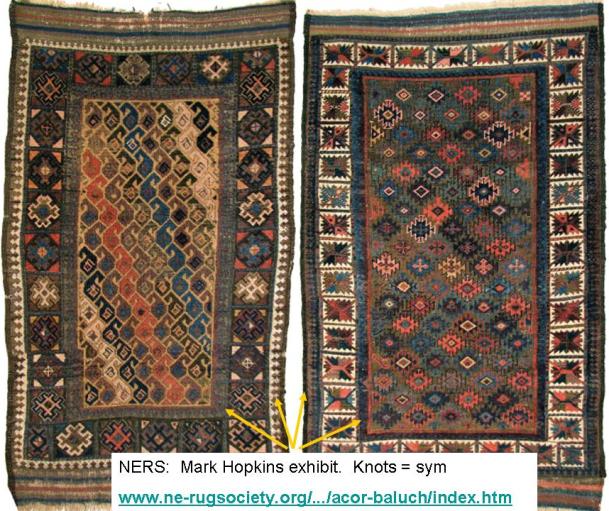
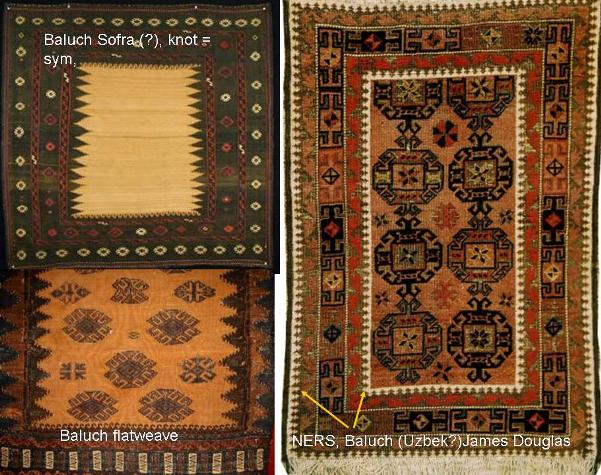
Now, if someone could just do a little research,
rationalizing the cotton structure…..
Regards, Jack
PS: In Mark's
NERS exhibition, in addition to the claim of some camel in #22 (see above), in
#19 (not shown) this comment is in the notes: “It is also quite unusual to
see what appears to be camel wool used for portions of the warp
structure." This may imply a simple (and unreliable) sensory approach to
identification.
Posted by Chuck Wagner on 07-04-2007 01:24 PM:
Hi Jack,
OK, so, one point does not make a trend. That said, here's a
closeup of the back of an early 20th century Ferdows figural rug with a cotton
foundation. Observe several things: 1) asymmetrical open right knots, 2) the
weft cotton is dirty brownish gray, and 3) lots of weft visible between the
knots.
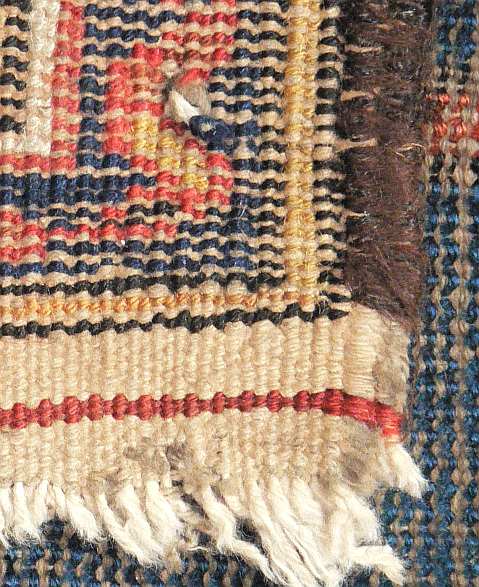
Regards,
Chuck Wagner
__________________
Chuck
Wagner
Posted by Gene Williams on 07-04-2007 05:23 PM:
Aimaq, Bahlul and cotton
Hi all,
Jack has found a new area to play with. Actually I was going
to post a Bahlul ...identified as such by JA...a relatively modern weaving to
start discussing them...but will wait till I get home. My problem with Bahlul
is...who are they and where are they and if they're Baluch which they supposedly
are..real Baluch speakers.., why cotton? And my problem with Aimaq is again
cotton but also turkish knots.
Here is a recent thread in which we
discussed Cahar Aimaq's:
http://www.turkotek.com/misc_00065/aimaq.htm
Depending
on who you talk to over the last 180 years.. The Chahar Aimaq are 5 named tribes
in an arc running from Baghdis province..upper Merghab ..down to Farah province
- middle Farah Rud. They usually include the Jamshedi, Ferozkhani, Hazara (the
ones around Qala ye Nau), Taimani; ok that's 4. sometimes the Timuri are put
into the grouip; and supposedly the Zuri (Suri) originally were in it.
The tribal group which as I understand it is/was located along the
Afghan-Persian border and spilled over far into Persia was Timuri...and they can
be broken up into numerous sometimes mutually-warring subtribes...in fact some
are Sunni, some Shi'i. I had a pretty good list of these Timuri
sub-tribes...left it out in Afghanistan. I'll retrieve it.
I've decided
I don't agree that Timuri are Aimaq...too much literature speaking about both
Cahar Aimaq and Timuris in the same sentence as different. But one this is
pretty clear: All are Turk or Turk-Mongol who now speak Dari. Most weave with
AsL. Again I posted a lot of Taimani bags...we had a good discussion...the
thread is lost unless someone saved it.
On Windsor's bag, I still favor
the Khurresan Kurds...the long pile (though Timuri sometimes have long pile)
does it for me...Have to defer to the Kurd guys.
Gene
PS. Thanks
Chuck. I postulated Ferdows when we were still in AsL mode. The wefts you posted
don't look like Windsor's wefts...I start to understand what Rich means by
"hammered wefts."
Posted by Jack Williams on 07-04-2007 10:09 PM:
King Arthur's Excaliber sword was Kurdish
Gene, hate to gainsay my older bro, but…
This long post will include
the definition of two topics. I. source of the word Aimaq and its
relationship to the Chahar Aimaq, see excellent summary here: http://www.everyculture.com/Africa-Middle-East/Aimaq.html
and
II. a possible (speculative) relationship of the “Jamshedi” and the Shia
Kizil Bash to the sect of the angels, Kurdish Alevism, and Zoroastrianism,
see this great site: http://www.xs4all.nl/~tank/kurdish/htdocs/cult/alev.html
I. Aimaq
It is important for this discussion not to
confuse the term “Aimaq” with the “Chahar Aimaq.” One is a
political sub-set of the other. Details below.
On the issue of symmetric
knot and longer pile, the “Arab-Baluch,” which term seems to be slowly evolving
to “Afshar-Baluch,” were known for longer pile. And there are quite a few
symmetric knotted rugs that have a distinct Timuri look.
I think that
the Timuri, the Chahar Aimaq, and many of the other “Aimaqs” are often somehow
related to descendents of Kizil Bash elements originally Turkmen (or Kurdish)
from Azerbaijan. I have a lot of references to symmetric knots in Baluch-group
rugs. Quite a few seem to be Timuri, if the Timuri still exist in numbers in
Afghanistan, which may be somewhat problimatical. See same site as above, http://www.everyculture.com/Africa-Middle-East/Aimaq.html
Quotes
from this site are below.
”…In western Afghanistan and far eastern
Iran, "Aimaq" means "tribal people," which distinguishes the Aimaq from the
nontribal population in the area, the Persians (Fariswan) and Tajiks. Most of
the population of 800,000 (1980) live in Afghanistan. In 1984, 120,000 Aimaq
lived in Iran. They are "considered" [my emphasis] to be Hanafi Sunni
Muslims. [my note: this might be misleading, at least historically.
Doctrinally it is ok to fib about being shia to avoid a
pogram.]
"Linguistically, the Aimaq differ little from the majority of
Persians surrounding them. The local dialects of the Aimaq tribes are very close
either to eastern Khorasan Farsi or to Dari, the Herati dialect of
Farsi."
'The Char Aimaq (chahar, four), an administrative grouping
of four seminomadic tribes, is the largest of twenty Aimaq groups. There are six
other seminomadic or nomadic Aimaq groups in western Afghanistan, including the
Timuri, Tahiri, Zuri, Maleki, and Mishmast...."
[my note: I like
this last named group...the "mishmash." In Southern American language, a
"mishmash" is an ad hoc, odd mixture just thrown together, often into the stew
or moonshine pot]
"...Other sedentary groups that may be considered
Aimaq are the Kipchak, Chenghizi, Chagatai, Mobari, Ghuri, Kakeri, Damanrigi,
and Khamidi. Geographically, the Char Aimaq live within an area stretching from
the central hills of Bâdghis north and northeast of Herat to the mountains of
Ghor in the west of central Afghanistan.
"The four tribes of the
Char Aimaq are the Jamshidi, the Aimaq-Hazara, the Firuzkuhi, and the Taimani.
The tribes of Char Aimaq date to the sixteenth and seventeenth centuries, when
the groups were unified by chiefs coming from outside the area. Descendants of
these founders are still influential in tribal affairs, although they have lost
their traditional power.
"During the second half of the nineteenth
century and early in the twentieth century, the Jamshidi were forced to lead a
nomadic life. All of the tribe or greater parts of it had been exiled in Persia,
in Khiva, and in northeastern Afghanistan. Thousands of Taimani and Tajiks of
Ghor were forcibly transplanted to the north of Herat, and the largest of the
other Aimaq tribes, the Timuri, was nearly exterminated…” [I think this all
was related to the anti-shia pogrom of the time...which makes one question the
Sunnism of the Jamshedis].
I. Alevism, Kurds, Kizil Bash,
Jamshedis
The “Jamshedi” is a name steeped in Kurdish history
of the Alawites. Here is a great site discussing the Kurds, Alevism, the
non-Islamic nature of Alevism. Also here is found a possible source of the name
“Jamshedi” which could be rooted in the history of the Kizil Bash Turkmen and
Kurds in Syria, eastern Anatolia, and Zoroastrianism. How this would relate to
the Turko-mongol verbal history of the tribe is unknown. See:
http://www.xs4all.nl/~tank/kurdish/htdocs/cult/alev.html
”…Dimili
Alevism bears closer links to ancient Aryan cults than does Yarsanism. Its rites
include daily bowing to the rising sun and moon and the incantation of hymns for
the occasion. The communal ritual gathering of Jamkhana is observed by these
Dimili Alev as the Ayini Jam, "the Tradition of Jam." The major Jam, or the
grand annual communal gathering, coincides with the great Muslim Feast of
Abraham that concludes the Ha pilgrimage to Mecca and includes the sacrifice of
a lamb.
"Jam (known as Jamshid in Zoroastrianism and Yamd in
the Veda) was the great Aryan hero in the tradition of the Zoroastrians to
whom is ascribed the creation of the feast of New Ruz-the Kurdish and Iranic new
year. The myth holds that Jam was sacrificed at the end of his own days to the
rising sun by none else than Azhi Dahak. In fact, in the renowned Iranic
national epic, the Shahnama of Firdawsi, Jamshid is depicted as "the worshipper
of the Sun and Moon" (chapter on the Advent of Zoroaster, line 71), as are the
Alevis…” More…
”Alevism. A majority of the Dimila Kurds of
Anatolia and some of their Kurmanji speaking neighbors are followers of another
denomination of the Cult of Angels. These have been called collectively the
Alawis ("the Followers of Ali"), the Alevis ("the People of Fire," implying
fire-worship or Zoroastrianism, from alev, "fire"), the Qizilbash ("the red
heads," from their red head gear; see Costumes & lewelry), and the Nusayri
(which can be interpreted as the "Nazarenes," implying Christianity, [my
note: I wonder about those cruciforms in Afshari weavings]or as the
"followers of Narseh,' the early medieval Kurdish revolutionary of the Khurrami
movement who settled with his followers in Anatolia).
”…Despite
the importance of Ali in the religion and its modern communal appellation
Alevism remains a thoroughly non-Islamic religion, and a part of the Cult of
Angels. Like, other branches of the Cult, the fundamental theology of Alevism
sharply contradicts the letter and spirit of the Koran in every important
manner, as any independent, non Semitic religion might…”
Lots of good
stuff. And later, since it seems to me that I have to do everything, as usual, I
will try to illustrate the range of symmetric knots in Baluch group weavings,
and why that may be a marker that allows some pretty tight geographic
identifications. But in the meantime, in my current opinion...the Timuri Turkmen
descendents are "Aimaq," (though not "Chahar Aimaq") and possibly "Kizil Bash,"
who are probably originally of "Alevism Shia," and who probably orginated in the
7 Turkmen tribes of Azerbaijan converted into the major military force of Ismael
by a Kurdish idiology. Hence the symmetric knot.
Oh...it is also
interesting that the myth of the "sword in the rock" of Arthurian fame orginated
with offshoots of the Alewites and the Jamshedis of Syria and
Anatolia.
Exhausted, Jack (who DOES know "Jack"...)
Posted by Gene Williams on 07-05-2007 03:16 PM:
Cahar Aimaq and cotton
Well, Jack,
Actually you can gain from what I say. (very excellent
pics of Baluch rugs by the way..outstanding..-no more than outstanding -
jealously producing, applause stimulating....The Mark Hopkins rug is
particularly evocotive and similar to Windor's design...all are compelling...I
spent a lot of time just staring at them).
But.I did a lot of reserach
from primary sources dating from 1821 on to 1990's on Cahar Aimaq and Timuri,
some of this in the field around Herat...I talked to Jamshedi Maliks and a
Ferozkhoi Malik...and to Hazara..and sort of subliminally observed the plowing
under of a Timuri Malik's opium fields.
And I also in Herat had access
to a number of historical records and old Great Game Lit and encyclopedic
compilations which the Brits specialized in, which made me wonder about the
Timuri and Aimaq. There is a host of conflicting information on who are the
Aimaqs and who are the Timuris and what are their various sub-tribes. IMHO The
link Jack put up from that encyclopedia..is just one more opinion...and
decidedly NOT the final word on the subject. I'll repeat what I previously
posted on the subject below).
And as for massacres and forced movement
of peoples and strong-arm tactics used against recalcitrant tribesmen he
mentioned, Abdur Rahman...Leader of Afghanistan after the 2nd Afghan War...was a
tough hombre..it was he who moved a lot of the Pushtoons into NW and N.
Afghanistan...
But, my point is...the Aimaq's don't weave on cotton base
that I know of..none of them. We all see the Baluch and Afshar and Kurressan
overtones of Windsor's bag..the vague feeling that it belongs in Korressan is
overwhelming to me....but it doesn't have the Baluch embroidery on the flat
weave (as I pointed out on the first page) (uhh. except for the red and blue
band which receives the closure loops) and its "hammered" cotton wefts are
something I've never actually seen from the area (as Rich pointed out ages ago
and as I...about as competent in structure as with computers...can only aptly
note after the fact from looking at the bag and Chuck's Ferdows rug.) (but I
hope Kurrassan Kurds will vindicate us).
And if Bahlul..well they are a
real Baluch sub-tribe...though there is a dispute about who they are, where they
are found and what they weave/wove and when...I've seen conflicting reports on
this..I'll address this at a future time. I have a "Bahlul" rug with the minimal
colors and wide open spaces similar to Windsor's design. But, the Bahlul don't
weave in cotton to my knowledge.
Finally, on the Allawite question (Watch
the "w"'s and "v"'s..in Dari you use a "w," in Farsi a "v" so Allavite becomes
Allawite, etc...its Indo-European..think "Volkswagan")...Allawites are splinter
of Shi'a...I think they split off in the latter stages of 12ver Shi'a
development....lets see Ismail's split after the 6th Imam..the Druze split off
from them about the 10th century.
I think the Allawites split from from
12ver Shia at the 10th Imam Ali Al Hadi...I can't say exactly why from memory.
Deceased Syrian Dictator Hafiz al-Assad and his son Bashir..now running
Syria...are Allawites...judged to be almost "Ghulat"...non-Islam..by even the
Shi'a themselves. From memory only, the Allawite believs do seem to contain a
lot of Christianity and Zoroastrianism. I've not heard of Allawites stretching
into Kurrassan...in any modern context...in the violent hatred and unremitting
conflict in Kurrassan from the time of Timur on between Shi'a and Sunni, if
there were Allawites up there there they must have been ground out of existance.
The Kurds did indeed have their own Shi'a subsect ..twelver for the most
part....but this was the Turkish side of the Kurds..the Ahl-i Haqq,
Bektashi...etc. (disclaimer: I spent some time looking into Shi'i Islam and the
various offshoots of it..an utterly fascinating topic...but the above is from
memory...I do not have my books with me..if I'm wrong..I'll correct it when I
get back home.) ... (Camille: do you know anything about Kurdish Shi'i sects?)
(a lot seem to have the name "Naqshabandi"..a Sufi name
really..right?)
Gene
Here is my previous post...following a
misunderstanding of sorts with JBOC Barry O'Connell..: Now I'd caution all to
take stories coming from out in that area with a grain of salt..Jerry Anderson
has his own take on the Feruzkhoi name...and I'm sure you can find a dozen
variations...i just happen to have respect for this particular tribal
elder.
To all,
I've put together this for you reading
pleasure:
CHAR AIMAQ:
I’m basing most of this on old British
Sources…all of which mention weaving without saying what they wove. I put it
into first person…but the most recent of the sources is dated 1939..most are
19th century when I expect the rugs you guys are interested in were woven. These
are three I have on my desk:
-- Historical and Political Gazateer of
Afghanistan, 6 vols, Adamec...1990's
-- Topography, Ethnology, Resources and
History of Afghanistan. Calcutta, 1872
-- Military Report; Afghanistan; New
Delhi. Gov of India Press, 1925
And there are more..Olaf Caroe’s book The
Pathans, etc.
Aimak is an E.Turkic and Mongolic word, originally meaning
“tribe.” Chahar or Char is of course Persian/Dari/Urdu/Hindi for 4.
They
are a conglomeration generally considered to have four main branches (though a
couple of others will be mentioned):
-- Jamshedi
-- Firozkohi
--
Taimani
-- Timuri (var: Taimuri)
They all speak Farsi/Dari. One souce
claims they speak an “ancient form” of Persian. They were (19th Century to WWII)
nomadic pastoralists – high pastures in the summer and low winter quarters in
yurts. They wandered from the Kabul River to Mashhad. One source (1887) claims
that “the Uzbeks and Afghans are ‘civilized people’ compared to the Aimaqs.”
They inhabited the Western end of the Hindu Kush, Generally the headwaters and
upper valleys of the following rivers (Counterclockwise from the North)
generally known as the Hazarajat with the center of gravity being Badghis
province (province just east of Heart):
-- Murghab (river which ends in the
Merv oasis),
-- Kushk (river which flows past Turghondi into the
Murghab),
-- Hari Rud (river which flows past Herat, forms the Iran/Afghan
then the Iran/Turkmenistan borders and disappears into the desert.
-- Farah
Rud (river which flows SW into the Seistan area)
They all speak
Persian/Dari with some Turkish words; all are Sunni (Hanafi) (except perhaps
some Timuri in Iran). They generally inhabit the Mountains of Herat, Ghowr,
Badghis, Farah provinces and Maimana. Roughly N-S they are distributed as
follows: Taimani in Ghowr and Shaharak; Timuri Diffused in lower parts of Heart
province along the Hari Rud, Gurian, Gulran district and into Kushk district and
in Iran from Kaf towards Mashhad; Firozkohi in Chaghcharan (capitol of Ghowr
Province) and neighboring areas towards Obeh, Qala-ye-Nau and Maimana; Jamshedi
now confined to the Kushk area of Badghis; and the Qala-ye-Nau Hazara only in a
small area around the city.
1. Jamshedis: They probably came from Seistan
and now live in Badghis. They are pastoralists and excellent equestrians. They
are Sunni and speak a dialect of Persian. Traditionally they were divided into
24 administered groups called “mohalla pukhta” and further sub-divided into a
“mohalla Kham,” each Kham equaling 500 head. They were believed “probably” to be
pure Tatar or Mongolian origin. They were “free from the truculent swagger of
the Pathan” and were noted to be of good physique, had considerable
intelligence, were active, fairly courageous, simple and comparatively honest.
They inhabited the Mountains NE of Heart and were bounded on the North by the
Salor Turkomans. They called their country the Bala Murghab..headwaters of the
Murghab.
2. Firozkohis: Gujars and Mongols by descent. They live between
Sar-e-Pul, Obeh and Daulatyar. They are Sunni and speak Persian. District of
Kadis is the Westernmost of the Firozkohi known as the Mahmudi. They are pure
Tatar and Mongolian and are the descendents of the Mongols who dwelt near a
mountain called Firoz Koh (Victory Mountain) near Samnan, Persia. They are more
distinctively Mongolian in appearance than the Jamshedis. They are bold, good
physique. They intermarry with the Dai Zangai Hazaras. They fought Timerlame
bravely and generally are influenced by Herat.
3. Taimanis: Shepards and
cultivators. They are Mongolian origin but are connected with the Kakar Pathans
of N. Baluchistan. They live in the upper Farah Rud Valley or Ghorat and extend
to the Hari Rud Valley and Farsi district of Herat Province. They are Sunni and
speak Persian. Even though Mongolian, they have Pathan blood and are
traditionally allied to the Kakars. They have a finer physique than the
Jamshedis and are reported to be less courageous than the Firozkohis. They are
the only Chahar Aimak tribe living in the Helmand basin south of the central
watershed. (down into Farah Province). They wander all over Afghanistan (as of
1925)
4. Taimuris: One source says they are of pure Tatar or Mongolian
origin; another lists the origin as “not clear,” another as possibly of Arab
descent. They live half in Persia, half in Afghanistan. They were originally
Shia but those in Afghanistan have become Sunni. They appear to have first
organized into a tribe along the N. side of the Oxus, then moved into Badghis
then into E.Persia. There are colonies all over Afghanistan and as far as
Mashhad in Iran. A number of families lived for a couple of hundred years near
the headwaters of the Kabul River.
With these 4, there are mentioned two
others, sometimes as part of the Char Aimaq, or sometimes in the same
breath:
5. Zuri: this was reported by one source as one of the 4 original
tribes of the Aimaq. The source speculates that it might be the “Suris” found in
Ghowr Province. They speak Persian/Dari mixed with Turkish words, are Sunni
(Hanafi).
6. Qala-ye-Nau Hazaras: They are centered around Qala-ye-Nau
(Capitol of Badghis) and are Sunni. They are reportedly bigger, bonier and more
intelligent than other Hazaras, less Mongolian in appearance due to
intermarriage and physical separation from the rest of the Hazara. They are
descendents of Mughal Tatars who entered Afghanistan under Ghengis Khan and
settled at Kala-e-Nao. As of late 19th century they had lost their independence
and were reduced to being peasants. They Jamshedis and Firozkohis regarded them
as ‘stupid louts” (the Aggies or Auburn tigers of central Badghis?) They lived
in yurts in the winter.
Ok that’s about it for now. I’ll leave it to you
all to figure out who wove what. I have at least a pretty good idea of what
Taimani weavings look like; Timuri designs also register. As for the Timuri -
Yacub Khani connections…I’m still working through these sources. The interesting
bit is the fact that some Timuri are or were Shia. This might explain why some
allied themselves with Persians. Hope above helps..you might need a
map.
Second post from the past-------------
Hi all,
I've
just finished talking to a Jamshedi Malik from Khushk District about the
Jamshedi and the Aimaq. He made a couple of comments which may modify the
above:
He said the Firozhoe are actually named after a mountain near
Chaghcharan (capitol of Ghowr province, Afghanistan, near the headwaters of the
Hari Rud...not in Iran). On this mountain is a type of flower called Fieroz. The
Firozkhoe, though change the meaning to "Firoz" (victory) because they didn't
like being named after a flower.
As for the Timuri, he was adamant that
they were not/not part of the Char Aimaq. (The literature on the subject goes
back and fourth on this point). He said they came into the area with Timurlame
(timurlang)'s troops. They are moghul-Turkic but are directly connected to the
Timurid Turks.
He did include the Kala-ye Nau Hazaras as part of the
Aimaq.
He added that the Aimaq are also Turkic origin. He said they
originated North of the Oxus (Amu Darya). However he said there is a massive
amount of Pashtun blood in them (they really do look Indo-European Afghan..at
least he does). He added that further east towards Mazar-e-Sharif, there are
Jamshedi groups who speak Pashtun.
On the subject of Timuri, in Farah
Province recently I was told of a Farsi speaking tribe which lives in Farah and
Western Herat provinces along the border with Iran. This is almost certainly the
Timuri and the various ethnic maps I've got confirm it. They do indeed stretch
into Iran...and the two sides of the tribe are involved in, of course, smuggling
stuff (including lots of "agricultural cash crop products") across the border.
Maybe I can get out there.
That's about it for now.
Gene
Posted by Gene Williams on 07-05-2007 03:34 PM:
Lord Curzon and
For an interesting topic raised by Windsor..here is Sargant's portrait of
Lord Curzon...sometimes known as the "last Mogul"...certainly a different Breed,
born and bred in utter self assurance, reinforced by an interlocking tribal
protective society (and helped by 10% suffrage at the time) and backed by
implaccable power and self-concious individual bravery and courage in the face
of adversity, a committment to personal, ethical, and national "honor," and a
reputation for incorruptability..true or not; I suppose a lot of it is now all
past..not the bravery but the self-assurance, the committment, the mystique of
command, and the power, k.o'd by WWI if you read "The Wasteland"...and, if you
believe all the Indian and Pakistani officers I talked to who went through the
Malaya campaign and the hell of Japanese prison camps...WWII; I have English
friends though who have the other qualities mentioned above; those are
innate:

And here is is Elinor Glyn, reportedly a fascinating
individual whether on a piled rug or tiger skin..actually she was an
extroadinary woman as any trip to google will reveal.
This is for those who are
interested in the Raj...known in India as the Sirkar...
From my limited
view point...which is only 9 years on the sub continent from 1975 on...Pakistan,
India, Afghanistan, there seems to be a schizophrenic view of the Raj...A huge
number of common people look back on the Raj with fondness..and not a few of the
intellectuals and businessmen..not that you could recreate it, it was what it
was..but rather as some sort of idyllic past (and they sometimes have a racial
chip on the shoulder because of it). The Sub-continent historians, thought, are
mostly Marxists or Nationalists and can't decide what the heck they're talking
about...reading about the attempts to relieve the Chitral fort in 1893, for
instance,...half the time the Pak or Indian historians are taking the part of
Umrah Khan..half the time the Sikh and Indian army soldiers climbing those
passes...
America hectored Britain unmerciably about its "imperialism" in
India from 1900 on...don't think it stood us in good stead..we got lumped
with..well.... we got lumped with the Turkish knotted
carpets!!
Gene
PS. I reread the above today...I'm trying to figure
out where to put Harry Flashman in the (maybe idealistic) picture I
painted...working on it.
(a phrase keeps coming back "Perfect
Albion".??..or something close to that...) '' There was some French phrase my
French wife keeps using..don't quite understand it although its from the 13th
century (I guess at the time the English Crown owned half of
France)
"L'Angleterre, ah, la perfide Angleterre, que le rempart de ses
mers rendait inaccessible aux Romains, la foi du Sauveur y est abordee."
Posted by Marty Grove on 07-06-2007 10:05 AM:
Sorry Windsor, but...
G'day Gene,
Not a bad place to be actually - with the Turkish rugs - the
English have always had a fondness for those... Hence Gene's reading from his
English friends and historical documentation characterising their belief systems
by which they operate innately.
Neville's book (thanks Gene, its
excellent) "Campaigns... interestingly writes of the Chitral Fort episode,
leaving one to see just where the India and Pakistan commentators, long after
the event, cant make up their minds who to barrack for!
The
lip,
Marty.
Posted by Unregistered on 07-07-2007 11:55 PM:
Hey Windsor,
Just for the record, I just got a new monitor for the
PC. It makes me feel much better about the red in your bag. On previous
monitors, I thought it looked a bit too bright. I know this one gives a truer
rendition because I can judge it based on the accuracy of the tapped out Turkish
prayer rug I posted awhile back.
Posted by Steve Price on 07-08-2007 05:43 AM:
Hi
Please overwrite the word unregistered (in the user name
field)with your name when you post.
Thanks
Steve Price
Posted by Richard Larkin on 07-08-2007 10:04 AM:
Hi Steve and Chorlton,
Me again, coming in from the cold and buying
the red in that bag.
Cheers!
Rich Larkin
Posted by Timothy Simmons on 07-08-2007 10:37 AM:
Purple and camel wool.
Hello as you may know I am new here. This is a long and interesting topic, so
I would like to join in. Pictures are never the same as seeing in real light. I
have a modest budget and tend to buy in junk shop and markets. This is my best
piece there is some corrosion in the dark areas otherwise the codition for the
type is really rather good.
![]()
Posted by Windsor Chorlton on 07-08-2007 04:46 PM:
Trying to Stay in Touch
Hi Timothy
Haven't a clue about the origin of your piece, but there
are knowledgeable contributors to the forum who can either nail it or lead you
in interesting directions. 'Purple' and 'Camel' were your definers, but you
don't expand on these qualities. The yellow highlights looks brighter than I
would expect in an older weaving. If I say any more, I'll just expose my
ignorance.
Regards
Windsor
Posted by Richard Larkin on 07-08-2007 05:32 PM:
Hi Timothy,
A veddy veddy interesting Baluch prayer rug. Interesting
for a number of reasons. I'll take a few deep breaths and get back to you.
__________________
Rich
Larkin
Posted by Richard Larkin on 07-08-2007 07:14 PM:
Hi Timothy,
You have introduced yourself as "new," but I don't know
how new you are to the rugs. Forgive me if I'm telling you things you already
know.
Your rug falls into the greater Baluch category. There are numerous
people in Afghanistan and Iran, on either side of the North/South border between
the countries, who consider themselves Baluchi. Many of them are weavers of pile
and other fabrics. In addition, there are many other ethnic and/or tribal groups
in these areas who weave as well. Traditionally, the production from these many
peoples tended to be called "Baluchi," though much of it was woven by others. Of
recent years, there has been much work and commentary aimed at distinguishing
and identifying the actual weavers of the goods. The tribal structures among
both the Baluchi and the other tribes tend to be very complex. Many contributors
to TurkoTek are far more knowledgeable than I about the details in these
regards, and I will leave the details to them. (There are also Baluchi people
more southerly of this region, in the area of Baluchistan proper, but they weave
few pile rugs.)
Regarding your rug in particular, an interesting feature
is the double step of the mihrab creating the arch that identifies the item as a
prayer rug. I don't recall having seen many with such a design layout. The camel
colored field is typical, and there are dozens out here who think that wool will
prove to have a different quality from the other wool in the rug, proving that
it CAME DIRECTLY FROM A CAMEL! Others will shout, "Nonsense!" That's the way
things go on TurkoTek.
Some of the colors look like possible low grade
synthetics from the look on my monitor. I'm not accusing them of that status,
just pointing out that some of them have that look on the surface. I'm referring
to the kinds of dyes that change color on the surface of the pile, but have a
very different look on the back, or if one folds the pile back and looks into
the knots. These include the grayed looking pile in the middle border (where the
purple and yellow appear...those colors don't bother me, BTW), and the red where
it changed in the two other borders at about the midline of the rug and below.
Whatever those dyes are, I like the rug. It exemplifies what the greater Baluch
do all the time, which is process and reprocess their design repertoire in
interesting ways.
If you are of a mind to provide additional information,
I would like to know whether the warps are wool or cotton. I would expect wool
in a rug with this look, but the picture on the screen suggests cotton. What are
the dimensions of the rug?
__________________
Rich
Larkin
Posted by Gene Williams on 07-08-2007 07:15 PM:
new Thread
Timothy,
Its Baluch of course, and the Baluch crowd...the usual
suspects..., me too, will be baying at it..and its not full moon yet..but the
triple step mirhab is interesting in its own right. But really to give it its
due, it doesn't have much to do with Windor's bag.. So, why not start a new
Thread? Just repaste everything under the "New Thread
"button.
Gene
PS. Windsor..we're still waiting for your "Dragons
and Dogs" rug to appear likewise...I am very curious about it.
PPS.
Richard....re the "nonsense" post above...I say: "LESS FILLING!!' ..And the
response is?? (This a generational ..and probably a national..marker)
Posted by Richard Larkin on 07-08-2007 07:50 PM:
Yep, Gene, you've landed on my favorite argument, "Tastes great," to which
the answer is, "Less filling." No kudos intended to any national beers. I'm
fortunate to have it as a favorite argument, as it can be found playing itself
out just about everywhere.
__________________
Rich
Larkin
Posted by Timothy Simmons on 07-09-2007 02:03 AM:
I will start a new thread
Thanks everybody. The picture is not very good. The ends are wool. The
"greying" is in real space a green/brown. Latter today I will take some close
ups and send them to Steve. It is really nice to find such alot of carpet
people.
Posted by Jack Williams on 07-09-2007 02:04 AM:
Do you favor design or structure for attribution?
Good morning.
I suspect that we will have to choose...accept an
attribution that favors design or one that favors structure. Try as I might I
just cannot make this into a Kurd weaving...nothing known Kurdish that I've
found looks even remotely like Windsor's khorjin.
Steve will add a couple
of pictures when he has a moment in the morning, but I'll go ahead and make this
post now because I'll be incommunicado later. Here are another batch of unusual
camel ground rugs...assigned to Aimaqa, Timuri's, etc.
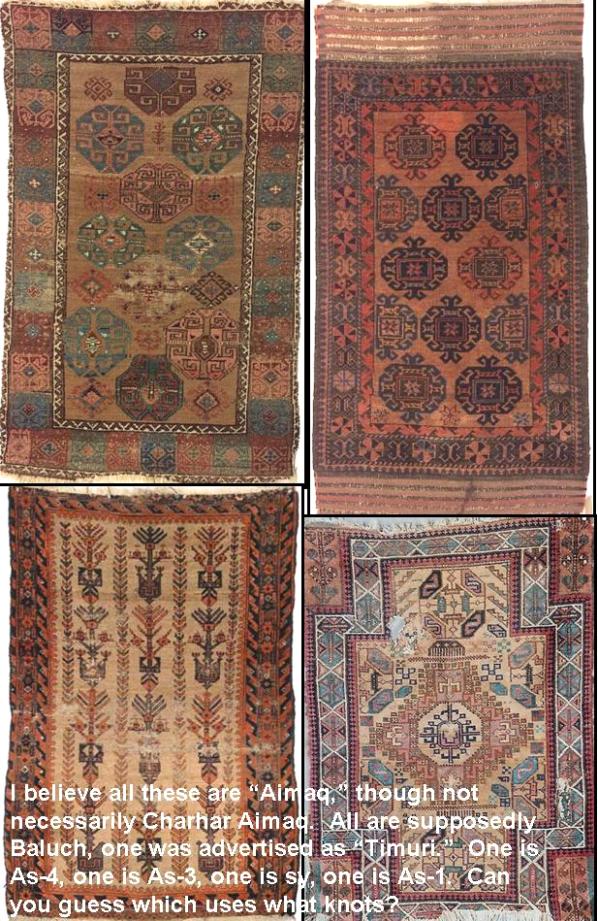
As said previously, I
think it may be important to note the remarkable percentabe of "camel ground"
rugs, bags, etc. in the world that are attributed to the Baluch in general...and
to the Aimaq or Charhar Aimaq, or Arab-Baluch-Afshar in particular.
A
goggle search for "camel ground rugs," or somesuch, produces a huge percent as
Baluch group. Furthermore, when dealing strictly with camel ground Baluch rugs,
the symmetric knot seems to be used in a larger percent than it is in Baluch
group as a whole.
Searching for that ruby red color, I have looked at
some pretty intense Tibetan carpets with reds that look similar to Windsor's,
thinking about that mythical Tibetan red dye. Eureka...here is a Tibetan rug
with a remarkable red. Trouble is, Tom Cole says the dye is madder . From: http://www.tcoletribalrugs.com/article6.html
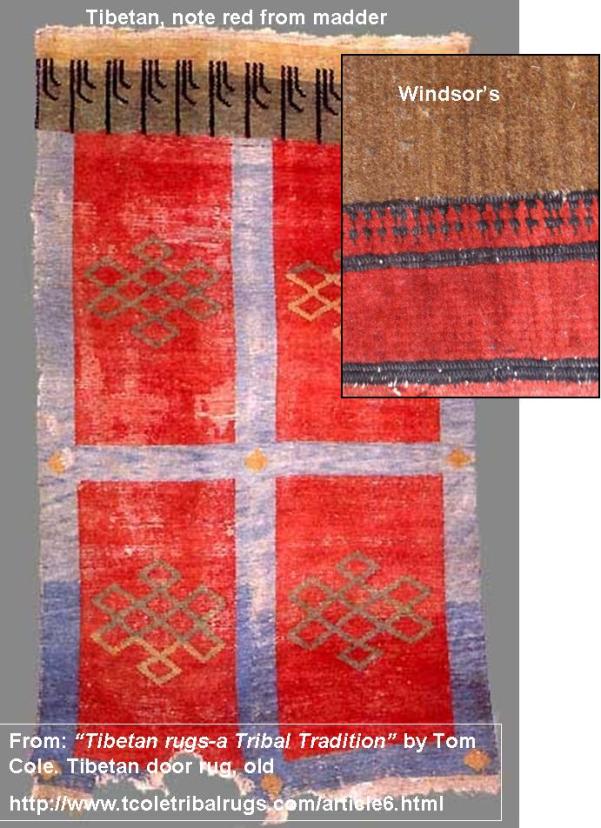
”Figure 20. Door Rug, Tibet, 19th century, 0.94m x 1.63m (3'1" x
5'4"). All wool foundation. The red is madder dyed. The obvious similarity in
format and function between such rugs and Turkmen ensi has often been noted in
the literature, and represents a common Central Asian tribal heritage. Private
Collection
Finally, re-reading the interview with Jerry
Anderson, he discusses the Aimaqs, Chahar Aimaqs, Bhalulis, "Arab-Baluch," etc.
and interestingly assigns so-called Arab Baluch rugs not to Ferdous
(who’s “Arabs” he says weave city designs) but to "Arabs in the Quain.”
This area should be a lot closer to the area populated by the Timuris, Aimaqs,
and the Bahluli than is Ferdous.
In the end, I think we may have to make
a choice....(1) accept an unusual cotton structure for tribe whose work looks
like it could encompass the design of the khorjin, or (2) assign Windsor's bag
to a group that uses a lot of cotton on the structure but doesn't weave many
camel ground designs like that Khorjin.
I think I will prefer to favor
the design-attribution and try to explain the structure-attribution as
an anomaly.
Regards, Jack
PS I think a good forum on
"Arab-Baluch-Afshar" and the relationship to Aimaq, Timuris, etc. might be an
interesting follow-up to this discussion.
Posted by Richard Larkin on 07-09-2007 01:26 PM:
Hey Jack, my friend, my man, my mentor:
That bag isn't Baluch, or any
of their fellow travelers, or Tibetan. There, I said it. I don't know what it
is, and I know "Kurd" is a cop-out, and I threw wet towels all over Camille's
suggestions, so I should shut up. But I think the reason we aren't pegging it is
because it doesn't match up with any of the usual suspects very
well.
Aside to Windsor: I see I called you "Chorlton" in a post back a
while. Sorry. I don't know where that came from. A brain cramp. I'm not British
("Holmes?" "Yes, Watson." Etc.), so no excuse for it. No unfriendliness
intended.
__________________
Rich
Larkin
Posted by Windsor Chorlton on 07-09-2007 03:33 PM:
No Offence Taken
Hi Richard
When you used my surname, I thought that's how some
Americans customarily addressed each other -- like members of a gentleman's club
c.1900 (or how some of my schoolteachers wearily claimed my attention much later
in the century). I share your doubts about Jack's suggested attributions while,
at the same time, genuinely admiring his indefatigable researches, which have
led me into areas that I'd never have entered under my own steam.
I
thought this bag would elicit 20-30 responses-- at most. The remarkable thing is
that thousands of people have now seen it, but no-one has come up with a
comparable piece. In design terms, Louis' sofreh and Camille's flatweave bag
show clear similarities, but there seems to be no cross-over between those
pieces and the similarly utilitarian but knotted and apparently up-market bag
that seems to have taken up squatter's rights on this
forum.
Jack,
I wanted to respond to that extraordinary Tibetan
red, but I haven't yet been able to post an image for comparison
(contrast).
Gene,
I haven't forgotten your request to see more of
the 'Dragons and Dogs' Rug. I don't want to curb your lust for dragon-slaying,
but I don't think the design represents fire-breathing monsters. I now have an
idea where it comes from, and I'll put the piece up for discussion once I haul
the filing cabinets off it.
Regards
Windsor
Posted by Camille Khairallah on 07-09-2007 06:29 PM:
Not trying to hammer the cube into the cylindar gap..
Hi Gene,
Sorry for that late answer, but I had not received post links
to my personal e-mail for many days while the thread was going on.
Today
I called an Iranian friend established in Beirut but born in the vicinity of
Mianeh (Azerbaijan) and asked him about the existence of Shi’a Kurds, he
answered with a positive “yes”. But, to be on the safe side, I reviewed the best
reference I’ve got on Kurdish rugs and other weavings (1988) and it stays on
page 12: “Further south beyond Sanandaj the Kurds themselves are for the most
part shia…”
Hi Richard,
Please let the towel be dry because the
bag seems to be humid enough! .
Someone suggested during that thread that the most reliable
suggestion would be from knowledgeable people from the country were it was made.
As I am nearly sure the bag was woven either in Serab or to a less extent in the
Feraghan/Malayer area, I’ll try to send the picture to Tehran and have some
valuable -and hopefully more accurate- opinions.
Regards to
all,
Camille
Posted by Jack Williams on 07-09-2007 07:29 PM:
blsiuit=knojkniu andinbo fiiiuujkxi sizniii
Gentlemen, I’m desperate. Without a sense of solution, I may have to turn to
drink, something I gave up long ago in a foolishly sober moment, rare in New
Orleans society. Camille...I hope your idea pays off.

The mystery of Windsor’s
khorjin attribution might forever remain uncertain, if for no other reason than
there just doesn’t seem to be an analog...anywhere...and I’ve looked at about
10,000 pictures, I kid you knot (pun intended).
I've offered Khorrison becaue
of lots of camel grounds, reds, battlement borders, even symmetric knots.
However, I am open minded enough to appreciate other alternatives, including
...oh... that Windsor's khorjin originated with visitors from outer space or
something.
Ok...Ok...Ok...If you must look elsewhere than Khorrisan
(which at least has all the individual elemental factors, design, color,
structure), below are example rugs pointing two possible alternatives....(a)
“Bijar-Kurd-Afshar”, and (b) “Afshar-Kerman.”
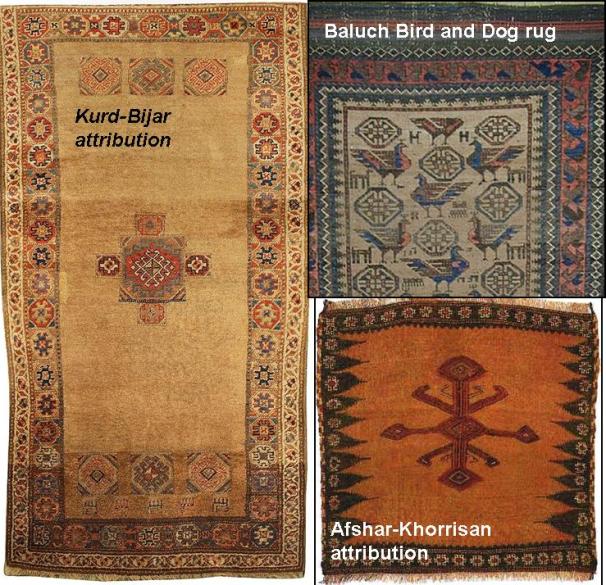
Also because I may be losing
it, I’ve included two more pictures, one (above upper right) being a
portion of a Baluch bird-dog-animal rug to provide company for Windsor's
dragon-dog rug and Marty's duck-pond and dog-pound rugs. Separately below
is the other picture of a fragment of a very, very early "animal
Baluch" that might indicate a Northeast Asian origin.
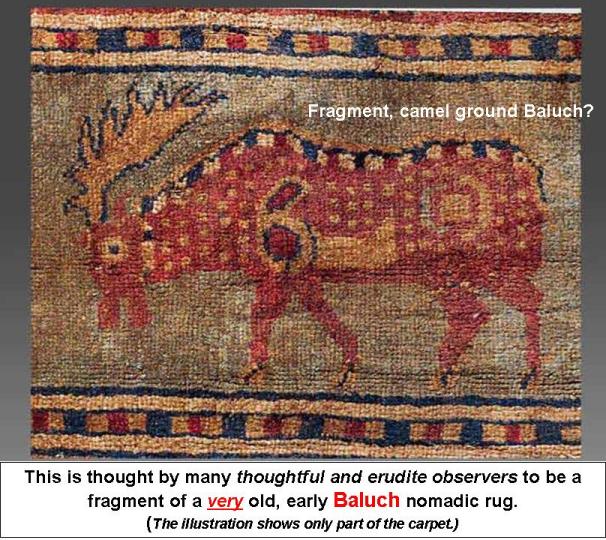
And last, to add to the
general data base, here are some pictures of a caravan of Kuchies on the move. I
looked at the camels, then the donkeys for evidence of khorjins. I couldn’t find
any. Since these Kuchies might presumably be moving through Khorrisan, perhaps
all Khorrisan khorjins, including Windsor's, are actually figments of our
imagination.
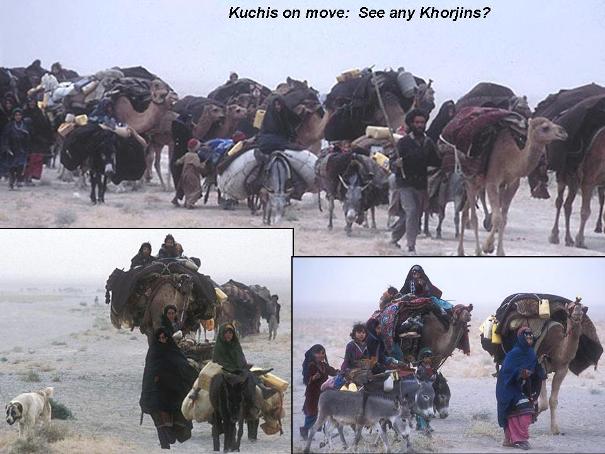
Regards,
Jack
Williams,
Proud, colorblind, Turkotekster, ATP*
New Orleans, "The
Lousiana Lake"
*Allowed To
Post
Posted by Patrick Weiler on 07-09-2007 09:41 PM:
A PLAIN piece
OK,
As all other avenues have been exhausted, (some,- I won't mention
names - ahem Baluch, - exhaustively exhausted) it is time to venture another
direction. Windsor's bag has a very PLAIN design. Therefore, it must have come
from the Varamin PLAIN.
As proof, I offer these pieces from the Tanavoli book
Varamin:
This first one is a bit more elaborate, but has the "camel"
field and a simple, no - PLAIN - , design repertoire.
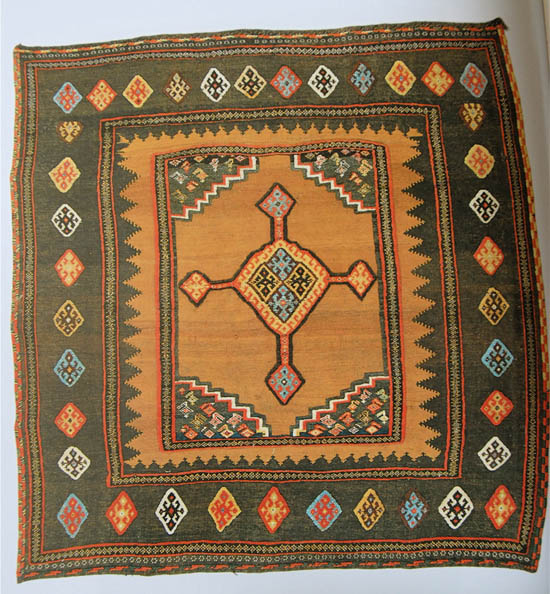
Here is a similar, but more
PLAIN version.
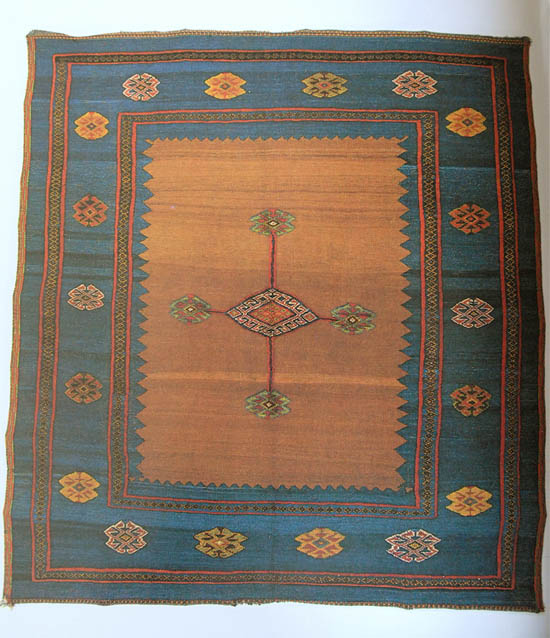
This piece, with a very PLAIN field and minimalist central
motif (not outlined as is common) is quite striking.
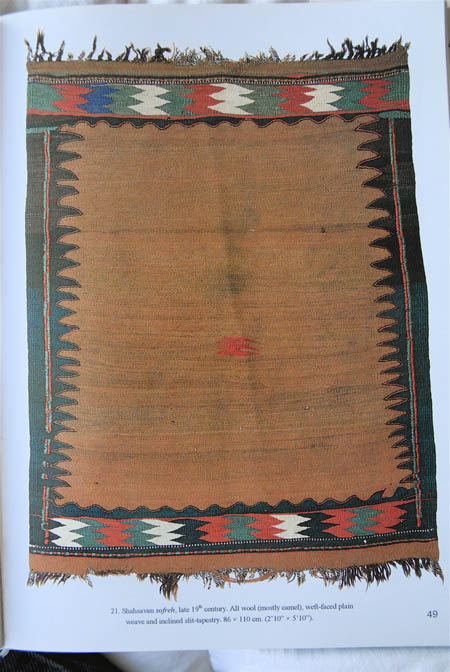
And here is a Kurdish piece
from Varamin. "Camel" field and somewhat more complex design.
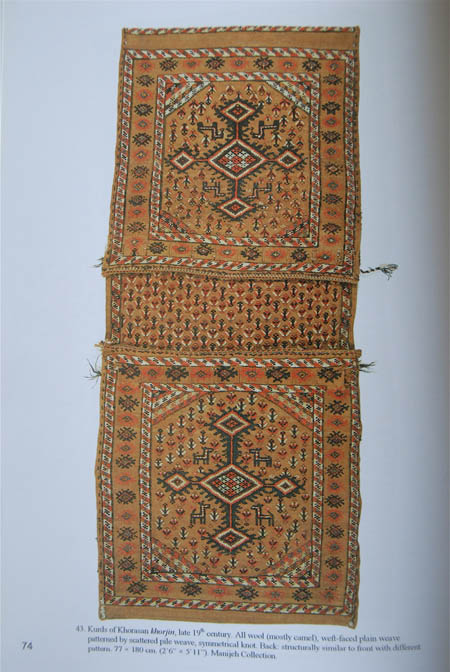
Lastly, a Varamin piece of mine
with a "camel" field and single field motif. The motif is placed right about
where the mihrab of a prayer rug might be - sort of a minimalist prayer rug.
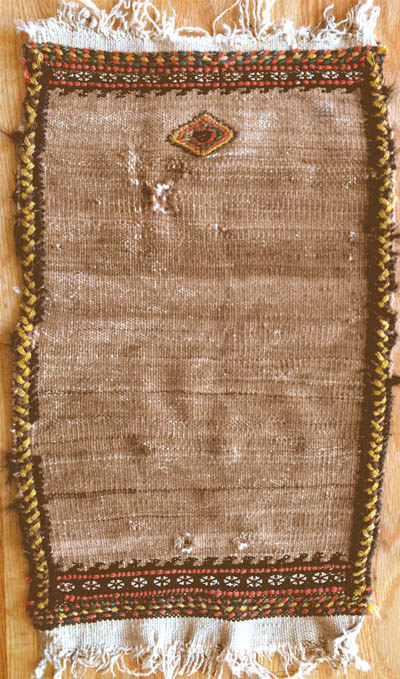
There you
have it, proof positive.
You are very welcome, Windsor.
Patrick -the
Plain- (or is it Pain?) Weiler
Posted by Jack Williams on 07-10-2007 12:05 AM:
lots of Cs...
Good Evening, Patrick and all,
Patrick, No fair…I just read
section 2-K.301 subclause 2B line 14-206.1D of the rules, and sofras are not
allowed as analogs. Despite the rules,..I really like your Kurdish thing. How
can something so simple be so interesting, huge wild selvedges and all? What the
heck is it..with those cool end finishes and burlap looking flat weave?
But...er...are you...er, ummm, ehhh... cheating?
That Kurd khorjin you
posted looks to be attributed to...er... the Kurds of Khorrisan,
wool structure and all,... at least according to the small print beneath the
picture (I learned to read small print from a great distance while being a
professional college student after Vietnam). Also, I know you are jus' funnin'
us-uns down South hyar, but before we close a case, wouldn't it be nice to
see some stuff that looks just a little like red dye, corrosive black,
battlement borders, fairly fine KPSI, depressed warps, double cotton wefts,
etc.?
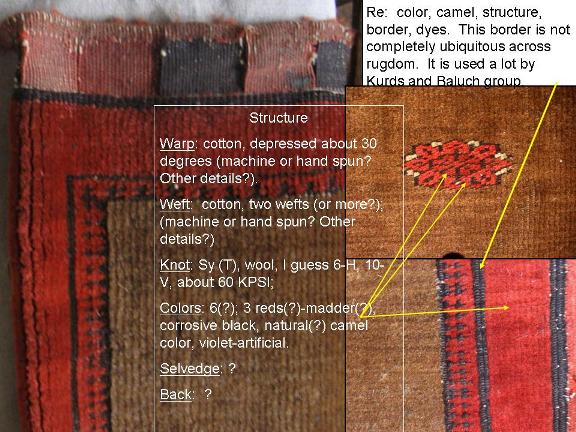
I am more than willing
to cede the field. Above is a picture (I like pictures) that shows just what we
don’t even know about the structure of Windsor's khorjin. For instance, I’ve
estimated the knot density at about 60 kpsi, 3:5 ratio…is it correct? I’ve shown what I think is
the origin of that border (see the funeral tomb decoration in Yarkand and
Kashgar). I’ve gotten the impression that border isn’t used much in
…say…Quashquai, Kamseh, the Caucasus, Anatolia, and most of Persia, except with
certain groups, mostly Kurds (and the Baluch, Aimaqs of course).
If we
are going to go somewhere other than khorrisan, it would be nice to cover “why.”
Windsor, your khorjin
deserves the attention because its mystery allows us to opine on just about
anything, and it is cool and very unusual. I think we all would like to have
that bag...nice nice..., oh yeah.
Regards, Jack Williams,
…who
a crude klutz comically characterized as the charismatic colorblind king
commentator creating chaos concerning Kurrisan camel-colored khorjins.
Posted by Windsor Chorlton on 07-10-2007 06:32 AM:
Distracted by Reds
Hi Jack and All
Any technical opinions that I offer should be taken
with a pinch of salt. I make knot count 6 x 12 = 72 KPSI. The wefts are tightly
packed, but I've made out two shoots in a few places. I couldn't say if the
cotton is hand- or machine-spun; it's certainly very white.
When Jack
showed that striking Tibetan red, I remembered that
I'd taken a pic (by
flash) designed to provide a reference for the red on the bag.
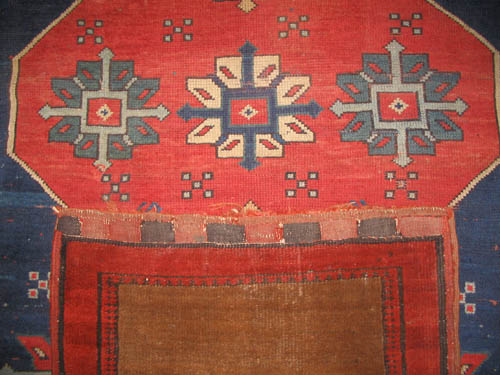
The rug is a
(dated) late-19th century Caucasian, Kazak by my guess, which I'd like to show
once this thread has finished. The rug red is brighter (pinker) than the bag
red, but where the bag has worn near the flatweave loops, the colours look
pretty similar.
Camille, it would be very interesting to get an opinion
from Tehran. I've viewed quite a few Serab pieces and can see stylistic
correspondences with the bag.
Regards
Windsor
Posted by Jack Williams on 07-13-2007 08:54 AM:
About Windsor's medallion, something okKurd to me.
Good morning all.
I was monitoring the Jaf Kurd line and a reference
was made to Mark Hopkins’ article, Diamonds in the Pile on Tom Cole’s
site. (see - http://www.tcoletribalrugs.com/article50HopkinsJaf.html ). I
revisited that article and found these border flowers on one of the Jaf Kurd
bags pictured.
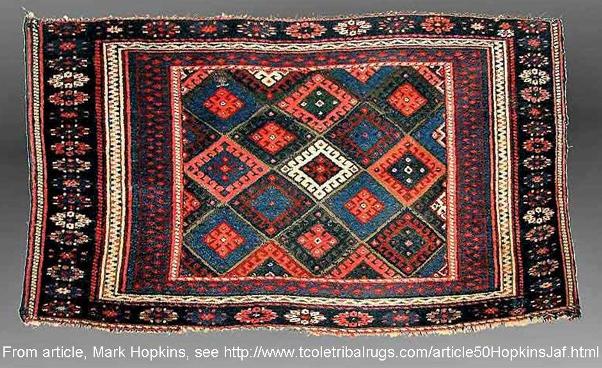
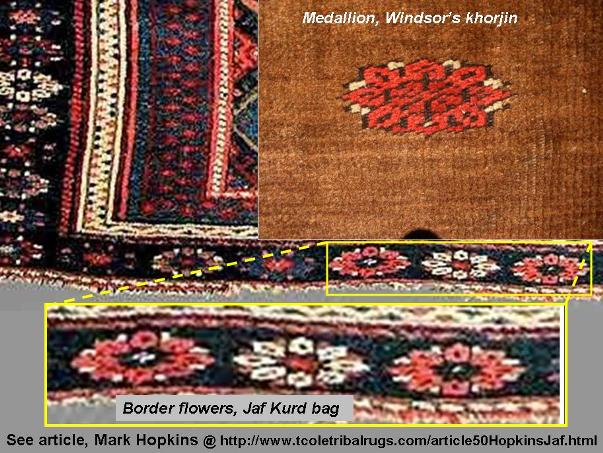
We have periodically speculated about a Kurd connection to
Windsor’s khorjin, whether in Khurrison, near Bijar, or up near Hamadan. These
Jaf border flowers are similar in design to the medallion flower in Windsor’s
field.
One might think that medallion flower to be relatively simple
with variants aplenty, therefore would not be unique to Kurds. Actually, I've
looked for that flower in 10,000 items and this is the first example that really
looks similar...for whatever it's worth.
Perhaps Camille will find it
useful for reference if he is able to reach his contacts in Iran.
Regards, Jack
Oh course this this bag from the Hopkins' article
might actually be baluch...
Posted by Camille Khairallah on 07-13-2007 03:12 PM:
Hi Jack,
I alresdy e-mailed the pictures with just technical
information and no personal evaluation. I am waiting for the answers in these
two days.
Regards
Camille
Posted by Camille Khairallah on 07-16-2007 10:31 AM:
News from Tehran
Hi all,
A few days ago I sent the pictures to a friend in Tehran, Mr.
Freydoun Youssefi who is my Iranian connection and who knows a great deal of
antique rug dealers there.
He showed these to three(I wish it was more
but cannot ask too much) reliable dealers established in the “Bazaar Bozorg” of
Tehran, to where new and old carpets (usually the best) from all over Iran find
their way.
One dealer is from Bakhshayesh (Azerbaijan), the second from
Isfahan (Central West) and the third from Shiraz (South-Western
city).
All three claimed Persian Azerbaijan. The second gave a possible
settled-Shahsavan village provenance.
As this will be my last post on
this subject, I would like to thank all 15 enthusiast persons who achieved
lovely brocade with this moving thread.
My special thanks go to Windsor for
starting the thread and for his technical support and patience, Williams
brothers: Gene for his valuable and always interesting historical information
and Jack for his efforts, nice and well-chosen posted pictures, Richard for his
experienced eye and rather objective ideas, and of course Steve for… just
everything.
Regards
Camille
NB: I just wish I was a little
better in English just to be able to take part to the cooking of your most
appreciated spiritual Anglo-Saxon delicatessen.
Posted by Steve Price on 07-16-2007 10:43 AM:
Hi Camille
Thank you for your very kind words. I have no trouble at
all understanding what you write in English, and I doubt that anyone else does,
either.
Regards
Steve Price
Posted by Windsor Chorlton on 07-16-2007 12:09 PM:
A Thousand Thanks
Bravo, Camille!
There isn't a smilie on the board that can express the
extent of my pleasure and gratitude to you for solving the mystery. Like you,
I'd also like to thank all the other participants for sticking so bravely and
enthusiastically to the task, and for giving me crash courses in so many
different aspects (not to mention geographical areas) of rug-lore. I, too, will
now draw a line under the subject and retire chuckling with embarrassment at
being credited with offering 'technical support'.
Best regards to
everyone
Windsor
Posted by Richard Larkin on 07-16-2007 05:29 PM:
Hi Camille,
I join the others in thanking you for taking the trouble
to seek out this opinion from your colleague in Teheran. Persian Azerbaijan
sounds very plausible.
I would add a point. Everyone has an opinion about
what TurkoTek should be about. I believe one of its great functions is to
provide a forum for just this sort of inquiry. The review and consideration of a
rug item that a good number of experienced people, covering many years of
experience collectively, and many thousands of rugs seen and handled, cannot
quite place. It was fun, stimulating and informative. Cheers to those who make
it possible.
__________________
Rich
Larkin
Posted by Gene Williams on 07-16-2007 05:46 PM:
Surrender?
Richard,
Based on your comments on the thread, I've finally been
dragged kicking and screaming into a convert to struture. And Azerbaijan seems
to work...(and who is in Azerbaijan...Kizilbash Turks...Shashavan being among
other things Afshar right?)..
But abject surrender?...I mean it was
loaded dice...Camille had the thesis, then went off and consulted his friends to
confirm it and declared victory! ''
Camille I'm just kidding of course..nice work. But..just
checking..I'll run it past the Herat merchants this Fall. Second opinion always
helps.
Gene
PS. and Camille, if we all could write French as well
as you do English..we could make this a bi-lingual board.
PPS. And by the
way..Jack posted pics of a Jaf Kurd bag border as illustrative of that central
gul. I think its virtually identical to a classic "peach blossem" Jahan Baig
gul...Now... a proposition and a story if anyone wants to hear:
PPPS.
Jerry Anderson once was consulted by a young archeologist meaning to interpret
the writing of the Mohandarro civilization (pre-Aryan invasion of the Indus
valley). Jerry talked a lot to him..finally said he had to figure out where the
bed of the Indus lay in 2000 BC..that was where the old villages, the
archeological sites he needed to excavate, would be (he also gave advice on what
to wear, etc.). My point being...Somehow we need to trace the historcal
movements of these peoples to understand the interrelatioship of the design
motifs. From my understanding..the Baluch as Indo European speakers with a
language very closely related to Kurd, started their migrations from the
Azerbaijan area about 1000 AD...and wound up in Seistan, then the Indus valley
by 1500 AD. That might explain something but needs to be taken further. And I'm
not at all convinced that there were Baluch up around Mashhad in 1700..I do know
they were there by 1745...they were forcibly transported...