Posted by Jack Williams on 04-29-2007 03:17 PM:
shar'nuff Afshars
I am interested in generating comments and a discussion about Afshar rugs.
I’ll start by showing some examples I own, such as this one.
rug
dimension, 6.3’ x 4.3’
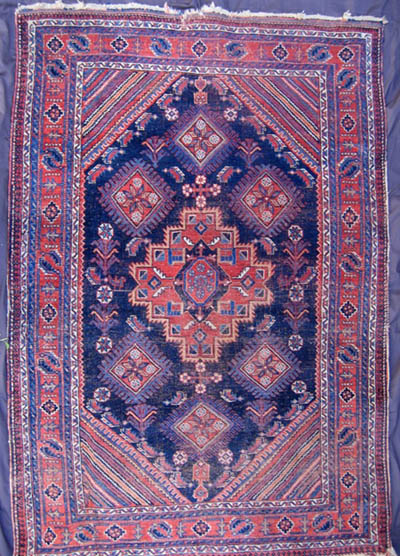
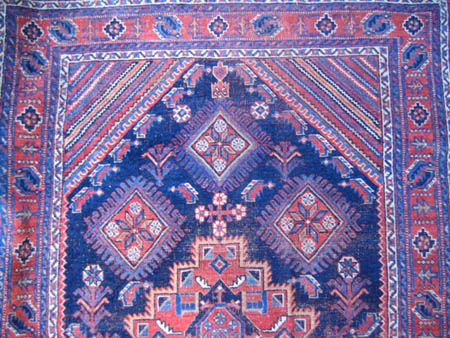
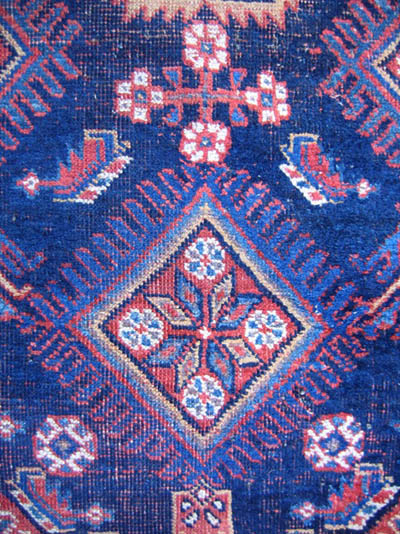
below -
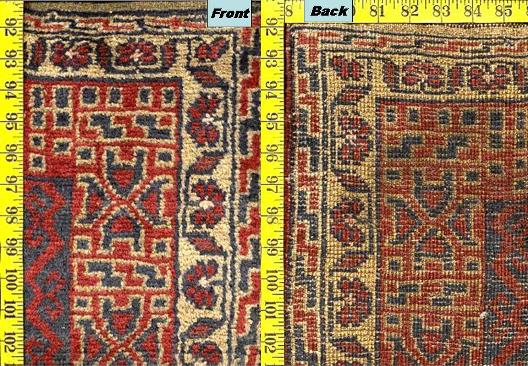
folded over to see back
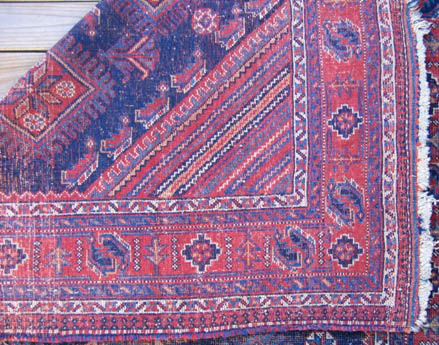
below - back closeup
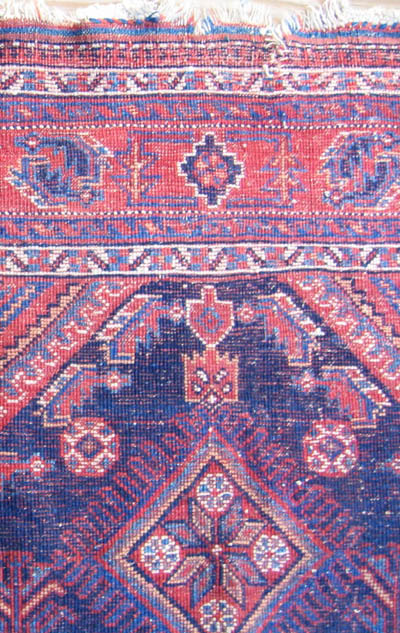
The rug is worn almost to knots
but very evenly with only moderate end and selvedge damage. As best I can
determine, this one has:
Knots - asymmetric open-right, about 80
kpsi, 9/9 ratio;
Warps – white wool (still checking…might have some
cotton), deeply depressed, moderate tight twist;
Wefts- fairly hefty
two shoots dyed red.
Colors - all colors look good to me.
Selvedge - partly redone, original was 2 groups of three wefts
overcast with a single wool red-blue barber poll stripe.
Ends - plain
flat weave, color-striped, warp ends pattern knotted for several rows at one end
and possibly originally looped (?) at the other.
The Afshar are now are
noted to occupy three regions, some in the Causcasus, some near Kerman and some
in Khorason near Meshed.
According to Edwards, all Afshar being good
Turkmen, originally used the symmetric knot. However, Tom Cole noted
asymmetric-right knots in 5 of 7 very old rugs featured in his article,
“Outback Afshars” (see - http://www.tcoletribalrugs.com/article2.html ). Edwards noted
that intermarriage introduced asymmetric knots and spread Afshar designs to
nearby villages in S. Persia. Also, In N. Khorrason, suspected Afshar
interaction with Baluch (and Kurd) design elements has long been noted. Jerry
Anderson went so far as to equate the “Afshar” with the Ersari.
In the
literature, to my knowledge no one has identified ways to distinguish between
the three regions of Afshar weaving. I wonder if this one may be from NW
Persia-Azerbijan area. The use of the multi-colored striped corners seems to me
to recall the stripes in gendji rugs…also some of the ornaments such as the
“stars” have a Caucasian look to me.
Comments including any clues to
geography appreciated.
Regards, Jack Williams
Posted by Marvin Amstey on 04-30-2007 11:31 AM:
Looks like a straight-forward 20th c. Afshar from Fars province in Southern
Iran. The only Afshars that I have seen and can identify come from there.
Posted by Jack Williams on 05-01-2007 03:47 PM:
follow up
Thank you for your comments Marvin. What are your thoughts on the differences
between 20th C. and 19th C. Afshar rugs?
I believe this rug has the
usual characteristics of an old Afshar including three blues, red wefts, deeply
depressed warps, even open right weave, etc. Its colors seem good so it
could be pre-WWI, possibly 19th C. at least in my opinion.
To me,
the corner striping design, some of the field-design elements and most of the
structural elements of this rug recall Gendje Azerbaijan rugs (which often seem
to me to have some Turkmen characteristics). Therefore, I speculate an
Azerbaijan-Afshari connection for this rug.
I understand that most Afshar
rugs are attributed to the Kerman, S. Persia area. I don’t think anyone has
attempted to systematically differentiate Afshar rugs between tribal groups,
much less from regional areas, except maybe Cecil Edwards. But some indicators
might tend to point to certain geographical areas for certain rugs.
Your
thoughts on the usefulness of these two articles as beginning points for Afshar
study would be appreciated. Tom Cole: http://www.tcoletribalrugs.com/article2.html , Eiland: http://www.tcoletribalrugs.com/article46AdraAfshars.html
.
Thanks and regards,
Jack Williams
Posted by Steve Price on 05-01-2007 04:01 PM:
Hi Jack
I think the stripes are a weak basis for linking this to an
Azerbaijan (or any other Caucasian) heritage. Note, too, that the piece has
asymmetric knots, while Caucasian rugs are almost invariably symmetrically
knotted (I'd say always, but someone would surely produce an exception within an
hour).
Regards
Steve Price
Posted by Jack Williams on 05-01-2007 05:31 PM:
The camel's nose...
Hello Steve,
Whoa...I am not saying the carpet is Gendge or Caucasian.
It is Afshar. But...Opie's famous map of the location of the Afshar early in the
20 C. shows an Afshari concentration in Azerbiajan - and that is where the
Afshari supposedly orginated before being partly deported by Shah Tahsemp and
Abbas, possbibly also Nadir. Gendge rugs not only are commonly striped, but
often have red wefts (unusual in the Caucasus?), multi knotted end warps, Kazak
stars, etc., all elements found in this rug. This particular rug type I think
might be the result of an ethnogensis design
spill-over.
The Afshar are/were Turkmen, perhaps related to the Azeri,
and often thought to be related to the Ersari. The design elements of Afshar
rugs are all conventionally thought to have come from outside the
group....according to some authorities, no one has definitively identified a
specifically Afshari design, though it seems to me that there are
definite "marker" designs.
I speculate that some Afshar rugs have a
distinct Baluch element in the design, use coachinal, and...etc. Therefore they
could well be from Khurrisan. Many Afshar rugs have a open endless repeat of
large scale...things...botahs, vases, flowers... with an unusual but
characteristic spatial relationship, sometimes compartmented like Bhaktiaris. I
think these, and the Afshar medalion rugs, could be mostly from the Kerman, S.
Persia area influenced by the designs of the region.
If the above makes
sense, then it seems possible that there was a design spillover that affected
Afshar rugs from Azerbaijan. And there is a class of Afshar that reproduces the
Frankish rose exactly...similar to a certain type of Caucasian. And there are a
couple of other unusual elements I've noticed in a lot of Afshar rugs which I
need to document first.
I have two more Afshar rugs that I think
illustrate regional points, plus the examples that started me thinking along
this path. More later, and thanks for your comments,
Jack Williams
Posted by Steve Price on 05-01-2007 07:22 PM:
Hi Jack
If I understood you right, you told us in your first post that
one of the three geographic regions where Afshars live is the Caucasus. You
noted the stripes on this rug, and find them similar enough to those common on
Genje rugs to make you think that this could be an indicator that the rug was
made by Caucasian region Afshars. The red wefting is, as you note, a common
characteristic of Genje and Kazak rugs. If I don't have that right, the rest of
this post is best ignored, as I'm proceeding on the assumption that it is.
Please correct me if I'm mistaken.
The stripes don't look terribly
Genje-like to me, I guess because their outlines aren't straight. But even if
they looked more like Genje stripes, I'd be reluctant to use that as anything
more than the faintest suggestion of a Caucasian origin, and I'd start by
looking for other Caucasian indicators. The red wefts is consistent with it. So
far, so good. But I don't know of any group in the Caucasus area that uses
asymmetric knots. That constitutes a reasonable argument against the rug having
a Caucasian origin.
In your later post (the one immediately above this
one), it's not clear to me whether you think this rug was done by Afshars living
in the Caucasus or by descendants of such Afshars who now live in south Iran.
Your perpetually puzzled co-pilgrim,
Steve Price
Posted by Marvin Amstey on 05-01-2007 07:29 PM:
Cotton wefts make me think of 20th c.
Posted by Jack Williams on 05-01-2007 10:01 PM:
Oh, I wish i was in the land of cotton...
Marvin, thank you for the explanation.
I deduce you refer to the use
of cotton wefts because of the way the rug has held shape despite its wear and
apparent age. I admit not testing the wefts. As originally noted, I think the
wefts are wool because they are dyed red. I am under the impression that it is
rare to find dyed cotton in older, nomadic-tribal type rugs, cotton being a
radically different (and difficult) “animal” when it comes to dying. I’ll test
the wefts when I get home later.
I still have some questions about the
warps. They seem to be wool, but there is a faint odor that seems… different…
when I do the burn test. However, Tom Cole addressed the issue of cotton and
Afshar rug age in his article “Outback Afshars” http://www.tcoletribalrugs.com/zPersianArticle.html Here in
part is what he says:
“…Nearly all aspects of the unusual group of
rugs illustrated here [the seven “outback afshars’] are distinctive within an
Afshar context, but perhaps the most striking features are their inconsistent
structure and use of materials. The weave hardly resembles what we have come to
expect in typical south Persian Afshar rugs of the 19th century. Commenting on
the structure of the few 18th and early 19th century Afshar weavings he has
examined, Parviz Tanavoli comments that they are '...closer in structure to
Azerbaijani weaving than that of typical Afshar work. They usually have cotton
or mixed cotton and wool foundations, are rather coarsely woven, with uneven
backs and slightly exposed wefts'"… [emphasis mine].
Your
experience may indicate something different. Your further thoughts would be
welcome to me.
Regards, Jack
(Steve…more coming with a better
pictorial explanation, if the men in white coats don’t find me first...methinks
i am on difficult ground, venturing into the swamps of Caucasus).
For
those with relatively unfamiliarity with the history of Afshar rugs, the
following is quoted from Cole’s article…I think it a good summary of current
scholarship at least as far as my look into the subject to date.
“Afshar tribal rugs present inherent problems to scholars and
collectors. There is some doubt as to which of the myriad types of south Persian
weavings should be classfied as Afshar, and we still have only a partial
understanding of who the Afshar actually were. Parviz Tanavoli (HALI 37, 1988;
HALI 57, 1991), Murray Eiland Jr. (Oriental Rugs from Pacfic Collections, 1990)
and James Opie (Tribal Rugs, 1992) have contributed much to our grasp of the
Afshar attribution, but the attempt to assign precise attributions to
identifiable subtribes is often of limited value. However, the appearance of a
hitherto unfamiliar group of weavings, apparently representing the early
aesthetic of an unidentified group of Afshar weavers, means that the problem
must be addressed.
The Afshar were Central
Asian Turkic nomads, part of the ancient Oghuz Turkmen horde. They eventually
populated areas of eastern Anatolia and, since the 16th century, have been
present in Azarbayjan (northwest Iran). In relatively recent history, Afshar
tribes have come to inhabit areas of northeast Iran (Khorasan) and northwest
Afghanistan, and are perhaps best known in conjunction with studies of tribal
rugs and peoples from the Kerman region of southern Iran.
After the seizure of power by the Afshar chieftain Nader
Quli Khan -- who was crowned Nader Shah Afshar of Persia in 1737 -- diverse
tribal groups swore allegiance and subsequently identfied themselves as Afshar.
In the wake of Nader's triumphant sack of Delhi in the early 1740s, Afshar clans
remained scattered from Kabul to Khorasan, living among the Afghan tribes, the
Pathans, Tajiks, Uzbeks, and the tribes of the Chahar Aimaq Confederation.
Khorasan itself remained under Afshar control until 1796. This patchwork of
groups may help account for the confusing interpretation of later tribal census
surveys by, among others, A. Cecil Edwards (The Persian Carpet, 1953). It is
also unclear to what extent the Turkic peoples of the Kerman region are Afshar,
or belong to other elements of the Qizilbash Turkmen Confederation, a
significant power in the past of which the Afshar were at times a dominant
member. We cannot therefore be certain of specfic attributions for rugs woven
within this cultural milieu.”
Posted by Gene Williams on 05-02-2007 02:27 AM:
Kizilbash
Of course the Kizilbash (Red Hats) were Turkoman and took over Iran around
1520 with Shah Tamaseph (Babur communcated with him and has a famous description
of the battle near mashhad in which he crushed the Uzbeks in the "Baburnama").
But, horror of horror.. They were shi'i. The Turkoman tribes..Tekke in
particular, north of Mashhad in late 1700's, early 1800's lumped any of the
Turkomen, who fled to the protection of the Persian government, whomever was in
power in Persia..the Safavids or their successors, even if they were Sunni..as
"Kizilbash"..i.e. Shi'a...and as such they were apostate and therefore, fair
game for the Sunni slavers.
So, Afshars..almost by definition at the time
were Turk, and were Shi'i..and were Persian in the sense that the wrote in
Persian-Farsi-Dari and probably spoke it (they may also have spoken Turkish but
I'd bet by 1800 the language of the Afshars had become predominately Farsi just
as it was in W.Afghanistan with the timuri and the Aimaqs). Which brings into
play a couple of different philosophical concepts on religion...i.e "imami"
-concept of the Iman..God's messanger on earth; and " 'Adl' " or "Devine
Justice...which leads the Shi'i philosphically into "free will" i.e. "mankinds'
free will to choose between good and evil")... .and definitively a different
calendar.
Gene
PS. I partucularly like that Afshar...from an
artistic standpoint, the "Stars motifs" or Worm Ourborous...or whatever in the
field have a hottish center..going to an orangesish red..down to a red outline
of a blue design, which from a distance turns almost purple..see impressionist
or pointilist paintings for similar effects...giving it a reddish glow on the
edges which from a distance seems to difuse the light from the whole.. a quite
spectacular effect.
Posted by Jack Williams on 05-03-2007 01:21 AM:
thesis of regional Afshar...off base?
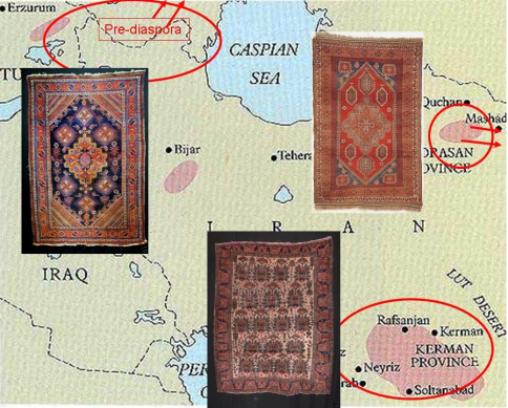
Good evening Steve
and all.
Gene, thanks for the nice review of the artistic nature of that
rug.
Above is a map that shows the three centers of “Afshari”
population, at least from my understanding, along with the three rugs I hoped to
attribute regionally.
My thesis began with the thought that the “Afshari”
are related to the “Azeri” population of Azerbaijan. I thought that since the
population of NW Persia-Azerbaijan, is predominantly Azeri descendents, perhaps
some Afshar weavings from greater Azerbaijan continued to be produced possibly
to current times. If so, I thought that they might have a distinctive signature
with some design (not construction) aspects similar to Gendge-Kazaks. But in the
market place, they would be assumed to be Afshar and automatically attributed to
S. Persia.
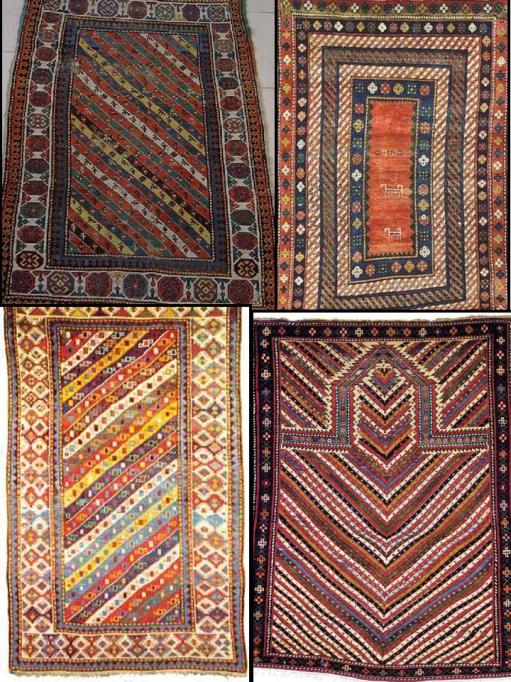
Below is a collage of Gendge rugs mostly from JBOC (and an
extraneous Kazak lower right from NERS)…
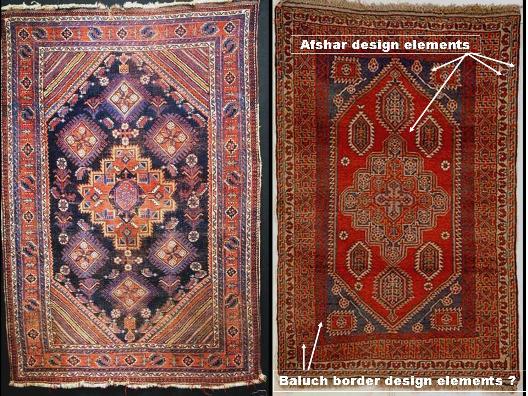
And here are two Afshars, one
from Danny Mehra’s collection…
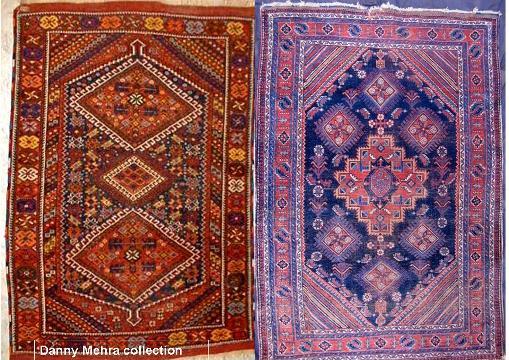
Pictorially, these kinda illustrate the Afshar-Caucasus
relationship I was trying make. I was hoping the striped corner, 8-point star,
28-plane cross-medallion (and smaller similar border decorations) Afshar rugs
could be identified with NW Persia-Azerbaijan because of design elements. If so,
we might be able to re-attribute the “striped corner” group of Afshar rugs to a
different region from the Kerman Afshars. But, I am having doubts….
These
next two rugs more or less illustrate the all-over field design Afshars in my
opinion. One on the left is actually an unkown Kerman rug, about 200 years old.
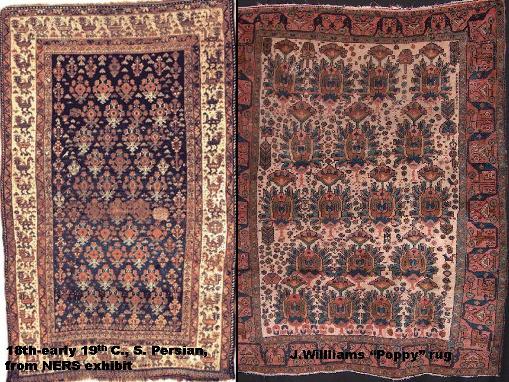
It seems that
most identified Afshari people are supposedly concentrated around Kerman...if
the Turkmen semi-nomads who were identified in that area by Edwards are indeed
“Afshari.” I agree that it seems reasonable to assume that most “Afshar”-rugs
are probably from this area. Part of my original idea was that the Afshar
“all-over” designs with certain distinctive spatial attributes (they
don't quite seem "endless") are mostly from the Kerman area. This would include
the "compartmented" endless designs.
Finally, below are two possible
“Khurrison Afshars (?)” (
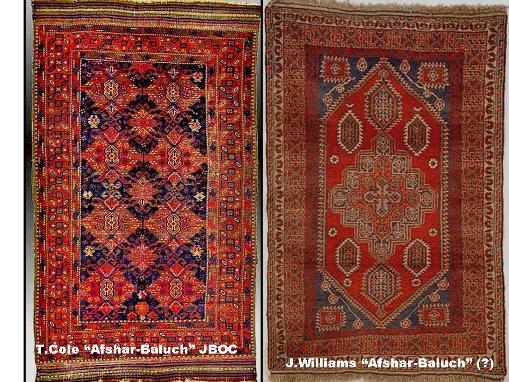
We know that there exist(ed?) an Afshar community around Meshed
whose presence was confirmed by Frazier. Many rugs seem to be “Afshar-Baluch” or
even “Afshar-Kurd.” I was hoping to develop some characteristics that might
identify Afshar rugs likely to be from Khurison, such as the two above.
BUT...this whole thing is falling apart at the first hurdle. I still
think we might be able to identify some characteristics of the “Afshar-Baluch,”
but I just don’t know about the other areas at this point.
I’ll probably
go ahead and show the other two “Afshars” anyway. What the heck.
Regards,
Jack Williams
Posted by Steve Price on 05-03-2007 10:51 AM:
Hi Jack
As I think you agree, making attributions of subgroups is even
dicier than making them in coarse groups. Designs and motifs move all over the
place, and probably get reinvented from time to time, especially if they aren't
terribly complex (stripes aren't terribly complex). Superimpose on that the
grain of salt with which I think many published attributions need to be taken,
and the problems become severe.
This isn't to say that I don't think such
exercises are fun, only that it isn't a good idea to get too invested in any of
them.
As an aside: Several years ago I visited eastern Turkey, and was
hosted by a very kind Kurd who also happens to be a dealer in Van, selling
mostly new rugs. The unpleasantness between the Kurds and the Turkish government
is another topic for another day, but the relevant thing here is that my host
would buy only Kurdish rugs for his inventory. I was astonished at the range of
attributions I might have made, which included a stack of classic Afshar sofreh
(he gave me one as a souvenir of the visit as I was leaving - a generous and
unexpected surprise). When I asked why he had Afshar sofreh in his inventory, he
explained that these were woven by Afshar Kurds. I'm sure he knows what he's
talking about.
As a further aside: I visited the homes of several Kurdish
dealer friends in Turkey, and all had Afshar sofreh among their floor coverings.
These are such heavy, meaty textiles that they stay in place nicely in places
where other rugs of comparable size wold be slipping all over the place when you
walk on them.
Regards,
Steve Price
Posted by Jack Williams on 05-04-2007 02:46 PM:
"A" is for "Afshar," and "Armanians?"
Good Afthernoon all.
Thanks to Steve for continuing to post this
flood of pictures.
I still have some radical ideas about Afshar rug
design elements. Where I was going with the proposed connection of Afshar to
Gendge-Kazak was not the end of the story. I’ve a wild idea that there may be a
weaving design connection between the Afsharis and... Armanians(!!!).
I’ll show and tell a few Afshars, and then try to make the case.
The next
Afshar is one I previously showed. The colors are unusually hard to capture.
I’ve played with the colors (except Picture 4, the direct scan) trying to get
them right and still allow seeing the design elements.
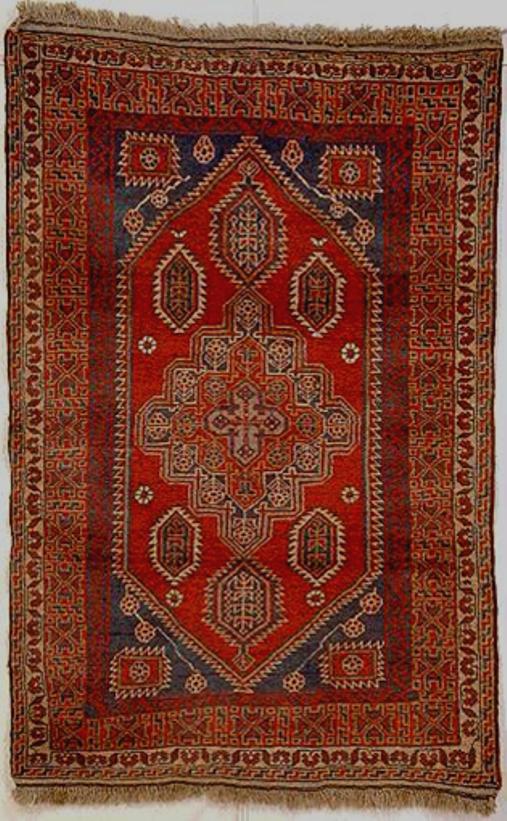
size approximately
3’ x 4’10”
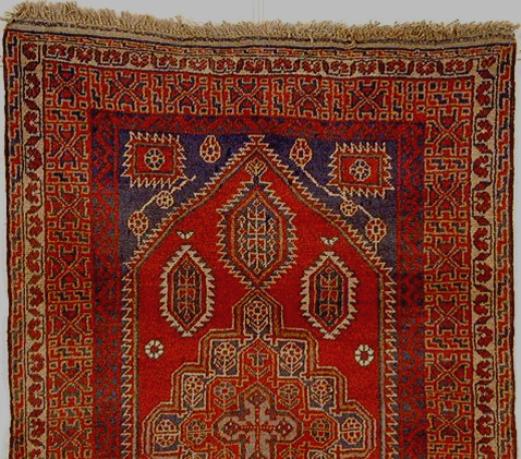
Picture 4 – direct scan (below)
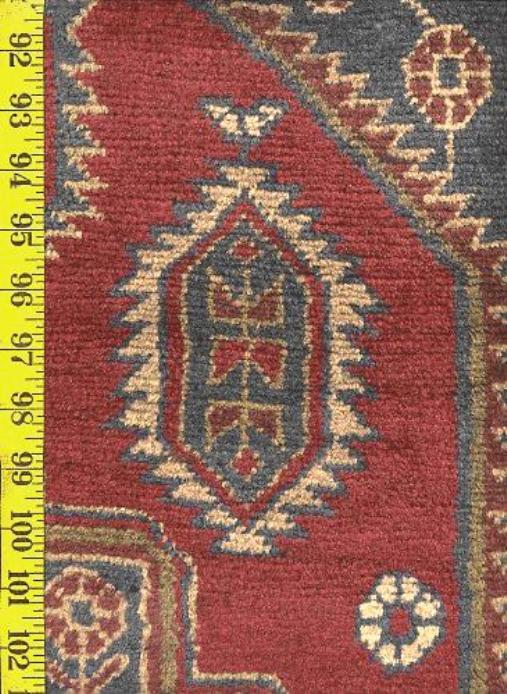
Note: the true
color of the “flames” that surround all the elements is pink or yellow-gold, not
white, but fading and photography limits has softened the colors so they
photograph either white or light pink. I think that the only white
originally in the rug was the vine meander border background and the border
element outlining. (ad edit later: On second look, I think the vine meander
border background was also bright pink originally!)
Though it is
probably mid-20th C., this rug is one of my favorites. I bought it off the
internet from a dealer that most of you know well. It was advertised as a
Baluch, but when I queried its “Baluch-ness,” he replied that it came in with a
bale of Baluch and it had typical Baluch structure including asymmetric, open
left knots.
But, the seller was wrong. This rug has depressed warps but
definitely has symmetric knots (I’ll add structure details to this post
later). The field design is almost 100 percent Afshar, except for the two inner
borders, which may be Baluch in design (see picture 5). The colors (seem natural
though there are only 4 or 5) also are a little unusual in that the field
colors, red and medium blue, are exceptionally translucent and evenly
saturated...as if the wool was dyed before being spun into yarn.
The
color combination seems a little "unAfshar" missing the peach-flesh tone.
Perhaps adding back the original pink and gold that has faded would have
produced the "Afshar aura."
The rug is not "fine" for an Afshar. But the
central stepped medallion always awes me because of its stained-glass window
look...in the wool the rug has a deep and abiding aura that radiates
something...almost peaceful...its hard to explain.
I would like to attribute this to
the Khurison province Afsharis and use it as an example of Afshar-Baluch. But I
cannot be sure about that though the red may (or may not) be the default shade
we associate with Cochineal dyes, and carpets can wander far from their point of
weaving. Still it is a thought provoking, even beautiful example of rustic
Afshar art, (which I particularly like).
Please comment if you like,
and/or post an Afshar.
Regards, Jack Williams
Posted by James Blanchard on 05-04-2007 11:18 PM:
Hi Jack,
I like both of those rugs, and being no expert I would simply
attribute them as "Afshars".
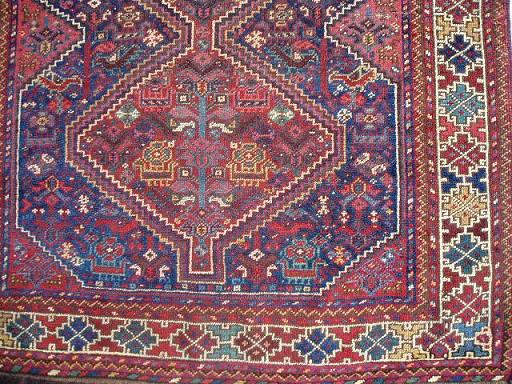
Actually, I think that main border design
element ("four inward arrows") is typically S. Persian and is often seen on
so-called "Arab Khamsehs". Here is an example of an older version of that border
from a "bird Khamseh" of mine. It is symmetrically
knotted.
Cheers,
James.
Posted by Anas Al Akhoann on 05-07-2007 01:44 PM:
Caucasian rugs
I agree with Steve, that all Caucasian rugs are woven with a symetrical knot.
But I would be very interested indeed, to see one that is woven with asymetrical
knots, either open right or open left, especially if it is late 19th
century.
Posted by Jack Williams on 05-08-2007 01:09 AM:
A is for Afshar, Afshan, Azari, Armenian, Asymmetric
Good Evening all.
I am far from being an expert on Caucasian carpets
so I was hoping someone with deep experience would comment. Oh
well…
"Caucasian" is both a geographical area and a carpet design group.
I have never heard of an Afshar carpet being thought of as a "Caucasian"
carpet...even though the recorded history of the Afshar initially finds them in
Azerbaijan, and Afshar descendents still live in Azerbaijan. Likewise, many
Kurds live physically in the Caucasus...but their rugs are still usually thought
of as "Kurdish." (ad ed: is this true?)
But, even a cursory knowledge of
the history of the region should make us a little wary of absolutes...especially
given the deep involvment of Persia. Folks, it doesn’t take too much academic
effort to discover that both symmetric and asymmetric knotting is used in
Caucasian (geography and design) carpets.
I will quote from
Rugs & Carpets from the Caucasus, The Russian Collections. By
Liatif Kerimov, Nonna Stepanian, Tatyana Grigoliya, and David Tsitsishvili,
Allen Lane/Penquin Books Aurora Arts Publishers, Leningrad, 1984.
After a
discussion of the prominent historical role of Persia in Azerbaijan, p. 11, “
…By the second half of the eighteenth century Azerbaijan was a motley pattern of
almost twenty larger and smaller khanates enjoying economic and political
independence…The khans bent over backwards to imitate the Persian Shah, their
feudal overlord. They built palaces in Persian architectural style…They had
their own court poets, musicians and artists, as wekll as workshops where girls
were instructed in the weaving of carpets after Persian designs…The close
ties between Persian carpets and those made in the various khanates are
observable even today…”
In the next chapter, the three basic
types of Caucasian carpets – the Kuba-Shirvan, the
Gianja-Kazakh and the Karabakh – and their many
groups and sub groups are discussed. Following the discussion of characteristics
of the Kuba-Shirvan type and sub groups, p. 19,
…”Kuba-Shirvans have ornate designs with pleasing heavy flowers and
are knotted either in the symmetrical or asymmetrical
knot…”
Following the discussion of the Gianja-Kzakhs type
groups and sub groups, p. 20 “…Both the symmetrical and asymmetrical knots
are used…”
The type of knots for the Karabakhs types was
not mentioned.
Looking through the book at the fine examples, most of
the pictures are of rugs with symmetric knots. But several examples have
asymmetrical knots. When I get my scanner operational again, I’ll post
several in a new post. This book has some of the example Armanian carpets that
helped form my thoughts on some kind of unique design connection between Afshar
and Armanian.
Regards, Jack Williams
Posted by Steve Price on 05-08-2007 08:45 AM:
Hi Jack
The conventional wisdom sure takes a beating sometimes,
doesn't it? One of the things that I find so attractive about Rugdom is the
frequency with which sand turns out to be the foundation
material.
Regards
Steve Price
Posted by James Blanchard on 05-08-2007 09:33 AM:
Hi Jack,
I don't know enough to comment on the reliability of
structural analysis to place your first Afshar, but I would still say that based
on the design elements, for me it fits very well within the S. Persian
group.
Here are a few analogies to illustrate my reasoning.
1)
Minor border of "connected boxes", which is common on Khamseh "bird rugs" (see
the example).
2) The "8-pointed" star, which Patrick Weiler has also
pointed out is a common S. Persian feature as seen on this "Sheka-Lur" rug of
mine. Patrick refers to them as "snowflakes", and indicates that they are also
seen in Veramin rugs.
3) The "oak leaf" designs and the two varieties of
circular "floral" devices. These are shown in the Qashqai?/Khamseh? rug in the
bottom picture.
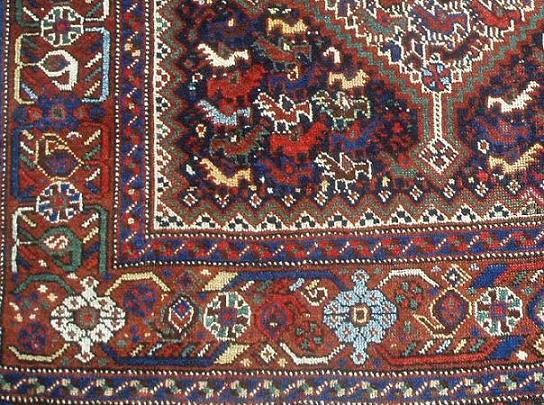
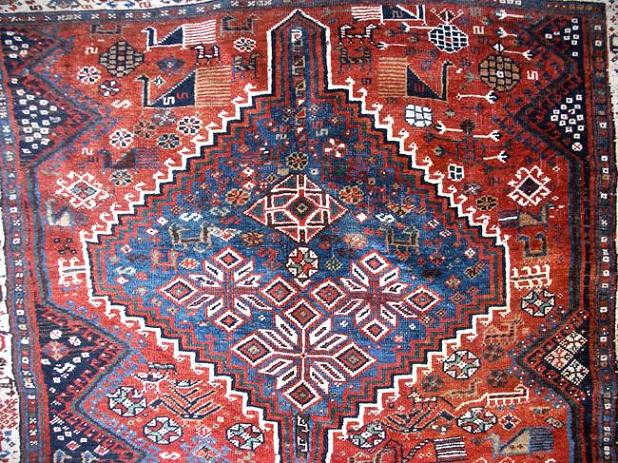

In sum, I
think that it is easier to place these design elements with S. Persian weavings
than with Caucasian.
But that is just my two rupees
worth....
James.
Posted by Filiberto Boncompagni on 05-09-2007 03:35 AM:
Hi Jack,
I’m no expert but I have a penchant for Caucasian rugs. It’s
a few years that I’m following my passion reading books, browsing on the web and
collecting. I don’t recall ever seeing a mention of Caucasians with asymmetrical
knots with the exception of Ian Bennett: “The majority of Caucasian pile rugs
have woolen warps and wefts and wool pile tied with a symmetric knot… Very few –
indeed only the two rugs in the Keir collection mentioned above have been
published – have asymmetric (Persian or Senna) knotting”. (Caucasian,
page 16)
Of the two books presenting some structural analysis that I
have, Gans-Ruedin (Le Tapis du Caucase) says: “La plupart des tapis du
Caucase sont noués au moyen du noeud turc” (most of Caucasian rugs are knotted
with the Turkish knot). Of the 143 knotted rugs illustrated in the book, though,
136 are said to be symmetrically knotted and of 7 there’s no mention of the knot
type.
The other book is Kaffel’s “Caucasian Prayer Rugs”: of the 97 rugs
1 is flat-woven, 80 have symmetrical knots and of the rest there’s no
mention.
So, of 239 specimens, 216 have Turkish knots and of the others
we simply don’t know. Notice that there isn’t a single one explicitly stated as
asymmetrically knotted.
Which makes me think that a Caucasian rug with
Persian knots is nothing else than the exception confirming the rule.
I’m
eagerly waiting to see your scans.
Regards,
Filiberto
P.S.
“Caucasian rugs are invariably woven with the symmetrical knot.”
Wright&Wertime’s (Caucasian Carpets & Covers)
Posted by Steve Price on 05-09-2007 06:00 AM:
Hi Filiberto
The Kerimov, et al book cited by Jack lists approximately
5% of the Caucasian rugs in it as having asymmetric knots. I'm not nuts about
the book or most of the rugs in it, but I think the authors' reports on whether
the knots are symmetric or asymmetric and whether they are truly Caucasians are
probably reliable. Until Jack called it to our attention, I was (like you)
pretty convinced that the conventional view - rugs of NW Persia, the Caucasus
and all Kurdish subgroups - use symmetric knots only. It looks to me as though
it's true for most, but not nearly all of them.
We live and learn (and
forget!).
Regards
Steve Price
Posted by Filiberto Boncompagni on 05-09-2007 06:44 AM:
Hi Steve,
Do I sound skeptical? Perhaps it’s because I am. And I am
more skeptical now as you say “the book cited by Jack lists approximately 5% of
the Caucasian rugs in it as having asymmetric knots”.
5% is NOT a
negligible percentage. Why nobody noticed it before? Besides, of the
above-mentioned 216 rugs whose structure is indicated, at list 10 should have
been asymmetrically knotted.
Skeptically,
Filiberto
Posted by Steve Price on 05-09-2007 07:11 AM:
Hi Filiberto
Bennett does mention that a few Caucasians have
asymmetric knots. Why doesn't ayone else except Kerimov, et al.? I can think of
a number of possible reasons,
1. Kerimov, et al. don't know how to identify
an asymmetric knot, so they're wrong in those structural analyses. I think this
is unlikely enough to be ignored.
2. Kerimov, et al. had some asymmetridc
knotted rugs in their group, but those rugs weren't Caucasians. Since their rugs
are all part of local ethnographic museum collections (some illustrate just how
awful "museum quality" can be), I think their attributions are very likely to be
correct - this isn't the right explanation.
3. Other authors simply call a
rug something other than Caucasian if it has asymmetric knots. This is, at
least, plausible.
4. A more thorough literature search would find a number of
additional Caucasians with asymmetric knots. Could be?
It's always
dramatic when a lovely belief and some ugly facts meet face to
face.
Regards
Steve Price
Posted by Richard Larkin on 05-09-2007 08:17 AM:
Folks:
I vaguely recall having come across one or two rugs attributed
to the Caucasus that had asymmetrical knots. They were not typical pieces or
very old (or very attractive), perhaps some type of Soviet era production.
Without doubt, the vast proportion of Caucasian rugs use the symmetrical knot,
at least as to the production that has reached the west. I believe any
exceptions are aberrations. I don't know what Kerimov, et al, are getting at,
probably something between 2 and 3 in Steve's post (they're counting rugs we
wouldn't call "Caucasian"), but I doubt that any 5%. or .00005%, have the
asymmetrical knot.
P. S. to Filiberto: You are too an expert.
Don't destroy our illusions!
__________________
Rich
Larkin
Posted by Filiberto Boncompagni on 05-09-2007 08:18 AM:
Hi Steve,
I like your point # 3, but I sill have doubts.
To be more
specific: I do not contest the possibility of asymmetrically knotted Caucasian,
it’s the 5% percentage that seems to me incredibly high.
I don’t know
that book but I notice that it has four authors. Kerimov is the most esteemed of
the group.
Question:
Who exactly wrote about the 5% percentage? Was it
a collegial statement? Did the percentage of 5% emerged before in other
publications by Kerimov or/and al?
quote:
It's always dramatic when a lovely belief and some ugly facts meet face to
face.
Unfortunately, books are not to be taken always verbatim, hence
the saying “do not believe everything you read”. If a bunch of scholars writes
something that goes against conventional wisdom and experience, even if they are
more than respectable, I’d like to know more than a bare one-line quotation. As
it is, I don’t consider it a fact.
About your point # 4, “A more thorough
literature search would find a number of additional Caucasians with asymmetric
knots”:
Structural analysis is generally ignored in the literature, so I
suggest an easier and more reliable way to check if the 5% percentage is true:
suffice to examine all the so-called Caucasian rugs we can access to see how
many of them have asymmetrical knots.
My collection is too small to be
significant – we could call it insignificant  – but there are no Persian
knots.
– but there are no Persian
knots.
Regards,
Filiberto
Posted by Filiberto Boncompagni on 05-09-2007 08:32 AM:
quote:
P. S. to Filiberto: You are too an expert. Don't destroy our illusions!
Thanks, Richard, but I strongly refuse the “expert” label. The
enthusiast one is much more appropriate. 
Regards,
Filiberto
Posted by Steve Price on 05-09-2007 08:45 AM:
Hi Filiberto
The Kerimov book is at home, I'm not at the moment, so I
can't check much. The four authors are all Soviets, one each from Armenia,
Azerbaijan, Georgia and, I think (trusting my memory, always dangerous)
Daghestan. My recollection is that each was affiliated with a state museum. Some
Karabagh rugs appear in the Armenia museum, others in the Azerbaijan museum, as
might be expected for a district that was claimed by both
"republics".
Each textile in the book includes a table of structural data
in its description - colors, materials, knotting, etc. I don't recall whether
the book mentions who did the analyses. And I'm not sure that the sample (about
100 pile weavings) is large enough to be representative of the total population
of Caucasian rugs, but there are about 5 in which the description of the knot
type is "asymmetric". This at least suggests that we might expect the total
population to include, perhaps, 2% to 10% that are knotted
asymmetrically.
You don't have to convince me that much of what is
written is wrong, but in this instance it seems likely that the authors know an
asymmetric knot when they see one and that all the rugs that they show are
really Caucasian. That leaves us with the possibilities that our beliefs in the
near-universal use of symmetric knots in Caucasian rugs is wrong, that the
published information leading us to that belief is wrong, or that Kerimov, et
al. have a number of Caucasian rugs in their museums that differ from the
overall population in knot type.
Regards
Steve Price
Posted by Filiberto Boncompagni on 05-09-2007 09:38 AM:
Mmmhh! Still, you will agree with me that it’s strange having 5 asymm.
knotted rugs out of 100 in Rugs & Carpets from the Caucasus, The Russian
Collections and not even a miserable one among more than two hundred in
Gans-Ruedin and Kaffel’s books…
If the 5% is not explicitly stated by the
authors but inferred only by the total of rug displayed in the book (which, I
presume, is not the full corpus of the rugs owned by all the museums of
Caucasus), am I entitled to think that this percentage is casually high and does
not reflect the real situation?
Regards,
Filiberto
Posted by Richard Larkin on 05-09-2007 09:41 AM:
Filiberto,
My old friend and mentor, Harold Zulalian (late of
Brookline, Massachusetts) used to say, somewhat sardonically, "An expert is a
person who knows more about the subject than anybody else in the room."
On the subject at hand,
I suggest that a large random sample of Caucasian rug production in
country, or in the greater Russian collection area, is likely to be
different from samples taken from the marketplaces outside that area. There may
well be lines of production known within the region, perhaps somewhat obscure,
that employ the asymmetrical knot. They may be known among persons such as the
authors of the book, but generally unknown elsewhere. I suspect something along
those lines accounts for the attribution. Nevertheless, I agree with you that
more hard facts need to be brought to light before I will add asymmetrical
knotting to my diagnostic checklist for Caucasian rugs.
__________________
Rich
Larkin
Posted by Steve Price on 05-09-2007 10:08 AM:
quote:
Originally posted by Filiberto Boncompagni
Mmmhh! Still, you
will agree with me that it’s strange having 5 asymm. knotted rugs out of 100
in Rugs & Carpets from the Caucasus, The Russian Collections and
not even a miserable one among more than two hundred in Gans-Ruedin and
Kaffel’s books…
If the 5% is not explicitly stated by the authors but
inferred only by the total of rug displayed in the book (which, I presume, is
not the full corpus of the rugs owned by all the museums of Caucasus),
am I entitled to think that this percentage is casually high and does not
reflect the real situation?
Regards,
Filiberto
Hi Filiberto
The "about 5%" estimate comes from my
doing a casual count of the number of pile rugs in the book in which the
description of the knot was "asymmetric" and comparing it with a casual count of
the number of illustrated rugs that were piled rather than flatwoven. The sample
presented in the book seems to be random - at least, I see no pattern to the
selection. These are ethnographic museums, and for all I know, the rugs may
represent their total holdings of rugs in those museums at the time of the book.
And, I have no idea whether they are a representative sampling of Caucasian rugs
vis-a-vis knot type. That is one of the possible explanations I offered. It
might be the right one.
Regards
Steve Price
Posted by Richard Larkin on 05-09-2007 12:01 PM:
Jack/Steve:
I gather you have seen the illustrations in the Kerimov
book. Do the items said to have asymmetrical knotting look like Caucasian rugs
to your respective practiced eyes?
__________________
Rich
Larkin
Posted by Steve Price on 05-09-2007 12:12 PM:
Hi Richard
Some do, some don't. But, I should add, the same can be
said of the symmetrically knotted rugs in the book.
Regards
Steve
Price
Posted by James Blanchard on 05-09-2007 01:44 PM:
I think I am with Filiberto on this one. I browsed through the first 150 or
so plates in Azadi's Azerbaijani and Caucasian Carpets book and not one had
asymmetric knotting.
Being a typical deductive reasoner, it would be
important to see some examples of asymmetrically knotted Caucasian rugs. Even
then, "a single swallow does not a summer make" (or something like that). If we
are pursuing some association between Afshar and Caucasian weaving, then even an
occasional example with asymmetric knotting wouldn't be a strong basis to move
the hypothesis forward.
James.
Posted by Steve Price on 05-09-2007 09:17 PM:
Hi All
Like everyone else, I have a hard time finding significant
numbers of asymmetrically knotted rugs attributed to the Caucasus outside of
Kerimov, et al.'s book. I just ran through "The Gregorian Collection" ,and of
more than 100 mostly Armenian rugs, only 1 has asymmetric knots, and that's as
odd a ball as I've ever seen. It looks for all the world like a Turkmen main
carpet, but has a lengthy Armenian inscription.
I'm starting to wonder
whether the descriptions of the knots in Kerimov, et al. are correct. The book
doesn't say who did the structural details.
Regards
Steve
Price
Posted by Richard Larkin on 05-09-2007 09:46 PM:
Steve,
Of course, it is quite possible the pseudo Turkmen carpet was
woven for Armenians (by someone else, somewhere else) rather than
by Armenians.
__________________
Rich
Larkin
Posted by Gene Williams on 05-09-2007 10:42 PM:
Afshars in Caucausland
Hi all,
I have a Caucausian design carpet, very fine, with cotton in
the wefts, which is single knotted, (I believe). I always thought it to be a
copy from somewhere...I'll post a picture.
Re brother Jack, put your hand
on your wallet. He was a powerf attacking chess player in his day..rated at
oh..1700-1800 as I recall...but put him in a Southern bar with the usual racaous
Papstr Blue Ribbon wild choruses, Jimi Hendrix blasting from the sound system,
and the normal Alabama Fist Fights going on in the background...(oh I suppose
something like Turkotek)...heck, I'd up the rating 300 points for betting
purposes.
I just wouldn't at this point bet the farm on ALL Caucasians
being Turkish knotted. Ok, I need to be convinced. From experiece though I just
won't put money on the table.
Gene
Posted by James Blanchard on 05-10-2007 12:03 AM:
Hi Gene,
Nothing better than a game of chess with Afghan carpet
dealers over a pile of central Asian rugs, substituting Afghan green tea for the
Blue Ribbon beer.
I certainly wouldn't bet against the existence of an
occasional asymmetrically knotted Caucasian rug, but maybe in this case the
exception will prove the rule.
Cheers,
James.
Posted by Steve Price on 05-10-2007 05:54 AM:
quote:
Originally posted by Richard Larkin
Steve,
Of course, it
is quite possible the pseudo Turkmen carpet was woven for Armenians (by
someone else, somewhere else) rather than by Armenians.
Hi Rich
Could be. Whatever the story is on that one
(and we'll never know), it's a strange rug.
Regards
Steve Price
Posted by Filiberto Boncompagni on 05-10-2007 06:04 AM:
Hi Gene,
quote:
I have a Caucausian design carpet, very fine, with cotton in the wefts, which
is single knotted
Perhaps you mean single wefted?
Regards,
Filiberto
Posted by Richard Larkin on 05-10-2007 08:45 AM:
Hey gang,
There's lots of rugs out there, and most of us have seen
examples we can't explain for one reason or another. But by and large, Caucasian
rugs have symmetrical knots, yes?
__________________
Rich
Larkin
Posted by Jack Williams on 05-10-2007 09:09 AM:
A-symmetric B-asic C-aucasians
Good morning everyone.
Attached are the example rugs with asymmetric
knotting from the previously cited reference.
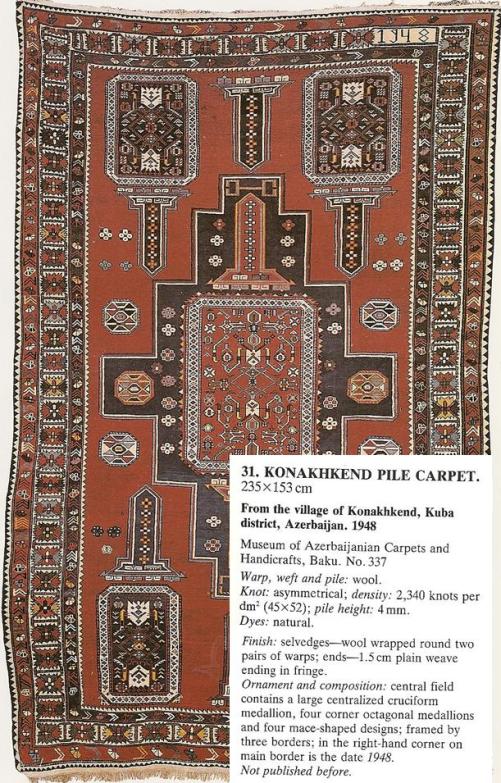
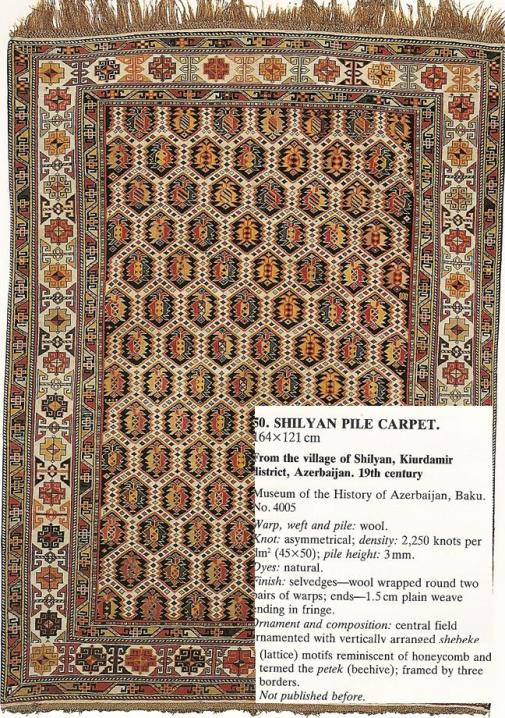
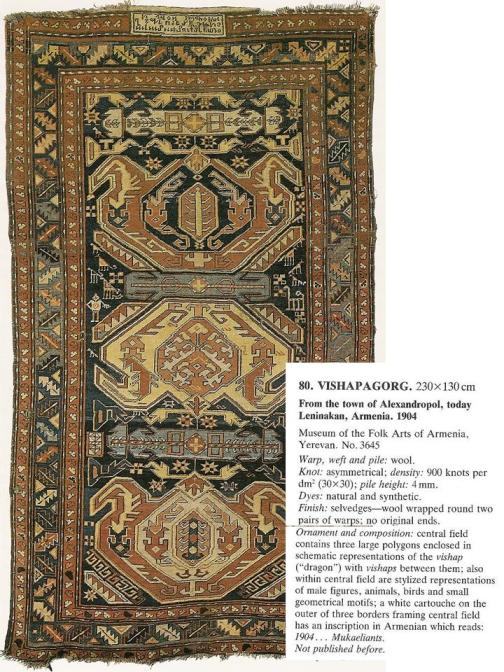
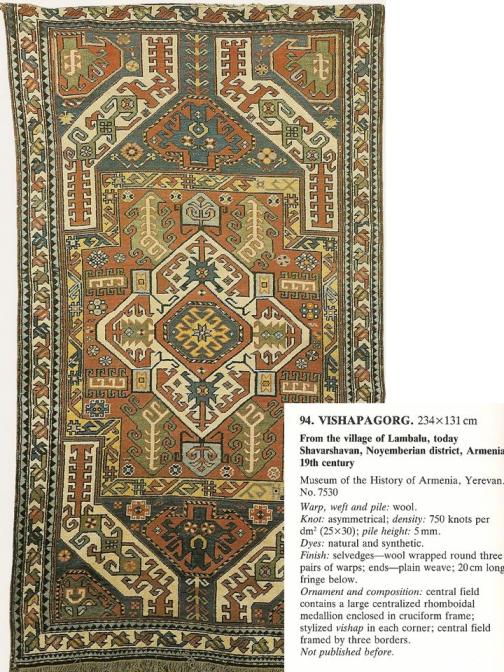
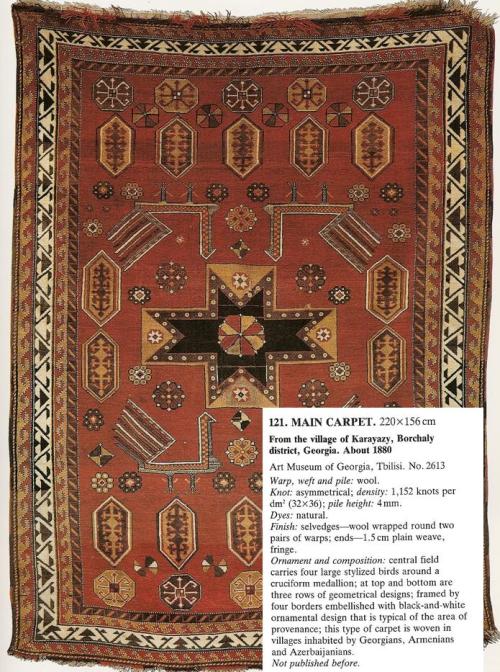
It seems to me that there is
nothing particularly sacred about knots. Of course the symmetric knot is
associated with the Turkmen and the asymmetric knot is associated with Persian
cultural influence. But...we know that many Turkmen tribes elsewhere use a
variant of the asymmetric knot. We also know that Azerbaijan was ruled by Persia
off and on through history and the eastern portion especially was certainly
within the Persian cultural sphere of interest.
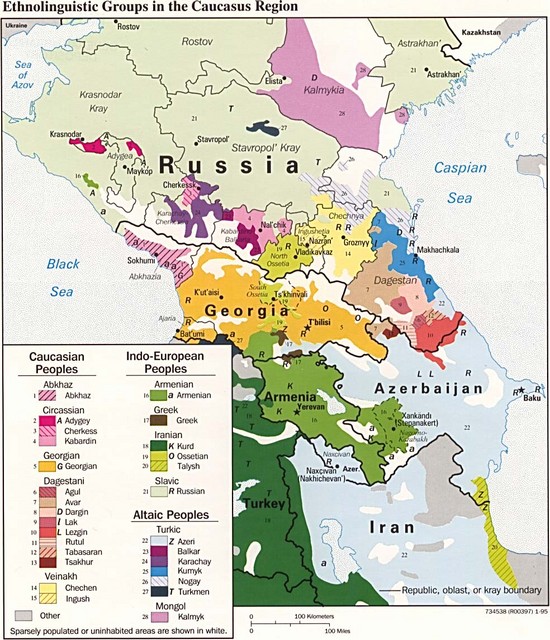
The population of the Caucasus
has been in flux throughout history. Heck…population deportation from the area
by Persian Shahs alone included both Armenians (to the Chahar Mahal region) and
Turkmen tribes (the Afshar). Furthermore, the Mongols and later Timmerlame
killed something like 80 percent of the population of Azerbaijan and presumably
drove others out (the Quasquai?). Continuous war in the area between Ottoman,
Persian, Russians and Khanates has certainly stirred the geography considerably.
A partial list of those forced elsewhere by the continuous tumult
through the centuries includes the Scythians, Cimmeranians (presumably including
Conan the barbarian), Bulgarians, Avars, Sakas, Kazars, Magyars, even possibly
the Baluch (and you wondered when we would make that connection)..
Why
the symmetric knot would be the only one used in such a polyglot region could be
a good question, unless the answer is simply, “if it has asymmetric knots it is
not Caucasian.”
Regards, Jack Williams
Posted by Jack Williams on 05-10-2007 09:21 AM:
Design ethogensis?
Greetings all..
I also wanted to discuss something else…about Afshari
design elements. I have noticed that where the Armenians reside, cruciform
symbols seem to infiltrate the regional weavings. For instance below are a
couple of examples of cruciform design symbols which are fairly common in
“Baktiari” carpets from the Chahar Mahal.
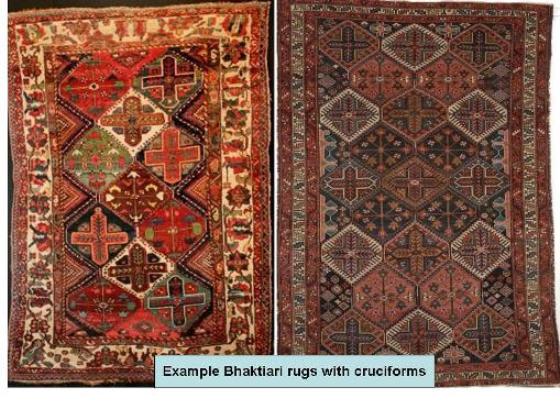
And here are four Armenian rugs
from the Caucasus (something about the second set is a little suspect to me
despite their use in the book op. cite.)
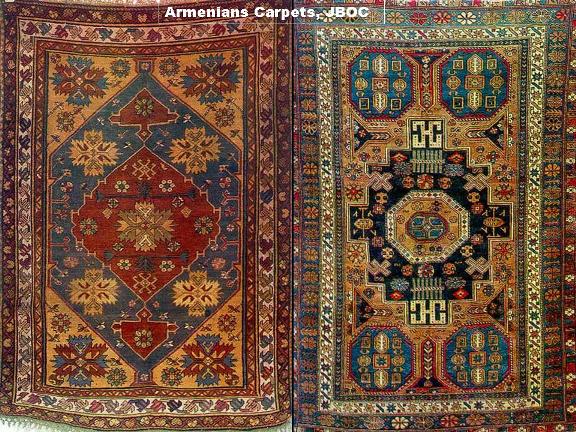
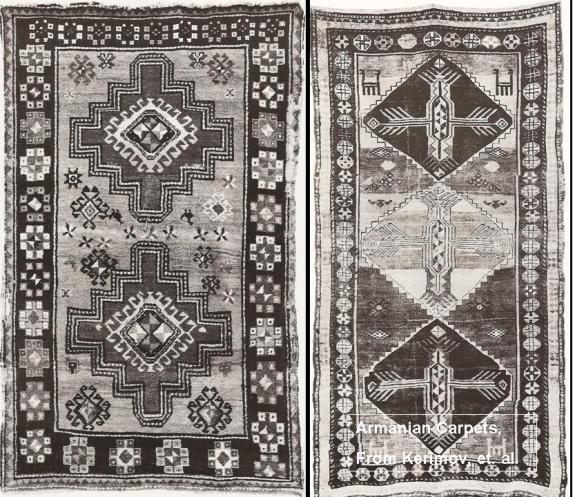
These Armenian rugs were
admittedly carefully chosen. Notice the designs recall common Afshar themes such
as the unusually prominent role of the cruciform in one form or another. Notice
also the use of what may be a variant of the “Legosi star,” and the stepped
cross medallion.
Next are a number of Afshar rugs. These particular
Afshar designs seem to feature the cruciform in various forms far more
prominently than other nomadic or tribal type rugs. Note the designs that seem
to echo the Armenian rugs shown above, the 8-point stars, the stepped cross
medallion, etc.
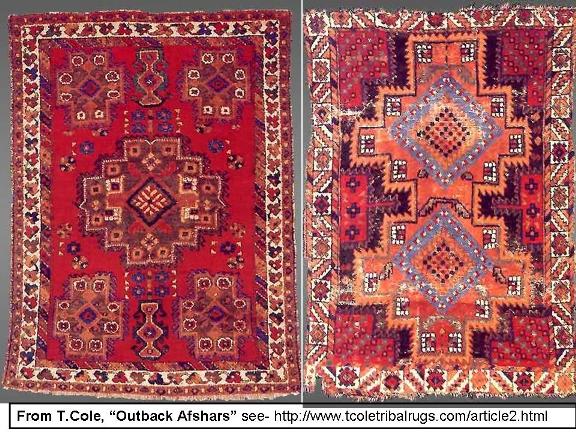
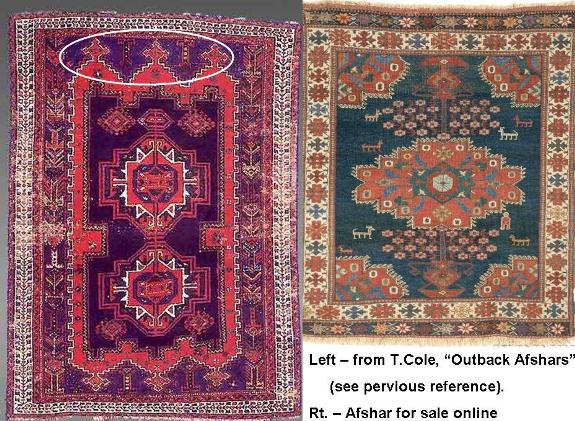

These cruciform designs in Afshar rugs are what caused me to
wonder if there were some historical Afshar-Armanian contacts in Azerbaijan. If
so, I wondered if the design migration or connection could be traced through
other Azerbaijan weavings? That’s why I originally tried to make the
Kazak-Gendji connection to Afshari rug designs, partly because the relationship
of Armenians and Kazak rugs seems to be pretty well established.
But if
not Kazak-Gendje, what about a connection between Afshar and Armenian designs
through Shahsevand confederation weavings? (There is a great Salon in archives,
see: http://www.turkotek.com/salon_00096/salon.html )
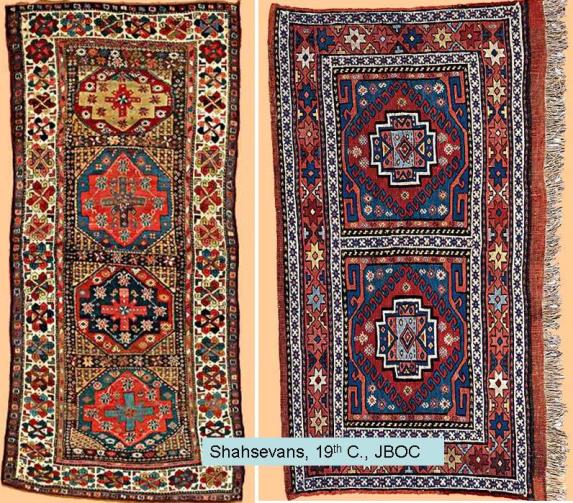
Summary of
topics...take your pick.
1. Knotting in the Caucasus;
2. Polyglot
Caucasus population;
3. Armanian-Afshar design elements, cruciforms,
Baktiari-Chahal Mahal;
4. Shahsevend (and-or Kizilbash) confederation
and the Afshar;
5. And especially for John Howe, “Caucasian themes in
Baluch weavings” (just kidding...).
Regards, Jack Williams
Posted by Filiberto Boncompagni on 05-10-2007 10:30 AM:
Hi Jack,
Topic #1: Knotting in the Caucasus.
First, many thanks
for the scans and for bringing this topic to attention.
I ‘m still skeptical.
Reason: adding "The Gregorian Collection" quoted by Steve, we now have 3 books
presenting the structural analysis of more than 300 rugs and only one rug is
indicated as having asymmetrical knots. That’s less than a 0.33% percentage,
about which I am quite satisfied, although, to tell the truth, I’d prefer a
0.01%.
There must be something wrong with the 5% percentage of Kerimov and
al’s book.
Topic of your Caucasian/Azeri/Armenian/whatever/Afshar theory.
The echoes you show are only part of all the echoes that rugs from
Anatolia through the Middle East to Central Asia have in common. As Steve has
written above This isn't to say that I don't think such exercises are fun,
only that it isn't a good idea to get too invested in any of them.
(Sometimes I find myself indulging in the same kind of exercise, you know….
 )
)
Regards,
Filiberto
Posted by Jack Williams on 05-10-2007 08:20 PM:
"Invest" only in a sure thing
Thanks Filiberto.
I know that nothing can be proved through "design
similarity." And I really am not that invested in the whole thing...I just
started wondering about the cruciform in the first Afshar I bought, and it has
bothered me ever since.
My original post was intended to just start an
"Afshar" discussion to spur some personal research. This has actually
worked...just learning that the "Kizilbash" (red hats) were a series of
different confederations of Shia Turkmen, and the nature of "Persian armies"
into the 20th C. has been interesting...the Caucasus questions were lagniappe.
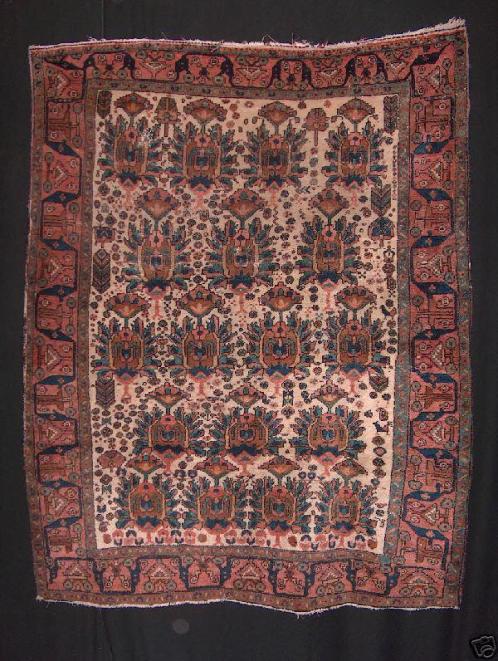
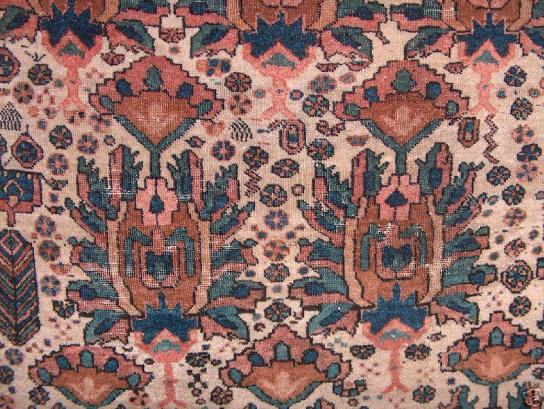
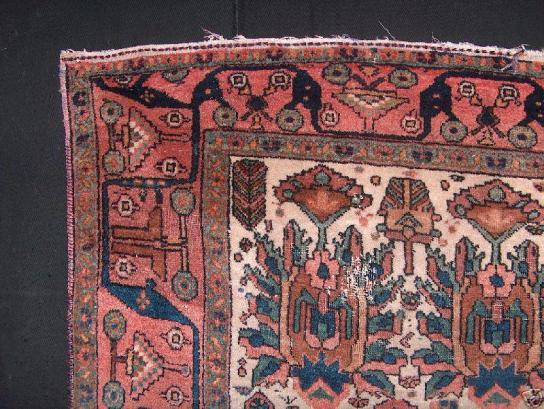
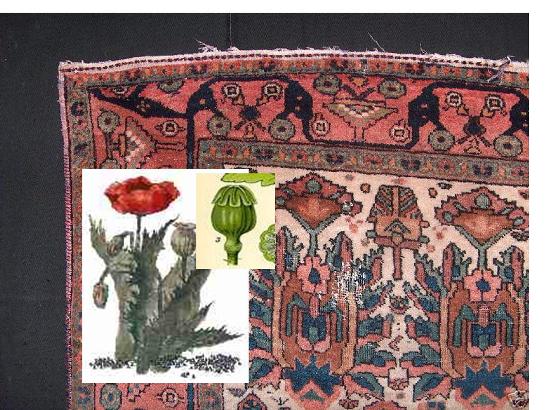
To maybe invoke some “Afshar”
discussion, I’ll post another “rustic,” unpolished, Afshar rug. This is possibly
between-the-wars in age (possibly earlier but I doubt it) and if a rug can be
called “entertaining,” this is one. The “field” of this rug is actually a
representation of a “field.” I superimposed a picture of an opium poppy ...
which I think definitively identifies the particular “crop” in the “field.”
I’ve noticed that some Afshar rugs have a certain style that uses an
“all-over” design. Various objects are used in the fields, including botehs,
vases, flowers, bushes, etc. Sometimes the design is compartmentalized, as in
the famous “tulip” Afshars. But it seems to me that all of these have an Afshar
signature look....as if the “all-over” pattern is not an “endless” one though it
completely fills the field.
Note: There is considerable uncertainty in
my estimates of dates of all of these Afshars. Cecil Edwards noted that the
Afshari were still using natural dyes at least into the 1950s. He allocated
considerable space for covering the Afsharis of S. Persia in his book and also
showed quite a few rugs, identifying them by sub group and/or village. No one
else that I’ve read has attempted to do this and I doubt that many people even
know what he meant by “Afshar-Kutlu” (for example). If anyone has some rules of
thumb for dating Afshar rugs, I would be most receptive
In any case, I
like the look that the Afsharis give to a carpet...kind of an enlightened Baluch
look.
Regards.Jack.
Ps: James, thanks for your contribution and
input. I see your point and the similarities in some of the design elements in
S. Persia. Eiland noted a similarity between some Lurs carpets and Afshars. But
I don’t see the cruciform featured in Quasquai, or Kamseh confederation rugs
like they often seem to be in Afshari rugs. I can only speculate… perhaps these
Turkmen peoples were not in close contact with the Armenians before being driven
south by the Mongols (?).
Posted by Gene Williams on 05-10-2007 10:44 PM:
History and the Afshars
Gentlemen,
Jack?s thesis as I understand it is :
(1) the
Afshars existed in three places:
--- the Caucasus,
--- NE Iran and
---in the area normally associated with their rugs, S-central
Iran.
(2) Afshar rugs can be found with asymmetric knots, especially in
NE Iran
(3) ergo, are there Afshars remnants left in the Caucasus and if
so do they weave with asymmetric knots?
First, I'll defer to you all on
the rug bits. But Jack's thesis is historically accurate as far as the Afshars
are concerned. You all know this of course but here is a synopsis:
1) who
are the Safavids:
--- a) the Safavids were a Sufi order located in the
Caucasus in the early 1400's. (the Sufi's are historically linked to
Neo-Platonic philosophy, as are the Shi'i and were profoundly influenced by
Christianity. The founder was a Sunni, Kurd or Turkoman named Shakh Safiyu'd Din
(I wonder if the name should have been Sufiuddin?). They were highly respected
by the Timurids and by the end of th 1400's had a huge number of adherents. The
peaceful Sufi sect, suddenly became aggressive and attacked the Georgians and
Armenians and took a swipe at Iran. The also drifted into the Shi'a orbit, and
became so extreme that their views were "ghulat" or non-Islam.
--- b)
One of Safiu'd's successors, his great-grandson organized the "Kizilbash" (red
heads), referring to a twelve point red hat they wore symbolizing the 12 Imams.
The came to believe their leader was the Mahdi and divine, the Imam on earth.
They united 7 Turkoman tribes (Afshars included) in the Caucasus and under one
of the great-great grandsons, Isma'il, took Shirvan, Baku, Ardebil and the whole
of Azerbaijan, from there all of Persia and a good bit of Iraq. (Late 1400's,
early 1500's)
PS: Here are the original 7 Turkoman tribes which made up
the Kizilbash: Ustajlu, Shamlu, Takalu, Baharlu, Zulkadar, Kajar and Afshar.
(the Baharlu per Edwards p.288 are listed as part of the Kamseh federation
now..and weave in both the Turkish and Persian knot.)
--- c) Isma'il was
so popular among the Ottoman Janizeries that Salim the Grim decided to massacre
all Shi'i in Anatolia to prevent any uprising. Ultimately Isma'il lost a battle
on the plain of Chaldarian and Salim took Tabriz though he withdrew shortly
afterwards. Had Isma'il won the battle, the whole area might now be Shi'a.
(1515?)
--- d) finally to forstall any follow-on risings, Isma'il
systematically elemented the various Sufi sects in Iran. To this day, Shi?a
Islam, which has a lot in common with the Sufis, has no real Sufi (Mystical)
components.
2) Shah Sevans: A century later, under Shah Abbas the old
order of the Qizilbash was deteriorating. Abbas had to rely on the 7 Turkoman
tribes for his army (I've a list of them somewhere but the Afshars are
definitely one of them), 60,000 calvary. They obeyed only their chiefs. This was
fickle and left him subject to blackmail. To counter this he formed a
professional army staffed mostly with Georgian, Armenian and Circassian
Christian slaves who converted to Shi'a Islam, imitating the Ottoman
Jannisaries. In addition, though, he created the Shah Savan tribe, a new tribe
in which he invited members of all tribes to enroll. They did by the thousands
and relieved Shah Abbas of reliance on the Kizilbash warlords. (early
1600's)
So, thus far the Afshars are Turk, originated in the Caucasus,
were part of the kizilbash, and were Shi'a.
In addition to this,
indisputeably by the late 1600's there was a large Afshar contingent living on
the NE Border of Iran. Nadir Shah, "the Great Afshar," was born in Khorrasan on
that border about 1680, was enslaved by an Uzbek raid from Khiva as a teenager,
escaped and founded his career by taking Mashhad and all of Khorrasan and
ultimately just about everything else including Bokhara, Samarkand, Merv,
Kandahar, Kabul, New Delhi, the Peacock Throne.... And he very definitely was an
Afshar. He was assassinated in Khorassan on the N. Border visiting kurds moved
to the area by Shah Abbas.
PS: Nadir Shah started out a Sunni; he
attempted to abolish Shi'ism. Towards the end of his life, though, he dreamed of
starting a new religion and had translations made of both the Jewish scriptures
and the New Testament...(I'm not saying the crosses so prominent in Afshar rugs
are related to this period...but its worth a look). he went down fighting
assassins from his own Afshar tribe. (1747)
So, Afshars were in the
Cacausas in 1500; They surely were in NE Iran as of 1700. There are NE Iranian
Afshar carpets which are single knotted... There is a traditiion linking them to
Armenia and Georgia and to the Shah Sevans....Historically, Jack?s hypothesis is
plausible.
So what did the Afshars weave, where and when? And are therer
Afshars still made in the Caucasus? I'll let you all decide
that.
Gene
Posted by Filiberto Boncompagni on 05-11-2007 06:45 AM:
Hi Gene,
Thanks for the history lesson, which demonstrates that if you
dig enough in history you’ll find why rug styles are so inter-mingled i.e.
because people were so often displaced and mixed with others.
But now I’m
at a loss with what is exactly Jack’s hypothesis… I’d be grateful if one
of you could condense it in few words.
Gene, you use again the expression
“single knotted”. Assuming that it doesn’t mean “single wefted” nor
“a-rug-with-a-single-knot”  I
guess it should be “symmetrically knotted”,
right?
I
guess it should be “symmetrically knotted”,
right?
Regards,
Filiberto
Posted by Gene Williams on 05-11-2007 10:50 AM:
asymetric
Hi Filiberto,
When I was first introduced to rugs 35 years ago, the
description/terms for carpet knots (not wefts) were "Persian" or "single" or
"Senneh" and "Turkish" or "double" or "Ghiordes." Since then I guess the
"single-double" term has fallen out of favor and the "assymetric-symetric" has
risen. When I say "single" knotted, I am of course referring to the Persian
knot. Sorry for the lack of clarity.
The summary of what I think Jack was
trying to say, is in the first paragraph of the above historical synopsis; i.e.
-- Afshar tribesmen are located in 3 different places;
-- They have been
known to weave Persian knot carpets;
-- Could it be that they make Persian
knotted carpets in the Caucasus still?
As I understand the response so
far; There are no/zippo Persian knotted carpets made in the Caucasus; There are
no Afshars located there. There are several really good scholars of Caucasian
carpets on this site, you among them (ok, I avoided the word "expert" but pls
accept "scholar"), so I'll let you all delve into the question
further.
Gene
PS. And by the way, the "Gendje" stripes in Jack's
Afshar set mentioned above, remind me rather of Steve's fantastic Baluch with
the stripes in the field which curved. See also plate 8 of David Black's "Rugs
of the Wandering Baluch." I wouldn't mind seeing that rug again. It must be from
khorrasan...maybe around Ferdows?...where Afshar (as well as Arab) influences
have been noted in Baluch carpets.
Posted by Marty Grove on 05-11-2007 10:59 AM:
Lotsa knots
G'day all,
Referring to Filberto's last post, single-knotted I have
read to indicate the separated ends of the assymetric knots, single meaning that
there is a 'wrap' on the warp between each woolen end of the knot;
double-knotted was read to mean 'together', two singles together, no 'wrap'
between them, ergo double, or symmetric.
This is what Gene was getting at
I think. Its a form of 'knot speak' usage.
Regards,
Marty.
Posted by Marty Grove on 05-11-2007 11:17 AM:
Apols
Sri Gene, your reply post to Filberto hadnt arrived when I read Filberto's
and it sparked my memory - somewhere read - and I replied ref the
knots.
Dash it - guzzumped 
Regards,
Marty.
Posted by Gene Williams on 05-11-2007 11:20 AM:
Afshar Kotlu
Hi all,
jack mentioned an "all over" cash-crop Afshar design and
mentioned an Afshar "Kotlu". Here is an Afshar Kotlu, allegedly taken from the
Khan of Kalat's palace in Baluchistan which I've shown before; might as well put
it here too:
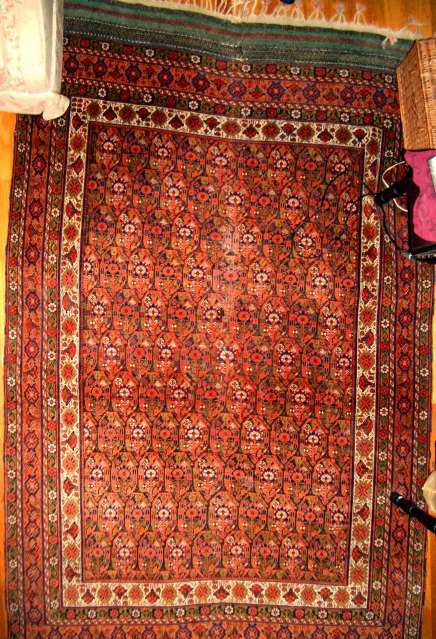
Kotlu seems to be a Turkish word. JBOC has a description (I
think he calls it Qotlu or some such) but this description doesn't match the
above, which was attributed personally by JA. Note the opium poppies in the
border. Note the furniture (make up table) which spouse refused to let me
move.
Gene
PS. Note the gradual fading which seems to take place
from upper to lower parts of the carpet.
Posted by Gene Williams on 05-11-2007 11:34 AM:
sub-groups
Hi Marty,
Thanks for the help. By the way I think the Gazzumpzais are
a sub-set of the Dashitis...in turn part of a Kurdish group who attached
themsleves to the Brahui around 1500. ('')
Gene
Posted by Marty Grove on 05-11-2007 11:36 AM:
Luverley
G'day all,
These nice pieces shown by Jack and Gene might be usurp't
by viewers with another 'motif' as indicator for 'happy' weavers - I remember
the ructions caused in an earlier display of speculation on the pages.
There is little doubt the
two Afshars shown are NICE! Didn't Thompson, or perhaps Bennett say that Afshars
are one of the last weaving groups to still produce good original designed
rugs?
Also, I find it terrific that the regular contributors here
generally seem to find some fabulous carpets to show, from a seemingly
bottomless trunk.
It sort of leaves one (moi') feeling a bit inadequate
in the rug species quality/interest realm
Wonderful.
Regards,
Marty.
Posted by Filiberto Boncompagni on 05-11-2007 11:52 AM:
Hi Gene and Marty,
Single-knotted used to mean Persian knot?
Thanks.
Scholarship apart, here’s why - in a very un-scholar way - I
don’t think that Jack’s rug could have been woven in the Caucasus:
Weavers of
that region, in spite (or perhaps because) of their multi-ethnicity managed to
blend several weaving traditions (of which the Persian was without any doubt a
very important one) in a common, unique style… Think about New Orleans’ music,
if you want an example in a different folk art…
A collateral result is that
it’s very difficult sorting out who wove what.
The Afshar rugs presented
by Jack, even if they have some common elements with Caucasians (Armenians etc.)
rugs are too easily distinguishable from the general Caucasian style. I mean:
that’s Caucasian influence gone East and mixed with other Persian styles.
Jack, I suggest a different and more difficult exercise: try sorting out
Afshars from other weavings of the Kerman province. Especially those flat-woven
items that perhaps are Afsahrs or maybe Baluch. 
In a different thread, of
course.
Un-scholarly,
Filiberto
Posted by Marty Grove on 05-11-2007 12:27 PM:
Mutts
G'day all,
As Im at work and awake, a spanner (in the works) just came
to me!
Some may remember, (Gene will for sure) I once displayed a curiously coloured
rug from Quchan/ Khorrasan with many dogs as the figures in the quadrants of a
turkman sort of gul in the field.
This rug, supposedly by Kurds pushed to
NE Iran by Shah Abbas, has assymetric knots, when Kurds supposedly knot Turkish.
Also this rug has been described by one more knowledgable than I, as NE Iranian
Afshar!
So possibly by Afshari Kurds, in a sort of turkman
design...
With all the transpositions of people from whence to where, I
feel it is more than likely a cross miscegenation of style, weave, pattern and
colour can occur pretty well anywhere in the weaving world.
To accurately
identify any rugs definite ORIGIN/weaving spot, that is the GPS spot on a map,
especially an old rug, is gonna be really werry hard by us today, (except in the
case of new rugs, perhaps by the dealers picker who found it outback, and maybe
not even by them, as it COULD have come from anywhere prior to being sold to the
picker, but unlikely).
In any case, I always enjoy these discussions
leading from provenance suppositions because we all learn, and remember, from
them. Something for everyone...
Luv Turkotek,
Marty.
Posted by Gene Williams on 05-11-2007 06:45 PM:
Dog pound
Marty,
I well remember the "Dog Pound Rug," which when soaked in a
particular fluid, and when placed in your doorway repels the roos. There's a
down side as I recall....some fading, right?
Gene
Posted by Jack Williams on 05-11-2007 09:29 PM:
Afshar is the word
Good Evening all
Filiberto, I haven’t been clear…I apologize. I wanted
to talk about Afshar rugs because I like them and not that much has been
published about either the rugs or the Afshar themselves.
To get the
conversation started, I introduced something I had noticed… design elements that
are common in Afshar carpets such as cruciforms and cruciform-like medallions.
The only other carpets I’ve seen that have a lot of cruciforms in them are
Armenian…and as the Afshar originated in Azerbaijan, historically at least, I
was looking for a connection as well as an Afshar conversation.
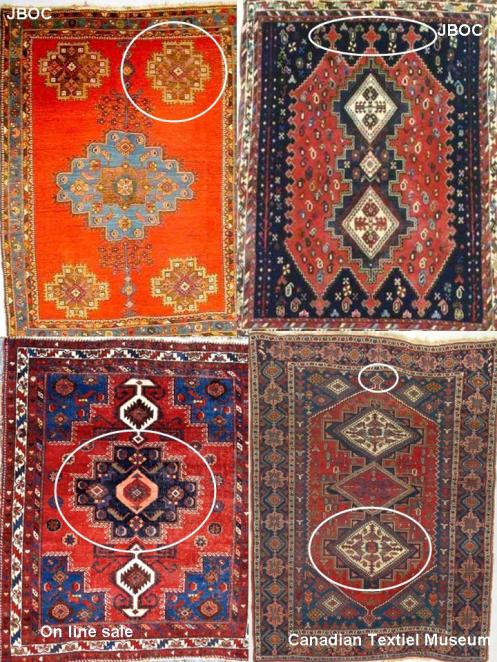
I initially thought
perhaps there was a way to distinguish between Azerbaijan Afshar, Kerman Afshar,
and Khorasan Afshar weavings…but I pretty much abandoned that idea for the time
being and said so. And I’ve never claimed that Afshar carpets are
“Caucasian.”
But…the Afshar are definitely still a part of the Azerbaijan
population, or at least they were at the end of the 19th C. Either:...
(1) The Afshar of Azerbaijan do not weave anymore, or ;(2)
They weave and their carpets are not thought of as “Caucasian”
even though they are physically woven in the Caucasus geographic area,
or;(3) They weave carpets that look/are traditionally
“Caucasian.” If they do this, I don't know how we would know it unless
they do something odd structurally. What knot they use and the whole
'Caucasian carpet knot thing just came up as incidental to the larger
Afshar design question.
There is a proper skepticism about “Caucasian
rugs” occasionally woven with the asymmetric knot, and perhaps rightfully
so. Perhaps “Caucasian rugs” are a design definition and have less to do
with the geographical region. If so, perhaps there are things woven in the
geographic Caucasus region that are not “Caucasian”...just as
there are Baluch, Aimaq, Kurd, Turkmen, Afshar in Khurason
I like
Caucasian rugs. But right now I am particularly interested in Afshar pile
carpets, and less interested in kilims, at least at this point.
I have
just finished reading a short, on-line description of life in Persia in the mid
1890s. It has a wealth of information that helps understanding the
still-feudal/tribal society of that time. Of special importance to this
discussion is the author’s association of the NW Persia-Azerbaijan
Afshars with the Shahsevends.
PERSIA REVISITED
(1895) By GENERAL SIR THOMAS EDWARD GORDON
http://books.reseau.org/fr/page.php?p=1&Submit=Envoi&id=13064
P.
30; “…A marked instance of this was shown in July, 1892, when Jehan Shah
Khan-Ilbegi was deprived of the chieftaincy of the Afshar section of the
powerful Shahsevend tribe, who range from Ardebil to Tehran. The famous
Nadir Shah was originally a simple trooper of this tribe, and belonged to the
colony of it which was planted at Deregez on the Turkoman border…”
The whole article is a good read. Also special is the discussion of
the “military tribes,” and the Bakhtiari army contingent that he associates with
Luris.
P. 35; “…On this occasion the smart appearance of the
Bakhtiari horse attracted particular attention. The Persian bystanders showed
their pride in these popular mounted mountaineers by the admiring exclamation,
'Here come the Bakhtiaris!' They were very noticeable by their white felt,
round, brimless hats, and the good line they preserved when passing. The
Bakhtiaris (Lurs) are the most numerous and powerful of all the military tribes,
and are noted for their superior martial qualities both as horse and foot. They
are of the most ancient Persian descent, and have held the hills and valleys of
Luristan from time immemorial; while all the other military tribes may be said
to be of much later date, and of foreign origin--Arab, Syrian, Turk, and
Tartar..."
The history of the Afshar tribe is pretty deep, the
Afshars being one of the seven great Azerbaijani Turkmen tribes (another being
the Qajar tribe who spawned the Qajar dynasty which lasted into the 20th C.)
Their Shia history and the history of the Qizilbash…the anti-shia pogroms in
Turkey and Afganistan are all interesting. And I like their
rugs.
Regards, Jack Williams
Posted by Filiberto Boncompagni on 05-12-2007 04:01 AM:
Hi Jack,
Now it’s more clear.
quote:
the Afshar section of the powerful Shahsevend tribe
Yes, the Afshars were part of the Shahsavan confederation. And
here comes the trouble… see Bertram Frauenknecht's Salon 96, The Confusion
about Shahsevan
Look especially at this thread:
http://www.turkotek.com/salon_00096/s96t2.htm
Where it is
said that:
"Many tribes from north-west Persian joined the Shahsavan, and
non-Muslims such as Georgians, Circassians and Armenians were also employed;
there was no cultural or tribal link at first, other than a common Turkic
language. Tadjic peasants were then taken on as soldiers to create a balance
between the Turkic and Farsi speakers."
So, the right answer should
be your above point #(3).
Hence, I would expect that Afshar weavings
in Caucasus/NW Persia were indistinguishable from weavings of other ethnic
groups (and don’t forget the Kurds among them) of the Shahsavan
confederacy.
Which, in turn, are very difficult to tell apart from Caucasian
weavings, like certain “sumak” saddle bags and mafrash…
Furthermore, if I
remember well what I read about Afshars, I got the impression that they tend to
blend very easily with other surrounding traditions. See again my reference to
weavings of Kerman Province.
Regards,
Filiberto
Posted by Gene Williams on 05-13-2007 12:15 AM:
A historical question
Filiberto,
There are several versions on the origin of the Shahsavan
but the most credible credit it to Shah Abbas in his attempt to break up the old
7 tribe Qizilbash warlords. in the early 1600's, .in other words it was an
artificial creation of a Shi'a Turk who was Shah of Iran. It also seems clear
that some particularly obstreperous (one thinks of twin brother) Afshar tribal
elements were removed by Shah Abbas from the Azerbaijan area to the area S of
Kerman..and other elements to the Turkoman-Afghan frontier in Khorrasan. I've
even found a good summary of this in Italian...
Now here's the question.
Some elements of the Afshar in Azerbaijan joined the new government sponsored
"confederation" of "Shahsavan" created by Shah Abbas...really an almost
mercenary martial undertaking it seems. But huge numbers of the Afshars and the
other original 7 turkoman Savavid tribes didn't buckle under. So in the
Azerbaijan area, what happened to the Afshar who didn't join the Shahsavan? Were
they annhilated?..moved to Kerman?...Are they still there?..Do they make
Shahsavan style carpets now rather than Afshar or are there still Afshar carpets
made in Azerbaijan?
As for the Persian-Turkish knot question...Edwards
maintains that the true Nomadic Afshar around Kerman..as of 1900-1948 wove in
the traditional Turkic knot...but they intermarried, their designs were copied
by setted Fars weavers and thus, a number of Persian knotted Afshar design
carpets could be found...and after the rise in the price of wool (he doesnt' say
when but assume this is WWI era), Afshars traded wool for settled area cotton
and used that in their Warps.
Then there remain the NE Iran - Khorassan
Afshars. I can understand how, by intermarriage and trading, Turkish knotting
tradition can turn into Persian knot...Just look at the Turkomans...the Timuris,
the Aymaqs... And I now start to have in inkling on Jerry Anderson's assertions
35 years ago on the interlationship in Khorrasan between Kurdish designs,
Turkoman, Afshar and Baluch...
So now the question I have..its more
historical and cultural than ruggie, is ... what happened to the NW
Iran-Azerbaijan-Caucasian Afshars, who refused to follow the new government
sponsored Shahsavans and remained true to their own Afshar tribal chiefs? Are
they still there in Azerbaijan-Turkey? What do they weave? In what knots and
designs?
Here's a photo essy on the Shahsavan by the way which show some
carpets in the makeing..as of the time of the overthrow of the Shah:
http://www.iranian.com/Travelers/2003/January/Migrate/1.html
Gene
PS.
I suppose you, as a European, could predict that the Brits are of course taking
credit for all of this. The Sherley Brothers arrived in Iran c1598 right after
Shah Abbas' victory over the Uzbeks ...among the members of his mission was a
cannon founder. The Shirleys assisted Allah Verdi Beg (Filiberto...I can't
resist singing somehow in connection with the second name..maybe "Nabucco"??) in
creating the first regiments of Abbas' regular army meant to supplant the 7
Tribe Qizalbash cavalry and most important the creation of an artillery corps.
"In the place of a feudal force of horsemen Persia soon possessed an army fit to
meet that of Turkey in the field.".... Sir Anthony Shirley wrote of his mission
to Persia via Russia at length...its worth taking a look at.
Posted by Filiberto Boncompagni on 05-13-2007 02:21 AM:
Hi Gene,
I don’t know the answers to your questions, but about the
knots matter I have the following opinion:
If intermarriage about different
tribes could have caused a change from the traditional Afshar symmetrical
knotting to the asymmetrical one, that couldn’t have happened in the
Transcaucasian area. Because all the weaving groups there (Azeri, Kurds,
Armenians and so on) are known for using the Turkish knot…
If there are
exceptions, as discussed before in this thread, I cannot explain them, unless
there is a (so far undiscovered) small ethnic group that used the Persian knot
in Transcaucasia and the Afshar “intermarried” with them. But I have HUGE
doubts.
By the way, all the examples of Persian-knotted Caucasian rugs
posted above from Kerimov’s book look like regular well-known Caucasian types
from Kazak, Karabagh and Kuba areas generally woven with Turkish
knots.
Regards,
Filiberto
Posted by James Blanchard on 05-13-2007 03:58 AM:
Just one more point, following Filiberto's observation about the few examples
of Caucasian design rugs with asymmetric knotting shown by Jack earlier in this
thread. It strikes me that these few examples are completely dissimilar to each
other in terms of design and putative weaving region. So if asymmetrically
knotted Caucasian rugs are due to remnants of Afshars then they are widely
dispersed into various weaving areas and have wholly adopted Caucasian designs
without any discernible introduction of non-Caucasian designs. If all of the
asymmetrically knotted Caucasian rugs had some design or regional commonality,
then perhaps the Afshar-Caucasian hypothesis would seem more plausible, at least
to me. But there doesn't seem to be any such consistency in these examples.
Applying "Occam's razor", my interpretation is that there is a more simple
explanation for the presence of these few stray Caucasian rugs with anomalous
structure:
1) The structural analysis or printing is incorrect.
2) For
some reason, there was a very small percentage of Caucasian weavers who
preferred to use the asymmetric knot.
James.
Posted by Filiberto Boncompagni on 05-13-2007 04:26 AM:
Hi James.
I agree, and your point # 2) For some reason, there was a
very small percentage of Caucasian weavers who preferred to use the asymmetric
knot could be explained with the existence of a few Persian weavers married
with local Caucasians but retaining their habitual asymmetrical knotting.
…
which could work well with
a percentage asymm. to symm. of 0.3% or less but NOT with a 5%, of course. For
this, we need your explanation # 1) too.
I have also to emphasize that
there’s absolutely no proof that Afshars in Transcaucasia wove with Persian
knots. On the contrary, they should have stick to their traditional symmetrical
knots, just like the other surrounding Caucasian groups
did.
Regards,
Filiberto
Posted by Sue Zimmerman on 05-13-2007 01:43 PM:
Listen, or don't, for a second aside.
Just as there are traceable formulas
used in rugs through their fibers, their fiber preparation, their spinning, and
other structural properties, there are traceable formulas used in rug design.
All of these formulas predate history just as the earliest historians
acknowledged they did. They are a legacy.
I don't know who this Occam is,
who's name crops up from time to time here, but if it's simplicity he aims for
he'd do better with a laser than a razor -- not as messy.
The answers are in
the math. All of them. The keys to the art in weavings are in the science of
weavings, according to me. Carry on now, however you choose. Sue
Posted by Steve Price on 05-13-2007 06:34 PM:
Hi Sue
William of Occam lived about 700 years ago, well before the
invention of the laser. A razor was pretty high tech for his day.
Since
none of us can read minds, would you be kind enough to explain the content of
your last post? For example,
1. What it is that can be answered from the
math, especially what the inputs and operations involved in the process
are.
2. Can you provide a few examples of the traceable formulas in fibers,
their preparation, spinning, other structural properties, and rug design?
In the absence of any of that, all your message says is that you
1.
think you know the answers to many, perhaps all, the questions raised in this
thread, and
2. if the rest of us were as smart as you, we'd know them to.
In the absence of evidence to the contrary, I think it's reasonable to
suspect that you're wrong on both counts.
Regards
Steve Price
Posted by James Blanchard on 05-13-2007 07:47 PM:
Hi Sue,
Occam's principle was that when assessing different theories,
the ones that lie nearer the truth rely on fewer assumptions. The razor was to
shave away the unecessary assumptions. Of course, the truth is not always
simple, but trying to prove something that is false usually takes a lot more
effort than explaining a truth.
I have an inkling that you are alluding
to some issues about rug lineage that extends well beyond the scope of this
particular discussion. I think it might interest me, but you would have to take
it a bit further.
James.
Posted by Richard Larkin on 05-13-2007 07:50 PM:
Filiberto,
For what it's worth, even 0.3% is high. That's three out of
a thousand. I doubt there are three out of ten thousand with asymmetrical
knotting.
__________________
Rich
Larkin
Posted by Jack Williams on 05-14-2007 12:58 AM:
general rant
Ladies and Gentlemen,
Confusion reigns...I have never said Afshar
wove those Caucasian rugs with an asymmetric knot. The whole issue of
Caucasian rugs with asymmetric knots just appeared out ot thin air. As
interesting as it may be I don't have a theory about that and I think it would
make a marvelous salon. My thesis is that Afshar in Azerbaijan wove
identifiably Afshari rugs, if they wove rugs...not Caucasian rugs.
I just cannot prove it right now..but my confidence in phylogenisis is
strong.
First, I wonder what knot the Afshar used orignally? I re-read T.
Coles article, "Outback Afshars (http://www.tcoletribalrugs.com/article2.html ). It seems
possible that the oldest Afshars, 18th-early 19th C., used asymmetric open right
knots. I think it interesting to contemplate what knots were used in the older
Turkmen rugs in Central Asia, Salor for example?
Second point,
Azerbaijan doesn't start or stop at the Russia-Iran border. Greater Azerbaijan
extends well below Tabriz and includes the Hamadan area...yet no one would call
a nice Heriz rug a "Caucasian" rug. Why would we think that suddenly a
political border laid down mid 18th C. causes an absolute change in carpet
styles, producing "Caucasian" rugs on one side.?
In the article I
posted, Gen. Gordon's "Persia Revisited," he tells a 1895 story of an Afshar
Chieftan from NE Persia with 3,000 men armed with Martini rifles. Assuming his
account is accurate, this implies a supporting Afshar population of at least
15-20,000 Afsharis in NE Persia-Azerbaijan. And..he notes they range from Tehren
to Ardebil in the Caucasus...i.e. on the Russia-Persia border.
My
point... people who apparently identified themselves as Afshar lived in NE
Persia-Azerbaijan in 1895..we know this...and we know about the earlier
settlement of Afshars in formerly Kurdish lands following the revolt of the
Kurds.
We can find similarities in weaving designs and styles between
Kerman-Afshar rugs and Meshed/Afganistan-Afshar rugs despite the people being
separated by 500 miles, 400 years, and a very dry desert. Would it surprise
anyone if the reminent Afshar in NE Persia/Azerbaijan wove in an identifably
Afshar manner with identifably Afshar designs? I think that is somthing Tom Cole
was touching on in his article.
It seems to me that "Caucasian" is
a design concept. It is not hard to imagine conventional wisdom saying that
Caucasian rugs with an asymmetric knot are suspect. In that case, the end
result is self-fulfilling... no one publishes Caucasian rugs with
asymmetric knots and it would be easy to believe there are no
such.
Likewise, to me it doesn't seem hard to picture Afshar-like rugs
woven in Azerbaijan, ether side of the border...yet when they were recognized
they're attributed to S. Persia, at least in the West. I just don't have a way
to prove it at this point. This is a varient of the Phylogensis vs Ethnogensis
argument.
I'll post Edward's comments about the Afshar tomorrow and the
rugs he attributed to sub-groups.
Regards, Jack Williams
Posted by James Blanchard on 05-14-2007 01:30 AM:
Hi Jack,
Thanks for clarifying your point. I think that some of this
line of debate was related to your previous statement (especially point #3):
"But…the Afshar are definitely still a part of the Azerbaijan
population, or at least they were at the end of the 19th C. Either:... (1) The
Afshar of Azerbaijan do not weave anymore, or ;(2) They weave and their carpets
are not thought of as “Caucasian” even though they are physically woven in the
Caucasus geographic area, or;(3) They weave carpets that look/are traditionally
“Caucasian.” If they do this, I don't know how we would know it unless they do
something odd structurally."
My current understanding of your thesis is
that there might be remnants of Afshars in the Caucasian region, but they would
not weave typical Caucasian rugs. Instead, they would weave Afshar rugs with
designs that are influenced by Caucasian/Armenian designs.
I suppose that
could be true, but I still think your rug that you presented as an example has
strong S. Persian design elements.
Cheers,
James.
Posted by Richard Larkin on 05-14-2007 08:43 AM:
Hi Jack,
You said:
"We can find similarities in weaving designs
and styles between Kerman-Afshar rugs and Meshed/Afganistan-Afshar rugs despite
the people being separated by 500 miles, 200 years, and a very dry
desert."
Did you establish a known type of Afshar production from the
Meshed/Afghanistan region? Maybe I missed something. You posted that one piece
on the map, but I thought you were speculating about the place of
origin.
It seems that just the ethnic composition of the Afshar is a very
complicated and multi-faceted matter, nevermind their weavings. This no doubt
accounts in part for the rather varied character of the weavings we can
attribute to them with some confidence. My own view of those has been that they
have come chiefly from the greater Kerman area, and that they reflected strongly
either the persianate style of that city or the tribal character of the
neighboring South Persian tribes, notably, Khamseh (e. g., the Danny Mehra
example), along with certain recognizable "Afshar" designs that seem to be
original. I'm not aware of other documented sources of Afshar weaving, although,
like you, I have often wondered what if anything those Afsharis to the North in
Iran were doing.
Not the least fascinating aspect of the "Outback
Afshar" collection in Tom Cole's article is how much they do look
Afshari, offbeat as they seem to be. If they represent the work of remote
Afshari weavers from down towards Baluchistan (Cole is cautious on attribution),
it says something about the persistence of tradition among weaving groups.
Perhaps it gives some hope for identifying Afshar production from the Azerbaijan
area.
__________________
Rich
Larkin
Posted by Sue Zimmerman on 05-14-2007 11:29 AM:
Thanks, James, I get Occam's idea now and will try again with that in mind
because stuff like knot choices in rug weaving are usually rather incidental in
the grand scheme of things. Not that such things can't have value, they very
much do, but that their value has no real context without understanding the
system first.
The underlying and overarching system which coordinates the
subordinant formulas in the system, is, I think, essentially a practical
planispheric application of spherical geometry. In rugs the most prevailent
reliance on the system can be measured as being based on the square root of two
and the square root of three. It doesn't end there but I'm going to
now.
Anyway, the best designed rugs whether "tribal, "village", or "court"
conform to variations of uses of the system and because it is mathatical it can
be proved by measuring the phi, (not to be confused with pi), relationships of
any rug's proportions. One way you can start doing this is to plot out any rug's
design with graph paper over a copy of it's picture using a compass and straight
edge. (There are other ways, too.)
When you do this, first off, you will be
able to see that motifs "grow" from the center outward in golden mean
proportions in rugs where the system was fully understood by it's designer.
Where the system was understood it was used to it's capacity on every measurable
aspect of a rug. You will understand exactly, and without any doubts, why this
is so very soon into this method of exploration. I hope this is clear because I
think it's a very important system to understandand shouldn't be neglected.
Sue
Posted by Jack Williams on 05-14-2007 11:26 PM:
Afshars in the literature
Gene, this is a rug that was in David Black’s Atlas... in the “Meshed”
section. It was called a “Doruksh” carpet.
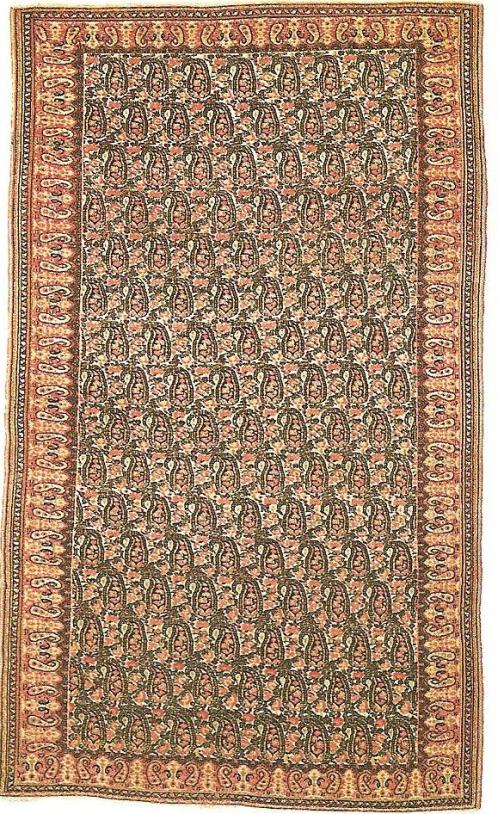
“This Doruksh
carpet has an elaborat design of botehs…which are used in the border and field.
Meshed, late ninetheenth century,…7’2” x 4’2”.
Dorukhsh is a
village in the Quainat way south of Meshed…and a Dorukhsh carpet is a “jufti
knotted Quainat carpet woven in a village floral style.” Edwards has the
following to say, p. 170: “The Dorukhsh area is situated in the hills about
45 miles NE of Birjand … Old Dorukhsh carpets are recognizable by their close
weave and their large bold medallions, usually on plain fields – either
cochineal red or cream. ..Another favorite design of old Dorukhsh was the large
pine boteh pattern."
But, your rug doesn’t look at all like the
Dorukhsh picture shown in Edwards, nor does the rug pictured in Black. I'm
certain JA was right on and your rug is classic Afshar...and I think the rug
from Black et. al. is too.
RE: Cecil Edwards… I thought I would share a
summary of Cecil Edward’s notes about the Afshari, and the pictures he included
in his monumental work. The pictures are in black and white But these are the
only Afshar carpets I’ve seen with a sub attribution attached to them.
Unfortunately, Edwards did not define these sub categories, though he obviously
knew what they were. I hope these terms have not been lost completely and
someone here can define them.
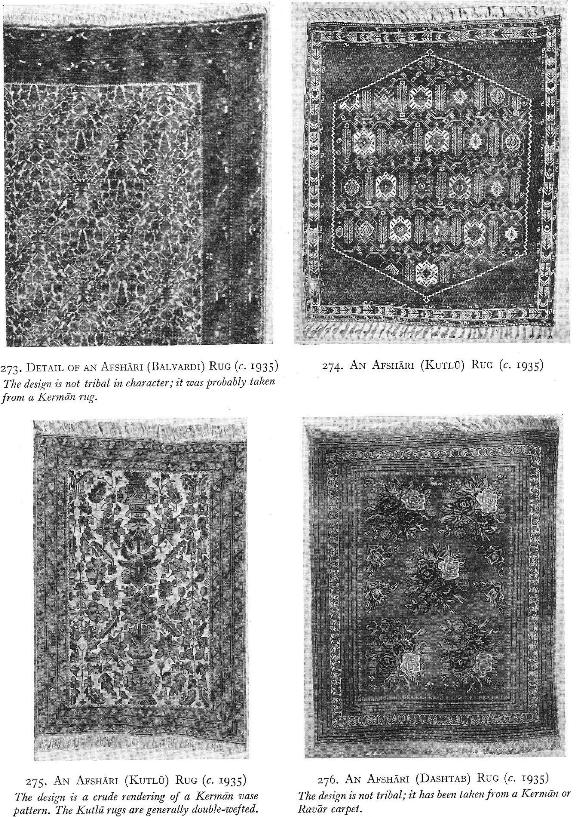
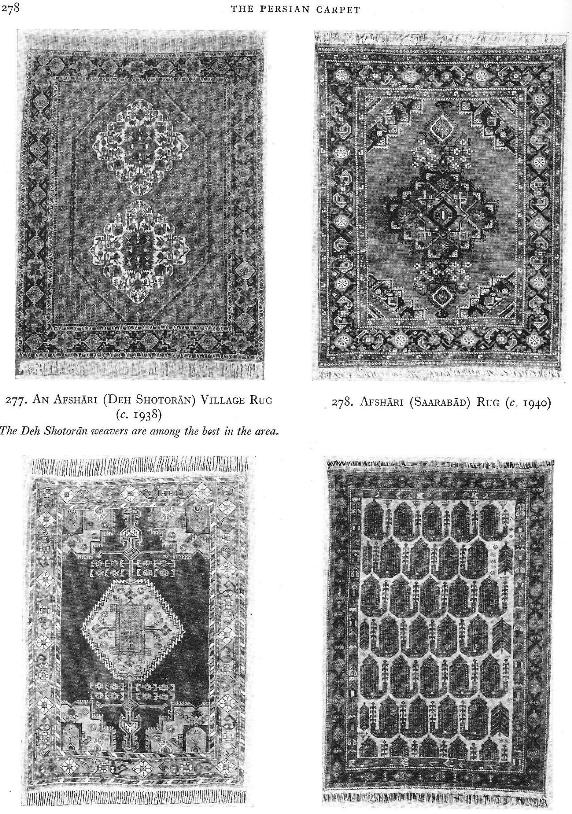
279. Afshari
(Al-Saadi) Rug (c. 1940). 280. Afshari (Parizi) Rug (c.
1945).
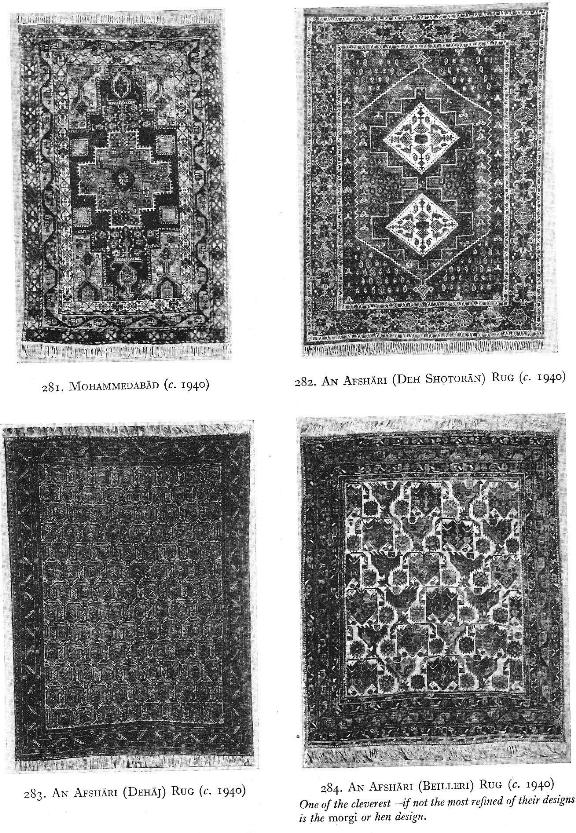
Edwards notes the ascension of Ismail in Azerbaijan and became Shah with
the help of the 7 Azerbaijan Turkmen tribes, of whom the Afshar were one. He
then notes the exile of the Afshar to the Kerman area by Shah Tahmasp in the
early-mid 16th C. He does not mention the transfer of Afshari to Khurrisan by
Shah Abbas.
According to Edwards, the Afsharis of Kerman have two main
divisions, the Afsharis and Buchakchis. Also, another Turkman tribe, the Shuli,
are in the province. He notes the migration patterns of the 40,000 Afsharis and
the presence of Persian villagers far outnumbering the Turkmen. When he wrote
his piece he said the Afshari were rapidly losing their sense of tribe, most
were bi-lingual. He noted that design overlap between village and nomad had
occurred to the point that the two were virtually indistinguishable.
He
did claim the Afshar, “being good Turkmen,” used symmetric knots and the village
weavings used asymmetric knots But he also noted that “by and large, the
Afshari rug (like most of the tribal weaves of Persia) is a single-wefted
fabric…” In these structural comments, knots and wefts, he is mistaken, as
he was about the Baluch rugs. Why he got these particular specifics wrong when
he obviously was so familiar with the general topic is not explainable.
He notes the many of the Afshar designs are original and striking, and
when his book was written, he says “…thus the dyes in the Afshari rugs are
excellent. The plague of aniline or synthetic dyes has not yet penetrated the
area [about 1950].”
When he wrote, he notes that as in Baluch rugs,
the design of an Afshari is no longer a sure indication as to the tribe or
village which produced it. Yet he felt comfortable adding the sub-categories to
the illustrations.
Regards, Jack Williams
Sue, I think i
understand. I might try graphing a couple of rugs.
Posted by Filiberto Boncompagni on 05-15-2007 02:36 AM:
quote:
Sue, I think i understand. I might try graphing a couple of rugs.
Hi Jack,
Lucky you. Do you understand also wherever Sue’s
geometrical analysis has anything to do to do with sorting Afshars from other
weaving groups? I don’t.
Regards,
Filiberto
Posted by James Blanchard on 05-15-2007 02:48 AM:
Hi Sue,
To pursue your ideas further, it would be really helpful if
you could illustrate these matthematical concepts with some rugs that have been
analyzed.
At least it would be helpful for
me.
Cheers,
James.
Posted by Filiberto Boncompagni on 05-15-2007 05:06 AM:
Hi Jack,
All right, I apologize for being so late on it, but I was
distracted by the knots matter and I had a look at Peter F. Stone’s “Tribal
& Village Rugs –The Definitive Guide etc.” ONLY NOW.
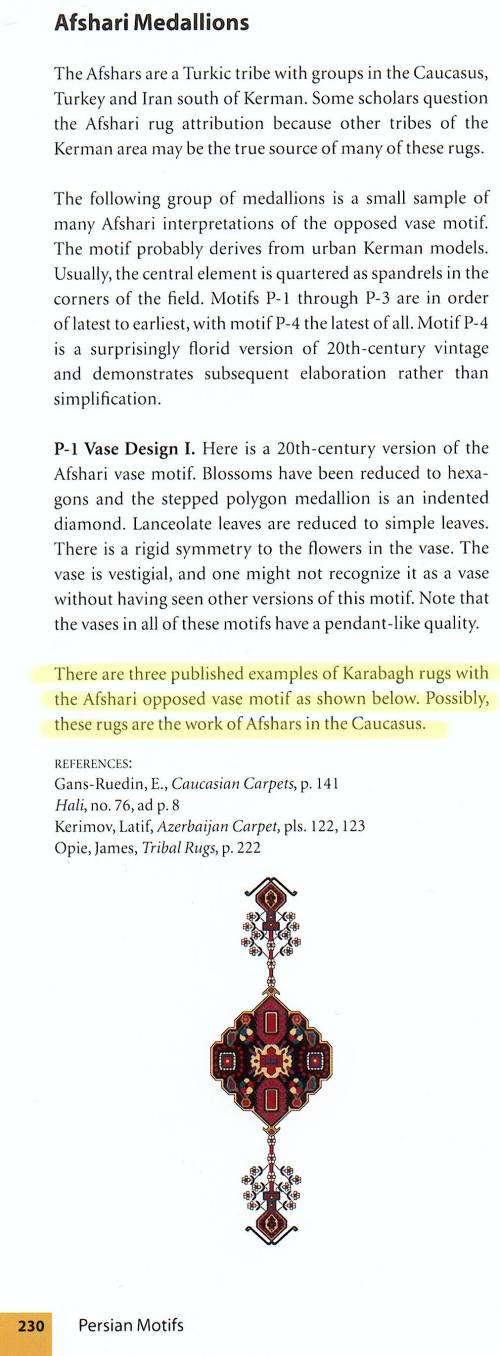
Scan from Gans-Ruedin (sorry,
I don’t have the other two other “Karabagh” sources mentioned by Stone: Hali
no.76 and Kerimov’s book):
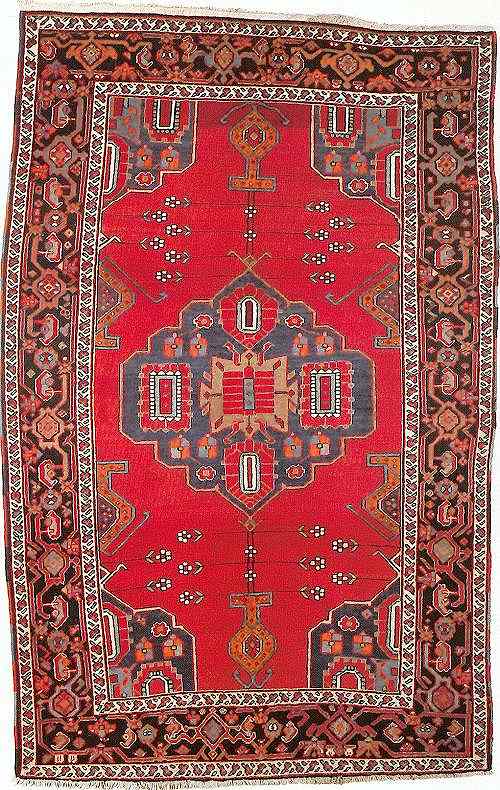
But I have Opie’s
“Tribal rugs” and this is the scan of page 222 mentioned by Stone. A truly
Afshar rug, probably quoted for comparison:
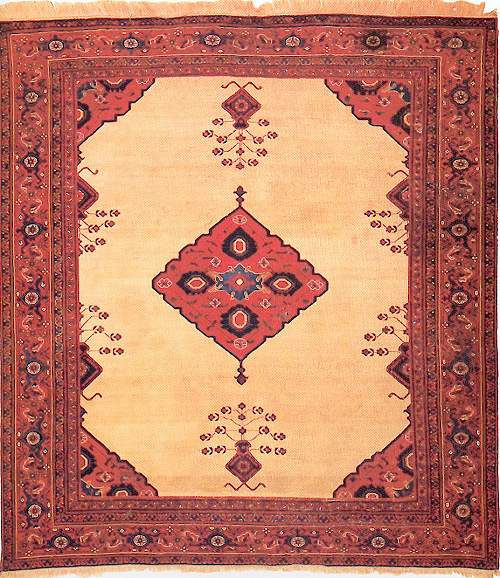
So, eventually we have here one
Karabagh rug that could have been woven by Afshars. (B.t.w., book says
it’s around 1930, Turkis knots.)
Comparing Gans-Ruedin’s with Opie’s, I
officially have to admit that the possibility exists…
Reluctantly,
Filiberto
Posted by Filiberto Boncompagni on 05-15-2007 05:26 AM:
BUT...
If this motif derives from urban Kerman models, how we explain
its presence in Karabagh? Wasn’t the Afshar migration from Caucasus to East?
Unless:
- Somebody (which could or could not be of Afshar
origin) in Karabagh simply copied an Afshar rug
OR
- The motif
doesn’t derive from Kerman models.
Posted by Richard Larkin on 05-15-2007 11:16 AM:
Jack,
I think those sub-entries in Edwards for the Afshari refer to
villages. I'm familiar with Dashtab, Bilvardi, Deh Shotoran. I remember seeing a
few newish rugs in Iran in the '60's that were of very excellent quality that
the dealer described, with a large smile, as "Bilvardeh," pronouncing it as
though it were French, with the acute accent on the "e" at the end.
__________________
Rich
Larkin
Posted by Steve Price on 05-15-2007 04:40 PM:
quote:
Originally posted by James Blanchard
Hi Sue,
To pursue
your ideas further, it would be really helpful if you could illustrate these
matthematical concepts with some rugs that have been analyzed.
At least
it would be helpful for me.
Cheers,
James.
Hi James
One of the options in the "View" menu in
Adobe Photoshop is to show a grid superimposed over any image you choose. Maybe
other image editing software packages have this function as well. Using it with
the image of a rug allows you to put a virtual piece of transparent graph paper
over it.
I tried it with several rug images, and saw nothing remarkable.
Perhaps Sue can select a few rugs on which she's used her method, tell us what
she finds and what it signifies. If so, it would be easy to extend the
observations using Photoshop and to try to confirm and/or refine her
observations.
Regards
Steve Price
Posted by Horst Nitz on 05-15-2007 05:34 PM:
Hi all
"... or the motif doesn’t derive from Kerman
models..."
This, Filiberto, is the perspective I would take. Design ideas
in the last image rug are a few hundred years old and were probably taken down
to Kerman by Afshars on their enforced migration.
Their original
homelands in Azerbaidjan were not far from the Karabagh; in the middle-ages and
after both were part of the same geo-political and cultural
region.
Horst
Posted by Gene Williams on 05-15-2007 09:20 PM:
Golden Mean
Hi all,
Sue commented below:
"When you do this, first off, you
will be able to see that motifs "grow" from the center outward in golden mean
proportions in rugs where the system was fully understood by it's designer.
Where the system was understood it was used to it's capacity on every measurable
aspect of a rug."
I won't go into the mathmatics of Sue's comment...but
would like to touch on the possible relevance of philosophy embedded in the
comment. Shi'a Islam (and the Sufi's) were profoundly influenced by Greek
Philosophy. There was a feeling that God's essence could be determined by pure
rational analysis...going back to Plato's construction resulting in his concept
of "the unmoving mover." (The Sunni's were too...until the reaction about the
10th century which ended the "golden age" of Islamic scientific thought). The
"Golden Mean" probably didn't mean much to an itinerate and illiterate tribal
weaver. But Plato, Pathagoras, Archimedes, and the other great Greek
philosophers were not only translated into Arabic, Aramic, and Persian but had
to be read by any Shi'a Ayatollah who could possibly call himself educated. and
maybe there is something in design porportions which just sort of fits the human
eye?...and I'm not going to delve into that metaphysical area..Sufi's I can
handle...new age???...that's another matter.
A salon on the influence of
differences in carpet design growing out of Shi'a and Sunni interpretations of
Islam..(and the role of philosophy in these differences) might be interesting. I
notice that this was regularly commented on by British historians in the 19th
century (among others see "A History of Persia" by Sir Percy Sykes, McMillian
and Co. 1915, v.II, p. 203.)
Gene
Posted by Jack Williams on 05-15-2007 09:46 PM:
ahh...progress
Filiberto,
My thanks for the enlightening quote from Stone. He.
Tanavoli, Opie and Eiland are pretty much the people who have done what research
has been published on the Afshar..and Tom Cole of course. But I do not have
their reference books.
If you get a chance, I would enjoy seeing a scan
of the "P1 to P4" medallions, oldest-youngest, he mentioned.
Reference
the "Persian vase design," I agree with Horst, that ornamental device is so
deeply Afshar that it could well have been a tribal totem of sorts internalized
long before the diasporas from Azerbaijan. It appears in rugs that are presumed
from Khurasan (I have one more "Khurrason-Afshar" rug that I hope is at least
semi-definintive) and from Kerman.
This continuity in design is pure
phylogenesis covering a population split several hundred years ago. And thanks
to Filiberto, we have possible indication of the same type of design existing in
vestigial form in Azerbaijan. It also appears in those Armenian carpets I
previously posted...which is a connection I quite want to be able to make...to
explain the cruciforms.
Richard...I suspect you are right. Edwards made
a point to note that designs were no longer identifiable to localities or sub
groups when he wrote his book, and he picked mostly newish, 5-10 year old
carpets to illustrate the Afshar gendre. However, he took the time to
sub-attribute them in the pictures...I guess to illustrate where things USED to
be attributed and to cover the range of designs.
Something Steve posted
early sticks in my mind. Steve noted seeing Afshar-looking rugs attributed to
Kurdish weavers, or included in Kurdish collections. The term "Afshar-Kurd" was
used. There is a Azerbaijan Kurd-Afshar historical connection. I'll post it
later...but it was not particularly friendly at the time. But…”Afshar-Kurd”
weavings appearing on the market today in some form? Could this be evidence of
NW Persia-Anatolia Afshars, never mind the Kurd?
Regards, Jack
Williams
re: Sues theory...I haven't bothered to do the math yet. But,
here is what Edwards, speaking about medallion rugs, says about proportions, p.
41:
"...There are no prescribed proportions for the usual
type...Nevertheless, the Persians possess certain rules for it [medallion rugs]
which they like to apply whenever possible; because they know that these
prescriptions, if followed, will produce a well proportioned carpet...There are
three rules, viz.:
(1) The length of the torunj or oval part of
the medallion (i.e. minus its two heads and necks) should equal one-third of the
length of the whole carpet.
(2) The width of the border should
equal one-sixth of the width of the carpet.
(3) The sum of the
widths of the guards (i.e. small borders) should equal the width of the middle
or large border.
Posted by Richard Larkin on 05-15-2007 10:13 PM:
Hey Jack,
I've googled some of those terms Edwards applied to Afshari
rugs, and I'm not so confident they refer to villages. There is a Dashtab, but
it may not be very close to the Kerman area, perhaps farther North. There is a
Bilvardi to the West of Heriz, quite a distance from the Kerman area. The term
"Kutlu" seems to be a Turkish surname.
I doubt the rugs I referred to as
having seen in Iran, called "Bilvardeh" by the dealers, were Heriz area rugs. I
remember them as having been consistent with very good Afshars. Very strong
color, densely woven, refined weave with fully depressed warps. They were
robust, not delicate in character, somewhat reminiscent of a fine Bidjar. But I
can't say where they came from.
The obvious possibility as regards the
Edwards labels, if not villages, would seem to be sub-tribes or extended
families. I note that Edwards speaks of both nomadic and village production
among the Afshars, and that there was increasing blurring of the distinction by
the middle of the 20th century.
__________________
Rich
Larkin
Posted by Gene Williams on 05-15-2007 10:14 PM:
Add the Baktiaris to the Stew of Khorrasan
Hi all,
Oh, I forgot...since the Baktiari are mentioned by Jack
above... Among the groups transported to Khorassan (to fight the Turkoman and
Uzbeks) ...which famously include Kurds and Afshars transported by Shah Abbas in
the late 1500's, early 1600's. are a large number of Baktiaris transported by
the "Afshar" Nadir Shah in the 1730's (who also tranported Baluch into the
area).
Sykes, in "History of Persia", v.II, P. 257, "Conquests of Nadir
Shah," refering to Nadir's first expedition against the Baktiaris:
"On
that occasion (ghw comment: Nadir Shah's first punitive expedition against the
Baktiaris), the savage Bakhtiaris, unable to resist the overwhelming forces
employed had submitted, and by way of punishment three thousand families had
been transported to Khorasan. ..."
Gene
Posted by Filiberto Boncompagni on 05-16-2007 03:00 AM:
Hi Jack,
There you go: Stone’s other medallions.
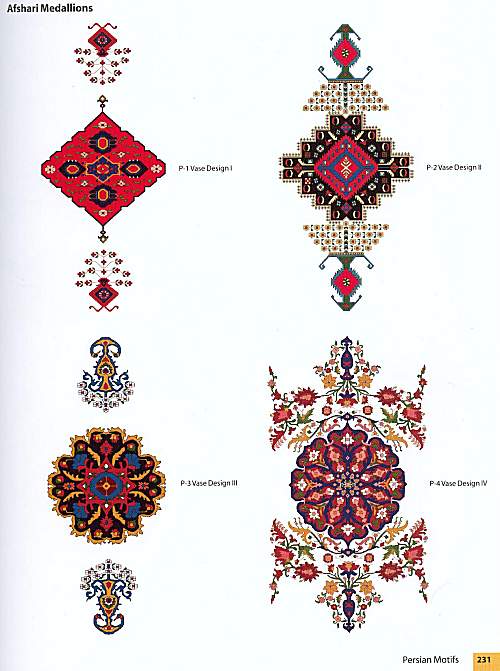
But, again, Stone's conclusion
is contradictory. If this design was learnt by Afshars after they were moved to
Kerman, the presence of the motif in Caucasus could only have happened
afterwards and there is nothing indicating that the Caucasian versions were made
by surviving “Caucasian Afshars”.
Opie’s comment on the matter, including
the scan from his book:
The pieces shown below and on the right (not
scanned, sorry) represent an important category of Afshar weavings: those
that copy urban patterns, particularly from nearby city of Kerman. It is
apparent that Kerman vase designs took hold in the Afshar district and
gradually became tribalized. The piece shown below is so urban in
appearance that the name "Afshar" can be applied only with qualifications.
It was probably made in a workshop.
Opie seems pretty much
convinced of the urban origin of this motif and, I understand , he’s not the
only one… So, we are back to square one unless we can demonstrate that the
current wisdom is wrong, this design is part of the Afshar’s tradition and it
was imported by them in Kerman, NOT learnt there.
About
proportions… Opie writes, on page 215 of “Tribal Rugs”: Another helpful
identifying feature relates to size. Formats of approximately 4 by 5 feet were
used so frequently that one can correctly guess “Afshar” simply by seeing these
familiar proportions.
Now, 5 : 4 = 1.25 – while the Golden
mean is approximately 1.6180339887.
So much for the Geometrical
Theory…
BTW, unless Sue can demonstrate that there is a typical Afshar’s
geometrical layout (apart the very simple 5:4), don’t bother with
it.
Perpetually skeptical,
Filiberto
Posted by Richard Larkin on 05-16-2007 08:26 AM:
Folks:
Opie's example looks like a very Afshari version of the vase
and flowers incorporated in an urban-workshop style carpet.
__________________
Rich
Larkin
Posted by Unregistered on 05-16-2007 12:57 PM:
Hi all
"The piece shown below is so urban in appearance that the name
"Afshar" can be applied only with qualifications. It was probably made in a
workshop."
I would subscribe to the first half-sentence of this statement
without hesitation, Filiberto, also to the workshop origin of the
rug.
But "Opie seems pretty much convinced of the urban origin of this m
o t i f ..." is proposing something quite different, i.e. that the motiv is an
artistic invention and not embedded in history and folk-art, which I think is
unreasonable.
Gene, what you were saying a few days ago I find very
interesting:
... "Shi'a Islam (and the Sufi's) were profoundly influenced
by Greek Philosophy. There was a feeling that God's essence could be determined
by pure rational analysis...going back to Plato's construction resulting in his
concept of "the unmoving mover." (The Sunni's were too...until the reaction
about the 10th century which ended the "golden age" of Islamic scientific
thought). The "Golden Mean" probably didn't mean much to an itinerate and
illiterate tribal weaver. But Plato, Pathagoras, Archimedes, and the other great
Greek philosophers were not only translated into Arabic, Aramic, and Persian but
had to be read by any Shi'a Ayatollah who could possibly call himself educated
...."
In which context would this transfer of knowledge have taken place,
who did the translations, do your sources say anything about it?
Regards,
Horst
Posted by Sue Zimmerman on 05-16-2007 01:30 PM:
Hi Filiberto,
Ancient geometry can be learned visually in a hands on
way. That is the only reason I get it. I cannot translate it into modern math
procedures because I don't get modern math.
I think you are misunderstanding
me in the same way my modern math oriented brother did when he told me, via a
phone call, that anything I wanted to know in regards to this avenue of my
pursuit required nothing more than a calculator. That this is not the case has
to do, probably in part, with it being a differently based more visually
oriented system, and also points to what Gene brings up. I would like to address
Gene's points once I, if I, figure out how to.
Please don't throw out the
system just because I can't figure out how to convey it in words. I did not make
it up I just use it. I would like other's to be able to, too, but it will
probably have to be conveyed by someone other than me for that to happen.
In
regard to the Afshar rugs in this thread, (and those linked), this old geometry
system conforms with and confirms Opie's assessment of urban origin. The
geometry concurs with many other factors about these rugs which, when added up,
point to the Afshar having been reduced to weaving employees for at least as far
back as any of these rugs were woven. Actually, though, the geometry alone is
pretty reliable and provides a good shortcut. It's worth learning the old way,
which is actually fun and interesting. The modern math way, using a calculator,
would be a labyrinthine logistical nightmare. Sue
Posted by Gene Williams on 05-16-2007 05:26 PM:
Books recommendation
Horst,
There are hundreds of books on Islamic thought. I'll recommend
three which touch on the subject of Greek philosophical influences on
Islam:
"An Introduction to Shi'i Islam, the History and Doctrines of
Twelver Islam" by Moojan Momen, Yale University Press, 1985. This is quite
simply the best overall exposition of Shi'i Islam and its off shoots that I've
ever found, presented in a very rational and understandable way. No religious
evangilism...just straight forward analysis...Twelver mainstream, "Ghulat" sects
some of whom bordered on Zoroastrian, Ismaili-Assassin, Druze, Alawite,
Bahai...
"A Short Introduction to Islamic Philosophy, Theology and
Mysticism," by Majid Fakhrky, Oneworld Publications, Oxford, 1997. The book goes
quite deeply into philosophy and theology. It assumes in some case that you
already know Platonic and Pythagorean concepts. But its worth the trouble.
"The Mystics of Islam, by Reynold A. Nicholson, Penguin Books...first
published in 1914. This small volume deals mostly with Sufis...including their
connection to Christianity and Greek philosophy. If you go to Pakistan, India or
Afghanistan, you're quite likely to run across Sufis...the most important
influence on Islam in South Asia. Its a pretty easy read and well worthwhile...
It discusses Christian Monastic influence on the Sufis...Influence of Greek
philosophy, Gnostics, etc.
Here is a short passage from the introduction
of "Islamic philosophy" above.
"It was at Alexandria however..that Greek
philosophy was to undergo its most radical transformation. From a purely
indigenous product of the Greek genius, it now became thoroughly cosmopolitan,
with profound religious and mystical leanings almost unknown to the classical
Greeks. Thus, the names we associate with Alexandrian or Hellenistic philosophy
are those of Plotinus (d. 270), Porphyry of Tyre (d. 303) and Jamblichus (d.
330), who formulated a new brand of philosophy desgnated as Neoplatonism, in
which all the major currents of classical Greek philosophy, Platonism,
Aristotelianism, Pythagoreanism and Stoicism were brought together in an
imposing synthesis.
"When Egypt was conquered by the Arabs in 641,
Alexandria was still flourishing as a centre of Greek philosophy, medicine and
science, as well as a Hellenized form of Christian theology which had a decisive
impact on Muslim philosophy and theology..."
Gene
PS. By the way I
mentioned the influence of Greek philosophy on Shi'a and Sufi. It also
profoundly influence the Sunnis...check out the Qadarites...run it on the
web..and the furious anti-phylosophy counter movement which destroyed it and a
great deal of scientific inquiry in the Sunni world.
And a short passage
from "the Mystics of Islam":
"...the conquest of Persia, Syria and
Egypt..brought the Moslems into contact with ideas which profoundly modified
their oiutlook on life and religion. European readers of the Koran cannot fail
to be struck by its author's vacillation and inconsistency in dealing with the
greatest problems. He himself was not aware of these contradictions, nor were
they a stumbling block to his devout followers, whose simple faith accepted the
Koran as the Word of God. But the rift was there, and soon produced far-reaching
results.
"Hence arose the Mujarites, who set faith above works and
emphasised the divine love and goodness; the Qadirites who affirmed, and the
Jabarites who denied, that men are responsible for their actions; the
Mu'tazilites who built a theology on the basis of reason, rejecting the
qualities of Allah as incompatibile with His unity, and predestinarianism as
contrary to His justice; and finally the Ash'arites, the scholastic theologians
of Islam, who formulated the rigid metaphysical and doctrinal system that
underlies the creed of Orthodox Muslims at the present time. All these
speculations, influenced as gthey were by Greek theology and philosophy, reacted
powerfully upon Sufism....'
Posted by Filiberto Boncompagni on 05-17-2007 01:35 AM:
Gene, Horst:
Great! And what all of this has to do with Afshar
rugs?
Sue:
Your “theories” once again are inexplicable and
incommunicable. I still remember your “bagfaces are obviously calendars” one,
and how you disappeared for several weeks when pressed for an explanation.
Ladies and Gentlemen:
When you find some real facts, like, say, an
Afshar rug pre-dating the Kerman move, whistle to me.
Filiberto
Posted by Horst Nitz on 05-17-2007 03:49 AM:
Hi Gene,
some lazy consumer has posted a rather cheeky comment. He
expects us to present our knowledge to him like waiters in a restaurant would
lay out his meal for him; and he wants it announced by whistling. Sounds pretty
low  .
.
Thanks for
those elements to the big puzzle, perhaps stepping stones. Yes, Alexandria seems
to be one of the places where the music played a long time ago. I imagine, if
someone would want to embark on identifying Afshar rugs predating the Kerman
move, he might as well start there - but it could be a long journey.
I
won't have internet access for the next couple of days.
Best
wishes,
Horst
Posted by Filiberto Boncompagni on 05-17-2007 04:29 AM:
Hi Horst,
Customers of restaurants are the ones that might whistle to
the waiters, not the other way around, so what I wrote before meant that I was
putting myself in a waiter position, respectfully waiting for your orders.
I won’t go to Alexandria in search of Afshar rugs, though... I suspect
that your tip will not be that good.
Perhaps I’m going to re-read some Stoic texts: one needs a lot
of stoicism with this kind of underpaid job.
Filiberto
Posted by Horst Nitz on 05-17-2007 06:42 AM:
Filiberto,
I am working on it and may be able to let you know before
you have gone deaf and I can't whistle anymore - hopefully.
Bye for
now,
Horst
Posted by Gene Williams on 05-17-2007 09:05 AM:
Whistliing
Hi Filiberto,
Can one whistle with tongue in cheek?
Anyway,
per above the Afshars are Turkish origin, Shi'a and originally from the
Azerbaijan area. They were originally one of the 7 Kizilbash tribes which put
the Safavids in power in Persia about 1500. The Safavids were originally were a
Sufi sect as were all the Kizilbash, though they rapidly morphed into twelver
Shi'a once in power.
So the question arose, How did being Sufi effect
their rug designs..if at all? Might crosses in the rugs somehow be related to
this?
Gene
Posted by James Blanchard on 05-17-2007 09:43 AM:
warp X weft
Hi Gene,
Gantzhorn has published a book with a wonderful collection of
colour plates of carpets and rugs from hither and yon. It was originally called
the "Christian Oriental Carpet", though I think later editions are called simply
"The Oriental Carpet". In any case, his thesis is that Christian Armenians have
influenced carpet design across most weaving groups, and this influence can be
seen in the ubiquity of "cross" designs. It is not only Afshars. If you look at
his examples, there are a number from South Persian groups (other than Afshar),
and it would seem that no group was more prolific at weaving "cross" designs
into rugs than the Turkmen tribes. So I am not sure how much one can infer from
observing "cross" designs in Afshar rugs, since there is not much specificity in
that.
James.
Posted by Filiberto Boncompagni on 05-17-2007 10:27 AM:
Hi Gene,
Can one whistle with tongue in cheek? One needs a
whistle for that.
What is worrying me is that we are at page 5 of this
thread.
As I see that you, Jack and Horst are willing to write more, may I
suggest opening separate threads? One could be “influence of philosophy on
tribal weavings”. 
Perhaps I’ll open one on the “Urban origin of the central
medallion motif”. Mmmh! Why not? 
Regards,
Filiberto
Posted by Gene Williams on 05-17-2007 12:11 PM:
Afshar design and diaspora
Hi Filiberto,
Some of the questions Jack raised in my mind at least
are still outstanding. i.e.
-- Are there Afshar tribesmen still living in
Western Anatolia, Azerbaijan area who still weave carpets who are not part of
the Shahsavan confederacy?
-- If so do they weave a distinctive design?
--
If so does this design conform with our idea of Afshars from S.Iran or is it
different?
-- i.e do Azerbaijan area Afshars now weave "Shahsavans" or some
other identified weaving from that area or is it possible that Azerbaijan area
Afshars still exist and still weave "traditional" Afshar carpets which are
systematically identified as S.Persian Afshars?
I have two Afshars
attributed by JA years ago...both of which I believe are S. Persian. Yet, I
remain interested in the above questions for reasons of history and ethnograpy
in addition to design and weave type. Having spent time in Khorrasan and
intending to go back there, I'm also interested in the possibly separate
question of Afshars in N.Khorrasan area and what they weave. I still think
Turkotek can help on this topic..it hasn't been exhausted yet. If there is a
page limit, though, perhaps we could open Volume II? ''
Gene
Posted by Steve Price on 05-17-2007 12:59 PM:
Hi Gene
I don't think Filiberto was suggesting a length limit on
threads. Very long threads often get that way by taking off in a number of
directions (as this one has done). The problem this causes is that it makes it
difficult to follow the many lines that coexist within such threads, a problem
that is alleviated by creating separate threads for the major topics that arose,
and moving individual posts into the threads for which they are most
appropriate.
The subjects you raise are interesting and
relevant.
Regards
Steve Price
Posted by Jack Williams on 05-17-2007 01:32 PM:
Summary to follow
Steve;
It looks like we are not making any further progress in
defining Afshar carpets, or identifying the region of provenence,
either Azerbaijan, Kerman, or Khurrasan.
But some very interesting lines
of inquiry have been developed, and some good facts about diverse but related
subjects have been posted. Some of the best is the history of the Shia
Quizilbash and related confederations...knotting in the Caucasus, even the
definition and history of the "golden mean".
I have a good summary
I'm preparing, ala how a Salon would be done. Perhaps this could have been a
salon with some more careful thought and organization. I'll post the summary
this weekend when I have a chance to concentrate. Thanks to all...
Jack
Williams
Posted by Steve Price on 05-17-2007 01:51 PM:
Hi Jack
I agree with all of that. A summary would be very useful, and
after you post it, I'll close the thread and, after a week or so, archive it.
Thanks
Steve Price
Posted by Richard Larkin on 05-17-2007 03:33 PM:
Hey folks,
I agree too. The questions distilled by Gene are very
interesting and they, as well as some others, beg for some answers. A few of
them I have asked myself for years, such as did the Afshars from Azerbaijan have
a discernible and distinctive line of woven goods. I didn't think this lengthy
thread advanced our knowledge very much, however. I agree with Filiberto that a
few more facts would help a lot. It got wild there at the end. I don't doubt
that it is possible to attack the study of rugs through the Alexandrian
philosophers, but the method has its limits.
"Afshar rugs" in my
experience always seemed to fall into three principal categories as recognized
in the marketplace: cousins to South Persian tribal rugs, especially Khamseh
types, like the Danny Mehra piece; village or workshop products reflecting
crudely the urban Kerman production; and some types apparently unique to the
Afshari. They made up a broad rubric. In light of this view of the matter, the
Tom Cole article on "outback Afshars" was especially fascinating. The Azerbaijan
angle looked like a wild card situation. I had little cognizance of the
Khorrassan area Afshars.
It would be very interesting to see how much we
can explicate these questions with hard information. Certainly, there are enough
vaguely tribal rugs generally attributed to "Northwest Persia" from which it
might be possible to assign something to the Afshars up there.
BTW, Jack,
I think your brother, Gene's rug looks very Afshari, but not that Dorokhsh
example next to it.
__________________
Rich
Larkin
Posted by Gene Williams on 05-17-2007 06:24 PM:
Philosophy, religion and rugs
Hi Steve,
I agree we can wander off into metaphysical speculation on
rugs and the origin of Design. Jerry did sometimes...its an almost irrestible
temptation to see symbolism in such art....tribal totems...sun
emblems...zoroastrian motifs...name it.
But sometimes its still important
to try to put the rug you're interested in into context. As examples,
--
can you understand dates on rugs in Persian speaking areas without understanding
the 5000 year history of the Persian solar calendar? And can you understand the
importance of that calendar without researching history beyond rug
literature?
-- another example: why the horns on the top of mosque domes
in Baluch carpets? Jerry said it was zoroastrian symbolism. Any truth to this?
Well, there sure were horns on mosques in the Pathan and Baluch areas. Here's a
quote from "The Wild Tribes of the Afghan Frontier," by T.L. Pennell published
about 1905 and rebulished by ABI Prints, New Delhi in 1998: p. 168 chapter
called "Alam Gul's choice": "The mosque was a little building on the hillside.
It was built of stone cementd together with mud, and in the centre was a little
niche towards the setting sun, where the Mullah, with his face towards Mewcca,
led the congregation in their prayers. There was a wooden verrndah, the corners
of which were ornamented with the horns of the markhor, or mountain
goat...."
Anyway, I don't want to engage in futile speculation on rug
motifs...but, still external influences on rug weavers are something to ponder
for the curioius and it was rugs which got me so interested in the history and
tribal structure of the area 37 years ago; questions like....
-- whether
Baluch were transported to N. Khorrasan by Nadir Shah c1730 and interacted with
Kurds and Turkomen..and if so did they learn weaving from them or did it modify
what they were making,
-- whether Saryk guls were coopted by Tekke,
--
whether the Aymaq wove Turkish knot originally and if so how did they come to
speak Farsi/Dari in the present day and weave in the Persian knot?,...
--
whether Zoroastrian symbolism survived in Baluch carpets..
-- whether or not
the Afshar were subsumed into the Shahsavan in Azerbaijan, did they weave
carpets before portions of the tribe were moved to Kerman area by Shah Abbas,
and did the N.Khorrasan group of Afshars from which Nadir Shah came also
weave?etc....
These are not cheeseless tunnels.. empty lines of
questioning for the interested imho.
Gene
Posted by Steve Price on 05-17-2007 08:04 PM:
Hi Gene
I didn't intend to suggest that the lines of inquiry were
pointless, simply noted that the more directions a thread takes simultaneously,
the more difficult it is to follow any of them. For that reason, I suggested
splitting some of the topics into separate threads. Closing a thread after a
summary (which Jack said he'd write, with no prompting from me) seems
reasonable, since summaries look like closing statements to me.
Am I
missing something here? It's not unusual for this to
happen.
Regards
Steve Price
Posted by Filiberto Boncompagni on 05-18-2007 03:27 AM:
Hi Gene,
quote:
Some of the questions Jack raised in my mind at least are still outstanding.
i.e.
-- Are there Afshar tribesmen still living in Western Anatolia,
Azerbaijan area who still weave carpets who are not part of the Shahsavan
confederacy?
-- If so do they weave a distinctive design?
-- If so does
this design conform with our idea of Afshars from S.Iran or is it different?
-- i.e do Azerbaijan area Afshars now weave "Shahsavans" or some other
identified weaving from that area or is it possible that Azerbaijan area
Afshars still exist and still weave "traditional" Afshar carpets which are
systematically identified as S.Persian Afshars?
I’m deeply embarrassed… Parviz Tanavoli published on HALI two
articles on the Afshars.
Now I remembered that I have the part 2, “Tribal
Weavings from Kerman”, HALI June 1991 #57 (“Afshar Part 1: A Tribal History” was
published on HALI 37 but I don’t have it)
The second paragraph of the article
says: “Four centuries of enforced dislocation have had a great impact on
Afshar dialects, traditions and weavings. In some regions, no trace of their
tribal characteristics remains. Even in Azerbaijan, their original homeland,
the few Afshar who have not migrated have been absorbed into the population of
local towns and villages and lost their Afshar identity.
Tanavoli
adds later, about the Afshars of Kerman: Their weavings, unlike those
from other areas have retained their identity although many other rugs from this
region have been erroneously attributed to the tribe..
Hope this
could answer in part to your questions.
Sorry for being late AGAIN, but
better late than never…
Filiberto
Posted by Richard Larkin on 05-18-2007 09:22 AM:
Filiberto,
Good one there. I'll have to dig out that Hali. As you said
so aptly, we need facts.
__________________
Rich
Larkin
Posted by Gene Williams on 05-18-2007 09:23 PM:
An expert research job
Filiberto,
Walking delicately around the word "expert," I must say
your academic research into the NW Persian Afshar question has been expert and
very quick. Thanks. Now for 2nd source confirmation..possibly from outside the
rug world?..on the intergration of Azerbaijan Afshars into other elements.
This integration/sublimation/subsumation/assimilation of ethnic groups
into their surroundings has happened so many times (especially in America) in
the past that its hardly surprising but still its nice to get some real solid
commentary on the subject of Afshars (especially because I own a couple, I guess
- capitalism at its essence I suppose). Thanks.
Gene
PS. Its
interesting to note that one of the other 7 original Kizilbash tribes the
Baharlu is now a minor part of the Khamseh Confederacy, separate from the
Afshars and like the modern Afshars apparently now weaves both Persian and
Turkish knotted carpets. (the Baharlu per Edwards p.288 are listed as part of
the Kamseh federation now..and weave in both the Turkish and Persian knot.)
Posted by Jack Williams on 05-18-2007 11:38 PM:
Afshar phylogenesis
Gentlemen (and Ladies):
About Tanalvi's statement:
(1) The
Afshar are not the only Turkmen group to lose their tribal identity. For
example, Eiland has stated he has been unable to find anyone anywhere who
claimed to be Ersari...yet Ersari carpets are/were still being woven and that
cultural identifyer (rugs) has outlived individual identification with a
specific tribe.
Many other tribes of Turkmen have fractured, heck, half
the orginal 24 (or 23?) tribes of the Oguz have disappeared and are
unidentified. But the residual cultural outlyers, especially for Turkmen, seem
to have tended to last because of the strength of cultural phylogenesis among
that group.
(2) There are a great many references in the rug world to
Afshar design and weaving elements in Khorrison and some pretty strong
researchers have alluded to that possibility. If the Afshar all left Khorrison
in 1796 (as has been proposed), then their design "memory" seems to have
lasted.
Because of this, it seems to me that for Tanavoli to say that
"the Afshar culturally were assimilated and disappeared except in S. Persia"
could be wrong in Khorrison-Afganistan. Likewise, there are also quite a few
references to seeming residual Afshar elements in NW Iran, Azerbaijan. One such
example associates those elements with some Bijar carpets (for
example).
(3) There are some carpets out there that are actually labled
"Afshar Caucasian." I'll post one in my summary.
For now, to my mind it
may be counterproductive to continue to piecemeal comments in this long line
without some additional hard facts. I'll summarize tomorrow. Thereafter, I might
start trying to gather all the available data so the next round will have
stronger base. It is nice to see good stuff beginning to flow, thank you
Filiberto, Gene and others.
It is remarkable how little has been written
about either the Afshar themselves or their carpets.
Regards, Jack
Posted by Filiberto Boncompagni on 05-19-2007 04:38 AM:
Gene,
quote:
Walking delicately around the word "expert," I must say your academic research
into the NW Persian Afshar question has been expert and very quick.
Thank you, but to quote and scan a couple of books doesn’t require
any expertise, only the right books and a scanner.
Nevertheless, it’s an
useful exercise: that’s the utility of a website like ours, in spite of
the different opinion of some people…
Regards,
Filiberto
Posted by Richard Larkin on 05-19-2007 09:53 AM:
Hey Jack,
You said:
"(2) There are a great many references in
the rug world to Afshar design and weaving elements in Khorrison and some pretty
strong researchers have alluded to that possibility."
I wasn't aware of
the fact. Could you mention one or two of these references in your summary?
Thanks.
__________________
Rich
Larkin
Posted by Sue Zimmerman on 05-19-2007 12:02 PM:
I don't see anything of "tribal" origin in Afshar rugs. All I see is various
translations, at the very least twice removed, from "urban" commercial rug
designs. The experimental structural aspects are shots at cost cutting. If a
"tribe" is found who originally used such unlikely structures it may be the
Afshar "tribe" but I think hell will freeze over before that happens. Sue
Posted by Unregistered on 05-19-2007 01:52 PM:
Hi Sue:
Are you referring to weaving structures or design
structures?
Posted by Steve Price on 05-19-2007 02:36 PM:
Hi
Kindly overwrite the word "unregistered" in the user name field in
future posts. We don't permit anonymous or pseudonymous
posting.
Thanks.
Steve Price
Posted by Kirsten Karrock on 05-19-2007 02:51 PM:
Hello.
When i bought my first Afshars (i only have three) i was
looking for something interesting to lay it on the floor.
After getting
more input about Turk-rugs i was looking forward to buy a Afshar with
woll-warps, a "good" one.
So i looked at my three pieces. The first is a
Shar-Babak with blue cotton-wefts and cotton warps from about 1920. Very soft
shiny wool, i belive also good colors.
The second one is with
vase-pattern, a very solid cotton foundation.
The last one is with a
white turkish-pattern border, blue field and red medallium, i think from about
1920, too. Well, so i looked at the warps and wondered: one plie cotton, one
plie wool. Whats that? Can you explain it to me or is this
normal?
Regards,
Kirsten
Posted by Richard Larkin on 05-19-2007 05:38 PM:
Hi Steve,
Sorry, that was me asking Sue about the structure. I was
using my sweetie's computer.
__________________
Rich
Larkin
Posted by Jack Williams on 05-19-2007 11:11 PM:
The Cotton is high and your mama's good lookin'
Richard and Kirsten:
Trying to address your posts in the summary
lengthened it. So I’ll first post this and then the summary.
Kirsten, your question about cotton and wool warps in Afshar rugs
can probably be addressed by reading Tom Cole's article, "Outback
Afshars", see - http://www.tcoletribalrugs.com/article2.html
Obviously,
a great many Afshars are wool on wool on wool in construction. But, here is a
partial quote from Tom’s writing:
“…Commenting on the structure of the
few 18th and early 19th century Afshar weavings he has examined, Parviz Tanavoli
comments that they are "...closer in structure to Azerbaijani weaving than that
of typical Afshar work. They usually have cotton or mixed cotton and wool
foundations, are rather coarsely woven, with uneven backs and slightly exposed
wefts…".
I begin to understand...in summary, the idea being that
possibly the earliest Afshars had some Azerbaijani, and some archaic Turkmen,
characteristics, such as cotton in warps and As2/4 knots. Later, especially in
Kerman, most were all wool on wool. laater, especially immediately post WWII,
cotton was again introduced due to the high price of wool.
Richard, here are a number of references that discuss the Afshar
influence, and or presence in Khorisan.
I. From T. Cole, “Outback
Afshars,” see - http://www.tcoletribalrugs.com/article2.html
.....A.
[my note: This first paragraph actually concerns Azerbaijan, not
Khorrisan].“…Eiland illustrates a bagface of uncertain provenance with this
border on a white ground (Pacific Collections, pl.205), suggesting that it
may come from the western Caucasus or eastern Anatolia. He also shows a
bagface (pl.66) "probably from the Karadagh region", with a similar primary
border and a Turkic medallion. The latter is unattributed, but suggests to me
the possibility of Afshar work from northwest Persia, a tribal weaving made
by descendants of the Qizilbash Turkmen…”
.....B.“…It is
possible that this rug represents the convergence in design of a south
Persian Afshar group with Baluch tribes of Baluchistan (or the Kerman
region, where they were a significant minority until the mid-18th century). The
Jebel Barez 'Afshar' flatweaves of Kerman and those of the Baluch tribes of
adjacent Baluchistan and Sistan share many aesthetic and technical
features…”
.....C.“…Another of the rugs illustrated here
(Figure 4) shows a rendition of primary elements that calls to mind so-called
'Baluch' rugs from Khorasan, a not unexpected confluence of design given the
proximity of tribes of the Chahar Aimaq Confederation and other 'Baluch' groups
to scattered Afshar and Qizilbash groups in northwest Afghanistan and
Khorasan…”
II. From Tom Cole's interview with Jerry Anderson
in Hali, see: http://www.tcoletribalrugs.com/article10JA.html
....."HALI:
Who are the Bahluli?
....."JA: The Bahluli have an
interesting history. They are descended from the Afsar, not Afshar as we
mistakenly refer to them. Around the 11th to 12th century, the Afsar and the
Arsari (Ersari) split and the Afsar came into Afghanistan. Soon after, the bulk
of the Afsar moved into the Kerman region of Iran. One group, the Istajlu,
remained in Afghanistan, and it is from them that the Bahluli are descended.
They are part of the Baluch confederation and adherents to Sistani culture. They
always weave using the symmetric knot. They are the ones who weave the true,
small burial rugs, called kaffani. These are more elongated than the average
prayer rug, and usually not as wide, with opposing niches that resemble those on
prayer rugs."
III. From Wegner, “Pile Rugs of the Baluch
and their Neighbors,” see - http://www.tcoletribalrugs.com/article9baluch.html
.....A. Rug Example No. 1
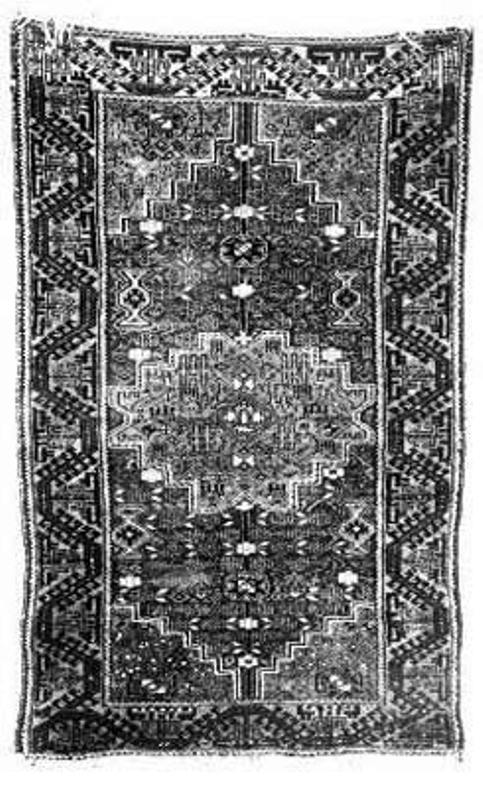
.....“Fig. 2. Fath'ollahi Baluch,
Sistan, with Afshar medallion, c. 1890
[note from Tom Cole: "Probably not
from Seistan, but rather a group of weavers located in Khorassan. The rug is
probably woven with an asymmetric knot, open right, suggesting a Turkic ethnic
origin for the weavers, possibly related ethnically to the Afshars of Kerman
accounting for the use of such a central medallion. -
TC]
.....B.“…The Bah'luri also are one of the main foreign
family units among the Baluch. They are to be found in northeast and east
Khorassan, between Tayabad and Gha'in, as well as in Afghanistan. They were
still camel-raising nomads around 1950. According to their tradition they are
originally west Iranian Turks. Thet were resettled to Khorassan by Shah Abbas
(1587-1628) because they were notorious trouble-makers [my note: this is
exactly the story of the Afshar diaspora to Kurrasan, and the Bah'lui apparently
weave using the symetric and asymmetric open right knot...see interview with
Jerry Anderson quoted above]…”[/i]
.....C.“…We see very
crude Afshar designs in the central field and even more so in the borders.
These pile rugs must, however, not be confused with other carpets that also
have a distinct Afshar influence, that were without doubt made by Baluch in
Sistan, about 500 kilometers from Ferdows. In contrast to Arab products,
these Sistan Baluch rugs have central fields rich with small, carefully designed
motifs and a stepped and/or incised central medallion, similar to those on
runners made by southeast Iranian Afshar (Fig. 2.)…”
IV. Comments
and rug example No. 2 - http://www.jozan.net/e-gallery/412.asp
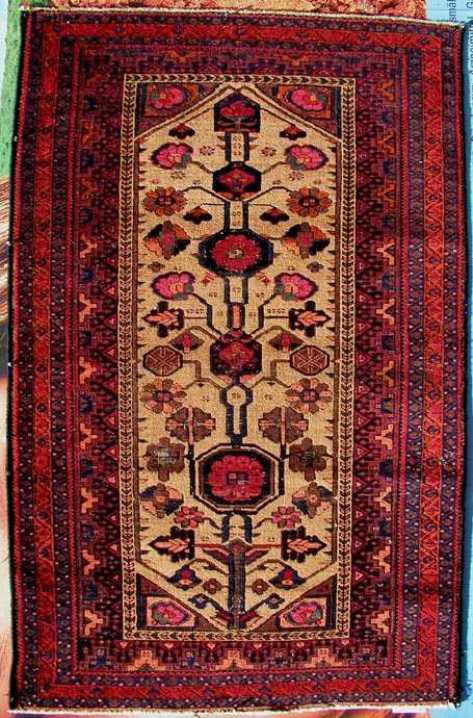
.....“…Comments: Popular thought
has the Afshar tribe vacating Khorassan after the blinding and subsequent murder
of Nadir Shah's nephew, the governor of Khorassan Shah Rokh, around 1790. A
number of weavings, executed in the Khorassan ('Belouch') style containing
characteristics of the Qainate Arabs and the Timuris of Khaf suggest that this
exodus was not total. This particular rug is an example of the vestigial remains
of Khorassan Afshar clans…”
V. Comments and rug example No. 3,
Tom Cole, Afshar-Baluch, http://www.persiancarpetguide.com/sw-asia/Rugs/Baluch/Bal941.htm
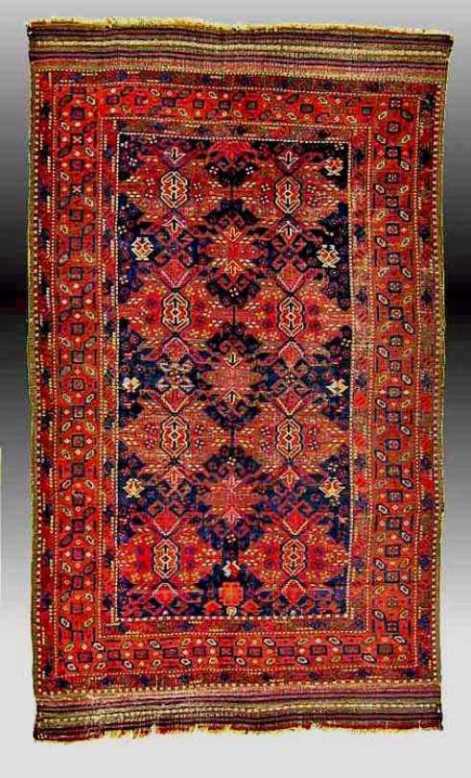
.....“…with a
field design that is often associated with Afshar groups, the open right
structure is not unexpected. Some have speculated that there are Afshar groups
living in Khorassan, weaving in the Baluch style. This may be just such an
example.”
VI. Comments and rug example No. 4, Tom Cole,
Afshar-Baluch http://www.persiancarpetguide.com/sw-asia/Rugs/Baluch/Bal932.htm
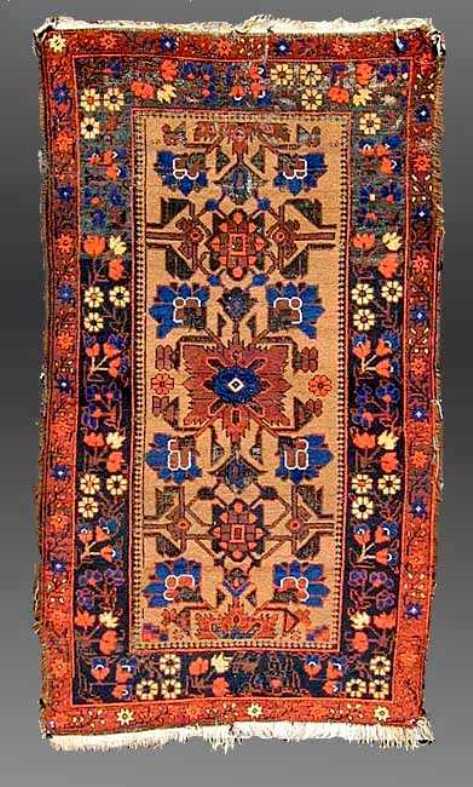
AB4
.....“…An extremely unusual composition with element
from different weaving groups harmoniously incorporated into this Baluch group
rug from Khorassan province of NE Persia. The field pattern is closely related
to Afshar element (see the article, Outback Afshars…”
VII. Rug
example No. 5, Hazara gallery, "Afshar-Baluch" rug, see: http://www.hazaragallery.com/HTMLFolders/NEP.htm
Inthe literature, there are
more comments and examples including some from Eiland, Edwards, etc.
Regards,
Jack
Posted by Jack Williams on 05-19-2007 11:25 PM:
Summary,
I always start with a picture when little of substance is
included(?)
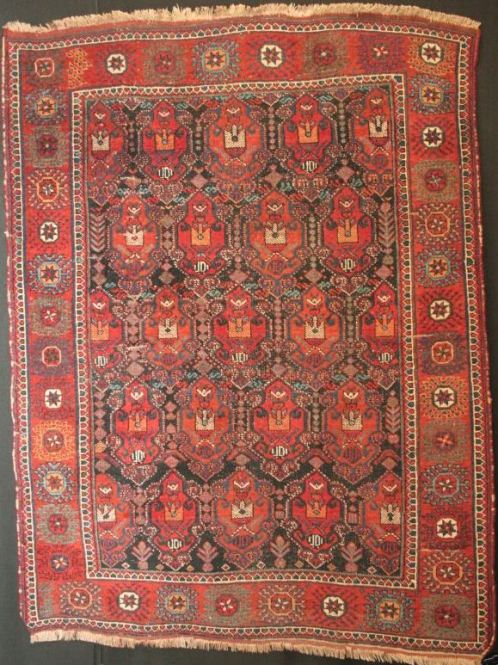
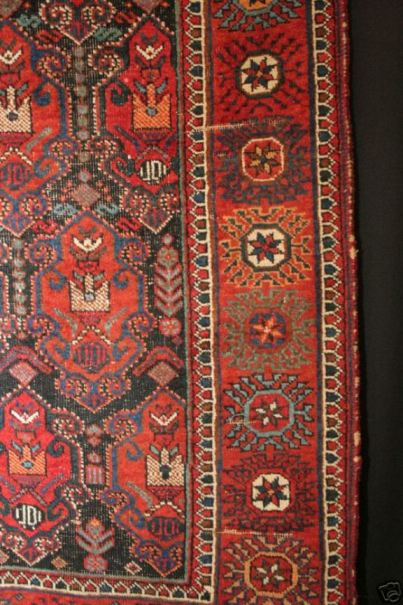
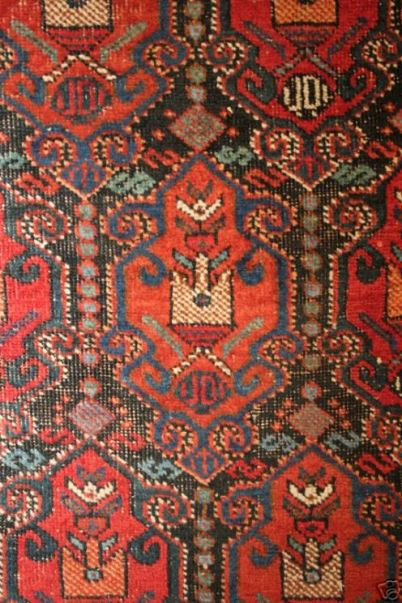
Above is a carpet I
purchased, inspired to impoverish myself by this Turkotek line. I’ve posted
pictures of it, not to start more conversation but to illustrate how much more
might be discoverable about Afshar rugs. Hopefully further discussion will
follow in the near future.
The initial post called for comment on
Afshari rugs. There followed a proposal to relate certain Afshar designs, those
with striped corners, to a class of Caucasian rugs, Gendje-Kazak.
The supposition was questioned as being based on thin evidence and the idea was
dropped as being transitional at best.
Then a broader question was
presented, asking if there were some evidence that three regions populated by
Afshari could be distinguished by rug designs from each other within an Afshar
context. The following was proposed:
(1) allocate certain
“all-over” and size-proportion rugs to Kerman;
(2) allocate
cochineal dyes and Baluch characteristic designs to Khurison; and
(3) attribute stepped medallion and cruciform’s to an
Azerbaijan derivation;
(4) investigate a possible influence of
Armenians on Afshari designs, originally in Azerbaijan pre-Afshar-diaspora, but
continuing within their designs post diaspora despite geography. Design elements
mentioned were certain common symbols including cruciform’s, Seljuk stars, and
stepped medallions.
A side conversation concerning the use of
asymmetric knots in Caucasian carpets developed. Skepticism was
expressed by Filiberto et. al., and a number of asymmetrically knotted, seeming
Caucasian-design rugs, were shown from Kirmov et. al.
A discussion of
the history of the Afshar, the Shia Turkmen, Kizilbash and Shahsevan
confederations, along with some Persian military history and Islamic Shia
philosophy as a historical explanation of population re-distribution, and
perhaps rug designs, ensued. Little of rug consequence was concluded but
groundwork knowledge was shared. Some documentary evidence of a remnant Afshar
population in Azerbaijan as late as turn of 20th C was presented.
The
information Cecil Edwards included in his book was presented, including
Afshari use of natural dyes into the mid 20th C. It was also noted that
Edwards pictorially attributed certain patterns to sub-tribes or
villages. This sub-attribution was questioned without firm answers being
found(?)
Filiberto presented Stone’s example of a possible
“Caucasian-Afshar” connection, and a chronology for a standard Afshar design
pattern, the stepped medallion. Stone attributed its use by the Afshar to
influence from urban Persian vase-medallion design assimilated from Kerman City.
While the medallion metamorphosis idea is well known, tracing the design back to
China (??), (Tom Cole mentions this broad thesis in “Outback Afshars”), in this
case the method of age identification was questioned because of the
following:
(1) The suggestion it originated in urban Kerman seemed
too specific geographically and in time...the genre is ubiquitous;
(2) The Afshar carpet used by Stone as a culminating example was felt
to be unrepresentative of the genre;
(3) Analogous rug examples
illustrating age attributions were not provided;
(4) The rugs
presented by Edwards were of a common age, but could be interpreted to fall into
most of Stone’s four categories.
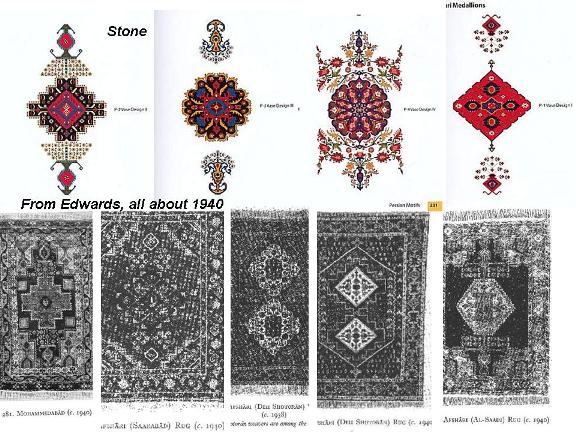
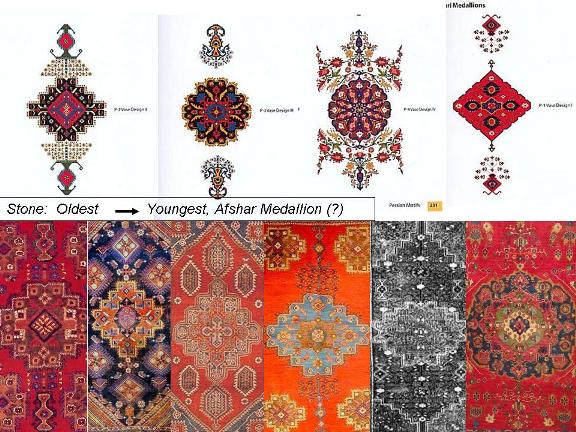
No
census, or hard data, identified Afsharis in Azerbaijan post diaspora, though
several literature suggestions of their presence were mentioned…especially in
context with the Shahevan. No Afshar rugs that predate the diaspora are known.
But a few weavings from Azerbaijan and/or Armania were suggested as possible
vestigial Afshar influence.
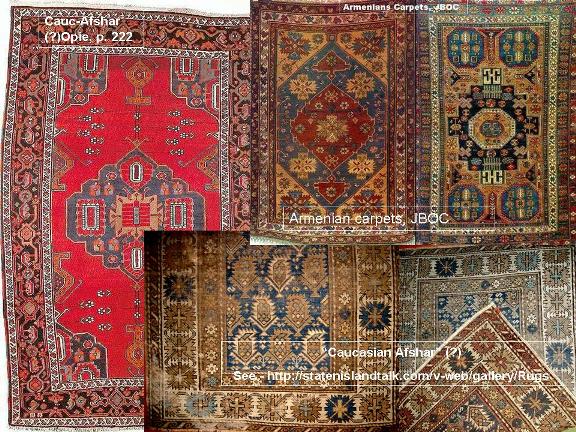
Filiberto posted a quote from Tanalvi noting the Afshar were
defunct as a tribe except in S. Persia. A rebuttal noted even if true, that
did not necessarily negate the existence of Azerbaijan or Khurrisan Afshar rugs,
the rebuttal using the Ersari as an analogy.
No proven evidence of
specific Afshari weavings from Khurrison was presented. However, traditional
lore, and frequent mention of the possibility is encountered widely in the
literature, apparently because of design and structure of some Khurrisan
carpets. Here are pictures of some of them:
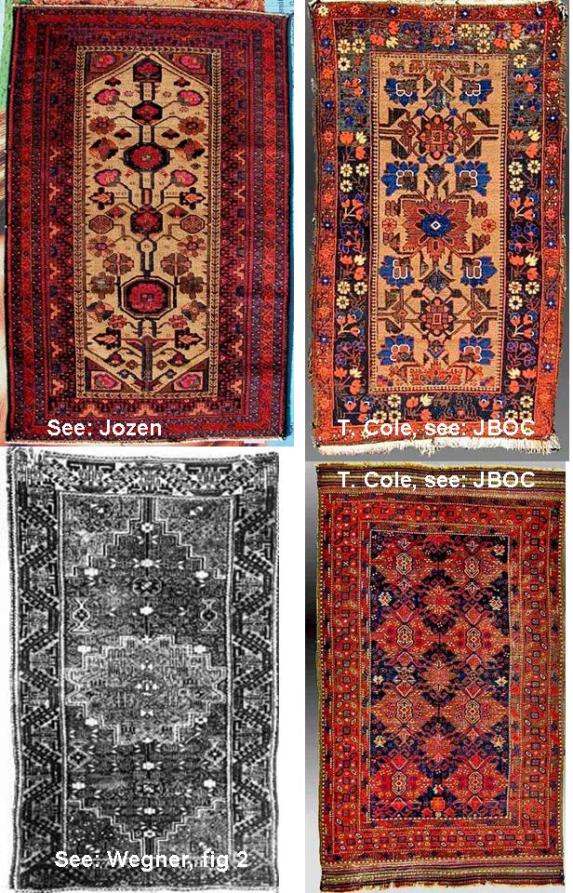
What was obvious from this line is
that comparatively little has been published about the Afsharis, or their rugs
(or we all are in the dark). The literature on Afsharis consists of about three
studies and two or three essays by Tanalvi, Opie, Stone, Eiland, and Cole. Some
further sociologic thoughts are found in a few unrelated sources, such as on
JBOC who relates the Afshari to the Oguz Turks and by reference back to the
Azeris and Ersaris, et. al.
Conclusions: Afshar rugs are
an easily identifiable set, attractive because of their tribal characteristics,
bold designs and the use of natural dyes well into the mid 20th C. The history
and sociology of the tribe is also of interesting complexity. What is needed
next is a better organized discussion, perhaps in the “salon” format. A “wish
list” of answers to Afshar questions might included the following:
(1) On what basis does one credibly assign age to Afshari rugs?
What knot did the archaic Afshar, or that matter Turkmen in general, Sy(or "T"),
As2/4, or As1/3?
(2) Afshar carpets are characteristically more
square-ish in l/w ratio than most other tribal rugs...is this true? why? Is the
difference between the characteristic ratio and the more elongated ratio of
other Afshar rugs significant?
(3) Edwards presented a number of
Afshar rugs. In total, they seem to represent several major design types. Can
the designs of Afshar rugs be accommodated within 5 or 6 definable categories?
What are they? Do they have regional significance?
(4) What is
the historical relationship between the Kizilbash, Shahsevan, and Shia thought,
and how were these confederations used geographically and militarily? How is it
that an artificially constructed military “tribe” can develop a unified body of
artifacts…or do they? Does this relationship show up in carpet
design?
(5) Can a connection between known Afshar designs and
similar Azerbaijan designs be supported? Is the perception of unusually
prominent cruciform use in Afshar weavings supportable?
(6)
Are/were there Afshar-attributable carpets woven in Azerbaijan, eastern
Anatolia, post diaspora? Are/were there Afshar-attributable carpets woven in
Khurrisan and western Afganistan? What is the evidence? Are they distinguishable
as being “Afshar?”
If I can round up the base information, perhaps a
Salon could help define the group. If so, it might be nice to start such a Salon
with a few unusual Afshar carpets, such as the one at the start of this
summary…and an older similar type without the very unusual Turkmen border
design.
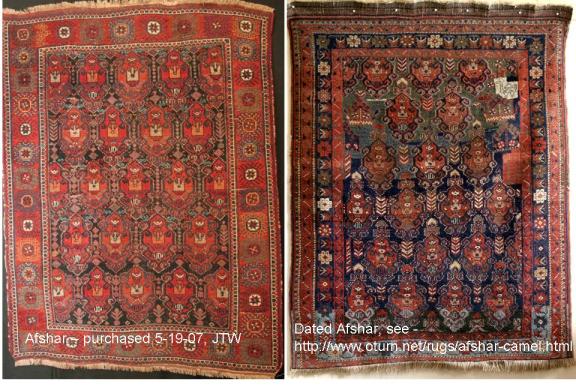
Regards,
Jack Williams
Posted by Filiberto Boncompagni on 05-20-2007 01:34 AM:
Jack, two images don’t show.
On the server there are 7 images, from
“Sum01.jpg” to “Sum07.jpg”
Your text links to 8 images, from “Sum.jpg”
(without numbers) to “Sum08” but not to “Sum06”.
Filiberto
Posted by Jack Williams on 05-20-2007 01:37 AM:
my bad
Filiberto, I inadvertently sent in some files that were way too big, those
two, Sum06 and Sum08, were the worst...guess I'm tired. I've sent steve some
replacement, smaller files. Hopefully he will have a chance to format them
tomorrow. Regards,
Posted by Sue Zimmerman on 05-20-2007 10:54 AM:
Sorry, Rich. I meant both. Chasing decorative. Sue
Posted by James Blanchard on 05-20-2007 12:32 PM:
Based on my experience of extant Afshar pile rugs, I tend to agree with Sue.
Most don't strike me as having notable tribal design elements, but rather seem
to be variations on the design themes of other groups, especially city designs.
In a way, they seem analagous to the "Beshir", though with perhaps less
distinctiveness.
It seems that the Afshar flatwoven and other utilitarian
items stick to more tribal themes. It might be interesting to compare and
contrast these more "tribal" Afshar weavings with most of the pile rugs. There
are a couple of interesting ORR articles on Afshar flatweaves here http://www.rugreview.com/122b.htm and here http://www.rugreview.com/6wert.htm
James.
Posted by Jack Williams on 05-20-2007 05:00 PM:
tut tut, tsk tsk, "don't make me come up there!"
James
I’m trying to let this line die a natural death. I can let Sue
get away with speculative opinions, but…. to just hang a curve ball with a bold
statement that Afshar rugs do not ‘look’ like tribal rugs with no
definition of what looks like a tribal rug, or any explanation of the
difference between tribal/nomadic and untribal/unnomadic, or any
indication just what it is about their designs that is purely an adaptation
of foreign, city symbols is unusual for you. It is very…“Sue like”…I
have to say (James…are you sure you made that post?).
Truth is we do not
know what Afshar tribal carpets looked like back… whenever. What separates the
Afshar designs from other more “tribal” looking (?) rugs, could well be the
overwhelming influence of Shia Kizilbash culture in my opinion…an opinion
apparently shared by others, possibly T. Cole for instance.
We know from
Edwards that the Afshar in the Kerman region were nomadic and tribal into the
20th C. and they made rugs with an emmently recognizable design…hence their
designs were by definition “tribal and nomadic.” Edwards also wrote that most of
their rugs were traded, not sold, and that the commercial market was
limited at best, the Afshar rugs not being particularly popular or collectable
in America.
Because there are a few apparently 150-200 year old Afshar
rugs, we know that the Afshari basic designs represent a tradition of some
length…leading back to…where? The Kerman Afshars appeared in that
region in late 16th C. Surely we do not think that they adopted rug weaving or
even their designs, suddenly, then? Surely they must already have had the basic
design elements at that time else why do the designs of Kerman echo in
Khurison?
That is the main point of this exercise. I personally wonder
if the Afshar designs could lead back to the Caucasus and Azerbaijan, eastern
Anatolia, where the Afshar first came to light historically. Before that,
who is to say where these obviously Afshar-specific designs started? As the
Afshar are one of the original Oguz Turkmen tribes, who is to say their designs
are less “tribal” than…say…the Tekke?
The reason we should pay attention
to Afshar history and Shia philosophy is to try to understand the source of what
are obviously traditional and recognizable Afshar designs. No offense
intended, but your comment looked a little light, a…er…rock aimed at Afshars in
general.
Regards, Jack
Posted by Richard Larkin on 05-20-2007 06:42 PM:
Folks,
When we really think about it, how much of the tribal weaving
in pile technique with which we are familiar is limited strictly to traditional
designs unique to the tribe? Putting the Turkoman portfolio aside for what it's
worth, not very much, I think. On the other hand, a lot of the production from
these sources seems to be derived, recently or remotely, from urban or other
"professional" sources.
A reading of Edwards suggests that in the first
half of the twentieth century, the Afshari production from the region around
Kerman was divided between traditional nomadic tribal weavers and settled
village weavers, with some blurring of the division. I would say that a
representative sample of the Afshar rugs one encounters in the marketplace would
be quite consistent with this description of the production circumstances.
__________________
Rich
Larkin
Posted by Richard Larkin on 05-20-2007 06:45 PM:
P. S.: The two ORR links James cites, leading to articles by P. R. J. Ford
and John Wertime, two stalwarts to be sure, are worth a look in these regards
__________________
Rich
Larkin
Posted by Jack Williams on 05-20-2007 07:24 PM:
mea culpa
ok...grump grump... maybe i was a little touchy and harsh with James. I
apologize, and mea culpa excuses of extrodinary mental fatique is not
acceptable, even to moi.
But...the strength of phylogenesis in most
Turkmen art has genrally proved to be pretty strong. While the incorporation of
Persian designs from the villages into Ashar weavings is noted by Edwards, the
reverse could have been stronger, Persian "village" weaving being pretty
eclectic, as far as I know.
Why? Because Ashar were dispatched to
Khurrisan by Shah Abbas, shortly after they were initially sent to Kerman. That
is, the latter part of the 16th C. Yet today we apparently see vestiges of
designs in Khurrisan that can be related to Kerman ones. This is after 400 years
of possible separation, and the interaction in Khurrisan with far more numerous
and diverse weaving traditions than those faced in the hinterlands of
Kerman.
It seems to me that at least the stepped medallion must already
have been an Afshar emblem when they went to Khurrisan. Therefore, it was likely
in use by the Afshar in the early part of the 16th C. at a minimum. If it is a
town or city adaptation, it is an old one. Does it make sense to believe it was
adopted by the Afshar after the move to Kerman and before mission to Khurrisan?
To me, it is more probable it was already in use by the Afshar in Azerbaijan
before the diaspora.
Regards, again, sorry James for the tone of the
last post.
Jack
I'll refrain from further posts so that this line
can die and a better organized discussion can begin. Thanks to all.
Posted by Richard Larkin on 05-20-2007 08:17 PM:
Jack,
I don't know why you'd want to let it die, except maybe for the
invitation from management. Anyway, that link to all those Baluchi rugs (I won't
say any more than that) was AWESOME. Those are some rugs.
__________________
Rich
Larkin
Posted by Richard Larkin on 05-20-2007 08:19 PM:
P. S.: I agree with you on that Afshar stepped medallion. I think it's very
old.
__________________
Rich
Larkin
Posted by James Blanchard on 05-20-2007 10:02 PM:
Hi Jack,
No need to apologize for your previous post. My comments were
light... (after all, it's about rugs, and it was Sunday afternoon).
I
didn't mean that the Afshar rugs were necessarily recent or commercial. I was
referring more to the design lineage and inspirations. Some very old rugs are
not "tribal". In fact, Gantzhorn illustrates what looks like a very old Afshar
that seems to have emerged from Holbein designs.
Eiland, Opie and others
have commented extensively on the migration of city designs and formats to the
nomadic tribal weavers. Opie (in "Tribal Rugs") gives a nice illustration of how
a city medallion was transformed by the inventive Qashqai weavers into something
that is now recognizably from the Qashqai tribe. This does not mean that some of
these designs are not very old (city carpets go way back several centuries), but
rather that the designs emerged from a different design pool. Opie suggests that
these designs seem to have a different lineage from others that these S. Persian
tribes use, including variations on the "bird-head" and other zoomorphic
designs.
What I meant by my earlier post is that compared to other S.
Persian tribes like the Lurs, Baktiari, Qashqai and Khamseh is that the Afshars
seem to have produced a smaller proportion of these other "tribal" types of
rugs. I could very well be wrong on this, but it is my impression based on my
limited experience.
I also agree that we don't know for sure the lineage
of many of the so-called "tribal" guls of the Turkmen and others. However, they
seem to have become much more tribally specific, which suggests to me that they
have taken on particular symbol and/or political significance for those tribes'
weavers. Maybe this was because the Afshar were so intermingled with other
tribal groups. Regardless, as you seem to allude to, one has to look much more
diligently to find these typical Afshar design
features.
James.
P.S. Here are links to Opie's articles on animal
figures in S. Persian rugs....
http://www.rugreview.com/122a1.htm http://www.rugreview.com/122a2.htm
Posted by James Blanchard on 05-22-2007 06:28 AM:
Hi Jack and all,
I don't want to put too fine a point on it, but I
reread an article by Murray Eiland that was reprinted on Tom Cole's site http://www.tcoletribalrugs.com/article46AdraAfshars.html
.
Addressing the issue of Afshar designs, Eiland comments:
quote:
The intriguing element in all this is that all of these designs, and others,
are derived from outside sources, and there is little, if anything, we could
describe as indigenous to the Afshars themselves. Even their bagfaces (and a
number of excellent pieces are shown in the exhibit) ordinarily display such
derivative designs as the boteh. This is not to criticize the quality of
Afshar rugs, as they certainly stand on their own in terms of color,
composition, and overall appeal. And yet we might be puzzled as to why nothing
specific to this group appears to have survived. Even one of the show's most
unusual pieces is again obviously descended from outside sources. Many surmise
that much of what was indigenous to the tribal groups of Fars, such as the
Qashqa'i, appears in the so-called Gabeh rug. I cannot say that I know of
anything equivalent from the Afshars.
While Eiland's position on this might be debatable, that is
what I was trying to get at with my previous post, without trying to be
dismissive of Afshar weaving per se.
Cheers,
James.
Posted by Jack Williams on 05-22-2007 07:46 PM:
on on, are you on? (HHH call)
James,
Eiland wrote this same thing in his first book, which I have,
in the late 1970s. I read it long ago, even repeated the statement several times
myself. I was going to post a scan of a rug from that volume...an early 19th C.
Afshar, roundish central medallion, cotton warps, As4 knots, that Eiland
declared one of the finest Afshars he has seen. But it is in black and white,
which doesn't scan well.
But...I have a nagging doubt about the sweeping
nature of this statement. That stepped medallion, used in the Afshar manner, may
have echos elsewhere, but it sure looks to have a lot of consistancy through
time. For instance the "flames" that surround it and other elements is
consistant in a lot of Afshars. These "flames" I do not see consistantly
elsewhere.
Actually, that medallion has been speculated to have developed
from a gol. Given that the Azerbaijan Turkmen tribes probably entered the area
in the 13 th C. with the Seljuks Turks, I think tracing the Afshar designs back
to Azerbaijan, if possible, is the first step. What the other six Shia Azer
Turkmen tribes wove/weave might the step two.
Without discounting what
Mr. Eiland wrote, the Afshar carpets are generally immediately recognizable.
They are rarely mistaken for something else, unlike just about every other genre
we discuss on this board and even Edwards comment on that fact. There must be
something about them that is unique.
Regards, Jack
Posted by Richard Larkin on 05-22-2007 08:04 PM:
Hi Jack,
I find your speculation about the connection between the
Afshar stepped medallion and early gols to be very interesting. It becomes more
compelling when one looks at early Anatolian carpets that obviously echo ancient
gol designs.
__________________
Rich
Larkin
Posted by James Blanchard on 05-22-2007 09:39 PM:
Hi Jack,
While risking prolonging this discussion about which I do not
have strong opinions, I just want to clarify that I don't think the issue is
that the Afshar rugs do not have old and stable designs that are recognizable (I
pointed out some very old examples shown by Gantzhorn), but rather that we don't
see very many that don't appear derivative from other, usually "urban", designs.
Depending on one's viewpoint about the design lineage of other tribal groups
(including the Turkmen), I suppose this could be said of many tribes' rugs.
Still, with a few exceptions (like the "Outback Afshars" of Tom Cole), I haven't
seen very many Afshars that convey to me a sense of indigenous tribal cultural
meaning. I am fully prepared to accept that as being due to my ignorance of
Afshar weavinig in general, and perhaps a somewhat romanticized notion about a
lot of other tribal weaving.
Cheers,
James.
P.S. Perhaps if
there is strong disagreement on this point, a different thread could be used to
explore "indigenous Afshar tribal designs", or something like that.
Posted by R. John Howe on 05-22-2007 09:57 PM:
James -
I have not been watching this thread but your post above
triggers memory for me.
The point you make with regard to Afshars is, in
fact, I think, held in some circles to be general.
That is, while there
are some who feel that some designs originate in early nomad societies and
migrate and are elaborated in urban settings, more scholars seem to think that
most designs originate in more settled parts of societies and flow from the
"cities" to the countryside and the nomads.
I'm sure you can find
ideologues on both sides but this argument is, I think, a general one not one
just applicable to the Afshars. There is a sense in which all designs are
"derivative."
And we sometimes talk about "old" 18th century Turkmen
designs, without acknowledging that you could find most everything in Greece and
Rome and China, long before that.
Regards,
R. John Howe
Posted by Steve Price on 05-22-2007 09:57 PM:
Hi James
You can see a suggestion along these lines, made more than 4 years ago, in
our "Topics for Future Salons" forum.
Volunteers,
anyone?
Regards
Steve Price
Posted by James Blanchard on 05-22-2007 10:23 PM:
Hi John,
I am aware of the differing views about the direction of
design migration between urban and nomadic groups. I suppose, like everything
else, there was some of both happening.
The vast majority of "old"
weavings that we can see today come from the 19th century, and usually from the
latter part of that time period. Even if one believes that Turkmen designs were
originally adaptations from urban designs, they certainly managed to tribalize
them and remain faithful to these tribal designs well into the 19th century.
There are design pools in Luri, Qashqai and Khamseh weavings that seem to retain
a strong connection to their tribal roots. Even though Baluch weavings show much
adoption of other designs, the good pieces seem to put a very "tribal" spin on
the design that make them interesting and mysterious. They also have plenty of
their own specific, recognizable guls and designs.
Maybe the reason that
Afshars appear to have been so inclined to adopt the urban designs from
neighboring towns and cities is that by the late 19th century they had been very
much "absorbed" into local populations and didn't retain as much of their tribal
identity, customs and designs as other groups. Eiland, Opie and MacDonald all
mention this in their books.
Still, I agree that Afshar weaving is
generally recognizable and interesting, and would be interested if someone was
inclined to mount a Salon on the topic.
James.
Posted by Richard Larkin on 05-23-2007 01:13 PM:
Folks:
I would like to emphasize that one of the more compelling
aspects of the "Outback Afshars" of Tom Cole's article is how "Afshari" they
actually look, including a couple that have strong Baluchi overtones (or is it
the other way around?). To my eye, in the context of this discussion about the
relative age and evolutionary design lineage of Afshar rugs, this "Outback"
group constitutes something of a wild card. Without them, we could neatly
pigeonhole Afshari production as mostly mediocre and derivative village material
strongly under the influence of a major urban center. Maybe their appearance as
wild, archaic, seminal pieces is illusory, and we can say the same with
them, but they skew the conversation.
__________________
Rich
Larkin
Posted by Horst Nitz on 06-04-2007 09:30 AM:
Hi Jack, Gene and all,
only by and by am I getting my ICOC notes
sorted out and have come across this one, that I think might interest
you:
Rachel Loewenstein from Haifa, in the poster session, presented with
"A Meaningful Afshar Rug". The botanical identification of an unusual vegetal
motiv depicted in the border of the rug reveals a plant (Ephedra family) that
plays a crucial role in Zoroastrian mythology and cult. Thus, other features of
the rug (Kerman province, early 20th century) also could be looked at in a new
light.
Here it is:
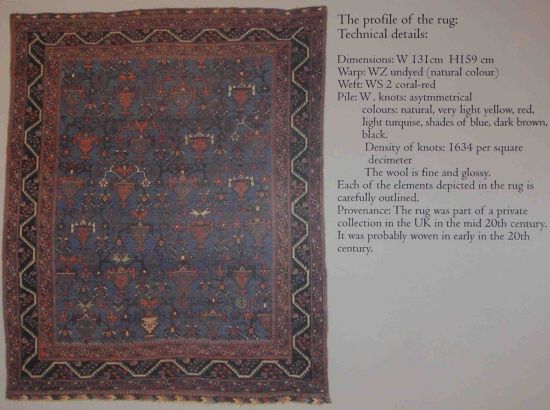
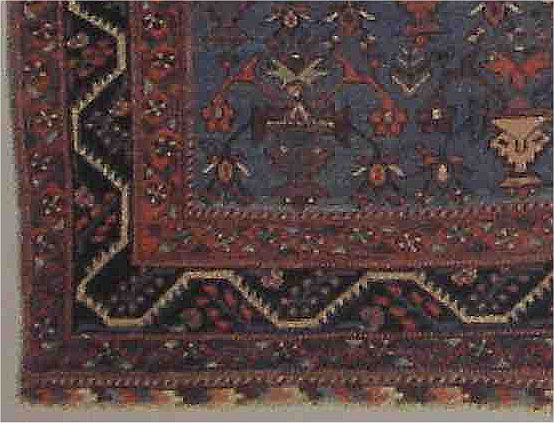
Horst
Posted by Filiberto Boncompagni on 06-04-2007 09:58 AM:
Hi Horst,
Your image was too big so I reduced it, but I cropped a
detail (in real size) to show the border. I sharpened it but it’s not very
clear.
Regards,
Filiberto
Posted by Sue Zimmerman on 06-04-2007 11:33 AM:
Hi Horst,
Hmmm. As I recall, the mummies of Urumchi were buried with
bundles of Ephedra roots in their hands. Sue
Posted by Filiberto Boncompagni on 06-04-2007 11:52 AM:
Right, Sue.
http://cloudband.fu2k.org/magazine/articles/rev_thompson_europeans_0699.html
I
know that guy, wasn't he in John's Salon on Red?
Filiberto
Posted by Gene Williams on 06-04-2007 05:22 PM:
Pan-Turkic culture
Hi all,
I have three questions:
--- What’s the definition of a
“true tribal” motif”?
--- How has this “true tribal” motif changed in contact
with multiple external contacts?
--- So, what’s genuine in Afshar tribal
contacts and what’s borrowed…and does it matter?
First as regards a true
“Turkic” tribal motif…there may have been one originally but its probably lost
in time…or the whole process may have been learned from other peoples the Turkic
tribes subjegated. Here are a few scattered thoughts:
There very
definitely was a shared cultural sense of historical kinship amongst Turkic
tribes stretching from Anatolia to India and a cross-fertilization of at least
military ideas in the late 15th-early 16th century (probably based on language).
For instance, Babur mentions his use of Wagons filled with sand, chained
together in front of his troops for the climatic battle with the Rajputs in
India...and mentions the Kizilbash used the same tactics against the Uzbeks,
identifying both as being "in the Anatolian style." He talks of raids, wars,
expeditions by Timurids from Samarkand against Turkish kinsmen in "Iraq."
Turkish tribal military units were mercenary and moved from place to place. At
times this shared past and culture seemed to transcend the Suni-Shi’a schsm. (Ok
I don't want to downplay the Shi'a - Sunni problems; Babur failed in front of
Samarkand because he was using a Kizilbash Shi'a army...Turkomen tribesmen by
the 18th century regard the Kizilbash Shi'a as apostate and fair game for
slavers.)
But clearly there was shared technology, art, artists, writers,
poets, artisans amongst all Turkish groups from the Timurids to the Ottomans …
all these artisans and ideas crossed international boundaries..this helped
create the mogul style in India, etc. So why not a similar cross fertilization
in carpet weaving?
I suppose it would be profitable to try to figure out
what were the seminal basal Turkish motifs from the time of their first
infiltrations into Persia as mercenaries in the 9th-10th century...I'd assume
two would be the vine leaf border and the 8 pointed "Seljuk" star..if that 8
pointed star wasn't used so prominently previously in Greek motifs. And given
that obviously carpets in tribal settings had to be sold to someone...(I mean,
how many carpets could a tribal group absorb - you have to assume 2 carpets a
year for half the women of the tribe! Plus the slaves. No doubt somebody in the
tribe was selling something to someone along the way of their migrations..its
just common sense. they couldn't haul around all the stuff they were
making)...
Now as for “tribal motifs,” the Brits in the 19th century
assumed “tribal motifs” (which they associated with the Sunni) to be
rectangular. Curvilinear designs were supposedly Shia city stuff. And, I assume
this is what James is talking about…that any design deviating from the
rectangular is regarded as city influences on the Afshar. Is this viable? I
mean..any kind of curvilinear design.. cloud-bands, horsetails, wolfs-heads…is
city derived? Can anyone support this assumption?
so in my opinion
there is a lot of hand-wringing about authenticity which might not be
appropriate. There had to have been market forces at play along the silk route
forever (see the Fraser comment in 1821 about the commercial value of Turkoman
carpets). So, why would there be angst about "city motifs" or symbols making
their way into tribal carpets like the Afshars? And how do we know it wasn’t the
other way around? (I assume the former of course). And if so, like the Baluch
and their adaptions, why would there be a problem with other tribal adaptations
of some non-tribal motif? I mean, somebody had to teach them something in the
beginning..after all..unless carpet weaving sprang full blown as an invention of
a Turk. And remember as far as city motifs are concerned, the Turkish tribes ran
the show in Central Asia including Anatolia, Persia and on down to Delhi for
well on 900 years..which included both destroying and ruling-rebuilding all the
major cities in the area, killing the artists and sponsoring them, building
pillars of skulls and libraries… Why not the union of the two in tribal motifs?
(heck, I'm thinking of the "Lawrence of Arabia" scene where the Arab sheif makrs
a bargin for a clock...and I've seen inlays on a major Baluch tribes' seat of
government in Pakistan containing images of trains!!!)
So everybody says
an Afshar is easy to spot. Ok, besides the ubiquitous opium poppy, pls define
here what makes an Afshar.
Gene
Posted by James Blanchard on 06-04-2007 07:53 PM:
Hi Gene,
Just to clarify, I don't know enough about rugs, motifs or
Afshars to form a strong personal opinion about this.
That's why I
referred to Eiland who has seen a lot more rugs than I, and he says that...
"there is little, if anything, we could describe as indigenous to the Afshars
themselves."
That is a strong statement, that has been echoed by other
knowledgable people in rugdom.
I think that the way to challenge this
assertion is to falsify it by providing specific examples of "indigenous" Afshar
tribal motifs or designs. I don't think this means something that was not at one
time inspired by urban or commercial influences, only that it has become
recognizably a feature of Afshar tribal weaving, without close connection to
urban designs.
Again, I am open to being persuaded either way on this and
I think this would be a good subject for a separate thread or
Salon.
Cheers,
James.
Posted by Jack Williams on 06-04-2007 10:05 PM:
On site research needed
Good evening all.
I don’t know why Mr. Eiland made that particular
statement, and it doesn't seem to echo Edwards' opinion (though his original
book certainly tracked Edwards for the most part). But that statement sure has
been quoted often enough. I wonder if he still holds that position, especially
since the catagories of "Afshar" design don't seem to be well defined? I don't
recall anyone ever making such a statement about any other group, even when it
was difficult to distinguish their weavings from others.
The question of
original gul for the Oghuz Turkmen has caused spillage of a lot of ink. There
are even a couple of archived lines on Turkotek. This topic is evergreen…and was
a theme in Hans Bidder’s great book on E. Turkistan weavings.
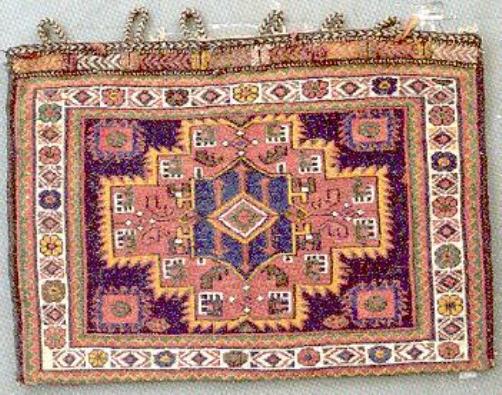
Here is a bag, woven in the
obscure and isolated Jamal Barez region. I has the colors, and both of
the characteristic symbols I think may be “native” to the “Afshar.” First
is the stepped medallion, and second is the
“flames” that edge the symbol. Either or both are something that has
a residual echo in, E. Anatolia and Azerbaijan, and in Khorrisan.
We know
the “Afshar” were just one of seven tribes in Azerbaijan that formed the
Kizilbash. Others included the Baharlu and the Qajars who formed a dynasty
lasting into this century. The Baharlu rugs I’ve seen in Eiland etc., often have
an eerie echo of some “Afshar” designs, having “flames” bordering the field
elements (these ‘flames” may be a totem of protection from the ever present evil
spirits). Tom Cole frequently referred to Afshar rugs in the plural context of
the Kizilbash…”of whom the Afshar were occasionally the dominant power.” Maybe
we should think of "Afshar" in this way.
One interesting fact…Edwards
exhibited several “Kutlu” rugs without defining whether that term referred to
design, structure, tribe or village. Well, Qutlu is a town on the SW shore of
Lake Urumia in Azerbaijan. Commentary on the rugs from this area occasionaly
reference Afshar weavers.
But the Afshar were indisputably the “tribe”
that was moved into a S. Persian vacuum…possibly an environment so remote and
isolated as to act as a design preservative. It would be very useful to know
what the social geography of Kerman provence when the Afshar arrived in the
early 17th C. It may be that Kerman town was small, weaving was possibly
nascent, Persian villages were possibly few in number. There certainly was no
Meshed, or Herat, or Quchon, or other centers of strong tribal groups to
influence design. Could it be that the designs of the Afshar of S. Persia were
under less ethnogenesis pressure than those that existed in Azerbaijan and
Khurrisan? If so, could Mr. Eiland have just made an offhand statement?
I believe we might be able to show the above is a “tribal” symbol for
these Oghuz Turkmen. But, even if it is, it's probably not that important…except
that the weavings of this group are possibly the most distinctive in the rug
world. They are rarely confused with any others.
Perhaps we will
eventually get to a Salon.
Regareds, Jack
Posted by Filiberto Boncompagni on 06-05-2007 01:31 AM:
Hi Jack,
A bit over-stretched, I agree, but this could be a “stepped
medallion” or, at least, A PROTOTYPE… Naturally born out of flatweave.
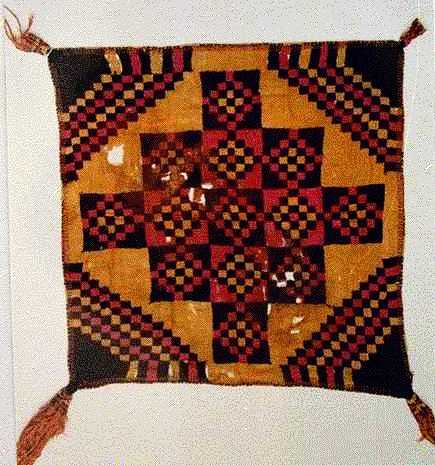
This
one is Inca, though, (new fashion on Turkotek: Precolombian textiles )
circa 1300-1500.
Ciao,
Filiberto
Posted by Horst Nitz on 06-05-2007 02:55 AM:
Hi all
Filiberto: "but this could be a “stepped medallion” or, at
least, A PROTOTYPE."
At first glance it seems it could be, but it is not
really. "Stepped medallion" is a technical term we are using as we are unaware
of the spiritual meaning or the values attached to symbols and emblems of past
times in their respective natural and social habitat.
The design
tradition in which the bag face stands that Jack posted, is at least six-hundred
years old - I can't imagine that it would have been called a "stepped medallion"
at that time by the people who made it.
Unless we are fully aware that
there is no historic link to the Peruvian textile and that "stepped medallion"
is used solely technically, I would reject that term in the given context as an
illegitimate parallelism. We could call it a pattern that looks similar to what
we call a "stepped medallion" in a different context.
Having said this,
of course, I would not think of it as a prototype either. The similarity has to
do with the mechanics of weaving and the organisation of perception and the
human nervous system.
A nice day to all of you,
Horst
p.s.
Sue, Filiberto, thank you for the link to the Urumchi mummies. Could we deduce,
that Zoroastrism had spread that far east? Why actually not? Urumchi and
Nishapur are both on the silk route, and if Taoist symbols have made in the
counter direction to Nishapur?
p.p.s I might be jumping conclusions here
- Sue, Filiberto, do you know how old these mummies are supposed to be? They
don't look that old and not "prepared" in the sense of the Egyptian ones
either.
Posted by Filiberto Boncompagni on 06-05-2007 04:17 AM:
Hi Horst,
Yesterday I read that the Urumchi mummies have ages
comprised between 2000 and 1000 B.C. In any case they predate
Zoroastrianism.
Yes, "Stepped medallion" is a technical term.
quote:
I can't imagine that it would have been called a "stepped medallion" at that
time by the people who made it.
Then, how do you suggest we call it?
If – as I guess - you
don’t know its original name either, does it make any difference?
quote:
The similarity has to do with the mechanics of weaving and the organisation
of perception and the human nervous system.
Exactly! As such, the Inca textile demonstrates how a “stepped
medallion” could have had its origin on flat-weave technique, so it could
be technique-derived and independent by cultural or geographical
influences.
Regards,
Filiberto
Posted by Gene Williams on 06-05-2007 03:32 PM:
Urban motifs in Afshars?
Hi all,
I’d like to return for a moment to two themes: (1) the alleged
use of “urban” motifs by Afshar Turks; and the related (2) alleged loss of
identity of the Afshars and their subsummation into whatever local area they
inhabited…
There apparently are two contradictory rug guru opinions:
Edwards said the Afshar’s retained their tribal identity AND their rugs were
being copied by villagers in the Kerman area and (2) Eiland said the Afshars had
no tribal designs and copied everything from city environments. Both statements
can’t be true. Even more so when both admit that an Afshar is "immediately
recognizeable."
Jack showed 3 Afshar rugs he owns to start this tread.
Could someone please point out what elements in those rugs are demonstrated
citified motifs? The botehs in the “opium rug”? The cross and stepped medallion
and squares with flames in the red field one? If these rugs are not “urban” then
what are they? And I put up an Afshar with rounded botehs and opium poppies in
the border…its a sophisticated rug..the colors gold and green and not what we
think of as "tribal." Yet what’s "city" about that rug? And if Eiland in his
sweeping statement is right, at what point in time did the Afshar tribe
disappear and become simple copy artists?…(they certainly were an identified
unique nomadic tribe weaving in a unique style up to Edwards’ time in
Persia…possibly from the late 1800’s since Edwards and his father were buying
carpets in Persia from 1895 on – this from memory since I don’t have the book
with me out here.
So, please look at the several Afshars on this line and
point out the identified city elements of these carpets…and how they were
interpreted by the Afshar weavers. To me they look basically tribal…different
admittedly with perhaps a Caucasian twist? Is it the central field corners
elements which put people off? Or is it that the Turkoman designs or maybe my
beloved Baluch designs have so accustomed all of us to assume this is what a
tribal carpet must look like that we have a sort of knee jerk reaction to
anything which doesn’t fit that stereotype? I'm trying to learn and I can't
quite figure out what Eiland was talking about.
Gene
PS. Re the
Ephedra plant and Zoroastrianism. Its common to assume that Zaruntha taught in
about 600 BC. I believe though that scholarship puts him back maybe as far as
1200 BC…and that elements of his philosophy were certainly influenced by Aryan
tribal beliefs (Hindu?) dating into antiquity. Now I know nothing about Ephedra.
But Its certainly possibly that this plant had uses in Aryan tribal structure
going back to the time of the early Egyptian dynasties. And if the plant was
useful in Egypt..it must have been independently useful elsewhere as wall..just
as the opium smoked by Oddyseus in the Oddesy Tale was also smoked in other
areas independentliy.
Posted by Horst Nitz on 06-05-2007 05:22 PM:
Hi Filiberto, Gene,
rug science is not a well ordered subject it seems
and I feared, it would increase confusion if we started to call everything that
grows on a tree an apple, only because apple-tree comes to our mind first. No
damage is done, thanks for consenting to the clarification.
As to the
usage of Ephedra/Ephedrine it seems to have been rather widespread. I wonder
about the rationale behind it. West to east transfer seems unlikely, but it may
be possible that Zoroaster grew up with it. Newer research seems to suggest, as
Gene already indicated, that Zoroaster was born at around 1200 BC.
Gene,
I don't think either that a rigid differentiation between tribal and town has
much explanatory value; although exquisite rugs and design-leaps may have a town
background more frequently, those provincial towns and their workshops always
were very much imbedded in tribal structures, if as extensions, as were the sons
of Bachtiari and Quashgai chiefs who studied in
Paris.
Regards,
Horst
Posted by Filiberto Boncompagni on 06-06-2007 02:57 AM:
Hi Gene,
I tried to demonstrate in another thread that the “boteh” is
an urban motif.
According to the book/catalogue of “Le Ciel dans un
Tapis”, (see links)
http://www.imarabe.org/temp/expo/tapis/tapis-oe09.html
http://www.imarabe.org/temp/expo/tapis/tapis-oe10.html
the
central medallion layout on carpets was introduced by the Savafides and it had a
Chinese origin.
But BEFORE it was already used on books bindings and in
architecture.
Book bindings: http://www.library.yale.edu/neareast/gallery1.html
Architecture:
http://archnet.org/library/images/one-image.tcl?location_id=4746&image_id=62657&start=1&limit=9
and
a better view of the photo:
The door belongs to Sultan al-Zahir Barquq Funerary Complex,
Cairo, Egypt.
It was built between 1384 and 1386. But “Michael Rogers has
demonstrated that this complex, with its marble paneling, bronze-plate doors,
molded stone ornament, and elaborately worked minaret, was to set the tone for
Cairene architectural decoration between 1400 and 1450.”
See:
http://archnet.org/library/sites/one-site.tcl?site_id=3355
For
me, these are the prototypes of the “Central Medallion” layout. Afshars and
others copied and “tribalized” it. The “stepped medallion” is a tribal
geometrical rendition of the above examples.
Horst,
Rug science
can be constructed by building theories then assembling facts corroborating the
theories. It seems you have heard at ICOC about a theory linking Zoroaster,
Ephedra and Afshar rugs.
What is the theory exactly and were are the facts
corroborating it?
Incidentally, that is what I found on the Ephedrine,
Encyclopedia Britannica:
Oldest and most important is ephedrine, an
alkaloid originally obtained from the leaves of ma huang, any of several species
of shrubs of the genus Ephedra, which has been used in Chinese medicine
for more than 5,000 years.
Regards,
Filiberto
Posted by Filiberto Boncompagni on 06-06-2007 10:02 AM:
Zoroaster and Ephedra
Hi Horst,
It should have something to do with the
Soma-Haoma.
http://en.wikipedia.org/wiki/Soma
http://en.wikipedia.org/wiki/Botanic_identity_of_Soma-Haoma
Regards,
Filiberto
Posted by Gene Williams on 06-06-2007 11:18 AM:
Confusion
Hi Filiberto,
Now I'm really confused. ' ' So the Safavids introduced the central
medallion technique to Persia...1500's presumably?? And their central medallion
design originally came from China?
' So the Safavids introduced the central
medallion technique to Persia...1500's presumably?? And their central medallion
design originally came from China?
But but...the Safavids were Kizilbash
Turks..the Afshar were part of the group...And all of the Turks came into the
Persian area of influence from China (T'ang dynasty) controlled regions
beginning in the 9th century...(as mercenaries enlisted in the Persian
service..sort of like the camel putting its nose in the tent). So was the
"central medallion" motif introduced by the Kizilbash Azerbaijan Turks to the
Persians really then a Turkish tribal motif/design, perhaps originating from
Chinese influences on the Turkish tribes during the T'ang dynasty??
If
so..it would seem that the central medallion design is in fact an old-old-old
Turkish tribal design which was adopted by Persian city dwellers...not the other
way around. Am I wrong?
And is the "central medallion" design of two of
the Afshar carpets presented which started this thread really the only "city"
motif in them which can be identified? Then, if the "central medallion" is not a
city origin design but originated with the Kizilbash Turks...what does that say
about Eiland's theory?
take a look at this Turkish "2 mirhab" prayer
carpet from the same site...the central field design to me resembles an Afshar
carpet....four corners .. a central medallion....
http://www.imarabe.org/temp/expo/tapis/tapis-oe04.html
Gene
Posted by Jack Williams on 06-06-2007 11:28 AM:
Picture of plant, more info
Humm, we are going in interesting directions. First I will make these
statements:
(a) During the 18th C., the population of Persia
apparently fell drastically because of endemic and continuous war and
misery. The decline is estimated to be up to 50 percent.
(b) By 1800, nomads accounted for perhaps one half of the
population Persia.
(c) The rural Afshar in Kerman province
probably outnumbered any "Persian villagers" by a considerable margin for much
of their time in Kerman provence, at least until the late 19th C.[/b]
Now...on to other things...
.jpg)
Because of the interesting
directions this conversation is taking, here is another
summary...:
1. Opium poppies were shown to be used as a decoration
in Afshar rugs...
2. There followed a discussion of Shia and
Islamic philosophic thought and the Shia armies composed primarily of Turkmen
tribesmen of the Kizilbash, later Shahsevan...
3. Mention of
residual Greek and Zoroastrian philosophic thought in Shia doctrine led to a
discussion of the use of Zoroastrian symbols in Persian tribal rugs. Then, the
effect of culture and pre-Islamic religious and philosophic thought on art and
symbolism, and rug designs was mentioned...
4. Horst identified a
recent publication showing the ephedra plant symbolized in the border of
an important Afshar carpet...mentioning ephedra's ancient use in
Zoroastrian religious-philosophic ceremonies.
5. It turns out
that mystical potion, "soma," is probably partly an ephreda based
drink widely used in proto-Iranian (2000-1000 BC) culture, both in India,
central Asia, and Iran. It has apparently continued in use to the present time
in Zoroastrian traditional religious rites.
This discussion seems to
link recent (last 150 years or so) rug designs to cultural events up to 4000
years in the past and it establishes a possible link to the lasting effect of
Zoroastrian religion on both Persia and Central Asia.
Here is a short but
intensely interesting discussion of the search for the source of "soma"
(by the way, Huxley, in his great novel, Brave New World, used
"soma" as the be-all hedonistic drink administered by the government for
control purposes). Note: the US banned ephedra based products in 2004.
But, after reading about its use in weight loss and athletic gains, I wonder if
I should....
http://www.huxley.net/soma/index.html
Partial quote
from source:
Soma
from
The Encyclopedia of Psychoactive
Substances
by Richard Rudgley
Little, Brown and Company
(1998)
"The Indo-Iranians were an ancient people who had their
homeland somewhere in Central Asia. About 4,000 years ago they split into two
distinct groups. One group, the Indo-Aryans, moved south to the Indus Valley;
the other became the ancient Iranian peoples. Both preserved a vast body of
religious oral literature which was only later written down. These scriptures
are the Rig Veda and the Avesta, of the Indians and Iranians respectively. Both
works describe rituals in which a plant with hallucinogenic properties was
consumed. The plant was called soma by the Indians and haoma by the Iranians.
Although some of the descendants of these peoples still perform their rituals,
the identity of the sacred entheogenic plant has been lost and non-psychoactive
substitutes are now used in place of the mysterious soma/haoma. In addition to
the various non-psychoactive plants that have been used as soma substituted in
both the Zoroastrian and Hindu traditions, a great number of candidates for soma
have been put forward by Western investigators over the last two hundred years.
Among the suggestions of more or less convincing candidates have been cannabis,
Ephedra, a fermented alcoholic drink, Syrian rue, rhubarb, ginseng, opium and
wild chicory." ...
... for entire article - which I highly recommend -
see following: http://www.huxley.net/soma/index.html
Regards,
Jack
Posted by Filiberto Boncompagni on 06-06-2007 12:33 PM:
Gene,
I’m not going to translate the book, but it says that the
“iconographic side of the composition is largely tributary of China both in the
detail than in the larger layout…
This vocabulary Sino-Persian or
Sino-Turkoman is a ‘noble’ one, reserved to official works, increasingly
elaborated starting from the Ilkhanides, the Mongol sovereigns of Iran….artistic
exchanges with the Ming court”… and so on… it names also Mazdesism, philosophy,
Buddhism, but what is clear is that:
It preexisted the Savafides (see the
1400-1450 mosque door that I posted above) but become fashionable under
them.
The origin is Chinese, imported to Persia by Turkmen.
quote:
take a look at this Turkish "2 mirhab" prayer carpet from the same site...the
central field design to me resembles an Afshar carpet....four corners .. a
central medallion....
Yes, but that is attributed to end of 16th beginning of
17th.
What about the first half of 15th c. mosque door from
Cairo?
Jack,
Before going too far, how many of Afshar rugs with “Ephedra” borders do
you know? 
Ciao,
Filiberto
Posted by Gene Williams on 06-06-2007 01:21 PM:
Problems with dates
Filiberto,
I have some problems with the dates presented in this
explanation:
The Ilkhanate was Mongol...Turk. It swept away the Kwarizim
Turks and the remains of the Seljuk Turks in Persia...destroyed the Shi'a
Assassins (Ismailis today), trampled the Sunni Caliph in Baghdad under their
horses' hooves...It destroyed Sung dynasty China and replaced it with the Yang
dynasty...a Mongol dynasty...Kublai Khan, visited by Marco Polo, being he most
famous..all this in the 1200's (dodici) (13th century).
The Ming
dynasty, a purely Chinese dynasty, didn't arrive on the scene until the mid 14th
century (1356 or thereabouts)..after they overthrew the Mongols. And by that
time the Ilkhanate in Persia was very definitely degenerating throughout the
1300's into impotency..
only to be revived by Timurlang and his Chaktai
Turks from Samarkand...once again a Turk doing the hard work...in the late
1300's. So I sincerely doubt that lkhanate "courtly exchanges" with the Ming
could explain the transfer of a Chinese origin central medallion design to
Persia. I could believe the Seljuks brought it in...or maybe the White sheep
Turks in the 11th century, or maybe the Mongols themselves, especially since
they pretty well destroyed everything in their path, leaving their own to create
new traditions.
Whatever, logically it looks like the central medalliion
carpet was an urban Chinese concept, was picked up by Turkish (or Mongol..pretty
much the same thing) nomads under Chinese influence, then was disseminated to
another urban environment, possibly aided by first totally destroying that urban
environment then recreating something new. This means the central medallion
Turkish nomadic carpets such as the Afshar are in fact legitimately Tribal
designs..at least to my mind.
anyway, for what its worth, here is a
painting in the royal baths of the citadel in Herat...dating from before
Timerlame...but after the Mongol cataclism which left 56 people alive in
Herat...say 1290's ...not a central medallion but there sure looks like some
botehs there:
Just for the heck of it, here are other decorations from the
same bath...obviously with echos in sophisticatged carpets woven in Persia much
later and a picture of the citidel..I look fat because of the armored vest under
the shirt:
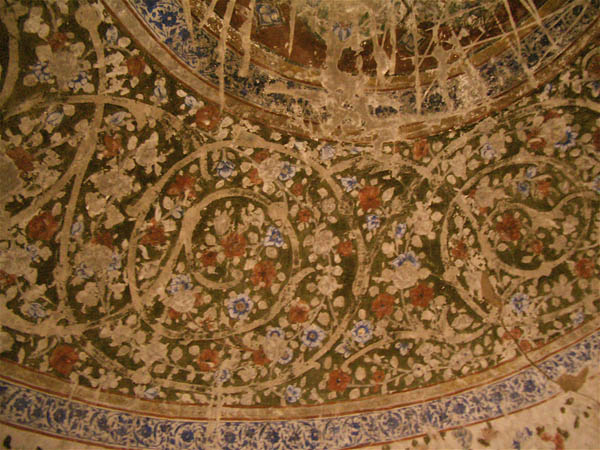
Gene
PS. I'll go out on a limb and be the first to
suggest that the Jan Baig Baluch famous flowery border is Ephedra.
Posted by Horst Nitz on 06-06-2007 04:34 PM:
Hi all,
after having identified the plant in the border as Ephedra,
Rachel Loewenstein went on explaining the field design; what at first looks like
a naive interpretation of a Kerman vase carpet, in fact depicts vessels like
they are being used in the essential Zoroastrian fire ceremony.
The
active ingredient in Ephedra/Soma is Ephedrine, chemically closely related to
Kat/Cat (d-Norephedrin; Yemen), Benzedrine and of course Adrenaline. It acts
centrally, changes the state of conciousness and releases physical and mental
emergency reserves, normally nor accessible. It is a very stable molecule and
can be taken per os and possibly inhaled similar to later asthma cigarettes (or
burnt in those vessels).
The Urumchi mummies seem to have been given
twigs from Ephedra into their hands in much the same way as the eucharist is
being delivered to the dying in our culture (yes, there seems to be a concept
tranfer into Christian practices):
http://en.wikipedia.org/wiki/Viaticum
By the way,
Filiberto, how far is it from Alexandria to Cairo ( .. "won’t go to Alexandria
in search of Afshar rugs, though... I suspect that your tip will not be that
good ...) ?
Best
wishes,
Horst
Posted by Jack Williams on 06-06-2007 05:35 PM:
Chodor-Afshar-ephedra-baluch
Filiberto,
I might as well pile on (old American expression from US
football).
To follow up what Gene said, here are portions of borders
from several Baluch and Afshar carpets, bags, etc., I own. No one has really
ever speculated about the specifics of the reed-like flowers common in Baluch
and Afshar borders. But...it seems possible that ephedra could be the
model.
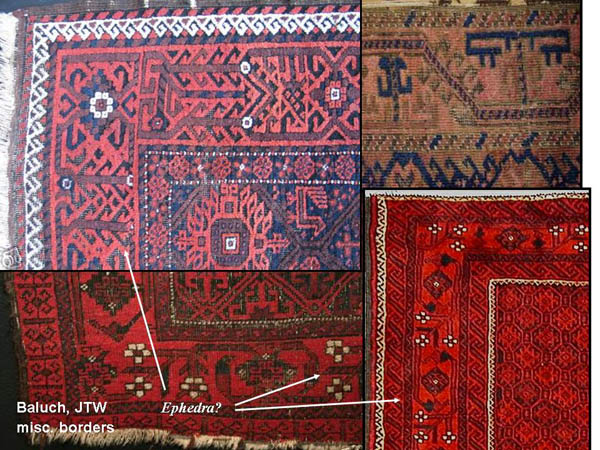
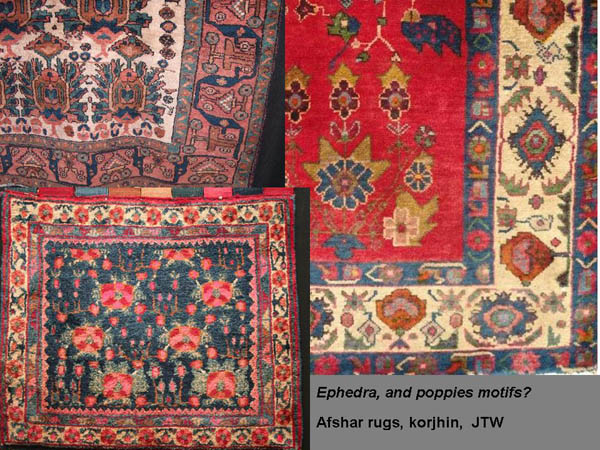
Also...about the central
medallion. I liked Hans Bidder's book, Carpets from East Turkestan, Known as
Khotan, Samarkand and Kansu Carpets ; London: 1964. His speculations about
the origin of Turkmen symbols seems pretty reasonable. Also his points...China
did not weave carpets, had little tradition or interest in wool until the 19th
C...are well documented.
If China influenced the symbols on rugs, that
influence was propagated by art other than weaving. But where does that leave
the source of the designs of the fantastic felts found with the Pazaryk
carpet?
To me, the source of the general type of medallion carpet designs
is not very important. It seems we assume that guls, as they are used currently
in Turkmen carpets, are the prototype for all the original Turkmen tribes, and
medallions are not. That may or may not be true...but little repeating
guls, ala Tekke, Salor, etc., could have had a medallion as their source. And it
isn't hard to imagine a small repeating Afshar gul growing like an "elephants
foot Ersari" design...first to a central set of figures, then into a medallion.
Here is an example of what an original "Afshar-chodor" could have looked like in
the current Turkmen mode.
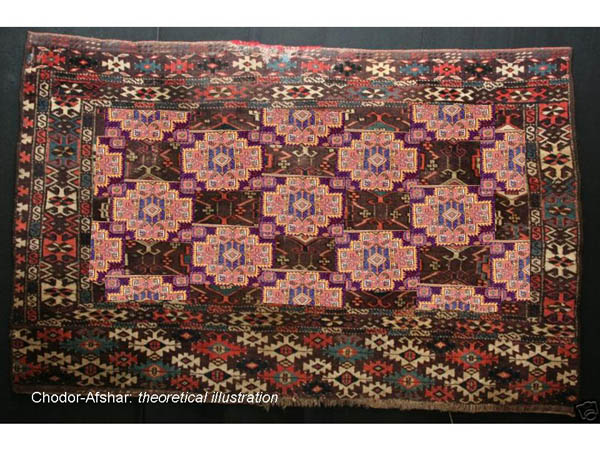
Regards, Jack
Posted by Steve Price on 06-06-2007 06:10 PM:
Hi Jack
I think the weaver who did that Afshar-Chodor was given access
to colored wool too early in her apprenticeship.
Regards
Steve
Price
Posted by Filiberto Boncompagni on 06-07-2007 02:04 AM:
All right, all right.
Ardebil Carpet:
Courtesy of Chuck Wagner
and the V&A. More photos in Chuck’s Salon #117
Some technical details about the
carpet, from V&A website
The Ardabil carpet measures 10.51m x 5.34m
(34' 6" x 17' 6") and is thought to be one of the largest carpets in the
world
Dated 1539-1540
304 kpsi silk on silk, wool 10 colors
Warp: cream or undyed silk. 35 threads per square inch
Weft: cream or
undyed silk. 3 paired shoots after each row of knots
Knot: asymmetrical; 340
per sq. inch
I think this is the earliest example of carpet with the central
medallion layout.
Hope nobody questions the fact that this is an URBAN
carpet.
Some scholars believe that this layout (on rugs) appeared at the
Savafide Court.
Hence, same scholars believe that this is the prototype of
the central medallion layout (for rugs & carpets). It wasn’t used before
but, of course, it was imitated AFTER.
If you guys show me another TRIBAL
rug (Asfhar, Turkman, Baluch
it doesn’t matter) that PREDATES the Ardebil carpet and with a similar layout,
you’ll succeed in convincing me that the scholars are wrong and that you are
right.

Filiberto
Posted by Jack Williams on 06-07-2007 02:33 AM:
another Chodor-Afshar weaving
Steve, I talked to a descendant of the weaver of that "Chodor-Afshar" about
your comments. She said that it was indeed a carpet woven by the young daughter
of the weaver of this other carpet, her
great-great-great-great-great-great-great-great grand mother. My contact said it
is more representative of the original designs of the Chodor-Afshar tribe and
that it dates from about year 585, Persian calandar (solar year).
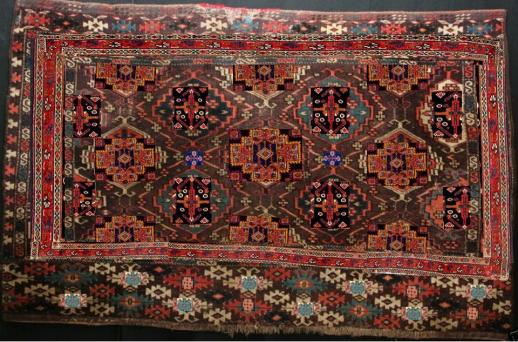
I notice all the
elements of this one, including the border, echo fairly well known more recent
Afshar designs proving the strength of phylogenesis. I find the colors more
harmonious and the design better drawn and well spaced but with lots of
interesting variability.
It cost me quite a lot, 150K pounds, to acquire
this rather old carpet from her. She said it is about 900 years old...but I
might need to have it checked by Carbon 14 dating to confirm it. I plan to make
it a show piece of my new Williams High Arts Museum Inc. or WHAMI*...Or I
might sell this obviously important artifact to a museum for a lot of
money..
*(Note: "whami" is an old, deep-South term
for an evil-eye hand sign that brings bad luck to the person being
whamied. The hand sign is like the U. of Texas "hook'um horns," i.e.: a
closed fist with the index and little finger extended...but the "whami"
is given with both fists, one on top of the other, with the "horns" of both
hands pointing at the target. One then says simply..."I'm gonna put the
whami on you" while making the hand sign. The target of the sign then
will miss his 'gimme' putt, or whatever).
Filiberto, if that Adebil
carpet were the prototype medallion carpet, the medallion genre sprang from the
womb full grown.
The trouble with finding really old tribal carpets
is...they got used in the dirt. Even town carpets didn't really last very long.
Heck, Edwards did a survey of the Meshed Shrine carpets...these were carpets
given to the mosque shirne in Meshed and used within the shrine. Most of the
carpets he mentioned were almost completely worn out after 50 years.
Anyway, I do have a sequence in mind...for what it's worth. But I would
like to develop the idea a little. Regards.
Jack Williams
Posted by Filiberto Boncompagni on 06-07-2007 03:08 AM:
Hi Horst,
quote:
after having identified the plant in the border as Ephedra, Rachel
Loewenstein went on explaining the field design; what at first looks like a
naive interpretation of a Kerman vase carpet, in fact depicts vessels like
they are being used in the essential Zoroastrian fire ceremony.
Its sounds overstretched to me, but I wasn’t present to the lecture
after all.
Fact is that, even if Ms. Loewenstein is right… How many Afshar
rugs with a similar design do we know? Looking at this thread, there’s none.
Same for my books.
So, what’s a meaning of ONE Afshar rug with
Zoroastrian connections? A sparrow doesn’t a makes a spring.
quote:
By the way, Filiberto, how far is it from Alexandria to Cairo
Not too far…
Which reminds me that Cairo was founded around the ancient fortress of Babylon
(Babylon in Egypt).
And this thread is indeed become a tower of Babylon, or
Babel… I pull out, if you don’t mind, but you guys keep searching and
good luck!
Filiberto
Posted by Sue Zimmerman on 06-07-2007 09:12 AM:
Ardebil *
* Just a reminder here. The Ardebil carpet was reconstructed from two rugs of
differing structures. While the rug's visuals reveal this, the oft printed
structural analysis of the rug most often do not. Sue
Posted by Steve Price on 06-07-2007 10:32 AM:
Hi Sue
My understanding is that the Ardebil in the V & A has some
sections in the borders and center that were restored with pieces of the now
fragmentary one, but that the usually reported structural details pertain to the
part that is original. Are you privy to information to the
contrary?
Regards
Steve Price
Posted by Marty Grove on 06-07-2007 02:11 PM:
NE Persian Afshar
G'day Jack and all,
Hopefully tomorrow night I will have the pictures
to show a fairly square newish rug which my father bought in the seventies,
described then as an Afshar from Khorrasan, but which I have seen a couple of
similar, on the net, described as Quchon -
The structure is wool on wool,
knots 13v x 9h As left, two grey wefts appear? wool, burn smell similar, flat 3
cords selvedge and 1" three stripe flatweave ends on plain undyed warps.
The warp fringe exhibits a strong curly crimp which suggests the
flatwoven ends may have been wider, though nothing really indicates this. The
fringes are unevenly both only about an inch and a half wide.
The ground
is very much coloured like camel, but probably not. There is a central medallion
with anchor extrusions, within which are evident crosses. Surrounding the
medallion are rows of boteh, looking very Caucasian, and sprinkled across the
ground are animals like deer, and ducks.
The main of many borders has a
motif of paired boteh like icons surmounted with long thin crosses which I have
seen on other identified Afshar rugs.
Its an attractive rug, and although
the colours have faded and the blues have greyed, remains one of those most
favoured by unknowlegible friends.
Trusting my friend transmits the
photos to my email tomorrow (as promised).
Regards,
Marty.
Posted by Gene Williams on 06-07-2007 03:20 PM:
Gosh
Filiberto and all,
Now I'm really really curious. Was the Ardibil
carpet woven from an original tribal layout?? It surely was commissioned by a
Turkish Kizilbash lord.... So, uhhhh are those early 20th century, late 19th
century Afshars...so derided as city motif copies...really the original? I mean,
could the Ardibil carpet "slave" weaver have taken a tribal kizilbash design and
shown what could be done with it..kind of like Mozart taking "Mary had a little
lamb" and producing... well you understand.
And I still haven't seen a
response to my question... i.e.: take the 4 Afshars shown at the origin of this
thread (including the one with the Turkoman sunburst borders Jack posted later),
and please tell me so I can understand what are the urban designs incorporated
in them. Eiland..Edwards..whatever...I'd like to understand these claims a bit
more i.e. that the Afshars as a tribe disappeared in the late 18th century and
those who remained wove only city origin motifs.
And I'd like to be sure
I understand whether all regard a central medallion with four corners in the
field as uncontroversably a city design...not a tribal
one.
Thanks
Gene
PS. Filiberto..to see the Ardibil again
takes the breath away. Butt whittling it down in light of this thread...doesn't
it look sort of like a dandied up Afshar??
Posted by Steve Price on 06-07-2007 03:42 PM:
Re: Gosh
quote:
Originally posted by Gene Williams
... the Ardibil again takes
the breath away. Butt whittling it ...
Hi Jack
Butt whittling? You army guys are even
tougher than I thought.
Regards
Steve Price
Posted by Horst Nitz on 06-07-2007 03:47 PM:
Hi all
Filiberto, I had the impression that Rachel Loewenstein was
fully aware that her rug is probably a one off design, possibly commissioned by
a well off Parsee from India with roots in the Kerman province. Ms.
Loewenstein's poster included a map of the Kerman area with markings of
Zoroastrian settlements at the time of 3rd quarter 20th century. She did not
mention - and neither did I ask, not knowing what was coming up here, whether
those settlements were inhabitad by Afshari.
The town of Yazd, just
south of the Kavir dessert, it to the followers of Zoroaster, what Meshed and
Quom is to the Shi'ite (Aschenbrenner E (1981) Oriental Rugs, Vol 2, Persia); it
also is situated in an Afshari settlement area. There may be more rugs with that
connection.
Regards,
Horst
Posted by Gene Williams on 06-07-2007 04:30 PM:
I deny
Steve,
I did not mention the word "Baluch" in refering to the
Ardebil... that's my story and I'm sticking to it.
...and and..I didn't
add such possible words referencing the Ardebil as "suck up".. i.e the "slave"
or "employee" or "clerk" or whatever wanted so much to gain credit with his
"master" or "manager" or "mentor" that he created something really neat to
please his master...imitating an drawing upon the master's own past...and
genuflected in front of it (thereby insuring he was fired immediately).
(there are three immutable elements of bureaucratic
advancement..."credibility," "visibility," and a "patron" ("mentor" in modern
terminology...I prefer the mafia terms)...but I have to insist that there was no
copywright in those days right?...just an execusioner's axe.
Gene"..
Posted by Filiberto Boncompagni on 06-08-2007 02:40 AM:
Hi Gene,

Eh, eh, eh,…. Don’t try to turn the table: now the burden of
proof is on YOU!
I already produced an early City carpet with the central
medallion layout, and that’s all I need.
Now YOU show me that EARLIER,
TRIBAL Afshar rug…
Your Turkish Kizilbash lords – which I infer is your
way to define Safavid rulers – commissioned many things in Persia: like the Shah
Mosque, Isfahan, Iran, built by Shah Abbas I
Now, for the same logic, are
you trying to tell us that this Safavid Mosque has a tribal layout because the
origin of the committer (Shah Abbas I) is tribal??!! Or does it look like a yurt
to you?
I may post
later, in a different thread and on a different subject (if I have time), an
interesting Safavid miniature that shows, without any doubt, Chinese influence.
Ciao,
Filiberto
Posted by Horst Nitz on 06-08-2007 03:37 AM:
Hi all
I regard the Adebil carpet (and a few related others) as a
quantum leap in the development of rug design and as a prototype in its own
right. But it is not that it did not have predecessors.
If you look at it
very carefully you can recognise the very lavishly expanded, underlying, older
Star Ushak design - yes, the oldest ushak design rugs had come from the east.
Before (and even after it, to some extend) the Ottomans seized East-Anatolia
from the Akkoqunlu, East-Anatolia and Azerbaidjan for many hundred years had
been a cultural and political unit.
This is where the Afshar come into it
again; rather, they had been there all the time. However, I can't imagine a
tribal loom onto which the Ardebil rug should have fitted .
Regards,
Horst
Posted by James Blanchard on 06-08-2007 12:07 PM:
Hi Gene,
I am not prepared to get into a discussion about which came
first, city or rural, but I think the point that Eiland (and to some degree
Opie) have made is summarized by the following statement by Eiland.
quote:
The intriguing element in all this is that all of these designs, and others,
are derived from outside sources, and there is little, if anything, we could
describe as indigenous to the Afshars themselves.
I would note that this statement does not necessarily mean that
Afshar have taken their designs from other urban sources, but could have
borrowed from other tribes as well.
I haven't had time to analyze all 4
of the rugs, but I have taken a crack at the first one. To me, it looks like it
incorporates a mix of design features that are "borrowed" from other weaving
groups. By that I mean that you will see them consistently on the rugs of other
tribes, but occasionally on Afshar rugs. The fact that one sees some of these
designs on a high percentage of other tribes' rugs, and much less commonly on
Afshar suggests that the Afshar are "borrowing" them, not the other way around.
But that is only speculation.
In the picture below you can see the
elements that I think are "borrowed" from other weaving groups. The "oak leaf"
design is typical of Afshar (and to a lesser degree Khamseh), the minor border
with the linked squares is typical Khamseh (usually on "bird" rugs), the
"snowflakes" in the diamond medallions are Luri (perhaps Veramin?), the stars
and the shrubs below them look Khamseh, and the cross with flowers at each end
reminds me of Joshegan rugs.
While I am this far out on a limb, I'll
make a very general observation about the Afshar and the Baluch. A feature of
the rugs of both groups is that you can see designs of several other tribal
groups in their weavings. However, to me, there seems to be some difference in
how this is done. It is as though the Baluch incorporate designs from elsewhere,
then really "Baluchify" them. So you can see a very recognizable gurbaghe gul in
a Baluch rug, but used in a very "Baluch" way. Again, this is just
impressionistic on my part, but I find that although the Afshar do have their
own recognizable style, their incorporation of designs from other groups doesn't
have the same level of transformation as do the Baluch.
(Wild
speculation alert!) I wonder if these patterns of design incorporation reflect
the differing history and social structure of the Afshar and the Baluch. As far
as I understand, the Afshar have moved, or been moved, into diverse locations
where they have more or less retained their tribal social structure. So when
they used others' designs, it was more superficial and didn't become as embedded
into the Afshar weaving tradition. It was more of an epiphenomenon. The more
designs they incorporated, the less "Afshar" were the weavings. In contrast,
according to Spooner and others, the Baluch tended to have a social structure
that grew to a large extent through assimilation of "foreigners". This greater
degree of assimilation might explain to some degree how Baluch weavers didn't
just "copy" other designs, but managed to assimilate them and make them their
own. When the Afshar and Baluch got together, the combination seems to have been
particularly rich from the perspective of weaving. Great
chemistry.
Finally, I would like to echo Hans König's approach to
classifying Ersari rugs. He describes a group of "quasi-tribal" rugs that do not
have the same narrow design lexicon as purely nomadic work, but rather have
transformed designs from different sources into inventive and often wonderful
combinations. In my view, the combination of a tribal aesthetic sensibility and
a range of possibilities for design and palette have created some great rugs.
Would it be fair to say that many Afshar rugs are "quasi-tribal", in the most
positive sense?
Fire away!
James
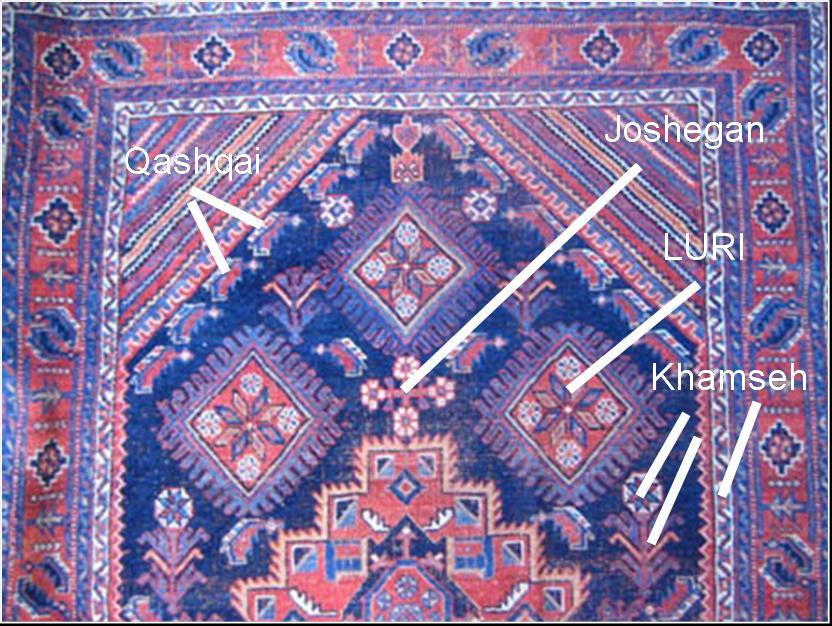
Posted by Jack Williams on 06-08-2007 04:49 PM:
one short, one long
James, a very reasoned essay.
But...I just do not see a common aura
emanating from Afshar and Quasquai or Bakhtiari rugs. The Khamseh are an
artificial construct and they include a sister tribe to the Afshar, the Baharlu,
another of the 7 Kizil Bash tribes of Azerbaijan. Still, almost no one mistakes
an Afshar carpet for carpets from Fars province dispite some common
elements.
There are a lot of more recent (post 19th C.) more urban
looking crossover carpets attributed to the Afshar, with sophisticated roses,
chickens and "stuff." But Tanalvi did a lot to pare away some of what is called
"Afshar" and tentatively assign it to other groups, villages, workshops. I think
this may be some of the truth about the Afshar...and after winnowing the chaff,
we might find that the isolation of rural Kerman province has acted as a
preservative.
One reason the Afshar may seem to have some non-tribal
elements is that in Kerman province, they pretty much were the tribal
element...no Kurds, no Tekkes, no Aimaqs and only a few Baluch. Any new designs
were extra-tribal. Heck, in Khorrisan, there were so many tribes butting heads
urban designs couldn't gain traction even if they could be imitated in a tent.
Jack
Posted by Jack Williams on 06-08-2007 04:51 PM:
Tekkes, Turkmen, medallions, and Zorro...
Good evening all.
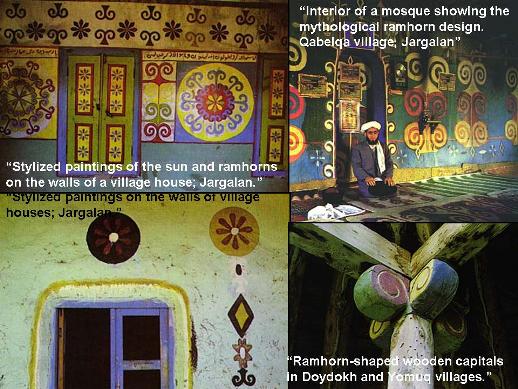
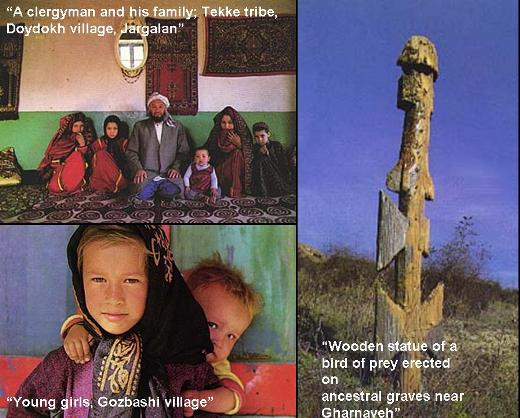
Above are some pictures from a 1997 photo essay, ”Envy”,
about the Turkmen of Iran by Nassrollah Kasraian (see: http://www.iranian.com/Arts/July97/Turkman/index.shtml)
These pictures show drawings on the walls of Turkmen dwellings,
including a mosque, and the photo comments by the author seem to leave little
doubt about the ram’s horns and connections to Zoroastrianism. I’ve included
other pictures of a Tekke mullah and his family to show that Turkmen do/did put
carpets on the wall.
Since rugs from a lot of locations feature many
symbols a lot like these that are connected especially to Zoroastrianism, to say
that only one rug has the Ephedra plant and a Zoroastrian connection may not be
exactly correct. There are a lot of borders in rugs that could be Ephedra
...heck... half the elems on Tekke chuvals may feature that plant. Obviously
Ephedra had a special significance and still does. If illustrations of opium
poppies are ubiquitous, especially on Afshar rugs, why not accept that Ephedra
could also be commonly represented for exactly the same reason?
It seems
to me we should not be hasty in dismissing attempts to understand symbolism in
tribal weaving, whether botehs, medallions, or guls. Perhaps there are only two
basic optional concepts for the origin of emblems and rug design...or “tribal”
art for that matter. Either (a) the common themes originally had serious
meaning for the people who wove them, or (b) the designs were just
off-hand sketches of a slice of life in the wild...like an impressionist
painting or like a modern existential thought. I tend to opt for “a” for those
patterns that repeat through history.
In my opinion, tracing carpet
designs almost has to be done in the social sciences, outside of simple carpet
analysis. That broader academic approach is needed to check basic
assumptions. For instance the oft repeated belief that the Afshar were absorbed
and their native designs subsumed by the ubiquitous and numerous “Persian
villagers” after they were moved to Kerman area at the beginning of the 17th C.
might need to be questioned. To be true, the demographics of that area in the
16-18th centuries should fit the theory, yet apparently the Persian rural
population in the province was quite small in the 16th C, and got a lot smaller
in the next 200 years. That idea may be an urban legend and the crossover rugs
are not really "Afshar" at all.
Re: Medallions and guls: I don’t
think discussing the Ardibil carpet adds much to understanding the motifs of the
Afshar. It is as hard for me to accept that carpet was the original prototype
for all “central medallion” designs is it would be to think the Prazyzk
carpet was the very first carpet ever made. I supposes we could go into
the morass of published history of medallion carpets...Seljuk, Ottoman,
Mamluk...but I don’t know if that would shed any light on gul designs on an
Oghuz tribal carpet circa 1050-1600 AD.
As far as China as a source
of weaving design, Bidder demonstrated that China had no rug weaving
culture, and indeed the Chinese distained such weaving as barbarian
until commercial production began in the 19th C. I concede it is possible that
Chinese art influenced some designs used in rugs. But even this seems to me to
be a lot more speculative than our attempts to trace Afshar designs.
Sophisticated designs in felt were found with the Prazyzk carpet...were they
also “Chinese?” For the Oghuz gul question, it might not be very germane to note
the “Chinese look” of certain motifs, because to define the Chinese
look would require an extensive discussion of ancient Chinese art, which
changed considerably through time.
Bidder takes another tack in
addressing the origin of guls. He seems to emphasize the relations to
proto-religious Zoroastrian influence, and the influence of Tibetan themes
including Buddhism. The Tibetans controlled E. Turkistan and dominated a lot
of central Asia for an extended period 2,000 years ago. Just for grins, below is
a “Khotan” carpet. Of course this is recent (100-150 years old) but Bidder takes
pains to trace the origin of design in these E. Turkistan oases in great detail.
His book is really worth the read.
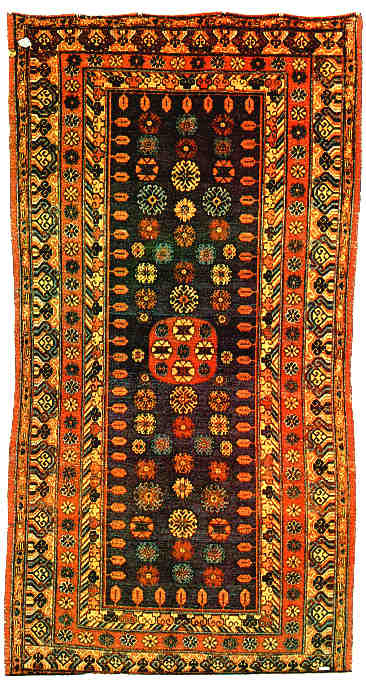
In any case, the Seljuk’s,
including the Afshar, were all Turkmen...and a goodly batch of them ended up in
Anatolia, the Caucusus, or Azerbaijan. Either they brought indigenous designs
into that area with them, or they learned it all from the Armenians, Kurds, etc.
Whatever the truth is, there are a lot of gul/medallion-looking devices on
Anatolian, Azerbaijani, and Caucasian rugs now.
Regards, Jack
Posted by Camille Khairallah on 06-08-2007 06:11 PM:
Hi all,
I agree with what Mr. Blanchard put forward but I would like
to correct two suggestions:
1 - The diamond-shape medallion with its comb
edges and its "snowflakes" is rather first Feraghan before being Luri or Koliai
Kurdish.
2 - The eight-pointed star inscribed in the octagon is Anatolian
Turkish -in rugs only- before being South Persian.
But moreover, what is
evident for me, this type of Afshar central medallion and the one with the two
vases was directtly borrowed to Khorassan rugs (cf. Walter Hawley plate 1).
First polylobed, and it appears in some Khamseh as so, than geometrically
rendered to become "stepped" in the Afshars. We should also bear in mind that
Khorassan was one of the few carpet-manufacturing centers to persist during the
18th and through the 19th century in Persia and I guess it would have been a
stronger source of inspiration.
Regards.
Camille
Posted by Horst Nitz on 06-08-2007 09:56 PM:
Hi James and
all,
quote:
--------------------------------------------------------------------------------
The
intriguing element in all this is that all of these designs, and others, are
derived from outside sources, and there is little, if anything, we could
describe as indigenous to the Afshars
themselves.
--------------------------------------------------------------------------------
It
seems to me that it would be correct to apply this Eiland statement evenly to
all other tribes as well, because we now next to nothing as to what their
indigenous designs were.
The Afshar arrived as one of the earliest
groups in Asia minor and have during centuries probably picked up more designs
and re-distributed them in their encounters than any other tribe, when
immigrating south and east. Therefore, looking at the process from an
alternative perspective to the one you put forward, it would not surprise that
the Afshar show a wider spectrum of designs than other tribes. It does not
imply, that the designs now displayed by their neighbours and earlier encounters
"more consistently" indigenously are theirs.
In this earlier thread: http://www.turkotek.com/mini_salon_00016/ms_16_t1.htm I have
compared some early Anatolian rugs with later Afshari rugs on a structural
level. It does not answer what the Afshari indigenous designs were, but allows
assumptions as to what the early influences on
them.
Regards,
Horst
Posted by James Blanchard on 06-08-2007 10:29 PM:
Hi Horst,
I suppose I shouldn't be in the position to defend Eiland's
statement. I am still trying to understand what he meant by it.
Your
theory of the Afshar diaspora as "disseminators" of designs that they picked up
here and there is an interesting one, and I suppose that if we see these designs
in other tribes' weavings they could have originated from the Afshar. But then
these other tribes seemed to have settled for a more consistent design pool,
while the Afshar seemed to continue with their more eclectic ways.
In
contrast, the Baluch seems to have spread more by assimilation than by
dispersion, which might explain how the "Baluch style" is characterized by wide
variety but with a distinctive overall aesthetic.
I accept Camille's
correction on the specification of the precendents for those designs on the
first Afshar. I pointed to the use by the local tribes which were probably more
in touch with the Afshar at the time of weaving, even if the original source was
elsewhere. As Horst mentions, maybe these designs came to the Khamseh, Qashqai
and Lori via the Afshar, but then those tribes used them more
consistently.
James.
Posted by Horst Nitz on 06-08-2007 10:37 PM:
Hi James,
thanks for reframing my thoughts so nicely - yes, possibly,
the Afshar in the role of a yeast in the baking of 'rugscape'.
Best
wishes,
Horst
Posted by Camille Khairallah on 06-09-2007 05:54 PM:
Hello again.
Mr. Jack Williams wrote (at page 6):
quote:
Edwards also wrote that most of their rugs were traded, not sold
Whether traded or sold, I guess Afshar rugs amd carpets
followed a market demand and I had observed many over-size carpets belonging to
the -late- 19th century.
Besides, a friend of mine, Dr. Hadi Maktabi, who
just graduated witha PhD. in carpet studies from Oxford told me that during his
research he noticed that large South Persian tribal carpets had entered the U.K.
as early as late 18th and early 19th century(!)
Should we still search
for the pure tribal designs among what is still available to us?...
I
personally, and since quite a while, am nearly satisfied in appreciating
features and values like spontaneity, aesthetics, symbolism (when I can read
it), and freedom of expression in South Persian tribal rugs.
Aren't these
enough to understand a good "piece of art"?
Regards
Camille
Posted by James Blanchard on 06-09-2007 07:38 PM:
Hi Camille,
I couldn't agree with you more with respect to your
approach to the aesthetics of "tribal" rugs. Some of my favourite rugs are those
which exhibit some innovation by a weaver who has the aesthetic judgement and
weaving skill to create something fresh. Louis Dubreuil alluded to this in
reference to the "quasi-tribal" rugs of the settled Ersari of the 18th and 19th
century in this thread (MAD
Ersari). Louis summarized this creative freedom as arising from a weaver
"with a great tribal experience but with the freedom of a person who is not yet
under the control of the tribe's eyes ("my daughter you cannot make this type of
design because this is not OUR tradition")".
Cheers,
James.
Posted by Jack Williams on 06-10-2007 03:12 AM:
the last word?
Good day all…this post is dedicated especially in honor of the recent world
wide celebration of my twin brother's birthday, which occured in real time two
days after D-Day.
I can certainly agree with James' last statements. I
think this is my last post in this line. There are so many pictures you may
think I’ve lost my mind…but they are needed, I think...because I feel it is
important to make sure we do not leave this line with an erroneous impression.
For review, here are some of the rugs that were a subject in this line.
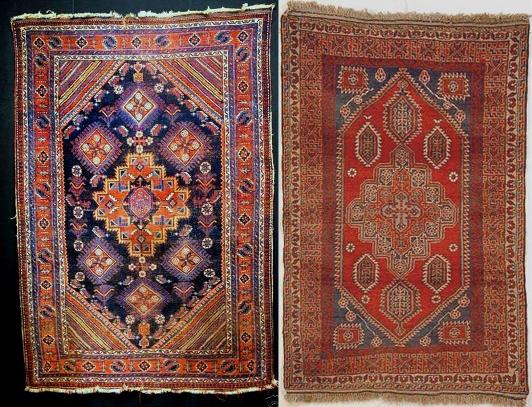
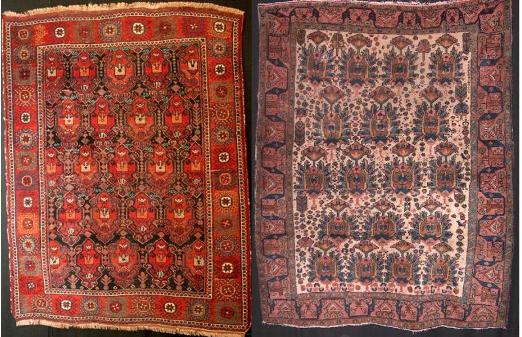
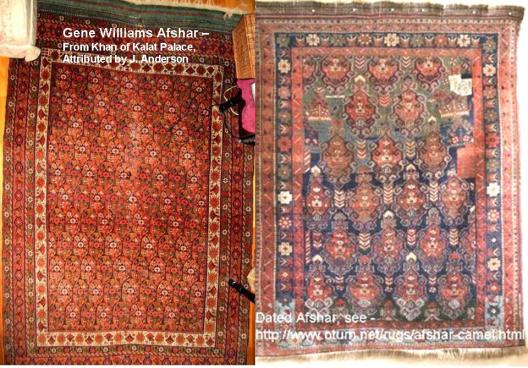
I do not agree with the
impression that Afshar rugs have no identifiable devices and employ urban
derived motifs. As Horst noted, virtually this same statement could be
offered about almost any “tribal” group.
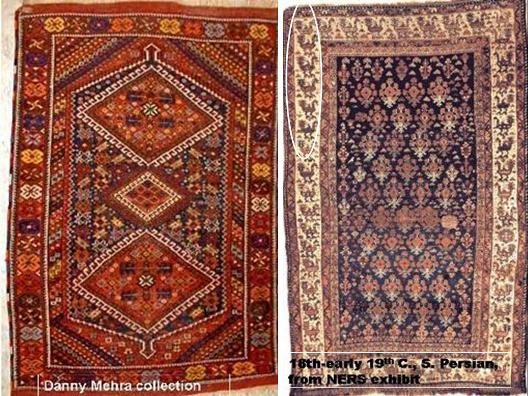
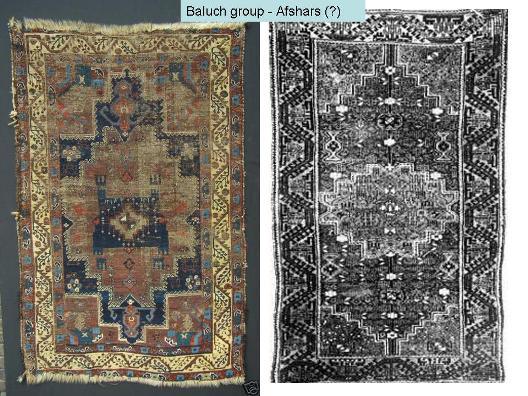
(The rug on left was
attributed to Baluch and posted for sale, since removed, and is dated to 1219
=1805 [or 1840 if persian calandar]. add ed: that sure looks like Ephedra in the
border, echoing that border on Horsts rug post!)
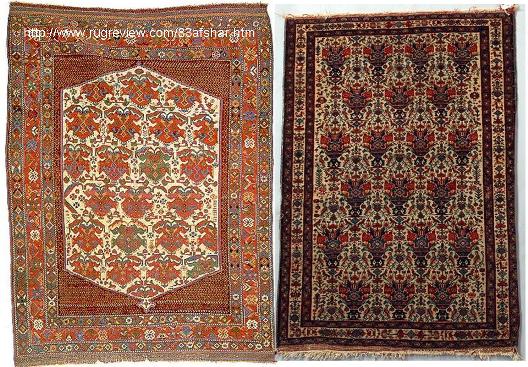
Above are more rugs shown in
this line along with a couple of additional examples. Yet throughout this
line, no one has shown any of them to be “un-tribal,” “un-nomadic,” of “urban
origin,” “borrowed from urban design” or even “copied from some other
group.” James showed some symbols that are common to other Turkmen tribal
rugs…but in my opinion none of the rugs of those groups have the aura of Afshar
rugs. And the ones shown above are all easily and eminently identifiable as
Afshar. By definition like Baluch group rugs, Afshars must have some features
unique to them.
Lets go to the mattresses with some quotes. Cecil
Edwards: “…The principal trading centre of the Buchakchis is Saidabad
(Sirjan) and of the Afshars, Baft. But the nomads prefer to barter their rugs
against tea, sugar, cotton cloth, needles, thread and other commodities – which
the traveling hucksters bring to their encampments – rather than to sell them to
the crafty dellals of the bazaars of Saidabad and Baft.”
Edwards then
discussed village/nomad conflict and interaction and made a point of noting that
the villagers apparently came to weaving after the nomads of the area, partly
shown because they … “borrowed designs and colours from the tribesmen; and
the tribesmen have, in their turn, borrowed from their neighbors a few designs
which are obviously Persian…”. He repeatedly emphasized that the provincial
villagers exclusively weave Afsar patterns… except ” in the immediate
vicinity of Kerman…the villagers – if they weave at all – weave Kerman
carpets.”
He went on to say:
“The designs used by the
Afshari tribesmen (and borrowed from them by the villagers of the area) are
unlike the designs of any of the Persian tribal or village
weaves…
"...Many of their designs are original and
striking…"
"...Their medallion patterns on plain or partly covered
grounds are superior to those of any of the tribal or village rugs of
Persia…”
In my opinion, it would be darn hard to convert those
statements into a perception that the Afshar designs are Kerman-urban or copied
in nature. Edwards does show two-three rugs, that he clearly identifies as
being copies of Kerman designs (see below) but they are not the medallion
designs. Edwards pointedly does not identify the other examples as Kerman-urban
derived designs.
Furthermore, Edward's comments about village-nomad
populations reflect 1950 demographics. In 1800, the entire population of
Persia was 50 percent nomadic...and when the Afshar originally arrived in
Kerman, it is possible, even probable that the outback was essential
unpopulated.
So where does this impression about the urban source and lack
of native of Afshar designs come from? I don’t think there has been a paper
about this. So, I think it all must be sourced from the opinions expressed by
Mr. Eiland. Here are his quotes from “Themes in Afshar Weaving,” see - http://www.rugreview.com/83afshar.htm
“The type
most obviously derived from city rugs is the medallion and corner design…rural
adaptations of the medallion design from the region near Kerman…The intriguing
element in all this is that all of these designs, and others, are derived from
outside sources, and there is little, if anything, we could describe as
indigenous to the Afshars themselves...”
He is not completely
consistent. Here is what he said in his book, Oriental Rugs, Expanded
Edition, Little, Brown and Company, 1973, p.92-3.
“Medallion
designs are common, particularly a variety with a stylized vase and flowers…a
stiff central medallion, and corner pieces drawn in the same style. The
medallion has many features in common with figures found on certain Karabagh
and Khurassan rugs, both of which may also have the same vase and floral
elements.” [emphasis mine].
But in that book, Eiland had a
caption to a picture of an archaic looking rug…for all the world similar to the
most archaic “outback Afshar.” “…Often Afshari rugs appear in crude,
rectilinear adaptations of Kerman city rugs….this piece is certainly suggestive
of the Kerman medallion and corner designs.” My comment… “com’on
doc, you have to be kidding!!!” Below is a typical Kerman medallion rug
and next to it is an outback Afshar. What is not obvious is the size difference.
The Afshar is about 1/10 the area of the Kerman.
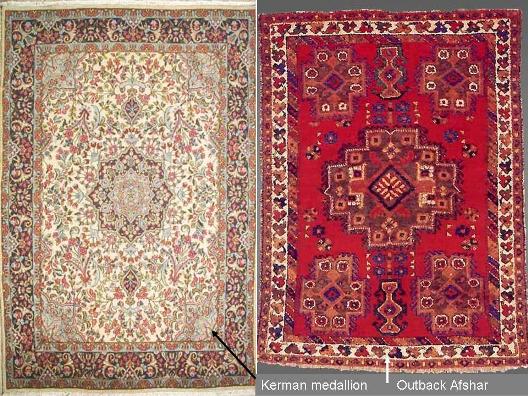
Well, what about bags? A lot of
knowledgeable people think that Afshar bag faces are by definition tribal. Here
are some examples:
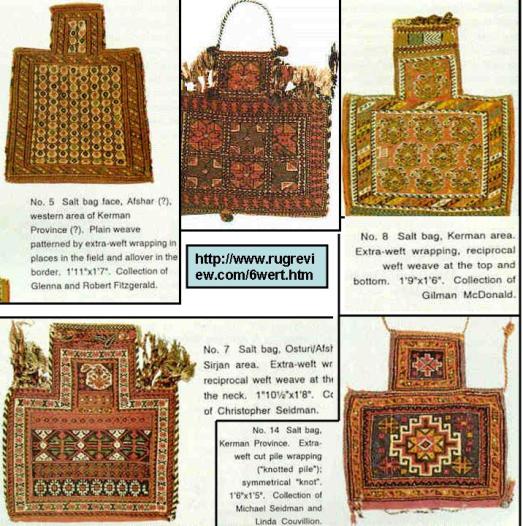
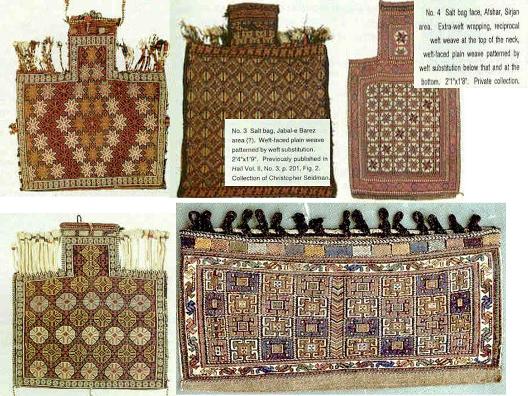
What
does Mr. Eiland say? “Even their bagfaces…ordinarily display such derivative
designs as the boteh.” I am thinking that maybe his whole theory was formed
from some impression, perhaps some statement from long ago, because there has
not been any scholarship that I am aware of.
Below are two more bags
from the nether reaches of the outback of Kerman province. Of special importance
is no. 2 with the classic outback Afshar stepped medallion.
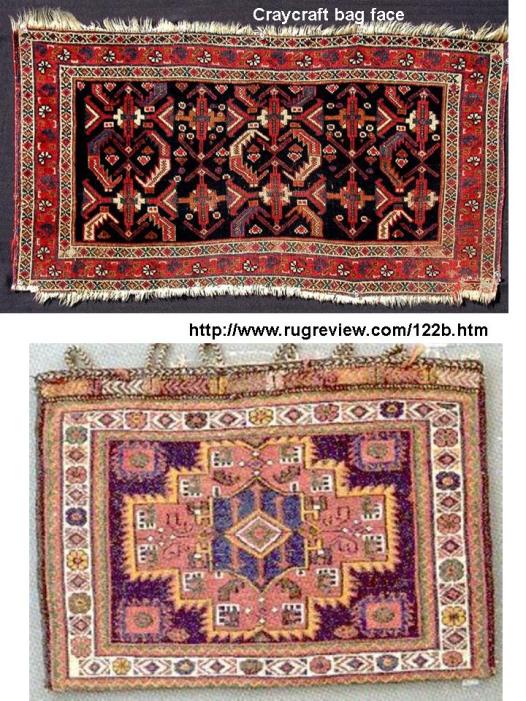
How Kerman designs would be
transferred to nomads in Kerman provence, when "Meshed" designs were
unincorporated by tribal weavers in Khurrisan is not explained by Eiland, nor is
the source of other "copied" motifs. And...
I find it very hard to
connect the characteristic Afshar medallion to any of those exquisitely
elaborate Kerman medallion rugs (and it would be interesting to understand just
when Kerman city switched to weaving rugs).
The proto-Afshar stepped
medallions are found in both Azerbaijan and Khurrisan, presumably products of
Afshari designs that are 400 years removed from Kerman. Logically the use of
that medallion predates the Kerman-Afshar connection. And given the almost
omni-Turkmen theme of 2-1-2 medallion type rugs everywhere, from the Ersari to
Anatolia, is it at all reasonable to claim the Afshar adaption is a Kerman
urban imitation?
In my opinion, Mr. Eiland is probably wrong
about this…and he certainly offered no explanation or examples. I think
his statements should be disregarded by the jury absent further author
explanation.
Regards, Jack
Posted by Sue Zimmerman on 06-10-2007 11:37 AM:
Happy birthday, Gene, and Jack! I've got one of those coming up this week,
too.
Jack, I stand by my own assessment which does not rely on rug book
writer's assessments. I hadn't read them until they came up in this thread. I
can't give you a list of references because, so far as I know, my basis of
assessing such issues hasn't reached Mainstreet.
Designer tradition and
weaver's traditions are two different traditions. Sometimes they arrive at a
loom at the same time but most often they don't, believe it or not. I didn't
mean to single out the Ashfar "tribe" as being alone. Just that these two
traditions seem to have parted earlier with them than most. Sue
Posted by Horst Nitz on 06-10-2007 03:08 PM:
Gene, Jack,
Happy Birthday to you from this side of the
Atlantic,
Horst
Posted by Marty Grove on 06-11-2007 09:49 AM:
Is it or aint it?
G'day Jack and all,
Here is one which perhaps (cautiously) may be of
the latest generation from the Afshar remnants in Khorrasan.
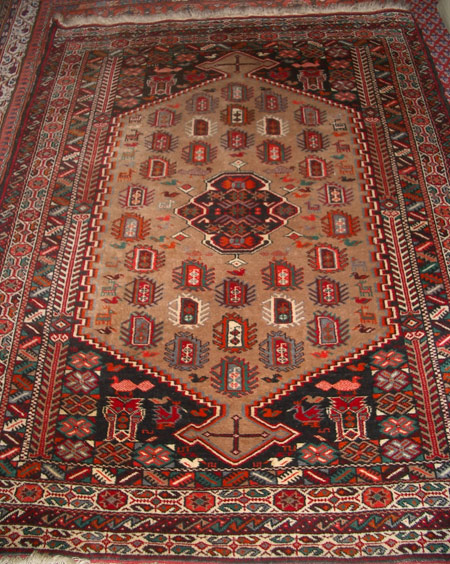
My dad bought this
secondhand in the 1970's at which time the rug was in very good condition. It
had a couple of small stains which remain, not so visible though, and was in
full pile of about quarter inch tall.
When I wrote my description last
friday I was at work and writing from memory, (not a good idea) and it has only TWO cords in the
selvedge not 3, and has only a half inch flatwoven end band of two stripes, not
1-1/2"x 3 stripes (thats from another) otherwise my memory wasnt too
bad...
Whilst this little rug - 4'11" x 3'x10" has a huge variety of
elements, to me it does not come across as 'busy' in the way some do - the
colours has mellowed rather well, and the orange and greyed blues are not
jarring, in real vision.
It has something from a lot of types of rugs in
its design and foundation, of which I think turkmen, azerbeijan, qashgai and
kurd can be found along with afshari, however given my total inexperience in
really being able to identify something like this, I offer it to those who may
have more to say about it.
Regards,
Marty.
Posted by Camille Khairallah on 06-11-2007 12:13 PM:
Hello to all,
First, I would like to precise that I was talking in my
last post exclusively about South Persian tribal carpets and did not have the
intention to generalize as it could have been understood.
What I was also
talking about is commercial v/s non-commercial weavings, and of course there are
many degrees to consider in both categories. The question is:
were large l.
19th / e. 20th c. Afshar carpets (reaching sometimes 30-35 sq. meters) made in
the purest tribal tradition? Where they made under tents? Weren’t they affected
by a certain demand? Weren’t then the small rugs woven with the same
mentality?...
Now weather a 30 sq. meter carpet was bartered against one ton
of needles, 3 tons of sugar or a few pieces of gold is another question… But the
fact is that it exists in a Beirut palace, built late 19th c., and owed by a
Lady in her late 80s who ascertained that all the carpets in the palace were
there since her little youth i.e bought by her father at the
earliest.
Talking about having the control of the tribe’s eye, I guess
the Afshar might have not have it, and the Khamseh were even freer in the
conception process. Still, I wonder whose eye were they under the control of...
and if it was the tribal eye James, it should have been to perceive things
differently …
Another question (related to the first): where are the pure
Afshar rug designs?
For me, as for Dr. Eiland, most of the Afshar designs (if
not all) are descending from urban or other village types. If my first
revelation about the central medallion -+vases- in my first post in this thread
was not enough satisfying, it is no use posting other demonstrations for other
designs. Anyway, I shall explain the origin of two of the major Afshar designs
(that are related to very far villages) in a publication that will hopefully
appear next year.
I finally wish to address my thanks and a great respect
to the people and to the souls of people who contributed in the carpet field
through their “good / or basic references” (never “bibles” as often attributed)
and also to those who published wrong thoughts or ideas that incited me to find
the "more" correct.
Also I wish to admit that till my very last minute, I
will remain a great ignorant because I am fully aware that no one will ever
reach the ultimate truth…
By the way, sorry James for having used at first
the verb “to correct” that sounded a bit pretentious but, although you approved
the comment, I admit there was a too quick reaction in this verb. I am
French-educated and do not always give my sentences the right shape .
Regards
Camille
Posted by Gene Williams on 06-11-2007 12:45 PM:
Dr. Eiland on the Afshar
Gentlemen,
I've read over Dr. Eiland's ORR article on the
Afshars:
http://www.rugreview.com/83afshar.htm
Two things strike
me:
... (1) The very tentative nature of his conclusions... Perhaps he
was being cautions but most of these conclusions (Afshar weave in city designs)
apparently were based on one show. See the above article.
... (2) In the
above article is pictured an Afshar from Azerbaijan (figure 2). And there is
mention of Afshars from Khorrasan (last paragraph).
Happy reading to you
all. Based on this read, I'd be very hesistant to draw firm conculsions based on
Dr. Eiland's article...I'd be much more likely to take a look at the Afshar in a
fresh light..such has been shed by this tread.
Gene
PS. There is a
second Afshar article in ORR I can't access. Here is the cover of that
issue...Afshar, dragon and Phoenix design, August/September 1993.
http://www.rugreview.com/orr/or136cov.jpg
(its pictured
in Jack's spread above). But there are two articles on Afshars in that issue I
can't access; If anyone has the issue and can scan the articles, I'd certainly
enjoy reading them (Steve, I know you published in ORR...might you have these
articles?):
Lead Article: The Dragon and Phoenix, by John J. Collins,
Jr.
Deconstructionism in Afshar design
Posted by James Blanchard on 06-11-2007 12:54 PM:
Not only Eiland...
Hi Jack and all,
Again, without expressing a strong opinion of my own,
I would say that it is not only Eiland who seems to disagree with Edwards. In
fact, Ian Bennett shared a surprisingly strong opinion about Edwards' views
about Afshar weaving, and in particular a quote that Jack emphasized in his most
recent post. From Bennett's book "Rugs and Carpets of the World" (2000 edition,
p. 241):
quote:
However, it is impossible to agree with Edwards' assessment that Afshar tribal
rugs are 'unlike the designs of any of the Persian tribal or village weaves'.
James Opie, in "Tribal Rugs: A Complete Guide to Nomadic and
Village Carpets", also echoes the viewpoint that the Afshar's designs were
heavily influenced by others. He writes: "Whereas other south Persian tribes
borrowed carpet designs from various distant urban workshops, Afshars were
strongly influenced by those of a relatively nearby center, Kerman". A bit later
he concludes: "The various streams of influences in Afshar work account for the
periodic discovery of yet another unidentified patttern, often tied to design
sources far removed from the tribe's nomadic origins". In discussing various
Afshar rugs, Opie clearly feels that some of the recognizable Afshar designs are
the result of the "tribalization" of urban designs. He illustrates this with two
rugs (plates 12.12 and 12.13). The first, is a "workshop" product with a central
medallion and corner spandrels. The "tribalized" version retains unmistakable
echoes of the first, but in a more "relaxed" format, and with the addition of
"tribal" motifs such as human and animal figures and hooked medallions. I would
mention that the second "tribalized" version of an urban design is very similar
to the examples that Jack showed with central medallions. Perhaps if someone has
a copy of Opie's book and a scanner, they could post those two rugs for
illustrative purposes, unless we are already to have this thread ride off into
the sunset.
Okay, enough from me on this.
Cheers,
James.
Posted by Gene Williams on 06-11-2007 03:49 PM:
Central Medallion and Corners
Hi James,
I can't comment much except from looking at the above
thread. It appears Opie et. al ....attacking Edwards..believes that all
Medallion and Corner designs originated in a city somewhere ... ergo..Afshars
are urban designs. Toss aside that learned literature and take a fresh look. Do
any of the above, especially the bags, look city? Really?
We all know
the power of published word..but it doesn't necessarily make it true. At some
point someone needs to point out what's possibly wrong and possibly right.
Edwards was wrong on occasion. O'Bannon certainly was. And I can't accept the
word of Opie or Eiland on Afshars, based on the above, without more evidence.
I'll say looking at the evidence of the Afshars Eiland studied...they are very
very sophisticated carpets with a very high knot count..the type a sophisticated
dealer would push....and.....I'd have a hard time putting them next to the
outback Afshars which have been exhibited above.
You guys have looked at
a lot of rugs....What do YOU think...not Opie or Eiland? Those Afshars and those
Afshar bags look "tribal" to me. Or do you in the end believe ALL central
medallion/4 corner designs are city? (And I'm just a guy at the bar with a drink
- Scotch usually - usually not John Howe's Islay though I have to admit its an
incredibly special taste - in hand with an opinion.)
Gene
PS. I'd
Kow Tow to established rugdom widsom if I hadn't been so rudely disabused of the
actual level of scholarship and informed of the realthink level of salesmanship
involved in the trade by a visit to London's finest "rug scholars" and
"auctioneers" in 1978...on which I've commented previously. I mean, JACK cASSin
is a "rug expert" right?
PPS. Marty...I'll let the Afshar gurus have at
your companion to the dogpound...by the way, is dogpound "Afshar" too?
Posted by James Blanchard on 06-11-2007 10:01 PM:
Hi Gene,
You asked for my opinion, so I'll try to restate it. I agree
that many Afshar rugs are distinctively and recognizably "Afshar". I also agree
that they very often do look "tribal". What I find to be recognizably "Afshar"
is a rug that has an eclectic mix of urban and tribal motifs, that have been
creatively blended to create an innovative design. Generally, the more urban
elements (like vases and botehs) get a tribalized makeover, whereas more tribal
elements like human and animal figures, latch hook medallions, and various
borders look to be the same as those used by other regional tribes (notably the
Khamseh and Qashqai). Overall, it just strikes me that the Afshar had more
exposure to a wide design pool, and were open to incorporating other designs
into their weavings. Other than a few examples, such as the "Outback Afshars", I
see their incorporation of other designs as being a bit less "conforming" as
when the Baluch do it. In other words, I often see Afshar rugs that have
incorporated design elements that are associated with other tribes without
transforming them very much. In contrast, I find that in Baluch weavings, the
incorporation of other elements get a noticably "Baluch" transformation. I agree
that the bags and flatwoven articles of the Afshar are noticably tribal and they
tend to be less eclectic. Maybe they are woven in places and for purposes that
are less influenced by other groups. Anyway, those are my observations on this.
Notice that I haven't tried to address the ultimate question as to which came
first, city or tribe. I'll leave that to others.
Finally, I haven't met
anyone who professes to be a "rug scholar", but I find the writings of Eiland,
Bennett and Opie to be at least well presented with some research and experience
evident in their conclusions. I think lumping them with Mr. Cassin and the
others you describe seems a bit harsh.
James.
Posted by Jack Williams on 06-12-2007 12:47 AM:
lets look at brass tacks...
"Lets get down to brass tacks"...an old frontier American expression...means
"...specifics please."
James.
I doubt Gene was equating these
people to Jack Cassin. His point was to think for ourselves absent some decent,
credible and repeatable research. Reputation doesn’t equal infallibility. And
opinions without a thesis, argument, and synthesis are just another thing
everyone has.
What constitutes the sum of research for Afshar rugs?
About 8-10 articles or short book sections by Edwards, Tanavoli, Opie wrote one,
Tom Cole, Ford, Stone, and Eiland. There isn’t a good definitive scholarly
dissertation devoted strictly to the Afshar, as there is to Baluch, and a lot
more dedicated to the Turkmen, Kurds, etc., that I know of.
What some
of these articles have seems to be simply some circular scholarship. How do
I deduce this? Because of the repeated avowal of the “Kerman-urban” source of
those Afshar stepped medallions. That is probably demonstrably unlikely even
without applying Occam’s razor.
To believe that the Afshar waited
until arriving in Kerman Provence in the early 17th C. to suddenly have that
ubiquitous Turkman 2-1-2 design brought out to their camps by some
Persian court rug weaving designers from the city is incongruous to say
the least. And without some scholarship, more than just “that looks like a
Kerman rug” the argument is nothing but speculation, informed though the authors
may be.
The weakness of that one argument raises questions about the
veracity of all the opinons, comments, value judgements about origin, etc.,
whether Mr. Eiland was purely thinking out loud or transmitting an early
prejudice or whatever. If others, Opie and Stone for example, accepted his
thoughts, as seems possible, they also possibly built on sand, and it
wouldn't be the first instance in rugdom.
Simply put, the Afshar
medallion rugs likely have little or nothing to do with the fantastic ornate
Kerman commercial rugs, and I doubt that most of the rest of the common
Afshar designs have much to do with Kerman designs either, excepting those
obvious commercial weavings such as the frankish rose.
Camille...Edwards
addressed your large cotton warped village workshop rugs in some detail ... but
without dismissing them, seemed to assigned them out of the Afshar mainstream,
to villagers, not Afshars per se.
I'm not ready to show them, but I've
some pictures of a series of 2-1-2 rugs from Anatolia, NW Persia, Caucasus,
Kerman, Khurrison, Turkistan and East Turkistan that seem to form a creative
whole. They could-might show the development of the Afshar medallion,
complete with the flames…possibly traced back to East Turkistan and Buddist
influences.
There is a visual similarity of the traditional stepped
flaming chair of the Budda to the Afshar "flaming" medallion (I
almost can picture an ancient late night Afshar ceremony, the principles
standing in a circle dressed in white peaked-hats, masks, white robes with
cruciform designs, facing a huge flaming cruciform…uhhhhh). I will
say this…the group of rugs I've been trying to tie into a chronology seem to
have a lot more interrelationships to each other than to a Kerman-medallion rug,
or the Ardebil carpet for that matter. Heck, that 2-1-2 motif is found in
Seljuk, Ottoman and Mamlukes, Turkomen all.
There is one thing that tends
to bother me academically regardless of the reputation of the authors, whether
on this board or in published papers. That is, a comment so generalized, without
illustrations or examples, that it almost cannot be replied to (ie:
statement: “Turkmen rugs have the individuality of Kudzu leaves”…;
rebuttal: ”No they don’t!”…; counter: ”yes they
do…!!”, etc.)
It is impossible currently to go to Iran, find some 90
year old Afshar people, and ask some questions and it has been for 25 years.
Unfortunately, those 25 years corresponds to the development of true rug
research. I guess we will have to rely on what info we have. But that doesn’t
mean we have to accept speculative and erroneous data even if it is disseminated
by the most respected researchers in the business.
I am open to
be convinenced otherwise. But I've looked at the topic with hopefully open
eyes...
Regards, Jack
Marty, great interesting rug,
especially the unusual camel ground field, which I guess is your connection to
Kurrisan Provence. I love the impact of the two white-bordered botehs(?) and the
plethora of ducks, fowl, etc. One's eye is caught by a lot of traditional Afshar
elements and individial colors...but with an overall faint alian aura. I think
that comes from that odd middle border, and the other light-background outer
border, the one's with almost a Shahsevan pattern. Hot-darn, ducks are
overrunning the place!! I'd like to see the "dog pound rug" again as well
juxtaposed next to your "Afshar duck pond rug."
Posted by James Blanchard on 06-12-2007 01:41 AM:
Hi Jack,
Now that we are down to "brass tacks", I will just offer a
few final observations.
First, I will admit that my views are largely
uninformed, and my first responses in this thread were based on what I saw in
the Afshar rugs that you posted. I saw a number of designs that were
recognizably and more consistently associated with other weaving groups. If
designs are shared by more than one group, there are a couple of ways this could
have occured: 1) the groups borrowed them from each other or, 2) both groups
borrowed them from a common third source. Using my own logic, I assumed that
since the Afshar seemed more prone than others to "mix and match" designs from
other neighboring tribes and seemed to have a very eclectic design pool, perhaps
they were "borrowers", and not just originators and disseminators. I agree that
my logic could be flawed and have admitted the possibility that the Afshar are
rugdom's "Johnny Appleseed", disseminating a large and diverse design pool
hither and yon. But if the Afshar were largely the originators and not the
borrowers, would we then surmise that the vase designs and botehs that show up
on so many of their tribal weavings also originated with the Afshar? Is a vase
with a bunch of flowers a meaningful tribal symbol?
In support of your
thesis, you extensively quoted Cecil Edwards, which I think is appropriate. But
I think it is then also appropriate to see what other writers have to say about
the topic, which is what I did by quoting Eiland, Opie and Bennett. Edwards
might be correct, and they might be wrong, but I think it is helpful to note
that there is no unanimity of opinion on this matter.
Finally, I think it
quite possible that some of these inheritance of design is more complex than we
think. For example, I imagine that it is possible that urban weavers adopted
nomadic tribal designs, and elaborated them. Thereafter, subsequent generations
of nomadic/tribal weavers could have re-adopted and tribalized these designs
from the urban workshops.
Whatever the case, I think we should all keep
an open mind unless there is strong evidence pointing in a particular direction.
Above all else, let's continue to enjoy the rugs!
James.
Posted by Jack Williams on 06-12-2007 01:53 AM:
d'accord
James, nice summary. I agree with all of it. I hope we can all re -arm and
prepare for the salon to come...after a decent break of course.
Regards,
Jack
Posted by Horst Nitz on 06-12-2007 03:29 AM:
Hi all
I think it is an unfortunate misconception on Opie`s side to
assume plates 12.12. and 12.13 being 'tribalized' derivates of Kerman town rugs,
a misconception that is due to a rather mechanical application of the art
historic concept of designs being handed down from court to town to tribe.
Plated 12.12. and 12.13 are more directly linked to 16th century rugs like the
Ardabil and its predecessors, probably the early Star Usaks, all originating
from a wider region where the Afshar had settled for six-hundred years (Eastern
Turkey and Azerbaidjan). There was no need for the nomadic Afshari to pick up
those designs in the 19th century when the increase of demand from the west set
in, this was done by town dwellers who had not been weaving rugs before or had
not done so very actively for a long time and suddenly saw a bussiness
oportunity in it. But even those, as far as they were ethnically Afshar, would
have taken to those designs like fish to water. Because of the long association
of the Afshari with those designs it would have struck a cord inside them that
was perhaps slumbering, but all ready to answer.
At this stage there is
nothing new to learn about he Afshari from Opie and I refrain from scanning
those two plates.
My appreciation to all of you who started this thread
and kept it going over such an extraordinarily long
distance.
Regards,
Horst
Posted by Marty Grove on 06-12-2007 08:16 AM:
To the dogs
G'day Gene,
Why am I getting the feeling my taste is in the
doghouse? Well, one anyway,
the last put up was my dads taste, although I must admit I like its 'carnival'
atmosphere.
My doggy rug from the past, which was apparently from Quchon
also, has been tentatively identified by a dealer as a possible, he said "Afshar
type, from the bush"; in Oz speak I suppose he was suggesting some form of
outback Afshar.
Its a puzzle still to me, as is the recent one above -
This last one has had no bites, so I guess its open for speculation as to just
what sort of rug it is...
Regards,
Marty.
Posted by Richard Larkin on 06-12-2007 08:40 AM:
Richard Larkin
Hey Folks,
Chiming in late, I have three comments:
-James sums
up my overall view of what's out there under the "Afshar" rubric. It is very
speculative to posit reasons for how all this eclectic material came to
be.
-I think the label, "Afshar," is a bit of a red herring, in that it
implies there has to be some kind of Afshari solidarity in the weaving. Edwards
makes clear that the term covers a wide diversity of weaving
peoples.
-Jack tends to get wild in this stuff (hooray!), but I agree
with him that the stepped medallion found in many Afshar rugs is not especially
suggestive of Kerman influence. That assertion by some commentators (including a
few of my heroes) feels more like seeing what they want to see on their part.
Looking at the design straight, it seems much more suggestive of early Turkic
vocabulary.
__________________
Rich
Larkin
Posted by Marty Grove on 06-12-2007 08:43 AM:
G'day Jack,
Apols for having missed the last page prior to my reply to
Gene, else I would have replied to you both.
Sure, the camel field
'multiplexity' design, my
recent pic, is an oddity. I have discovered two others on the net in recent
years which somewhat approximate it, but they had different field elements and
no medallion but did have similar colours.
The main border which you felt
had a Shahsevan appearance is actually one thing I felt was Afsharish, having
seen the same border in identified Afshars in Thompsons and Cohens
books.
As for the 'dogpound' rug, thats another weird one; although it
has been suggested it could be one from the 'bush' Afshars, that was only the
opinion of a dealer whom I showed it to hoping for a more realistic
identification - still purely speculative in any case.
If I can grab a
passing camera Ill get another pic of it sorted out, but I doubt it will add
much to the thread.
Regards,
Marty.
Posted by Gene Williams on 06-12-2007 03:19 PM:
well
you guys..(a 2nd person American plural vous...better known south of the
Potomac as all-of- you ..i.e. you all or the contraction y'all).
Well I'm
overseas again with no access to my databases. I apologize for equating a
certain donkey to Opie and Eliand; I have great respect for the latter.
But, from my brief experience in looking a weaving under JA's tutaledge,
35 years ago, Imho both city and tribal carpets are actually woven in
sections...we all know about "repeats." But in tribal memory learning by rote a
"repeat" is especially important (unless weaving from a cartoon). It enables you
to weave tribal designs..and to weave them if you want in an imaginative
fashion.
Now I'd imagine that the Afshar like the Baluch must have asked
their girls..in a non turkoman regimented society where weaving came to be
dominated by slaves and became to some extent "sterile," some questions:
...
Can you weave Stripes? yep..ok put stripes here.
... Now..can you weave a
chicken...yep..put a chicken here.
... Can you weave an opium poppy? yep here
it is.
... Ok stick in some Homa..nice little flowers in the border (and maby
can youl slip in a dog..how about maybe a bunch of dogs while you're at it..and
put them all in a central pound)
... How about a stepped medallion? Voila
(for Camille)..Ecco (for Filiberto)
I think we might have become too
regimented in our thoughts of what is or is not "tribal" (and there are
scholarly articles on the difference between Tribal and Nomad)...(and as you all
know I believe Nomads in the whole area actually were selling/trading carpets
from time immorial..so there was a capitalistic market value assigne to
them..Edwards goes into this).
Finally, in the end, I guess I trust
Edwards more than the others on the Afshar. The Afshars really and truely
existed as a tribe...they were not a phantom...there is historical evidence that
that moved, created, warred and lived up to recent times...and played an
extrodinary part in Persian history from 1500 until recently. The fact they
didn't have a military regime for their little weavers with a forever repeated
tribal design doesn't mean they didn't weave tribal carpets... break down the
elements in those carpets and I think you'd agree.
I can even imagine
that the Afshar tribal genious lay it its decentralization or maybe in modern
terms its willingness to "delegate" to the weaver the design repeats and leave
it to her to create something unusual... And I still believe that those Afshars
pictured above are tribal designs until proven otherwise.
In the end,
even the most urban looking Afshars might be basicaly tribal..after all a 1900
Tekke woven at 240 kpsi with 10 colors, silk in the guls, cotton et. al. can
hardly be called an unsophisticated fabric...just...well...more of the same-o
same-o..something neither Baluch nor Afshar can be accused
of.
Gene
PS. by the way..no one commented on the Eiland notation
in his article of an "Azerbaijan Afshar" which he pictured in his article
(figure 2). Seems rather important to me based on the previous argument about no
Afshars being left in Azerbaijan...but maybe I need another Islay.
PPS. I
have a tremendous respect for two "amateur" observers James and Richard...and by
no means am I disregarding what both of you say. I'm just sort of inching
towards calling the Afshar the Baluch of the Turkomans...and of course I am not
anything approaching a scholar..just a scotch drinker and a sometimes
observer.
Posted by Camille Khairallah on 06-12-2007 07:52 PM:
Hi all,
James, I liked the way you thought it all and I guess one
should hold the key verb “borrow”. Now, that the cities borrowed to tribes could
at a given period be possible but then quite difficult to prove at another: a
square turning into a flower (?). The other way around (tribes taking from other
sources) is much easier to master. As for who borrowed from whom, (from each
other or both from another source) I guess I’ll retain both alternatives.
Before putting forward my modest opinion about “macro” borrowings, I
wish to re-emphasize on what I already mentioned and that seemingly no one
noticed or commented:
I believe the Afshar medallion, before taking a
more tribal stepped rendition was adopted from Khorassan. There is a rug
published by Walter Hawley (1913) plate 1 that could confirm -or at least let
you wonder about- this. For the same medallion (but another arrangement), one
can confer Robert De Calatchi, Oriental Carpets, pl. 20.
Another Afshar
macro /or micro borrowing is related to Opie’s plate 12.11. While baptized by
the author as dragon and phoenix I simply see it a horizontal border of either a
prayer Boursa Anatolian Court rug border, or a 17/18th c. Transylvanian one or
18th c. Basra Ghiordes one or also a late 19th c. Hajji Jalili Tabriz prayer
one. Note that the “repeated borders” is a common feature of the Afshar field
design.
The same design shows on Eiland’s article fig. 2 but without the
rosettes and he sends back the origin of the palmettes to the Harshang.
Nevertheless, I do also wonder why it should be Azerbaijani regardless of the
technical features but the structure of the design IS Southern Afshari. Voila
Gene. Satiafait?
I am
of those who believe that a pure tribal rug should be attributed to the period
pre Nasser ed Din Shah (i.e. pre mid 19th c.) when some tribes still had their
own patterns that bore their own symbols or meanings… a rather small output of a
few tribes (and yet!) that was not yet affected by the market demand.
After
the long period of turbulence that hit Persia and the Persian economy (including
rug production) from the early 18th till mid 19th c. started a revival period,
while Turkish rugs were still selling well into the Occident. There I guess,
regardless from the Qajar Turkic culture and from the Turcoman origin of the
tribes, started the Macro borrowing to many Turkish designs that were then
either Persian rendered or added to patterns inherited from the Sefavid or
Indo-Persian times. This production had more colors and a greater fineness and
with a slight Turkish flavour resulting in a product that would sell better.
Most tribes were affected by that wave and the mentality Gene explained in
detail (can I weave a…?) I believe was incarnated a bit in all the
tribes…
I think this subject needs a thread of its
own.
Regards
Camille
Posted by Steve Price on 06-12-2007 08:50 PM:
Hi People
Here is the rug from Hawley, sent to me by
Camille.
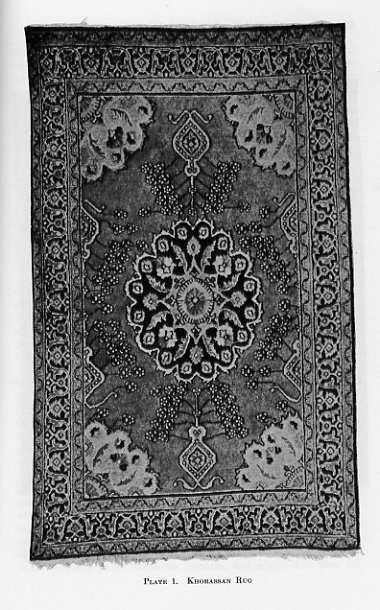
Thanks, Camille.
Steve Price
Posted by James Blanchard on 06-13-2007 02:06 AM:
Hi Horst, Camille and all.
First, I have been careful to repeat that I
don't have strong views about the direction of design dissemination and
borrowing between town, village and nomadic weaving groups. I think it is
possible that these designs went back and forth, with the general observation
that the more nomadic weavers had this wonderful openness to incorporating other
designs into their own weavings.
Even though Horst is loathe to follow
Opie's reasoning, and reluctant to scan Opie's plate 12.13, it is an instructive
one to me, particularly in light of the Hawley Khorassan rug referenced by
Camille. To me, the Afshar medallion and vase in Opie's 12.13 is convincingly
closely related to the design of the Khorassan rug. Again, I can't say which
direction the design moved, and I agree that they both came from a third,
earlier source via parallel channels. However, the commonality of design is
unmistakable, even to a casual observer. What is interesting about the Afshar
rug in Opie (12.13) is that in addition to the medallion and vase design, a
number of animal and human figures, along with some latchhook medallions have
been added to the field, which strike me as being very much a feature of the
South Persian tribes (Lori and Qashqai). In fact, the combination of design
elements seems somewhat odd. You have the echoes of a fairly formal Persian
border, vases with flowers, a central medallion and then a bunch of scattered
animals and humans. We could say this is a "tribal" rug (and I think it is
wonderful, in many ways), but what are the essential Afshar tribal components?
That is harder for me to grasp.
If you go from Hawley's Khorassan to
Opie's 12.13 Afshar there is not much further to go to reach a "stepped
medallion", complete with "flaming edges". But perhaps that is just an eye of
faith.
Sorry if I seem slow to comprehend, or
stubborn.
Cheers,
James.
P.S. Just to show that I am not
prejudiced against Afshar tribal weavings, here is a largish flatwoven bag. I
think it is Afshar, from the Jamal Barez mountains.
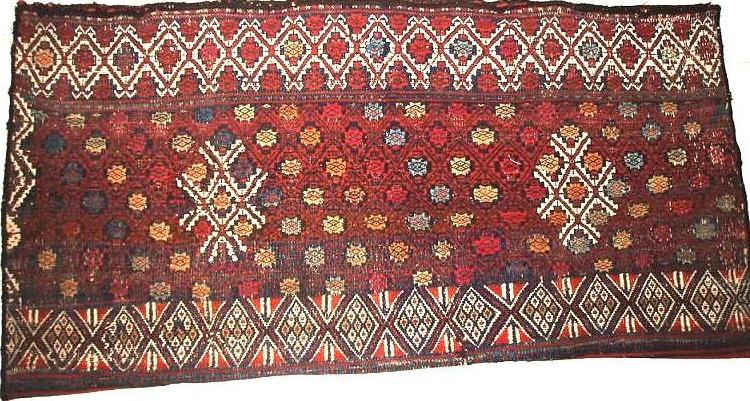
Posted by Horst Nitz on 06-13-2007 02:20 AM:
Hi Gene,
quoting you: "The Afshars ... played an extrodinary part in
Persian history from 1500 until recently."
As far as the aquisition and
processing of rug designs are concerned, the preceding several hundred years of
the Afshar in East-Anatolia would probably have been the more decisive
ones.
and
"... no one commented on the Eiland notation in his
article of an "Azerbaijan Afshar" which he pictured in his article (figure 2).
Seems rather important to me based on the previous argument about no Afshars
being left in Azerbaijan..."
In my post dated 12-28-2006, 04:51 PM I am
discussing a number of Afshar rugs; three of the last four images are referring
to an Azerbaidjani Afshar from around 1900: http://www.turkotek.com/mini_salon_00016/ms_16_t1.htm
Best
wishes,
Horst
Posted by Camille Khairallah on 06-13-2007 10:55 AM:
Hello everyone,
Sorry for my delayed image posting.
I would like to
thank Steve Price for his help in the picture attachments and
posting.
This one, taken from a Transylvanian rug border published in
"Antique Oriental Carpets from Austrian Collections" could well be for me at the
origin of Opie's plate 12.11 and also related to Eiland's article fig. 2. Please
confere comments in my last post.
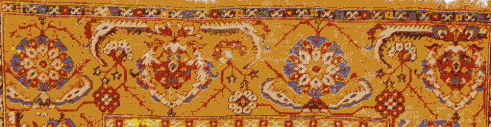
Regards,
Camille
Posted by Horst Nitz on 06-13-2007 12:14 PM:
Hi Camille
Plate 12.11 rather not on basis of my edition of the book.
Could it be you are mixing up numbers ? Yes, the borders in 12.12 or 12.13 show
on 17th century Transylvanian rugs. How do you think the Afshar got the idea
?
Regards,
Horst
Posted by Camille Khairallah on 06-13-2007 01:49 PM:
Hi Horst,
No, I think I am not mixing plate numbers . 12.12 and 12.13
have the so-called Herati borders. But I am talking about the field design of
12.11 which is based on a repetition of a version of Ottoman border (also
encountered in Transylvanian prayer rugs).
I also mentioned that the border
repetition in Kerman Afshar rugs is a common feature so why should it be
attributed to Azerbaijan?..
By the way the edition I have is Laurence
King 1992.
Regards,
Camille
Posted by Gene Williams on 06-13-2007 02:12 PM:
thoughts
Hi all,
Here are a couple of thoughts..since i've been and am going
bact to khurrasan.
For Camille, as you know Khurrasan is not all tribal
(Kurds, Baktiaris, Afshar, Baluch..all transported into the area by Shah Abbas
or Nadir Shah to fight the every maurading Turkoman and Uzbeks from Samarkand,
etc. and the "locals" - Timuris and the Cahar Aimaq...and other "Els"...black
tented nomands from wherever). But Khurassan is also Herat and Mashaad. Just
because its a Khurrasan motif, doesn't mean its Afshar. I have a hard time
identifying Afshar in the picture you posted. (again I'm not an
expert).
And James..that's a nice tribal looking flatweave ...
unfortunately, if you accept Eiland and Opie, if its tribal looking and
Afshar...it has to all be borrowed from somebody else...if its not borrowed,
then it can't be Afshar. Voila my problem with the analysis of those two
gentlemen ... and again I'll take Edwards. You all follow the guru you
choose.
Gene
Posted by James Blanchard on 06-13-2007 02:41 PM:
Hi Gene,
Although I live in India, I am not inclined to follow "gurus"
in any sphere. I think you have over-simplified the positions of Eiland and
Opie. Opie, for one said: "Nomadic Afshar pieces include salt bags, saddlebags,
horse covers, soumak rugs, and an assortment of small tribal woven objects.
Pieces for domestic use sometimes reveal urban influences but with qualities of
verve and individuality that would never appear in items made in an urban
workshop."
With regard to my flatwoven bag, some folks identified it as
Baktiari or Kerman Luri, whereas others thought it looked Baluch. Parviz
Tanavoli identified it as work of the "Jabalbarezis", which I take to be
Afshar.
Camille can correct me, but I don't think he was asserting that
the Khorassan rug was Afshar. But now that you mention it, doesn't it seem to
have a lot in common with some of the "stepped medallion with vase" Afshar rugs?
I am persuaded that they are related designs. If so, then there are three
possibilities: 1) they were inherited through different and parallel tracks from
a different source, 2) the Afshar "tribalized" this design (though I don't
particularly like the term "tribalized", I hope you get my meaning) or, 3) the
urban version of Hawley is based on a refinement of a tribal Afshar original. Of
these three options, I find the third the least likely, but what is your
view?
Cheers,
James.
Posted by Horst Nitz on 06-13-2007 04:13 PM:
Hi Camille
yes, I agree, one could relate the field design of 12.11 to
the borders of a 16th century 'Lotto' from Brashov / Kronstadt; also the borders
of 12.12. and 12.13 to another first half 17th 'Lotto' from Brashov. I am not
sure whether I want to go along with calling it a Herati border.
Best
wishes,
Horst
Posted by Camille Khairallah on 06-13-2007 06:56 PM:
Hi James,
I join Gene’s opinion in saying that your piece is nice and
I also believe it is an Afshar as well.
The upper border design is shared by
some Baluch but I cannot trace the origin of any motif and this for me is a sign
of authenticity, untill a proof of the contrary, especially that these large
bags were not made for the trade. I personally would call this bag a true tribal
piece.
Hi Horst,
I do not have the book you referred to, but I am
interested to know what the designs in the Brashov book you are comparing
are.
Regards to all
Camille
Posted by Jack Williams on 06-13-2007 09:28 PM:
on and on
Camille, thanks for the thoughts. I'm ready to give it all a
break.
The Afshar influence in Khorrisan Province has been an early,
reoccurring theme in this thread. There has been much written and several rugs
shown that are presumably "Afshar-Baluch" from Khorrisan. Unfortunately, I don’t
see too much in that carpet you posted that has an real air of Afshar or tribal/
nomadic. Though its theme is a common one (see page 4), and the flower
arrangement is certainly Afshar reminisent, it doesn't seem have the common
2-1-2 Turkmen motif. Perhaps if we had colors....
I think we had one of
Opie’s rugs posted some time ago (see page 4). The consensus here seemed to be
that Opie’s example was not exactly representative of Afshar work...that it is a
more modern, urban interpretation. Though I think his example was from
Azerbaijan, perhaps used for illustrative purposes, this could be circular
scholarship. Even Stone's comments about Opie's rug makes for some confusion.
Maybe this hobby needs refereed peer review.
Here is what I think a
“tribal “ Baluch-Afshar tribal carpet from Khorrisan presumably looks like. This
rug was recently sold on ebay, and has a date, 1219 (arguable) which would be
1805 (or 1841 if Persian calendar). It was advertised as a "Baluch," but
those of us participating in this line know better, don't we!
Judging
by the border, the carpet might have been quite a nice piece at one time. Notice
the border similarity to Horsts’ "ephedra" rug. For other “Khorrisan-Afshars,”
review previous posts.
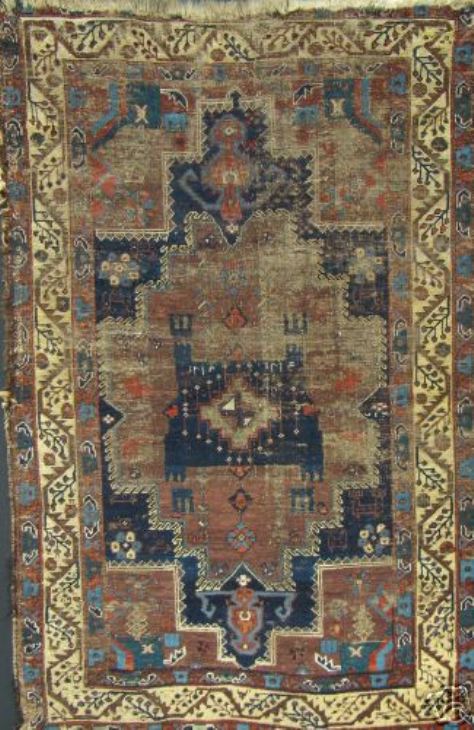
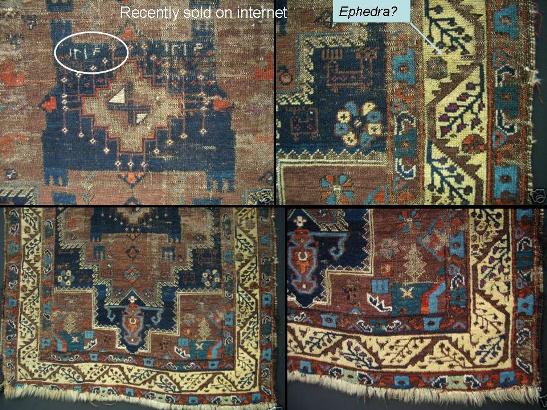
James, you previously questioned the multiple vase motif in
Afshar rugs. The vase motif is one of the oldest in Turkmen repertories, and has
deep pre-Islamic roots. There are many artistic examples outside of rugs, and
especially in East Turkistan rugs. Here is what Tom Cole says in his article, http://www.tcoletribalrugs.com/article39SingaporePowerPt.html
“Plants
in vases is a common theme in certain parts of Central Asia, especially in
Chinese Turkestan as seen here in this 3rd to 4th century wood carving from Niya
in Xinjiang, also represented in carpets of the region as seen here as an
overall pattern in this classic image of rug covering the field from one of the
oasis weaving centers”
He notes Fig 13 is a “wood carving dating to the 3rd-4th century
CE, depicting a flower vase. From Niya, e. Turkestan, excavated by Sir Aurel
Stein.”
Normally I would give several in depth examples but I kinda feel
like I'm just marking time.
I’m honestly a little mystified. If you
think Camille's carpet is Afshar, or looks Afshar, or is in the same family with
the Afshar medallion rugs shown in plethora in this line...whatever… we just may
not on the same wavelength about Afshari rugs. You are of course welcome to see
what you want to see, or for that matter, not see what you do not want to see.
All I can do is ask you to keep an open mind about the Turkmen theme of 2-1-2.
Regards, Jack
Posted by James Blanchard on 06-13-2007 10:32 PM:
Hi Jack,
I think this will be my absolutely last post in this thread
 , since I think I am creating
more heat than light.
, since I think I am creating
more heat than light.
Anyway, let me reiterate, I don't think that the
Hawley Khorassan rug is an Afshar, and I doubt that Camille thinks it is
Afshari. However, to me, that rug with its central medallion and flower vases
shows an unmistakable similarity to the Afshar rugs that I juxtaposed with it in
my last post. Anyway, that's what I see, and I can't help it. I will reiterate
that I don't claim to know which version came first, or if they both came from a
third source.
Maybe I have an over-active imagination, but I can imagine
a 2-1-2 format emerging from 2 spandrels, 1 central medallion, and 2 spandrels.
Couldn't that be what the "ephedra border" and the bottom left of the set of
four Afshar examples exhibit?
I
won't dispute for a moment that the vase with flowers design has ancient roots,
but then so do a lot of "non-tribal" designs. When I refer to "non-tribal", I
don't mean that they are not fairly typical for a particular tribe, but rather
follow Jon Thompson's definition of a "tribal rug":
quote:
... a tribal rug must have been charged with significance by its maker and her
society at the time it was made.
. Perhaps the vase of flowers did have some particular significance
for Afshari tribes in the late 19th century, and maybe it was a design that was
directly inherited from ancient times. But I think it is not beyond the realm of
possibility that AT THE TIME THEY WERE WOVEN, the Afshari weavers had been
influenced by other weavers in the vicinity. If not, they were perhaps the only
tribe that was able to remain relatively impervious to outside influences and
commercial incentives.
Okay... 'nuff said by me.
James.
Posted by Jack Williams on 06-13-2007 10:57 PM:
trees grow to the sky
James,
I've probably just misinterpreted a lot of things
here.
About the vase things, I was refering back to Horst's discussion of
that ICOC rug with the Ephedra border and vase interior, about page 7. Horst
later said...
"after having identified the plant in the border as
Ephedra, Rachel Loewenstein went on explaining the field design; what at first
looks like a naive interpretation of a Kerman vase carpet, in fact depicts
vessels like they are being used in the essential Zoroastrian fire
ceremony."
I thought that then the whole repeating vase theme, which
is a design one finds in Afshar rugs, was questioned and my response was a
belated support of Horst's notation above. But I see your point about "nomadic,
or tribal"...
I wonder, if a design is traditionally tribal, but it's
meaning has been forgotten, is it still "tribal?" What about...say...the Tekke
gul?
I've gotten a lot from your contributions and thank you for taking
the time to make them. I hope we have helped each other think, look, and
study..I know you have encouraged me to do a lot of reading. Next round we all
will start way ahead.
Regards to you, Jack
PS addedit: You are
right, a piece of central medallion in the corners counts as a 2-1-2. Camille's
corners are differenct.
Posted by Camille Khairallah on 06-14-2007 10:23 AM:
Hi all,
My first post on page 9 reads:
quote:
[But moreover, what is evident for me, this type of Afshar central medallion
and the one with the two vases was directtly borrowed to Khorassan rugs (cf.
Walter Hawley plate 1). ]
And my irst Post of June 13th (page 10):
quote:
[ I wish to re-emphasize on what I already mentioned and that seemingly no one
noticed or commented:] [I believe the Afshar medallion, before taking a more
tribal stepped rendition was adopted from Khorassan. There is a rug published
by Walter Hawley (1913) plate 1 that could confirm -or at least let you wonder
about- this.]
Did I mention guies that Hawley's rug was Afshar or even
tribal?
I guess "Khorassan" as a generic name for most people in the rug
world refers to a town or workshop production from that region. Doesn't it? And
if I am mistaken, please correct me.
Now whether the piece is from Qainat,
from Dorooksh or any other town, I will not be able to precise...
Quoting
my first post again at page 9:
quote:
[We should also bear in mind that Khorassan was one of the few
carpet-manufacturing centers to persist during the 18th and through the 19th
century in Persia and I guess it would have been a stronger source of
inspiration.]
Finally, I should thank James twice for having well read and
well understood what I meant.
As for the vase design, if it is your aim
Jack to search for its roots, cheer up!
Regards,
Camille
Posted by Jack Williams on 06-14-2007 11:54 AM:
Camille, I misunderstood your points. My apologies. I thought you were
advocating Afshar origin for the Hawley rug.
You are correct in the rug
from Hawley has the similar vase motif...and I think you have an insight in
mentioning the Quainat. My thesis is that the motif became common in Afshar rugs
pre 17th C., or 1600 AD. Whether that design was evident in Khorrison in 1600 is
probably unknown.
Given the drastic problems that beset Persia from the
death of Nadar Shah to the mid 19th C., your point about the preservation of
weaving in the Quainat and Khurison is worth considering.
But Khurrison
was not spared the misery inflicted on Persia...that 100 year period cooresponds
to the worst of the Turkmen slaving raids and they were especially awful in
Khorrison Province all the way to Zabol. Up to 1 million people were carried off
into slavery from the Khorrison during this period.
Here is a quote
attributed to Sir West Ridgeway, October, 1887...
...”For hundreds of
miles before we reached Herat we found the country desolated and depopulated by
Turcoman raids, while even in the Herat valley we continually came across the
fathers and brothers of men who had been carried off from their peaceful fields
by man-stealing Turcomans, and sold into slavery many hundred miles
away.”... See:
http://www.schulers.com/books/ge/i/Indian_Frontier_Policy/Indian_Frontier_Policy6.htm
In
any case, the thoughts you shared have opened possibilities that are worth
considering. Perhaps I will read more carefully in the future.
Regards,
Jack Willliams
Posted by Gene Williams on 06-14-2007 02:44 PM:
Desolation
Its not just from the late 19th century that the effects of Turkoman slaving
raids are noted. Fraser..Journey to Khorrasan 1821-22 (mentioned provioiusly)
recounts in detail the utter devastion from Kerman to Mashaad wroth by these
slaving raids...and mentions joyful particpation of Baluch, timuri, and Charar
Aimaq in the general looting.
I have to believe that from the fall of
the Timurids until late 19th century...all of Khurrasan was a mess (And remember
that Khurrasan extended all the way across the Salt desert...and that Turkoman
raids are documented hitting Kerman in 17th and 18th century). Not a nice place
to try to weave a sedantary carpet unless you had a fort around you.
This
is why the place became such a stew. Afshar moved to Kerman and to the Turkoman
border by Shah Abbas. Kurds moved to the Turkoman border by Shah Abbas or maybe
before. Baluch moved to the Turkoman border by Nadir Shah. Baktiari moved to the
Turkoman border by Nadir Shah....not to mention the "Baluch" woven by the Timuri
and gthe Chahar Aimaq...and always the survival of an urban environment in
Herat, Mashhad and a few other places...and the beat goes
on.
Gene
PS. just so we don't miss anything, here is an Afshar
article from ORR:
http://www.rugreview.com/113cor.htm
And here is Dr.
Eiland himself talking about the difference between Tribal and Nomad:
http://www.rugreview.com/95eil.htm
Posted by Gene Williams on 06-14-2007 06:42 PM:
Ephidra or grapes?
Are you all sure that vine border is Ephidra? Babur and others don't say
diddly about ephidra..but they sure go on and on about grapes and the squashed
deritive thereof. Kind of dovetails with the later advent of border poppies.
doesn't it?
Gene
Posted by Gene Williams on 06-19-2007 03:07 PM:
Mathmatics in carpet design
Hi all...this really has nothing to do with Afshars..but has to do with the
exchange we had with Sue on carpet mathmatics. I just found this article. It
looks interesting.
http://www.math.utsa.edu/~salingar/life.carpet.html
Gene
Posted by Steve Price on 06-19-2007 03:25 PM:
Hi Jack
Unless I missed it, Dr. Salingaros neglected to mention the
1.601 to 1 ratio that we've been assured lies at the center of it all.
He hosted a Salon here some years ago, which may interest you. The URL
is
http://www.turkotek.com/salon_00011/salon.html
Regards
Steve
Price
Posted by Gene Williams on 06-19-2007 05:20 PM:
Euro vs the Dollar
Thanks Steve,
I was searching the web looking for Windsor's Chinese
vermilion scroll stamp red (it does look like a ruby but i do have Chinese
paintings with the same color on their "tu jang" stamps) when I came across that
article. I didn't realize it was known..but should have..Turkotek has covered a
lot of territory.
As far as I'm concerned..that 1.6 ration is getting
pretty near the $ vs Euro ratio in Europe..which is why I'm not staying here.
Wonder if that's a possible new thread..carpet porportions based on exchange
rates?
Gene
PS. come to think of it, when I ran across Turktek
about 18 months ago I did read that thread. I was amazed to see attempts to
quantify beauty by mathmatics...kind of like trying to quantify performance in
any job by "number grades"...objective vs. subjective...painting by numbers. It
must be a human need to put everything down to science.. That's not at all bad
considering the contributions made to all of us by the great encyclopediast
quantifiers..the latin philums and all. and since I'm in Athens..I'll just
wander down for the 187.76th time to the Parthenon and quantify it's
porportions.. But in the end, rereading all the posts, I kind of like what Tom
Cole had to say..personally interpreted as.. "art is spiritually subjective" and
in the eye of the beholder (think I'll coin that last phrase). Thanks again for
bringing that thread to light...and I realize our small disputes these days are
pretty much patty-cake-on-a-Sunday-morning compared to yesteryear..the past is
always so much more ideallic...Ahh..the smell of argument in the air...
Posted by Sue Zimmerman on 06-20-2007 09:14 AM:
scaling heirarchy
Thanks, Gene, for finding and posting this very valuable, (to me at least),
link!!
Under the heading "Scaling Heirarchy In A Design" where Alexander
states
..."A hierarchical relationship between the different scales
relates a design to the structure of biological forms (Salingaros,
1997a)"..........."The exponential constant e = 2.7 is proposed as an
approximate working ratio between consecutive scales." ....
Well, that's
pretty much, essentially, what I have come to see and have been trying to try
tell of, only as seen from a different angle than Alexander's, I
think.
For me, though, the proposed exponential constant would be.... e
is = to 1+1.608... [2.608.... ], the "life" built with Phi progressions, in
other words, which not only has both a prehistoric and historical hierarchical
relationship context but also, as I have determined for myself, and tested for
proof, is more accurate than Alexander's proposed e=2.7 which, as he says, is
just an approximation. So 2.7, in my opinion, (an approximation used as the
constant), would be a step along the path of systemic degeneration. See? Sue
Posted by Steve Price on 06-20-2007 11:05 AM:
Hi Sue
You're moving a little too fast for me to follow.
1. How
does 2.7 become an approximation for 1.608? Salingaros treats it as an
approximation of the base of natural logarithms, 2.718, and that seems
reasonable. I understand that you added 1 to 1.608, bringing you to 2.608. And
2.7 is an approximation for 2.608. But what's the logic that permits this? After
all, any number becomes an approximation to any other number if you're allowed
to arbitrarily add to or subtract from it. Is there something I missed that made
2.7 an approximation of phi?
2. How is approximating 2.608 or 2.718 as
2.7 a step along the path to systemic degeneration? While we're at it, what is
systemic degeneration within the context of rug designs and layouts?
3.
You ask, "See?" I answer, "No, I don't."
Steve Price
Posted by Sue Zimmerman on 06-21-2007 10:13 AM:
Hi Steve,
Mr.Salingaros writes "By codifying the principles
underlying the design of carpets, it may eventually be possible to compute the
"life" of a carpet as a mathematical coefficient from the design."
What I
am saying is that, in this universe, one must stick to the golden mean
proportioning system to establish placement of "nodes of interest" in design if
it is a design's harmoniously proportioned "life" one wants to codify. If you
want the joints of your fingers,etc., the "nodes of interest" in your hands, for
instance, calibrated to an ungainly dysfunctional 2.7 proportioning system you
would have to take that up with maybe God or Allah. I can't help you or
Mr.Alexander or Mr.Salingaros there.
On a line, in this universe's
golden mean proportioning system, the "node of interest" and the lengths it
divides into sections is self replicating in it's proportions, regardless of the
various lengths of lines drawn, they have identical proportions if the system is
conformed to. That cannot be said for any other proportioning system. That is
why it's golden.
When one goes beyond the example of a line into building
golden triangles and golden rectangles, etc., as used in a composition, the
"lines of force" are expressed by connecting up "nodes of interest". That is
where the "life" is found. Being a universal system it can be taken as far as
one wants to and translates into any field of one's interest to any level of
complexity.
When Mr. Salingaros says "By codifying the principles
underlying the design of carpets, it may eventually be possible to compute the
"life" of a carpet as a mathematical coefficient from the design." What he is
missing is that the "life" of a carpet designed in conformance to the golden
mean proportioning system started with a codified mathematical coefficient and
what he says may one day be done is, in essence, decoding what was originally
codified, something I have been doing for several years and so know it as
possible. What I would like to see eventually someone do, which I can't do
myself, is to decode good rug designs into music. Now that would be cool.
Sue
Posted by Steve Price on 06-21-2007 11:03 AM:
Hi Sue
The so-called phi relationship, or "golden mean", is a
principle that is widely used by artists (of many types) because it gives
pleasing results. It is not something handed down by the gods to be a guiding
principle. In this universe, it is not mandatory for anything. Salingaros didn't
make up the 2.7 proportioning system that he (and Alexander) see so often in
aesthetically "live" rugs, he found it there. It may be described by a number of
adjectives, but "ungainly" and "dysfunctional" aren't among them.
You
wrote, of the phi relationship,
... the lengths it divides into sections
is self replicating in it's proportions, regardless of the various lengths of
lines drawn, they have identical proportions if the system is conformed to. That
cannot be said for any other proportioning system.
This is, well,
let's just say, not right. In fact, the same thing will happen with any ratio.
If you conform to it, the line sections will have identical proportions
regardless of their absolute lengths.
Do I take it that you no longer
consider 2.7 to be an approximation of 1.608? If so, we agree about
that.
Steve Price
Posted by Sue Zimmerman on 06-21-2007 11:38 AM:
No, Steve, Sorry, Can't help you. Sue
Posted by Horst Nitz on 06-26-2007 11:48 AM:
Hi Camille
at last the images to the earlier discussion of a
relationship between Afshar (Opie. Tribal Rugs. Plates 12.11 - 12.13) and
Transylvanian rugs. Following this link you find images of plates 4 and 6 of the
exhibition catalogue and of the Black Church in Brashov where those rugs have
been kept for the last four-hundred years approximately:
http://www.turkotek.com/mini_salon_00016/salon.html
What
comes next are details of plates 6 and 8:
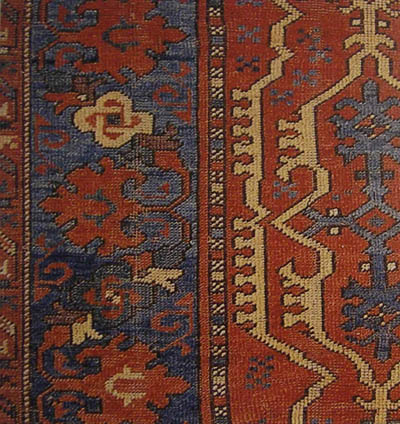
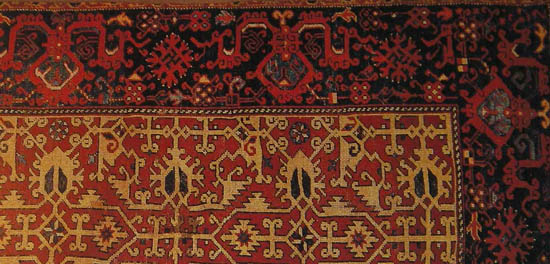
I am inclined to see the
border design of plate 4 as a predecessor of the border design of plate 6.
Not all Transylvanian Rugs decorated those churches in Romania, some
remained and survived in Anatolia. One could now assume that 'design hunters'
who had come all the way from Kerman at the end of 19th century were able to
sniff out those rugs and have their motives knotted into Kerman town rugs - all
possible.
In my opinion it would be less hypothetical though to assume
that these designs, in the 16th and 17th centuries, were part of the East
Anatolian and West Persian design pool in which the Afshar used to fish at the
time before they were resettled south.
Regards,
Horst
Posted by Gene Williams on 06-26-2007 02:28 PM:
Churches in Transylvania
Hi all,
Having spent considerable time in Romania, I'd like to add an
irrelevant comment about the Brasov Black Church and others in the area and the
rugs in them. They all were set up by German (Romanians call them "Saxon")
settlers brought into the region about 1100 by a Hungarian king...about the same
time as the 1st Crusade. The churches in the southern area of Transylvanian were
Catholic. (the country around them after the last schism was Orthodox). When
Martin Luther tacked his 95 Theses to the door of the Cathedral in Wittenburg on
31 August 1517...all of the Transylvian Saxon churches converted to
Lutheranism..
So the Black Church is a Lutheran church even now and even
has a woman circuit rider Preacher (as I recall who preaches in German).
Catholicism didn't arrive back in the country until the Austrian victory over
the Turks outside Vienna after that wild charge down the mountain of Polish and
Lithuanian cavalry and Prince Eugene's campaign around Belegrad...say 1688??.
Same goes for a 100 other churches in the same area...a lot of them
incidentally were fortified and used as fighting refuges by the German
villagers...the bell towers are actually crenilatted battlemented fighting
towers.
How in the world did these churches preserve all those carpets?
Well....they were German after all...and Protestant. All the graveyards have
German names..lots of them with Iron Crosses on them.
Most of the
"Saxons" went to Germany during the Ceauceascu Communist nightmare. Very few
pure Saxons are left... I noticed the Romanian government has started putting up
the old German names of the towns in Transylvania next to the Romanian names
(Brasov's German name is Kronstadt)..the Romanians (Rumanians..until Ceauceascu)
got Transylvania from the Austro-Hungarian empire after WWI, courtesy of a
sustained campaign by the Queen of Rumania..a daughter of Queen Victoria. and
I'm sure with the advent of the Euro, Germans will soon be buying up vacation
villas in the Carpathians and Transylvanian Alps...an extremely beautiful..and
up until about 3 years ago, affordable area..but watch out for the
bears.
Gene
edit: for those interested in the Saxon fortified
churches in Transylvania (beyond the forests)..here's a good site:
http://www.saxontransylvania.com/gallery.php
Posted by Horst Nitz on 06-26-2007 03:19 PM:
Hi Gene,
very well presented. Please, allow me to add: Sibiu
(Herrmanstadt in German) in Transylvania was elected Cultur Capital of Europe
2007; in 2010 it will be Istanbul's turn.
Last reports that reached me
from Romania say that it still is very remote and romantic, and affordable. We
had a friend from Berkely / California staying with us the other week on her way
back to the US; she had been teaching in Bucarest for a few days and afterwards
went on a hiking tour through Transylvania, which sounded a very enjoyable
adventure. The brandy she brought from there as a donation to our household was
equally enjoyable.
Best,
Horst
Posted by Gene Williams on 06-26-2007 03:52 PM:
Sibiu
Thanks Horst,
I spent a few weekends in Sibiu - Hermanstadt. It is one
neat city once you get to the center after wading through the horrors of the
"communist new-man" suburbs surrounding it..(That stuff is found everywhere, in
all Romanian cities..travesties of peeling, degenerating, concrete, square box,
personality deadening, architecture...like toadstools growing in a garden..that
gypsy (Roma) song "Ceauceascu Destroyed Rumania" is apt). The people there are
very cosmopolitian and believe Sibiu ought to be the capitol of Romania.. Good
beer, good sausage..(but the cuisine of Romania is country poor and not/not
Mediterranean..Saugage, cabbage and potatoes..grilled meats... pretty much)..
And I love the country..if you speak French and Italian, you can almost
read the language. even though Ceasceacu litterally destroyed 1000 years of
culture. (Sometimes, for instance here in Greece, I run across
unreconstructed..well you know...I wish what happened to Romania on
them...otherwise they won't learn.)
By the way, in Bucharest there is a
peasant museum which has a lot of embroidary from the countryside..very very
similar to the gowns and apron's you'd find in Hungary and Ukraine..and a
country house museum...country houses transported in the 1930's and
reconstructed outside in a huge park....all kinds from all areas of the country,
underground houses, white stucco houses, Turkish houses from near the Black Sea,
heavy hand-sawn planked house..natural stone foundation houses...the high roofed
spiked steeple wooden orthodox churches, etc...including interwoven hand-made
fences with carpet like patterns in them..you can almost smell the horse manure
(I remember my great grandfather's farm in Illinois in the early 1950's..no
electricity and two of the biggest horses "Jim" and "Ted" this kid has ever
seen...very much a similiar feel). In some of those reconstruted peasant houses
are looms...
Gene
ps. excuse me you all..this rant is far from
Afshars..but the rugs in the churches there aren't...in the end they are
Turkish...and sometimes "o-man" more or less.
Incidentally, there was a
French-Romanian film made recently, "Train de Vie," which featured a lot of this
Romanian country architeture and weavings.. about a Jewish village in Romania
which got together at the height of the deportations and hijacked a train to
escape to Israel via S. Russia during WWII. Very funny and the architecture and
landscapes are absolutely authentic. (and the French actress heroine absolutly
gorgeous). You can sometimes find it with sub-titles in video rental places. I
went looking all over translyvania for the old Jewish temples (and masonic
temples)...you can find them...pretty run down and deserted now.
Posted by Marty Grove on 06-27-2007 09:16 AM:
Movie
G'day Gene,
Ref the film you mentioned, it cant have been made too
recently as I have seen it as reruns twice on telly in the last year - and yes,
you are right, its a good little film with interesting locales and a plot which
is very 'feel good', tricking the Nazis with funny subterfuges.
Romania
has definitely suffered under the red banner but regardless of that, it still
has that 'romantic' feel in the outback areas, with the Romany (gypsy) villagers
living much as they did a hundred years ago - its not very progressive and one
wonders if and when so called progress does eventually catch up, if it will be
good for the place, or maybe the confusions caused might leave them much more
adrift.
Some of the Romanian rugs are pretty well made although Im not
sure I like the ornate Russian style patterns so much, but of the kilims, there
have been a few which are similar to Turkish in style which are not too bad, the
thin ones anyway; many if not most I have seen locally, are fairly coarse and
heavy.
One of the things I like about so many of the outback villagers
pretty well worldwide, is they cling to their old national dress codes - often
beautifully embroidered handwoven fabrics with rich colours.
So very
different to our western mass produced clothing, same same which everyone
nowadays wears.
Regards,
Marty.
Posted by Camille Khairallah on 06-27-2007 03:09 PM:
Hi Horst,
Thanks for your post and for the link.
The border
design I posted on June 13th and which belongs to a Transylvanian prayer rug is
borrowed to more sophisticated Boursa Court prayer ones and it is, in my opinion
at the origin of the field design of pl. 12.11 in Opie’s Tribal Rugs.
“Design
hunters” did not even have to reach Turkey to copy them, Tabriz is much closer,
and the design appears in the borders of some Haji Jalili prayer.
As for
the Afshar border of pl. 12.13 in Opie’s book featuring the so-called herati
border, and I prefer to call it turtle border because the principal motif looks
like a turtle, would probably descend from the 17th c. Persian production
(confer Beattie M. “Carpets of Central Persia pl. 28 & 45; Knowing of course
that the tribe had in the 19th c. closer sources for that border design in
Persian cities and towns.
As for the Transylvanian border design of pl. 6 in
your link representing cartouches enclosing a similar turtle-like motif, finds
its roots most likely in North Persia, a medallion cartouche shows well the
relation in pl. 151 of Erdmann’s “700 years of Oriental Carpets”.
As for the
cloudbands, whether Persian or Turkish, I guess their deep roots are in
China.
Regards
Camille