Posted by Jack Williams on 06-07-2006 11:44 PM:
Turkman Juwal...need help.
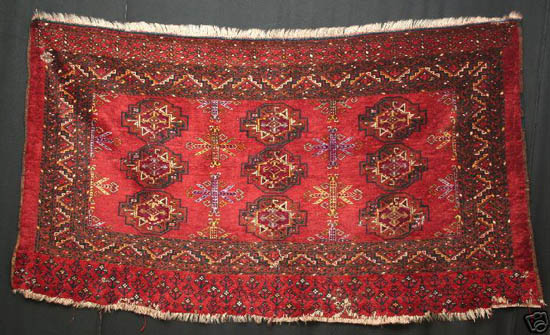
I am quite
inexperienced in this field. Oh..I own a juwal or two, a couple of Ersari
carpets that I like, but the arcane fine-ness of Turkmen weavings, the detail
differences, the small things that loom large, the different guls...I have never
gotten the hang of the whole genre.
But, oh my foolish, impetuous
heart...I just bought a juwal on the internet because...uh...I don't know. Now,
I do not even know where to start to understand it. Even the dealer, who I
respect from my baluch dealings, described its thusly;
"...Turkman....ehh...aah... Ersari(?)" (I've never seen an internet offer with a
title like that).
I would like to start reading and research. If it is
possible to make judgements from the design, guidance and opinions would be
appreciated. Regards,
Jack Williams
Advertised
information:
"Size: 3.2 x 5.8 Feet / 98 x 177Cm;
Age: 19th.
C;
Color : Silk parts : purple and red , both not natural / yellow is good.
The other colors are natural / red field color very good ." (Keep in mind he is
located in the Netherlands and his offers are routinely understated in English,
a characteristic that I find both honest and refreshing.)


Posted by Tim Adam on 06-08-2006 08:31 AM:
Hi Jack,
Just to clarify, the red ground color is all silk, as well as
the purple inside the primary guls?
Tim
Posted by Jack Williams on 06-08-2006 09:05 AM:
another picture
Tim, I haven't received it as yet...but my impression is that the silk is
limited to highlights including the purplish outline of some of the secondary
guls. Where the "red" silk is, i'm not sure. But the field appears to be wool
from the pictures. Can't tell what the fill inside the guls is, though this may
be the "red silk" referred to above..in which case it may be cochinal, not
chemical, given the hue. I'll ask Steve to post two more closeups on this post.
The first is of the back, upper right corner. Thanks
Here are the
closeups. Steve Price


Posted by Marty Grove on 06-08-2006 12:57 PM:
Juwal Magnificent
G'day Mr Williams.
If the article in the photos proves to be as it
looks on my monitor, then it would have to be absolutely THE best I have ever
seen!
The colours look fabulous, the guls, both major and minor are
terrific and the whole piece comes across to this total Turkman inexpert as, Ive
read beautifully described, 'jewel like'.
It looks a perfectly balanced,
magnificent glowing piece of the weavers art. I love it and I wish it was
mine!
Regards,
Marty.
__________________
Martin R.
Grove
Posted by Jack Williams on 06-08-2006 01:01 PM:
Sayrk adaptation of Salor design?
Examining only internet resources, and keeping in mind my lack of knowledge
of this area of carpet academia, this is the best association I can find so far.
My chuval may have some characteristics of Sayrk design adopted or
co-opted from an older Salor form. The gol in my chuval and the one pictured
below look similar to my eyes including the silk touches. And, the color of the
internal design, the magenta, looks somewhat similar to other sayrk things I've
seen. Comments refutations, would be more than welcome.
From Tom Coles
site, a link to an article, "The Tribal Gol in Turkmen Carpets," by
V.G.Moshkova,http://www.tcoletribalrugs.com/article35Moshkova.html
displayed this picture and discussion:

"Plate 12. The
chuval gol as it is seen in the weavings of the Saryk. This gol is apparnetly
derivative of the Salor chuval gol (Plate 9 a) according to Moshkova,
appropriated subsequent to the defeat of the Salor in the 1840s. Though Saryk
chuvals are rare, I believe one may encounter early chuvals using this or a form
of this gol type. On the other hand, the appearance and use of the gol seen in
Plate 9 b corresponds closely with this time frame and may be the supporting
evidence for Moshkovaa's theory regarding ornaments of rugs being 'taken over by
the victors, to be used as models for reproduction of patterns.'"
The
plate 9a referred to above is in the same article (ibid). The picture and
caption for plate are below.

"Plate 9a. (Above) The
classic 'chuval' gol of the Salor used on these large bags with majenta silk.
Possibly early 19th century. Silk used in such profusion is seldom seen in 18th
century Turkmen weaving."
One other thing I found...'The Atlas of Rugs
& Carpets,' edited by David Black, Tiger Books International, London, 1994,
the "Turkoman" chapter by Rachael Feild. On P. 166 is a Saryk chuval,
unfortunately rather small to scan (I'll try later though). It looks quite
similar in design to mine. The description of the chuwal includes this, "...This
tent bag, or chuval, has some of the most typical designs found in Saryk
weaving; The minor border composed of small triangles and the small flowers
found in the panels at each end. Chuvals can be found with either this gul [my
note, one that looks quite similar to mine, to my eyes] or the octagonal Salor
chuval gul. Early nineteenth century..."
Posted by Gene Williams on 06-09-2006 02:54 AM:
juwal
Jack,
As we discussed before you bought it, I think the juwal is
Saryk...maybe "second phase" (when silk and odd colors started to be added).
There is likely to be silk in the centers of the major guls as well as outlining
the minor guls.
Gene
Posted by Jack Williams on 06-13-2006 08:55 AM:
earthshattering border design symbol?
In keeping with the spirit of the "dimensionality" discussion going on
another board, last night I noticed a particular design element in this rug that
may shake up the world of Turkmen carpet academia. The main border may have a
truely unique emblem.
It is easiest to see in the photograph of the back
of the chuval. I am almost sure that encased in the little triangle designs that
form the main border is the exact design of a baseball park, complete with
infield, bases, home plate, stadium seats, outfield wall, even the support beams
for the scoreboard or lights. There may even be some parking and perhaps even
some cars outside the stadium. Take a look and see if you agree. If this doesn't
break the bank of Turkmen research, nothing will. Well, I guess I will go smoke
a cigar or something and ponder this Turkmen field of dresms.

On a serious note, also
from the back of the rug I see that the minute quadrant flags in the corners of
the guls are all colored differently. Thought I would point this out in case it
allows anyone to have an idea.

Right now, I am quite
confused. It looks far too fine a weave to be a Ersari, and the interior guls,
designs on the skirt, etc., all seem to fit the Saryk definition from the
article by Moshkova and others. However, the border does have a faint
Ersari-Kazil Ajak look to the design as per JBOC (see one example and
discussion, http://www.spongobongo.com/daxv645.htm).
Compiling a
large amount of writings and references on Saryk and Ersari chuvals has just
confused the issue even more for me. OK, if it is symetrically knotted it is
Saryk and asymetrical it is Ersari (from references on Tom Cole's site, etc.,
et. al.)...oops, except when these weavers don't use that knot (later notes,
Murrey Eiland, Tom Cole, et. al). Humm...the major gul is a chuval salor gul
varient taken over by the Saryk in the early 1800s, which was apparently thought
to be a slam dunk give away for Sayrk, except later articles note that these
emblems are also used by the Ersari, etc. . I have just run into contradiction
after contradiction, including some people who I highly respect in the
field.
Any further effort to identify this chuval may have to await its
arrival. What I would like to know is what I should look for as far as structure
to attempt to resolve the contradictions, when it arrives . Actually, it is all
academic compared to the apparent beauty of the piece..this weaver was a true
artist in my eyes. Still, it would be nice to have a clue on age and provenance.
Regards to all.
Jack Williams
Posted by Steve Price on 06-13-2006 09:09 AM:
Re: earthshattering border design symbol?
quote:
Originally posted by Jack Williams
It is easiest to see in the
photograph of the back of the chuval. I am almost sure that encased in the
little triangle designs that form the main border is the exact design of a
baseball park, complete with infield, bases, home plate, stadium seats,
outfield wall, even the support beams for the scoreboard. There may even be
some parking and perhaps even some cars outside the stadium.
Hi Jack
If you focus your eyes on the stadium seats, you
can see a runner beating a throw to second base.
The strings of
contradictions from "experts" is almost a hallmark of writings on tribal arts,
not only tribal rugs. The conventional wisdom is such a mix of fact and
marketplace folklore that you can find published support for almost any
position. Skepticism is a fairly constructive default position. As one of my
undergrad professors used to say, it's good to have an open mind, but you have
to be careful not to let your brain fall out.
Regards
Steve Price
Posted by Marty Grove on 06-13-2006 03:13 PM:
Magnificent Juwal
Mr Williams,
I wish it would arrive in your hands (or mine
preferably ) as I can
hardly wait for a complete and accurate description of this lovely
piece.
) as I can
hardly wait for a complete and accurate description of this lovely
piece.
I know nothing about Turkman weaving (nor much about anything else
really) but from the appearance of THIS one over the Net, perhaps temptation can
tickle me as it did you and I may be lucky enough to find something which grabs
me the same way.
Whether yours is young or old doesnt particularly worry
me because it sure looks a beauty.
Regards,
Marty.
__________________
Martin R.
Grove
Posted by Tim Adam on 06-14-2006 12:20 AM:
Hi Jack,
In my opinion this chuval is not Saryk. Both the drawing and
the colors are inconsistent with late 19th centurey Saryk work, which is
generally much darker than your piece. Certain design elements are also quite
untypical for Saryk. For example, the two minor borders are common on
Ersari/Beshir pieces, but not on Saryk. The square hooks at the upper and lower
ends of the secondary guls are also very strange.
The pictures you have
posted so far give me the impression that most colors are synthetic. When you
get the chuval, I would carefully inspect the light blue. Looks like it faded to
something more greyish on the front. I wouldn't be surprised if this chuval is a
reatively young piece.
Regards,
Tim
Posted by Jack Williams on 06-14-2006 02:03 AM:
Pehaps so, perhaps not...
Thanks Tim, you may be right. But, I am unsure of what light
blue-faded-to-gray you are seeing as on my monitor I see neither of those
colors. The only thing I can think of is the purplish silk outline of some of
the minor guls..the color of which appears on my computer as about the same
front and back. I'll check it though.
However, I have found some
interesting information. From my readings, I assume that this is not a 3rd phase
Saryk weaving for the reasons you have pointed out. It appears to have most of
the characteristics of 2nd phase weavings as Gene Williams previously posted
(purely for review and reference, here is one of many sites that lists the phase
characteristics):
http://www.spongobongo.com/Saryk.htm
But, you have also
noted one obvious argument for Ersari...the two minor borders . They seem to
have elements common to Kizil Ajak, supposedly a member of the old Ersari
confederation as I previously mentioned. However, to my eyes this entire rug
composition forms an unusually artistic structure...and the border seems to me
to be custom designed to artistically mirror and compliment the field
guls...which have a possibly unusual serreated interior reflecting the border.
Perhaps this "artist imperative," may need to be honored or at least taken into
consideration.
I read an pretty deep academic article this evening,
"Phyllogensis versus Ethnogenesis in Turkmen Cultural Evolution," and it
contained some surprising and interesting data. Here is the link:
http://www.ceacb.ucl.ac.uk/ceacb_files/misc/Tehrani_Collard_2002.pdf
It
connects the Saryk and Ersari culturally and ethnographically, closer than other
confederations...especially the Tekke whom the Sayrk were supposedly allied with
and absorbed by. But also as part of the research it contains an extensive list
of design elements common to the weavings of each Turkmen confederation,
including Tekke (before Gok Tepe and after), Saryk, Salor, Ersai, and Yomut.
Among several things, this study notes the lack of use of the chemche
secondary gul by the Ersari. It isn't clear if the Ersari never used the chemche
gul in the time period studied, but this characteristic was aparaently factored
into the decoding of the various tribal relationships.
As far as this
chuval is concerned, as best I can determine thus far from the pictures, the
weave appears to be about 160 KPI, with a warp-weft ratio of 1:1.6 or
so...pretty high in the Ersari range. On the other hand, the warps look
depressed which is supposedly not a common attribute of Saryk weaving. Perhaps a
key question may be the knot....
Finally, when the rug arrives, I'll take
a look at the minor gul outlining to insure color fastness. Are there other
characteristics you see that in your opinion tend to identify this rug as
"recent" and the dyes as chemical? It would be an excellent learning experience
for me.
I guess I have a good deal of faith in the dealer of this
rug...so for now respect his word that most of the rug colors are "good," the
rug is "19th C.", and it is "monumental." (His usual descriptive English is
something like "pretty good old Baluch rug" for an piece that would go on most
people's wall.)
To sum up, the knot density seems high for Ersari, the
minor borders may be unusual for Saryk (but I havn't seen them on an Ersari
chuval either), the chemche gul is apparently unusual, or unknown for Ersari,
assuming this is an old piece. The flowered skirt is typical of Sayrk but is
apparently occasionally encountered in Ersari weavings. The warps appear to be
depressed..which is supposed to be an Ersari characteristic more than Saryk. The
composition is well spaced with only three borders, which I understand is
usually a characteristic of older Turkmen chuval weavings. The knot? Unknown for
now.
From the pictures, regardless of age or provenance, it is still a
monumentally beautiful weaving to me...with colors that compliment, designs that
float, a harmonious border that magnifies and enhances, and a weave that is hard
to fault, all of which is why I bought it.
Thanks for your
thoughts,
Regards, Jack Williams
Posted by Gene Williams on 06-14-2006 05:33 AM:
dyes
Hi all,
I've looked at a lot of turkomen juwals (years ago admittedly)
including some Saryks (in several of which the reds sometimes had dulled to a
muddish brown), some with silk in the Guls.
From this and the pictures,
I'd bet that the major ground colors of the wool in this juwal are good.
The silk parts...the outline of the minor guls and/or the dyed silk
parts in the interior of the major guls...may have chemical dyes. maybe the
purple. Then again they may not. and I particularly like the deep magenta in the
center of the guls. I'm just not familiar with what it takes to dye silk.
Does silk take vegetable dyes as easily as wool? (I'd assume so from
Chinese silk pieces). Comments on silk and silk dyes in older carpets as used in
Central Asia would be a most welcome academic exercise.
Gene
Posted by Tim Adam on 06-14-2006 01:28 PM:
Hi Jack,
I am referring to the blue in the minor guls.

From the front the
color looks different, more grayish. If this is the case, then it is a synthetic
dye almost surely, which would rule out a 2nd phase Saryk attribution. However,
even if that is not the case, the whole composition of your chuval is, in my
opinion, inconsistent with a mid 19th century Saryk
attribution.
Regards,
Tim
Posted by Gene Williams on 06-14-2006 02:07 PM:
purple or grey
Hi Tim,
Yes we're looking at the same questionable bit of the
carpet...the purple or grey or whathever...and I agree its suspect but its never
been advertised as else... the orginal advertisement from a reputable dealer
said the silk dyes were probably not vegetable.
Personally, I think from
the pics that the colors you point out..are in the silk...ergo bets are off on
its dyes. and I'd be very interested (owning three such myself which have been
stuffed into trunks for 30 years) in the relationship between the silk dyes in
turkoman carpets and the general design, wool, layout, dyes of a classical
turkoman carpet.
What do you all think? worth a research effort..i.e.
jugtoposition of silk and wool, dyes and age?
ton ami, Gene
Posted by Jack Williams on 06-14-2006 02:25 PM:
silk acquired already dyed?
Gene, what I think forms the base of your thoughts is that since the sillk in
Turkmen carpets was not locally produced, it was likely already dyed a certain
color, no telling where (geographically) or with what, before it was acquired by
the Turkmen for use in a rug.
Therefore, limited to the date of the
appearence of artificial dyes in the major market-trading centers, artificially
dyed silk does not make a good marker for age.
This seems reasonable and
I believe it has been commented on. It is worth looking into...but perhaps I
will await the arrival of the article first. Regards.
Posted by David R.E. Hunt on 06-16-2006 09:44 AM:
Ersari For Sure...
Hi Jack
Find below an Ersari rug, plate 87 from Thompson's
"Turkmen".

The size of your bagface and the "judor" border, as well as
this stepped main border and the barber pole guards, and the use of silk all say
to me Ersari.
Dave
Posted by Jack Williams on 06-16-2006 11:12 AM:
Powerful published article...
Thanks David.
You may well be right, but I think the jury is still
sequestered...the actual chuval has not arrived for inspection yet. The age and
provenance is primarily of academic interest to me, I like research. I've dug
pretty deep into this in the last week, viewed pictures of hundreds (thousands?)
of rugs and chuvals (though I missed the one you posted).
I've also
accumulated and catalogued all the historical information I can find. While
doing this, I found an article published last year (link below). In my opinion,
it might be one of the most important academic studies on Turkmen tribal
relations and history ever published. It certainly seems to be a great resource
for understanding Turkmen weaving.
http://www.ceacb.ucl.ac.uk/ceacb_files/misc/Tehrani_Collard_2002.pdf
The
authors’ approach, using carpet weaving to retroactively recreate the history of
relations between the various Turkmen confederations, could play a role in
understanding not just this chuval but a lot of Turkmen carpet articles.
Basically the authors are applying biological science methodology to sociology.
This article is heavily influencing my thoughts on the chuval.
I located
some data on the guard border design [JBOC refers to what looks like a similar
guard border, as a “badam Gulli-gul” border...badam apparently being a Baluch(?)
term for almond], and it does appear to be generally associated with attributed
ersari weavings. I’ve found considerably less information or examples of the
main border design. And so far, I’ve found few or no similar designs associating
either border with a chuval weaving. So far, from my limited range of
investigation, this border design seems to stand alone.
I hope you will
share other information you find that may be relevant. I’ll post a footnoted,
referenced article on my findings, when the chuval arrives and I am able to
confirm structure. Thanks for your interest and assistance. You might want to
read the above article. I would be interested in what you think of it. I’ve read
it three times and am just beginning to comprehend the implications.
Regards,
Jack Williams.
Posted by Jack Williams on 06-21-2006 07:25 PM:
Rug Phylogenesis and the chuval
These pictures are of a rug that has a very interesting weaving flaw. It’s
relationship to the subject chuval will be explained below...


To my eyes this is a
normal, very well woven, even beautiful, prayer rug with natural dyes, featuring
a common Turkmen-theme...very nice, I like it a lot...but nothing particularly
noteworthy...except... the incredible weaving flaw noted on the pictures.
Two thirds the way through the rug, the weave changes dramatically from
asymmetric open left depressed warps, to asymmetric open right un-depressed
warps, continues for 5 inches, and then changes back. After close study, I
cannot see that the rug was patched, just the weaving method was changed.
Weirdly, because the warps are not depressed in this section, it should have
been almost impossible to make a rug this way...but the problem was apparently
solved in an interesting way. [The flaw itself, and the precision and beauty of
the weave before, during and after the flaw is a big reason I was attracted to
this carpet.]


The effect of the change from open left knot to open-right knot
is dramatic on the design when viewed from the front. All the straight lines
become offset ½ knot [for clarification, the apparent wavyness of the lines
higher up the pillars are just fold lines in the carpet, not other weaving
flaws]. From the back, however, the lines are completely straight. How did this
happen? A rational explanation is that a different weaver took over this carpet
for a while. It is reasonable to suppose that no one including the substitute
weaver realized the error until later, probably after the carpet was shaved down
to final height, perhaps because the working length of the pile masked the
flaw.
What this may be is a type of “smoking gun” for what Tehrani and
Collard in their study... [http://www.ceacb.ucl.ac.uk/ceacb_files/misc/Tehrani_Collard_2002.pdf]
...refer
to as a phylogenesis factor in carpet weaving; cultural features passed down
internally within a group. Obviously the two weavers of this carpet learned to
weave in a markedly different ways. It is reasonable to suppose that they were
kin in some respects, perhaps belonging to the same language group, or they
would be even more unlikely to have partnered on a project. It also seems
reasonable to postulate that they were thrown into close contact in a situation
that required a woman from a different weaving culture to step in and continue
the manufacture of this carpet when something prevented the original weaver from
continuing.
But, in normal circumstances, such a flaw is virtually
inconceivable. An oba (family-tribal) group would likely have one of their own
people finish the carpet, or would have awaited the original weaver’s return. Of
course, an easy explanation is that this carpet was woven in a refugee camp,
where Turkmen tribal members of various weaving traditions were forceably thrown
into close contact, working under contract producing a rug to a dictated design
(ethnogenesis marker, i.e. outside influence).
The inability to
coordinate weaving methods left this indelible proof that in this case,
phylogenesis learning of weaving technique trumped an ethnogenesis design
criteria.
What does this have to do with the chuval? Well, pending its
arrival, close study of the pictures available indicate that a phylogenesis
contradiction may be in the offing. The weave appears to be 145-160 kpi, and I
now believe that the warps are at best only mildly depressed. Suppose when it
arrives, it is found to be symmetrically knotted with the other characteristics
listed. Given these structure traits, imagine if the carpet looked like this
(note: I overlaid a known Saryk-Salor border, covering the actual border of the
chuval):

In this case, it might seem resonable to suspect attribution to
a Saryk group. Therefore, can we agree that currently, it is mainly, or even
only, the DESIGN of the border that indicates a possible attribution to other
than a Saryk group? Right now, to my eyes, the double minor borders (what JBOC
called “Badam”) form the primary (only?) design that points to an Ersari
attribution, as these borders are used occasionally in Ersari group weavings
(see prayer rug above). However, let me note that I have not yet found an
example of that "badam" minor border on any Ersari chuvals that I’ve looked
at...torba-yes, chuval-no.
Tehrani and Collard believe that design is as
good a phylogenesis marker as a weave. As in weaving methodology, designs are
also passed down matriarchal, with new designs rarely infiltrating an obo. This
phylo-inherited trait is a core point of Tehrani and Collard’s paper. They
postulate that knowledge of 10-12 standard designs would be carried in the
memory bank of women raised in a certain confederation, learned at an early age.
The ability to recall and reproduce those designs, which might seem so difficult
to us, would be akin to asking an American 10 year old ball player to draw an
exact replica of ...say...a baseball field, i.e., no problem. T & C made
note of the Turkmen cultural barriers to marriage outside of the oba...which
means the design continuity has great stability within a tribal unit through
time, similar to weaving methodology.
So, allow me to speculate. What if
the subject chuval structure proves to be as described above PLUS...say...it
proves to be knotted symmetrically. All the phylo structural indicators would
seem to me to point toward a Saryk provenance, while the minor border design
would give a phylogenesis marker of Ersari group.
Put in absolute terms,
this would be either (1) a recent piece woven in a Saryk methodology from a
dictated design (ethnogensis). [note: other design features, dyes, spacing, etc.
do not look particularly recent to my eyes, and I have been unable to find a
phase catagorization of Saryk weaving that mentions any restriction on phase
based on the existence of small amounts of artificially dyed silk]. Or (2) it is
an old Ersari piece woven using Saryk methods, or (3) it is an old Saryk piece
with a border design that is either occasionally used by Saryk weavers
(phylo-transmitted), or borrowed in some way (ethno-transmitted) from elsewhere,
likely an Ersari group...OR (4) it is neither, perhaps Salor or something.
Hence, for any explanation other than (1) and (4), there exists the potential
for a huge contradiction; i.e. the chuval would contain phylogenesis
characteristics of both Saryk and Ersari.
Final piece of the puzzle, I
can find not a single example of a similar main border in any Turkmen weaving,
and I have looked at thousands. Occasionally, I thought I detected a whiff of
similarity in a few bashire carpet articles but they proved to be only
superficially similar. Believe it or not, what I am now looking for is any
Turkmen weaving with a major, or even minor, border that contains both the step
pattern and the miniature “ball park,” but so far, zilch, nada, nil, strikeout.
Surely, this “miniature ball park” cannot be the only known example of this
specific design emblem?
Resolving this contradiction will be interesting.
Perhaps when I get the chuval, the structure will carry some recognizable Ersari
signature, in that case ball-game. Perhaps I will find a Saryk, et al., example
of the major border, and the use of the double “badam” minor border. In that
case walk-off home run. But what if the contradiction is confirmed? How would
you all rationalize this?
Posted by David R.E. Hunt on 06-21-2006 10:34 PM:
Hi Jack
Interesting, but I suspect that in reality the phenomena you
discuss here is of rather humble origin. As they moved foreward in time, the old
techniques, designs, and traditions of the weavers were lost. I think the
variation in the knotting of the prayer rug has more to do with a change in
shifts at the rug factory than anything else. Eiland noted somewhere that rugs
are to be found upon looms in manufactories with designs and knots specific to
their respective tribes. Say Salor, Tekke, and Saryk style weaves all under the
same roof.
Trust me on this one Jack, the step/ballpark pattern is fairly
common, and found on Ersari weaves. I used to own a kapunuk with this pattern
myself; with the accompanying "badam" border it is signature Ersari in as far as
I know. If this rug arrives and proves to have symmetrical knots, I suspect this
will be proof positive that it is later than I already think it is  .
.
Dave
Posted by Jack Williams on 06-22-2006 01:10 AM:
Shift change?
Thanks Dave.
I recognize that you have much experience in this field.
It's just that I have spent the week looking at thousands of carpet pictures
attributed to Ersari (and every other Turkmen gourp for that matter), read
everything I can find on the internet, and have yet to find a main border or
design that resembles the one on this chuval more than superficially.
I
keep thinking that the color combination has an aura of ersari or sub-group like
Kizil Ajak...but just can't find a precedent. Then through bleary eyes I'll see
that yellow-gold-brown impression radiating off of some Salor or something, and
have to stop looking and take two advils. If you have an example, I would dearly
like to see it to set my mind at ease...at least on that issue.
However,
I wonder a little about accepting the border design alone for attribution
ignoring other markers. Doesn't this approach contradict the direction of the
bulk of Turkmen research the last couple of decades? Perhaps I misunderstand,
but it appears if more attributes are found that tend to point this chuval in a
Saryk, "older," direction, the greater the assurance would be that it is not.
It would be very helpful if I understood specifically what it is about
the pictures of this chuval that cause one to think it new or recent factory
made "ersari design" rather than being of some other age or Turkmen group
provenance. I do not mind saryk, ersari, antique, old, or new, I've gotten my
money's worth from the learning experience and the apparent beauty of this
weaving. So any specific help you could provide by quantifying your thoughts
would be greatly appreciated simply in that vein. And if you could find a
picture of that "baseball park" decoration, I would be very
greatful.
Regards,
Jack Williams
PS: "Shift change at the
factory?"
Posted by David R.E. Hunt on 06-22-2006 05:25 AM:
Hi Jack
You had stated
I recognize that you have much
experience in this field. It's just that I have spent the week looking at
thousands of carpet pictures attributed to Ersari (and every other Turkmen gourp
for that matter), read everything I can find on the internet, and have yet to
find a main border or design that resembles the one on this chuval more than
superficially.
A whole week and your not an expert? 
Dave
Posted by Jack Williams on 06-22-2006 12:03 PM:
Ford plant
Nope, but excuse me, I have to report to my shift down at the Ford plant.
Today we are going to install some Chevrolet fenders on some cars just for the
heck of it. Regards, Jack Williams
Posted by Gene Williams on 06-23-2006 01:18 AM:
Similar Juwal
Hi all,
Here is a juwal I bought in Karachi. (missing outer borders on
its sides). How old is it? Well...I bought it in 1976 so I know its 30 years
old. The border is different from Jack's but the whole format is very similar to
Jack's juwal including the silk bits colored in magenta, blue, yellow, pink,
etc. in the middle of the guls.

I was told by Jerry
Anderson that he thought it was Saryk. Any thoughts on this from the Turkoman
experts? Does this help in trying to determine the age of
Jack's?
Gene
and added postscript: its one of the reasons I said
"saryk" above...and why I pestered Jack so much to buy it.
Posted by Jack Williams on 06-23-2006 08:33 AM:
100% saryk design features
Gene, incredible rug. How come you never showed me the things in all those
trunks? From the several hundred chuvals of all ages I've viewed in the last
week, from a design standpoint this looks to be almost 100% saryk if it is not
salor. It is hard to tell color and of course there is no info on structure
but...it is definitly looks either Saryk or Salor. That connection I posted
http://members.fortunecity.com/mustafamercan/
to the
on-line, scaned, copy of Uwe Jourdan's book is one place to confirm this as he
has quite a few old cuvals with structure comments. If mine had your main
border, I do not think it would be so hard to attribute. But, I have some
developing information. The game is on.
One other thing. As you know, I
have been involved in War Between the States reenacting for many years.
(Gentlemen, if you wish to see virulant arguments over textiles and dyes and
authenticity, check out that hobby's quest for the perfect reproduction
uniform). But...our local group in New Orleans is involved with the Confederate
Museum in preserving artifacts, especially old flags.
Over time, silk
deteriorates, especially when exposed to sunlight, but also even in controlled
enviornments. Many of the existant silk flags from War of Southern Independence
are now in bad shape and are having to be repaired. I am trying to find a marker
in the deteriation of silk that can help determine age.
In the course of
this search, I've found some good stuff on dyeing silk, even an indication that
some types of chemical dyes were available AND USED as early as the 12th
century, including Flavone (on silk), see...
http://www.cs.vassar.edu/~capriest/vikdyes.html
Perhaps crossing information from other hobbies can impact this one.
Your chuval puts mine to shame. I love it. Regards
Jack
Posted by Sue Zimmerman on 06-23-2006 09:24 AM:
Hi Jack, I've got too much to do today for talk but I have time to say I
agree with you about info available outside rugdom being most valuable. SCA
group members are dead serious and inspired in their pursuits to get to the
bottom of things and are not afraid to get their hands dirty. They are a great
resource particularly, in my opinion, for dyeing info. Sue
Posted by Jack Williams on 06-23-2006 10:04 AM:
Second look = EUREKA
Sue, in my investigations (day job) I am always surprised at who contributes
what clue. Sometimes one can be too close to the forest.
Gene, I took a
second look. Your chuval not only appears to have the double "badam" border, but
EUREKA, it appears to have the "baseball park" emblem as part of the major
border, even though the major border has a different and well known primary
motif.


Some have
opined on this board that the double "badam" minor border design feature is an
absolute marker for Ersari (and other things?), regardless of other elements
such as wool, materials, structure, weave, color, field elements, skirt-elem,
etc. But absent backup on the intellectual source of this opinion, I definitely
take Jerry Anderson's attribution as a strong endorsement. It would be hard to
not heed Jerry's opinion in any case.
This breakthrough on both the
minor border and the baseball park emblem in the major border really encourages
me. This is the first picture of a chuval from any group-attribution, from any
source, that I've seen that has that double "badam" border. It is also the first
picture I've seen of any weaving other than mine that contains the baseball
park. To see that border along with other such prominent Saryk-Salor elements is
like opening a door.
I have some promising information being developed.
More later, will probably edit this and add. Regards, Jack.
Posted by David R.E. Hunt on 06-23-2006 11:06 AM:
Hi Jack
Tehrani and Collard implicitly suggest that the format
exhibited by your chuval is common to BOTH the Ersari and Saryk. If you open
your copy of Thompson's "Turkmen" to plate 87
you will find an
enlightening discussion of the relationships which exist bewtween Ersari and
Saryk carpets. Seems the above Ersari, plate 87, was originally classified as
Saryk.
Dave
Posted by Jack Williams on 06-23-2006 12:14 PM:
Dave, thanks for the tip. Please excuse my phrasing if I come across having
an arrogant tone when I note things that are commonly known. I have no intention
of "talking down" to people who have spent years in the Turkmen trenches. If I
mention a well known fact, it is not intended to lecture, but just act as a
footnote for whatever point I am rambling on about.
That relationship
was very much on my mind when I wrote the "phylogenesis contradiction" post with
the weave-flawed Ersari prayer carpet. Influenced by the T & C article and
other sources (for example, see... http://www.tcoletribalrugs.com/article33ODonovanTurkmenl.html
)...including your reference, I was already wondering if the close relationship
between salor-sayrk-ersari would allow characterizing this chuval as some kind
of crossover weave. This might thereby rationalize the budding phlyogenesis
contradiction. That was going to be the theme of a follow-up post after the
chuval arrived.
In the article referenced above located on Tom Cole's
site, O'Donovan noted in 1882 that the Tekke, who had forced the Saryk out of
Merv 30 years or so earlier, apparently referred to the Salor, Ersari, and two
branches of Saryk, by a single name, grouping them as Yelkamish, or "south
[turkmen?]." Admittedly though, the name could have been used just a geographic
reference, like "Yugoslav" - i.e. south-slav.
But so much turkmen
structural dogma seems to differentiate the weaves of the three groups, if not
the designs. From the literature, it seems to me that most sources attribute
deeply depressed warps, asymetric open left as a Salor marker; deprssed warps
open right, as an ersari marker (though apparently there are plenty of open-left
ersaris), and raised warps, symetric knotting as generally forming a saryk
attribution, abit other knots have also been shown to be used in Sayrk
weavings.
T & C's paper usefully addressed questions as to how much
cross-over designs existed between these groups pre-russian period, and how much
has developed post russian takeover in the late 19th centruy. Apparently, they
found significant crossover in design, depite the dissimilar
structures.
Interestingly, their paper notes only a 10% increase in the
infiltration of outside design features into Tekke weavings in the post-russian
takeover period, though ?1980? This speaks for remarkably stable weaving design
traditions. Hence the posting of that prayer rug featuring strongly ersari-salor
(?) open left main weave with a sayrk? ersari? open right belt as a really weird
aberation (and that beautifully woven flaw, before, during, and after, is one
main reason I bought that carpet).
From the look of Gene's chuval, if
someone were required to make a single, definitive, attribution, I suspect it
would not be Ersari, but would be saryk, if not Salor (!?). With his chuval
forming a precident for incorporation of the "badam" minor border and baseball
emblem in the major border, I certainly will have increased confidence in
calling mine, "saryk," pending the arrival of the rug and structural
information.
Could you share what you see in the chuval picture you have
posted that impacts thoughts of the provenance of my chuval? Obvious design
characteristic similarities don't immediately present themselves to my eyes,
unless the minor borders on the edges are "badam" borders. Unfortunatly I cannot
make that out. And...please accept my apologies for my previous snippiness. I
know my writtings can sometimes inadvertently convey a patronizing arrogance I
do not intend or feel.
Thanks and regards,
Jack Williams
Posted by Gene Williams on 06-23-2006 04:06 PM:
hummm
Hi all,
Well, the similarity of the two rugs is eerie. Jack, if I was
a betting man, I'd go 50:50 that your's is older than mine....why..oh again gut
feel from handling maybe 500 juwals....maybe precise deliniation of the minor
guls and less ostentatious coloring of the center of the major guls.
I
particularly like that border of yours; It appears as if you are looking into an
acquarium at exotic fishes (mine on the other hand...which has not seen light of
day for years...looks like something out of a star wars attack game).
But surely there is someone who can discuss this at greater length
(probably for sure twin brother will have at it...but rembember, as the chinese
say he is "swanshung di di" i.e. "younger twin brother."... with all that has to
say about Confucian filial piety duties.
Gene
Posted by Jack Williams on 06-23-2006 04:37 PM:
Elevation perspective-sun from NW.
hummm...I don't know about that "filial piety-obligation" stuff, but i do
know about cartography. At the risk of re-opening a greatfully dead (heh heh)
line of discussion, note the difference in depth perspective between your chuval
and mine.
That is strictly due to the dark shading of the guls in mine
being placed "as if the sun were in the N.W.," while the shading of yours is
placed as if the sun were in the N.E.
In the old cartography books, a
big deal was made about the way the human eyes sees perspective. If shadowing is
placed in any spot that does not coorespond with sun from N.W., the human eye
sees the feature as "flat" or as a depression, not as a raised elevation.
Because the guls in mine look raised, the eye automatically causes the
red field to subside, and as a result, the border rises like a mountain range,
which does give it a swimming pool effect. If the shading of your guls were
rotated 90 degrees, I'll bet you would see the same thing on your chuval. I will
note that your guls do have some "elevation." But that is caused by the eye
trying desperately to see NW sun shadow to the point of adding imaginary
apparent ridging running NE-SW away from the center motif, thereby justifying
the shadowing that is there.
I thought this is a particularlly good
side-by-side illustration of this shadow effect....oh...I don't think any of the
guls are waving around though.
Later bro,
Jack
Posted by David R.E. Hunt on 06-23-2006 04:49 PM:
Hi Jack, Gene
You dont say...
Dave
Posted by Gene Williams on 06-23-2006 04:50 PM:
well actually
You keep talking cartography; I discuss air-photo interpretation. two
different things. One is simple mind-tricks by shading; any elementary school
kid knows how to make is letter look 3D. But to make your eyes create 3D is
another thing and has nothing to do with Japanese type perspective..i.e. simple
shading.
Based on the stereoscopic air-photo effect...I had noticed that
the various guls in my juwal seemed to have different shading; The further
towards the bottom of the juwal, the deeper the shading of the guls...meaning
(to my fevered mind) that the weaver was obviously trying to aim the guls at
some focus point in infinity somewheres towards the upper end of the juwal.
I rotated it photographically on my Mac to see if I could make the guls
blend into one sort of daze induced stereographic image. I couldn't do
it...maybe lack of practice? I did go the the Atlanta Pop in 1970 and heard Jimi
Hendrix play "Star Spangled Banner" at midnight on July 4th. Nothing much
since.
Gene
ps. and its not like there aren't fields of opium
poppies planted at the bottom of both juwals.
pps. and besides, on second
look, my major guls look like menacing alian space ships landing with lasar
anti-gravity beams.. Yours just look like encaged toothless whalesharks being
attacked by giant squid-like starfish. which would you prefer?
Posted by Jack Williams on 06-23-2006 07:38 PM:
firebases and helocopters
uhhh...brother, what are you all "doing" in the evenings in those mountains
so far away? My juwal looks like GONDOR, yours looks like MORDOR. What's going
on down in the sinister, evil, glowing rock-like guls on yours? I'll bet orcs
are multiplying.
Personally, my field design reminds me of dangerous and
powerful artillery and machine gun equiped mountain top firebases, cleverly
located with interlocking fire grids, surrounded by fortrified mountain ridges,
launching a new and deadly type of heliocopter gun ship to search out the enemy,
or returning from a sucessful missle attack mission, leaving
behind....
...Yours...which, as a result of my attack, looks like flat,
barren mesas squating over a bomb cratored, desolate and depopulated wasteland,
with maybe a few forlorn camels or something huddled around, trying to find
water in the little holes blown into the dark and forboding desert floor between
the low-rise volcanic rocks.
I prefer the attack helocopters. Goodness
knows what cool stuff they are equiped with.
Regards Jack...oh yes, oh
glory!!!... two beautiful pieces of u.s.post paper in my mailbox...I think it
may be here!!!!...along with the cool baluch rugs and the Turkish prayer carpet.
Tomorrow may be like christmas in June. I'll be like a cow looking at a new
gate...time to whistle up the dogs, put out the campfire and move!
ps:
nope, never thought I would be disappointed in getting a beautiful baluch
delivered...but waiting for this is spoiling things. While we wait though, I'll
share a picture of the baluch that just came in.

Posted by Marty Grove on 06-26-2006 01:07 PM:
The Baluchi
G'day Mr (delayed) Williams
Nifty Baluchi, always liked 'em. What do
you reckon about that outside minor border? Havent seen another like that, with
the green coloured dice portions.
Sartinly interrrresting, it
looks.
Regards,
Marty.
__________________
Martin R.
Grove
Posted by Jack Williams on 06-26-2006 05:37 PM:
More Saryk pics and characteristics
Hello all:
Pending arrival of this chuval, I thought I would share a
picture comparison, and some notes. This was put together for my own edification
as part of this learning excercise, but perhaps others may find it interesing.
From Uwe Jourdan, Oriental Rugs, Vol 5, Turkomen, Introduction to the
English edition by Ian Bennett. ( see scanned copy on line:
http://members.fortunecity.com/mustafamercan/), here are some
descriptions of the Saryk characteristics as noted by the author, and others
including Elena Tazevera. Below the list of characteristics is a picture with a
corner of my chuval on top, and part of Saryk attributed items, one chuval and
two torbas, taken and enlarged from Jourdan to (hopefully) show the relevent
characteristics.
Characteristics listed in Jourdan: (Saryk carpet
characteristics, p. 29) "...Ends: Main carpets same as Salor; upper end of
ensis, bags and panels often with a blue border; lower end often with a long
blue fringe added as with Salor..."
Saryk characteristics from
description of individual items pictured in Jourdan, p. 88-91, op cite, and
Elana Tazevera, Hali, 1/3, p. 277. "...Characteristic features of Saryk chuvals
include the quite wide extra panel above the upper border with a seam decorated
with diagonal stripes along the opening edge..." "The upper edge is finished
with a dark blue strip in soumak technique..."
Attribution of pictures in
study: 1st-subject chuval; 2nd-see op cite p. 84; 3rd-see op cite p. 88; 4th-see
op cite p. 90.

Marty, I
haven't really even examined the baluch worrying about this chuval, or obsessed
about it. But the baluch is unique and beautiful...and I have some work to do to
evaluate and enjoy it and later maybe attempt to place it geographyically and in
time [my brother, Gene "Jon Beggi" Williams usually helps by just telling me
what is what...saves lots of work]...it looks like a keeper though. I'll add a
couple of pictures so that the color of the baluch shows up.


More later, Regards,
Jack Williams
Posted by Gene Williams on 06-26-2006 06:06 PM:
overload
Marty.
Patience on the Baluch (my personal interest for 30 years..and
I want to know more about it too). From long experience don't overload Jack. His
current obsession obviously is Turkoman... even though he has 3 fantastic (imho)
Baluch in the mail. Just don't short-circuit the guy... after all, if N.O. can
cease to exist after 300 years...what might asking too many questions do to
survivor?
Gene
Posted by Marty Grove on 06-27-2006 08:23 AM:
N. O. Forever
G'day Gene and Jack,
Dont ever say New O. no longer exists. Im a jazz
lover (amoungst other genre) and this city above all represents the mystique of
the music together with its fabulous history. It will always live within me as
the part of America Im most familiar with. The spirit of the people who remain
to keep it alive deserves bottling.
Yeh, me too; a beluchi will always
give me a lift. And generally speaking, I think they are still THE (maybe I
should have said A) remaining expression of nomadism (even if they sometimes no
longer are) in rugs.
Regards,
Marty.
__________________
Martin R.
Grove
Posted by Jack Williams on 06-28-2006 12:58 AM:
Hear-yee..Hear-Yee It is here, and here it be
It is in my fumbling fingers at this moment. And it is perfect,
incredible....and perfectly confusing. And it is outstandingly beautiful...that
from someone who has never really thought of Turkmen products as "beautiful" in
an artistic sense...but this one...this is the most beautifully striking woven
thing I have ever seen. I am looking at a old, old good Yomat chuval right now
and it looks like a rag compared to this one. My best silky-shiny baluch rugs
are cowering in the corner liked whiped puppies. It is hard to believe, it glows
and radiates.
Being a Baluch-o-phile, I have never really paid much
attention to structure. As I said at the outset, the arcane world of Turkmen
carpets really never attracted me, maybe too much repitition, kinda boring or
something...until this jewel of a creation. But, I can see that this will not be
easy at all. Way too much to look at, understand, comprehend, research, etc., so
I will need some help. Detailed pictures will probably have wait until this
weekend.
But so far...
Materials: Wool, silk, cotton. Wool is some
of the best I've seen outside of the best-of-baluch..silky shiny, smooth with a
little bristle, deep saturated dyes.
Handle: flexible...don't have a
baluch comparison. Tighter, heavier than baluch but can easily be draped, but
not floppy. Feels somewhat like like a good lined wool army
overcoat.
Condition..by and large good to very good in pile...but areas
of moth damage, and three or four holes, some in moth damage areas, one or
two...just holes..but all with advancing erosion, losing knots, etc. Pretty much
old repair and stablization of ends, maybe two different times. Ends are at
best, ragged, eroded, etc. Considerable (?) selvedge repair but selvedge is in
pretty good shape. Pile is not "worn" but the whole carpet shows age, and has
the arua of having been around for quite a while, but not walked on, not really
"used." just old, like something out of your grandmothers trunk.
Ends:
Top - (actually bottom) stabilized. Repair-stabilzaton of upper end is strange
and includes a stabilizaton double blanket stitch holding several wefts of
lighter blue - something - layered on top of a dark blue-indigo border or
stripe. The added blue wefts look platted and I would guess they are added as
part of stabilization. The warp ends that are apparent on the top of the chuval
are strange. They protrude beyond the added blue wefts (held in place by the
blanket stitching), and there are the remains of a few partial wefts of flat
weave red outside of the blue border and platted blue wefts, in this warp
fringe...as if there were once some red based flat weave or something that
extended on up. Experts will be needed.
Ends: Bottom elem- fair amount of
wear, loss, pretty ragged. Two strange panels, one 3" x 18" in middle, and one
in corner, 4" x 6" have been crudely tack-sewn to the back of the elem. They
were apparently added as reenforcement for the edges that are receding the most.
Interesting in that they are flatwoven, red weft on ivory warp, with what looks
like the start of a pattern on one end that has been cut off..also a bit of pile
on edges. Oddly, they are fringed opposite the fringed end of the elem. The
color looks vaguely similar to the front, red maybe slightly more orange. It is
remotely conceivable they were once actually a part of the "back" of this
chuval, but that is probably a stretch.
Selvedge: Pretty good, three
bundles of three warps each, overwraped in brown or black, some odd tan colored
wool, seem to alternate every few inches or so, but not in regular pattern,
probably repaired several times. I cannot tell for sure, but I think the darker
brown is the original.
Warp: Ivory colored...wool, will test and try to
find help on internal warp composition.
Weft: Mostly walnut brown, maybe
some gray-brown...wool, may have something else in it, will try to find help on
composition, quite thin.
Knot: Appears to be AS open left. There may be
some Sy2 near selvedge, but I'll have to check that in detail. The warp
depression and my inexperience makes it a little problematical. There isn't much
weft directional "grain" in the pile. The warp depression appears about 30-35
degrees or so, less near edges.
Density: 160-170 KPSI, (10-10.5 x
15.5-16.5), probably 160 is good conservative average (ratio
1:1.6).
Colors: Here it is confusing because there has been some
bleeding, red, apparently from only the purple-ish-red silk, which has masked or
slightly changed some colors. Also there is considerable dirt that has made some
colors, some of the gold silk for instance, a dingy color in places right on
surface, but with good color just below surface, and these dingy knots often
abut good similar.
1. Deep brick red, slight orange cast - wool, field,
absolutely beautiful.
2. Dull pale green - good (?) - silk (?)
3.
Clear pale yellow - good - wool, not sure if this is different from gold
below.
4. Gold - silk - good
5. White - cotton (?) some has
received some bleeding from red silk.
6. Crimson-red - silk - some
highlights, outside fill of main guls, other highlights, lighter, redder-orange
than field and inside center gul...looks pretty good but may have run some,
which has changed some knot colors in places.
7. Very dark indigo - wool
- this looks black at first glance, but does not appear to be black under a
magnifying glass, but looks like a very dark indigo, perhaps dyed on naturally
dark wool.
8. Brown - a lot of outlining in this...this is a little
strange, maybe the strangest color, because from the back it is a deep chestnut
brown, dark, hard to pick out from the "black" which it outlines quite a lot.
But it is a lot lighter, muddy shade in the front, but evenly lighter, not tip
lighter. It remindes me of color darkening I noticed shaving that bag...when the
yarn is tight, it is darker than when it is loose and longer. Some of what
appears to be tan or brown on the front is actually good yellow or gold with
dirt, and a little is gold silk with some red bleed.
9. Deep purplishRed
- silk - major use inside major guls and in some chemshe guls (where it is
outlined with the purple-gray, see below) and inside of some bodoms*. This color
has a different cast front and back, but also from different areas of the rug.
It has run some into the bordering colors. [*note: I have been refering to the
minor borders as "badoms" which I got from JBOCs site. I understood it to be a
baluch word for almond. Reading Elena Tzareva's book tonight, in her glossary of
central Asian terminology, she lists the word "bodom" as a "Turkoman, Uzbek"
term for almond motif. I guess I will switch over to her spelling.]
10.
Purple (steel-gray?) - silk - this appears at first glance to have a variable
steel gray shade on the front, as Tim pointed out early in this line. But in the
wool it is not so clear cut. If the pile is exposed either weft or warp, the
purple looks fairly uniform top to bottom of pile. If the gray-purple pile is
viewed against the grain, it looks purpleish. It looks steel gray-quite shiney
when viewed with the grain, fluff the pile and the gray disappears and a purple,
abit lighter than the deep purple on the back, appears...
...A
magnifying glass reveals little that I can see that looks like tip fading when
the tufts are looked at from either weft side or warp side. If there is tip
fading, it is quite hard for me to detect reliably. But viewed directly from the
front, the lighter grayish- shiney caste is definitly there...almost a light
reflection or something, most evident when veiwed down grain. It might-could be
the way silk behaves in light. Or it could be the tight-bundle- of- fibers-
create- a- darker- color- effect, seen especially on the back knots, in silk or
something. Or it could be tip fading that I do not have the experience to
reliably identify. But I'll try to find someone to look at it..maybe see if I
can catch it all on camera.
There is just so much to look at I have
hardly looked at the carpet itself. And now that I am finished with this message
and am looking at it as a whole, it is breathtaking. Gentlemen, this is not a
new carpet...but I would not care if it were. I just wish all could see it and
bask in its overwhelming aura of inate good-as opposed to evil. It is a woven
representation of "Gondor."
Late this summer I will possibly visit my
brother in Washinton area. I would love to show this carpet off to the Turkotek
breathern who might be interested. If none are, the elves of Rivendale will
probably like it.
Regards,
Jack Williams
Posted by Marty Grove on 06-28-2006 11:48 AM:
Magnifique! (Theres a french movie on)
G'day Jack,
You poor, poor soul; smitten in possession of this
outstanding piece of weavers art.
The description you offer has me in
raptures - Im stoked. The juwal (your usage) must be, from your beautiful, clear
and lucid expression of it, as good as initially I saw on my
monitor.
Your gleeful handling of something so magnificent and completely
beyond my experience, comes across so vividly: would that I could share the
pleasure. Lucky you.
Have to take you to task a bit though. Your being American can be
excused, but I am offended hugely by the mangling our fine australian spelling
of words such as color, when everyone knows properly it is colour, and again I
can console myself that an American may choose to spell amongst instead of
amoungst, but I can never, never reconcile myself to your spelling of 'platted'
for plaited 
Gee, our clothes, movies, music, Australian integrity even, and maybe
some of our food, is American, but really, please leave us the last remnant of
our old language, (or rather, spelling)
Contentedly,
Marty.
__________________
Martin R.
Grove
Posted by Steve Price on 06-28-2006 12:05 PM:
Re: Magnifique! (Theres a french movie on)
quote:
Originally posted by Marty Grove
clear and lucid expression of
it, as good as initially I saw on my monitor.
Hi Marty
The correct spelling is
monitour
Yor pal,
Steve Price
Posted by Marty Grove on 06-28-2006 12:21 PM:
Quite Write!
G'day Mr Price,
With so much of that lovely french language (which
really, is all french to me -) within ours and yours, perhaps I was a bit of a
cad for using the American version
Regards,
Marty.
__________________
Martin R.
Grove
Posted by Gene Williams on 06-28-2006 03:09 PM:
as in
the battle between the Merrimac (aka Virginia) and the Monitour?? (or was the
Minataur??)
Posted by Marty Grove on 06-28-2006 03:22 PM:
Minataur?
G'day Gene,
Nah, the Minataur was the freaky looking Cretan dude with
horns and lived in the caves (or tunnels), which caves is where I feel I
recently came from compared to you blokes ... we really are taking a mini
tour.
__________________
Martin R.
Grove
Posted by Jack Williams on 06-30-2006 02:00 AM:
New James Bond girl - "pictures galore"
Good morning all.
All lines must dye (sic), and it will be some time
before I have the full story on this carpet. Perhaps it is time to let this go
for now. Suffice to say I think it is 1860-1890, Saryk, minor chance of being
possibly Salor, some possibility of Ersari. I need to finish my node analysis,
but the weight of finess of weave, structure, most of the designs, and the
colors, magenta, soft orange, etc., is settling toward Saryk phase
II.
Attached below are some pictures compositions. Most have
explanations, arrows, etc. embedded in the picture so should be self
explanitory. Also embedded are a few things specially included for Marty because
he likes this carpet.
First picture is the carpet itself to remind what
we are looking at. Then some detail shots, various guls, minor guls, and some
close ups with an engineer-architech ruler to judge finess of weave (note..the
pics were taken in bright sun and the ruler is white, not yellow). Then some
problem shots, bleeding, end damage, etc. A few front-back shots with the images
reversed so you can see front vs. back like opening a book.
There are a
couple of shots of the purple back, steel gray front, silk. One shot shows the
front gray silk bordering a minor gul, taken with grain, and a second of the
same gul showing purple when shot against grain illustrating the effect I
mentioned previously...unfortunatly it is more evident in person than in these
pictures. Finally, a longer shot of the back, closing with the full carpet in
all its glory.
Any dye problems are all with silk, magenta and red
bleeding and color change in the purple. Everything else is beautifully solid to
my eyes, absent chemical analysis. I do not quite know what to make of the silk
problem. It could be the dyes, though the red and magenta look good to me,
purple is suspect. But, it could be a dye process problem.
I have read
that silk can be a different process in regards to mordants.. On the rug, I
think both the red and magenta are good dyes, just not fast. And silk is also
pretty fragile and fades quickly under sunlight. I am looking at a Viet Cong
silk flag on my wall that I captured 38 years ago, The red is now almost pink
and the blue is sky blue, yellow star is soft but still at least yellowish,
decent. Well, hope you enjoy these. Regards, Jack Williams


Posted by Marty Grove on 06-30-2006 09:12 AM:
GLORIOUS!!!
G'day Jack,
Overwhelmingly glorious! I like many things, some I love;
but never have I fallen in love with a Turkman small piece before. Not that I
really have had much access to very good old ones before, and certainly none
which have taken my breathe away as this does.
In your latest pictures,
the top left yellow cross in the gull appears to have in the outlining, 2 knots,
whereas on the right cross pic, there appears to be only say 1 knot in
comparison; might this be from another outlining more evident on the left and
not on the right? The thickness difference is very apparent. Or is it thicker
knots?
The green in the left top star is interesting, deliberate or a
colour change in dye?
Really impressive is the rich magenta in the lower
right pic, still deeply saturated colour coming through.
I find very nice
the red/purple in the backside gul, and the crisp red (madder?) alongside the
star is very distinctive still.
The whole carpet impresses me very much
as a truely wonderful example of old weaving, and now I am beginning to see just
what there is which so captivates those who collect so assiduously these
Turkomen artifacts.
And my especial thanks for the small ordinance; is it
(or they) grey or blue? Perhaps I noticed another with muzzle bands, atop a
gul?
Replicating local manufacture, or something from elsewhere? I have
books on Civil War small arms, but have not come across a comprehensive book
inclusive with the larger boomers.
Although repeating myself is a common
occurence, my overt enthusiasm for this carpet is I hope not misguided, or
decried by those of greater knowledge
Enviously,
Marty.
PS. I see now where the greens have been
interspersed on various parts of some of the star elements throughout, so
obviously it was with deliberate intent. There are different coloured parts to
elements in places which dont seem to conform with what one would expect, and
when colours radiantly new, perhaps they may have appeared sort of kaleidoscopic
in effect.
__________________
Martin R.
Grove
Posted by Unregistered on 06-30-2006 10:38 AM:
Hi James
Interesting, but my guess would be Ersari/Ali Eli, turn of
the century at best.
Dave
Posted by Steve Price on 06-30-2006 10:58 AM:
Hi Dave
Would you be good enough to send me your name by e-mail, so I
can insert it into your post?
Thanks
Steve Price
Posted by James Blanchard on 06-30-2006 11:57 AM:
Hi Dave,
I think I am the only "James" posting regularly on Turkotek,
but I haven't posted anything on this discussion about Jack's chuval. Were you
referring to his piece, or something in another
thread?
Cheers,
James.
Posted by Jack Williams on 06-30-2006 12:27 PM:
Why?
Why?
I've listed a dozen characteristics that are characteristically
Saryk: finess of weave; high top border and border design; blue top border band;
elem design; guls-main and minor; weft and warp material; selvedge material;
plain side borders; colors of guls and field and borders; number of colors; use
of cotton-silk-wool combination; I could go on, but I beleive that the
cumulation of just these makes an argument. And if the attribution is correct,
the "phase II" designation become likely...and that phase is deliniated in time
by Tzaravera...post 2nd Q-19th C, pre 20th C. Do I have my logic cap on straight
or am I missing something?
In response, one person suggested Ersari based
on bag size (?); a single picture was offered to support Ersari attribution, yet
despite requests, no explanation why it was germaine to the issue was offered,
which adds frustration rather than revelation.
Tim legitimably noted dye
problem with purple. This is an example of a positive comment in that it has led
me deep into a study of mordants, dyes and how they react on silk. Also, a
discusson ensued about the border design, main and minor...which is the most
important point for Ersari to me.
Ill willingly concede that many of the
Saryk characteristics above are also found in Ersari chuvals...but not all of
them in any one bag that I've seen. One of my theses about the Ersari border
design is this: design among the Salor-Ersari-Saryk is 30 percent ethnogensis
(that is the point of including the Therani and Collard paper discussion in this
line) between these groups so is the most likely characteristic to cross
confederation boundries...again, my opinion from deduction.
Truth is,
this chuwal has considerably more Salor characteristics than Ersari...and that
could be an interesting thought...the source of the bodom and main borders could
be Salor.
Furthermore, I have other intreguing support data that is just
not solid enough to post yet, including a postulation of why such a chuwal has
made its appearance at this time. A reconstruction of Turkmen tribal migrations,
history, and ultimate settlement patterns is necessary for that, which I have
undertaken with some very interesting results (strickly for the sake of
establishing credentials, though I am an engineer by profession, I am somewhat
of a historian by earlier education and avocation, with published articles on
civil war research, for instance).
I am open to everything including that
this is a new chuwal made in a rug factory. But it would help me a great deal if
people would include "why" they think such-and-such. I do...how else are we all
to learn if we do not share our knowledge, research and the basis for our
thoughts, even if our opinions are are flawed? And I do not mean this negatively
at all...just wish I could get factual input to open new lines of
thought.
Thanks, and regards
Jack Williams
Posted by Steve Price on 06-30-2006 12:51 PM:
Hi Jack
The need for criteria and their bases, not just someone's
conclusions, is something I ask for all the time here. It's good to have another
person doing the same - maybe we can make some headway on that front.
Oh,
one point: in Virginia (I'm a native of New York, but have been in Richmond for
40 years), we don't talk about the Civil War. It's the "War of Northern
Aggression" down here.
Regards
Steve Price
Posted by Gene Williams on 06-30-2006 01:10 PM:
Bag closure system
Gentlemen,
One thing that hit me about the bag before Jack bought it
was the warp extenstions on the top (bottom) of the juwal. I've never seen them.
I assumed that they were there because of (1) missing border; or (2) they were
added during some previous rug repair to make it appear more "rug
like."
Now based on the descriptions and photos, I have to wonder if
we're looking at the remnents of a flatweave closure system for the bag (such as
is found in saddle bags, etc.) I've never seen any closure system on any juwal
and always wondered how they shut tight these bags. I finally had decided they
were just left open on the sides of the tent and things were sort of stuffed
into them. But then that makes them pretty usless as transport baggage.
I
have an old (maybe saryk) juwal at home with what I always thought was an intact
back...I'll have to look again though, not having really investigated this in
the 30+years I've owned it, and it may prove to be only added.
But
perhaps the warps in Jack's juwal are a real find...a left-over bag closure
system that I've never seen on a juwal.
Has anyone ever seen a closure
system for a juwal? thoughts?
Gene
Posted by Marty Grove on 06-30-2006 01:14 PM:
Attribution.
G'day all,
Relative to this thread, maybe we can call it the "War of
Differing Attribution"?
It has never really crossed my mind so strongly,
how difficult it is, to accurately put all the pieces together and reach a sum
total that can conclusively and accurately indicate just by whom, or where or
when, an article was made.
This is a really fascinating adjunct to the
'mere' appreciation of carpets
Regards,
Marty.
PS. And Jack, regardless the
provenance, it remains the beauty in your hands.
__________________
Martin R.
Grove
Posted by Steve Price on 06-30-2006 01:40 PM:
Hi Gene
The backs and closures seem to have been removed from nearly
all Turkmen juvals, probably because this makes it easier to ship and to display
them. Here is a Tekke ak-juval with closures nearly intact. It has appeared on
Turkotek before, and I really should photograph it again or at least do a decent
scan, but the only image I have handy right this minute is this one:

There are
braided ropes along the upper "lips" on the front and the back, which are sewn
down with interruptions in the sewing every few inches. Another braided rope is
threaded through those to close the bag - the one that's on it seems to be
broken from abrasion.
The braided ropes on each side of the bag are also
sewn down, but each has two unsewn regions about the right size for hands to get
under them (they are at the ends of the white stripes, where you can see them
"bulge"). There are discolorations and wear on the juval right under those
unsewn regions, and I suspect that the filled bag was carried by two people
using those ropes as hand holds.
It's a very elegant piece, with silk
highlights, and was clearly used as a container (probably for grain). It's one
reason that I think people are mistaken when they claim that Turkmen pilewoven
bags made with silk in them were purely decorative
items.
Regards
Steve Price
Regards
Steve Price
Posted by Gene Williams on 06-30-2006 01:53 PM:
closure systems
Many thanks Steve and a beautiful piece.
From working with Baluch bags
for many years, I've seen that loop (usually goat hair) system for closing
bags,..usually grain bags as a matter of fact. I've also seen the loop enclosure
system used on pillows.
But there are other closure systems widely used
uncluding the "baluch bag method" (also qashqai, etc)... i.e a flatweave front
with slits and back with goat hair loops. the loops pass through slits in the
front flatweave and the bag is closed by pushing a stick through the loops.
Could it be that juwals had two different closure systems used for
different items?
Gene
PS. I forgot to add that just about all the
"horizontal" stuff...pillows, etc, that I've seen that still had a smell like
camel on them when I bought them in 1970's had long cords down the selveges to
secure them to beasts of burden. I have one juwal with the side cords
intact..again haven't looked at it for years and it may be added; will check
when I get home. But, to have cords on these things makes sense when you're
trying to secure them to an animal.
Posted by Steve Price on 06-30-2006 02:02 PM:
Hi Gene
There are so few juvals around with closures that it's hard to
know how many different closure systems the Turkmen used with them.
They
used a unique system for khorjin, though. It consisted of braided ropes, one
sewn to the back and one to the face, as loops an inch or two apart. The loops
were then interlocked, kind of like a zipper. If I can find a photo of one, I'll
post it.
Regards
Steve Price
Posted by Lewis Kline on 06-30-2006 02:47 PM:
I hate to let the air out of your balloon, Jack, but the list of
characteristics you assert argue strongly in favor of a saryk attribution for
your piece in fact do not. The fineness of weave exhibited by your chuval
wouldn’t rule out any of the Turkmen tribes. The upper elem border and blue
plainweave top finish can also be found on the bags of other Turkmen tribes. I
own an interesting tekke torba with those same characteristics. The major and
minor guls are found on both ersari and saryk pieces, for the most part later
examples. The wide variety of colors actually argues against a saryk attribution
and the cotton, wool, silk combination can also be found in ersari and tekke
weavings. I own examples of both. And the primary and secondary borders along
with their many variations are found only in ersari pieces in my experience.
As for the “phases” you mention, I believe it was Jon Thompson who first
developed that theory of the three phases of saryk production and he articulated
it in the 1980 Turkmen book he co-authored with Louise Mackie. If you haven’t
read that text, I’d strongly suggest you put that at the top of your reading
list. His second phase ends with the migration of the tribe to the Merv Oasis,
which can be historically pinpointed to the 1860-1870 time period, before the
development and widespread use of synthetic dyes which are present in your bag.
I am not aware of any parallel phase theory of saryk weaving advanced by
Tsareva.
Lastly, I want to address the fact that you purchased this rug
on ebay. There are a number of knowledgeable Turkmen collectors who regularly
scan ebay listings for collectible Turkmen items. If you were to do a seller
search and look at the recent concluded auctions of (dealer's name
deleted), you will find some above average, reasonably old Turkmen items in
very distressed condition that were bid up to prices that were several times the
final price of your piece. And yet your piece, in superior condition, failed to
attract so much as a single bid from (dealers' name deleted) buyers.
While this will occasionally happen on ebay when an item is mislabeled or
incorrectly identified, such is not the case with your piece. It was clearly
identified as an ersari or Turkmen chuval in the listing. I know because I
looked at the auction before it ended. I’m not saying your bag isn’t worth what
you paid for it. I’m saying if it was a real second phase, mid nineteenth
century saryk chuval in good condition, it would have sold for at least ten
times the price you paid for it, even on ebay.
Lew Kline
Posted by Gene Williams on 06-30-2006 03:42 PM:
hi
Dear Mr. Kline,
Who are you? I tried to follow your intellectual
contribution to this discussion. I didn't get much beyond the "I lost the bid on
e-bay" bit. We all know Jon Thompson's book. Would you pls expand on your thesis
on your attribution of the juwal? (it seemed awfully muddled...i.e. it could be
this or that or those...)
(From the tone of your note, i.e. "I validate
myself by invalidating others," I'd swear you were a kin to JC. Forgive me if
I'm wrong.)
Gene
Posted by Steve Price on 06-30-2006 04:07 PM:
Hi Gene and Lewis,
Before this gets much more unfriendly than it is,
here are some things I'd like to ask of you both:
1. Gene, although we want
our participants to post under their names, we don't ask them to provide more
information about themselves unless they choose to do so. I hope Lewis isn't
using a pseudonym, but I don't like to see anyone accused of that unless we are
pretty sure. What he has to say is much moe important than who he is, as long as
he stays within our rules.
2. Lewis, your post has an edge to it that elicits
the reaction that people have to trolling. I'd be grateful if you'd choose your
words in such a way as to sound less condescending. It's offensive to open a
message with, "I hate to let the air out of your balloon, Jack,..." because it
gives the impression that you don't hate it at all.
I've offered no
comments about the juval because I just don't know what to make of it. It
doesn't look like any of the things I've seen attributed to pre-1875 Saryk
weavers, mainly on the basis of the palette. Nor does it look like any Ersari
juval I can recall seeing (live or in a photo). It's a very handsome piece, in
my opinion, but its attribution (tribe or date) isn't obvious to me.
Thanks,
Steve Price
Posted by Gene Williams on 06-30-2006 04:51 PM:
juwal
steve,
I apologize for the comment. Its almost 0200 here. I'm a little
tired. But I also have several silk filled juwals stuffed into trunks. I
happened to have photos of one with me which I put it out on this site for
others to judge.
It seems to me that if one wants to contribute to the
discussion, and has photos of rugs to support the arguement, then put them on
the net. we all learn. But the comment about buying the rug from e-bay seems to
have nothing to do with anything... anymore than "I bought a rug at Saifuddin's
in Karachi in 1976."
Again, sorry for the sharp edge...I didn't mean it
and hopefully await posts from our new contributor on the above mentioned silk
filled juwals in his possessioin and his analysis (oh heck, what's the Latin
plural..I forgot) of their provenence.
Gene
Posted by Steve Price on 06-30-2006 05:10 PM:
Hi Gene
No harm done - my post was intended to prevent a mini-war
before it got too heated. Suggesting that Lewis is Cassin is awfully insulting,
but since Cassin's appeared here lately under enough pseudonyms to qualify for
group rates with his psychiatrist, I understand, and I hope Lewis does, too.
I agree that the source of the juval is irrelevant, but I think Lewis's
point was that it elicited no other bids while "collectible" Turkmen pieces
almost always bring out a number of bidders. This suggests that it was not
recognized as "collectible" enough to be bid on by The Usual Suspects.
Regards
Steve Price
Posted by Lewis Kline on 06-30-2006 08:42 PM:
Little did I suspect that my first post in this thread could provoke such a
hostile response. I only attempted to share insights gained from my collecting
experience and cite the reference to Thompson's, not Tsareva's, three phases of
Saryk weaving as a means to correct the hypothesis stated by Jack that his
chuval could be a second phase saryk chuval. If you guys don't want to hear that
message, go ahead and continue to marginalize the messenger because then you
don't have to address the information he presents. But if you would rather
investigate my assertions, then dust off your copies of the Thompson book and
re-read the chapters on saryk and ersari weavings, because I'm not making this
stuff up. The third phase of saryk production did begin when the tribe migrated
to the Merv oasis in the 1860's before the introduction of synthetic dyes. It
was at that point that the second phase of saryk weaving ended. The subject
chuval contains at least one synthetic dye, based on the seller's own
description of it. Therefore, it cannot be from the second period.
But is it
a saryk from later period? In the ersari chapter of the same book, Thompson
discusses the nine gul ersari chuval that David posted to this thread. He
mentions that while its iconography could easily be mistaken for that of the
saryk, its colorfulness leads away from that attribution and toward the ersari,
who employ a much wider color palette. This is the opposite of the assertion
that Jack made when he argued that the wide range of colors in his piece argued
for a saryk attribution.
You can disregard my other comments as hearsay
if you like. The Thompson references should be enough "proof" to help establish
a mid course correction in your discussion.
Good luck.
Lew
Kline
Posted by Sue Zimmerman on 06-30-2006 09:29 PM:
purple
Hi Jack, I've a few years experience with dyeing silk with natural dyes.
Purple with cochineal mostly comes from raising the PH. This can be done at
several stages--even in subsequent washing, unfortunately. I have no idea
whether this propensity lessens over time or not. The purple at the higher pH is
less fast, runs, and damages the silk a bit more than I find acceptable. I
haven't tested many of the other natural dyes, mordants, and techniques I've
been accumulating which can give purple yet. I've backburnered dyeing for now
but my ever ongoing research looks promising. My summer and Fall is spoken for
with fleece processing as I can't do that indoors. There are others, outside of
rugdom, who can help you. Sue
Posted by Jack Williams on 07-01-2006 03:25 AM:
Mr. Kline: Not the only thing you may have missed.
Good morning Mr. Kline:
Thanks for your post. Trouble is, just about
everything you have said in both posts is erroneous.
RE: HISTORY: Sir,
you are completely wrong. Saryk-Salor took Merv oasis territory in the 1780s,
after the population was slaughtered (700,000 killed) by Khan of Bokhara, Begge
Jan, leaving an uninhabited wasteland. The Saryk then displaced their kin, the
Salor, whom they had shared the area with for 50 years, in the early 1830s, lost
it to the Tekke 1854. They then made common cause with the Persians in the
attack on Merv in 1857 that the Tekkes repulsed with great loss to the
attackers.
The Saryk did not "occupy the Merv oasis in the 1860s and or
1870s"...they were driven out of it in the early 1850s. Sir, you have your
history wrong by an order of magnitude. That should just about invalidate your
expertise and put your two posts in their proper catagory..."fabricaton."
RE: DATES OF SAYRK DESIGN PHASES - RELATIONSHIP TO HISTORY: Again you
are monumentally wrong. Generally, turkmen history in central Asia, has five
significant dates, though actually each is a range, not a specific moment in
time.
1730s, beginning of migration-invasion of Persian territory south
of Khiva-Bokahara following decline of persian power after Nadar Shah died.
1780s, invasion of Persia proper, occupation of Merv, after Khan Begge
Jan of Bokahara, depopulating the area.
1830s, the defeat and
displacement of the Salor from Merv area by Saryk, their migration toward Persia
and the begining of their demise. And
Early 1850s, pesian counterattack
scattering the Salor (destroyed 70,000 homes), defeating the Tekke at Sarakh. In
the rebound domino effect...the Tekke retreated, attacked, defeated and
displaced the Saryk from Merv. Then in 1857, the Persians with Salor-Saryk
allies, attacked the Tekke in Merv, but the attack failed and the Persian army
was routed with huge losses.
1873-1882, the defeat of the Tekke by the
Russians, the methodical enforced settlement of all of the nomads and their
enforced acceptance of govermental control...pacification if you will, ensued.
This was a process that was not completed until the end of the 19th
c.
The phases of Sayrk rugs are generally attributed as follows:...phase
one begining (questionable becaue few if any Sayrk items that old have been
identified) with the close association of Saryk-Salor after occupation of Merv
oasis after 1780 (not 1870?). Phase two supposedly began becoming apparent in
first Q 18th c, and was complete about when Saryk-Salor split in 1830s. Phase
three started appearing about the time of the Russian pacification in 1880s.
The change to phase three after settlement and pacification is addressed
everywhere in the literature...see Tharani and Collard for instance. Also, Sayrk
phases, see...heck...anyone, Thompson (1980), Tzareva (1990s-current), O'Connell
(current), Eiland, etc.; these sources do not mention phase two or three
attribution as being dependent or caused by type of dyes. You are either
mistaken, mis-reading what has been printed, or are relating having read
something that is not there.
RE: SARYK PHASES, definitions of: - The
"third phase" is a design and palette issues that cooresponds to wide(er)-spread
use of non-natural dyes...but these dyes are there mostly because of
history...IE: PACIFICATION AND SETTLEMENT. Phase three has little or nothing to
do with dyes themselves. Pardon me, but I already have read what the experts
have said and none have mentioned dyes themselves being the cause of the slow
change in design from phase 2 to 3, rather it is pacification.
Indeed
the Tekke design changed hardly at all after they began using chemical dyes,
staying on course with normal internal development [pjylogenesis]. Therefore, it
is reasonable to suppose Saryk design would have pretty much also stayed in
their normal evolutionary course. IE: given pacification, they would have moved
toward phase III design whether chemical dyes were available or not. And, where
did you get the idea that a single chemical dye in a sayrk rug condemned it from
being 2nd phase? Did you "just make it up and toss it out there as fact?"
Chemical dyes were available in the major centers of Bokahara, Khiva,
probably Merv ceratinly by the end of the 1860s...from sales receipts. The dye
problems with this rug, (if there are problems...that has not yet been
determined), are strictly with a very small amount of the silk. Do you think the
Saryk grew their own silk, or bought raw silk and dyed it themselves?
Re: CHARACTERISTICS OF ERSARI - Where did you get the ideas you posted
about what is and is not a marker for saryk vs ersari characteristics? Just
about any book gives those markers and what you have posted is busted....heck
you can read in Jourdan's book scanned on the internet and save some late fees
at the library. The traits listed for this chuval thus far are all
characteristic of Saryk, except those listed by you which are so much made-up
balogna. Though one or another of these traits "can" (your word Mr. Kline) be
found in the individual weaves of other Turkmen groups, the total are not. It
would be highly unlikely, at best, that an Ersari weave would have all the
features listed (and others I've not gotten around to discussing). Salor? - yes
it is possible, even plausable. Ersari? - unlikely.
For example,
fine-ness of weave...I hate to let the air out of your bag, but the fine-ness of
this chuval will rule out a great many turkmen groups. There are quite a number
comments about rugs along the lines of "too fine for ersari, Salor must be
considered." The statistical chance of finding an artifact that is the absolute
uppermost of the range ever woven by that group, is virtually nil. This chuval
falls in the higher-normal range of Saryk but it is apparently virtually outside
of Ersari range. There is a famous picture of a Confederate cavalryman soldier
dressed in leapord-zebra skin chaps. But, I would not presume Jeb Stuart's corp
was uniformed in leapord skin trousers. The extreme end of a scale is actually
not on the scale.
Colors: I do not understand how you can make such a
statement as "The wide variety of colors actually argues against a saryk
attribution and the cotton, wool, silk combination can also be found in ersari
and tekke weavings," and "...its colorfulness leads away from that attribution
and toward the ersari, who employ a much wider color palette."
Furthermore you are disembling when you say "Jack argued that the wide
range of colors marked it as Saryk." I said and implied no such thing, you know
it, you are a l***er. I simply listed 9 maybe 10 colors after leaving out pink,
which i thought might be red-run cotton. I said nothing remotely about "wide
range of colors equals sayrk. Every good technical collecction book lists
examples of the number of colors encountered in 2nd phase Saryk chuval, or bags,
as being from 8 to 11...and those colors usually include the silk colors that
are in this rug. But almost more important, those colors are used as the colors
in this rug are used, sparingly as accents, not "colorful" per se., such as that
chuval Dave posted. Where did you get that idea Mr. Klein? Let me suggest
reading Jourdan, or maybe Elena Tzarova. Your statement remindes me... my
grandpa told me that most people who say "I'm not making this up..." are making
it up. Trust me on that, Mr. Kline, I'm not making it up.
Furthermore, on
the "colorfulness of Davids Chuval he posted." I doubt many could look at that
chuval and see any resemblence with mine at all. The number of colors is one
thing...but the use of them is another. I do not mean to be too critical, but
David also suggested he thought this was an Ersari chuval "based on its size"
followed by strange comments about rug factories mentioned by someone
"somewhere," followed by a few undocument rocks thrown for the heck of it. I
think he might have been just started making a few off-hand comments, and
probably regrets posting both the picture of that irrelevant bag, and those
strange comments, unless "size" of chuval can be used to attribute. Or perhaps
he just doesn't know. But maybe you can help me...is the physical size of a
chuval used to attribute it?
About buying it on ebay...Now you are
straight out telling falshoods. The Dutch dealer, who I have bought 10-15 items
from, specifically adertised it as follows: "Monumental...ah...er...Ersari (?)"
exactly those words. That is NOT an endorsement for being Ersari. Sir, I can
prove it..and when I asked him about it, he told me that he was perplexed and
had to call it something. What does that make your statement?
I'll share
this with you. I actually bid over two and 1/2 times what I paid for it. I
recognized its potential, but more importantly, my brother, with 30 years
experience, a lot on the ground on location, recognized it. He is the one that
put me on to it. Just because others could not believe what they saw is no
argument for attribution. That is all intellectually utterly and completely
meaningless.
Furthermore, I queried the dealer about the dyes. He said
only that he thought, but was not sure, the purple was "not good", and maybe the
crimson red. He did not say why. But, as always, he was simply being quite
conservative. He does not hype his products and is low key providing full
pictures of all flaws. For the edification of this board, the baluch I posted
while awaiting delivery of this chuval, was bought from the same dealer. In his
offering of that baluch, his listing headlines described it thusly: "pretty good
old baluch rug." I suggest taking a look at that rug in light of that
description and make a judgement about his salesmanship. If it is a "pretty good
old baluch," what do you make of it when he called this chuval
"monumental?"...especially as i have rarely even seen him use an adjactive such
as "outstanding."
Mr. Kline, your characterizations of dates, phases,
dyes, colors, dealer opinion, are erroneous, therefore to my mind your
credibility is pretty low. But, also your characteriztion of "widespread use of
synthetic dyes in this chuval" seems a little rediculous don't you think? Would
you like to tell me just what dyes in this chuval you know are "chemical", and
why? And what constitues "widespread?" Actually, I am not really that interested
in your opinions because they just seem designed to stir the pot and have no
truth to them at all. Anyone who presents the gross...er...errors...that you
have presented as absolute fact, is suspect in the trust department in my eyes.
Tell me the truth, ...actually you just made all that up didn't
you?
Finally, Mr. Kline, regarding price...let me assure you that the
next person that buys this chuval WILL pay 5 to 10 times what I paid for it,
once they have seen it in the wool. And once it is seen in the wool, it will
still be a bargain...Sorry you missed it...my brother and I didn't...but in my
opinion, that is not the only thing you may have missed.
Jack
Williams
Posted by Sue Zimmerman on 07-01-2006 09:15 AM:
In my opinion there is no deep study of mordants, dyes, and how they react on
silk without an awfully lot of dyeing silk oneself or subjecting the dyed silk
to good scientific testing. It is a vastly complicated subject and there are far
more factors of influence than are reported on in anything I have read, at
least.
The purple in Jack's rug, as it appears on my monitor, I have obtained
with relatively fugitive natural dyestuffs. If I had only had experience with
insect dye ranges I would have thought the one's shown here were man made. I
have no experience with man made dyes but I can easily see how they could be
thought that. If all the dyes in it are natural, as they may well be, it surely
must have some real importance. If it were mine I would cut to the chase and
have it properly tested. I don't think there are any shortcuts on this one.
Sue
Posted by Jack_Sprague on 07-01-2006 12:27 PM:
By golly Mr. Price if you are right then both the Shahsavan and the Anatolian
Afshar must be Turkmen. Are you sure "Unique" is the word that you want to use?
Jack Sprague
quote:
Originally posted by Steve Price
Hi Gene
There are so few
juvals around with closures that it's hard to know how many different closure
systems the Turkmen used with them.
They used a unique system for
khorjin, though. It consisted of braided ropes, one sewn to the back and one
to the face, as loops an inch or two apart. The loops were then interlocked,
kind of like a zipper. If I can find a photo of one, I'll post
it.
Regards
Steve Price
Posted by Steve Price on 07-01-2006 01:02 PM:
Hi "Jack_Sprague"
Here are two images of Turkmen khorjin, both from
Reinisch's Sattel Taschen ("Saddle Bags"). The first is atributed to
Yomud, the second to Ersari. Both show the closure system I'm referring to, as
do several others in his book and every Turkmen khorjin I've ever seen with a
closure system still on it.


Reinisch has seen
lots more khorjins than I have, and considers this closure to be diagnostic of
Turkmen. I don't think I've ever seen or read about a Shahsevan khorjin that
didn't have fairly widely spaced slits in the top of each face through which
less than ten loops more or less like these, sewn to the backs, projected. Some
Anatolian and Persian bags have much thinner cords sewn to the fronts and backs,
but nothing like the "Turkmen zipper", which typically has 18 to 30 loops or
heavy braided rope.
By golly, Jack Sprague, I think I'm right. Why would
you think Anatolian Afshar or Shahsevan are Turkmen?
Regards
Steve Price
Posted by Gene Williams on 07-01-2006 04:21 PM:
Silk
Sue,
I'm sorry your posts on dyeing silk got kind of subsumed by an
assulaut by two apparent trolls... Personally, being a Chinese speaker, I am
fascinated by your hands-on observations on dyeing silk. This imho is the
essence of intellectual investigation (sort of like Jack shaving his bag)...it
gets to the heart of the issue, people doing not observing (Marty also deserves
a hand for his dogs and camel hair observations).
If you and Jack are
right, "synthetic" dyes were used on silk 800 years ago. And I've yet to
research Chinese sources on silk to which I have access. I have a few of these
silk filled tribal carpets..I've put one on the net (I can think of a couple of
guys recently with strong opinions but who won't put up and won't s..up).
If you have more observations on dyeing silk....and or on the history of
silk importations into Central Asia or sites which discuss this would love to
hear more.
(Look, lets face it..silk was a major Roman Empire import as
early as the 1st century and all of it passed through the Central Asian Oases on
the "Silk route"; I don't know whether it was raw silk or whether it dyed...I
suspect a lot of it was dyed...and the Romans loved purple! but recall that some
of this purple came out of Lebanese shellfish...don't know whether this was used
on the silk but it was expensive; I suspect the Chinese figured out how to beat
this market).
Gene
PS. By the way I thoroughly enjoy your "artist"
interpretation of our disputations; (admittedly artists and engineers will
always have a problem understanding each other..that's why there are
architechs). Carpets first introduced me to color and design and space...and
this to art....and from art to buying my first paintings...and from there to 150
paintings in the house .. and ..and . the consciouness has continued to
expand.
Posted by Jack Williams on 07-01-2006 05:12 PM:
Sue, dyes and silk
Sue, thanks...I think you are right. There are a lot of holes in the
information available about the technical side of rugs. Heck, there doesn't even
seem to be standard teminology that is understood across the hobby, including
dyes and color, design elements, weaves, etc.
Most books and most
articles about rugs are concerned with design and structure. The dyes?
well...there are some standard references etc., but little science other than in
Edward's, "The Persian Carpet." Only lately has spectoscopy started to be used
to identify the source of dyes. Before that, destructive testing was the
alternative. And if information was gathered in that manner, the details were
mostly just not published that I can find. What is out there is simple "camel
hair," what people have heard.
For instance, I was told that you should
not walk on silk. Walking on it will change its color, eventually removing the
color. This supposedly from a reputable dealer. Also, that you should not clean
rugs with silk in them, as silk fades rapidly. Is it true? Who knows? Searching
the internet, libraries, etc., for information on how silk reacts to dyes vs how
wool, etc., reacts, draws a big blank akin to the "shaving" of a rug.
From the camel hair line and the discovery that basically camel wool
must be tested to confirm camel, I think you are right about the silk and dyes.
I will probably have the silk colors tested to see if dye origin can be
determined.
Sue, you have a scientific gear or two. Thanks for your
suggestion.
Regards, Jack Williams
Posted by Steve Price on 07-01-2006 06:41 PM:
Hi Jack
The story you heard about silk losing its color is new to me.
I do believe that silk is poorly suited for foot traffic, but not because of
color problems. It has rather poor abrasion resistance, and will wear rapidly
for that reason. Well to do Japanese use it for floor coverings, but they leave
their dirty shoes at the entryway when they come into their homes, so there's
little grit indoors.
Its positive qualities, rug-wise, are that it takes
dyes beautifully, feels wonderful, has great luster, and very high tensile
strength. It is the tensile strength that allows it to be used as extremely fine
fibers, which is why it can be used for extremely fine
weaving.
Regards
Steve Price
Posted by Jack Williams on 07-02-2006 12:52 AM:
folk takes and assumptions
Steve, I had never heard that either, until today. Is there any truth to it?
heck, I don't know. But it is the type of information, or mis-information that
we have to wade through, chase down, to find truth.
As far as science
goes, I am a little surprised at the level of myth, unproven assuptions, lack of
agreed upon terminology, etc. that I constantly find in this hobby. It may be
because of the strong link to commercial activity or something and the inherent
conflict of interest. But I find an surprising number of things need to be
questioned back to the orignal source data. Though we think we have some
knowledge of dyes, there seems to be a lot of misunderstand out there to me, and
a lot of folk tales about how to identfy them. Actually it is all pretty
interesting because there is so little source documentation compared to other
hobbies.
Let's see what comes out of looking into silk. I still wonder if
there is a marker in the natural deteriation of silk that can be used to date
the silk. that could certainly be interesting.
Regards. Jack Williams
Posted by Rob van Wieringen on 07-02-2006 11:42 AM:
Mr. Jack Williams,
Just for the sake of being correct, the exact words
of the advertisement were: "Monumental Antique Turkoman ..ehh..Ersari....Chuval"
. and not, as you claimed :"Monumental...ah...er...Ersari (?)."
After
handling for years many Ersaris, Turkoman torbas, chuvals and other smaller
items, I think I have to agree with Lewis Kleine's opinion this being an
Ersari.
I never saw this typical strong golden-yellow ( as shown in the
smaller detail pictures ) in Turkman pieces and it is a typical Ersari
indicator.
Best regards,
Rob.
Posted by Gene Williams on 07-02-2006 01:13 PM:
Turkoman Juwals
Rob,
I'm sure all much appreciated your clarification of the ad. It
added a lot.
By the way, last I heard Esari was a Turkoman tribe...am I
wrong...or did you miswrite?
Look Rob...I've handled a lot of turkoman
pieces as well.. this was years ago since my interest went quietecent for
awhile.
So a question for you. My Juwal posted above has a somber field
but bright silk in the guls including a brilliant silk yellow. How do you
attribute that? Its been a great curiosity to me over the years and I have
received some opinions from some people I trust.
And, the format is so
similar to Jack's juwal that its hard to ignore them. Look forward to your
further intellectual explanation of your attribution.
I believe for the
moment that your thesis that this juwal is Esari (Turkoman...right?) is based
solely on the fact that you don't recognize "brilliant yellow as being Saryq. Is
that it? Anything more? My juwal has brilliant yellow...does that mean it isn't
Saryq? Does that mean that any carpet with brillian yellow is not Saryq? (i.e.
if one can produced, does that invalidate your thesis?)
I'd like to
amplify on this. I'm not sure after a couple of posts above, that I would put my
faith in someone who says simply...."trust me, I know" without a complete
explanation of his thought processes. I can't think of another scientific or
investigative profession which would accept that as the basis of
anything.
Regards , Gene
Posted by Steve Price on 07-02-2006 01:40 PM:
Hi Guys
Before the grenades start flying, bear in mind some ugly facts
about attributions.
1. One is that most Turkmen attributions are slam
dunks. Unambiguous, fairly easy.
2. Another is that the ones that are
ambiguous can virtually never be attributed with anything approaching 100%
certainty.
3. A third is that this one is
ambiguous.
Regards
Steve Price
Posted by Gene Williams on 07-02-2006 01:51 PM:
precision
Dear Steve,
I understand your concern...and this database is conducted
with amazing civility and quite often attention to intellectual
rigor.
But occasionally someone comes up and makes a blank statement
without going through the scientific process. It then becomes all about type-A
ego and very little information is imparted. This is the "I am great" syndrom
which seems to be a major trap for the human race.
Rob's post
unfortunately seems to fall into this category. Jack has posted extensively on
his thoughts on the carpet and on his research. Rob has given diddly except an
imperious opinion. How can we learn unless us poor unwashed slobs can be
educated...and i mean in detail.
I posted on another thread my experience
in London in 1978 with Clyde Lovleless and David Black and a famous London
Auctioneer (Who shall go nameless). If I couldn't trust what they told me then,
how can I trust what Rob says or "Klienssin" or whomever, unless they go into
further detail.
Sorry but Steve, you're an academic; when you're not
sure of something you say so. Some of these guys... experts... remind me of the
early archeologists in Greece and Crete, imperiouosly sitting on their
excavations and declaring this pot and "import" and that "indig."
Opinions are everywhere. But then why not demand from Rob and Kleinssin
the same exposition of their thought processes and intellectual investigations
which Jack was forced into (his imho very interesting post on Turkoman
history)?
Regards to all..and I am never chastised, only
educated.
Gene
PS (Edited): by the way, it sure looks like there
are some nice yellows in the bags you posted above. If Rob is to be believed,
that means they couldn't be turkman.
Posted by Jack Williams on 07-02-2006 02:33 PM:
ok
Good morning Rob.
I am on vacation, using a brand new laptop, thus do
not have the data I have stored at home available. You are probably right about
the exact wording of that ad, I was relying on memory and this is unpardonable.
Still...Mr. Kline's claim was this..."It was clearly identified as an
ersari...in the listing. I know because I looked at the auction before it
ended." I think when a respected dealer headlines his offering as this one did
(Monumental Antique Turkoman ..ehh..Ersari....Chuval) it can only be interpreted
as being open to question...don't you?..which makes Mr. Cassines interpretations
and comments what? I feel certain that a responsible intellectually curious
collector would not say that the dealer's headline for this offering was an
endorsement of attribution as claimed by Mr. Cassine. Nor would he then use that
flawed claim of dealer endorsement as part of a mostly bogus set of "facts," not
to support of attribution, but to support "non-attribution."
Regarding
your tonality comments, I willingly concede they have weight. In fact, I
modestly note that I was the first to mentioned the tonality issue, as I also
was the first to raise the border design question, etc. I have tried not to hide
anything or to hype, and I've provided pictures, backup, footnoted my thoughts
etc. because this is an intellectual issue to me, not an ego issue - if you
could see this chuval in the wool, you too would not be worried about derogatory
claims.
Re: the border design issue, see the comment and link I provided
in post #7, "earthshattering..." For the tonality question you mention, like you
I initially thought it to be a marker of sorts for a Ersari sub gourp...see post
#20, "shift change?." Both of these questions must be dealt with when discussing
age and attribution, and they probably form a core of why this chuval may be an
intersting subject...as I previously noted, if the border was traditional sayrk,
it would all be slam dunk thank-you-maam...and how boring would that be?...heck
I probably wouldn't have bought the carpet.
However, as I keep saying,
the cumulative data nodes make this a difficult chuval to place into a typical
Ersari weave. And, as I have gotten deeper into the research some interesting
things are coming out, though I am not completely ready to submit them for
critical discussion here yet because the back-up data, statistical analyses, and
example displays are not organized...it will await my return home.
The
gist of one of these theses will be this...some experts have published that the
design, pallette, etc., of smaller weavings,especially bags etc., is a truer
representation of the artisitc impluses and [phylogenesis] artistic culture
tendencies of a group than the main formal weavings. One thing I suspect is that
the original Salor (parent of most Saryk, Ersari, and a goodly portion of Tekke
weavings) tonality and composition themes used in bags and smaller weavings is
far closer to the more recent Ersari composition patterns and tonality than to
the repetitious renderings commonly used ias examples to illustrate the Turkmen
gendre in many standard references....ie: the boring red-gul-minor gul pesudo
Tekke type weavings. The brown-gold etc., tonality you mentioned could therefore
be far older than conventional wisdom implies, though this may be common
knowledge among the most expert researchers, which you may be of
course.
I am working on that point, and when I get back home, if it seem
intellectually promising, I will post a little study that illustrates this
thesis. I emphasize, the thesis is far from being academically solid and is more
anadoctal than statistical sample, at least at this point. As we have seen from
some posts in this line, antadocts are not reliable except that they provide
food for thought and research.
What burns is the not just the totally
fabricated case posted by Mr. Kline and Cassine, but the unsupported statements
knocking this carpet such as those by Mr. Hunt. I suspect some of the
invalidation process comes from people who looked at this sale item and decided
not to take a chance because of exactly the uncertainity we are here discussing,
... therefore they have a stake in invalidating those who took a chance when
they were unwilling too...and that is human nature.
But others seem to
be throwing rocks for no apparent academic reason other than that may be the
only thing they can do. For example, among other things, in addition by a claim
of attribution by bag "size,"Mr. Hunt initially stated that the existence of
symetrical weavings would confirm his opinion that this chuval was a recent
factory made copy...then when the bag proved to be primarily open left
asymetrical, he has implied that fact groups the bag with recent factory made
copies. But he has never given an actual supported opinion...just inuendo and
implication...the mark of a suspect scholor.
It is easy, actually boring,
to refute assumptions underlying shallow and trivial comments... especially
those unsupported by any discussion, examples, etc. But dodging rocks, however
ill-thrown, takes time and distracts from dealing with real questions.
I
absolutely welcome the type of comments you have made...with the reasons for
your opinion displayed, however briefly. Such comments require consideration and
thought and a comprehensive reply...which should be the reason a board like this
has value. I will reply to the tonality queston in more detail on Monday. I
would be pleased if you would consider the overall picture of structure, weave
etc. supplied thus far. Thanks and regards,
Jack Williams
Posted by richard tomlinson on 07-02-2006 10:45 PM:
Dear Jack
I won't pretend to know much about Turkmen weavings though I
have seen a fair few over the years.
I am writing regarding Mr Kline's
comments regarding bidders on ebay. I have been buying on ebay for close to 6
years now. I watch rug listings EVERY day.
Regardless of who Mr Kline
is, I would have to say that I agree 100% with his comments about knowledgeable
bidders and dealers on ebay.
Jack, I can promise you that there is a
small group of people (I can't mention names) that VERY rarely, if EVER, miss
the really really good pieces. OK - you can argue that they missed this one, but
I don't for one moment believe that is the case. I would say that they passed
over this piece because it simply wasn't considered 'highly-collectible'. In
fact, not one of their names was on the bidding list.
In the last year
or so it has become almost impossible to outbid several high-paying
dealers/collectors who will pay top dollar (relative to ebay) for anything
considered highly collectible.
I have compiled a list of bidders who I
consider to have a really good eye. Most of them I know. And they take risks on
ebay images - don't for one moment think they do not. Most seek extra images and
information from the seller as well. I am fairly convinced therefore that this
is not a mid 19C Saryk.
If you wish to ignore these comments, do so, but
I think there will be many readers here who will be nodding their heads in
agreement.
Regards
Richard Tomlinson
Posted by Gene Williams on 07-03-2006 07:06 AM:
oh gosh
Richard,
Jack is on the road...I'm up in my mountains in Pakistan.
Lets start over again. Jack asked for help in attributing this Juwal. Your sole
arguement is (and Richard you sound very similar to Klinessin and Rob in this
regard), "it can't be any good because it was on e-bay and noone bid."
Now forgive me but what does that have to do with the subject of
attribution?
Tell you what. You comment on this juwal...give details
about what you think and why. Then we'll all learn. And I love data and love to
learn. I'll listen to what you have to say. But why don't you and Klinessin and
Rob drop the e-bay stuff. It seems to be quite a specious
arguement.
Regards and look forward to your analysis and point by point
refutation of Jack's post above.
Gene
PS (edit): Richard i
apologize if my post seems obstreperous. But, I've followed this thread closely
because i have some juwals I'm also curious about at home that I bought 30 years
ago. Now here are the folks who had something negative to say about this
juwal:
-- Kline: arguement: dust off Jon Thompson and besides it was on
ebay. He hasn't been back to take on Jack's refutation or to correct his gross
...errors... in his post.
-- Rob : arguement: it couldn't be Turkoman
because it had yellow so it must be Ersari...and besides it was e-bay. Huh? He
hasn't been back to correct or add to his post except for a brief message
cursing me.
-- Richard: argument: It can't be worth anything because it
was on e-bay.
Richard, this is a pretty barren collection of
arguements... with a common thread of complaint about the rug being e-bay..all
three seem so obsessed about that you've looked up the ad and the dealer on the
internet, who bid on it, etc. Gosh, the obsession seems vaguely..how to say
it...unhealthy??
Now, Jack Cassin has been known to post on one thread
numerous times using numerous aliases to bolster his arguement...in this respect
seems he could teach a thing or two to a certain South Korean genetics scientist
about integrity. Anyway, I hope you can do better....
or maybe one of the
legion of collectors you know, who are now shaking their head (because they
missed it??), could post. I'm here to learn.
Buy you a beer when I get
home.
Gene
Posted by Jack Williams on 07-03-2006 10:15 AM:
ebay
Hello Richard, thanks for your thoughts. But as I said, dodging extraneous
rocks takes time. Suffice to say that I also know these people, and their ebay
handles. I have beaten most of them time and again in bids on ebay for the items
I really want. And if I lost a bid, it was for an exhorbitant price, that my bid
was topped only in the last moments. And I have found some bargains that were
overlooked by the herd...example, a dated Kuba-afshan long carpet, circa 1895
that was the subject of an archived discussion, "dates in rugs, what a
difference a language makes."
I could give...oh...10 examples, who bid,
what I bid and who won. But these dealers and collectors all share a weak point
on ebay. They generally do not take chances on an item they have questions
about. I generally DO take chances when I am resonably sure of something. You
can check ebay bids recently on good items. When I began accumulating rugs after
Hurricane Katrina wrecked the city with some personal fallout, you will often
find bids in my name on top of all the people you think so highly of. That
should alliviate your concern about my willingness to risk money, acumeme, eye,
etc...and you might find, as I suspect, that my bidding on an item now often
attracts the attention of the very people you esteem so highly. After I
discovered this, I ceased placing early bids for fear of attracting sharks, or
should I say...other sharks.
The fact that this was not bid up higher
than it was I attribute to the fear these collectors (dealers are easy to
beat...they are looking for bargains to make money on, not to collect) of
risking considerable for something that has questions attached whereas I, in the
aftermath of Katrina, insurance money in hand, don't really give a hoot. On
ebay, the prices are not that high because of the pictorial nature of the
product. These people are not hard to beat, as you state. I've done it time and
again...but, I do not bid for the pedestrian everyday plainly attributable items
that seem to attract the most competitive attention...such as a "camel ground
baluch prayer rug circa last Q 19th c." There are only about 2 million such rugs
and i don't need to own one to see one.
Are there other thoughts about
the chuval that you consider would be a worthwhile line of inquiry...and that we
all could learn something from? Oh...I will be in the Washington DC area in mid
August. I will bring the rug with me...and I would love to find a nice coffee
shop somewhere to show off the wool to those interested...or perhaps at my
brother's house. I believe seeing is believing, and maybe I can get some germane
comments if the rug is seen in the wool.
Regards, Jack
Williams
PS: I guess I may be one of thepeople who as you put it..."In
the last year or so it has become almost impossible to outbid several
high-paying dealers/collectors who will pay top dollar (relative to ebay) for
anything considered highly collectible." Except that the word "only" should be
left out. There is so much on ebay that all the big boys do not see the same
things the same way except on rare occasions.
Posted by Steve Price on 07-03-2006 02:47 PM:
Hi All
A day or two back, the subject of closures on Turkmen khorjin
came up. Today, I found a photo showing a pair, the one on the left with the top
closed and the other with it open. I show it here because I'm not sure I made
clear how the system worked, and you can see it very well in this pair. The
photo is from Jourdan's book; the attribution is Saryk.
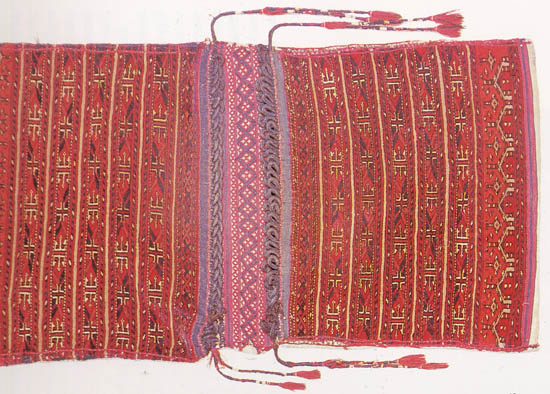
Regards
Steve Price
Posted by Gene Williams on 07-03-2006 03:06 PM:
ahhh
Steve,
An absolutely beautiful bag. I love it.
Of course the
palette has yellow....and..and. pink and purple and and ...the field colours
look...vaguely similar to Jack's juwal...no?
The closure mechanism is
fascinating and seems quite definitive. and...and..there are blue strips
underneath the fastening loops!!
Now the question to my mind on how this
relates to juwals is, what were the were juwal closoure (Marty, I paying
attention) loops fastened to... amongst all this stuff... and where?
This is really good stuff. Thanks. We're back to
Turkotek.
Gene
Oh by the way, I have a piece of embroidery at
home. Jerry one time let slip that he thought it was "Sariq." about a year later
I said, "Jerry take a look at this embroidery..Saryk right?" (not having a clue
about what he had been talking about the year previous). He replied (lifting his
scotch), "Ahh, the student becomes the master." Nothing more, no explanation,
nothing.
This embroidery has been under my crystal decanters for 30
years..with brandy and scotch being dribbled onto it. Based on this and the
pallette you just displayed, and on Jerry's enigmatic comments so many years
ago, I'll have to put it onto the net when I get home for comment. many
thanks
Posted by Steve Price on 07-03-2006 04:22 PM:
Hi Gene,
You wrote, what were the loops fastened to and
where?
The closure for each bag consists of two long braided ropes.
One is sewn to the back (but facing forward), the other to the top of the face
of the bag. They are sewn into the form of loops. A bit is attached, then a
loop, then the next bit is attached, then another length is thrown into a loop,
and so forth. In the end, the back and the front of each bag has a series of
loops on it.
The loops are interlocked to close the bag, as you can see
in the most recently posted picture. The loop at the end gets "locked" by any of
a number of things. A stick is all it takes to keep it from coming undone. I've
seen some with a short rope, appearently for the purpose of locking the end
loop. Marty Groves has seen a photo of one with a padlock on
it.
Regards
Steve Price
Posted by Marty Grove on 07-04-2006 09:56 AM:
A red bag
G'day All,
This has been an absolutely fascinating discussion which
has encompassed a huge variety of subjects relevant to Central Asian
carpets.
During its progress, we have had innumerable diversions which
have taken us into the distant realms of tribal peoples and their history; we
have experienced people relating information about dyes, colours and their
ingredients past and present; there has been much made of tribal groups and the
designs inherent in their woven bags during a specific timeframe; we have read
the opinions of people about the merits for and against purchases from Ebay and
even had to digest the idea that because certain knowledgeable persons fail to
bid upon an offered rug, then that rug might not be considered
worthwhile.
I am astonished and amazed that such a beautiful rug can
generate so much positive and negative feedback, especially when considering the
fact, that for all the information provided by the many contributors, no one can
conclusively refute the description offered by the owner Jack, and his brother
Gene.
Jack has stated time and again that this rug was bought simply
because of its perceived beauty; and possible differences to commonly held
positions on Turkman rugs made it interesting to him.
He has the bagface
in hand, and has discussed at length what it shows in structure, materials,
colours and design. He holds a position which he believes is validly possible,
after researching in depth to provide himself with sufficient evidence to make
his assertion.
While that position may not be acceptable to others, is it
really of such great consequence? After all, we are really only having a
discourse about something which at most is a beautiful handmade object from a
distant period of time reflecting a long dead womans interpretation of the
elements and motifs important to her family and tribe.
I do understand
there is always a need for greater knowledge when handling artifacts from
history, and appreciate that people will expend much time and resource to fulfil
that endeavour.
Ultimately, for me though, in my ignorance of Turkmen
weavings, there remains the object itself, which is manifest in its own inherent
beauty and presence, regardless of the disputed provenance by so many.
In appreciation,
Marty.
Posted by Steve Price on 07-04-2006 10:03 AM:
Hi Marty
Collecting is neurotic, and a frequent part of this is
persistent efforts to know everything about the objects. Superimpose on this the
well-known tendency of Turkmen collectors to obsess on details.
No time
to post more right now. Gotta finish sorting the jumbo bag of M&M's into
packages of one color each. Should finish by this afternoon.
Steve
Price
Posted by David R.E. Hunt on 07-04-2006 10:15 AM:
Hi Marty,
You did notice, however, that they did not PROVE their
assertions regarding this chuval as well, didn't you?
Dave
Posted by Marty Grove on 07-04-2006 11:05 AM:
Assertions
G'day Mr Hunt,
Well, actually what I did notice, was that no one was
able to DISPROVE Jack or Genes suppositions either!
For all the refutations
offered by the opposition to Jacks point of view, there was nothing which could
be said to convincingly shoot his idea down. From where I sit, Jack holding the
piece puts him in a better position to determine the actuality of the bag. If we
were to look at this as a debate, personally I would put Jack a few points
ahead.
Then again, Im talking as usual thru my a..se about something of
which I know absolutely nothing, so can only take in all the information and
references and try to distill them into such which can help me make up my own
mind.
That an old bag can raise such ire amazes me. If we were discussing
the relative merits of wives or girlfriends, then it may be understandable, but
on a subject such as this, well, it certainly shows how civilized we are
Regards,
Marty.
__________________
Martin R.
Grove
Posted by Steve Price on 07-04-2006 11:15 AM:
Hi Dave
Did it really take nearly 40 posts for you to conclude that
the attribution is ambiguous?

Regards
Steve
Price
Posted by Sue Zimmerman on 07-04-2006 11:30 AM:
Hi Marty, I would pay more heed to what you call your "talking through my
a..se ..." than a nodding cast of thousands consensus, anyday, but I have to
wait to tell why for a bit later. Sue
Posted by R. John Howe on 07-04-2006 12:29 PM:
Dear folks -
This is an interesting thread.
I'm not sure I have
taken in at all accurately nearly all that has been said, but it seems to me
that some interesting things have been claimed.
In no particular order
they seem to include:
1. The "Ersari" are not "Turkmen."
2.
Something like "no one has every seen an 'Ersari'." (not the actual
words)
3. The notion that a piece that has Saryk indications must be that
and not Ersari.
4. Disagreement about what Jon Thompson seems to indicate
are his indicators for third phase Saryk weavings (i.e., dark palette,
asymmetric open right knot).
5. A failure to acknowledge that elements of
almost every one of the "western" Turkmen tribe can occur in "Middle Amu Dyra"
pieces (a usage that says to me 'we simply don't know yet') Specifically, this
means that a piece can have a "cruciform" Saryk-type center in it major guls and
still be "Esari." There were in fact lots of Saryks in the Middle Amu Dyra area
and they likely still weave with echoes of their traditional usages in their
pieces but are/were also exposed to the influences of being in the middle of the
"Silk Road."
6. An insistence by the brothers Williams [who obviously
look around and know a few things) that the piece that initiated this thread is
likely second phase Saryk (something that would amaze me if true); it looks both
sumptious with all that silk and as Tim said early, rather recent, on my monitor
(there is no hope stronger than that of an ebay winner who has not yet receieved
a piece won; I've been there myself)].
7. The amount of assertion
(without sources) posing as fact. "History" is example A here. It may all be
correct, but what are the sources?
8. The tolerated level of intemperate
language that took hold pretty quickly. Steve must have seen this since he is
participating actively in this thread, but at one point someone seems to have
called another a liar. We are not holding much here to our objective of what
O'Bannon would have called "spirited yet civil" exchanges that do not resort to
ad homenim characterizations. These seem to abound.
The "Ersari" complex
and especially its "Middle Amu Dyra" components are being sorted out, but there
is (as is true of the Yomut complex as well) a great deal that is unknown and a
deserved tentativeness in the indications being made.
More of the latter
would seem appropriate coloration for the indications in this
thread.
Regards,
R. John Howe
Posted by Gene Williams on 07-04-2006 03:52 PM:
Ersari?
Hi John,
Your post maybe is a little harsh. Jack put the bag up for
comment. No attributions were made. Some propositions put forward. Some research
done.
A guy comes along (Kline) and says.."sorry to bust your balloon"
and proceeds to make obviously wrong unsubstantiated and pretty obnoxious
arguements.
And you object to the tone of the response? Do you believe
Kline was right? why? You claim Jack's history is "unsubstantiated." why? Or do
you believe the Saryk weren't driven from the Merv Oasis in 1854?? As I recall
he but a number of books on the post (which couldn't have footnotes) for others
to look at. Did you look at them?
The bag may be Ersari...it may be
"Middle Amu Darya." But, I understand it is beautiful and unlike what you've
said, it has not only been seen in the wool, but extensive photos of it have
been posted.
The arguements for its attribution have been extensive. The
arguements against have been pretty scanty. So intellectually we've all gained.
right? And in the end, its beautiful...right?
But if you have some
observations on the carpet, put them out there. Gosh. My objections to Kline,
Rob and Richard's posts were laid out above. There was nothing you could learn
from them...just fluff, complaints and opinion. and I've had a problem with that
since college.
Post away. By the way my bag is also on this thread. Have
at that as well. I'm willing to listen to you. (and personally I really care
more about the art than the attribution).
regards, Gene
PS. (edit)
John, here's an idea. You and a lot of Turkotekers are in the Washington Area.
I'll be home first week of August. Jack is passing through there about
mid-August and will stop over with the juwal. How about I invite all of you over
to McLean to have a beer (or whatever) and look at the rug? Might be an
interesting afternoon.
Posted by David R.E. Hunt on 07-04-2006 03:52 PM:
Hi Gene
It's simple. If the knot is not symmetric, it can't, by
definition be Saryk. Or at least Saryk of an appreciable age. This is of the
most fundamental principals of attribuition. What is so difficult to
understand?
Dave
Posted by Gene Williams on 07-04-2006 04:31 PM:
invitation
Hi Dave,,
I guess I don't understand much. Anyway, I'll repeat my PS
for you.
PS. (edit) John, here's an idea. You and a lot of Turkotekers
are in the Washington Area. I'll be home first week of August. Jack is passing
through there about mid-August and will stop over with the juwal. How about I
invite all of you over to McLean to have a beer (or whatever) and look at the
rug? Might be an interesting afternoon.
Dave, come on over...I'll try to
set up a date for an afternoon and let you all know. You all will be more than
welcome.
Gene
Posted by Steve Price on 07-04-2006 04:33 PM:
Hi Dave
There are a small number of pieces with asymmetric knots that
are attributed to Saryk, and this is generally believed to be a late
development. But whether there might be a few that were earlier is hard to say.
I don't think there was a day when the supervisor of weaving came around and
told the Saryk ladies to start making one piece out of every 20 with asymmetric
knots. If I'm right, then it must have developed gradually, from extremely small
numbers to very small numbers.
Small point in passing: symmetric knotting
is a common property of Saryk weavings, but it isn't part of their definition.
The definition of a Saryk weaving is that it is a textile woven by a Saryk. The
properties help to identify them, albeit imperfectly.
My position on this
one is a firm, definite, You can quote me on that.
Regards
Steve Price
Posted by Richard Larkin on 07-04-2006 05:17 PM:
Hi Steve, Dave, et al.
I think Dave's point is that according to the
accepted orthodoxy, early Saryk is by definition knotted symetrically. Thus,
apparent Saryk work manifesting assymetrical knotting is thought to be later. We
should keep in mind that the attributions we make are based on models. Who wove
what and under what circumstances is what we are trying to figure out.
My
opinion is that the two examples of the Williams brothers fall outside the range
of typical Turkoman weaving. They are interesting, but I don't know what to make
of them. I, like many others, would love to see them in
person.
Incidentally, in cases such as these "odd" pieces (as compared
with more typical Turkoman examples), I think an observation that they have been
passed on by knowledgeable buyers is fair comment. Especially when the original
request for comment was tendered with what seemed at the time like humility.
__________________
Rich
Larkin
Posted by Steve Price on 07-04-2006 05:55 PM:
Hi Richard
I don't want to turn this into a semantic debate, but knot
type isn't part of the definition of Saryk weavings any more than it is of any
other. It is one of the diagnostic criteria. The definition of early Saryk
weaving is that it is a textile woven by a Saryk before, perhaps, 1850. That
wouldn't change if someone discovered a cache of documented early Saryk weavings
with asymmetric knots, jufti knots, or any other characteristic that surprises
everyone. But the diagnostic criteria would have to be modified. It's something
that's happened in the past (look at the attributions in Amos Bateman Thacher's
book) and is likely to continue to happen in the future.
These pieces
clearly fall outside the mainstream, which is what makes their attribution
difficult. I'd love to see them in person, too, but I don't think that would
make me any more certain of what they are than I am now (which is not very
certain at all).
One of the things people often lose sight of is that
attributions are actually probability statements, although that usually isn't
made explicit. The process of reaching an attribution consists (in formal terms)
of looking at all of the criteria that are available, assigning what we think
are reasonable weights to each, and seeing where that leads. Most of the time,
the probability of a particular attribution seems very high, but sometimes (like
these), it's not definitive. I agree that the opinions of other collectors,
especially those that we think are pretty knowledgeable, is one factor to
consider in arriving at a probable attribution. I'm not convinced that the fact
that certain people didn't bid on a particular piece is powerful evidence about
anything. I buy an occasional rug and an occasional piece of African art, but
pass on the vast majority of what I see, and I suspect that this is not atypical
behavior.
To complicate things even further, some criteria are often
based on what appears to be orally transmitted folklore.
Regards
Steve Price
Posted by Richard Larkin on 07-04-2006 06:35 PM:
Steve:
Attributions are actually probability statements. I couldn't
agree with you more. The real circumstances of these weavings are certainly much
more complex than we know. Now and then, something big breaks out, such as the
work and research done by Wright and Wertime, and we (sheepishly, as far as I'm
concerned) realize how much in the dark we've been. So we have to be somewhat
circumspect in our application of the attribution criteria we use. A common
fault of rug affidionados, in my opinion, is to be too dogmatic in attributions
based on accepted criteria.
__________________
Rich
Larkin
Posted by James Blanchard on 07-04-2006 06:35 PM:
Where angels fear to tread, again...
Hi all,
I agree with John that the tone of this discussion is much
more heated than most on Turkotek, so it is with some trepidation that I offer
any observations. As most of you know, I don't consider myself to have much in
the way of real knowledge about Turkoman weaving, but I did take some time to
read through the article on "phylogenetic analyses of Turkmen textiles"
referenced by Jack early in this thread (Tehrani and Collard. J Anthropol Arch
2002:21:443-63). Although I found the basic approach interesting, and some of
the background and discussion illuminating, it seems like the authors have not
been able to escape the continued problem with attribution of Turkmen textiles;
for many textiles we don't know for sure who wove what and when? So in
classifying textiles according to the five tribal groups (Yomud, Tekke, Salor,
Saryk and Ersari) it appears that the authors have relied on two criteria: 1)
attributions provided by others (museum curators and writers) and, 2) structural
criteria. With respect to structural criteria they categorically state that (p.
447, column 2, para 1):
quote:
The weavings produced by the Salor have asymmetrical knots open on the left,
those produced by the Tekke have asymmetrical knots open on the right, and
those produced by the Ersari have asymmetrical knots open on the right and
depressed wefts. Saryk weavings employ symmetrical knots with raised warps,
while Yomut weavings employ symmetrical knots with depressed warps.
Even with my own limited knowledge, it seems as though these
structural criteria are not wholly accurate. Moreover, basing attributions on
the opinions of others tends to replicate circular arguments based on some sort
of "group consensus", and can hardly be used as a "gold standard" as is required
for such an analysis (if the tribal attributions are wrong, then the basis for
the analysis is weak).
How does that relate to the present discussion?
Well, for me, it seems as though much of the assertions vis-a-vis the
attribution and age of the present juval is based on contrast and analogy with
other weavings, which have been assigned a tribal attribution and age based on
conventional wisdom and the experiences or judgments of others. For weavings
that are clearly within a given group (like a typical Tekke main carpet or Yomut
dyrnak gul carpet or a Yomut asmalyk), this is a reasonable and probably very
accurate approach. However, for weavings that are more ambiguous in terms of
structure and design, I am not sure how firm the foundation is, or can be. It
seems to me that as long as a piece is well-liked by the purchaser, and has not
been purchased for purely commercial reasons (i.e. for resale), then the matter
of age and attribution is less important.
Regards,
James.
Posted by Richard Larkin on 07-04-2006 06:38 PM:
James:
Hear, hear!! Amen.
__________________
Rich
Larkin
Posted by R. John Howe on 07-04-2006 06:39 PM:
Hi Gene et al -
I had and have not intention to be "harsh," but when
we begin to describe one another's comments as "fluff," I sense that things are
moving in directions we try to avoid. Such conclusiveness seems to rule out the
possibility of sound disagreement.
And I don't single you or Jack out at
all. I was speaking to a tone of intemperateness that seemed to arise in the
posts generally. But with regard to the "fluff" usage, it might be better to say
"I strongly disagree...etc." A great deal of what passes for "knowledge" about
the rugs we collect, is visibly coated with "opinion." Have you noticed that
many experienced rug folks disagree with one another and sorrow about each
other's visible inabilities?
I have no conclusions about who is right in
this discussion, since I have not had the piece in my hands (and might not have
much to say even after that).
I'm sorry if I am mistaken that no one in
the conversation has seen the initiating piece in the wool. The coloration and
tactile side could be described with more confidence if that were the
case.
I should say that I disagree with David Hunt's indication that
Saryk pieces of an "appreciable" age will have symmetric knots. If I read
Thompson correctly, he seems to be saying that the "second" period of Saryk
weaving, as he estimates it, is that of the "middle third of the 19th century."
Not to put too fine an edge on that indication, that seems to be about 1834 to
1866. Thompson also explicity says that the later period of Saryk weaving
includes 1880, the approximate date when he believes synthetic dyes began to
appear in their weavings.
This shows how unsatisfactory descriptions
such as "appreciable" are. Let's not insist on 1870 as the beginning of the
third Saryk period, but instead say that 1880 will do (since there seems to be
some suggestion that there are synthetic dyes in the silk of this piece). A
Saryk/Ersari piece woven in 1880 is now 126 years old and meets my own sense of
"appreciable" age. I own one large-ish chuval which is dark, has asymmetric
right knots and cruciform centers in its major guls, that is also estimated to
be both Saryk and woven in the late 19th century.
About your proposal:
I'm here in Washington, DC until July 23, but leave then for two weeks of
vacation, but am back after that until about the week of Labor Day. I'm happy to
try to meet somewhere agreeable to look at this piece together (the closer to a
subway stop the better). Let me know.
My email is: rjhowe@erols.com
And if someone contacts
me with an email, I'll provide my cell phone number as well.
I, by the
way, collect mostly Turkmen pieces, but do not hold myself out as at all expert
concerning them. I am very interested, own a number Turkmen weavings, ikats and
embroideries, and have a reasonable Turkmen English language
library.
Regards,
R. John Howe
Posted by David R.E. Hunt on 07-04-2006 08:19 PM:
Devil's In the Details...
Hi John
Of course, exceptions to every rule. But still I would expect
the most likely candidates for this "exception" to be those sporting a more
tradition design. In other words, the occasional piece with "other than
symmetric" knots which conforms closely in other details, is the most likely
candidate for the Saryk with "odd" knotting.
We can assemble a list of
characteritics, create an entire nebulas of evidence, but there seems be, better
needs some heirarchy of criteria by which to filter all of this
evidence.
Steve, point taken. True we really, barely know who wove what,
but I am more dogmatic than that
Dave
Posted by R. John Howe on 07-04-2006 09:43 PM:
David -
I need to continue my quibble with your indications about
pieces attributed to the Saryks that have assymetric open right
knots.
You use the terms "exceptional" and "occasional" to characterize
the occurence of asymmetric knots on pieces attributed to the Saryks.
My
own understanding from the literature is different. Here are the two Eilands in
their most recent edition of their "comprehensive guide:"
"...The
structural feature most commonly associated with Saryk weaving is the
symmetrical knot, which appears in virtually all of the early rugs thoght to be
Saryk, although on later rugs with Saryk designs and colors, the asymmetric knot
becomes increasingly common..."
This comports with my own understanding:
that we are not talking about "occasional" or "exceptions," but rather about an
emerging group of the later 19th century production that carry both darker
colors and the asymmetric knot open right.
Of the pieces I've seen in
this latter group, most also seem not to have the cotton pile in guls that many
Saryks have.
Our respective understandings about the frequency with which
late 19th century Saryk pieces carry asymmetric open right knots is different.
Further, these "Saryk" pieces with asymmetric open right knots are still
frequently estimated to have been woven in the last quarter of the 19th century
and so often have "appreciable" age.
The claim you are making seems more
aptly applied to "earlier" Saryks, those estimated to have been woven before
1875 and even more likely to those woven prior to 1850.
Regards,
R. John Howe
Posted by Jack Williams on 07-04-2006 09:58 PM:
border design, dyes, Knots defined, D.H. K.O'd
Ladies and Gentlemen.
This is from Dave Hunt's first two posts on this
issue, my comments in brackets: "The size [???] of your bagface and the "judor"
[?]border, as well as this stepped main border[?] and the barber pole
guards[??], and the use of silk [?????] all say to me Ersari." And "If this rug
arrives and proves to have symmetrical knots[??], I suspect this will be proof
positive that it is later than I already think it is.[???]" I have no problems
with David or his opinions. I've tried to answer with facts, or ignore his
comments because I don't think they are designed to help, just
divert...or...whatever.
Well, here Dave's recent post: "It's simple. If
the knot is not symmetric, it can't, by definition be Saryk. Or at least Saryk
of an appreciable age. This is of the most fundamental principals of
attribuition. What is so difficult to understand?" ... That statement is
laughable...see JBOCs and O'Bannon one paragraph below. Yo! Dave! are you
kidding or something?...and what is the meaning of the little devil face you
use?
I noted that I believed this to be 1860-1880, 2nd phase, not
pre-1850. My problems with Ersari have been clearly stated with extensive
backup. My thought of Saryk have always been tempered by such statements as
"seems to be.." My sources for history are many, but here is one. (by the way, I
provide extensive properly footnoted references for my posts...there IS a
difference in scholarship presentation, I hope you will agree...). For brief
history, see
http://www.tcoletribalrugs.com/article33ODonovanTurkmenl.html
The
2nd phase Saryks are said to include open left asymentric knots by many experts.
Here is one, JBOCs, see http://www.spongobongo.com/Saryk.htm
"Structure: 1st
and 3rd phase Symmetrical knot. 2nd phase may be Asymmetric open left [what's so
difficult to understand about this?]. 100 to 250 KPSI. No depression to slight
warp depression in older rugs and deeper depression increasing to deep der [sic]
on very late rugs. [my note...modestly depressed warps on the chuval in question
fits mid to late/mid 2nd phase-1860s or so-...does it knot?]
"Knots Per
Square Inch. Densities recorded were 108 (Lot 123), 112 (Grote-Hasenbalg, Plate
85, est.), 162 (Jones/Schürmann), 200-250 (Thacher but probably 125), 134
(Herrmann VI), 135 (Lot 133), and 144 (Franses). O'Bannon, The Saryq Main
Carpet.
"Saryk weavings the vertical to horizontal (knot) ratio is
1:1.5-2.0" [these are all characteristics of this chuval]
George OBannon
wrote: "There are two implied assumptions which present problems in assessing
these rugs. The first is: if they are Turkish knotted, they are Saryk. We know
from past and current production that the Yomud Turkoman tribal groups used both
the Turkish and Persian knots. The Saryk Turkomans in Afghanistan today weave
rugs with both types of knots. They probably did so in the past." http://www.rugreview.com/82saryq.htm . I'll refrain from
pointing out explicitly some recent erroneous posts on this issue by the
Ersari-ites.
By the way, I have an idea about why the knot types vary,
impacting some of the dead-gul, live-gul theory, and helps explain the more
varied and diverse bag designs. That will wait though. It concerns...just who
weaves in the oba.
John, I have posted facts, tried to discuss this
reasonably. I am not sure the same thing can be said about the Ersari advocates
who seem to me to have diverted to weird issues when faced with the fact that
nothing other than border design fits Ersari attribution...but most (not all, by
any means) of these people have have shown that they are not to be taken
seriously.
I have been in communication with the dealer in Netherlands,
the underbidder had seen the rug and thinks it a bargain, and more...whatever
that is worth. But, I might be able to get some background history of the rug
from him later as I told him of this "discussion." That said, here is a load of
data that might be of interest.
So far, (1)the age and (2) attribution
have been...er..."questioned." Proposed attribution has either been
(1)directionally sayrk, (2) Ersari, or (3) "not sayrk." The questions about age
and saryk phase has been limited to dyes.
The Saryk attribution has
relied on structure, design of field, elem, top border, etc. The question of age
and dyes have turned on the existence of artificial dye “markers” especially
purple-silvergray. Most of the “non-Sayrk” arguments including “no ‘big-boys’
bid on the item on ebay," etc., have been pretty much deconstructed. Most Ersari
arguments have been flawed ignoring as they do all other data except only two
(1) the border design as an absolute marker for Ersasri, and (2) the “tonality.”
The border has two elements that have been raised…the bodom minor borders, and
the step major border.
Lets add some data. First the “step boarder as
absolute marker for Ersari.” All that is needed is to show that border is not
confined to Ersari. Does that mean it is SaryK? – nope –but one can no longer
demand Ersari based on that one design feature. I present this, two Chaudor
torbas from Thompson’s collection and Craycraft displayed on JBOC. There will be
more from diverse groups later.

http://www.spongobongo.com/ltf/ltf9967.htm
The
tonality question, i.e. a gold-yellow-brown aura is a marker for Ersari, is not
going to stand up. I am developing a nice collage, showing the tonality of Salor
bags that looks quite similar to Ersari…and some from other groups (if you
cannot wait for the collage, go to the constructed photo on page one where I
overlaid a known Sayrk border on the chuval…see the tonality of that constructed
rug). This leaves only the bodom design of the minor borders..Ersari is starting
to look weak if that one feature, a design element, is the only thing left...I
think that border has a possibly interesting history..a possible connection to
caucasian rugs...(that is going to be an interesting thesis.)
After all
these alternative positions are deconstructed, “no big boys bid, bag size,
etc.,” does it mean the bag is SaryK? Nope…just that the indicators point in
that direction..unless one wants to go down the Salor road. But it will probably
eliminate Ersari.
About dyes. Again, let’s get the theses up front: (1)
On silk, gray is a natural result of purple after mordanted with iron. (2) Dye
fastness has little to do with natural or chemical dye, and a lot to do with
process. (3) silk is different, more difficult to dye; (4) Chociinal makes a
purple with an afterbath mordant of iron…but the wrong aeration will change the
color, ph being a key..too acidic can remove the color entirely. (5) acidity in
certain situations will remove the purple color from silk if it is produced with
logwood-w/iron mordant. (6) sweat, including sweat from bare feet, is acidic.
(6) light will affect both chemical and natural dyes, but will sometimes change
the color of chemical dyes, and just lighten natural dyes. (7) afterbath of
iron, in wrong ph will change gold to green in natural dyes.
Silk is
different, takes dyes differently, and apparently produces different colors.
Most basic books just brush the top to the dye questions. Edwards and Eiland go
considerably deeper. But without going into too many details, here is what
Eiland has to say in the midst of his section on dyes: (see Eiland, Oriental
Rugs A comprehensive Guide, New Your Graphic Society,, 1976,
p.16.)
“…(Dyes affect other fabrics differently; cotton and particularly
silk, are more resistant to color)…”
Here is what seems to be a good web
site dealing with natural dyes and silk, (see, http://www.aurorasilk.com/index.html).
Here is a section
discussing the introduction of artificial dyes and the differences or lack
thereof with natural dyes (see section from above,
http://www.aurorasilk.com/info/why_naturaldyes.shtml
).
“The advantages of the new colours were ease and simplicity of use,
general reliability with regard to strength and composition, and certainty in
reproducing the same colour again without trouble. (3) WITH REGARD TO FASTNESS,
TO LIGHT AND TO WASHING THERE IS PRACTICALLY LITTLE DIFFERENCE BETWEEN THE TWO.
IT IS MORE THE METHOD BY WHICH THEY ARE DYED AND NOT THE DYE ITSELF (ALTOHUGH OF
COURSE IN SOME CASES THIS IS NOT SO)THAT DETERMINES THEIR FASTNESS [emphasis
mine]...”
Next section, see http://www.aurorasilk.com/info/logwood.shtml This deals with
logwood because that section has advanced information. I suspect (but do not
know at this point) this is not uncommon other natural dyes, including
Chochinal.
"Advanced Dye Issues
"The molecule that is the Logwood
dye can exist in three different forms, depending on how much oxygen has been
incorporated into it. The unoxidized form is useless as dye, unless either the
mordant or the dye process adds oxygen. This is why it is necessary to use
well-fermented wood, and to further soak it overnight, to "air" it and add
oxygen. Over-oxidized Logwood is of limited usefulness, giving dull, grayed
purples, however it works well for black: black baths keep and get stronger with
age, but purple baths generally go gray after a few days of storage.
Logwood
is an "indicator" color, one that changes with the pH of the solution. Thus
adding either acid or alkali to the dyebath can modify the hue obtained. Too
much acid will actually cause the dye to "disappear". Just enough will give
redder tones, while alkalis like chalk or bases like ammonia will turn the tone
more blue.
"Because the iron-Logwood combination has such a pronouncedly
blue tone, iron-Logwood can be used to turn yellows and golds into lovely soft
greens [note a section of green silk in the midst of gold silk minor gul
outlining in the subject...iron after/mordant?]. Compounding mordants by adding
tin or alum in with the iron gives very fashionable lavender
grays."
"Cochineal- Colors: Scarlet Red with tin, Crimson Red with alum,
Violets with chrome and iron"
"Natural Dye Color Chart"
"These are the
most popular, fastest dyes available for natural dyeing, and the colors you can
expect with the different mordants.
Alum Tin Chrome Iron
Copper
Indigo blue - no mordant needed
Cochineal: crimson scarlet
lavender to violet gray-violet to black;
-
Brazilwood: Xmas red to garnet
pink deep maroon off-black -
Logwood:blue-violet purple blue-black silver,
gray, black gray...
Madder:brick red bright orange burgandy off-black
-
...etc.
• "Iron is often used to modify other colors. By itself it
mostly results in shades of gray, but in as an after-dye application it can
modify your colors. See How To Use Natural Dyes for more information.
..."
From the section on the above site:
http://www.aurorasilk.com/info/natural-dying.shtml#adjust
"Step
2 - Dyeing"...
• "Now is the time to modify the colour, if desired, with the
additional mordant of iron. (See directions, below.)...
"Adjusting the
Color"
"IRON "AFTER-MORDANT" TO MODIFY COLOURS:
Dissolve about 1
tablespoon of ferrous sulphate per pound textile. Add to the dyebath, or fill a
bucket with warm water, add the iron and transfer the textile to this "after
mordant" bath.
"This is an important technique to know, for iron will
turn golds to moss greens, reds to plum and maroon colours, and will darken
browns. Many leaves and plants will make grey with iron as the only mordant
needed."
It is possible that a lot of common knowledge markers for
non-natural dyes could be different when dealing with silk. On the other hand,
Eiland chooses his words very carefully dealing with this issue, but notes one
dye which "likely orginated with chemical dyes," in Caucasian rugs, circa 1880s,
a mauve-magenta, that fades to dull gray on surface, staying vibrant violet on
back. He does not mention Turkministan or silk. Also, of course, no mention of
looking purple with grain, silver down grain. He also notes a carmine, similar
to cochineal, noted for instability in water...with other characteristics. Both
are supposed to assume a "muddied" appearance. op cite, p. 20. Note, even if the
purple-gray SILD proves to be chemically dyed...it is perfectly plausible the
rug is 1860s, 2nd phase Saryk, as I said previously...
One last thing,
please pardon me. I am primarily a baluch collector...never really was struck
with the turkmen bug. But in this line, I seem to be the only one imparting
information, doing research, sharing findings and data, running down leads and
dodging rocks. Is it little wonder that Gene and I get frustrated with yet
another troll, or troll-like comment? That's ok, its my rug. But one would think
that there is a little experience and expertise in Turkmen carpets out there
that could provide a little postive guidence...
Thanks and
regards,
Jack Williams
Posted by R. John Howe on 07-05-2006 05:55 AM:
Hi Jack -
This last is a very nice post, in my view.
It is
clear, as I said before, that you look around a bit and are familiar with and do
consult a variety of sources.
[I do note that you consult and cite
spongbongo (seemingly authoritatively) a lot. I think Barry would insist that
he, like many of us, is primarily a collector of information about rugs, rather
than an authority on them. The strength of his effort is that he is making a
great deal of information on rugs conveniently available. He is functionally
applying his professional skills as a builder of data bases to the rug
world.]
And the more explicit citation of sources is, at least to me,
more useful than is uncited reporting of what they might say.
Your
citation of Tom Cole's reports on his site on Donovan's book tripped some recent
memories for me.
I just finished reading Donovan last month and have
been meaning to draw attention to some interesting things he reports (among them
how much the Tekkes he lived among for quite awhile abhorred being in walled
cities).
Donovan also turned around my understandings of the extent to
which the Tekkes seem to have been in the 1860s already "settled in tents," so
to speak, and actively engaged in agriculture. The markedly qualified character
of the "nomadism" among the Merv Tekkes, perhaps not something to be surprised
about for people living in an oasis, had new and richer meaning after this
reading.
I was also struck as I read of how frequently Donovan seems to
have at hand, as he travels, an impressive array of historical information about
the locations he travels through. He clearly had some maps of the time, but it
is not always clear to me what his sources of this surprising detailed
historical information are.
I do, as a number of others have done,
recommend Donovan's book (my set is in two volumes) as something for anyone
interested in the Turkmen to read.
But do note that Donovan says that
while he has done the best job he can reporting the "history" of the Tekkes (and
other tribes mentioned) told to him by older members of the Turkmen tribes with
which he came in contact, he cannot vouch at all for the accuracy of what they
reported.
So some of this history may still be a bit muddy. (I do
remember a professor from Indiana University who came to a TM rug convention one
year and gave (what was to me) a surprisingly detailed history of the Salors. (I
always meant, but never tracked him down to do so, to ask for a copy of his
bibliography. And I haven't heard that he published, although that could have
occurred in an academic journal without my knowing of it at all).
So
some seem to claim that they are now sorting out Turkmen history more
successfully. That is apparently why Erik Risman and his associates are tracking
the work at IU closely in their attempts to sort out the "Middle Amu Dyra"
complex more satisfactorily.
But back to your chuval. I see no reason why
it could not be a later phase Saryk weaving, but am less clear about why you are
so insistent that it be seen as second phase.
Depite an elaborate
argument and the array of dye information you have dug out and present, this
seems to me to be an attribution claim that is both unnecessary and a bit
aggressive (I use that last word, of course, in a non-punitive sense; as you
know, this term is frequently used to characterize attributions that seem
optimistic). Does something important that I'm not getting (other than age
itself) hang on its being seen as a "middle period" Saryk weaving?
Only
at the end do you seem to backslide a bit into complaint about the rest of us
here. This is a discussion board. Folks here are expressing their interest in
conversations about the rugs we collect. There may be some of us who have come,
however inadvertently, upon some knowledge of some aspects of the rugs we
collect, but we are usually cautious about any effort to speak definitively. For
me, at least, such caution is wise, not something that deserves
complaint.
Regards,
R. John Howe
Posted by Gene Williams on 07-06-2006 02:30 AM:
academics and artists
Hi all,
It seems we're reaching an academic impasse of sorts. What a
tremendous amount of good stuff posted; enough for a book? Has there been
another discussion on Turkomen juwals as informative recently?
Sounds
like the discussion is what I used to see in academia. I remember two geologists
the Alabama State Geological Survey almost coming to blows over one's then newly
published restratification thesis for a certain oil dome. And I think the tone
went downhill when someone (an alias maybe?) stirred the pot with a
condescendingly imperious "sorry to bust your balloon" post which proved to have
numerous demonstratable errors in it.
And a certain frustration factor
takes hold. Obviously some people have a strong opinions about what is and isn't
Saryk but don't want to share how they arrived at these opinions or why. This
seems vaguely anti-intellectual and vaguely anti-social ("I don't have time to
explain myself to you"), especially when some of the strong opinions expressed
so tersely turn out possibly to be wrong. Nor will they come back and
acknowledge the counterpoint and reargue their case.
Myself, I listen to
stories (and repeat them) and look at the art in the rug; I've never dug much
into structure or done a lot of rug-specific research on background (although I
have read an awful lot of history of the area from Tehran to Peshawar). Jack,
though, is obsessive and digs and as an engineer and a historian (and an
investigator of oil-field accidents) always is looking for truth of some sort or
another.
I'd like to repeat my invitation to come out to McLean when I
get home for an afternoon or evening and see the carpet. Dave and John for sure
are pretty close by - John I could pick you up at West Falls Church station
(orange line). Maybe Steve could drive up from Richmond. Heck, maybe Marty could
fly in from NSW.
I have some things from Jerry Anderson days in Karachi
I'd like to show you anyway...see if they're worth posting on Turkotek and you
could look at that leather rug too. As soon as I get back, I'll post a proposed
date. Hope to see you all.
Gene
Posted by Steve Price on 07-06-2006 07:40 AM:
Hi Gene
I'd love to come to McLean, meet you-all. I'm in northern
Virginia pretty often, as the ferry service and mobile ATM for my hockey playing
14 year old. His team's home rink is in Woodbridge.
Let me know when the
dates firm up, and if I can be there, I will be.
Regrds
Steve
Price
Posted by Marty Grove on 07-06-2006 09:07 AM:
To a Rugalong I wish
G'day Gene,
I wish! How nice it would be to hop aboard and fly -
especially to have in hand that splendid Turkman which precipitated such an
indepth discussion. Who would have thought it?
Usually when I post
everything goes quiet, but this I accept as my coming on duty when you all are
crashing out. With Jacks rug and my expressing such liking, well, what was
unleashed!?
Much appreciation Gene, for a lovely suggestion, however my comrades
here at Rescue would have kittens were I to suggest my absence for even a couple
of days (Ive had 2 two week breaks in eleven years, and no sickies ) No doubt you may know how welcome
overnight shifts are amoung the workforce... So when you find someone such as
myself who is willing to do five nights with absolute reliability and no
illness, its unlikely that absence is welcomed.
But Gene, the thought was
nice
Truely, I
am looking forward to an indepth analyses of all the comment illicited from the
people who attend your 'salon' to examine the piece in question, with their
aquiescence of course!
An in person, not cyber, discussion amoung
knowledgeable, interested, and hopefully unbiased people may get to the heart of
the matter - we can hope
With thanks,
Marty.
__________________
Martin R.
Grove
Posted by R. John Howe on 07-06-2006 09:33 AM:
Gene -
I'm definitely up for a meeting.
Let me know. You have
my email.
I might even bring a "Saryk" chuval.
R. John Howe
Posted by Jack Williams on 07-06-2006 11:03 AM:
I propose an attribution solution
Good Morning, John and all, I would love to meet for just the
socialibility...and rug talk would be lagniappe. It's not much fun in New
Orleans right now. Perhaps others can also bring a favorite item or something.
Also, I think I may have a possible solution to attribution of this chuval:


Purely to grab interest, for reference I’ve asked Steve to post
some pictures of Saryk chuvals that seem to me to represent the three Saryk
phases. They are titled and attributed in text boxes on the pictures. The first
two are from Jourdan, p. 84, and illustrate (I think) 1st phase and 3rd phase.
The third picture is from http://www.gallery-arabesque.com/type/chuval web site. This
chuval is attributed to 18th c on that site and therefore should be a phase 1.
Personally, I think it seems to have a lot of the characteristics of 2nd phase
including silk, cotton, and general ornateness. True 2nd phase Saryk chuvals
seem hard to find on the net… Most seem to be labled “early 2nd phase,” or
“transistion-1st to 2nd phase.” Since I can’t find a definitive one..I’ll cheat
and let the gallery-arabesque one suffice.
Forgive the paucity of
references. I have them, just don’t have them organized to readily access them
at this moment. The list of the characteristics of chuvals and bags of Ersari,
Salor, Sayrk, etc., are pretty generally available, and I’m sure well known to
you. But here are a few sites that have some of those characteristics for
reference:
JBOC’s site has a good accumulation of information as we are
all aware, and he seems to have as clear a delineation of Sayrk phases as
anyone. http://www.spongobongo.com/Turkoman.htm
Eu Jourdan’s
book, scanned online at the below site has characteristics listed on pages 28-30
and a significant amount of other data including some discussion of Saryk phases
on page 75. http://members.fortunecity.com/mustafamercan/
Tom
Cole’s site discusses the Saryk phases:
http://www.tcoletribalrugs.com/resources/rugshtml/71Saryk.html
There
seem to be four possibilities for attribution of this bag. I am ignoring Tekke,
Yomut, Chodour, etc. whose weave seems unlikely to be the source of this chuval,
at least to me..
1. Ersari – In my previous posts I’ve listed some
indicators of about 20 major attributes of this chuval. These include the
structure information as best as I can determine it, weave, knots, number and
type of colors, use of wool-silk-cotton (an important marker?), elem design, top
wide elem-border construction and design, number and design of borders,
thickness of borders, blue band on top elem-border, selvedges, warp and weft
composition and color, field design, guls – major and minor, color of silk in
the major guls, etc.
From what I’ve read, its true that many of the
features of this chuval can be found in one or another Ersari rugs, or bags.
However, many of these features do not seem a common norm to Ersari...for
instance the fineness of weave would seem to be pretty far up the Ersari range.
It seems to me that even if some of these characteristics do commonly occur in
Ersari chuvals, it would be unlikely for all of them to be present in one
chuval.
I get the feeling that the Ersari were east and south of the main
Turkmen events of the late 19th century. As a result they seem to have been
insulated and maybe because of that their bags of the time seem to have a lot of
variation and creativity, perhaps harking back to much earlier Salor
confederation days (examples and references forthcoming). Most of their older
bags seem to me to have lacked the appearance of this one…with the formal nature
of chuval gul, chemche gul etc. (need attribution footnote). Other than the
design of the bodom borders and main border, I have trouble seeing any other
obvious attribute of structure, weave, composition etc. that marks this as
Ersari. Since there is another choice that fits this bag much more exactly,
Ersari would be a third choice of attribution in my opinion.
2. Salor – A
lot more of the characteristics of the chuval seem to be Salor, especially
structure, fineness, design, etc. However, I understand that the Salor were
fractured into small units and defunct as a tribal unit by the time this was
likely woven. Since there is another choice that fits the bag more exactly,
Salor would be a second choice of attribution in my opinion.
3. Other or
unknown group or MAD – The chuvals of other known Turkmen groups do not seem to
have characteristics of this bag. A really good article discusses the more
mysterious middle Amu Darya (MAD) chuvals, a point John proposed, http://www.dmreuben-carpets.com/Articles/Art1.htm That is an
interesting idea. But before this one gets tagged with MAD, I think that there
is another choice that fits this bag pretty completely therefore making MAD
unnecessary, at least in my opinnion.
4. Saryk –The list of all the
features of this rug and the supporting data seems to fit a Sayrk designation
almost perfectly. The cool thing about attributing this to Saryk is that it
might be then dated with a fair amount of precision. And, it might be that the
thesis can be tested scientifically.
I understand that what is known
about the Saryk is less than what is known about some of the other groups. There
may be some good historical and geographical reasons for this which might also
fit this puzzle - as usual, I have a social theory that might explain the
existence of phases...later though. But because the current thoughts about a
Saryk genre provides a nice division into phases it might allow a fairly precise
estimate of the time the chuval was woven.
It seems to me that following
pacification, the design change to 3rd phase, with the dark palette, somewhat
garish overuse of silk, ornate borders, crowding, etc., became the dominant
Saryk weaving style pretty quickly. Simultaneously, because of pacification,
Russian control, the railroad, etc., the move to widespread use of synthetic
dyes also may have progressed quickly including the rapid growth of the use of
synthetic reds for the wool in the field. In Oriental Rug Review, no. 117 (see
http://www.rugreview.com/orr/116mush.htm) Paul Mushak says he
could find no naturally dyed reds after the 1880s or so.
To me, the
subject chuval seems to have very few 3rd phase characteristics, including
colors, border number, design, weave – and it does not use the silk and cotton
in the way commonly described as being 3rd phase. It occurs to me that given Mr.
Mushak’s article, if the chuval has natural dyes for most if not all of the rug
it would be a petty good indication that it was weaved pre 1880s. It certainly
looks to me to have pretty good natural dyes, especially the field. For now, I
would like to assume natural dyes for the field..which along with the design
difference from 3rd phase pretty much would establish it as pre
1880s-90s.
Also, I cannot connect the design of the chuval to the
characteristics of first phase...which as I understand are generally identified
as the parent designs for 2nd phase, but less ornate, little silk and cotton,
more “Spartan” possibly harking from an era prior to occupation of the Merv
oasis and the access to both silk and cotton.
Finally, assuming natural
dyed wool, most or all of the features of this chuval pretty much fit 2nd phase
Saryk down to the weave, density, structure, cotton and silk, natural dyes, etc.
If I understand it right, even the following small trait seems to have Saryk
connotations, “…the extra colored hooks at the top and bottom of the gul [not
sure if he means the minor, chemche gul as on my chuval, or is refering to the
main gul] is typical of the Saryk” which is a quote from Mr. Rueban’s MAD
article referenced above.
So why doesn’t it resonate with a Saryk feel
to many of us who see the pictures? Personally, I think it that there are just a
limited number of 2nd phase chuvals that have been identified and published
widely. It might be that when we see one, most of us are just plain unfamiliar
with the sumptuousness of 2nd phase Saryk, being far more familiar with the
gaudy dark palette 3rd phase and the spare Spartan look of the 1st phase. I know
that’s speculation, but what the heck, I’m a speculative kind of person.
In summary, It seems to me that the chuval has the hallmarks of Saryk,
does not fit either third phase or first phase, but fits second phase to a tee.
If so, it seems reasonable to conclude 1860s or so to be conservative. That date
would allow the purple-gray silk to be a synthetic dye as long as most of the
rest was natural. If all the dyes prove good, it could well be dated before the
loss of Merv to the Tekkes in 1854. If the field is dyed with synthetics, then
it could still be 2nd phase, but dated after the 1880s…weaved by some throwback
mountain reprobate Auburn-like group who hadn’t gotten the 3rd phase message
yet.
I have a good deal more information and deductions, speculations,
and lines of inquiry. Included are how the Turkmen made war on each other, the
nature of “confederations,” the role of a “leader” in war between
Turkmen/Turkmen and Persian, the role of the poor and slaves in making carpets,
etc. But that is a major research effort, and I probably don’t have the
technical background to do it properly. Heck, I know I haven’t even footnoted
this properly. However, I hope you can see how I came to claim age, and
provenance.
So, to the proposed solution: If I can find a lab that can
test the dyes in this carpet, I think I will do it. The upside could be pretty
significant, and it certainly should answer some questions straight away. If the
field and most dyes prove natural, do you think my attribution will gain
weight?
Regards, Jack Williams
Posted by Gene Williams on 07-06-2006 03:26 PM:
Auburn
Hi all,
I'm sure you are '' at Jack's reference to
"Auburn." Well, for the unitiated (this will be ther Turkoman problem to unravel
in 500 years) this is the state of Alabama at its best. I got myself in trouble
once with a senior supervisor. We discussed education and the conversation went
like this:
I : I went to Duke University originally.
He: "we
(imperial we) went to Auburn university."
I : "geez after the Vietnam war I
considered going back to school at Auburn."
He: "Well why didn't you?"
I :
"Well, you see I could read so I went to the University of
Alabama."
Gasps and horror all around the meeting..
Gene
Posted by David R.E. Hunt on 07-07-2006 10:18 AM:
Hi John
Granted, I probably haven't read Thompson's discussion of
Saryk weaving in some time, but I still think we are basicly on the same page. A
couple of points you raise are worth further consideration.
In the first
instance you had quoted the Eiland's as saying that
"...The structural
feature most commonly associated with Saryk weaving is the symmetrical knot,
which appears in virtually all of the early rugs thoght to be Saryk, although on
later rugs with Saryk designs and colors, the asymmetric knot becomes
increasingly common..."
All well and good, but I find this further
qualification "later rugs with Saryk designs and colors "as opposed to "Saryk
weaving" to be most implicative. Why the further qualification if these
asymmetric weavings are clearly Saryk? Doesn't this period also coincide with
the time frame in which market forces came to fully bear upon Turkmen weaving,
the period of the "Salor gul" Tekke? I believe a quick survey of the market will
reveal numerous examples of weavings in Saryk designs with ambiguous tribal
provenance. There are also numerous examples in the literature.
Regarding
these last quarter 19th Saryk carpets, it is my understanding/impression that
these are not the most highly regarded, as the colors tend to be ugly ( have
seen a few in the market ),in the least as compared to the earlier
weavings.
In conclusion, last quarter 19th century Saryk carpets
represent a class dergraded by market influences, and this earlier period of an
apparent diversification. Better yet, could this apparent diversification be
more at mimicry, on the behalf of other tribes and the behest of market
influences, rather than diversification among the Saryk?
Find below an
image of the asymmetric open left,approx 100 Kpsi chuval that I
own,

followed by
an asymmetric open left, 120 Kpsi weaving #7 ,
from the New England Rug
Society's "Rare and Unusual Turkmen Pile Weavings".

Next, let's take a
look at NERS #8,

168Kpsi open right,and compare it to these asymmetric left
knotted weavings, and the subject bagface below.
Note the proportions of
the major and minor guls, the prominence of the field, spacing of elements, and
proportional relationship between field, guls, and border. A major MIddle Amu
Darya riddle?
Dave
Posted by Marty Grove on 07-07-2006 01:53 PM:
jacks.
G'day Dave,
My apologies Dave, but I found your examples a primary
reason why few Turkman chuvals have grabbed my attention.
Its probably my
ignorance, however one puts it, but those which you show, to me personally, do
not have the 'red red' colour, nor graphic balance and 'zap' which Jacks bagface
accords to my taste.
Of course, the matter of the provenance of the piece
means little to me really, but I do understand Jacks interest in getting to
grips with his rug, as do we all with those which we treasure.
Regards,
Marty.
__________________
Martin R.
Grove
Posted by Sue Zimmerman on 07-07-2006 03:26 PM:
Hi Jack,
Are you absolutely sure the white knots are cotton? In my
experiences of dyeing silk red I use unmordanted cotton skein ties. If
experimental reds bleed they always dye the ties pink. In the areas in your
photos where there sees to be bleeding red dye the white knots seem totally
unscathed. They may not be cotton. They don't look like cotton on my
monitor.
Incidentally, some may have noticed my posts are often inserted into
threads quite a while after I post them. This is because my posts can spend
quite a while in the line. My last post, 26 hours ago, has not appeared yet as I
type now so these two will probably be posted together. I'm sure Steve is busy.
I just wanted to explain why any possibility of real time conversation is
impossible for me. Sue
Posted by Steve Price on 07-07-2006 03:47 PM:
Hi Sue
I recall approving a fairly lengthy post from you yesterday,
but don't see it. We get a lot of spam posts that I delete without letting them
into public view, and it's possible that yours got caught in that by mistake. If
so, I apologize. If neither you nor I see it, it must have gotten knocked off.
If you would, please post it again. I am traveling, but I check what's waiting
several times a day, and at least every 12-16 hours.
Regards
Steve
Price
Posted by James Blanchard on 07-07-2006 05:10 PM:
Hi all,
One aspect about Jack's juval that also seems a bit unusual to
my inexperienced eye is the use of white in the main guls, or lack thereof. It
strikes me that most Saryk/Salor guls, and in fact most juval guls of all types,
have opposite quarters that are white, with the other two quarters in a shade of
red or orange. In the guls on Jack's juval the white is reserved for
"highlighting" in opposite quarters, as is usual for the red/orange gul in other
juval guls. The only other juval example that jumps to my mind that lacks the 2
white quarters is the example shown by Dave Hunt earlier in this thread, which
has been attributed to the Ersari.
Below are three pictures to
illustrate... 1) A Saryk gul from Moshkova (http://www.tcoletribalrugs.com/article35Moshkova.html), 2)
Jack's juval and, 3) the Thompson juval shown by Dave Hunt which has been
attributed to the Ersari.
Given my lack of knowledge and experience it
this area I am not sure if this is a pertinent observation, but it struck me as
a reason why the guls on Jack's juval looked different to me. Perhaps others
with more experience could indicate whether my generalization is off-base and
could show some examples accordingly.
Regards,
James.
.jpg)
Posted by Sue Zimmerman on 07-07-2006 07:02 PM:
Hi Steve,
Here's the post from yesterday morning again. It's probably got
knocked off due my goofy email address which PO's just about everyone and I
won't change for my own reasons.
Hi Jack, Gene, and all,
I like
looking into big problems meticulously but I'm in a different time frame than
most. Not only am I slow but I also take care of my mother 24/7, by myself, in
lockdown conditions, and all that that entails, so please bear with the form of
what follows because it is the best I can muster.
Have you looked at the
archived pictures of Amir's two-sided Asmalyk? It's silk, like yours, is not
wild produced, but cultivated Bombyx. It requires knowledgeable and settled
production with mulberry trees at hand. Of course we're looking at just
pocketfuls of silk which could arrive from anywhere. However, my further
research into that points toward the railroad's, and the transportation method
used previous to that one's, "backdoor" and beyond Vladivostok. And are you
aware there are "Salar" in the most eastern portion of Qinghai to this day? I
have no way of knowing, of course, but I suspect they exist in North Korea, too.
Some of the 5% misc. population of Iraq are Turkmen. There is just so dang much
we don't know about to consider. The toadstool Dermocybe Kula, for instance,
could produce "that" purple, amongst many other dyestuffs, naturally.
I wish
you would include in your major Turkmen event timeline Alexander the Great's
forced Turkmen mass, (thousands at a time), intertribal marriages. I have read
that there are primary source records of his gift lists for these but have been
unable to locate them.
I buy dyestuff from Aurora silk and have spoken with
it's owner some. In response to my questioning about madder reds she told me
that my problems with it were not unusual and that she, herself, when going for
what I was going for, accomplishes by top dying with cochineal and that there is
no other way these days, when dyeing naturally. She told me this was not the
case 30 years ago when everyone knowledgeable could get it. She said the best
madder, was/is grown in Afghanistan and is not available. I don't know if it
still exists but if it does I would be first in line to buy it.
I hope
someone has a really good camera at the rug get-together so those of us at home
can vicariously see. I can send out some silk, sheep, and camel samples if it
can be arranged. While I think camel can be determined without a microscope so
long as Steve has one available, and is going there, it could come in handy to
have around. My dog's vet thinks 200x would be all I would need to observe camel
guard hairs in cross section but I'd go for 1000x myself. Nature has provided
these amazing beasts with a novel thermostatic blessing--the hairs each have
double-walled medullary canal. That's one that should interest Chuck, at least,
I think. Sue
Posted by Jack Williams on 07-08-2006 01:08 AM:
cotton and pink
Sue, I looked again. I am pretty sure most if not all the white is cotton. I
did the burn test on a very small amount and it smelled positive for cotton to
me...warning... I smoke cigars, I do not have the keenest nose. But you are
right, there is no red run into the white that I can see. As a matter of fact,
what run there is is from silk to silk..small amounts of red invading the
gold-yellow silk next to it. This is what I thought was pink inside the bodoms
of the border and in a couple of other places. Oddly, where the white and gold
silk both abut some magenta silk, the white will be untinted and the gold will
have a slight tint.
Actually, there is only a little red run in the
entire carpet, strictly from the red-magenta. Interestingly, I found this quote
tonight in a book, by Majid Amini, Oriental Rugs, Care and Repair, Van Nostrand
Reinhold Company, NY, 1981, p. 37; "...Dyed silk tends to run more readily than
wool containing the same natural dye." By the way, under a powerful magnifying
glass, all of the brown looks to be undyed natural wool. Here is another quote,
op cite; "even natural brown sheep's wool fades in sunlight..."
Tomorrow
I will take some closeups of the white "cotton", and gold invaded pink color.
The more I look at this, the more I think the main, perhaps only suspect dye is
the purple-silver/gray. I have an aquaintence who is knowledgable about textiles
having owned a business-hobby pre Katrina. If she visits the coffee shop
tomorrow, I am going to try to enlist her to look at the cotton and the dyes.
She told me several weeks before I confirmed it that camel wool and sheeps wool
could not be definitively identified using the senses.
James, there
apparently may have been considerable artistic diversity allowed in rendering
guls on chuvals. Heck, there are a lot of examples where the guls changed color
once or twice in the same field. The article about MAD has several examples. See
http://www.dmreuben-carpets.com/Articles/Art1.htm.
The
first reference you posted is the one that started me looking into this...and I
am pretty sure it is a phase 1 field. What was rendered there may not be exactly
copied in later bags. These guls were adopted from the Salor and I think I've
seen a lot of variants even in confirmed, pedigreed saryks. I wondered about
this myself early on, and looked at the main gul design in this chuval for qute
a while, including the color reversal of the usual dark side side of the
interior gul. Then I read an article (I hope I didn't dream it) that discussed
the relative freedom weavers apparently were allowed in the design of bags, and
smaller items, maybe an artistic liscense of sorts. I'm pretty sure I found a
reliable reference for this diversity, but I'll have to dredge it up.
It
is looking like I will visit Gene in Virginia-Washington the week beginning
Monday, August 19. It is possible that I will be there Sunday, August 18, which
might be a good day for a get together. In anycase, I can arrange my schedule so
that if a weekend is needed, I can be there as late as August 24-25. Of course
that assumes it will be ok with my twin brother. I will bring my camera...I hope
anyone with a saryk or suspected saryk will bring it or something cool. I
promise you will not be disappointed in this rug.
And Gene has some good
stuff hidden away, that leather rug is one thing, I suspect there is more. He
apparently had Jerry Anderson discuss and attribute many of his rugs back in
1978-79, and took copius notes...informaton that is certainly unigue....if you
can keep him from diverting to a tale about "climbing the hindukush with his
baluch bodyguards in 1976, in a snowstorm which made the light a foggy
impressionist vision, to a site overlooking where the british 33rd made its last
stand on the retreat from Kabul, following the path that the mogul hoards used
when they decended..."-...etc.
Regards, Jack Williams
Posted by James Blanchard on 07-08-2006 01:48 AM:
Hi Jack,
I have also read that there was a lot of variation and
sharing of guls between different tribal groups from some point in the 19th
century, so I think you make a good point. Perhaps I am reading too much into
these details. Regarding "artisitic diversity" are you referring to the article
by Moshkova (http://www.tcoletribalrugs.com/article35Moshkova.html) who
wrote about "live gols" (i.e. those that retained their tribal usage and
significance) and "dead gols" (i.e. those that were transfered from carpets to
chuvals and lost their tribal significance and were therefore mutated
rapidly)?
I was browsing through R.D. Parsons' "The Carpets of
Afghanistan" book this evening and noticed a juval (Color plate 7a) that has
several design elements that are similar to Gene's juval, including an almost
identical main border design (including the "ballpark" motif that you have noted
on both yours and Gene's juval), major guls that are similar to yours and
Gene's, and minor gols that are similar to Gene's. Parsons notes that the rug is
"finely woven" and has areas of silk pile. His assessment is that the juval was
woven in Taghan-Labijar (Afghanistan) circa 1920. I am not sure if it is a
reasonable analogy for Jack or Gene's juvals. It looks somewhat more
conventionalized than either Jack's or Gene's to me, but if others have a copy
of Parsons' book handy perhaps they could
comment.
Regards,
James.
Posted by Sue Zimmerman on 07-08-2006 11:13 AM:
Hi James,
I see what you mean on the gul whites. The guls on Jack's
bag are interesting, too, in that what he calls "flags" look pretty close to me
of what remains of the endless knot outline in Holbein guls. The "flags" being
what are mostly, but not always, depicted as empty in the Holbein guls. In the
Holbein use most of the one's I've seen where the holes are shown divided and
further subdivided are under people's feet in western paintings--but I don't
have a lot of rug books with Holbein rugs in them to compare. The guls in Dave's
example have these remnants, too, but in a more distorted and misunderstood or
forgotten form, as do many of the rugs in the links provided on this thread.
Most of the linked gul "flags", or, as I see them, holes from endless knot gul
borders, have moved away from the borders and are either free floating or just
touching at one corner. I think it's an interesting thing to check into further.
Maybe I will.
.
Hi Jack, because of the above reasons I'm going to
disagree that the guls in your bag are from Salor guls. I also disagree with
your friend that camel hair and sheep wool can't be known from each other for
their differences. I am probably even less concerned with attributions than
Marty is but I'm having some problems with the selvages on your bag. Have they
been rewrapped or something? Not that I know anything in those regards--just
wondering.
Yes, UV damages wool. This is why I now only buy fleeces from
covered Lincoln longwool lambs. In ancient times the Roman's always covered
their best fleeces. They also oiled them down now and then "on the hoof" but
I'll not be the first modern handspinner to ask shepherds to be doing that for
me. I've got enough problems. Karakul is not covered but my fleeces of that
breed come from a low UV area anyway and I have a "black hole black" one to
prove it.
The more I work with fiber the less seriously I take rugdom's take
on it, quite frankly. I trust none of it anymore. There are many plant fibers
and all of them have their own distinguishing characteristics, too. Nature is
like that in it's gift giving. Sue
Posted by Mike McCullough on 07-08-2006 09:50 PM:
hi all,
here's a nice bag i found here in bagram. it has a fairly fine
weave, (14v 13h) and has a field pattern almost identical to the bag steve
posted on 7/3 from Jourdon's book.
the bottom of the bag also has the same
patterns found in the ballparks of the chuval that started this debate.
the
knots are asymetric, open left. it used to have a fringe, but has worn away
except for a few strands.
just thought you might like to see it.


Posted by Jack Williams on 07-09-2006 12:51 AM:
A LONG rationalization of Saryk phases
Good morning everyone who is interested. (Mike, I think your bag is
interesting, the derivative bodom type border being a fairly common device used
in many different ethnic and tribal groups including baluch). Also, please note
some GREAT period maps with huge information...hold pointer on map to enlarge.
But....
I was going to present about 10 known 2nd phase Saryk chuvals and
again modestly review my thoughts of the characteristic of phases, proportions,
guls, etc. to rebut a previous post ... better though is to post Mr. Reuban's
site with some Juwals that are just outstanding. This compliments the link I
previously gave to his article on MAD juwals. And it acts to counteract the
rather pedestrian group of juwals posted earlier by another, juwals that don't
appear to me, at least at first glance, to have a lot to do with the subject at
hand. Mr. Reuben's collection however is a pure pleasure to view.
http://www.dmreuben-carpets.com/Turkoman/Juval.htm and
http://www.dmreuben-carpets.com/Articles/Art1.htm
...But,
I thought I would do something different, pending finding someplace to test the
dyes in the subject chuval. So, suppose I set out my very own set of theories
that may rationalize Saryk weaving based on history, geography, sociology?
Oh…you just cannot wait? Shucks….Ok, here it is…at least in outline.
I
have come to believe...The Saryk wove “PHASE 1” rugs when they were nomads of
the steppe avoiding the Persian-Turkmen, Kiva-Bokara Khanate strife. They
initially continued this pattern when they occupied the Merv oasis after it was
conveniently depopulated by the Uzbeks from Bokara.
Subsequently, they
slowly became rich and their “PHASE 1” rugs evolved into “PHASE 2” rugs.
Increasing wealth because of control of Merv was reflected in the progressive
enrichment of decoration of their carpets, with increasing amounts of silk and
cotton. After the occupation of Merv and the riches acquired from trade and
tilling, the weaving was mostly done by the poor and the increased number of
slaves (see: http://www.tcoletribalrugs.com/article26InSearchofTurkmen.html).
Therefore, knots other than symmetric could have become more common as these
were the knoting methods used by the slaves.
After the Saryk were driven
up the Murghab by the Tekke in 1854, they were of necessity widely dispersed,
and possibly lost much of their slave labor. But the natural continued evolution
of Saryk carpets to the ornate seems to have continued (though one source
mentions the lack of silk in Saryk rugs in the 1890s, see link on TCole listed
above). Finally, after the Russian capture of Merv in 1885 and the forced
pacification of the Turkmen, the Saryk submitting somewhat later than the Tekke,
the ornate reached the garish stage, and “PHASE 3” progressively become more
apparent. At this time the dark somber color began to appear, my speculation
being it appeared first nearest the populated centers spreading up the valleys
where the remnants of Saryks still maintained a separate identity. (I have
wondered if the initial dark fields were simple caused by using the early
synthetic reds introduced in the 1880s. These supposedly darkened
rapidly...then, perhaps the Saryk liked the look. But then again, the Tekke
weavings of the same time do not seem to show the same dark colored fields).
Given the above, especially the proposed use of slaves to produce carpet
articles, I wonder if attributing an unknown or unusual Saryk-like carpet to
“middle Amu Darya (MAD)" is not a geographic misnomer. Perhaps it should be
“Murghab, Upper, Darya" or "MUD." One reason being that I think that possible is
that the Saryk-Salor may have reached the Merv oasis from the west, leading or
following the path of the Tekkes, not down the Amu Darya with the Ersari. This
is speculative of course, and there are both Saryk and Salor elements among the
Ersari. Still, it is possibly erroneous to aver that most of the Turkmen tribal
groups passed through the middle Amu Darya. Perhaps the only Turkmen groups
originally migrating through this area were the Ersari...though obas from other
groups may have later taken refuge there.
Well to back up all this, I
planned a book using the hundreds of articles I’ve perused, and these
maps….
http://www.lib.utexas.edu/maps/historical/bokhara_1838.jpg
note in this 1836 map the location of the Turkas (Tekke)Sarouke (Saryk) and
Earsaree (Ersari).
http://www.lib.utexas.edu/maps/historical/persia_afghanistan_1856.jpg
The
table of contents was to include extensively footnoted discussions covering
sociology, geography, history. But it is just too much effort to academically
document all that I have read, assimilated, etc. And it would be too long to
cover the following:
SOCIOLOGY: I was going to discuss the nature of the
Turkmen, their razah horse-born raids and depredations hundreds of miles from
their center of population, their decentralized, savage nature, extensive use of
slavery and kidnapping, the nature of their warfare, role of confederations,
what happens to a blood-relationship based “nation” when the related oba were
dispersed by military defeat-and why these oba of necessity then adopted the rug
designs of the new rulers. It would be nice to then include a chapter on the
Turkmen tribe’s organization for warfare, the nature of their warfare, (hit and
run guerrilla raids, inability to support a formal siege, etc.), the role of a
leader, and to cover the Turkmen social mores, slavery, raiding tendencies, even
their famous fully covered horses whose skin never saw the sun,
etc.
GEOGRAPHY: Then I imagine a deep discussion of the scientific basis
for history which of course is geography - this would require some detail of
central Asian climates, water, topography, vegetation, the nature of the desert
and the role of oases. Of course we would need an understanding of the meaning
of the MERV OASIS, Merv once being the largest city in the world and a key point
of the silk road, the oasis sometimes (and now) supporting populations of up to
1 million. I guess it would be important to mention the periodic slaughter of
the entire population of Merv, once by Ginghas khan, once by the Uzbeks from
Bokaraha. And it would be nice to understand the geography of the Murghab river,
its course, the delta, the fertile land, its source and interconnecting valleys,
etc.
HISTORY: Once the scientific basis for understand the Turkmen is
laid, then a detail of the history of the area would be nice, concentrating on
the role of the Turkmen in the key time period of our interest in rugs…1720 or
so to 1920 or so. We ought to look at the domination of the Kiva and Bokara
Khanates, the continuous war with the Persians, raid, counter raid, slaughter,
depopulating the frontier. Then the rise of Nadar Shah (a full blooded Turkmen)
restoration of the Persian power, driving the Afgans from Persia, forcing
submission of Merv, Bokara and Kiva, and his settlement of Kurds and Afshars as
a buffer to the Turkmen…
Then we might need a study of the decline of
Persian power just about the time the Russian advance to the north was getting
underway. We should examine the south-east migration of Turkmen tribes
by-passing Kiva and Bokara, the Tekke moving to the Persian border and then as
far south as Sistan, and the Ersari pouring south along the Amu Darya under
pressure of the Uzbeks. Perhaps of great importance we should review the effect
of the desolation of Merv by the Khan Begge Jan, the subsequent unopposed
occupation of the rich Merv oasis and the rise of the Saryks to power in Merv
(they never could have taken Merv themselves because of their light cavalry
military methods and lack of siege engines and discipline).
http://www.tcoletribalrugs.com/article33ODonovanTurkmenl.html
Once in possession of the great Merv oasis, it could be a
sociological-historical imperative to predict their subsequent enrichment with
the trappings that come with rich and key land, including lots of slaves, silk
and cotton. Of course we should mention the continuing war with the Persians,
especially the 1850s Persian counter offensive driving the Tekke from eastern
Persia, recapturing Serukhs. It would be nice to know the details of the rebound
effect, the Tekke attack on the Saryk at the Merv oasis and the Tekke victory,
driving the remnant free Saryk obas, those that did not submit, from Merv up the
Murghab river into the mountains. It would also be nice to document the diaspora
of the Saryk and depth of the bitter hostility between Saryk and Tekke (every
one hated the Tekkes for that matter including the Ersari across the desert in
the Amu Darya basin now overrun with Uzbeks).
Then we would probably
need to examine the Russian advance to the line of the Syr Darya, and subsequent
move south to the line of the Amu Darya…which advance was actually west to east
beginning at the Caspian sea port and fortrified base at krosnovodsk. Maybe we
would need a brief description of the Russian’s first repulse at Goek Depe,
their determination to suppress the endemic banditry, raiding, and slavery. Of
course we should have the details of what happened after the Russians defeated
and slaughtered the Tekke at Gok Depe in 1881 followed by the capture of the
Merv oasis in 1885 and the Saryk held Pendjeh oasis somewhat later with almost
world war consequences.
http://www.schulers.com/books/ge/i/Indian_Frontier_Policy/Indian_Frontier_Policy6.htm
ECONOMICS:
We should at least outline the political, social and economic imperatives that
changed the Turkmen life including the commercial growing of cotton in part
caused by the shortage during the US WBTS. Details would be good to have of the
Russian victory and the completion of the Russian railroad as far as Merv in
1887. Because of Russian control, the desire for economic gain from a desolate
and undesirable piece of the world, we couldn’t ignore the organization of
carpet making into a commercial activity and the widespread adoption of
synthetic dyes including the new red dyes. Probably we should discus the 1880
second British-Afgan War, and the 1885 Pendjeh incident that almost caused world
war between Russia and Great Brittan and resulted in the settlement of the
Russian-British sphere of influence. http://www.logoi.com/notes/public_opinion/central_asia_york_herald_june_3.html
http://www.granvillehistorical.org.au/Newsletters/February%20Guardian%202005.pdf
http://www.fullbooks.com/The-Life-of-the-Rt-Hon-Sir-Charles-W-Dilkex37373.html
Finally
we should note that the Turkmen were not fully pacified until after WWI and even
as late as the 1930s...they were still making horse mounted raids into Persia
attacking and looting vehicles on the Tehran to Meshed road as documented by
Edwards, The Persian Carpet, p. 157.
But, alas, this all seems so vast
just to explain the existence of three phases of rugs produced by a Turkmen
tribe that rose to prominence and virtually disappeared as a force in the space
of 70 years…and that documentation only undertaken to provide a case for
provenance of one little rug, owned by moi. Perhaps I’ll undertake the whole
thing some other time.
Regards, Jack Williams
Posted by Marty Grove on 07-10-2006 09:24 AM:
Historical Access
G'day Jack,
And many thanks for a beaut condensed idea for a
comprehensive view of the experiences endured for centuries by the Turkmen
tribes. Such upheavals are beyond my capacity to absorb.
We Australians
of the so called 'baby boomer generation' and the period we have lived
relatively untroubled by outside influence, for the greater number of us, from
the middle 50's of the 20th century until now, might actually be the longest
period (for most of an entire generation) in the worlds history, of peace and
plenty.
So much has happened to so many, throughout the world, excepting
my generation (and Vietnam was a minor blip to the majority, other than those
servicemen who went) that reading history only serves to emphasise how lucky we
have been.
The many mass extinctions of population in Central Asia is
horrific, and yet they managed to rise above their displacements and worse, to
create their own particular expression of weaving art which has not only
survived intact until now, but which probably will remain extant forever; not to
say unchanged, and perhaps not bettered.
Looking at your rug in
particular Jack, the first which has truely made me view early Turkman bags with
more than a passing glance, is the ultimate example for me of that distant time
and place. Personally, I feel that you have made more than an excellent argument
for the bag to be some form of early Saryk, and I have also comprehensively read
from the Net, books and articles in trying to keep up with the threads of your
belief in its genesis.
As Sue has commented, the truth and actuality of
the bags provenance is not really of major importance to us, but that said, I at
least, would really like for your indepth analysis to prove fruitful, and that
others might come to your conclusions.
An all round excellent, and very
stimulating discussion. Look forward to your possible future literary
compilation of the Turkmens history.
Regards,
Marty.
Posted by Tim Adam on 07-10-2006 10:56 AM:
Sorry to come back to the discussion so late (I was backpacking in the Rocky
Mountains for two weeks).
What happened to the discussion of synthetic
dyes? There seem to be several highly suspicious dyes, and their presence would
surely rule out a second phase Saryk attribution.
Tim
Posted by Jack Williams on 07-10-2006 11:35 AM:
thumbnail update
Tim,
Most everything that can bear on this chuval has been discussed
in great depth with a lot of pictures, closeups, front-back comparisons etc.
posted. The different effects of dyes in silk, mordants, ph, gray as a natural
shade of purple, effect of acidic liquids on silk dyed with logwood or
coachinal, etc. has been discussed. The fact that silk behaves differently with
dyes, was possibly dyed elsewhere (Bokara) than in the locale where the rug was
weaved, has been proposed and commented on. It might be interesting to take a
look back at the range of subjects covered thus far.
The only really
suspect dyes firmly id'd at this time seems to be the purple-silvergray...and
that is subject to testing because it is in silk, not wool. The time span of 2nd
phase Saryk weavings has also been discussed and small amounts of synthetic dyes
in the silk do not appear to rule out Saryk "2nd phase." This phase may have
extended to approximately pacification by the Russians in the mid
1880s.
Other dyes have not been fingered as particularly suspicious. I
will probably have several portions of the carpet tested including the
purple-silvergray silk, the magenta-red silk, some other silk bits, and the red
wool field. We are tentatively planning to meet in Washington DC area in August
and have an afternoon solon or something. Regards,
Jack Williams
Posted by Gene Williams on 07-10-2006 04:55 PM:
me also
I just got back from "hiking" in the Hindu Raj. I've found an incredibly
dense and intellectual expose on juwals. Wow!!! You guys are great. Might this
be the definitive essay on the subject?
And my invitatiion is still open
to come up to McLean to see and talk and imbibe. Vodka or Gin Martinis are an
option. I'll let you know when I actually get home.
Gene
PS. And
for those who want to repair carpets in Pakistan..I've talked to a few repairers
here...I'll pass the info on to you in McLean
Posted by Sue Zimmerman on 07-11-2006 10:47 AM:
Hi Jack,
You say (Bokara) on dyestuffs to Tim. Why? Sue
Posted by Jack Williams on 07-11-2006 07:30 PM:
Sue - imported dyes and silk from Bokara, and more...
Sue:
I've found several references to the import of both dyes and silk
from Bokara. I just don't have them all catalogued..the "link" nature of the
internet knocks my usual approach to research to pieces. (Off the main
subject,aAt the end of this post, I postulate some other things...)
While I sort out my other references, below is one article on Tom Coles
site, by Richard Wright (see: http://www.tcoletribalrugs.com/article26InSearchofTurkmen.html),that
several times mentions:
(1) the domination of Turkistan by the Uzbeks
primarily of Bokara;
(2) the stocking of dyes for the carpet industry in the
region in Bokara and Kiva...
(3) the importation of silk from Bokara into the
Merv area;
(4) the marketing of Turkmen carpets which is often stated as
being in Mershed or Bokara;
(5) the subject dependance of the Ersari the
dependence of the Ersari in the Amu Darya vally on Bokara. In Wright's paper,
these points are covered by quotes at length from source references from
different time periods extending from early 18th c, but mostly from early 1880s
to early 20c.
I believe understanding trade, trade routes, commercial
centers, and the theory of geographic settlement is useful to visualize the
invisable ties of commerce (and power, and the power in the region was Bokara,
much moreso than Kiva). To that end, I will link two maps, one circa 1836 and
one from 1856.
http://www.lib.utexas.edu/maps/historical/bokhara_1838.jpg
http://www.lib.utexas.edu/maps/historical/persia_afghanistan_1856.jpg
Also,
it is probably important to have a handle on world events in relation to the
Turkmen...so here is a site that outlines significant events... http://www.oxuscom.com/cahist2.htm. and information on
Russian-British-Merv interaction in the 1880s http://www.schulers.com/books/ge/i/Indian_Frontier_Policy/Indian_Frontier_Policy6.htm
Of
note is the mention in Wright's paper of the dye, fuchsine...one of the first
synthetic dyes on the market, and one that was being used as early as the 1860s.
Fuchsine has some interesting qualities...and it is my default assumption for
the purple-silvergray silk in my carpet. This is deductive...from a number of
sites, but Wikipedia is a good source of research: see - Fuchsine - http://en.wikipedia.org/wiki/Fuchsine,
the color, magenta
- http://en.wikipedia.org/wiki/Magenta_(color), aniline dyes and
color - http://en.wikipedia.org/wiki/Aniline, then default back to the
previous notes based on Aurora silk...oh...and fuchsine may have had a short
life as a yarn or silk dye as the Khan of Bokara apparently banned it in 1876 or
so.
I'll put together a group of additional quotes to add weight to my
thesis. In the meantime, here are some quotes taken from the previouslymentioned
article on Tom Coles site, by Richard Wright (see: http://www.tcoletribalrugs.com/article26InSearchofTurkmen.html).
A
description of the rug bazaar of Bokara is provided. Wright quotes an 1898
observer
..."'Inclusion of Turkmen carpets in this bazaar description is
typical. Observation after observation, photograph on photograph indicates that
the Turkmen rug was a staple furnishing in Central Asia. The Bokhara lady at
leisure (2) in the 1890s illustrates the point. Numerous writers use the phrase
"Turkmen and Bokhara rugs"; these were the two recognized genres. The presence
of Turkmen, as distinct from Bokhara, rugs can be noted in urban places
throughout western (Russian) Central Asia. The rugs were, in one scholar's
phrase, woven by Turkmens to suit an Uzbek taste.'"...
another
quote...
..."An on-site report of 1884 originates with Lessar, a Central
Asian veteran, later to become Russian political agent in Bokhara. He toured
Transcaspia's eastern extremity to the Pende oasis and the Persian border town
of Seraks. Among other things he describes the weaving activity of the Saryq
Turkmens:
'There are also hand-made goods which the Saryks
export.
'1) First place among them is taken by rugs; their pattern is
slightly different from those of Merv, and the quality is worse than those of
Merv, due to the admixture of cotton and absence of an admixture of silk. In the
oasis, due to the lack of mulberry trees, silkworm breeding is not practiced.
The price of the rugs is nearly the same as those from Merv.
'2) Felts
are produced in significant amounts in Pende; a piece 5 arshins (11 feet) in
length and approximately 3 (7 feet) in width costs 10 krans.
'3) From the
hair of young camels (one to two years old) a beautiful material for robes is
made. One woman can make one piece of the material about 9 arshins (21 feet)
long and fourteen to fifteen vershoks (1 foot, 3 inches) wide. This material is
very highly valued in Persia and Herat; one piece costs 200-300 krans. Among the
Saryks themselves there are not people wealthy enough to wear these robes...
Other goods manufactured by the Saryks' artisans serve only to satisfy local
needs.'10"...
From Wright's article, another quote...
..."'Weaving
in Ersari territory is glowingly described by Logofet who was there shortly
after the turn of the century: "Kerki and all of the left bank of the Amu-Dariya
to the kishlak Bassaga has been from earliest times a center of rug production
in the Bukhara domain. Passed from generation to generation, this art in the
above-mentioned region, was brought to a high level of market. perfection;
thereby Kerki rugs, or as they are often called, kizil-ayak, from the name of
the village which is 40 versts from Kerki, justifiably, after Tekkes, occupy
second place in the rug commodityLately the quality of their production has
deteriorated and the main reason will be found in the fact that the producers of
the rugs could not afford to dye their wool with expensive vegetable dyes, in
view of the fact that the market price of the rugs is at a comparatively low
level, and the expenditure of time and effort in the production of each square
arshine of rug is tremendous. So counterfeiting touched the rug industry as
well.11'"...
..."Here is a general comment from the early 1880s on the
home industry of Tekke Turkmens, by one who unwillingly lived with them for
several months:
'When a Turcoman is blessed with a large number of
daughters, he contrives to realize a considerable sum per annum by the felt and
other carpets which they make. In this case an ev (felt tent) is set apart as a
workshop, and three or four girls are usually occupied upon each carpet,
sometimes for a couple of months.
'Each girl generally manufactures two
extra fine carpets, to form part of her dowry when she marries. When this has
been done, she devotes herself to producing goods for the markets at Meshed and
Bokhara, where the Turcoman carpets fetch a much higher price than those
manufactured in Khorassan or beyond the Oxus. Sometimes these carpets are made
partly of silk, bought from Bokhara. They are generally twice the size of the
ordinary ones, which are made from sheep's wool and camel hair mingled with a
little cotton, and are almost entirely of silk. They fetch enormous
prices.'"16"...
Here Wright quotes sources for the weaving industry in
lat 19c early 20c, mentioning sources of dyes and the Kustar
program...
..."At the same time Curtis was writing about Bokhara City,
the Statistical Committee, Transcaspia Oblast, was fully describing the kustar
industry of the Turkmens. Both Merv and Ashkabad had warehouses for furnishing
the weavers with vegetable dyes and high grade wools. A government effort to
improve the quality of the product in this way had begun around 1907. All of the
woven products are reported on and include rugs, kilims, saddle-bags, prayer
rugs, juvals, torbas, and tent bands. In 1911 Merv produced over 1,000 rugs and
more than 2,000 juvals, torbas, and tent bands (combined). Ashkabad wove but 200
rugs but
nearly 4,000 tent bands.17 There was a large overseas export; in
the year 1913 the product value of overseas shipments was 1,244,000 roubles, 62%
of an annual production estimated at 40,000 pieces.18
"Furthermore, an
established weaving industry existed in the heart of Turkmen territory in the
early 1880s. While the data are sketchier, a Transcaspian commerce in woven
products is described and the same product line revealed.19 There are several
particulars
"One, primarily a curiosity, is the fact that during the
years 1884 and 1885 the Merv Tekkes were making Persian design rugs. There is,
of course, a principle here: design shifts can easily occur in commercial
weaving. The serious question, not illuminated by this episode, is whether
weaving for the trade differed in any important way from weaving for home use.
The record, so far at any rate, suggests they were the same.
"Another
item of interest is the statement that other than for one local plant used to
produce a yellow dye, dyes were imported from Khiva and Bokhara. This practice
means that dyes for Turkmen rugs, particularly Yomud, have to be seen in this
perspective.
" A matter of deeper significance is revealed in these
reports: they state it was the poor who wove..."
Previously the Turkmen
society had been accurately described...in that even though settled, to have and
maintain flocks and herds was to have both status and means, but to till the
land was to be poor and by inference, lower class. I use that reference along
with the note that the poor wove the rugs to back track to the note about slave
labor...which is a deduction.
One more passage from Wright's
article...
..."There is also information from the past concerning dyes.
The list of Schuyler, one of the standard encyclopedic sources on Central Asia,
is typical. He identifies the local sources for yellow and black and mentions
both local madder and imported indigo. Concerning red he observes: "Cochineal is
frequently used for dyeing silk red. It is chiefly brought from Bukhara,
although the insect is found in abundance in the spring in Tashkent and the
neighborhood, on the young leaves of the ash, mulberry and other trees. Since
the introduction of fuchsine from Russia, the use of cochineal and of other
native dyes have fallen off. For that reason in Khokand the Khan prohibited (in
1876) the importation of fuchsine, as being an inferior
dyestuff."22
"Schuyler's treatment can be taken as typical; an equivalent
source of the same period (1880s) would be Lansdell.23. Later (1902) Annette
Meakin identified dyestuffs in Bokhara as indigo from India, cochineal from
Russia, native madder, and sophora japonica for yellow.24
"Chemical
analysis of dyes is an important research tool. But the historic sources reveal
the messiness of reality: an apparent widespread use of imported dyes by the
Turkmens, a concentrated effort to import Bokhara natural dyes into Turkmen
territory circa 1910, and the apparent use in Bokhara of "Russian," i.e.
imported, insect red as late as 1902. The trek from dye analysis to date is
slippery, and any attempt to use synthetic red as an absolute dating method
would be simplistic.."
Hope I didn't bore you...of course you could have
read the complete paper yourself...I just thought I would cut and paste.
Incidentally, I still wonder about the routes taken by the Tekkes,
Salor, Saryk in the migration/invasions of the mid-late 18c. Conventional
scholarship seems to have assumed that the Salor and Saryk accompanied the
Ersari down the Amu Darya under the overlordship of the Bokara Khans (Uzbeks).
However, there seems to be some contradiction...it may be that they follwed the
more western path of the Tekke to get to Merv. Surely there is a definitive
study of this somewhere.
Another thing I wonder about...early in this
line I said that the evolution of Saryk carpets into the "dark-gaudy" 3rd phase
was caused by pacification. The large scale use of synthetic dyes were also a
by-product of pacification but were not the reason for the evolution into the
3rd phase. This has bothered me. The evolution of 1st to 2nd phase makes perfect
sense...increasing ornateness cooresponding to increasing wealth.
But
the relatively sudden change to a dark palette doesn't have a corresponding
rationale, though the increasing silk and cotton decoration could be a natural
continuation of the evolution evident from 1st-2nd phase. So...I wonder if the
intial rugs with "dark palette" were not orginally dark...but were woven more
traditional red grounds, but with faulty red dyes that quickly faded to a dark
or mud quality. I'll propose this in yet another post, with some
examples.
Regards, Jack Williams
Posted by Gene Williams on 07-12-2006 05:46 AM:
Saryk Juwal
Hi all,
From JBOC spongobongo. Might this Saryk juwal dated "c1800" be
relevant? Are those Badam borders? Shape of guls, "flags" in the guls, and
general layout look familiar? There is use of cotton, interesting colors,
Fuschia red silk. Do the minor guls ring a bell? ....worth a comparison?
1800??
Gene


Labeled as follows:
-- Southwest Turkistan circa 1800.
Cotton whites, silk highlights, overcast sides, slit, oxidized browns, losses to
ends and sides.. Approximately 4 ft. 3 in. by 2 ft. 2 in. (130 by 066
cm)
-- Warps: Wool, Z2S, ivory.
-- Weft: and Wool, Z2, ivory/brown
mix.
-- Pile: Wool, silk (fuchsia) cotton (white), symmetrical
knot.
-- Density: 10 - 11h 16 - 17v
-- Sides: Not
original.
-- Ends: Warp fringe.
-- Colors: Cranberry, persimmon,
white, peacock blue, indigo, pewter brown, fuchsia.
Lot 34
--
Sotheby's Fine Oriental Rugs and Carpets
-- New York Saturday
12/16/93
-- Est. $8,000 - 10,000
--Sold for
$6,600
s1290n34
Provenance: The Tent Band
Collection
Published: Hoffmeister, Peter, Tent Band * Tent Bag, Esbach,
1988 plate 7.
Posted by Gene Williams on 07-12-2006 05:57 AM:
closure systems
Oh by the way, I went to several of the sites with pics of Saryk juwals which
Jack posted. Several juwsals have similar warps projecting from the top of the
bags...it looks like this indeed was either part of an extended border or a
closure system. I'd suspect an extended border so the "zipper loops" could have
some support without ripping out the woven design. But I'd still like to know if
there were flatweave remnants on those warps.
Gene
Posted by Steve Price on 07-12-2006 06:04 AM:
Hi Gene
The finish on every Turkmen bag that I've ever seen with the
"opening" end intact was a short length of flatweave turned under and sewn down
to form a lip. The exposed warps are the remnants of
those.
Regards
Steve Price
Posted by Gene Williams on 07-12-2006 06:14 AM:
Thanks Steve,
That really makes sense. I guess we're pretty close to a
consensus that the closure systems on Turkman juwals was very similar to other
Turkoman bags..using the zipper loops you illustrated earlier with a flatweave
support sewn in.
Don't know why I feel so good about knowing this...I
guess it was just an unfinished story I carried around for 30 years since I
bought my first juwal.
Gene
Posted by Steve Price on 07-12-2006 06:31 AM:
Hi Gene
I've not seen the "zipper loops" on juvals, only on khorjin.
The very few Turkmen juvals I've seen with closures intact were like the one on
the ak-juval that is buried somewhere in one of these threads. More like a
shoelace than a zipper, although made with braided ropes similar to those on
khorjin.
Regards
Steve Price
Posted by Tim Adam on 07-12-2006 10:40 AM:
Hi Gene,
There is a world of difference between the chuval you show in
your last post and Jack's chuval. Only on the surface do they appear
similar.
Tim
Posted by Gene Williams on 07-12-2006 11:35 AM:
differences
Hi Tim,
In a post above Dave was discussing spatial relationships and
proportions which is what I was trying to illustrate with that juwal. That and
the dyes, cotton and silk in an "c1800" Saryk juwal:
"Note the
proportions of the major and minor guls, the prominence of the field, spacing of
elements, and proportional relationship between field, guls, and border."
(Dave)
However, would much enjoy your exposition on the differences you
see between the two. I put the question marks after each statement to try to get
some feedback. Lookk forward to hearing more.
Thanks, Gene
Posted by Sue Zimmerman on 07-12-2006 11:57 AM:
Hi Jack,
Then the yellow should be tested, too. If there was Cochineal in
Tashkent in spring then that was when shipments of it arrived there. It wasn't
indigenous. What lab will you be using for the tests? Do you have a date set
up?
Hi Gene,
Only in the most cursory first glance at the layout
arraignment have they any resemblance at all. Look again. Sue
Posted by Jack Williams on 07-12-2006 01:48 PM:
Sue and Tim
Thanks Sue,
I had that in mind though the gold-yellow looks as solid
as a dye can to my eye. I am open to a lab suggestion. New Orleans is not the
best place to find specialty work right now. The article notes the cochineal was
imported from Russia to Bokara, thence to the rug centers. Do you have a
particular concern about the yellow or would that just be the logical thing to
test? The article suggested that yellow was the only color made locally in
Merv.
Re: Tim statement, and Sue's reply to Gene Williams. Early in this
line a post showed an ad hoc chuval that bears little resemblance to the one in
question and multiple request to make the connection where not answered. Then a
new display showed a group of chuvals that at least by inspection are further
removed from the subject, followed by comments about proportion, again without
much explanation of why they should be regarded as being similar.
In the
meantime, huge efforts to describe structure, detailed pictures, discussion of
phases, history of the turkmen, origin and nature of dyes in silk, origin of
silk, etc. has been made so that those with knowledge can share their best
judgements based on as many facts as possible.
Gene Williams posted a
chuval complete with closeups and structure, to rebut previous post that
apparently was questioning something about proportion. The chuval he posted has
far more compositional and structural similarities to the subject chuval from my
take than those posted by Dave. But, Tim, you just say to the effect..."nope,
not at all alike, trust me." Sue... in this case you too are spare with
words..."just superficially alike," without a word of explanation. Is this an
academic approach?
Tim, if you have knowledge about Turkmen carpets, I
wish you would share it. If you do not have an opinion that can be supported by
a modicum of facts, then just say so...then I'll either get interested in your
opinion ipso facto, or ignore it and it will not tend to mislead other readers.
If you do not see any similarity between the subject chuval and the one
Gene Williams posted (complete with details), what do you think about one of
these three comparisons? For good measure, I've placed the chuval Gene posted
next to mine. I'll share structural information and attribution
later.


Posted by Marty Grove on 07-12-2006 02:15 PM:
Duality
G'day Jack,
If you cover up the last row on Gene's pic, I'd say the
similarities - with the exception of the colour, which may be something to cause
another ruckus, but I would say theyre as alike as brothers (or maybe
cousins?).
The spacial arrangements of both seem very similar, and
although it must be said that in the last one, the guls seem a little taller,
but that may be a visual perception caused by the colour differences between the
two pics, but which has been said is an indicator of age.
I luv 'em both,
and thats from a mindless non turkomaniac
Regards,
Marty.
__________________
Martin R.
Grove
Posted by David R.E. Hunt on 07-12-2006 03:36 PM:
Hi jack
Find below an image of an Ersari chuval from R.J. Howe's
reporting of Dennis Dodd's "Rug Morning" at the Textile Museum
.

Dave
Posted by Sue Zimmerman on 07-12-2006 03:51 PM:
Hi Jack,
I agree with you on the comparison offerings. I just look at
them and scroll on by. The reason I commented on Gene's, which I put in that
category, was because I thought it was a drive toward consensus building which
might change your mind about having the necessary dye tests done. I have been
worried, due to your concern with footnotes and your mention of having enough to
write a book, that you would forget what is needed.
The dye tests you will
need are not unusual nor are the labs which do them beyond your ability to
research. You do not need my help for that. You either have them done or join
the ranks of those who have said they are needed, or that they will have them
done, and drop the ball at almost exactly the place you now stand, as I see it.
Sue
Posted by Tim Adam on 07-12-2006 07:56 PM:
Hi Jack,
Your chuval is highly unlikely to belong to the middle period
of Saryk weavings for a number of reasons. Both the general coloring and drawing
of your chuval are inconsistent with such attribution. For example, the mid blue
(which you call purple, I think) and the light green look completely non-Saryk.
Yellow is typically used sparingly in mid-period Saryk work, but it is all over
your piece, in two shades even. The red too does not look right either (at least
on my monitor). The differences in the drawing of your chuval and the comparison
pieces that you and Gene posted are difficult to put into words. If you do not
see those differences yet then you may need to look at more rug
books.
Several dyes look suspiciously synthetic, which would make your
chuval post 1880. Further indicators of the presence of synthetic dyes are the
fading and the color run.
You wrote that the knot is asymmetric open
left. That too is inconsistent with mid-period Saryk work.
Then there are
several design characteristics that are unusual, to say the least. For example,
the additional squarish hooks on the secondary guls, and the Dshudur minor
borders look more Ersari than Saryk. I challenge you to show Saryk work with
those design features.
I am not sure what your chuval is, but it is
definitely not mid-period Saryk work in my
opinion.
Regards,
Tim
Posted by Jack Williams on 07-13-2006 12:04 AM:
Thank you for your opinion, Tim. I probably could have saved myself a lot of
research if I could just have known what books I should be reading. Gene could
also have just forgone handling about 500 chuvals from various tribal groups
with the right books.
On the AsL, again I guess the considerable
attention given to that question earlier in this discussion, the opinons of
O'Bannon and others, could also have been omitted. And your idea of what
mid-period Saryk covers, and why, is probably interesting and I hope you publish
it at some point. Your comments on the chemche gul hooks is also probably
important, ...though I wish I knew what Mr. D.M.Reuban meant when he wrote
(about a different bag), "...the extra colored hooks at the top and bottom of
the gul is typical of the Saryk."
And thanks for your thoughts on dyes,
silk, dye-runs in silk, etc. I suppose I can go back and delete all the
information on those subjects now. Also, thanks for mentioning the trade name of
the border...though it doesn't seem to be noted in the books I have, including
Tzareva's. I do agree about the border design...can't find a prototype in any
chuval or bag from any tribal group. It is good to know all that structure
stuff, elem design, warp-weft-weave-density, etc., is trumped by
"look."
One suggestion, the color of the silk is not mid-blue...but a
clear purple. You might want to upgrade your video card a bit. And perhaps that
explains your thoughts on the field color as well.
Actually, after
parsing and considering your post, I think at this time I will opt for door
number two pending some expert advice. I am appreciative of your thoughts on
colors and color percentages...that certainly is a unique
perspective.
How were the mountains this time of
year?
regards,
Jack Williams
PS: Sue, not to worry. I don't put
that much definitive credence in "it looks like...." or "it doesn't look
like..." at least as far as Turkmen bags go. Those comparisons were to answer an
apparent objection about proportion...which I think they do pretty well.
I am going to have selected sections looked at after my visit to the DC
area in August for my own satisfaction but I don't really expect the result to
change any opinions. I shoud be able to locate a facility, just not in New
Orleans at this time. I'll share the results with you as I know you are
supremely interested in dyes and dyeing. It might be some time though.
Regards.
Posted by James Blanchard on 07-13-2006 12:54 AM:
Hi Jack and all.
Let me reiterate that I don't have enough knowledge
or experience to provide expert comment on the age or attribution of Jack's
chuval.
But it seems to me that the discussion in this thread has sort of
reached an impasse. It appears that based on his investigations Jack has
developed a fairly strong view that the chuval is an old (2nd phase) Saryk, or
Salor. Gene has been persuaded by the evidence, but a number of other
Turkotekkers appear to remain skeptical. Jack, in your most recent post you
mention that you would still like opinions from other experts. Since this thread
is a longstanding one, I wonder if you will get any more in this forum. In the
past, I have proactively sent pictures and structural details to others who seem
experienced with Turkmen weavings directly to ask their opinion and I have found
them usually to be responsive to such enquiries. You mention a couple of
individuals earlier in the thread, and you have no doubt come across the names
of others in your internet searches who might be willing to give you some direct
feedback as well. I would also be interested to hear what others have to say.
This is not to say that any individual's opinion will be definitive, but it will
broaden the experience base somewhat.
I will admit that having gone
through Jack's argument, I do still have some unresolved questions. The dyes are
an obvious concern based on my observation that most experienced collectors,
scholars and dealers put a lot of weight on that in assessing age. I don't know
whether Jack is correct that these do not necessarily disqualify it as an older
Saryk piece, but I would expect that if he is correct, then experienced Turkmen
collectors and scholars would have noted these dye problems on other old Saryk
weavings as well. It doesn't seem likely that these dye problems would turn up
on only one example. Has Jack or anyone else run across "runny" or fading dyes
on silk in other old Turkmen weavings? If so, then it would add weight to Jack's
argument. Of course the results of dye testing would be a much more objective
approach, and I for one would be very interested in the results.
Anyway,
I would like to echo the sentiments expressed by Jack when he started this
thread. I think it is an attractive chuval regardless of age and attribution,
and has offered an opportunity to explore a bit more about Turkmen weavings.
Cheers,
James.
Posted by Jack Williams on 07-13-2006 02:03 AM:
Let's talk baluch
James, I am in agreement with you, though Gene thought it possibly Saryk
before I bought it and before I knew or cared much about Turkmen carpets.
Actually I have considerable doubts, or I would not take the pains to
research the anomolies so deeply. My primary problem with attributing the chuval
is with the border design, as I said in my second post, and the "phylogensis
contradiction" between that single design feature and all the structural data.
The dyes are causing me less and less a problem the more I study coachinal and
silk...but the whole chuval bothers me intellectually because I can find nothing
similar of any age, not one...which seems to be highly unusual especially in
Turkmen weavings.
The several 100 hours I've spent researching this have
been well worth it...knowledge of dyes, silk, history, geography (I have yet to
post the link to one of the most amazing books scanned on the internet on
central asian geography), tribal relations, phylogensis and ethnogensis, phases,
sociology, etc., and - yes - fair familiarity with Turkmen weavings, is its own
reward.
I am going to seek opinions and suspect that, as on this site,
the most knowledgable will be the most discrete. My objections to certain
differing opinions offered in this discussion has been with the arbitary and
dismissive "trust me" type comments that are plainly at odds with known and
posted facts. But I too am pretty much burned out on this at the moment, and
will put it on hold pending results of testing. Perhaps if we actually have that
meeting at Gene's house a separate note to let everyone know the consensus would
be appropriate.
It really is beautiful...looking at the several
side-by-side comparisons of some of the most attractive Saryk chuval pictures I
could find, my chuval just looks more....more, at least to me.
Thanks
for your patience and comments. I'm ready to talk baluch.
Regards,
jack
Posted by Tim Adam on 07-13-2006 08:39 AM:
Hi Jack,
Your sarcasm is not appreciated. You have posted your chuval
here on Turkotek and invited comments and opinions. Several people have voiced
their objections to a second-phase Saryk (as defined by Mackie and Thompson)
attribution, but each time you have brushed aside their comments, followed by
some hostile remarks. I find this reaction rather closed-minded and surprising
for a novice like you.
You could consider bringing your chuval to a major
auction house for appraisal, or just send them a picture. If the chuval were
second-period Saryk every auction house would be happy to have it.
The
good news is that you like your chuval. So, I am happy that it found
you.
Regards,
Tim
Posted by Steve Price on 07-13-2006 08:14 PM:
Hi All
This thread has now gone on for more than 140 posts. I think
everyone concerned has had ample opportunity to present arguments and evidence,
and I doubt that any minds will be changed by pursuing it further. Besides that,
the amount of heat it's generating is overtaking the amount of light. This isn't
doing anything good for anyone.
For these reasons, I'm closing the thread
to new posts. If anyone has something new and substantial to add, I'll reopen
it.
Thanks,
Steve Price
Posted by Sue Zimmerman on 07-13-2006 08:55 PM:
OK, Steve, but some may be interested in looking up a photo I just found in
"Rugs and Carpets from Central Asia" by Elena Tzareva on page 14.
The
none too pleased about being photographed woman is sitting on a yurt floor with
culled silk cocoons on the floor in piles, a large tub of cocoons next to her,
and in her hands, in another bowl in front of her, she is preparing a bowl of
cocoons for spinning.
Silk used for warp yarn is reeled, by those in the
know, so it will have tensile strength. Opened cocoons cannot be reeled. So the
woman is probably going to be spinning pile yarn.
I think her hands are
too spotless for this to be a photo of cheese making or something but my
magnifying glass has escaped me for the moment so I'm not totally sure. She
doesn't look like the type who would put food on the floor though, even though
she seems to be looking in two directions at the same time. Sue
Posted by Steve Price on 07-13-2006 09:03 PM:
Hi Sue
I hope this sheds more light on the juval for others than it
does for me.
Steve Price