Posted by Filiberto Boncompagni on 11-24-2003 05:52 AM:
Michael Bischof's "Grading System"
Dear Michael,
It’s quite a while that you are repeating on Turkotek
your "Grading" system on rugs and kilims: you presented it first in your Salon
85 and repeated it in your Salon 91 (see Archive of Salons and Selected
Discussions). Every now and then the subject resurfaces in your postings.
In
the Summary of Salon 91: you wrote: That A-pieces exist and that such
intelligence may be collected in fact seemed to have been a surprise to many of
you.
As a matter of fact I had the impression that you were not much
successful in convincing people that such intelligence exists. You even were
rather reticent on clear examples. Am I wrong?
In any case you did not
convince me at all and I am still unconvinced.
I do not question the
existence of really antique A-pieces, but I think that the probability of their
appearance on the contemporary market is VERY low.
The only case I can think
about an A-piece is something like this:
- A rug was acquired for a
Museum or a collector, say, 150 or 200 years ago by.
- The buyer was either
the collector himself or a trusted employee of the collector/museum or a
trustworthy traveler (an ethnographer would be nice - diplomats are fine
too).
- The rug was bought "out of the loom" from the weaver in its place
of origin.
- The purchase was duly recorded in the museum or collector’s
files with a good description of it (better, with a picture), a matriculation
number and the rug was tagged with that number.
- All those records, are
still in existence and are accessible.
- The rug either was always in the
same collection or its movements are traceable (and of course, one has to be
sure that the tag is original).
Only those conditions (or something
pretty similar) fulfill the requirements for an A-piece.
Thinking about
it, not even the famous Dudin collection should meet those requirements: if I
well remember Dudin bought the textiles in the Bazaars of Merv and Samarkan, and
they were already old or oldish.
Now, If he bought something new directly
from the weaver, THAT should be an A-piece! The rest, alas, it’s only formed by
B-pieces…
By the way, I imagine that at parity of conditions and quality,
an A-piece should be much more worthy in monetary terms than a B or
C-piece!
Furthermore, my guess is that if one looks for A-pieces, one has
to look for them OUTSIDE the country of production i.e. in the West where it is
more likely to find accurate records of purchases like the one I described
before. Sadly the Orient has a poor reputation for such things.
Michael,
you keep on saying that those pieces exist and you suggest (so I understand)
they are available on the market. Besides, it seems that they were found in
Anatolia on the spots of origin - or at least the movements of the pieces can be
reconstructed from the origin to the actual location.
How that it is
possible, I wonder, considering that we are speaking about very old pieces woven
by nomads or semi-nomads that obviously weren’t very keen on keeping written
records?
What I really would like to hear CLEARLY from you is the answer to
the following question:
What are the indicators that make you
believe in the authenticity of those claims?
You could very well give us
an example without going too much on the specific - or about something that is
not on the market anymore.
Thanks and regards,
Filiberto
Posted by Michael Bischof on 11-24-2003 10:37 AM:
thank you for this question ...
Hi Filiberto,
of course I will ! The only limitation : I must ask for
your patience to wait till Thursday - some more urgent things to finish
now.
If I can do it before I will do it.
Okay
?
Regards,
Michael Bischof
Posted by Filiberto Boncompagni on 11-24-2003 11:02 AM:
Sure! Take your time.
Posted by Michael Bischof on 11-25-2003 03:11 PM:
Request for a scan ...
Hallo everybody,
anybody here who owns an example of
Ignazio
Vok: Vok Collection - Anatolia. München, 1997. Edizione Vok. Plate
35.
This is the plate I need a scan from .
For the contribution
that I want to start on Thursday (hopefully) I would welcome a nice scan of this
particular kilim.
Yours sincerely,
Michael Bischof
PS. My
own book is in Turkey. And there is Seker Bayram ...
Posted by Michael Bischof on 12-01-2003 12:07 AM:
sorry for the delay ...
Hallo everybody, hallo Filiberto,
sorry for the delay: it took some
time to get the necessary pictures for the
upcoming discussion, the
permission of the owners of the particular pieces to be
shown and discussed -
hopefully this evening I can start...
Regards,
Michael
Posted by Richard Farber on 12-01-2003 11:52 PM:
Dear Turkotekbashies,
Mr. Bischof, last week I wrote a reply called
"ethnomusicology and carpet research" [or some similar name] Mr. Price has, at
my suggestion, put it in the "modern carpet" thread.
It might have some
bearing on your grading system. Perhaps you might consider a reply
?
Sincerely
Richard Farber
Posted by Michael_Bischof on 12-04-2003 07:49 PM:
Why do we need any grading system ?
Grading means to establish a
hierarchy according to a set of criteria. We propose here to use the criterion -
how "sure" (proven, checked, documented ...) the provenance of a particular
piece is - information about the integrity status of the
piece.
Importance of provenance
Early kilims and village rugs
are not in the high esteem they should be. They are mainly part of some "home
decoration textiles" stock and only a few are distinguished from that simply by
their high prices and as they appear in the posh galleries of this market. There
are no clear criteria available according to which this separation between the
"pedestrian" and the "high ranked" material has been done.
If questioned,
a typical collector/rug lover gets served some art dealers argot (archetype, but
without documentation; archaic, without a qualifiying discussion of that "tool"
...), but no statement that might be proven or falsified (in science a "thesis"
that cannot be falsified by empirical data is not even a shaky dream: it is
nothing,depending on the politeness of a certain author). End of the eighties we
had high-flying "dreams" of that type. Based on them two early, good kilims (1)
were sold to leading collections at quite high prices based on the"impression"
that the only motiv that the showed on a plain yellow ground were designed to be
(represent) abstract "vultures". In other words: they were a quite perfect
expression of the "hype of the day". If sold today they would hardly achieve 20%
of their selling price as the hype is gone and in the meantime all those
"assumptions" could not be substantiated in any serious respect. The "other
respects" I will not comment here, but on a different
site.
A part of the insufficient esteem goes to the account of the
anonymous character that this type of textile art has for Western consumption.
But this art has never been anonymous - this is an artefact made on
purpose. The second chapter of this claimed anonymity is the fact that is
art is only insufficiently researched and therefore valid criteria for its
estimation (and criticism) could not develop.
Any serious research must
start somewhere - this is the only available point that connects us with a
particular piece: the location where it had been found.
(to be continued
with the first example tomorrow ... Regards,
Michael Bischof
(1)
Details that I do not want to publish here in the net I will give to the editor
of Turkotek, Steve Price, as he is a unquestioned moderator, has no own personal
interests in this matter (does not buy or sell early kilims and village rugs)
and thus an independent status. You may ask him whether I delivered such
intelligence or not but you may not ask him what I communicated. We talk
quite delicate things here ... kind of "independant third party approach". This
style KOEK developed for practical reasons in the early nineties. Let us see how
far it will take us ...
Posted by Steve Price on 12-04-2003 08:00 PM:
Hi People
I'll just add a few remarks to Michael's post.
1. A
thesis that can't be falsified by evidence, even in principle, is false in
scientific terms. This is a convention which, if not adopted, would allow
every phenomenon to be explained as a miracle. I can elaborate on that if
anyone cares.
2. While Michael has sent me confidential information that
persuades me of some of the things he has to say, the fact that I am persuaded
is not compelling evidence for anyone else. I understand why the information
can't be shared. This is simply a dilemma that Michael must endure.
3. One of
the links in his post is in error. I have asked him to send me the correct URL
and will fix the link when I receive it.
Regards,
Steve Price
Posted by Steve Price on 12-04-2003 09:31 PM:
Hi People
Marla Mallett has sent me an image of plate 35 of Vok
Collection: Anatolia Kilims and Other Flatweaves from Anatolia.Udo Hirsch
and Ignazio Vok. Munich, 1997, which Michael requested.

The description is:
Kilim, one piece, Cumurlugiret, south west of Konya, central Anatolia. Mid 19th
century. 407 cm long, 150 cm. wide.
Many thanks, Marla.
Steve
Price
Posted by Filiberto Boncompagni on 12-05-2003 04:34 AM:
Hi Michael,
You first wrote:
…two early, good kilims (1)
were sold to leading collections at quite high prices based on the"impression"
that the only motiv that the showed on a plain yellow ground were designed to be
(represent) abstract "vultures". In other words: they were a quite perfect
expression of the "hype of the day".
then:
1) Details that
I do not want to publish here in the net I will give to the editor of Turkotek,
Steve Price, as he is a unquestioned moderator, has no own personal interests in
this matter (does not buy or sell early kilims and village rugs) and thus an
independent status. You may ask him whether I delivered such intelligence or not
but you may not ask him what I communicated. We talk quite delicate things here
... kind of "independant third party approach". This style KOEK developed for
practical reasons in the early nineties. Let us see how far it will take us...
Thanks for trusting a moderator of Turkotek. I am the other
moderator, by the way, but probably I’m not so unquestioned or independent, in
your view. 
Yes,
I’d like to ask Steve something about that "intelligence".
It has to
do:
- with the sale of "two early good kilims" at inflated prices thanks
to a more sophisticated version of the bazaar fairy tales?
- or with the
main subject of my inquiry, i.e. the possibility to find a-pieces and the
indicators that make them a-pieces?
Please Michael, do not link to other
web pages outside Turkotek. I did not open them and I’m not going to do so
anyway…
Because the discussion is here and let’s keep it here, if you don’t
mind. Thanks.
Regards,
Filiberto
Posted by Steve Price on 12-05-2003 05:16 AM:
Hi Filiberto
The information Michael sent to me bears on both of the
questions you asked.
Vis-a-vis your request that links to other web pages
not be included: We have always permitted links to other web pages on Turkotek
and we still do. I believe that you are objecting to what appears to be a
secondary agenda external to the discussion being pursued through them. Please
correct me if I misunderstand you.
Regards,
Steve Price
Posted by Filiberto Boncompagni on 12-05-2003 05:52 AM:
Hi Steve,
quote:
I believe that you are objecting to what appears to be a secondary agenda
external to the discussion being pursued through them.
Yes, for the sake of clarity it's better to keep everything
here.
Incidentally, Michael, I noticed that Richard Farber asked you
several times some interesting questions. Don’t you think it would be polite to
acknowledge them, at lest?
Regards,
Filiberto
Posted by Michael Bischof on 12-05-2003 11:54 AM:
politeness ....
Dear Filiberto,
yes and ... yes ! This weekend ! We are at a
stressy
period in school, forgive me. And to prepare the upcoming discussions
here is not that easy. First I had to learn how to scan ... see, this is a tool
for me, not my aim.
I agree that I let you wait a bit longer than usual.
Sorry, for that.
Trust: according to what I have written ( "third party
approach") the number of people who will get to know the "undiluted" background
intelligence should be limited. Plus: as far as I know Steve does not buy the
kind of things that we talk about here ... an important consideration, don't you
think ? As he cannot benefit personally from it he is really independant
then.
Regards,
Michael Bischof
Posted by Filiberto Boncompagni on 12-05-2003 12:34 PM:
Hi Michael,
Well, the waiting is longer than I expected  but I’m not in a
hurry.
but I’m not in a
hurry.
Remember, though, that my main question is rather simple:
What are the indicators that make you believe in the authenticity
of those claims?
You don’t need to write again the whole body of your
system or give away secrets of the trade. Besides, it will take more of your
time - and ours.
Just explain how you can be absolutely sure that an a-piece
is an a-piece. That’s all!
Regards,
Filiberto
P.S. What do you
teach, chemistry?
Posted by R. John Howe on 12-05-2003 04:05 PM:
Dear folks -
Three things:
First, I think that the piece that
Michael has referred to and that Marla has provided an image of, appears also in
an early salon by Robert Torchia.
http://www.turkotek.com/salon_00038/salon.html
Torchia
owns a possibly related piece that he compared to this one and to several
others.
Two, I would also advise that Michael Bischof refrain from
linking to the site and to the comments of a person banned from posting on
Turkotek. We have linked to other sites liberally, but have also made the point
from time to time that regardless of the behavior of a banned person, we should
not be putting up on Turkotek something to which they cannot respond here.
Perhaps Michael can find different illustrative links.
Third, I'm
personally a little concerned about the repeated claim that Michael has made for
his ability to discern the very best pieces, when the justification of this
seems so closely related to his business that he cannot speak openly about it
here. This unsubstantiated claim, apparently so closely linked to business
purposes, could be read as a kind of advertising on our pages here, something we
have tried mightily, although not always sucessfully, to avoid. I am sure that
Michael does not intend that.
My own view is that if Michael is free to
present his entire case, let him do so. But if business confidentiality prevents
this, then, I would recommend that the claims for the system for detecting "A"
pieces not continue to be made here.
Regards,
R. John Howe
Posted by Michael Bischof on 12-05-2003 04:25 PM:
the Vok kilim ...
Hallo everybody,
a short foreword: we have so many question here that
you might forgive
me if I try to answer them step by step.
The
following lines refer, as a first example of this grading system,
to the
kilim that is shown above:
When Ignazio Vok presented his collection of
Anatolian kilims at his
vineyard establishment near Padova some years ago the
catalogue was
published as well.
Ignazio Vok: Vok Collection - Anatolia.
München, 1997. Edizione Vok. Plate 35.
It was a splendid,
overwhelming exhibition with a lot
of necessary free space in a huge hall ...
some hundred people from all
over the world attended it.
But people
realized that 2 pieces from the catalogue were not on show
there and started
to build up suspension. When everybody was ready for
the climax the group was
guided into the huge, dark cellar - no electrical
light there. One felt like
walking through endless tunnels of underground
protection installations in
the middle of a war - till , at the last moment,
spotlights were put on to
show the 2 personal favourites of Ignazio Vok.
One piece I will not further
comment as I find it weak and insignificant.
The other one, one of the the
hightlight of this leading collection, was this kilim. It provoked the loudest
"aaah's" and "oooh's" that I met within some decades of being engaged with
kilims.
It is not its age that is impressing. First try to imagine
its dimensions: 4 m x 1,50 m !
Then just believe me that it ranks very high
among all known early kilims for
the mint and splendid condition of its
dye
lakes.
It has a magnificent rich madder red-rosy with the desired blueish
cast,
an opulent dark violet from madder and a brillant contrast in form of a
deeply saturated
yellow.
Though your scan, Marla Mallett ( thanks a lot
for contributing it ! )is much more pretty
than mine as a matter of fact even
the high-quality print in the catalogue
is a pale ghost in relation to its
original. In the McCoy-Jones Collection there is not a single piece that
comes
close to this piece in this respect.
When it appeared in the
West it was clear for all experts that it must come from
Cappadocia proper as
all other similar "baklava" of this design.
Regards,
Michael
Bischof
( to be continued tomorrow ... )
Posted by Michael Bischof on 12-05-2003 04:29 PM:
how to be sure ...
Hi Filiberto,
"Remember, though, that my main question is rather
simple:
What are the indicators that make you believe in the authenticity of
those claims?"
In general that depends on the particular case - in this
case it is very easy: I hve seen the piece at its "original spot" long before it
"went", I knew all the relevant people including the villagers concerned for
many
years from reasons that have nothing to do
with antique pieces ( raw
wools, collecting plants, spinning wool, some weaves )
...
Regards,
Michael
( the rest per mail ... )
Posted by Richard Farber on 12-05-2003 11:13 PM:
Good morning,
Mr. B wrote in the discussion of his salon when I asked
then about standards and suggested some changes which he did not reply
to:
I would like to express it even stronger: the use of "measures" or
"standards" can only be tolerated if they are made public and if and as long
there is an open debate over them. That is part of the success of science. What
I find untolerable are "hidden measures" - how many of them do we have around,
unspoken imaginations that rule our estimation but that make us angry if
somebody insists that we "speak them out" ?
And yet Mr. Bischof
writes at the end of the last thread to Filiberto "the rest per mail"
"
STANDARDS CAN ONLY BE TOLERATED IF THEY ARE MADE PUBLIC "
Then in the
salon he continues :
"If you compare the carpet world with the science
world - isn't one of the many difference the dominance of not outspoken measures
and aesthetique judgements based on nothing that one can check ? Where all I can
do is to resist a suggestion or not resist ?
The lack of independant science
in our field to balance what the trade does ( the trade must make money and
there is nothing wrong about this !) is a serious unwelcome weight that keeps
down the attention that
the most exciting cultural objects of this textile
tradition deserve - and these are early kilims ! "
Richard
Farber
I suggested in the salon 91 that the categories be called
Provenance category "A" etc. . . . . no reply
I wrote on the
techniques of research in Ethnomusicology re carpet research in the modern
carpet thread and ask Mr. B to related to that specific request . . . . no
reply
Sincere attempts at dialogue have been made by a number of us . . .
and dialogue does need some counterpoint.
Posted by Filiberto Boncompagni on 12-06-2003 06:43 AM:
Thank you Michael, that is the answer I was waiting for.
quote:
I hve seen the piece at its "original spot" long before it "went"
And how do you know that this was the original spot? Were
is the indisputable proof, the record, that made you so sure of
it?
Regards,
Filiberto
Posted by Michael Bischof on 12-06-2003 08:53 AM:
how to be sure ...
Hallo everybody, hallo Filiberto,
"And how do you know that this was
the original spot? Were is the indisputable proof, the record, that made you so
sure of it?
...
Filiberto"
To enable the readers to understand
properly what is discussed here I should mention that yesterday I had given to
You, Filiberto,
and to Steve Price much more information than what is written
here. This remark does not intend to increase suspension in anybody.
Simply
certain things cannot be published in the net - but I insist on the fact that
this in no way endangers the primary goal of our
"grading system" : that is
to ensure know how about the provenance of a piece, thus removing the
artificially attached "anonymous art"
tag.
What makes me sure ? Well,
if people in this particular village know this piece since long neveretheless it
might have been brought
there before I asked them. But when ? In the
seventies there was in Turkey no market for such pieces. All established local
carpet dealers ( that furnish private houses - antiquities were for tourists ! )
had no interest in them.
So this is not the story of any carpet dealer.
We knew these villagers from buying raw wool, spun wool, collected plants and
weaving orders
before this had happened. Yes, may be, there is always some
uncertaincy in life ... but in relation to what normally happens in the carpet
business when people in New York or Munich identify pieces from picture books (
without being able, even if they would like, to question the reliability of such
"sources") I guess it is quite okay. At least it served the above given purpose:
anybody who would collect people able to do such a research, some funding and
some motivation could start to further research the history of this weave - as
its "identity card" is not lost.
Regards,
Michael
PS. Now I
must concentrate on Richard Farber before it gets too unpolite ....
Posted by Bob Kent on 12-06-2003 10:54 AM:
great discussion
MB: It does seem intersting to know where a piece believed to be 150 years
old was "found"/located 30 years ago. But for the the kilim to have survived for
the "missing" 120 years, people had to value it, or else it would have been left
outside and now be gone. It seems that if people valued it, they might have
moved it... ?
Posted by Michael Bischof on 12-06-2003 01:18 PM:
vok kilim , continued ...
Hallo everybody, hallo Filiberto,
as I wrote yesterday all experts
were sure that such a kilim must have been made in Cappadocia proper.
( like
pl. 35 and 36 in the Rageth book ). So the provenance was questioned. Keep in
mind that "provenance"
means only a more or less safe starting point for
further research.
And here there is anothing thing to be mentioned. The
picture in the Vok catalogue is shown above ( scan
from Marla ). It looked
like this at the exhibition as well. Seeing it I was upset. Because an extreme
important
detail was missing:
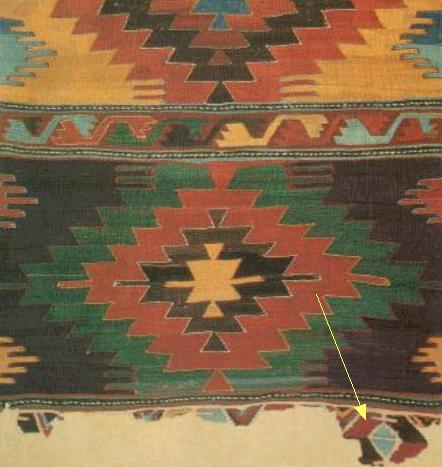
This one
!
When this kilim was exhibited later again in one of the most important
kilim exhibitions that we ever had ,
in
( Guido de Werd / Dietmar Pelz:
Gewirkt - Geschweisst, Linie und Farbe im Raum.
Zollverein-Ausstellungen,
Essen 2001. Pl. 5)
the piece contained this
original detail "again": the owner, Ignazio Vok, had not removed it but for
aesthetical reasons
did not want it to show up in his
catalogue/exhibition.
Why is it so important ?
Keep in mind that
the earliest idea that Oriental weaves as we know them might perhaps have
evolved in Anatolia
was brought up by Herwig Bartels at the ICOC congress in
London beginning of the eighties. This, as far as I know,
was his idea,
independant from a kind of feministic Mother Goddess "revival" that arouse in
the seventies. Later
we saw the contribution of Mellaart in Frauenknecht:
Early Turkish Tapestries. Then (!) the Mother Goddess "theory" was introduced
with the Balpinar/Hirsch/Mellaart book at a fabulous congress on kilims in Basel
that Jürg Rageth had organized. A bit later
Jack Cassin published 10 kilims
and put them into the same "frame". As it appeared kind of childish to compare
7000 old pictures on Neolithic pottery to 19th century kilims the idea that in
very remote places in Anatolia certain peoples survived the waves of Turkic
infidels until today and were thus able to keep
this artistic and religious
tradition from the Neolithic period till today. These people were called "yerli"
( ~ bound to a certain place, as opposite to nomadic
people). - They "Mother
Goddess" hype was about the end of the eighties - just to remember as of today
only one person apparently has kept his
memory fresh.
Putting together
our own field work in Anatolia and lengthy literature work Jasmin Hofmacher,
Michaela Glanz ( former Kühnert) and I
presented a kind of anti-thesis at
that time
( at the Freundeskreis Orientalischer Textilien in
Nordrhein-Westfalen, a workshop in the house of the Rautenstengels
)
according to which all this material that we have was made by Turcoman
people in Anatolia and that these people are the vital center of this particular
textile art.
Developing this anti-thesis we had learned that in whole
Anatolia all weavers never looked at the allover design when asked where a
certain weave was made
- they looked always for certain small details, and of
course to the yarns and to the dyes. So we discovered that the "key factor" are
these little "habits"
that do not influence the overall picture very much.
So, as an analogy to the evolution process in biology, they are not that much
under "evolutionary pressure" and are much more conservative than the total
design.
A second minor detail is not clearly visible on the detail scan.
So I recommend for a deeper look
( Michael Bischof: Frühe Kelims aus
den Bergen westlich von Konya.-
In: Kelim - Textile Kunst aus Anatolien.
Aachen, 2002. p. 34 - 40. -
[ This contribution I have written together with
Memduh Kürtül and
Susan Yalcin. ] This is the exhibition catalogue of the
kelim exhibition that was organized by Sabine Steinboeck/Harry Koll
at the
Textile Museum in Krefeld last year and in the Pfalzgalerie in Kaiserslautern
this year - look at the review in the latest
issue of HALI . Here we describe
entirely this aspect in details ... )
The above mentioned "Cappadocian"
kilims and this one differed in these two details ( letting the wool and the
dyes aside ). So they shared the overall
design - but this is all. Their
provenance ( in case the attribution for Cappadocia is correct ! ) separates
them for a distance of about 300 km.
They represent clearly two different
weaving traditions.
To establish this was only possible because the
provenance of the Vok piece was clear. The people who live in the village where
it was found descend
from Caucasian refugees that came to that place about
110 years before - and they state clearly that this particular kilim is not
their work ! The second
thing that I must mention here is the fact that
kilims with total different overall designs ( but sharing the above mentioned
"minor details" have been found
in several mountain villages in this area - a
further confirmation, or, vice versa: we had developed our "thesis" knowing that
... ).
Regards,
Michael Bischof
( to be continued ... )
Posted by Michael Bischof on 12-06-2003 01:28 PM:
moving a piece ( Bob Kent )
Hallo everybody, hallo Bob,
without being able to give further reasons
here this piece could not have been removed
and the local people knew this
well. At the beginning of our contact with them they did not value the piece
that high. That came later ... please do not forget that in the seventies and
early eighties mediocre antiqe Konya Ladik type carpets were believed to have
been made from gold, not from wool, but kilims were not appreciated locally.
Some furniture tool, like that ...
Regards,
Michael
Posted by Filiberto Boncompagni on 12-07-2003 08:06 AM:
Hi Michael,
I received the e-mail concerning your "secrets" and my
reply is ready. I don’t want to distract you from answering to other people,
though, so I’ll wait before posting it.
Regards,
Filiberto
Posted by Michael Bischof on 12-07-2003 11:45 AM:
A-pieces continued ...
( Attention: from Steve I had learned this morning that it might be an
idea to press the "reload" button in the browser
and keep the shift-button
pressed as well in order to have the pictures loaded up !
For your
convenience I will give the URL where they sit in this moment as well
)
Hallo everybody,
yesterday I had mentioned that the
provenance of Rageth 35 and 36 as from "Cappadocia" was not clear.
When they
had been sold such considerations were not important as the usual "selling
atmosphere" of dealers
at that time was to pretend that they virtually had
discovered them through the dust on their feet, wandering
through Anatolia.
And, admittedly, the leading collectors at that time followed the
"aesthetic-only" approach.
So it is very important that this provenance
could be established via another A-piece
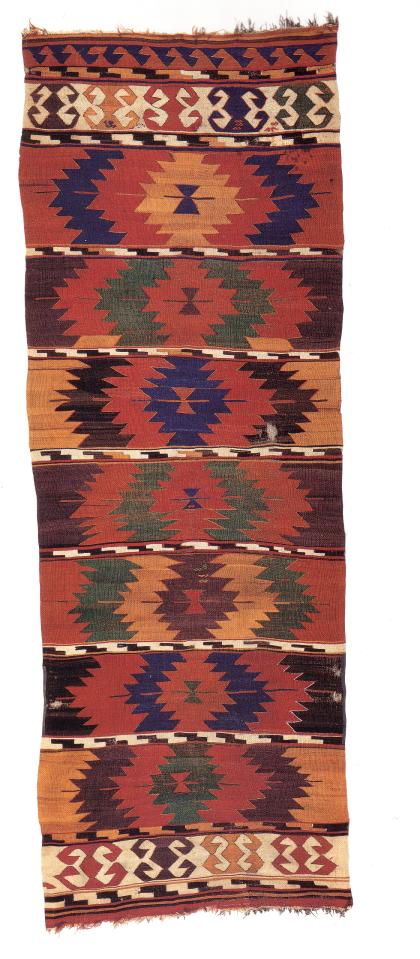
from Cappadocia, see this detail
as well:
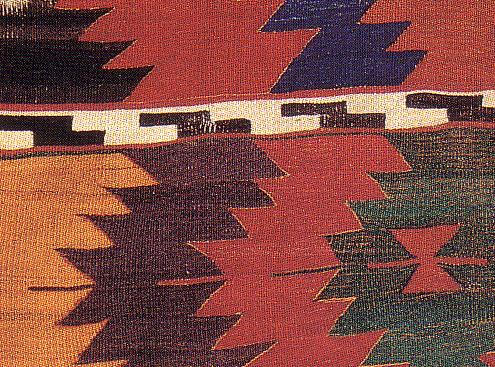
( To get a better picture quality you may download them
from
http://koek.dv-kombinat.de/amm.tif
http://koek.dv-kombinat.de/amm2.tiff )
They are from the
exhibition catalogue Essen that was mentioned yesterday. The measures are 395 x
142 cm.
The pieces Rageth 35 and 36 are a bit smaller. This one is in nearly
mint condition, especially what concerning
the conditions of its dye
lakes k-and this is another aspect
of our proposed grading system: the
integrity of the piece ( what has happened to it after it was found ? And
how
does one know about that ? ).
I must admit that for kilim
discussions both, the best printed books available and especially the current
quality of
digital photos on the net, are not appropriate. Both lack the
ability to imagine the space that these kilims have - and
they cannot show
the colours. So all I can do is to assure you that the visual impact of this
piece is like described here
- in case of doubt I may help to contact people
who had viewed it in Essen ( but look: in what kind of competition
!).
Its provenance as an A - piece is granted threefold: two people have
seen it at its spot long before it started to move
and we have the record of
the picker. All three news match perfectly ( details I will give to Steve Price
).
R. John Howe: the Robert Torquia piece that you mentioned is
not something belonging to this group. Its attribution
to Karapinar is
may be not wrong but not helpful. "Karapinar" in this context means an area
amounting to some states in the US
- so it is far removed from describing any
location. The best piece of this particular type has been found recently ( again
an
A-piece ... details to Steve ).
But to stress one thing again and
again: with this "grading system" we do not aim for ranking pieces ! To be
strict with the provenance is a conditio sine qua non for the starting
point of any research that should be done on early kilims : not more, but
not less !
Plus: part b - the integrity - today is an essential task for any
serious collector ( since about 1992 : see "Repairs and fakes ... " here on
Turkotek, Archived Discussions ).
Regards,
Michael Bischof
Posted by Filiberto Boncompagni on 12-08-2003 04:33 AM:
Dear Michael,
In your last post in page 1 of this thread, you wrote:
I should mention that yesterday I had given to You, Filiberto, and to
Steve Price much more information than what is written here.
I will go
through that, but before let me notice that you wrote on the same
post:
What makes me sure ? Well, if people in this particular village
know this piece since long neveretheless it might have been broughtthere before
I asked them. But when ? In the seventies there was in Turkey no market for such
pieces. All established local carpet dealers ( that furnish private houses -
antiquities were for tourists ! ) had no interest in them.
So this is not the
story of any carpet dealer. We knew these villagers from buying raw wool, spun
wool, collected plants and weaving orders
before this had happened. Yes, may
be, there is always some uncertaincy in life
A VERY scientific
method indeed!
In your last post above, there is another example of this
method:
Its provenance as an A - piece is granted threefold: two
people have seen it at its spot long before it started to move
and we have
the record of the picker. All three news match perfectly ( details I will give
to Steve Price ).
Uh, your secret evidence…
In your private
missive the ONLY answer I could find to my question "where is the proof?" is
this one:
"This particular piece…
…It was not found by any picker -
it was direct personal relation to that particular village. We took it in a cold
and very snowy winter as I remember well as it was a happening to move to this
village by car. Nobody had seen it except these 2 people - no other dealers!"
If I‘m wrong Steve can easily correct me.
This WAS the "much
more information than what is written here."
Again, were is the
indisputable, scientific proof? Were is the RECORD, the PAINTING, the TESTIMONY
- whatever could be considered as an independent and credible OLD document
shoving that the piece in question was there from its birth or at least was
there for over a century?
Without that, your assumption that the piece
originated from that spot can be considered only as an educated guess proved
perhaps by some reasonable evidence. That is far from being a SCIENTIFIC
PROOF!
We have only your word for it and you are not exactly an independent
party in this matter.
On the contrary, you are a VERY interested party in
this business, because, as it happens, you were the seller of that
piece.
So far, Michael, you failed to produce a clear evidence of the
possibility that you can find a-pieces.
When pressed with insistence,
either you hide behind a barrage of words or behind some "secrets" you cannot
share in public.
I can understand the reasons you do not like to speak about
certain things, even if I do not like them.
Those reasons,
however, have nothing to do with the proofs I requested from you.
In lack
of that corroboration I feel difficult to distinguish your "grading system" from
a bazaar fairy tale.
Steve wrote yesterday in the "Modern Rugs"
thread:
"As an aside, the present discussion ought to put to rest the myth
held in some circles that Turkotek forbids expression of opinions counter to
those of its managers, or even that the managers are monolithic in their
views".
I have some serious doubt that what is under discussion here is
only a matter of opinions.
Michel’s "grading system" itself is perfectly
acceptable.
The stress he puts on the superior virtues of a-pieces as
collectable is disputable but still acceptable.
But the constant
MARKETING of a-pieces and the "nudging" that Michael performs on Turkotek with
veiled hints that he can find (and obviously deliver) a-pieces is not
acceptable.
The constant refusal to give clear PUBLIC evidence is not
acceptable.
For example:
in Salon 91, Rudolf Hilbert questioned the
"grading system" (in the "Provenance" thread) saying "I think will never, never,
never be possible to establish the exact provenance (history????) of a tribal
weaving that is e.g. more than 150 years old".
On which, I fully agree, by
the way.
After the usual barrage of words Michel replied: "A straight answer
with full details would offend the rules of Turkotek. So I have to split it into
one general remark and further details which I am ready to supply via
e-mail."
Michael, Turkotek is a public forum, not a secret society where
only a few initiates can share arcane secrets.
If you don't want to speak
freely of your a-pieces, I invite you to refrain from mentioning them again in
the future (once this thread is finished, of course). John made more or less the
same suggestion.
Last but not least: I seriously question the existence
of your a-pieces!!!
I am still open to evidence, though.
PUBLIC
evidence.
Best regards,
Filiberto
P.S. Michael, I will not
accept from you any private e-mail on the subject. If I receive them I’ll feel
free to publish them here.
Posted by Filiberto Boncompagni on 12-08-2003 05:53 AM:
Correction:
When I wrote:
"In lack of that corroboration I feel
difficult to distinguish your "grading system" from a bazaar fairy tale."
I
was referring to Michael’s claims on the availability on the market of the
"a-pieces", not to the system itself
Posted by Michael Bischof on 12-08-2003 08:31 AM:
more specific, please ...
Hi, Filiberto,
" What makes me sure ? Well, if people in this
particular village know this piece since long neveretheless it might have been
broughtthere before I asked them. But when ? In the seventies there was in
Turkey no market for such pieces. All established local carpet dealers ( that
furnish private houses - antiquities were for tourists ! ) had no interest in
them.
So this is not the story of any carpet dealer. We knew these villagers
from buying raw wool, spun wool, collected plants and weaving orders
before
this had happened. Yes, may be, there is always some uncertaincy in life
A VERY scientific method indeed! "
Okay, now you tell me please
what a "scientific method" that would be sufficient for you would be
!
"In your last post above, there is another example of this
method:
Its provenance as an A - piece is granted threefold: two people
have seen it at its spot long before it started to move
and we have the
record of the picker. All three news match perfectly ( details I will give to
Steve Price ).
Uh, your secret evidence? "
Yes, as long as the
names of these people are available this is enough. No need to publish them
here, what for ?
It does not contradict the public character of Turkotek
as a forum to mention that such evidence is there, specify it in a way that the
person who has made such a claim cannot run away - without publishing this
evidence.
We discuss whether it is possible to locate the origin of such
old pieces or not. To remember: locate the origin does not automatically mean to
have identified the weavers ( or their group).
The example I had given
here is not discussed until now - a piece that till this information came was
put totally wrong.
Regards,
Posted by Richard Tomlinson on 12-08-2003 08:53 AM:
hi
i am REALLY enjoying this salon !!!!!
seems that qualitative
research will always take a backseat....aaaahhhhhh !
still - this thread
is like viewing the 1st 20 minutes of "pulp fiction" - have no idea really what
is going on but am looking forward to it all falling into place at the end
:-)
keep going guys !Q!
richard
Posted by Filiberto Boncompagni on 12-08-2003 08:58 AM:
quote:
Okay, now you tell me please what a "scientific method" that would be
sufficient for you would be !
If you care to read my very first post of this thread you
will see what I consider to be a valid method for identifying an a-piece.
quote:
Yes, as long as the names of these people are available this is enough. No
need to publish them here, what for ? It does not contradict the public
character of Turkotek as a forum to mention that such evidence is there,
specify it in a way that the person who has made such a claim cannot run away
- without publishing this evidence
If the person who has made such a claim is the weaver of the
kilim and she is over 150 years old I could consider her testimony.
But Id’
like also to see her birthday certificate. 
Otherwise, testimony of
people involved in the business it’s just a laughable matter.
It isn’t
new either. It’s called "bazaar fairy tale".
Regards,
Filiberto
Posted by Richard Tomlinson on 12-08-2003 09:43 AM:
filiberto
why do you consider verbal 'proof' as laughable?
if
it's all that is available why is so scorned?
must you ALWAYS have rock
solid proof of things?
does 1 + 1 always = 2?
funny how einstein
disproved this.
richard
Posted by Filiberto Boncompagni on 12-08-2003 09:44 AM:
Just in case, I do not want to be misunderstood: I wrote TESTIMONY, not
EXPERTISE - which is a very different thing.
I do not want in any way to
offend those reputable dealers who, with their expertise, help collectors to
find the right stuff.
Regards,
Filiberto
Posted by Filiberto Boncompagni on 12-08-2003 09:55 AM:
Hi Richard,
No, verbal proof is not always laughable. It depends on
the context and on the credibility of the witness.
I cannot even count the
times when they tried to sell me "antique" stuff that was not even old - or
wasn’t at all what they said it was.
Regards,
Filiberto
Posted by Filiberto Boncompagni on 12-08-2003 10:34 AM:
Hi Richard,
To elaborate more on the subject of the verbal proof:
Let’s say you are on trial accused of killing somebody.
If the
prosecution can find a witness which claims that he saw you killing the victim …
- that could send you to the gallows.
But if your lawyer can demonstrate that
the witness is not credible - that could save your neck.
Verbal proof is not
scientific evidence. People LIE - or make mistakes.
A video tape showing you
killing the victim: that is a scientific evidence.
quote:
must you ALWAYS have rock solid proof of things?
If I have to pay a lot of money for something with an
astonishing pedigree, yes, I want a solid proof of that pedigree before
buying.
Regards,
Filiberto
Posted by Michael Bischof on 12-08-2003 12:10 PM:
show your criteria now ...
Hi Filiberto,
even for Turkotek standards we are now in the middle of
a really vivid discussion, yes ?
"We have only your word for it
and you are not exactly an independent party in this matter."
Indeed,
that is true - so I took quite some efforts to deliver more than just my word.
But that does not mean, again, to publish these effort on a
website.
On the contrary, you are a VERY interested party in this
business, because, as it happens, you were the seller of that
piece.
Such a stupid and unprofessional thing I would
never publish on any website ... and it has nothing to do with what we discuss
here !
If the person who has made such a claim is the weaver of
the kilim and she is over 150 years old I could consider her testimony.
But
Id' like also to see her birthday certificate.
Ok, Filiberto: the
echoes of our laughters are over now - up to you to answer my question
seriously: what is a "scientific method" in this very context
?
Otherwise, testimony of people involved in the business - including
YOU - it's just a laughable matter.
It isn't new either. It's called "bazaar
fairy tale".
Might be - but I cannot see how this remarks moves
anything ahead ... no, involved or not involved: this must not corrupt any
judgement automatically.
There is one thing you cannot know: I started
collecting in the seventies - and I am a very curious person. You just have to
tell me what I should not get to know. The next moment I start to work hard to
get what I perhaps may not need ... when trying to research early material in
all Anatolia, which I travelled for about 3 months per year I met a kind of
"rubber wall", intransigent. Until I realized that I had to start to buy and
sell such pieces, to become part (party) of the game to get hold of what I
wanted to know. But then you stand on two legs, literally speaking, and that
creates new balance problems.
Nevertheless it was possible to bring forward a
lot of things, including things that you saw here on Turkotek ( for example in
"Repairs and Fakes ... " and in the kilim salon ) that did not find their way
into any carpet literature. Why didn't you question that - we gave no names
there, you see ?
( and all the communications done before that essay we
did not mention at all here - basically the same situation that you criticize
now as being opposite
to a public forum )
So, Filiberto: I am curious
now.
Why did the lines I contributed hitherto not support this A-piece
claim ? And: what would you insist instead of that ? Any positive examples ?
Here on Turkotek or elsewhere ?
Last but not least: I seriously
question the existence of your a-pieces!!!
To question is your duty ,
I guess, as long as you want to move the discussion. Then let us know what are
the specifications of your questioning - the laughter is over now
...
Regards,
Michael
Posted by Filiberto Boncompagni on 12-08-2003 12:41 PM:
Hi Michael,
First, I corrected almost an hour ago my
phrase:
"Otherwise, testimony of people involved in the business - including
YOU - it's just a laughable matter."
That "including YOU" was an editing
mistake. The phrase was different at the origin.
Something like" Everybody
knows - including YOU". I changed it on the preview page because I did not like
it and I forgot to delete the - including YOU - part.
As soon as I realized
it I deleted it, sorry for the mistake.
About the rest, my son is bothering
me because has to "chat" on MSN with his friends and I have to quit.
After I’ll have no time, so the answer is for
tomorrow.
Regards,
Filiberto
Posted by Filiberto Boncompagni on 12-08-2003 01:26 PM:
OK, my son let me the computer, but after I have to run!
Look,
Michael, I don’t have to prove anything.
It’s yours the "grading system",
it’s yours the claim that you can find some "a-pieces". Which have some tight
specification.
Let’s say I want to buy from you one of these kilim. There
is one that I like.
You say to me:
-This particular piece…
…It was not
found by any picker - it was direct personal relation to that particular
village. We took it in a cold and very snowy winter as I remember well as it was
a happening to move to this village by car. Nobody had seen it except these 2
people - no other dealers!
My answer: - Excuse me? And how do you know it
wasn’t planted there for you?
Your answer: - What makes me sure ? Well,
if people in this particular village know this piece since long neveretheless it
might have been broughtthere before I asked them. But when ? In the seventies
there was in Turkey no market for such pieces. All established local carpet
dealers ( that furnish private houses - antiquities were for tourists ! ) had no
interest in them.
So this is not the story of any carpet dealer. We knew
these villagers from buying raw wool, spun wool, collected plants and weaving
orders
before this had happened. Yes, may be, there is always some
uncertaincy in life
Me: - Perhaps you mean uncertainty. So, if you are
not sure, it’s a b-piece isn’t it?
You: - No it is an A - piece. This
granted threefold: two people have seen it at its spot long before it started to
move
and we have the record of the picker. All three news match perfectly
.
Me: - But how do you know they tell you the truth? You don’t have a
more solid evidence?
You can answer to that yourself,
please.
Regards,
Filiberto
Posted by R. John Howe on 12-08-2003 02:19 PM:
Hi Michael -
You have said several times:
"...two people have
seen it at its spot long before it started to move..."
I am unclear about
how this is established. If this is a 19th century piece, then it was made over
100 years ago. There are at least four generations separating us from this
kilim's maker. Even in traditional societies, I would wonder how much is lost
from generation from generation and how many times such a piece even if it is a
prized family piece was of necessity "moved."
The phrase "started to move"
has no evidential basis for me.
One doesn't have to question whether such
folks are telling the truth, to ask how we know that they know it.
Such
evidence may be the best we have, and the best you can do at the moment, but it
does not provide, for me, a sufficient basis for the claims being made to be
able to identify an "A" piece.
Regards,
R. John Howe
Posted by Michael Bischof on 12-08-2003 03:42 PM:
one example more ...
Hallo R. John Howe, hallo Filiberto,
now I must take care not to
confuse things - in the meantime I got an explanation about the difference
between "testimony" and "expertise".
Okay: testimony is available for these
two A-pieces - but not to be published here. And about how to get it I
will definitely not talk on a website and I insist that this is not necessary at
all. More details tomorrow .... bed time now for me.
"...two people
have seen it at its spot long before it started to move..."
What this
means please ask Steve: again this info will not be published here. If this is
your condition , Filiberto, then I must say at this point: I am not willing to
move this topic any millimeter further. You are living in the Orient and for
sure are informed about regulations in these countries. As it has nothing to do
with assessing my claim I must not continue with this aspect.
"I
am unclear about how this is established. If this is a 19th century piece, then
it was made over 100 years ago. There are at least four generations separating
us from this kilim's maker. Even in traditional societies, I would wonder how
much is lost from generation from generation and how many times such a piece
even if it is a prized family piece was of necessity "moved."
It did
not move at all after being dropped there.
Unfortunately the mentioned
source, the exhibition catalogue of Krefeld, contains a detailed study of this
problem - but in German. To summarize it in short:
the people in this village
that live there today are Caucasian refugees. They know that this piece was at
its former spot as long as they can remember but they are sure that "they" (
that means: the people from whome they descend, these refugees ) did not
weave this kilim.
The same happened in Cappadocia. Todays inhabitants of this
township ( not village ! ) did not feel this piece related to them ( and people
who wove kilims
in their place ).
This is what I meant when I said to
assure the provenance of a piece, the spot where it has been found, must not
automatically mean to know who has made it.
It may be different ( as it is
with the Vok piece and the Cappadocian kilim ) but it may be the same like with
this A-piece where I show only a detail .
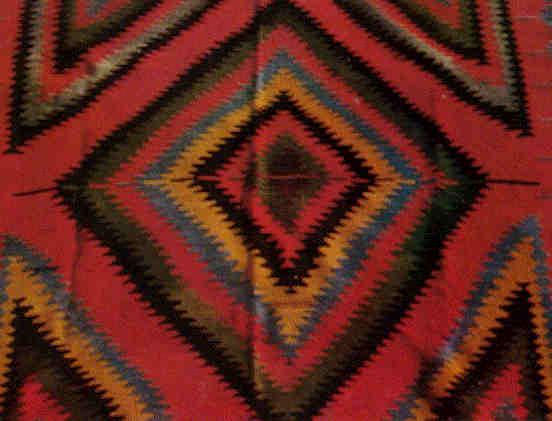
It is from a
Central Anatolian village and the family whose forerunners have woven it still
owns it. Up to the best of my knowledge only 4 pieces of this particular type
showed up. One of them in a neighbouring country. To weave such a kilim has been
a part of the ceyiz ( the set of weaves people should have there for marriage )
and as far as we know this particular type is restricted to one village ( this
is a kind of exemption !). One of the "third parties" that I mentioned has seen
it over there but for sure will not publish the location here or elsewhere -
until, later, may be we would together agree on doing such a thing.
So in
this case "starting point of research" means: find out you was around that
township in Cappadocia 200 years before. This is something, as we had mentioned
in the kilim salon, to be done by ethnohistorical researchers, linguists ,
historical geographers and ethno-textile specialists - but for sure not for art
historians as we have them, not to mention Western dealers , even if they did
many shopping trips to Turkey. - In the case of the Vok piece we have some early
kilims that have a very different overall design but share with this kilims
these two details ( one in the border and the other mentioned one ).
These
are no A-pieces. These pieces have been exhibited in Krefeld and in
Kaiserslautern recently. Only "expertise" is available plus some hearsay that
they have been brought in by pickers that serve the same mountainous area. The
people there define themselves as settled Turcomans but do not remember any
tribal name. They know this origin, claim that their settlement there beyond
their memory achieved by grandfathers and -mothers but insist that they do not
live there for extreme long, whatever this means.
Without this starting
point, without being quite sure of this provenance: what can you do ? Even in
case you would like to come in from the structure of the weave, technical
features that it has: how do you want to calibrate your "system" if you do not
have at least one "firm" point ? The Near East is a multi-ethnic area where more
often than not anything related to ethnic groups today is a taboo
topic.
Regards,
Michael
Posted by Rudolf Hilbert on 12-08-2003 04:48 PM:
Hello everybody,
I am very happy that Filiberto again brought up the
issue of Michael Bischof's grading system.
Now in the course of the
discussion we have got a concrete example and a rough idea of what might be
included in a Type-A certificate.
Last year Michael said it is not cheap
to obtain the information to prove a piece as Type-A.
Now my question: Can
you give us a rough guess what would be the premium of a Type-A piece over a
comparable Type-B piece (10, 50, 100 or more %) ?
For me personally it
would be sufficient to get some reasonable record of the provenance of a weaving
for the last 20 years. That should be a fair insurance against fakes. That would
be Type-B, or ???
To be of any practical relevance in the trade with
antique weavings, we would need quite a lot more trustworthy grading experts.
What about the grading approach with respect to rugs (any real world
cases) ?
To try to establish the grading system in areas like Caucasian
weavings is in my opinion an absolutely hopeless affair because in Caucasus the
traditional weaving culture came to an end by WW I. Where are the people to ask
?
But especially here we would need some greater safeguard against
fakes.
Suppose I buy from someone a perfect anatolian or caucasian type-A
rug. Probably the Type-A story will not give me a strong clue as to the age of
the rug. Here I am still alone with my "educated guess" or that of the dealer
experts.
With kind regards,
Rudolf
Posted by R. John Howe on 12-08-2003 06:01 PM:
Michael -
I'm getting clearer about some things. In the last exchange
it became clear to me that the basis for a "A" piece is "provenance," not
necessarily "attribution."
You may have said that before, but I have
often felt you were also claiming "attribution." (Although, you seem in some
instances still to claim to discern that too.)
"Provenance" is likely
easier to establish than is "attribution" but would often not, it seems to me,
go very far to indicate much about the piece itself. One might better to be able
to track its age within the knowledge of those living, but I wonder how much
more. Testimony of "refugees" in the town where it is "found" that it is not
something their people wove, says nothing, excepting that, about who did weave
it.
At the end you wrote"
"...how do you want to calibrate your
"system" if you do not have at least one "firm" point ?"
My
thought:
No one in these conversations has denied that it would be useful
to have a system of "calibration" such as the one you propose. And no one has
said that "calibration" does not require "at least one firm point" as an anchor.
The question has been entirely about whether you have found such a point and how
you justify its being treated as firmly as you argue that we should.
I
would not recommend that you tell any secrets at all, but rather (this will
echo) that you simply stop making the claims for your system here on Turkotek.
Regards,
R. John Howe
Posted by Filiberto Boncompagni on 12-09-2003 02:07 AM:
Dear Michael,
quote:
Okay: testimony is available for these two A-pieces - but not to be published
here. And about how to get it I will definitely not talk on a website and I
insist that this is not necessary at all.
I agree: the names of the witnesses and the way you got their
testimonies are not necessary at all. That is not the point and nobody is asking
about that.
BUT you have to explain HOW testimonies of living persons can
confirm that a kilim never moved from the same spot in the last 150 or 200
years. That’s simply unbelievable!
Yesterday Rudolf Hilbert wrote on this
thread:
"Last year Michael said it is not cheap to obtain the
information to prove a piece as Type-A.
Now my question: Can you give us a
rough guess what would be the premium of a Type-A piece over a comparable Type-B
piece (10, 50, 100 or more %) ?"
Thank you Rudolf, very relevant
question. I’d like to hear the answer to that one
too.
Regards,
Filiberto
Posted by R. John Howe on 12-09-2003 10:44 AM:
Dear folks -
In my last post to Michael Bischof above I said in
part:
"...I would not recommend that you tell any secrets at all, but
rather (this will echo) that you simply stop making the claims for your system
here on Turkotek."
Someone has noted that that could read as if I am
speaking for Turkotek. I do not and it does not.
I was merely expressing
my personal view (I think this is now the fourth time I have said it) that if
Michael is not free to explain his system fully here then perhaps (and
especially since he could be seen to be touting his business in the process) it
would be best simply not to talk further about this "A" system here at
all.
I do not speak for Turktek. The internal workings of our
owner/manager group are far more mysterious than that. 
Regards,
R. John
Howe
Posted by Michael Bischof on 12-09-2003 11:18 AM:
calibration detailed ...
Hallo everybody, hallo R. John Howe,
it became clear to me that the
basis for a "A" piece is "provenance," not necessarily
"attribution."
Yes, these latest lines helped to clarify things quite
I bit , I guess. What I mean is
calibration of
attribution
- that is the main goal of this "system" , except from
taking out the piece out of the artificially made fog of being anonymous.
I
would rather prefer to call it a proposal - system sounds too bombastic for
me.
As I tried to outline just before the "attribution" to a certain group,
to a certain geographic area ( a set of villages, e.g.) you must do by doing
your own research. How this is done in principle I have written. As well that
"we" , private people interested in early kilims and village rugs, can
contribute only tiny bits to it. In case of the Vok kilim you need to find which
Turcoman groups moved there about 200 - 150 years ago ... and this group/one of
those groups most likely has/have made this kilim and the other ones as well.
Let us assume ( an invented example ) this group would be the Gercek Bahsis
group. In this case one has
to find places where members of this group have
settled later. Such places might be very far away but always, of course ,
somewhere close to their previous courses ( a topic for historical geography
then).
Go there and try to find pieces which in a way belong to this one -
most likely one would find very different designs ( the overall design is the
one thing that can change quick and easy, but not this particular "detail habit"
).
One example of minor importance: above Lake Egirdir in Central
Anatolia, up in the hills, there is a village where people do not weave since
long. In this village you find only flatwoven yastiks in the salon of the houses
( some piled ones as well, but then the people tell you: these are not our
yastiks, these we bought from Isparta or it had been made according to our
order there and there ... ). You interview them about their history. They say
they are settled Yörük people that until 60-70 years before changed places
between the Cukurova and this yayla area at Lake Egirdir. The distance is huge
and you hardly believe it.
Then you take the map and will find a second
village with the same name in the foothills above the Cukurova. The people have
recorded their history correctly, then. You move down there - and what will you
find: flatwoven yastiks that undisputably belong together with the Egirdir one
into one group. For such a task
you apparently need a safe starting point, an
"A-piece" whose provenance you definitely know. Otherwise you are lost in this
huge country.
"Minor importance" in this context means most of those
pieces had not any significant value in the antique business ... and a second
thing you might have realized quick: for such a task you not only must talk and
understand Turkish including some dialects. You must do it together with Turkish
people otherwise it would take too long for you to come that close to the people
in question - in case you are interested in "structures" you need to have a well
qualified Turkish weaver with you to be able to communicate your questions and
your approach to the ladies ( which you cannot quick enough contact as a male.
To be a foreigner would enlarge the distance , to have handsome kids with you
would shorten it ).
Then you would try to establish their old repertoire. For
each "unit" ( kilim , cuval, cul , yastik, rugs ) you would need a
well-calibrated "A-piece" - otherwise your whole enterprise is rubbish. If that
is establish you may, slow by slow, ask for the possible meaning of some
motives, "symbols" ... but as of today this is quite far behind the mountains in
front of you. To listen to people that claim to have landed there already ( by
helicopter ?) is a waste of time . These people have never been there. They
found a picture book about that place in New York ...
Testimony of
"refugees" in the town where it is "found" that it is not something their people
wove, says nothing, excepting that, about who did weave it.
Well,
what it says and what it does not say is clear now, hopefully : much more than
nothing. Keep in mind: without that you would have nothing , you would
still believe this is a splendid Cappadocian kilim !
I would
not recommend that you tell any secrets at all, but rather (this will echo) that
you simply stop making the claims for your system here on
Turkotek.
The term "secret" I reject strongly. Secret means that a
certain information is not delivered , not given out. This is not the
case. It is not published - but this is not the
same.
Regards,
Michael Bischof
From an American who
commands a very crippled language I recently have learned that my English is
"fractured". Therefore, Filiberto, this time I need to polish it a bit better
before I answer your question from yesterday.
Posted by Michael Bischof on 12-09-2003 11:24 AM:
second thoughts ...
Hi R. John Howe,
Dear folks -
" In my last post to Michael
Bischof above I said in part:
"...I would not recommend that you tell any
secrets at all, but rather (this will echo) that you simply stop making the
claims for your system here on Turkotek."
" ... that if Michael is not
free to explain his system fully here then perhaps (and especially since he
could be seen to be touting his business in the process) ... "
Could you
please be a bit more frank about which particular information you need, you are
missing,
to be able to fully understand what we are discussing here ? What is
missing ? And if something "delicate" is missing: why must it be you who should
know that ?
For me it is mysterious.
Regards,
Michael
Bischof
Posted by Richard Farber on 12-09-2003 12:35 PM:
Mr B.
you wrote
"Hallo everybody, hallo R. John Howe,
it
became clear to me that the basis for a "A" piece is "provenance," not
necessarily "attribution."
Yes, these latest lines helped to clarify
things quite I bit , I guess. "
If you, sir, had taken the trouble to
read the responces that I wrote to you on your salon nr. 91 you might have saved
yourself and the readers of this site considerable time in reaching this
conclustion of yours.
In the two letters I posted to your salon on
10-26-2002 :
I wrote to you at length about the differences [as I
understood them] between attribution and provenance.
I suggested calling you
system Provenance catagorie A
Provenance catagorie B and Provenance catagorie
C.
I am amazed that you did not attempt to respond then to an honest and
considered opinion whose only purpose was to help you clarify your
thoughts.
Richard Farber
Posted by R. John Howe on 12-09-2003 01:06 PM:
Hi Michael -
I wrote my posts this morning before seeing your longer
one above.
Perhaps my understanding of what you propose is more defective
than I thought.
Let me try again (to summarize in terms of my current
understanding).
The system you propose is one aimed at establishing
provenance rather than attribution, although attribution might be encountered
too in some instances.
The method is to select a location and to assemble
the resources needed to do sound field research in a Moslem community and then
to go to that location and to attempt to be shown the textiles the locals have
and to ask what they know about them.
Since folks have often moved about
over the 100-150 years of interest, often folks being interviewed will have
textiles in their possession which they deny that either they or their ancestors
made. Sometimes you can find additional instances if you back track along the
routes on which such folks migrated to their current location.
The usual
result of such field work will be negative. That is, its real function will be
to demonstrate that most attrubution indications in books about Turkish textiles
will be found to be inaccurate and perhaps without much basis at all.
I
think my mistake was to read your claims (and they seemed vigorous ones to me)
for your ability to identify an "A" as one with a positive rather than a
debunking object. The ability to identify an "A" piece will function
primarily,as I now understand it, to show that pieces are not what they are
claimed to be. It will not usually (ever?) have a positive result.
If the
ability to identify an "A" piece has a postive result then you could be seen to
be touting a busness purpose here. But if this ability is in fact mosty a
debunking program attempting to demonstrate that most of the literature on
Turkish textiles rests on an inaccurate basis then my objections to discussion
of it (although I am not at all sure I understand it, but don't try to help me)
here, vanish.
More, I would have been willing to give you the debunking
point without much demonstration. It is clear that we have few "anchor" points
in rug analysis and that, given our position, a word like "calibration" is
nearly laughable. What we have mostly are what Robert Pinner has characterized
as "conventions." That is, "rules" socially established among those who study
rugs about such things as attribution. Such rules may in fact sometimes be
rooted in an occasional "anchor" point of objective data, but usually they are
mostly judgments and learned distinctions being applied. As such they are
greatly prone to error.
Jon Thompson is reputed to have said somewhere
that he believes perhaps 25% of what he reads in rug books. If that was your
thesis about Turkish textiles and the primary function of the ability to detect
an "A" piece, this conversation could have been much shorter.
I thought
you were claiming to have constructed an system for identifying "A" pieces and
that there was a potential, but unstated, related thesis that folks could
contact you to acquire one.
Regards,
R. John Howe
Posted by Steve Price on 12-09-2003 01:18 PM:
Hi John
This is a digression; I hope it will not be a big one. You
wrote, Jon Thompson is reputed to have said somewhere that he believes
perhaps 25% of what he reads in rug books. In order to know which 25% to
believe requires a considerable level of expertise. I think about 75% of what I
read in rug books is wrong, but I don't know which 75% it is.
I visited
the USSR as a guest scientist in 1979, and was struck by the extent to which the
Soviet government kept information from the people. The educated ones knew that
what the government told them was untrue, but were painfully aware that knowing
that they were being lied to was not the same thing as knowing the
truth.
Somehow, I thought this was relevant when I started composing it.

Regards,
Steve Price
Posted by Richard Farber on 12-09-2003 01:29 PM:
Dear Steve,
I thought that it was a good joke . . . and little humor
here was just on time
whoops, I meant your second paragraph. I dont think
withholding information is a laughing matter.
regards
r
Posted by Sue Zimmerman on 12-09-2003 03:53 PM:
Hi Everyone, Peace,
I can't help but thinking that these
billboard-sized kilims with gigantic motifs were modeled on, or were at one time
themselves, meant to be seen at a distance.
I don't think I am digressing
to question their use here because, if I am right, they might well have been
displayed publicly, either on land or at sea, in the past. This may well be why
that which could make them "A pieces" might be more reliable than, say, weavings
woven on a more personal sized scale. Sue
Posted by Michael Bischof on 12-09-2003 05:36 PM:
one yellow more ...
Hallo everybody,
another A-piece:
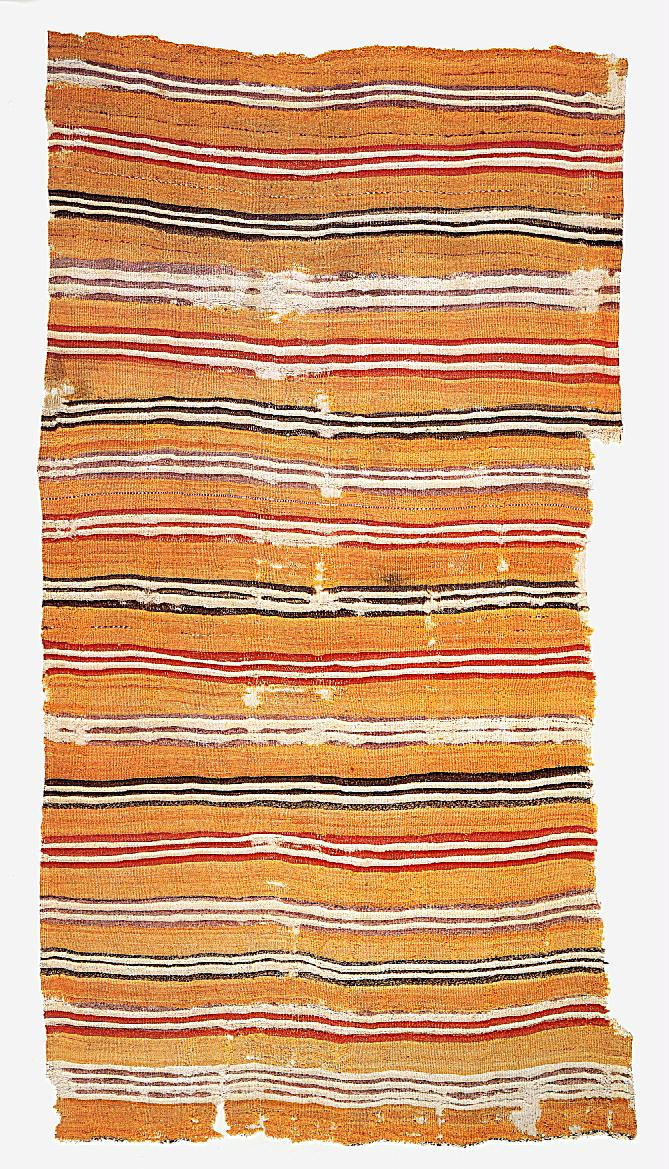
It was found in
another small township in Central Cappadocia and obtained from a picker
that we know well.
He claims it comes from the "city" , from a family that
lives in this town as long as they can remember as artisans ( not something
connected to weaves, wool etc.). They say that one of their ancestors had woven
it at home. - I have no information at hand
to substantiate any doubt against
that.
When it came in it several holes were covered with hand-woven,
natural dyed fabrics that had quite some age ( yarns, dyes and weaves are not
connected in any respect to this kilim !) and that was sown loosely to cover
these holes.
By the way:
if such an authentic weave ( kilim or village
rug does not matter ) was damaged it was never (!) repaired in old times.
In
case one has "old repairs" these are always contemporary and show that the piece
has been moving around - but
in shops, not with the people.
An
electronic picture will not display such details: unusual in this kilims are the
dyes. For us these are typical local dye workshop dyes - and the yellow we once
had commented like this:
"It contains a lot of dye stuff - 30% of the wool
weight with a good sample quality is the upmost amount which is useful. As a
straight decoction it results in a brilliant open yellow of very poor light
fastness. The dyes in this kilim have either been made with black Cehri or the
dyers have used special pre-treatments of the green berries or applied
fermentation techniques. Some old people in Cehri areas that we had interviewed
and who had worked as professional dyers when they were young had forgotten how
it was done (we believed them, in this case, as their memory was not very
"healthy" on related details as well)."
(http://www.turkotek.com/salon_00091/dyes.html ) - the url
works ...
Hopefully some time later we may get enough cooperation ( and funds
) to run a proper HPLC with DiodeArrayDetection - Analysis
of the dye
lacquers of such a piece and by comparing it with the dyes of certain pile
weaves of that area ( some "A-pieces" , ~ "calibrated" then ) it can well be
that a similar picture arises like the one we have found for Karaman
( http://www.turkotek.com/salon_00091/original.html )
.
Now imagine this weave would not have come in as an A-piece:
in a
striped kilim what could one gain from "structures" - there are the yarns and
the dyes. How many people would dare to try any attribution of such a piece
based on that ?
The tiny yarns that link it to its original environment (
yes, many questions remain unanswered ! ) it would have lost any trace of
identity, a second-hand car without proper documents.
In the normal
processing the sewn-on fabrics would have been removed, the dye lacquers would
have been damaged by improper washing, may be even some silicone applied ( for
the shine , you know ) .... even then if would make a fascinating sunny spot at
any wall in a Western house in the sense of distinguished interior decoration.
As a kind of cultural event , highlighting the abilities of "simple minded
remote" ( but known !) people to create great things even with upmost basic
means it would no longer exist.
Regards,
Michael Bischof
Posted by R. John Howe on 12-09-2003 08:16 PM:
Hi Michael -
So there may be such a thing as an "A" piece after all
and this may be one. And dyes seem to be your primary indicators, so it sounds
like the "technical" features were important after all. What the villagers say
about it seems irrelevant. You say you have no reason to doubt what they report
but I would argue that needs to be the default position with regard to verbal
reports.
The real function of declaring a piece an "A" now seems to be
that it becomes identified as a piece worth doing further tests on. If it had
not met the "A" piece criteria it might have be "lost."
It looks quite
nice on my monitor and the ground color is unusual, but I have the back (only)
of a "Bergama" grain bag that has similar stripes, and about which I make no
particular claims, that I think I like better.
Zero provenance, but it
still looks good on my wall.
Regards,
R. John Howe
Posted by Filiberto Boncompagni on 12-10-2003 04:08 AM:
quote:
another A-piece:
was found in another small township in Central Cappadocia
and obtained from a picker that we know well.
He claims it comes from the
"city" , from a family that lives in this town as long as they can remember as
artisans ( not something connected to weaves, wool etc.). They say that one of
their ancestors had woven it at home. - I have no information at hand to
substantiate any doubt against that.
But do you have any information at hand to
substantiate that what the picker claims correspond to the
truth?

Filiberto
Posted by Filiberto Boncompagni on 12-10-2003 04:20 AM:
Could you cross-check it ? It may well be true , it may well be a kind of
marketing story. So how do you know ? - And in case you know: wouldn't it be
right then to interview this family?
Posted by Richard Tomlinson on 12-10-2003 05:50 AM:
to be honest this seems to be going in circles.
no verbal report (in
its purest form) can ever be regarded as the 'truth'.
even a thousand
people sould conjure up a lie and corroborate evidence.
but surely when
we KNOW we cannot obtain any 'written' or 'video' evidence, we must then take
some sort of 'leap of faith' and trust in those who 'verbally' report. obvioulsy
every context is different, discretion is needed.
we may be proved wrong
but will that be anything new?
richard tomlinson
Posted by Steve Price on 12-10-2003 06:34 AM:
Hi Richard
I disagree. While one verbal report is a poor basis for
certainty, two, if they are consistent and independent, is convincing when the
issue isn't a matter of life and death importance. Three or more, independent
and consistent, is more than enough to convict or acquit in the American courts.
It's true, there are mass lies. But they are rare enough to make the
probability of truth high when a group of independent witnessses all say the
same thing. Bear in mind, too, that when fraud is the objective, video tape and
photos can easily be made to lie and that it's about as easy to lie in writing
as it is to lie orally.
The pursuit of truth necessarily involves
accepting false ideas sometimes. This is because we have to adopt criteria for
testing truth, and any set of criteria will automatically exclude certain things
that could, in fact, be true. The alternative is to accept everything, which
gets us nowhere. It helps to be aware of the limitations of the process while
using it, though. This reduces the shock when we discover that we were wrong
about something and keeps us open to the possibility of being wrong.
Regards,
Steve Price
Posted by Richard Tomlinson on 12-10-2003 06:41 AM:
so then steve, you would not argue against michael's methods of gathering
'proof' ??
best
richard
Posted by Filiberto Boncompagni on 12-10-2003 06:43 AM:
Granted, verbal proof is better than nothing.
But, then, one cannot
use hearsay as an absolute evidence, as an "Identity Card".
THIS is
only, in the best of hypothesis, reasonable evidence NOT absolute
evidence
In short, that piece - according to Michael's system - should be
a B-pieces, NOT an A-piece.
Regards,
Filiberto
Posted by Filiberto Boncompagni on 12-10-2003 06:49 AM:
Dear All,
Notice that in this case Michael said that it was an A-piece
based on the claim of a (ONE!) picker.
Filiberto
Posted by Richard Tomlinson on 12-10-2003 07:13 AM:
granted 3 reports are better than one but again we are treading on shifting
sands.
one person's evidence can (in a given context) be more reliable
than 3 others.
michael said a picker that we know well.
there is/was obvioulsy a certain amount of trust based in the picker's
claim.
that claim may well be worth 3 villagers' claims in another given
context.
richard
Posted by Filiberto Boncompagni on 12-10-2003 08:15 AM:
Sorry Richard,
That wasn’t a 3 villagers’ claim!!!
That was A
claim from ONE picker who said that… and so on.
Filiberto
Posted by Steve Price on 12-10-2003 08:43 AM:
Hi People
There's more than one kilim in this thread. The one posted
most recently is classified by Michael as "A" group on the basis on one picker
who he says is well known. Of one presented earlier in the thread, he wrote:
Its provenance as an A - piece is granted threefold: two people have seen it
at its spot long before it started to move and we have the record of the picker.
All three news match perfectly. So the mini-debate over whether there was
one or three witnesses seems to be confusion over which kilim is being
discussed.
It seems obvious to me that Michael isn't going to convince
some of the readers without giving them details that he can't reveal in public.
There's no compelling reason I can think of why they must accept evidence that
they can't see and evaluate (I wouldn't), and I think the positions of the
parties to the debate are, and will most likely remain, stalemated for that
reason.
Sometimes, to quote A.A. Milne, that's HOW THINGS
ARE.
Regards,
Steve Price
Posted by Bob Kent on 12-10-2003 08:55 AM:
It seems interesting to know where something was located and what the people
there had to say about it. I like the idea that this kind of information might
be used along with design and structure in the difficult task of trying to
understand origins. But as the pieces are believed to be older, this kind of
information seems less useful, and the interests of people involved in giving
and gathering the information (owners, pickers, and sellers) is also an issue.
Maybe it's a"here's what I've been told" versus a "here's what it is" sort of
information? If a picker were told emphatically by people in Eastern Turkey that
some Persian classical carpet had been in the village for 40 years and was
probably even made here way back when, they'd buy it and be amused. So the
claims are used with the other stuff.
They may be better attached to a
provenance, but I don't agree with the idea that pieces with this sort of
attached information are more likely to be textile art, etc. This reminds me of
the common ideas that such a thing as "best of type" exists, or that particular
pieces are "world class." I love articles that compare similar pieces, but these
specific judgements presume a higher level of agreement about aesthetic
reactions than I think you can really expect in something so subjective, whatver
sense they make given the nature of the collecting system.
Posted by Steve Price on 12-10-2003 08:56 AM:
quote:
Originally posted by Richard Tomlinson
so then steve, you would
not argue against michael's methods of gathering 'proof'
??
best
richard
Hi Richard
I would take the position that "proof" is
so elusive that gathering evidence is probably the best we can do except for
trivial matters, and that his methods for gathering evidence seem sound to me.
On the other hand, trying to persuade people without giving them the opportunity
to critically evaluate the evidence is clearly not going to
succeed.
Michael places considerable weight in the fact that he has spent
much time in the villages for many years, speaks their language, and is known
and trusted by the local folks. I place considerable weight in those factors,
too, and consider him a highly credible source for those reasons.
There
are others in the readership who have also spent considerable time in
communities of western Asian weavers. I'd be interested in their take on things,
too. For instance, the notion of a "signature detail" (for want of a better
phrase) as a key to attribution is a new one to me, and if the weaver's are
aware of such things, perhaps someone can confirm it.
Regards,
Steve Price
Posted by Chuck Wagner on 12-10-2003 09:27 AM:
Hi All,
I propose that someone cobble together a new smilie
in
honor of this thread, entitled Cream Pie Fight:
By the
way, can one call a naturally dyed offensively ugly rug with well
established
provenance an "A" piece ?

Regards,
Chuck Wagner
__________________
Chuck
Wagner
Posted by Steve Price on 12-10-2003 09:44 AM:
Hi Chuck
Michael's classification system is not aesthetics-based, so a
very ugly rug with a perfectly documented provenance would be an A-piece in his
system. Since most of us think in terms of aesthetic desirability, confusion
happens. This is why Richard Farber suggested that he use the term provenance in
his descriptors of categories. Richard's suggestion makes sense to
me.
Regards,
Steve Price
Posted by Filiberto Boncompagni on 12-10-2003 09:55 AM:
Dear all,
I don’t know if you noticed it, but in the previous page I
posted a message without signing it.
(It’s the one starting with: "Could you
cross-check it?")
Do you know why? Because those words weren’t mine. Those
were Michael’s words.
In Salon91 Mr. Ali R. Tuna wrote in the thread
"What is so special about Kilims" (page 1):
I happened to know that at
least two of the Yuncu long "yolluk" kilims came into the trade directly from
the possession of important members of the Yuncu tribal community. One was
purchased in the village from a family that kept it -who knows for how many
generations .
Michael answered him:
Then everything depends
on how you happened to know this story. Could you cross-check it ? It may well
be true , it may well be a kind of marketing story. So how do you know ? - And
in case you know: wouldn't it be right then to interview this family?
So, if Michael was so ready to question Ali with those (rightful)
doubts, I don’t see why Michael should not be questioned in the same
way.
Regards,
Filiberto
Posted by Chuck Wagner on 12-10-2003 10:01 AM:
Hi Steve,
Yes, I think Richard makes sense. For me, provenance is one
attribute of a piece, amongst several. Because my interests
lie more in
Central Asia and Iran, I'm more accustomed to thinking in terms of structure,
dyes, and design. Oddly enough,
Turkey has been pretty stable, in terms of
population displacements, compared to those regions that interest me (Central
Asia, Iran) and because of that, claims of (example) family possesion of a piece
for an extended period of time (/example) are more
plausible.
Nevertheless, I think the word "proof" should be set aside in
favor of the phrase "judged highly likely by one knowledgable in the
field".
Regards,
Chuck
__________________
Chuck
Wagner
Posted by Michael Bischof on 12-10-2003 03:32 PM:
pickers ...
Hallo everybody,
about pickers :
"If a picker were told
emphatically by people in Eastern Turkey that some Persian classical carpet had
been in the village for 40 years and was probably even made here way back when,
they'd buy it and be amused. So the claims are used with the other
stuff.
They may be better attached to a provenance, but I don't agree
with the idea that pieces with this sort of attached information are more likely
to be textile art, etc. This reminds me of the common ideas that such a thing as
"best of type" exists, or that particular pieces are "world class." ( Bob Kent
)
"Then everything depends on how you happened to know this story. Could
you cross-check it ? It may well be true , it may well be a kind of marketing
story. So how do you know ? - And in case you know: wouldn't it be right then to
interview this family?
So, if Michael was so ready to question Ali with
those (rightful) doubts, I don't see why Michael should not be questioned in the
same way."
Of course, Filiberto. Double standards are not acceptable.
What I do not remember is : did Ali R. Tuna say that he interviewed the family
or does he report
that the dealer who gave the piece to him reported that ?
And in case it was like this: did Ali R. Tuna say that he knows the name and the
adress of the family ?
- The case itself, that at certain spots there
villages exist where people can trace back own weaves for several generations is
plaubible for me and in the eighties we were ourselves "engaged" with some of
them. One such "output" was exhibited in public some years before. It is an
extreme rare type of textile, only 2 pieces are known ( the other one mistaken
in a Turkish museum catalogue as something from Eastern Anatolia ): a part of a
yüncü mafrash, including tiny spots of naturally dyed silks and metal brocading.
Weaves that I would estimate to be 200 years or older from that place I have not
seen and do not assume they are there, at least not in village
houses.
"But do you have any information at hand to substantiate that
what the picker claims correspond to the truth?"
Yes, but as a kind of
"expertise", no testimony : I have seen similar weaves in that township
independant from this person and at much earlier times.
Second: with this
striped kilim came an early village rug fragment from a more distant village in
Central Cappadocia ( his claim of the location, he gave the village name but not
the name of the family from which he bought ) fitted to what I have seen in that
village. 2 other pieces from the same buy were also there ( fitted as well ).
One of it came first into the "Istanbul circulation", then to auction last year,
repaired with old wool to about 30% of the piece ( "minor repairs") was stated
in the catalogue, and I had the opportunity to discuss this with a collector who
is well known in the USA.
"Could you cross-check it ? It may well be true
, it may well be a kind of marketing story. So how do you know ? - And in case
you know: wouldn't it be right then to interview this family?"
Of course
this would be an idea. But as long as this family still has something that might
be sold one day this picker will not give to me their adress.
"If a
picker were told emphatically by people in Eastern Turkey that some Persian
classical carpet had been in the village for 40 years and was probably even made
here way back when, they'd buy it and be amused. So the claims are used with the
other stuff." ( Bob Kent )
No, Bob, impossible. A picker is not some guy
from Istanbul who runs around with his car in Eastern Anatolia and to whome one
could serve some local stories, some true, some fabrications. He is a regional
guy in rural Turkey - he would research such claims within some weeks and in
case it is a fabrication he would know that . In Turkey you may leave your car
open overnight in a "slum" ( gecekondu ) and even leave the keys outside at the
driver's door - nothing will happen ! This society is not anonymous, not even
there - and in Eastern Anatolian villages such a thing is impossible to
do.
Yes, you can do this: but not with a picker. With a city based dealer
without local contacts, or with foreigners that come in for some shopping. That
has been done, in fact.
"They may be better attached to a provenance, but
I don't agree with the idea that pieces with this sort of attached information
are more likely to be textile art, etc. This reminds me of the common ideas that
such a thing as "best of type" exists, or that particular pieces are "world
class." ( Bob Kent )
Such a thing we did not write nor propose - a piece
with this attached information is "calibrated", may it be even junk, ugly,
unimportant ... whatever, but
it can be researched further. The opposite
might be true : as long as sound research is not done on them early kilims and
village rugs will not be appreciated as an own type of textile art, not inferior
to, just different from classical rugs . "Calibration" does not make a piece
better ...
"Oddly enough,
Turkey has been pretty stable, in terms of
population displacements, compared to those regions that interest me (Central
Asia, Iran) and because of that, claims of (example) family possesion of a piece
for an extended period of time (/example) are more plausible." ( Chuck Wagner
)
Hmmh, that may be true in relative terms, not in absolute ones.
Especially groups that apparently produced the textile that we discuss here
moved in the last 800 years to a big extent. But this always includes that parts
of such a group settle arount the yayla and around the kisla over the time - and
then normally the textile output increases, especially with piled pieces. - The
Kurdish immigration to Eastern and Central Anatolia is something quite recent:
starting at
about 250 years ago and going on till about 80 years ago. I have
visited with a collector a Kurdish village close to Ankara where people claim in
this village ( its outlook is perfectly "Turcoman") that they moved in at that
time and that the pieces we saw ( "semi-antique" , that means with acid dyes
)
were not their pieces !
The population of some weaving centers might
have been more stable, for 200 - 300 years, not for more. In this respect Turkey
is and has been a very dynamic country.
"Yes, I think Richard makes
sense. For me, provenance is one attribute of a piece, amongst several. Because
my interests
lie more in Central Asia and Iran, I'm more accustomed to
thinking in terms of structure, dyes, and design. " ( Chuck Wagner
)
Okay, how do you calibrate your results then ? Who do think has made
these weaves then - and how do you know that
?
Regards,
Michael
Posted by Michael Bischof on 12-10-2003 04:07 PM:
withholding informations ...
Hallo everybody,
"This is a digression; I hope it will not be a big
one. You wrote, Jon Thompson is reputed to have said somewhere that he believes
perhaps 25% of what he reads in rug books. In order to know which 25% to believe
requires a considerable level of expertise. I think about 75% of what I read in
rug books is wrong, but I don't know which 75% it is." ( Steve Price)
A
splendid joke ! May be I am less sceptical than you: there is literature where I
believe about 100% in the sense that the authors report correctly what they met.
These are ethnographical works with contemporary weavers or other local people
or plain empirical records of what somebody has found somewhere - unless I
recognize a heavy methodological mistake in what the authors have
done.
And then there are "rug books". Steve, are you mad ? 25% - that
much ? To be frank: more often than not I have no chance to check what is
written. So I concentrate on those parts where I know from my own works the
backyards, backgrounds ( not the "truth" but what I could grasp from it ). If I
then find a part of a book misleading , uninformed or simple wrong by purpose I
stop to "believe" it. - In this moment I have no motivation and no time to
review some of it more thoroughly. A sentence like "It looks old. It feels old.
It must be very old" from a very prominent American book never left my ears. It
even outperformed the second champ of this "literature" who lives in the USA and
whose construct we have mistaken for a long time with a great, georgious parody
of such "literature".
"I dont think withholding information is a laughing
matter. "( Richard Farber )
Yes, I agree with you, Richard. But no
information here is "withhold". Certain things I simply reject to publish and
discuss on a pubic website - but I am ready to communicate infos on the matter
of how to check such informations by e-mail. telephone, personal visits , at
lectures etc. , on a peer-to-peer basis .
In case some readers think like
"well, the topic is interesting but I do not want to enter such a task ... "
-well , I can live with that. You did not do that, Richard, but if someone says
"If this information is not published and discussed here I do not believe such
claims" I would answer: yes, go on like that. But I would say: your attitude is
like openly questioning the integrity of a textile that is published stating it
is a fake on the basis of a digital photo ... if you do not want to study the
matter further, if you have no time or more important things to do - okay, but
must you speak up then ?
But when, for example, the Ethnographic
Institute of the Museum of Anthropology from Kansas City (invented) comes who
wants to acquire ( and study at the source ) such textiles these informations
must be communicated and checked, of course.
I must admit that most
likely some lines of mine were misleading and people might have suspected this
issue is mixed with "trade secrets". No, this would conflict with Turkotek's
rules. Filiberto wanted to see some A-pieces so I selected those that were
"closed" quite some time ago. Nothing of it is on offer ...
no remarks about
pieces on offer have been made. I did not make any remarks about prices and I
will not. May be a ratio between the cheapest and the most expensive of those
pieces - but this as a confidential remark to the editor, not to be published. I
like the basic decision of the Turkotek makers to keep these things
out.
That our proposal does not intend to rank pieces according to their
"art market" - value I hopefully have made clear enough now - and the second
part of what we propose, the "integrity" aspect, we did not discuss yet. This is
in fact commercially much more important.
Regards,
Michael
Bischof
( Sorry, Richard Farber: from 23.10. - 1.11. I was not
regularly in the net and I have lost your contribution. Is it still here
somewhere on Turkotek - in this case I would like to get the URL ! A pity but
sometimes this new medium is too quick for me ... )
Posted by Bob Kent on 12-10-2003 04:30 PM:
from MB's salon 91: "Detailed information about the real place of origin is,
in our opinion, one of the most valuable parts of a piece. Only when this is
clear one has a chance for any further research of any aspect of the particular
weave.
That the "normal" process of surfacing early pieces covers this
information, which is potentially available, of course, with a huge heap of
fairy tales is in our opinion the biggest problem that prevents meaningful
textile art research - and development.
It is sometimes even more costly
to obtain this information than to get hold of the piece itself. Therefore such
intelligence is either given to the collector who purchases the piece or to a
trustworthy middle man - but it is not a kind of thing that should be published
here. That our opinion is not just another story we can confirm at any time with
ease as we have contacted some well respected personalities (no dealers, of
course) of the collecting scenery for whom we have established to have the
necessary backyard insights. What we write here can be checked - but not be
published."
This is a bit frustrating: The loss or lack of detailed
place-of-origin information is the greatest barrier to "meaningful textile art
research." This crucial information can be obtained, but it is often so
expensive that it can't be shared beyond a few people in the trade and /or the
eventual owner .... and it can't be published.
So how might "textile art
research" proceed?

Posted by Michael Bischof on 12-10-2003 04:36 PM:
a museum job ...
Hallo everybody,
Imagine in the cellar of the Museum of Natural
History in Philadelphia
(invented) you have some thousands of little bottles.
In each of it is one
specimen of a fish.
These are the results of 3
expeditions, done in 1923 - 1928. Fishes were caught in 200 - 500 m depth, one
near Iceland, one near Sri Lanka and the other one in Northern Peru.
( I
assume the same temperature, salinity etc. at these locations so cheap
shots
in order to identify them are not possible ... )
On each bottle
there is tag
with a code number. And we have a little book listing all these
bottles. For
several reasons (workload, no funding ) nobody until today has
ever worked on
this collection.For sure there are quite a lot of hitherto
undiscovered new
species of fish inthese 3 collections.
Now imagine
two possibilities:
a. the book gets lost
b. all the tags on the bottles
get lost
What do you do then in researching this material ? In case b
even if you could
identify certain species that are endemic, occur only at
Iceland coasts, Sri
Lanka resp. Northern Peru - you are not done. You would
know that you have
fishes - but this you see at first glance anyway.
(
Clarification: our proposal of "grading" was and is meant for those Oriental
textiles that have been picked up at their spots in the last 20 - 30 years.
Itdoes not aim at material that came to the West before that time. -
About
this material we state that "identity tags" would have been possible and
are
possible and that they are urgently necessary in case future research
should
be done on them . Just for the "home textile distinct decoration" use
all this is not necessary )
Keep in mind that textiles without these tags
are like corpses that stayed for
some weeks under water, were then
decapitated and then some have cut off all
their finger tips ( that is only
for the "provenance" problem ; details on their
integrity/possible damage are
not touched yet).
So I am still curious: how to make research and draw
conclusion from it if the
subject is not "calibrated" ? Somebody available
with a better idea ?
Regards,
Michael
Posted by Bob Kent on 12-10-2003 04:57 PM:
"Keep in mind that textiles without these tags are like corpses that stayed
for some weeks under water, were then decapitated and then some have cut off all
their finger tips ( that is only for the "provenance" problem ; details on their
integrity/possible damage are not touched yet)."
this is a vivid image,
thanks for the Phily reference also!
"So I am still curious: how to make
research and draw conclusion from it if the subject is not "calibrated" ?
"
This was my real point: you claim (and I don't really doubt it) that
very important place-of-origin can be gathered but it can't be published or
shared. How can research be done with or based on information that can't be
shared beyond a few people?
Posted by Michael Bischof on 12-10-2003 05:22 PM:
not publishing - but sharing ...
Hi everybody,
I must admit that I like this discussion: but it is too
quick now, we have hightide in school, and I do not want to write nonsense, make
mistakes ( unclear expressions ... about "secrets", for example)...
How
can it be shared ? First: by peer-to-peer -comunication , why not ?
For
example: the names of the two persons who saw the kilim 2 at its spot I cannot
just publish here. What benefit does it make to any reader ? - But that does not
mean that I am keeping it back !
I can even show to you the place - in
case we could meet down there. Again I would not write that here - what not
means that it does not exist. Why the most unprobable assumption is that this
piece did not move from there within the last 200 years if absolutely
self-evident once you are there - but this, again, I will not publish on a
website. So I would take you there under the conditon never to publish it until
you and I both agree on it.
As always in life: if you once know the
solution things look extreme simple. And, Bob, if you talk to experienced
American collectors who know the conditions down there, read again our salon -
it should not be that difficult to understand that.
It is not the
climate that lets us find early kilim in Turkey so much older than material
found elsewhere.
"Sharing" must not mean to publish on a website - and
sometimes on simply has to wait. I am accustomed to it: until a certain kilim ,
sold some years ago, is shown in the public no owner wil give a permission to
publish it for some discussion where he does not contribute. I can force nobody
to do that - European collectors in general are no PC-fans, for us it is quite
new ...
Now good night,
Read you again tomorrow
Michael
Bischof
Posted by Sue Zimmerman on 12-10-2003 06:12 PM:
Hi Michael,
Not to disparage what you are trying to do but I think I
have a better idea.
How about this. Offer rewards for the privilege of
thoroughly documenting heirloom kilims. Advertise. Get rid of the middlemen.
That way those weavings not for sale, too, could be documented, analyzed, and
photographed, while at the same time remaining in the possession of those who
should have them. Those who want to sell can, maybe at a post-documentation
auction.
Perhaps rug lovers could form a nonprofit organization or
piggyback the project onto an existing one. The costs could be funded by
donations and preselling copies of a kilim picture book with resultant findings.
Call the project something like "Adopt-a-kilim-weaver's-descendants", or
something. Sue
Posted by Richard Farber on 12-11-2003 02:15 AM:
Dear Turkoterrians
this is reply to ‘witholding information’ from
further up the page. I will answer in bold. whoops bold doesnt seem to work . .
. I will put
******farber********* before my replies and leave the
Bischof paragraphs unmarked.
Bischoff "I dont think
withholding information is a laughing matter. "( Richard Farber )
Yes, I
agree with you, Richard. But no information here is "withhold".
Of course it
is being withheld. What you are doing is not an open discussion of an hypothesis
in order to prove it or improve it.
“Certain things I simply reject to
publish and discuss on a pubic website -”
******farber********* why?
If you are not doing research than dont produce theories and if you are doing
research than share it.
but I am ready to communicate infos on the
matter of how to check such informations by e-mail. telephone, personal visits ,
at lectures etc. , on a peer-to-peer basis .
******farber********* If
scientists had always behaved in this manner I dont think we would have
computers or electric sockets to plug them into.
In case some readers
think like "well, the topic is interesting but I do not want to enter such a
task ... " -well , I can live with that. You did not do that, Richard, but if
someone says "If this information is not published and discussed here I do not
believe such claims"
******farber********* I dont believe people are
talking about your claims to a particular textile. I for one am not. Many are
trying - and I might say with remarkable patience - to understand your system
and help you clarify improve and prove it. And this questioning and later
refinement is part of a system which scientists use to increase knowledge.
I would answer: yes, go on like that. But I would say: your attitude
is like openly questioning the integrity of a textile that is published stating
it is a fake on the basis of a digital photo ... if you do not want to study the
matter further, if you have no time or more important things to do - okay, but
must you speak up then ?
******farber********* You continue here with
an attack on an unnamed person in context of a reply to me. People on first
reading - as I did - might combine these last statements as part of the initial
answer to me. That is confusing. And possibly insulting. Who are you answering
in your last lines ? Who must ‘speak up’
Richard
Farber
******farber********* at another location you asked for the
location of my commets where i suggested calling your system Provenance system
'A' etc etc.
I did this as the first responces to your salon number 91. You
can find it in archived salons . . . after the salon are the discussions.
Posted by Filiberto Boncompagni on 12-11-2003 04:22 AM:
Dear Michael,
quote:
Of course, Filiberto. Double standards are not acceptable. What I do not
remember is : did Ali R. Tuna say that he interviewed the family or does he
report that the dealer who gave the piece to him reported that ?
I don’t remember that too. You can look in our archived
Salons. It’s the # 91 and the thread is "What is so special about Kilims" (page
1):
What I DO remember is that YOU said in THIS thread that YOUR picker
REPORTED that story. You DID NOT say that YOU interviewed that family. You said
that ‘He claims it comes from the "city" , from a family…’
OK, let us
discuss for a while about this last kilim you presented in this
thread.
Here, for once, it seems there aren’t any secrets involved
so you wrote freely about it. Right?
A picker found it. He is a
trustworthy man. He told you a story that you found credible. You have a long
experience and it all makes sense to you. Therefore you are sure to have found a
kilim with an identity card, an a-piece. Right?
The identity card example
is yours. You used it several times - also in the parallel discussion about
modern rugs.
You also compare a c-piece " with a second hand car of unknown
provenance, without papers, motor and chassis numbers are removed".
I
think it’s a good exemplification. But an identity card or the papers of a car
are documents issued by a governmental authority, which is supposed to be
neutral and above the parts.
Then, let me push your example to the
limit.
You decide to go to Turkey by car with some friends. The border
police stops you asking for your passports and, of course, the car documents.
You realize that you lost them. Do you think that the border police will accept
the verbal or even written testimony of your friends about you being the
legitimate owner of the car or do you think they will send you
back?
Regards,
Filiberto
Posted by Michael Bischof on 12-11-2003 09:48 AM:
Hallo everybody, hallo Filiberto,
Filiberto:
on 8.12.2003 you wrote
:
"Me: - Perhaps you mean uncertainty. So, if you are not sure, it's a
b-piece isn't it?
You: - No it is an A - piece. This granted threefold:
two people have seen it at its spot long before it started to move
and we
have the record of the picker. All three news match perfectly .
Me: - But
how do you know they tell you the truth? You don't have a more solid
evidence?
You can answer to that yourself, please. "
My
answer:
Yes, I can: "These are the facts. Two testimonies ( available at a
European notary, if necessary) , 1 report of a picker". - If that is not enough
for you it is not enough. You decide what you do -but please tell me an early
piece that has this amount of information about its provenance . - Kilim 1:
the idea that a certain person has dropped such a kilim at a publicly accessible
point in such a mountain village without having the villagers knowing it -
sorry, absurd. To cover that you must make out of the entire village a sworn
community able to consequently hide this fact over many years. This I very far
removed from anything I can imagine in any Turkish village.
"Here, for
once, it seems there aren't any secrets involved so you wrote freely about it.
Right?
A picker found it. He is a trustworthy man. He told you a story
that you found credible. You have a long experience and it all makes sense to
you. Therefore you are sure to have found a kilim with an identity card, an
a-piece. Right? " ( Filiberto , 11.12.2003 )
"But an identity card or the
papers of a car are documents issued by a governmental authority, which is
supposed to be neutral and above the parts.
Then, let me push your example to
the limit. " ( Filiberto , 11.12.2003 )
Thank you, Filiberto, I found the
remark of Ali R. Tuna ( salon 91, what is so special about kilims, 11.02.2002 ):
:
"I happened to know that at least two of the Yuncu long "yolluk" kilims
came into the trade directly from the possession of important members of the
Yuncu tribal community. One was purchased in the village from a family that kept
it -who knows for how many generations . The other was brought to the bazaar by
a committe of members who wanted to negotiate it for the sake of the village
community. We still ignore their function but that tells us about the importance
of this type within the tribal context.
The provenace is more important for
the trade , but unfortunately the acquirers rarely have the true and reliable
information."
These are, for me, key lines ! First of all Ali R.
Tuna here reports what he has heard. He does not cite from whome he has heard
that. Of course we should respect that. Unless there would be a special reason,
unless the person mentioned admits that: why should he do it ? Both cases seem
plausible to me. According to what I have experienced in Turkey it might have
happened that way and often enough I have established prominent
collectors/authors to witness such cases at the spot - on a peer-to-peer basis,
of course, no publishing unless an agreement for this is done...
Now I
assume I am a branch director at a Western museum / Ethnographic
Institute acquiring such woven documents of the (former) Yüncü community - the
material should be exhibited, some doctoral thesis would, may be , done by
working on this material. In this case I am responsible for the "A-status" of
the acquired material ( again, I mean the amount to which the provenance is sure
in a documented and checkable way ). I would insist to talk to this family -
otherwise I would not buy the pieces offered from this family.
Most likely I
could manage it to talk to them. To be sure that the dealer did not produce a
"fabrication" I would need to find reliable Turkish counterparts totally
independant from this very dealer and let them check the case. This is possible
as well.
I may take photographs of the people, acquire some "human interest"
background material about this village - but if I am fair and let them know that
I intend to publish it I have to substantially lift the price . They will ask
for a compensation for future trouble they might have... but nothing
serious will happen to them.
Then I would acquire the material, let is be
brought to my home country, the exibition is done with a catalogue in which this
yolluk kilim is estimated to be about 130 years old. Then I would find fun in
digesting the applause - and would never ever go back to Turkey in the future (
until unexpected things happen there ).
In the second case I would insist on
meeting these people together with the mentioned reliable Turkish counterparts
totally independant from this very dealer , inspect the places where the pieces
are from - and might buy them. Under no circumstances they will admit to publish
(!) later their names, the name of the village , photographs of the places
inspected - but to communicate it on a peer-to-peer basis they would admit. So,
if I still want it, I make a very detailed report and write files for the
archives of my institution
and make sure that these archives are not publicly
available, in each case I want to be contacted to have a look onto who wants to
see what and why. My students who want to prepare a doctoral thesis on this
material will find to handle the "sources" much more difficult than , example
given, details about contemporary weaves from that area - but there is no
alternative. My own ability to travel to that country is not touched in any
respect.
All this, Filiberto, might not be sufficient for you. But more
you would not get. On the other hand I will ask then:
tell us anything
exhibited or published that could compete with that
!
Regards,
Michael Bischof
Posted by Sue Zimmerman on 12-11-2003 10:43 AM:
OK, have it your way.
While the Turkotek posse of scientific
methodology inquisitioners shadow box and hair split about who to believe and
who to debunk, and why, scientifically, what remains of old kilims quietly slips
away into the private collections of those who, we are told, have no interest in
even buying a piece if other collectors have so much as seen it
first.
Nice. What a Norman Rockwell moment we have here. A "lost in the
mists of time" machine being assembled before our very eyes. Sue
Posted by Bob Kent on 12-11-2003 11:02 AM:
MB. thanks, I like this thread and I admire your patience.
"tell us
anything exhibited or published that could compete with that!"
Why
compare the quality of information that can't be published to the quality of
information that has been published?
If the best information can't be
published, what would make things (research, etc) better? Funding for research
that is not attached to the collector market? Do museums in Turkey do such
research?
Posted by Filiberto Boncompagni on 12-11-2003 11:08 AM:
Hi Michael,
About Mr. Tuna: NOW you say "Both cases seem plausible to
me."
Reading the original thread:
http://www.turkotek.com/salon_00091/s91t8.htm
you
sounded quite dubious at the time.
In my opinion an a-piece, a kilim
with an Identity Card, MUST be something of the kind I specified in my first
post:
A textile bought on the spot of origin long time ago, acquired at once
by a public institution, duly recorded and tagged. The record (and of course the
tag) and the kilim can be matched unequivocally.
No record, no tag? Then
no identity card, no a-piece, sorry!
What do we do?
We can guess on the
basis of structure and design, we can compare, we can inquiry and research as
you do where it is still possible, but the best we can hope to obtain is a
REASONABLY ACCURATE GUESS: a B-PIECE like most of the other rugs on the
trade.
Nevertheless, I declare myself satisfied with the questioning - if
not with all the answers.
I don’t know about the
others…
Thanks,
Filiberto
Posted by Richard Farber on 12-11-2003 11:41 AM:
Ms. Zimmerman,
inquisiitioner ? Who are you refering to
?
shadow box and hair split ? who is doing that please ?
who are
the posse ?
And on poetic note, sorry but I dont understand the
images in your last paragraph. . . " Nice. What a Norman Rockwell moment we have
here. A "lost in the mists of time" machine being assembled before our very
eyes. "
I would like to understand what you are
saying.
Sincerely
Richard Farber
Posted by Michael Bischof on 12-11-2003 03:29 PM:
overdue answer ....
Dear Richard Farber,
thank you for your reply.
"I do however
suggest that you might want to add the word "provenance" to your paradigm of
grading. Perhaps
Provenance Catagory A,
Provenance Catagory
B
Provenance Catagory C
This would make your intentions more clear and
eventually allow catagories in other areas as well." ( Posted by Richard Farber
on 10-26-2002 12:34 PM )
Sorry, I looked for something from 26.10.2003 ....
of course you are right: this is anyway the result in the meantime that our
discussion has achieved here, I guess. It could have been done quicker...
:-(
" ******farber********* You continue here with an attack on an
unnamed person in context of a reply to me. People on first reading - as I did -
might combine these last statements as part of the initial answer to me. That is
confusing. And possibly insulting. " ( Farber , 10.12.2003 )
You are
right. Sorry for that. It was an example that I had constructed (invented) but
it was not clearly enough separated from the initial direct answer to
you.
"******farber********* why? If you are not doing research than
dont produce theories and if you are doing research than share it.
but I am
ready to communicate infos on the matter of how to check such informations by
e-mail. telephone, personal visits , at lectures etc. , on a peer-to-peer basis
.
******farber********* If scientists had always behaved in this manner I
dont think we would have computers or electric sockets to plug them into.
"
No, this analogy does not work here. Biographers sometimes wait for
some time before they may publish certain material. The reasons here are
potential legal issues to finish it up. Again I repeat that no information is
withhold. Infos may be given on a peer-to-peer basis or may be at lectures of
carpet collectors clubs but not on a public website. People who came to know the
methodological problems of finding early material in such countries will
understand. The other ones will learn it.
I do not like that the word
"system" comes along with what we propose. Too bombastic. What I mean is quite
simple:
when early pieces are found there they have quasi automatically
"tags" ( calibration marks, a checkable provenance ). In the recent processing
of this material these tags are removed ( decapitation, cutting the finger tips)
the weave becomes anonymous by an artificial process. . One should find a way to
secure these tags. Sometimes this tag alone shows which group created the
textile ; sometimes the tag is the only chance to start any research for this
group. Research based on structure may be valuable in case it can be connected
to "calibrated" items. Otherwise it is meaningless at all in order to understand
a certain early weaving culture.
There are some areas of research where
calibration is not necessary at all: for example the thread of Ali R. Tuna in
this moment deals with weaving mistakes in village carpets. As long the
character of these weaves is not
misunderstood ( what more often than not happens) for such topics it makes
not much sense.
But for further research on , e.g. , the "meaning" of
motives, symbols etc. one first must identify the group , find out then what for
the particular textile was made - and then (!) can start to find answers for
such questions.
Calibration and "expertise" are not the same - the last one
is at best a kind of workaround if the calibration fails.
To judge
"expertise" for most readers is for sure much more "mysterious" than my remarks
done here - as it needs a quite complete knowledge of the biography of the
expert ( what he has done to come close to the subject, not what he has
published. Publishing is easy , coming close not
).
Regards,
Michael Bischof
Posted by Ali R.Tuna on 12-11-2003 04:25 PM:
some observations
Dear Turkotek participants,
I have been following this tread as much as I
could.
In reference to what has been discussed in salon 91, at the time
the discussion turned about the aesthetic value of the kilims and whether the
provenance alone has given the kilim a "nobility" that would make it more
collectible - and obviously a higher valued/priced item.
My personal
conclusion is no.
I still do not believe in "promoted" nobility based on
provenance but only to a set of aesthetic , emotional response and rational
criteria that makes the value of the kilim (or the carpet).
An example of
this would be that one should refrain from acquiring a piece just because it is
a Yuncu, Hotamis , Karapinar or that it has Parmakli or elibelinde designs.
Obviously for some people the provenance grading would have constituted a
simple and assumed reliable system for acquisitions but the reality is much more
complex.
To my opinion, one has to only value the pieces based on some
intrinsic qualities that have been discussed under Salon 91 , or elsewhere by
other authors.
For instance Bertram Frauenknecht had a nice proposal to
evaluate the merits of a kilim and he has published it in one of the early
issues of HALI.
A general system to calibrate the aesthetic value and the
"kilim art content" in each piece is still to be found- if we at all want such a
system to exist !
I would also like to make the following points , which
are my conclusions from some of this debate :
1) That the provenance grading
system proposed by Mr. Bischof is not for evaluation of aesthetic qualities but
is a help for our better understanding of kilim as a nomadic product . The
gathering of that knowledge , joined to other etnographic and historical data
might yield some interesting conclusions in the future about the nomadic groups
and the design relationships.
2) One immediate corollary is that the
general denominations like Cappadokia , Aksaray ,etc.. . are too general . They
are OK for communication between us (same as Holbein carpets) but they do not
progress our knowledge unless we have some further data about the place of
discovery and the likely identification of the owner tribal group.
3) The
methodology of getting into tribal villages , for the sake of research (not for
trade) has been the privilege of a handful people only (Belkis Balpinar exposed
her views in the catalogue of vakiflar Museum) , Josephine powell and a few
others that I certainly miss here. Actually there is also a lot of research
,probably badly published , some in Turkish , still going on by the
universities.
4) The trade has been on the other side motivated to find
interesting pieces. We owe to the circuit of dealers , pickers , merchants in
the bazaars the appearance of more pieces , some of them which would habe been
lost without their energy to chase for pieces.
My own experience in the last
25 years is that there is a lot of competition in the business and that your
sources are your competitve advantage as a dealer. So, the open discussion has
been always a tabou. Information obtained on forcing has all chances to be
wrong.
Only after a trustful relationship after years, one (a normal
acquirer) will hear some of the provenance and acqusition stories.
This is
how I came accross some of the Yuncu information and some of the dealers
acqusition stories. They may be true or they may be untrue but the context I
heard them was a non profit context.
As a textile lover , I feel it is
our duty to "record" any information we obtain on our pieces. Their veracity can
only be checked after several observations and cross checking.
Another
example I have is the provenance of the small piece I have posted in Salon 91
(we discussed if it was a prayer kilim or not). The dealer told me he has
purchasd the piece from an aging dealer who was closing his business and had it
for some years. He has added that a picker from Bergama area has seen the piece
in his shop two days ago and has told him :"This piece comes from the Gomec
village near Ayvalik. It is a KILAZ kelim. I have seen similar pieces there long
time ago". Now , this is a third party hearsay. I do not know that picker , I
have not been at the village , did not have time to take the kilim back there
and check if anybody remembers. Maybe it is from that village maybe not .
However , it is our duty to pass on the information because it might recoup some
additional information some time.
This piece would otherwise be classified as
a Yuncu (still a related group) and would probably have more marketable value
under "provenance".
This is how we can build more knowledge about the
provenance.
I personally do not believe that there is a 100% methodology
unless kilims had body numbers printed in. Maybe that exists but we have not
found it yet.
On the other side we have to be cautious about the
provenance and authenticity as I happened to have identified some unsold pieces
in the west that were recyled through Anatolian pickers and "reborn" in the
trade for the neophyte.
Ali R. Tuna
Posted by John Taylor on 12-12-2003 06:04 AM:
Grading
According to Michael Bischof`s system of "Grading"antique pieces,the majority
of Safavid carpets would have to be placed in the "C" Grade,as we know virtually
nothing about their true origins.This would include the Chelsea Carpet in the
V&A,which was apparently bought in an antique shop on the King`s
Road,London,circa 1890,and about whose previous history nothing is known.The
Ardebil Carpets would just about scrape into Class B-although obviously they`re
in a class of their own.
Perhaps I have misunderstood all this and
Michael is purely applying his grading system to Anatolian Kilims?It is
certainly inapplicable elsewhere.
His interest seems to be the original
provenance of antique pieces,leading all the way back to their
weavers."Integrity"is a word he uses on his website to corroborate
this.
This seems to be a mistaken attempt to apply eugenics to rug
studies.
Talking about Duduk`s carpets on Turkotek,Michael made the
following statement"It looked "wrong", like a Mediterranean type person, with a
teint according to her heritage, with bright blond hairs. Or a pale Central
European person, with blond-reddish hairs and an according skin colour, with
hairs dyed deep black".
Draw your own conclusions.
__________________
John
Taylor
Posted by Bob Kent on 12-12-2003 09:58 AM:
please!
to suggest quote above has anything to do with "eugenics" is silly. I am
hardly a careful reader, but michael acknowledges that he has to work a bit at
English, and he is obviously prone to unusual analogies (as in the "beheaded
underwater corpses" quote from him above). people change their hair color and
contours, it might cool or surprising or whatever, it's a contorted analogy and
nothing more...
Posted by Richard Tomlinson on 12-12-2003 10:36 AM:
seems there is a swell of disgruntled senators gathering in the forum...
Posted by Steve Price on 12-12-2003 11:42 AM:
Hi John
Michael's system grades only the reliability of provenance,
and has nothing to do with aesthetics. You are correct, the carpets you mention
would be C-pieces in this system.
Regards,
Steve Price
Posted by Sue Zimmerman on 12-12-2003 12:18 PM:
Richard,
I am not talking about people I am talking about what I
perceive as a rug collectors "blind spot". I will try again as I think it is
important.
Reports from the "front lines" of rug collection relay that
old kilim's have known histories, ID's, which are "disappeared". On
this...
1. Maybe it's a "women's thing" to realize that 100 years is not
much in terms of what is known and passed down about the history of family
heirlooms. This information can be obtained in about five minutes by men in the
family consulting their female kin. Try it. In the case of "public community
heirlooms" 100 years is probably a blink of an eye.
2. The middlemen who,
we are told, play a crucial role in obtaining these kilims, and any information
about them, have territories to protect. This is understandable to anyone
anywhere at any time who has any understanding of business. The middlemen must
either be removed or have their "job description" altered to conform to new
standards of the marketplace. The only hope for this to occur, and time is
running out, is for COLLECTORS to understand that it is only they who can make
it happen, because...
3. Our era's "rug scholars" and "rug experts",
some self-admittedly, some not, don't know much about rugs, yet these guys, the
one's who are relied on to know what is going on, are mute on the subject of ID
removal. (Perhaps they forgot to bring children with them in the field, don't
talk to women, or are busy defending their territory, which, by the way, they
seem to spend a lot of time doing, I've noticed ). Do they think that if they
can't solve the mysteries no one else in the future will be capable of it? Are
they totally unaware of the situation? Are they trying to insure that their
names are not attached to what can only be seen, in the future, as obsolete
ideas, should enough information about rugs remain intact to be available to
analyze? Is it simply hubris?
Details our current crop of "rug experts"
find unimportant or meaningless might one day prove crucial in advancing the
field. (I hope I am not alone in understanding the significance on the subject
of the sentence before this one but where is evidence otherwise to consol myself
with?)
4. If the report from the front lines is true, (and it rings true
to me), it is an almost incomprehensibly stupid unconscionable rectifiable state
of affairs. Am I the only one who finds the front line situation an outrageous
hideous thing? Where is the outrage at this outrageous situation? I don't
understand the silence on the issue. I'm hearing what mostly sounds to me like
waiters fighting over who gets a table in a restaurant. Sue
Posted by Chuck Wagner on 12-12-2003 01:28 PM:
Not A New Topic
Hi All,
The notion of provenance is not a new idea in the world
of
collectible items, and there is a substantial amount of
written
material available as well as a lot of online info (the Getty
Museum
has a nice web presentation) regarding establishment of
provenance.
The fact that this many of us can have so many differing
opinions
on the subject is INFORMATION. It tells us that we all understand
implicitly
that in the rug world, provenance is going to be dodgy in all but
the most
unusual circumstances. After all, unlike the world of paintings,
there is no
standardized methodology or well established database upon which
we can
"hang our hats" in the rug world. And, for most pieces, there is
no
pre-existing paper trail that has been vetted and blessed by the
rug
community.
And, so what ?? Even with all the work in the painting world,
there
is still PLENTY of misrepresentation, unintentional or
otherwise.
I think Michaels work toward establishing a methodology for
determining
provenance is laudible, but I also think that it must be kept in
context:
it is only useful for the pieces he and his lot are researching, and
probably
not for the rest of us. This methodology would have little hope of
succeeding in
Turkmenistan, and almost none in Afghanistan, even though it
works well enough
for him in Anatolia. Thus, it cannot be held up as a ruler
(or a judgemental hammer)
to rank, or value, other pieces from other sources.
It relies heavily on personal
recollections of events and word-of-mouth
testimony: hearsay evidence.
As such, it is admissible in court but
cannot be used ALONE to convict...
Regards,
Chuck Wagner
__________________
Chuck
Wagner
Posted by Richard Farber on 12-12-2003 01:37 PM:
Ms. Zimmerman,
first let me thank you for prompt and well thought out
reply. Much of what is going on in this thread would not have happened if all of
the participants would have followed the answers to their inputs and replied to
them.
I am not a dealer in killims. I don't collect killims. I probobly
never will collect killims. I have an interest in embroidery which is just a
hobby and am concerned with, and interested in, the methodology of research or
even discussion into the releated fields which are discussed on this site. There
is a reason for that. At some point I plan to do my best to do some analysis on
the form and motives [layout and design] of the one particular form of
embroidery that I collect. That is why I am concerned with the methodology. I am
not concerned about the particular kilims that are discussed even though I
appreciate the images of many of them that are presented here. A method must be
tried and tempered and if found valid used. And if not discarded.
As to
the provenance question. I realized that that was being discussed when salon 91
first appeared, but my imput was ignored.
You are most convincing in your
concern for the loss of information and in fact for the loss of culture that is
going on in the world.
Pickers have a different agenda from
ethnographers. Dealers have a different agenda from culture historians or
philosophers. I think it is sad that some people of one generation have no
interest in holding on and passing down the heirlooms of of their
forefathers.
I think that a hunderd years and in particular the last
hunderd years are an eternity. There have been massive upheavals and many
population movements. The world - the scientific community - has not been doing
the neccesary research to preserve what is rapidly being lost. I agree that this
is miserable.
"Public community heirlooms" is a wonderful idea when the
communities are intact. People have been moving into cities for centuries.
Village life and its institutions have been changing. We are at the last moments
when some information can be preserved. But I for one am not a waiter argueing
over my station --- I just wanted to understand a suggestion for a methodology
and offer some input in sharpening the ideas presented. That exchange of opinion
and information had happened when I presented my salon and I hope that collegues
will offer their opinions and comments when I attempt to say something about the
very small area that I am trying to understand. [eventually a future salon I
hope] I have no influence on the sociological trends that I perceive are quickly
happening. I can just try to be honest in trying to learn about textiles and
share with others especially from a related artistic area that I do know
something about.
Sincerely
Richard Farber
Posted by Michael Bischof on 12-12-2003 05:14 PM:
copies ...
Hallo John Taylor,
in former years I appreciated your subtle humour.
And I admire your courage as you seem to be the only unforced contributor to a
website where nobody else seems to dare to go... unfortunately this courage
leaves you with the Safavid pieces. According to my thoughts these would be
"C-pieces", of course, as their provenance has been successfully obscured. And
what would we have gained in case the Ardebil's moves could have been fixed ,
may be later, in a checkable way after potential legal problems would have been
overcome ? Isn't this a nice illustration for the need to secure data on
provenance in a way whose details must not be published at the moment but must
be trackable later ?
Whether what we propose to do is applicable elsewhere I
do not know. One thing is for sure: after a collectors market had evolved in the
West one needs own "structures" in the countries where pieces are found ,
separated and independant from the supplier. And any supplier should provide
data for later checks ...
"Integrity" is a word he uses on his website to
corroborate this."
Yes, John Taylor, this is the second part of what me
mentioned under the title "grading" and we hitherto have not discussed it here.
I am surprised a bit that you put your attention and energy on minor issues as
the following analogy instead on this as it affects your professional work as a
carpet repairer much more.
Now the heavy part:
" Talking about
Duduk`s carpets on Turkotek, Michael made the following statement "It looked
"wrong", like a Mediterranean type person, with a teint according to her
heritage, with bright blond hairs. Or a pale Central European person, with
blond-reddish hairs and an according skin colour, with hairs dyed deep
black.
Draw your own conclusions."
( Taylor, 12.12.2003 )
Taking
things out of context and citing fragments is an easy way of coming close to
lie. In this respect you learned a lot from your friend who uses the same
technique. What I said and meant there was this: if a person with blond hairs
and according skin colour dyes the hairs deep black there is something looking
wrong. This you may see daily when you meet young people in the city centres of
Ansbach, Fürth or Nürnberg . I think they call this fashion
"grufty".
This visual effect I meant taling about Tuduks carpets: the
copy of the drawing is done well but nevertheless the whole thing looks "wrong",
as the wool and especially the dyes are differing so much from the originals
that I was shocked to learn that these fakes have had an impact on a lot of
people. There is no better illustration of to what the "picture-book" method of
studying rugs leads ...
To link this analogy to eugenics is a remarkable
thing. Unfortunately at this point your courage left you so you did not enable
the readers to realize where you copied such
ideas from.
get real,
Michael Bischof
Posted by John_Collins on 12-12-2003 06:35 PM:
STOP THE MADNESS
I have been reading the “Bischof grading system” brouhaha and I am simply
aghast at the amount of hot air that has been expended on this
non-subject.
First of all, provenance is a lovely thing to have.
Acquisition dates, for example at the V and A, are often helpful in interpreting
the history of a rug, vis a’ vis its age as well as its design development.
“Ownership” provenance can often be an interesting part of the history of a rug,
but is rarely of artistic importance. Mr. Bischof seems to feel that he has
acquired some solid indicators of specific tribal attributions by traveling in
Anatolian villages and speaking with the indigenous people. This is a good and
worthwhile pursuit of knowledge. However, there is no conceivable reason for
building these accretions of fragmentary information into some “secret” or
arcane cult knowledge other than to obfuscate the inconsequential nature of the
findings. All knowledge and research thrives in the light of open discussion and
shared experience. Theorizing about the exact village in which a kilim was
created in is not the Manhattan Project. Nor is it the most important thing
about the work of art.
Mr. Bischof derides the old “aesthetic” method of
evaluating rugs. Well, I’m sorry but that is the only reason to consider these
items art. Attribution of origin certainly is an important part of understanding
these creations but it is not the most important aspect. This has been alluded
to by several posters who suggested that knowing exactly where something was
made does not mean that it is good or beautiful. Furthermore, the entire history
of western art appreciation has been built upon the development of aesthetic
criteria which allow experts to evaluate objects without regard to exactly where
they were made or who in particular owned them at any given time. Certainly,
experts want all available information and those things will contribute to a
greater understanding. But do we need that information to know when we have
discovered a Vermeer? Isn’t the whole purpose of connoisseurship that we can
recognize and evaluate art based on our knowledge and experience? That knowledge
and experience includes comparative studies, cultural background and technical
expertise. Certainly the Bischof area of interest is a part of the picture, but
I would posit that it is a small part, indeed.
If there should be
such a thing as an “A” piece, is would most certainly be a categorization based
on aesthetics and comparative art historical value, and not based on which
village it was woven in or who bought or inherited it. Mr. Bischof’s criticism
of the “B” category seems to be that the origin-information of other dealers is
not to be believed, although his own stories are reliable. The only concrete
reason offered by
Mr. Bischof for avoiding his “C” category is that one
doesn’t have to worry about fakes if one can establish that the piece existed
intact before it was economically tempting for someone to fake it. While the
faking problem seems to be a real a growing danger, especially in his part of
the world, it is the job of connoisseurs and experts to be able to distinguish
between the real and the ersatz. I do not for a moment suggest that an expert
cannot be fooled. I do state, however, that the only “certificate” worth having
is the one with an expert’s signature guaranteeing the correctness of an item
rather than an affidavit about whose grandmother owned it.
Sincerely,
John Collins
Posted by Michael Bischof on 12-13-2003 08:46 AM:
Hallo everybody, hallo Mr. Collins,
"... am simply aghast at the
amount of hot air that has been expended on this non-subject."
If it is a
non-subject or not is an empirical thing. How many people discuss it, how many
people read it (clicks) - not up to you , just look for the figures...
May be
you want to say: I want that it should be treated as a non-subject
?
"This is a good and worthwhile pursuit of knowledge. However, there is
no conceivable reason for building these accretions of fragmentary information
into some "secret" or arcane cult knowledge other than to obfuscate the
inconsequential nature of the findings. All knowledge and research thrives in
the light of open discussion and shared experience. Theorizing about the exact
village in which a kilim was created in is not the Manhattan Project. Nor is it
the most important thing about the work of art."
again and again: there
is no "secret" at all. Just some things are not communicated on a website, but
open to peer-to-peer-communciation. Who claimed it is the Manhattan Project
?
"All knowledge and research thrives in the light of open discussion and
shared experience"
- yes, of course, and the carpet business of today is a
good example for that ?
"Mr. Bischof derides the old "aesthetic" method
of evaluating rugs. Well, I'm sorry but that is the only reason to consider
these items art. "
"But do we need that information to know when we have
discovered a Vermeer?"
Well, whether I deride it or not I am not sure.
What I am sure of is the fact that a lot of carpet literature, especially that
on the aesthetiques of carpets and kilims , belongs to the most ridiculous
things that I ever read in my life. I remember ( and we shortly discussed this
in the kilim salon , that a totally mishappened kilim in San Francisco
was
one of the darlings of collectors and dealers there.
I am absolute sure that
whereever in the Near East you would show it to any contemporary weaver , in
Anatolia, at the Gashgai in Iran, ... the spontanous reaction of any (!) weaver
would be:
"Yamuk !" ( mishappend, wrong, a failure )
If this is so (
and in Anatolia where I tried this serveral times it was always like this
)
the fans of the aestheque-first-approach may go on - but they should not
forget to
calibrate their standards with those of the culture that produced
these items as well !
Anything else I would regard to be an ethnocentric
fiasco - for the normal trade this would not matter but you would be slept on
you cheeks when you approach serious professionals at a Western
museum.
Sir, we speak of hitherto unsatisfactorily researched material of
a non-Western culture. If "aesthetics" should be more than an auxilliary tool
for Western home decoration needs then at least the measures and standards of
the culture that produced an item should be regarded as well. In order to know
whether a textile is an aesthetic success within that frame you first should
know what for it was made.
If you do not know whether it should be a funeral
auxilliary or whether it was made for a joyful spring time ritual/festivity -
how can you find out whether it was a successful solution or whether it failed ?
So this Vermeer example simply cannot work ...
"That knowledge and
experience includes comparative studies, cultural background and technical
expertise."
Exactly - this is what we asked for and this is one of the main
motivations for having started our stimulus. So if you have that: why don't you
show that,
here and now, "...in the light of open discussion and shared
experience" ? Especially curious I would be on how to study the cultural
background in case you were not able to calibrate the provenance of the pieces
that you discuss properly ( so you would not know who has made them in what
context).
" .... seems to be that the origin-information of other dealers
is not to be believed, although his own stories are reliable."
Well, where
exactly did I write that ? I showed what my criteria would be, gave some
examples and these were discussed, interrogated.
Using the term "stories" to
belittle my position you may try. But:
to get
- two testimonies, available
at a public notary in a Western country, that a particular piece has been seen
at a certain time
- the right to be shown the house where the pieces came
from when you come over ( thus enabling you to check with people that you select
there on your own whether it's true or not , whether some "placing-the-weave"
had happened )
is lightyears ahead of what you would be able to give to your
customer in case you would sell ( as a dealer ) some early "Yüncü" kilim in this
moment.
"... that the only "certificate" worth having is the one with
an expert's signature guaranteeing the correctness of an item ..."
this we
did not discuss yet. Just believe me that the status of today is that at least a
substantial part of the most educated and experienced experts ( my personal
guess: more than about 30% ) available would fail to discover those
incorrectnesses. For this fact here I gave only one example ( a carpet at an
auction house: about 30% repaired in "state-of-the-art"-quality of today with
old wool, "minor repairs" is written in the catalogue).
From your lines
the smell of somebody deeply disturbed arises. Makes me curious why this is so !
What are your personal interests in this matter - collector, dealer , museum
stuff ?
Regards,
Michael Bischof
Posted by Filiberto Boncompagni on 12-13-2003 09:29 AM:
A further note on testimonies:
There are a lot of testimonies of
people declaring they saw UFOs.
They are not necessarily available at a
public notary in a Western country but, even if they were, this wouldn’t be
enough for convincing me of the existence of UFOs (which I do not exclude a
priori either).
Regards,
Filiberto
Posted by Richard Tomlinson on 12-13-2003 09:48 AM:
hello all
mr collins, you wrote;
<<<<<<
If
there should be such a thing as an “A” piece, is would most certainly be a
categorization based on aesthetics and comparative art historical value, and not
based on which village it was woven in or who bought or inherited
it.
>>>>>>>>
i understand the 'aesthetics'
side of things, though i would think aesthetics is somewhat of a subjective
choice.
i am though, a little unclear exactly what you mean by
"comparative art historical value"?
regards
richard tomlinson
Posted by Bob Kent on 12-13-2003 10:28 AM:
"Mr. Bischof derides the old “aesthetic” method of evaluating rugs. Well, I’m
sorry but that is the only reason to consider these items art. Attribution of
origin certainly is an important part of understanding these creations but it is
not the most important aspect."
Different people pursue different things,
but many rug collectors seem pretty neurotic about extra-aesthetic things such
as age and attributions (sometimes attributions down to small groups or
geo-spots). Things seem to be included in exhibits and publications based on age
or rarity that wouldn't be there based on their aesthetic appeal alone. "it's
the seventh Saryklor camel wedding bedding ever found..."
"Furthermore,
the entire history of western art appreciation has been built upon the
development of aesthetic criteria which allow experts to evaluate objects
without regard to exactly where they were made or who in particular owned them
at any given time."
Sure, but even under the best of circumstances --
disinterested experts, a large literature, above-the-fray critics who don't fawn
over certain collections or clients, a large set of institutions, tradition of
study, etc. -- aesthetics is still highly subjective, no matter how many
good-better-best and best-of-type things are done. Some of the rug literature
and talks are great, but rugs don't always have the best of circumstances.
Posted by Michael Bischof on 12-13-2003 11:01 AM:
welcome, Ali R. Tuna !
Dear Ali R. Tuna,
thanks a lot for your contribution here !
"A
general system to calibrate the aesthetic value and the "kilim art content" in
each piece is still to be found- if we at all want such a system to exist
!"
Personally I would not believe that this would be possible to
construct. And I would not find that necessary.
" ... at the time the
discussion turned about the aesthetic value of the kilims and whether the
provenance alone has given the kilim a "nobility" that would make it more
collectible - and obviously a higher valued/priced item.
My personal
conclusion is no.
I still do not believe in "promoted" nobility based on
provenance ... " ( Ali R. Tuna , 11.12.2003 )
I don't think that a piece
with a secured provenance is more "noble" . It even may be ugly, like some
"study material". But one can more safely draw conclusions from it, that would
be the point. As it seems you still misunderstand the motivation for our
stimulus:
European kilim collectors are relatively active. There have
been marvellous kilim exhibitions in the last years here about which KOEK
reported at Turkotek.
But these exhibitions always were products of the
passion, intrinsic motivation and money (!) of private collectors
!
Non-European readers may not know that here museum stuff are highly
educated people that get their money from the government. Their activities
concerning village rugs and kilims is nearly zero. Those exhibitions were
prepared by private people outside the museums, catalogues as well, and then the
museums just gave some space for a certain time. In some cases the private
producers even had to go there to mount the pieces on their own. If the museums
got it for free ("free" as in free beer ) they took it , if not - not.
Why do
we have such a "crazy" situation then ? The main reason, as I see it after many
discussion with museum people in the last years, is the extreme low status (
image ) that carpet and kilim-related issues have there. In spite of the quite
low amount of "safe" knowledge about those weaving cultures ( even such basic
things like secure provenances are missing in most cases ) there is a flood of
posh books with incredible claims ( Image-Form-Symbols , Cult Kilims , Mother
Goddesses ... just to name some ) and this, sorry, makes professional people
like educated ethnographers simply laugh. Nobody wants to burn his good
professional name with such a mix of high claims and then nothing
proven.
They may want, for example, not only exhibit something but as well
let have some doctoral thesis' done about that material. Do you guess such
people would even start to think of it unless the material is sufficiently
"calibrated" ? Would you , as a Professor of Ethnographer and museum director,
take the responsibility for supervising a thesis on "the world-best kilim
collection" is all information you get is some art dealers argot ?
Until
now there I can see only one group of kilims where I would feel one can confront
such stuff with an aesthetical explanation without getting a red
face.
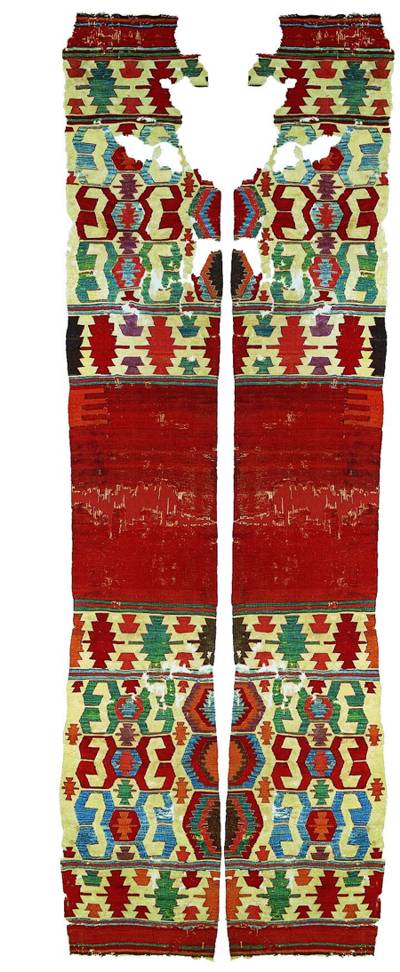
Early kilim with empty middle, reconstruction, 395 x 130 cm (2
, pl. 38 ) in the Krefeld catalogue , shown in the kilim salon 91
What I
find remarkable in this case is the fact that the correct aesthetical evaluation
is the opposite of what the followers of the "aesthetical approach" would have
stated and supposed ! It may still be true that for a Westerners aesthetical
approach such a kilim with a much bigger empty central field would be much more
attractive ( ~ valuable).
That is , damned, okay for a normal collector who
wants something to decorate his home: but , please , shut up when it comes to
"textile art". This coat does not fit you , one must say. Then let us accept the
fact that we need 2 aesthetical approaches: one for home consumption and one for
textile art. But this is not the topic of this discussion ...
"Actually
there is also a lot of research ,probably badly published , some in Turkish ,
still going on by the universities."
Until now KOEK has never rejected
any invitation to work out lectures for Turkish university congresses etc and
did a few. But there is nearly no such research.
And if so they cannot do
much as they lack even the most modest funding to travel to the places of study,
leaving aside all other aspects. Except a handful of top places ( without
"torpil") the purpose of such universities is not research and education but to
nourish cadres of ultra-right wing parties and religious sects.
"I
personally do not believe that there is a 100% methodology unless kilims had
body numbers printed in. Maybe that exists but we have not found it
yet."
Ali R. Tuna, here we both are close to a lie: most of them, nearly
all , have such "body numbers", as you and I know. But both of us will not be
likely to discuss this on a website, rather peer-to-peer. This is not my "last
price" , but my "last word" on that matter here ...
"On the other side we
have to be cautious about the provenance and authenticity as I happened to have
identified some unsold pieces in the west that were recyled through Anatolian
pickers and "reborn" in the trade for the neophyte."
Yes, does this fact
not make our approach to this matter even more necessary ? But for this purpose
you need an own, independant "structure" down there - and this had been my main
motivation to start to deal with carpets and kilims in the early eighties. Until
that time all I got was being fooled ...
Regards,
Michael
Bischof
Posted by Michael Bischof on 12-14-2003 08:45 AM:
overdue answer to Filiberto ...
Hallo Filiberto,
"In my opinion an a-piece, a kilim with an Identity
Card, MUST be something of the kind I specified in my first post:
A textile
bought on the spot of origin long time ago, acquired at once by a public
institution, duly recorded and tagged."
( Filiberto, 11.12.2003 )
Such
a thing is, of course, the optimum. But these times are over - after there
evolved something like a collectors market.
Today it would work with
contemporary weavings as long as members of this institution are at the spot
while the weave is done.
"... but the best we can hope to obtain is a
REASONABLY ACCURATE GUESS: a B-PIECE like most of the other rugs on the
trade."
( Filiberto, 11.12.2003 )
No, I do not agree.
Let us go on
to differentiate "testimony" and "expertise". The letter is an interpretation
whose value depends on
the qualification of the expert. So there is another
factor above the expertise itself involved. The expert may be in error - and to
evaluate the expert needs a knowledge of the biography of this expert. Some
elderly antique dealers have an extreme knowledge about certain unique antique
rugs in the West. When the question arises when and where it appeared first,
where did it move - amazing, how exact they are in this respect. For attribution
however this does not help. As such knowledge cannot be more exact than its
calibration sources - and these are always old picture books. If you would like
to find out where , e.g., the Transsylvanian most likely had been made, you
would not even get something like an "educated guess" from them.
Certain
findings at the spot by Erdmann naming the mosques where they appeared,
pictures, measures etc. - this is, as I believe, rock solid. The question "who
made it ?" requires nevertheless further research - till we may be able to
attribute a piece to a certain group or to a certain local weaving culture. May
be we never will find it ...
Of course the testimony of any picker is
much "softer" than such a documentation ( the one from Erdmann). Nevertheless I
find it important to try a lot to get it ( plus counter-check it using
independant local people , of course ) and document it. This applies for the
carpet in the auction house, that I mentioned as being offered as "Karapinar".
Walking from there to its real place of finding ( and, but this is an expertise
from me: its place of weave) would take a week !
Between Erdmanns
discoveries and their publication a considerable time was in between. Whether
Erdmann today would have published the details the next day on the internet we
can never know ...
The first two kilim examples given here are the best
of my knowledge nearly as solid as that of Erdmann. Just one elements lacks. I
have reasons to claim that - okay, at least my name is at stake if it would come
out that this is not correct.
So with what we called A-pieces the level
of the situation that Erdmann had is not reached. But it is what can we can do
today and this is far removed from being at one level with "a B-PIECE like most
of the other rugs on the trade". On these A-pieces ( in my sense )
one could
indeed work for a Western doctoral thesis ( including the mentioned limitation
on publishing the sources ) - with "a B-PIECE like most of the other rugs on the
trade" this is impossible. No one did and no one even will think of starting
it... and that is the point where my thinking of "grading provenance" had
started !
"About Mr. Tuna: NOW you say "Both cases seem plausible to
me."
Reading the original thread:
http://www.turkotek.com/salon_00091/s91t8.htm
you sounded
quite dubious at the time." ( Filiberto, 11.12.2003 )
Yes, indeed, and I
still am. Look at it close:
both things ( at certain spots in Anatolia people
remember pieces in their property as having been woven in their family much
earlier than, e.g., her grandmother's youth ; a village community decides to
give away a certain part of material that it owns ) are plausible as that indeed
happened and happens. The credibility of Ali R. Tuna is for me above any doubt.
But he did not say that he talked to that picker nor that he researched at the
spot that this picker is "okay" ! The guy he has in mind ( that he did not name)
evokes much doubt in me and that for good reason. Such a thing I would not use
to secure a provenance - and , e.g. as a museum stuff member, I would insist to
get name and adress of that picker, go over, talk to him ( plus let somebody
unknown to both, the Istanbul guy and the picker, research the background). In
case I cannot get the name of the picker I would immediately drop the whole
case.
Regards,
Michael Bischof
Posted by Filiberto Boncompagni on 12-14-2003 09:52 AM:
Hi Michael,
I keep on disagreeing with you for reasons already
presented: testimonies of people that are or could be involved in the business
should be taken with a BIG pinch of salt.
Then there is the not
negligible question if - even in the case the testimony is really trustworthy -
how this can help in making an Identity Card of a piece more than a century
old…
In lack of documentation (like the one you quote: Erdmann) I stick
to my guns. You say the contrary.
Well, here we are! 
By the way, do you mind
to answer to Rudolph Hilbert’s question?
"Can you give us a rough guess what
would be the premium of a Type-A piece over a comparable Type-B piece (10, 50,
100 or more %) ?"
Thanks,
Filiberto
Posted by Michael Bischof on 12-14-2003 12:10 PM:
overdue II
Hallo Rudolf Hilbert,
Rudolf Hilbert wrote on 8.12.2003:
"Last
year Michael said it is not cheap to obtain the information to prove a piece as
Type-A.
Now my question: Can you give us a rough guess what would be the
premium of a Type-A piece over a comparable Type-B piece (10, 50, 100 or more %)
?"
No, we made a proposal of what should be done. For counter-checking
Anatolian material one needs "one leg" in Turkey. To run it costs money. How
much depends on the single case. All early textiles are single cases anyway.
Opposite to what a usually uninformed commentator told ( sorry , I just checked
that he even cuts his own "products" .. ) this is not connected to anybody who
issues "certificates". As usual: lies ...
In case , as mentioned before, a
community gives away a certain part of what they have additional costs of
safe-guarding the provenance simply are put on the price of the total lot. Such
events are anyway more the subject of only a few leading collectors or museums /
public institutions so it makes no sense for me to discuss this further. It is
not in first order a price problem - the approach counts !
"For me
personally it would be sufficient to get some reasonable record of the
provenance of a weaving for the last 20 years. That should be a fair insurance
against fakes. That would be Type-B, or ???"
If the provenance cannot be
documented in a checkable way, yes. The "fate" ( what happened with the piece
after it was found ) the dealer who sells this piece to you must give. Most
likely he will not like to list in a sufficient detailed way ( including names
and adresses ) where he got this piece from. So my advice would be that you find
a serious experienced and well respected person to whome the dealer has to issue
this list. There are some leading collectors in Germany who are not personally
interested in the type of things that you collect. A conflict with own interests
should not be there.
If this person looks into the paper and finds "holes" in
the documentation he will tell you something like "loosely documented" or
something like this. Then you must not buy. It must not cover the last 20 years:
since about 1992, as we have outlined in our salon "repairs and fakes ... " -
and yes, what Ali R. Tuna wrote is correct: there were unsold pieces that came
back and were "re-discovered" again at some "remote places in unspoilt
Turkey".
"To be of any practical relevance in the trade with antique
weavings, we would need quite a lot more trustworthy grading experts."
Of
course. KOEK has done a lot to focus people on this topic, has shown to experts
what we find necessary and as these lines show try to communicate the case. We
do even more - but this again peer-to-peer ...
"What about the grading
approach with respect to rugs (any real world cases) ? "
Yes, a lot. But I
must wait till the present owners exhibit their pieces in the public - no more
early may I try to get a permission to discuss such pieces
on a
website.
"To try to establish the grading system in areas like Caucasian
weavings is in my opinion an absolutely hopeless affair because in Caucasus the
traditional
weaving culture came to an end by WW I. Where are the people to
ask ? But especially here we would need some greater safeguard against fakes.
"
"Suppose I buy from someone a perfect anatolian or caucasian type-A rug.
Probably the Type-A story will not give me a strong clue as to the age of the
rug.
Here I am still alone with my "educated guess" or that of the
omnipresent dealer experts."
I am glad that it is you ( and not me: :-))
who serves the letal dosis: the question who made these "Kazak"
rugs.
I guess there is no area in carpet studies where the lack of such a
grading that we propose ( no reliable provenances ) is limiting all studies that
much like here. Last year we had an interesting discussion here about
"Fachralo". And there was a nice peer-to-peer communication with Mike Tschebull
thenafter.
My proposal ? See "calibration detailed ... " from 9.12.2003 in
this thread. Works only if you have some calibrated things at hand. But this is
like I would try to do it - for early Caucasians this should be done, like
stated earlier, by an apt team of ethnographers, historical geographers and
linguistic experts in Eastern Anatolia and the Caucasus. Because this "grading
system" was not applied again a big chance passed - the big amount of "fresh"
weaves that came in since 1989. In most cases it would have been possible to
secure a lot of data and to find at least "starting points" far superior to what
we have now.
Take the "TKF-Mappe", a nice book that the Austrian
collectors have made. There is a chapter dealing with Caucasian weaves. Now ask
yourself ( and the author, of course: in nearly all cases collector-authors like
to communicate !): how do you know that this is a Caucasian weaving ?. Then take
out each case
where the original ( the last part in the chain of references )
source is only a "picture-book" and treat this case then as "open". You will
realize that then you do not know even whether the piece was made in the
Caucasus and not by which group / regional weaving culture.
"Probably the
Type-A story will not give me a strong clue as to the age of the rug" - of
course not. An "A-piece" is the conditio sine qua non for further studies
but cannot substitute them .
At present the fake problem is the bigger
one, as I guess.
Regards,
Michael Bischof
Posted by Filiberto Boncompagni on 12-14-2003 02:17 PM:
Uh, yes, the Fachralo thread…
If after 6 pages of this thread,
somebody wants to put up with more pages, they will found that
discussion:
http://www.turkotek.com/salon_00091/s91t4.html
a very
instructive one indeed!
Regards,
Filiberto
Posted by Sue Zimmerman on 12-14-2003 03:24 PM:
Filiberto,
I have an "A piece" heirloom which is way over a hundred
years old. It's written documents concur precisely with independently procured
"hearsay" evidence my grandmother told me when I was young. It was made in
Wisconsin from silk and silk satin fabrics purchased in Paris. It took me, just
now, a few seconds to count that it has been stored in 9 closets located
throughout the US during it's existance. It would take me a bit longer to put
addresses on the closets but that could be done.
A quick quiz revealed
that 66.6% of my male siblings didn't know so much as the heirloom maker's first
name despite having grown up with portraits of her hanging in the hallway where
their bedrooms were located. A quick quiz, a few years later, revealed that
66.6% of my male siblings remembered her name, after I told it to them--but not
because they asked.
My heirloom making ancestor was married to a man who
was the school principle, postmaster, and mayor of a small Wisconsin city. On a
whim, while passing through that city, on her way to somewhere else, a female
relative stopped to ask a local resident where the old ***** house could be
found, and why she was looking for it. The person she asked was alone and young
-- no elders around to consult--and was able to accurately guide her to the
house where my heirloom was made. This discovery process was repeated by other
relatives, later, with the guidance of other locals.
I have not been to
that town but while passing through another one where my great-grandmother's
brother had lived in the mid 1800s, a middle-aged local not only was able to
direct me to where his log cabin had been but, too, tell me where it now stands,
it had been moved, but it still exists.
I know a lot more about my
heirloom, too much really. There is a family tragedy connected with it.
Heirlooms take a long time to make, things happen. Family tragedies often become
family legacies of the sort which is not the business of outsiders.
There
is, in general, "men's stuff" and "women's stuff". My male siblings are not
stupid or forgetful or disinterested in their heritage. They just focus on
different aspects of it than I do. For instance, they know far more about our
heirloom making ancestor's son than I do. I think it's a "men's thing" because
her son became world famous.
Anyway, if my family's scenario had taken
place in Turkey and the sale of an heirloom was the only alternative to children
starving, or something, the heirloom, along with it's history, would be
sold.
A "women's thing" maybe, again, but an heirloom is not usually
relinquished unless it is deemed necessary for survival, or something close to
that. As my neighbor stood, stunned to numbness, as she watched her house, which
her husband had built himself 30 years before, burn down, I relayed the message
to her that the firemen said that if there was anything she wanted most to save,
now was the time to tell it. She told me "my photo albums" They were her
heirlooms. See? Sue
Posted by Mike Tschebull on 12-14-2003 04:59 PM:
Attributions for Azerbaijani pile rugs
I think it's pretty well known that in Azerbaijan, there are often different
names used for attribution than in the West. Some academics there have old
fragments and sometimes complete rugs or flatweaves that they have collected in
specific villages, so they have some basis for their use of village names as
sources. A good example of a source that looks reasonably believable is
Bahmanli, in Jebrail, which I suspect is the source of a whole group of "cypress
tree" pile rugs. But fully dependable? Of course not.
Often, when asked
to identify an old Azeri rug from a Western collection, Azeri researchers have
no way to help with attribution, because all their comparative material is
newer. And sometimes, there are whole catagories of weavings known to Azeris
that Europeans and Americans know hardly at all, like deve chulu.
Indeed,
it's messy, not neat. Taxonomy rules!
Posted by Filiberto Boncompagni on 12-15-2003 03:20 AM:
Hi Sue,
If you have written - and I presume old - documents, pictures,
or something like that, then THIS is the "Identity Card" of your A-piece, no
question about that.
But here we are speaking of:
1- kilims older than
a century. At least a generation or more older, I guess.
2- of nomadic or
semi nomadic weavers, much likely illiterate and unlikely owners of photo
albums.
3- it is in fact the problem of the old age of those kilims and the
lack of documents that makes me very doubtful about ID based on verbal
testimony.
Then there is the matter of the personal interest of the
person selling the piece. This could lead to distorting the truth or to pure
lies, if there is no corroborating documentation.
For example: a couple
of years ago, at my "Daghestan Pilgrims flea market", I was looking at a sort of
blanket styled like a Turkoman rug.
It was oldish but obviously machine
made. The lady selling it pretended that her mother had made it. Last year I saw
more of those blankets. A more honest seller told me they were made in Italy.
Surely machine made, I infer…
Regards,
Filiberto
Posted by Sue Zimmerman on 12-15-2003 08:42 AM:
Filiberto,
Do you think that there is no alternative to writing for
documenting anything? Please carefully reread Michael's post on 12-6-03 @6:18
PM. The visual evidence he shows and the spoken testimony he writes of is where
the rubber hits the road on this issue, for me. Sue
Posted by Michael Bischof on 12-15-2003 10:04 AM:
deve chulu ...
Hallo Mike Tschebull,
yes, and again I am astonished how close to
Anatolian things all this is: it is called here deve cul ( sharp c ) - a cul is
a kind of flatweave with a special technique that admits vertical lines, is done
from behind the loom and very common with certain groups in Anatolia. This
"deve" cul must be designed then for being used somehow with a camel (deve).
But to be correct: more than once this term "cul" is applied to normal
flatweaves by the people who made them and who use them
( like with the
example of weaves without borders ... ).
Regards,
Michael
Bischof
Posted by Filiberto Boncompagni on 12-15-2003 10:13 AM:
Dear Sue,
That example?
quote:
Developing this anti-thesis we had learned that in whole Anatolia all weavers
never looked at the allover design when asked where a certain weave was
made
- they looked always for certain small details, and of course to the
yarns and to the dyes. So we discovered that the "key factor" are these little
"habits" that do not influence the overall picture very much.
quote:
The above mentioned "Cappadocian" kilims and this one differed in these two
details ( letting the wool and the dyes aside ). So they shared the overall
design - but this is all. Their provenance ( in case the attribution for
Cappadocia is correct ! ) separates them for a distance of about 300
km.
They represent clearly two different weaving traditions.
To
establish this was only possible because the provenance of the Vok piece was
clear. The people who live in the village where it was found descend
from
Caucasian refugees that came to that place about 110 years before - and they
state clearly that this particular kilim is not their work ! The
second
thing that I must mention here is the fact that kilims with total
different overall designs ( but sharing the above mentioned "minor details"
have been found
in several mountain villages in this area
To me it shows how important is the comparative study of
structure and design.
IF Michael had not known that those details were
common to kilims of the surrounding area, finding that kilim 300 km. away from
Cappadocia wouldn’t have had any particular meaning. For
me.
Regards,
Filiberto
Posted by Sue Zimerman on 12-15-2003 11:16 AM:
Hi Filiberto,
I have been thinking that the "small detail" Michael is
referring to is the one the arrow in the photo is pointing to. The "small
detail" points to a symbol. The weaving of the symbol into the kilim is what I
have been thinking of the as the "habit" Michael is talking about -- not a
matter of structure design relationships at all.
Now I am confused. It
seems you and I are understanding the post in completely different ways. We are
talking about completely different things. At this point it would be useless to
continue this discussion until this misunderstanding is cleared up.
We
need some help here, some clarification, of what Michael means. Michael? Sue
Posted by Michael Bischof on 12-15-2003 04:54 PM:
the little motive ...
Hallo everybody, hallo Sue,
" I have been thinking that the "small
detail" Michael is referring to is the one the arrow in the photo is pointing
to. The "small detail" points to a symbol. The weaving of the symbol into the
kilim is what I have been thinking of the as the "habit" Michael is talking
about -- not a matter of structure design relationships at all."
in case
I do not misunderstand anything here : yes, this is what I meant. This litte
"motive" seems to be a habit of the group that made this kilim. It has nothing
to do with structure design relationships. If you like: we treat this as a kind
of fingerprint of this particular group. The other pieces showing it were in the
Krefeld
exhibition als well, but no A-pieces. So a sound "calibration" was
not possible - herein lies the significance of this A-piece.
Posted by Filiberto Boncompagni on 12-16-2003 03:26 AM:
Dear Michael,
This little "motive" seems to be a habit of the group
that made this kilim. It has nothing to do with structure design
relationships.
Excuse me if I quote and quote and re-quote you again, but
you wrote in the same post of 12-6-03 @6:18 PM:
they looked always for
certain small details, and of course to the yarns and to the dyes. So we
discovered that the "key factor" are these little "habits" that do not influence
the overall picture very much.
So, when I hear about "a little
motive" (shall we call it a little "DESIGN" perhaps?!) and YARNS and DYES, it
sounds me very much like you are speaking about design and
structure.
But, of course, you cannot admit it because it disturbs
your system.
And I stress it again: the fact you saw the kilim in such
place was of no help for its attribution WITHOUT your knowledge that the small
"design" or "motive" belonged to the surrounding area.
And I bet that
also the dyes and the yarns and some different weaving structure helped in the
diagnosis.
Because I doubt that ONLY the presence of a small DESIGN is enough
to make you affirm: "They represent clearly two different weaving
traditions". My emphasis.
But, then, I bet you’ll never admit that
point because it would show the limits of your
theory.
Regards,
Filiberto
Posted by Filiberto Boncompagni on 12-16-2003 05:01 AM:
Correction: Michael said it!
quote:
The above mentioned "Cappadocian" kilims and this one differed in these two
details (letting the wool and the dyes aside).
In this phrase I understand that the kilims differed for
two small designs AND in the wool (yarns? quality?) AND for the
dyes.
Otherwise what is the meaning of the part "letting the wool and the
dyes aside?"
Regards,
Filiberto
Posted by Sue Zimmerman on 12-16-2003 07:24 AM:
Hi Filiberto,
"Letting the wool and the dyes aside" means [Aside from
the wool and the dyes]. In other words, [Factoring out the wool and the dyes].
I don't think I'm wrong in thinking that Michael considers wool and dyes
important and would not call them "little habits".
The Vok kilim examples
provided an excellent illustration, (I mean in both pictures and words), of what
he is talking about. Do you think he knows of no others? Why should he go on to
the others if the first is so completely misunderstood? I wouldn't. I would take
my findings elsewhere, maybe to the general public, beyond the tentacles of
rugdom. Sue
Posted by Filiberto Boncompagni on 12-16-2003 08:07 AM:
Hi Sue,
I think exactly what I wrote.
Regards,
Filiberto
Posted by Michael Bischof on 12-16-2003 11:30 AM:
One more example ...
Hi Sue, hi Filiberto,
here is another kilim from the area of kilim no.
1. In this piece one can see
again this "motive" at the end plus thedetail
that I mentioned:
the composition is made up from very broad "stripes" in
which we see kind of
"medaillons". Look onlky, please, to the style which is
used to build a small
frame around each single motive.
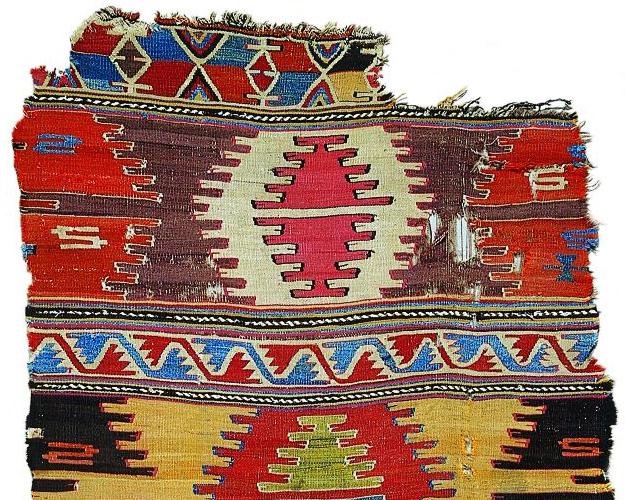
The red small
"medaillon" on white ground has a very dark frame. In order to
prevent slits
they applied a small hoizontal line which runs "inwards". This is
the second
thing that I called "detail".
Of course the wool and the dyes of this
piece ( and the kilim no. 1 in this
thread) differentiate it from the
Cappadocian material. But :
- without treating the kilim no. 2 as a
calibrator ( A-piece) for all
such kilims the attribution
"Cappadocian" for this type would just be some more
unfounded dealer hearsay.
Since the mother goddess hypes and the idea that
early kilims are made by
"relics" of the pre-Turkish population of Anatolia (
still some people seem
to follow that idea though nothing has been found since
then to support this
idea) the trademark "Cappadocian" is welcome in the West,
where the customers
are. If one is sceptic against our "A-piece" proposal all
these attributions
should be dismissed at once as they are of course
unsubstianted and
apparently lead by extrinsic interests.
- the kilim 1 was put into this
"Cappadocian" group by all experts because of
the design and colour
composition ( the "picture book" method) , until rumors
had it that one knows
the village where it was found.
- the further research into building up an
own "group" was done by KOEK and
published in the Krefeld catalogue in
detail. It was based on this A-piece
approach plus regarding these above
given details without taking into
account the overall design. This
method was and is new and uncommon - but we
hold the opinion that kilim
studies should follow this line.
- of course one has to take into account
yarns and dyes as well. But to judge
things from these factors without having
access to "calibrated" things will
fail.
The method ( without having
any "start point", a calibrated A-piece !) just to
look at some pictures and
then claim an "archetype" based on such subjective
things like "archaic" and
"articulation" ( without having studied it in length,
sitting at the side of
contemporary weavers to check the limits of this concepts
this "articulation"
thing is just one more art dealers blabla ... ) we
simply
reject.
Regards,
Michael Bischof
Posted by Vincent Keers on 12-16-2003 11:34 AM:
Hi Michael,
In most cases, whenever a textile gives us a hard time, we
look for the "out of tradition" marks.
To know if some design is "out of
tradition" you'll have to know what is "normal tradition" in design, for a
particular group. So you must have seen a lot of textiles from that group. But
you must also have seen all the other groups in order to identify to what other
tradition this "mark" belongs. Without this knowledge you'll be lost.
I
think there must have been some disappointments because "people told you" but
the moment you saw the kilim you could see that what they where telling you
wasn't possible. No dishonesty, only wrong info.
Maybe this is the case in
99%?
Now, we're left with 1%
You're told the history about a
Kilim.
1.....2......3.....4 times.
You go for it.
But the story doesn't
support what you see.
What to do?
Rewrite your brain? Rewrite your
knowledge?
Now, we're left with 0.5%.
You're told the history
about a particular kilim.
1 time.
You go for it. And the kilim backs up
the history.
You know this, because you know something, if not everything,
about kilims. But more info can't be found.
Now, we're left with
0.25%
You're told the history about a particular kilim.
3
times.
You go for it. And the kilim backs up the history.
Time to get
drunk.
No need for more info. What you see is what you'd
expected.
Now, we're left with 0.05%
etc.etc.etc......
In
the end it's your knowledge that does it.
Only you can decide if the info is
correct, or not, based on everything you know.
I trust you to be honest. So I
respect your findings.
Best regards,
Vincent
Posted by Michael Bischof on 12-16-2003 12:22 PM:
step 1 step 2 step 3 ... go
Hi Vincent,
yes , I admit, the endloss loop works like this
!
Now we have calibrated 1 piece of this group. The piece whose details
are shown above is no "A-piece". To group it into this category was based on the
arguments given here. The "hearsay" about its origin does not contradict the
"a-piece"-background but is , weak as hearsay is, no confirmation either.
As the villagers in this region describe themselves as settled
Turcomans ( but no tribal unit's name remembered ) and expressis verbis not as
"yerli" ( Anatolian "aborigines" ) one should now look which particular groups
moved in and out of this area regularly until the 19th/20th century.
And then
, as described previous in this thread ...
Regards,
Michael
Bischof
Posted by Sue Zimmerman on 12-16-2003 02:22 PM:
RED FLAGS
Hi Michael,
The motif part of the "small habit" you in kilim [1] is
not the same as the one in kilim [2]. The second part of the "small habit",
(didn't know there was a second part till now), IS a structural matter. I don't
know whether this structural technique is rare in Turkey or not but it is a
quite common one elsewhere, certainly nothing unique. Everyone and their sister
has probably been through Turkey at some time or another, too. So, as you can
see, you have set off many red flags for me. If there is a part [3] to the
"small habit" you are keeping up your sleeve for suspense purposes I will be
left especially unamused. Sue
Posted by Michael Bischof on 12-16-2003 03:39 PM:
suspense ...
Hi Sue,
" The motif part of the "small habit" you in kilim [1] is not
the same as the
one in kilim [2]. "
It is - see my contribution with the
picture of 6.12.2003 ...
"The second part of the "small habit", (didn't
know there was
a second part till now), IS a structural matter. I don't know
whether this
structural technique is rare in Turkey or not but it is a quite
common one
elsewhere, certainly nothing unique."
Sorry, either there
is a misunderstanding or you must look closer. I mentioned
this before but on
the first picture of kilim 1 one cannot see good enough this
feature. A
similar (!) thing is very common in Anatolia - but here it points
inwards
(!), that is the "local" speciality, the "normal" mode is opposite -
for no
rational reason, as Iguess. But these pieces from that area show it like
that ...
"So, as you can see, you have set off many red flags for
me."
???
"If there is a part [3] to the "small habit" you are
keeping up your sleeve for
suspense purposes I will be left especially
unamused."
Uch, what a suggestion ? But I cannot know today who will ask
what tomorrow...
Regards,
Michael
Posted by Vincent Keers on 12-17-2003 07:09 AM:
Hi Michael,
But serious:
Because in this last kilim the
reinforcing, extra outline wefts go into the positive and in the negative
design, you think it's different?
It only shows that this last kilim was
woven by a better weaver. Herhis work is more balanced. (What she does to the
left, she does to the right.
Don't think this aspect has anything to do with
design tradition.
One design, outside local tradition, can give a lead.
Yes.
As I've said before, i think it's more easy to adjust certain
technical aspects for a weaver, as long as the outcome of herhis work fits in
the local design tradition. Why weaving a kilim if all your brothers and sisters
will say:"What the heck did you make? A TOPLESS mother
goddess?!!"
Hmm...maybe that's what I liked about the Mother Goddess
hype.
About your anti-Mother Goddess feelings.
Because slit-kilim
construction as fundament does limit the designs, I do not think it's strange
that certain designs survive, sleep, get re-invented etc. People, cultures get
lost in time but the product can be adapted by the next civilization, and the
next, and the next etc. Think this is called "Progress". (That what already is
and some luck that once and a while some genius is born that doesn't belong to
the main stream)
And if a Girl weaves a picture from Madonna, with the iron
bra and 2 boys at her side, the design looks like the Mother Goddess but do
"they in the future" know it's Madonna? I don't know. But the design looks the
same.
So, yes, I do think designs can last for ever. The meanings get lost in
time etc. But it's nice to see certain designs pop up all over the world in
different times.
Best regards,
Vincent
Posted by Michael Bischof on 12-17-2003 12:26 PM:
more details - mother goddess hype - joke of the year ...
Hi Vincent,
" Because in this last kilim the reinforcing, extra
outline wefts go into the
positive and in the negative design, you think it's
different? It only shows
that this last kilim was woven by a better weaver.
Herhis work is more balanced.
(What she does to the left, she does to the
right. Don't think this aspect has
anything to do with design tradition. One
design, outside local tradition, can
give a lead. Yes."
The crazy
thing is that all kilims that show this particular "habit" are either
of
unknown origin or come from this very area. I just showed one detail
but
there are much more !
( Kelim-Connection Aachen (Hrsg.): Kelim -
Textile Kunst aus Anatolien.
Aachen: Eigenverlag 2002. - Pl. 17 is another
one, again with a different
all-over design ).
So our interpretation
is:
as these pieces come from different villages in
this areaeither a
local tradition has evolved showing these two "details" or one
mobile group
wove these kilims and "dropped" them there.
"About your anti-Mother
Goddess feelings.
Because slit-kilim construction as fundament does limit
the designs, I do not
think it's strange that certain designs survive, sleep,
get re-invented etc.
People, cultures get lost in time but the product can be
adapted by the next
civilization, and the next, and the next etc. Think this
is called "Progress". "
Of course you are right . But in the context of
kilim studies the
"Mother-Goddess hype" stands for the most anti-empirical -
art-dealers-blabla
type of approach. Not bad books with nice pieces - but
about the text you either
laugh or forget about it. If you claim ( in the
sense of a theory) that these
designs were "invented" in the Anatolian
Neolithic period and were then in
continous use in Anatolia, the Turks just
copying what they found when they
came - then you must prove that. Until
today this did not work : the arguments
in the Balpinar/Hirsch/Mellaart book
we have proven to be wrong, new one did not
come up - so it stayed at the
most
ridiculous
level that "kilim
research" can have. Just look to some pictures , see
some details that resemble
each other-here we are !
"(That what
already is and some luck that once and a while some genius is
born that
doesn't belong to the main stream) And if a Girl weaves a picture
from
Madonna, with the iron bra and 2 boys at her side, the design looks like
the
Mother Goddess but do "they in the future" know it's Madonna? I don't
know. But
the design looks the same. So, yes, I do think designs can last
for ever. The
meanings get lost in time etc. But it's nice to see certain
designs pop up all
over the world in different times."
Of course it
is like this in most cases. But if the "meanings get lost in time"
then it is
lost. Such a motive is no longer any symbol or icon and we had shown
that
most likely this has happened with that "mother-goddess"-motive as early
as
2500 B.C. in the West, in Egypt. But then "analysis" using key
words
like "symbol", "iconography" , "archetype" and "archaic" is simply
dealers
blabla - and gets punished by serious educated museum stuff people.
And we
cannot build up a more sound basis for kilim and village carpet
interpretations.
This is , not to forget that, one of the motives of our
"a-piece" grading
proposal.
Regards,
Michael Bischof
Posted by Sue Zimmerman on 12-17-2003 03:07 PM:
Hi Michael,
I cannot let your assessment that the STRUCTURAL "small
habit" is meaningless, except for determining what you want it to be used to
determine, without comment. I am not convinced, quite frankly, that you have
enough working knowledge of weaving to judge that for yourself. No one can see
what you are talking about for themselves. It's not good enough to say something
like "trust me it is there and is just a mindless habit".
There are many
things which may seem insignificant to you about this "habit" that could be
highly significant to others. Certain things must be known that you have not
provided. The direction the wefts are laid into the shed on either side of these
"habits", for instance, may be of use in determining whether this "habit" was
originally used on a horizontal or vertical loom -- things like that. A lot of
things like that, actually, which go beyond picture-book weaving knowledge.
Mental planning plays a part in kilim weaving, things which are not visible to
onlookers, things which can only be understood by doing. Try to think of it this
way -- weaving is a lab course, like anatomy. An anatomy teacher has ways of
determining which students have done their lab work. Remember, too, weavers
today do not have the quality lab time that was available in the past. Past
knowledge still awaits reconstruction. It will have to be reverse engineered in
the "lab" -- on looms, before the significance, or lack thereof, of habits, can
be determined. This, in my opinion, is at least as important as determining
which square feet of land kilims were "born" on.
Dismissing anything as
insignificant which pertains to old textiles, at this point, is no less
outrageous, to me, than the cropping of the photo of the Vok kilim's raggedy end
for "esthetic reasons".
Crisp close up photos, (front and back),
diagrams, and explanations of the technique's variation written by someone who
knows what they are seeing are needed of these "small habits". Otherwise they
will have been every bit as lost as the Vok kilim detail was at the hands of the
"esthetics only" crowd. Guess it's up to you now to understand this.
The
Vok kilim motif and the one you say is the same as it are not the same. Sue
Posted by Michael Bischof on 12-18-2003 08:40 AM:
importance of details ...
Hi Sue,
" I cannot let your assessment that the STRUCTURAL
"small habit" is meaningless,
except for determining what you want it to be
used to determine, without
comment."
I did not say it is meaningless at
all - in this particular context of finding
out which "little habits" kilims
of this "group" have I cannot see where it's
importance is except in the fact
that it is there.
"I am not convinced, quite
frankly, that you have
enough workingknowledge of weaving to judge that for
yourself. "
I am
convinced that I have two "left hands". I can do anything related to
dyeing
with my own hands - spinning and weaving I cannot. But we had
discussed such
issues , of course, with quite experienced weavers. They did
not take it as
important.
"Dismissing anything as insignificant which
pertains to
old textiles, at this point, is no less outrageous, to me, than
the cropping of
the photo of the Vok kilim's raggedy end for "esthetic
reasons". "
No: according to what we have found these two "habits"
differentiate kilims of
this group from other Anatolian kilims with the same
overall design. I did not
state that one cannot find more such "habits".
Anybody is welcome to find more -
but he also has to show where its
significance is.
"The Vok kilim motif and the one you say is the same as
it are not the same. "
Well, they are not 100% the same , of course. But
in this context I
cannot see any difference: kilims of this group and
this origin have it , others
not. Whether all 3 that are shown here differ
slightly ( what they do, actually)
or not I find to be of secondary
importance.
Regards,
Michael
Posted by Vincent Keers on 12-18-2003 12:07 PM:
Hi Michael,
"The crazy thing is that all kilims that show this
particular "habit" are either
of unknown origin or come from this very area.
I just showed one detail but
there are much more !"
All right. How
many more? And how many do not show this extra wefts from this area. I realize
this is a terrible question to answer for one person but I can't give the answer
and you are bringing it up.
I think there's a difference between EXTRA
wefts getting into the positive design only (for me this is a design related
feature) or the EXTRA wefts getting into the positive and the negative design
because this shows it is done to prevent wear and tear at the slit spots. These
extra wefts need to be EXTRA, so no slit or dove tail at the end.
(About
Turks copying:
I don't think the M.G. story is the only story that goes
around. I'm hearing all kinds of stories. Don't think that's the problem. But
you think it's strange that people copy. Well I think that's the only thing that
has been done in the entire history of mankind. (But on some occasions something
goes "wrong". This failure is the decisive point. Some failures seem to be the
starting point for innovation).
I do not think the Turks copied, they
adapted.
The Qashqaï, in SW Iran, up to this moment use a related M.G.
design. So some designs seem to work well. I agree that this doesn't mean that
the design can be translated by us as a Neolithic M.G. design. I'm the only one
in this world that sees the M.G. design in the Lesgi star (Do not pitty me
because this makes me very happy). But what I mean is: The basic pattern
qualities can be found in different designs. This means to me that some designs
seem to work well. So no simple copying, it's more like mathematics. 1 + 1 =
2)
Best regards,
Vincent
Posted by Sue Zimmerman on 12-22-2003 11:06 AM:
I have reasons to believe that the "small habit" is the tip of an otherwise
invisible iceberg of a probably extinct weaving tradition. A tradition in which
the "symbiotic" relationship between design and structure was once understood
and utilized as is in evidence by the harmonies within harmonies exhibited by
the best weavings of the past.
Through shear hard work, thinking and
studying these kilims said to have this "small habit", I think I have worked out
the rest of the iceberg -- the formula. I have written it all down and can
explain, maybe even clearly, (with editing), why these kilims could not have
been woven in the manner kilims are now woven.
I wish I had reason to
believe that rugdom is interested in even thinking that such formulas at one
time existed, much less a rank amateur, like me, could figure such a thing out.
I don't. The formula is a cool one and I would like to share it despite the
flack I would have to take for it. The only thing which is holding me back is a
moral dilemma I am having trouble working out on my own.
There is one
sector of rugdom which would be very interested in having, and could make very
good use of, this formula. That sector is the bad guys who turn fakes out into
the market. My fear is that fakes could only get better and more undetectable if
the bad guys were armed with what I have learned. This sort of information, in
the wrong hands, could turn even real experts, if there is such a thing in
rugdom, into expertoids.
If someone can think of a a good reason for me
to explain the formula I am all ears. I would like to be convinced it would be
OK to explain it. Otherwise I think it might be best to keep it to myself for
now and maybe forever. Sue
Posted by Steve Price on 12-23-2003 08:09 AM:
Hi Sue
New ways of doing things and new information always contains
within them the potential for being used in positive and negative ways. This is
unavoidable, and is the price of progress. The basic technology of a gangster's
getaway car is the same as that of an ambulance.
Whether an individual
should reveal newly discovered information (as an ethical matter) is a personal
decision. My opinion is that if the new knowledge is correct, someone will
discover and reveal it independently sooner or later (probably sooner) no matter
what the first discoverer does.
I don't know if this helps.
Steve
Price
Posted by Sue Zimmerman on 12-24-2003 10:55 AM:
Hi Steve,
Progress is a mighty God, but, like a child who has yet to
learn discipline, he is left always feeling empty. He is never satisfied with
what he has. I have never seen the God Progress but can always hear him coming
because he always drags his loud tool collection around with him. Out here, in
the hinterlands of civilization, the "bread basket" of the world, Progress is
very busy. With one hand he dismantles whole fields and packages the soil into
50 pound bags while with his other hand he smashes forests into mulch and puts
that into 50 pound bags, too. I, quite frankly, give him a D- in gardening
skills.
The God Progress is very systematic in his approach and loves to
organize his stuff. Around here he builds huge ugly metal warehouses which he
sets on immense concrete and asphalt pillows where his followers, with suitable
offerings, can purchase whatever they want, and, with suitable offerings, can
purchase paraphernalia to organize their other purchases which often comes at a
higher price than that which is to be organized.
Well, not me. When I
hear the God Progress coming I hop in a getaway car so I won't need an ambulance
later. I am not too big a fan of the God Progress. He seems, to me, to have a
highly compartmentalized mind. I don't know where he came from but rumor has it
that he has no belly button. I suspect he is another product of immaculate
conception, which, I guess, would put his birthday in the
monotheistic/patriarcal and thus historical age.
I don't mean to offend
his worshipers but to me the God Progress seems a little like some sort of
aspect of Kali, without a conscience. Words are weird, aren't they?
Con--Science.
So, yes, your thoughts have helped to clarify the problem,
thank you for that, but they essentially leave me still undecided. I remain all
ears though. Sue
By the way, Mike Tschebull's mention, on this thread, of
Bahmanli has got me wondering. With but one more letter Bahmanli becomes
Brahmanli. In Dravidian Brahmanli means "mother goddess".
Posted by Steve Price on 12-24-2003 03:51 PM:
Hi Sue
Sorry, I hadn't intended to precipitate a dissertation about
how much better off we'd all be if progress (I have a feeling that you mean
technological progress) had come to a halt, perhaps, 500 years ago. Personally,
I prefer a world in which women can reasonably expect to survive childbirth and
in which the problem of feeding everyone is essentially distribution rather than
production. We all see things through our own eyes.
Regards,
Steve
Price
Posted by Sue Zimmerman on 12-24-2003 06:00 PM:
Hi Steve,
Sure we all see with our own eyes. If I die, go to hell, and
am forced to, I suppose, I will read the book "Mauve", but not one second
sooner, and not without a lot of kicking and screaming first. Come on now, give
me a break. Sue
Posted by David R.E. Hunt on 12-26-2003 01:04 AM:
Rant as Acceptable Social Criticism
Sue-
I think it readily apparent, especially in light of the nativity
which this day so many around the world are observing, that both the novice and
the lay are perfectably capable of making important contributions to society on
both a personal and historic level, so please Sue, enlighten us all as to these
important observations of yours. Let your audience and history be the
judge.
As to this earlier digression regards the Progress God I concur,
at least to some extent, but do believe that some of your animosity may be
displaced. It seems to me, as I believe the history of the human condition will
bear out, that technology has nothing but improved the human condition. All of
our failings are moral in nature.
I for one reserve my wrath for that
vast archipeligo of moron mills trading under that viciously banal moniker
commonly refered to as Public Education, cranking out a vast sea of products
possed of a stuptifying, industrial strength and vocationally oriented
education. This step by incrimental step, inculcation of a mind set born of rote
and repetition, of queing from room to room at the seeming Pavlovian belltone of
the admonitions of authority,
is characterized by a complete subdjucation to
authority which has historicly been associated with that condition refered to as
- slavery.
The Patrician viewed law as a tool to be used to achieve an
end, and as such obeyed or ignored as seen fit.
The American incarnation
of the institution of slavery was singular in that the primary agent of
compulsion was force of the chain and whip variety, as opposed to an
intellectual process, a globalized subserviance to authority and belief that
authority existed as such because of it's inherent superior
qualities.
Telling that the slave of the republic and the typical
standing on a street corner American should be possessed of essentially the same
mindset.
Sue, the truth is important and time is our most precious
commodity, so if you have anything we need to know PLEASE tell us. - Dave
Posted by Filiberto Boncompagni on 12-26-2003 04:11 AM:
I would rather suggest to Sue to open a new thread, as this one is long
enough…
Regards,
Filiberto
Posted by Steve Price on 12-26-2003 06:37 AM:
Hi All
I agree with Filiberto: if Sue has something important to share
about the history of weaving, it would be best to open a new thread on it. If
she chooses not to, that's her privilege.
If she does choose to share it,
the subject should be textile-related. We are not a forum for debate on the good
and evil aspects of technology, educational methods or political systems, and we
are not going to become one.
Thanks,
Steve Price