One of the rugs that Jerry Thompson's eye went to quickly as he and I tried to select a few from his exhibition of particular interest was the Perepedil.

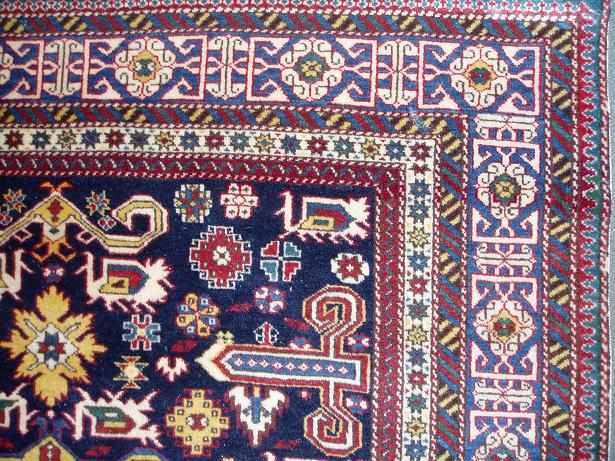
This piece has better color up close than the image above indicates but the feature that Jerry thought might be of particular interest was its Kufesque border.

Here's a corner.

Now I don't want to be accused of suggesting that I am providing anything like a complete account of the possible development of kufesque borders over time, but I have sketched some varieties below for your possible interest.
I started with Peter Stone's convenient treatment in his recent book on rug design.
Stone's example of a typical Caucasian kufesque usage is this one:

Stone says that such borders are thought to be based on "a particular Arabic script termed "Kufic." He provides an example.

And it seems to be true that instances of such script were transferred to textiles. Although Patricia Baker does not include the term "Kufic" in the index of her widely admired "Islamic Textiles" she does provide an example of such tranfer and usage.

The textile above is a "Detail of the 'Shroud of St. Jesse', mid-10th century, eastern Iran." Note the Kufic script is upside down in this detail. Probably one side of a surrounding border.
Daniel Deschuyteneer once provided some additional examples of older Kufesque usage in a salon here.
http://www.turkotek.com/salon_00080/salon.html
Next Stone provides a version that I think he is saying is "an early form of Kufic border (ed. that) appears on 13th century Seljuk carpet fragments."

He goes on to say that Kufesque borders are frequent on Anatolian rugs of the "Lotto" and "Holbein" varieties. Wendel Swan once treated some National Gallery pieces of this sort here.
http://www.turkotek.com/journal/lotto.html
And Kufesque borders are frequent on Caucasian Shirvan rugs and other Caucasian varieties.
Here are some examples of the latter.

The piece above (I just noticed also treated by Daniel in his salon) is a long rug from Schurmann. He describes it as "Kuba - North Shirvan."

I selected it for the seeming complexity of the connecting sections between its small "medallion" shapes, but in fact it is very much like the first Stone example above.

The rug above is a similar, smaller example provided by Eiland and Eiland.

They describe it as "Shirvan."
That should provide you with some varieties of the Kufesque border that suggested to Jerry that this was a rug we should share with you.
Regards,
R. John Howe